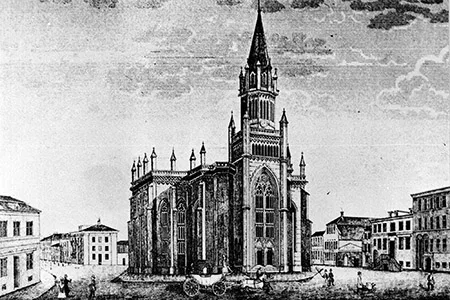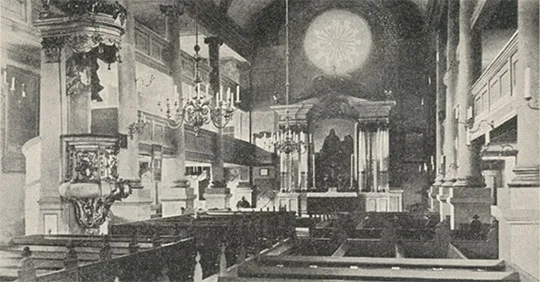
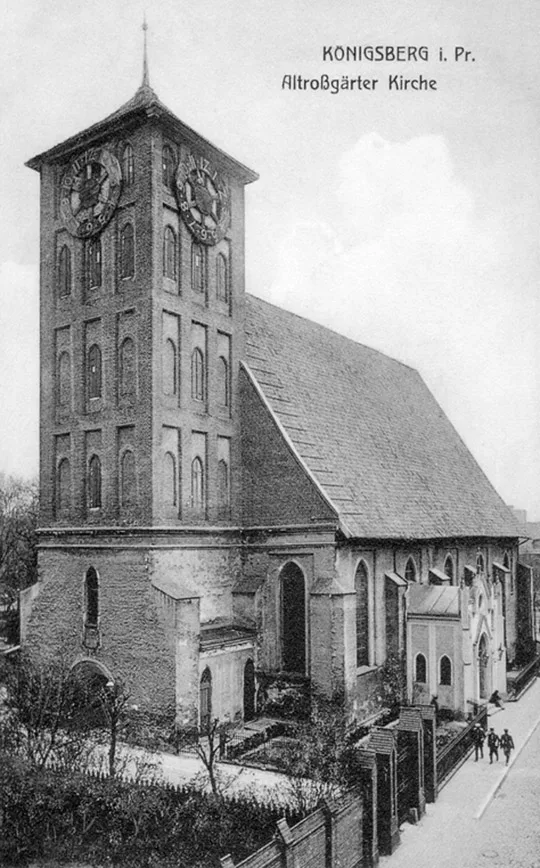
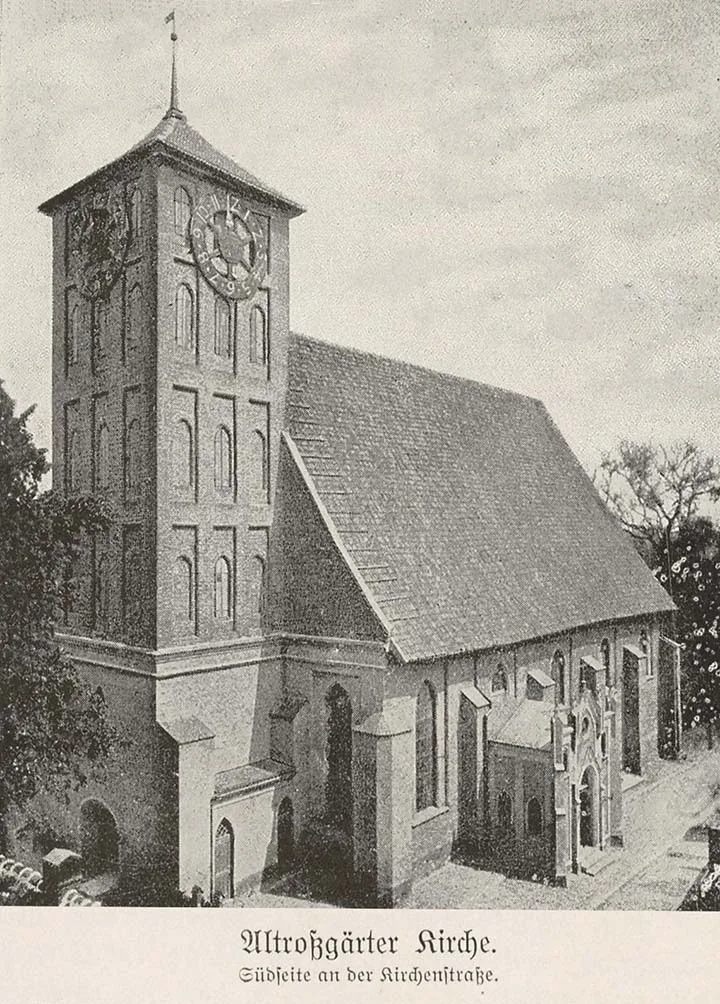
It took quite a long time to build, but in 1681 (according to other sources, in 1683) it was consecrated. It was a brick building with a square six-storey tower on the west, which was fully completed in 1693. On the south there was a porch with a handsome Gothic gable, on the north a sacristy with a crypt. The lancet windows were set in rectangular recesses. The east gable had six narrow blind windows. Inside, the church had three naves divided by light octagonal columns. The side aisles had galleries (balconies). The ceilings were wooden and vaulted, with paintings of 1624–1680 under the plaster. The interior was adorned with portraits of pastors of the 17th–18th centuries and fairly simple epitaphs of the same period.
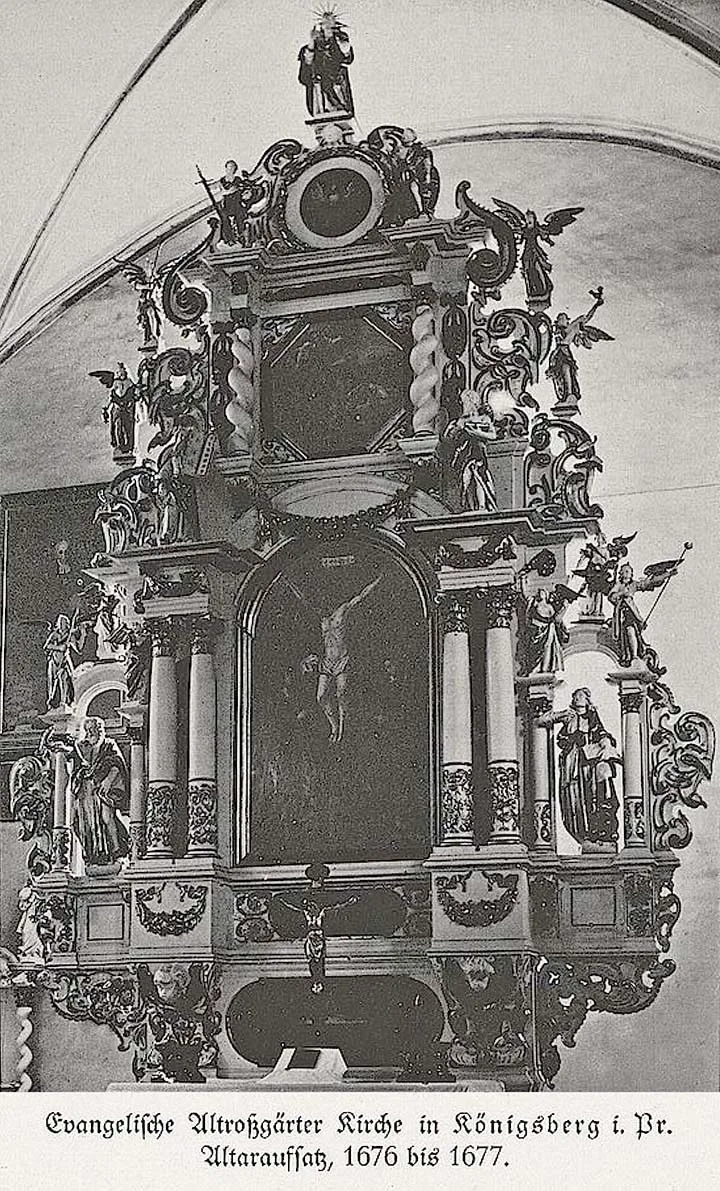
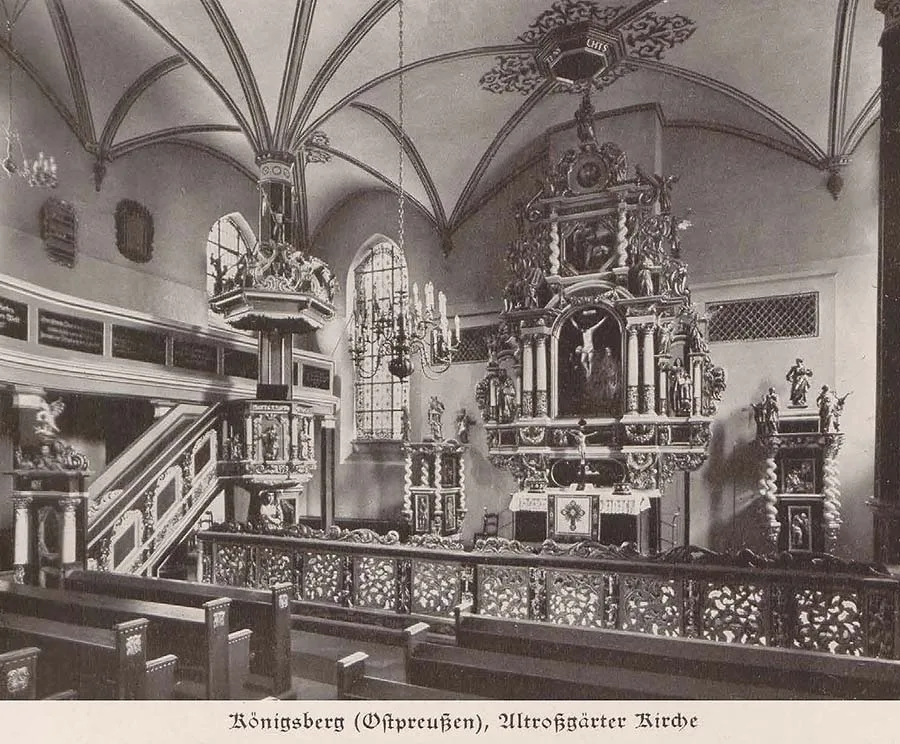
The altar was consecrated in 1677. At its centre was the painting "Christ in the Garden of Gethsemane".
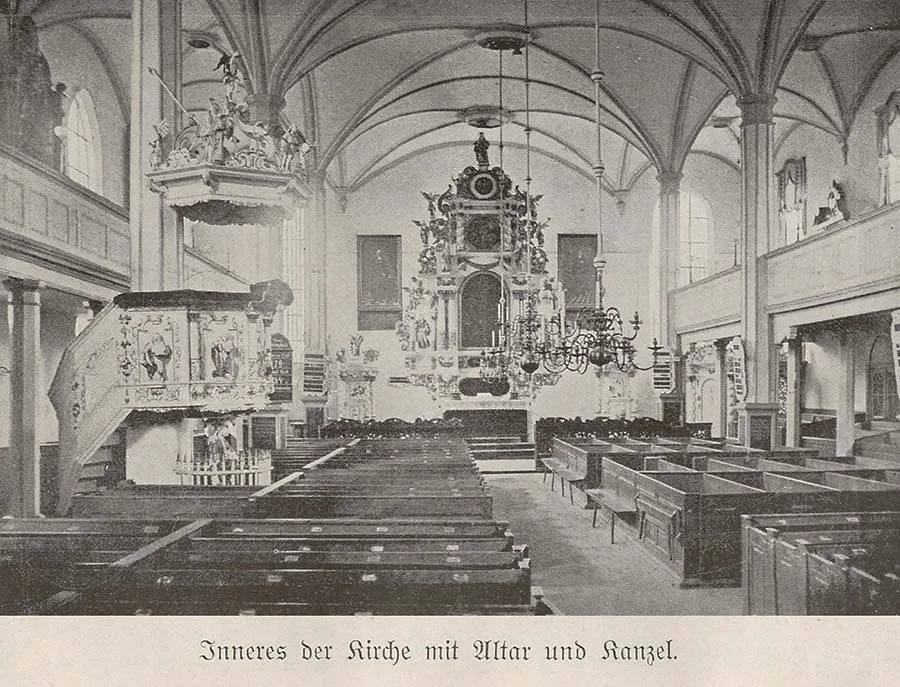
The richly decorated pulpit was made in 1666. The fine organ of 1747 was the work of Adam Casparini. The church had three bells, one of which was cast in 1694.
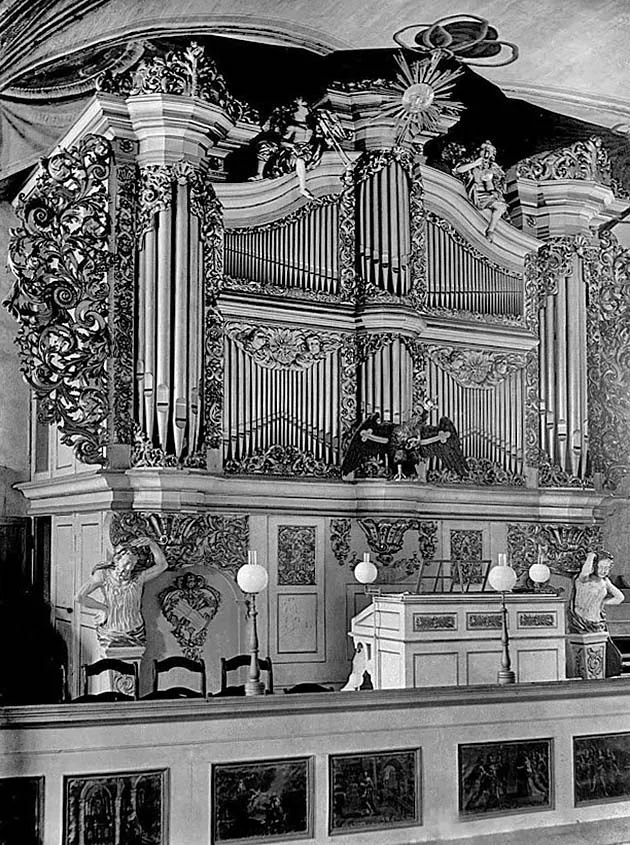
The organ of the Altrossgarten Church.
As a result of the fighting in April 1945 the church was partially damaged. Afterwards it was even put to some use. But by the early 1960s it was no more than a shell of fairly well-preserved walls. The porch and the sacristy were dismantled. The tower survived up to the fifth storey. Then it was taken down to the third storey, and in 1968 the remains of the church were finally demolished.
Photo: Bildarchiv Ostpreußen bildarchiv-ostpreussen.de, Anton Ulbrich «Geschichte der Bildhauerkunst in Ostpreussen».
In the 1950s the East Prussian expellees' newspaper Ostpreussen-Warte, published in Göttingen in Lower Saxony, ran a series of sketches entitled "Corners of Königsberg" by Herbert Mühlpfordt, a former Königsberg physician and passionate local historian. Some of them have been translated and are available on our website, others are still waiting their turn. Below we present his account of the Altrossgarten Church and its surroundings.
The Altrossgarten Churchyard
As the name Rossgarten suggests, this is where the horses of the inhabitants of Löbenicht used to graze. Later the local road, which led from the Cross Gate (Kreuztor) past the "Blue Inn" (Blauer Krug) through Samland and along the Curonian Spit to Riga, was built up. Duke Albrecht, in particular, settled Dutch colonists here who had been driven from their homeland for their faith. In this way the quiet suburb of Löbenicht gradually grew, and plans were drawn up to build a small church for the people of Rossgarten. However, Löbenicht was not a wealthy town, and for a long time its devout parishioners had to make do with a small wooden chapel.
But in 1651 the time finally came to begin building a church. So as not to interrupt the services, the church was built right around the wooden chapel. The chapel was demolished only in 1683, when, after 32 years of construction, the new three-nave church was completed, resting on 18 columns and covered with a flat wooden vault.
The tower remained unfinished and was "temporarily" covered with a pyramidal roof.
Next to the second eastern window of the south facade, on Altrossgarten Church Street (Altroßgärter Kirchstraße), near the rear entrance, three bricks were neatly set into the wall. Legend has it that the estimate had been calculated so precisely that these three bricks were all that was left over after the building work. We may take this story at face value, since the Rossgarten parish, though large, was as poor as a church mouse. No wonder the local pastors kept a close eye on the builders!
Even around 1900 the desperately poor parish had to collect money from parishioners in its two Baroque confessionals in order to pay for the communion wine and wafers!
Some may wonder how confessionals came to be in Protestant churches, especially in one like the Altrossgarten Church, built in the Protestant era. The explanation is that confession continued in Protestant churches for a long time, right up to the 18th century.
Inside, the church boasted fine Baroque furnishings: a pulpit of 1666 supported by an angel, with a handsome door and sounding board; an altar of 1672; an organ on whose parapet a garland of charming cherubs seemed to hover; and a baptistery of 1692 with magnificent carving.
The churchyard with its beautiful old trees became a shady playground for children and a resting place for the elderly — truly a pastoral corner of Königsberg. Here one could sit for hours recalling bygone days and pondering the fate of two lovers whose shared grave was adorned with two trees intertwined as only lovers embrace. This story was told by the satirist Theodor Gottlieb von Hippel (1741–1796), who by office was mayor of Königsberg.
But by the time I grew up, those trees were long gone — all love fades in the end.
Or one could listen pensively to the splashing and murmuring of the fountain which in days of old — the legend does not say exactly when — graced the parish garden by the east wall of the church. It belonged to the widow Dorothea Gnadcowius. The water of the spring had miraculous powers — rumour had it that it cured women of barrenness. People seeking a cure came from far and wide. At some point the demon of greed put it into the widow's head to demand money for "replenishing the stock of healing water", and from that moment the miraculous fountain ran dry.
Even the graves hold old stories: here lies the pharmacist Carl Gottfried Hagen (1749–1829), owner of the fine Baroque Court Pharmacy on Junkerstraße, which was so carelessly demolished in 1913. The famous apothecary lived in that building from 1749 to 1829 and was the best-known member of the Hagen family of pharmacists. He held doctorates in medicine and philosophy, was professor of chemistry and physics at the Albertina and the founder of scientific pharmacy. The university owed its Botanical Garden to his efforts. A medallion with his portrait adorned the facade of the New Albertina on Parade Square, and his grave was marked by a massive granite cube with four neoclassical urns at its lower corners.
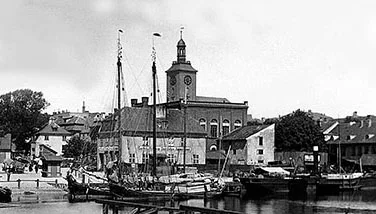
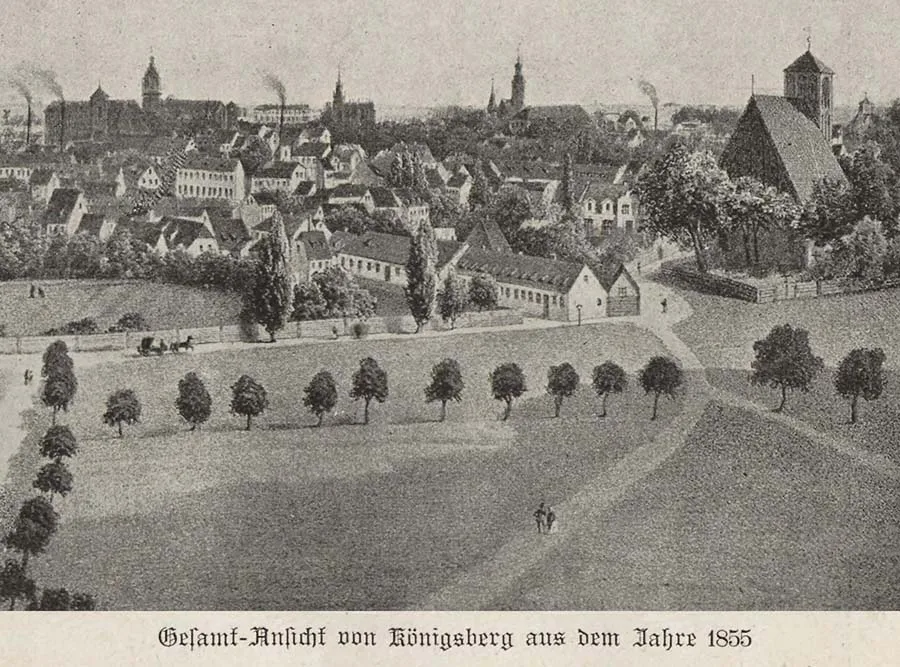 The Altrossgarten Church (right) in a panorama of Königsberg, 1855.
His son, Ernst August von Hagen (1797–1880), art historian and founder of the journal "Prussia", was also buried here.
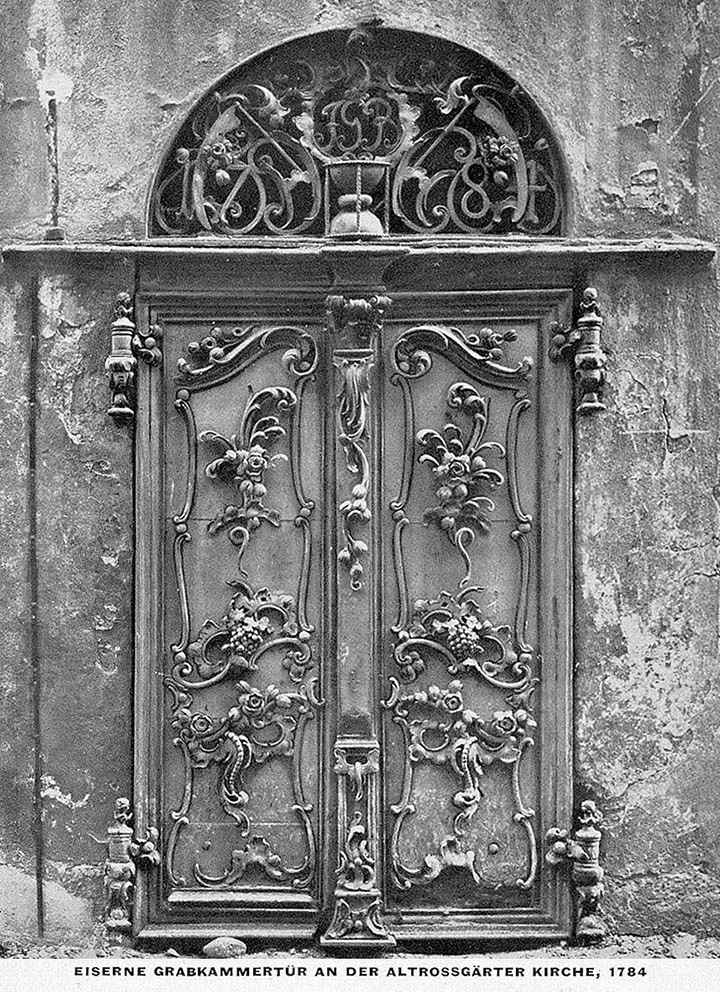
The wrought-iron Rococo doors of the Bekenstein family crypt.
The decorative wrought-iron grille of the transom includes: JGB (the initials of the client), 1784 (the year Johann Michael Sommer forged it), an hourglass (in the centre) and two scythes (symbols of the transience of all things).
Here were the graves of the historian Johannes Voigt (1786–1863), the classical philologist and antiquarian Christian August Lobeck (1781–1860), and the director of the Collegium Fridericianum, Friedrich August Gotthold (1778–1850).
On the north side of the church was the family burial vault of the town councillor Johann Gottfried Bekenstein. It was closed by a Rococo door (see above) made in 1784 by the late Königsberg master locksmith Johann Michael Sommer (1737–1787), whose roses, leaf tendrils and bunches of grapes bore witness not only to outstanding skill but also to remarkable inventiveness.
What heights the simple master craftsmen of former times could reach!
Sommer was certainly aware of his exceptional talent. Why else would he have engraved his signature on the door: Fecit J. M. Sommer, March 2, 1785?
Alas, this quiet corner of Königsberg has vanished too. During the Second World War a bunker was built here, and on the very first night of bombing, 26–27 August 1944, the British reduced Rossgarten, church and all, to ruins. Not yet suspecting the terrible destruction the next three days would bring to Königsberg, I looked sadly at the fragile Baroque angels that had fluttered around the organ for so long. Now they lay broken on the floor of the nave among the fallen beams.
Translated from Russian with the help of AI (Claude, Anthropic), October 2026.