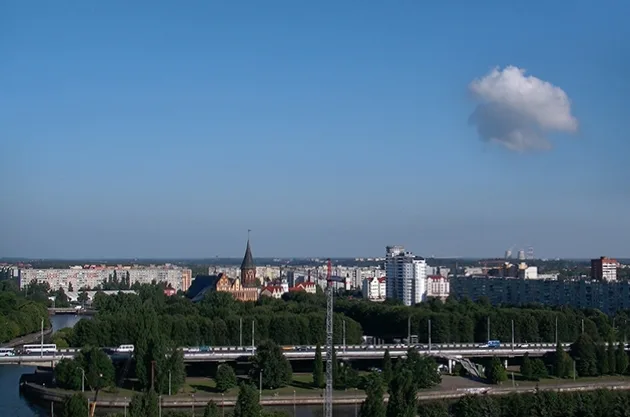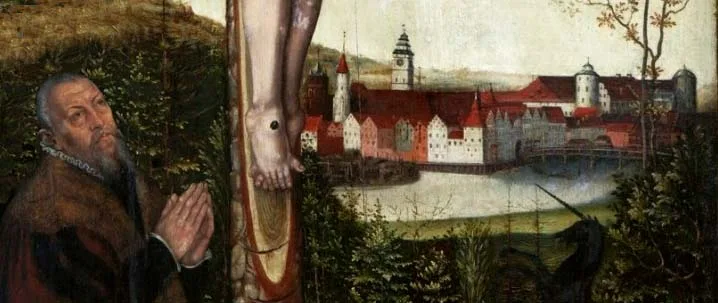
It is hard to find anyone in the Kaliningrad Region with an interest in the architectural face of the regional capital who has not heard of our project to recreate the historic centre. We have been working on it for more than twenty years now. Today I will once again try to convince those who see our ideas as irrelevant that only by paying our respects to the past can we look to the future with confidence. In Kaliningrad's case, this means that a key element of the city's urban planning strategy must be a plan of action for restoring the historic centre, which suffered more than any other part of the city during the Second World War. As is well known, the land in question currently stands empty, and that opens a window of opportunity for us. The architectural decisions taken at this stage will, to a great extent, determine how our city's fate unfolds — whether it will be a happy one or not. Each of us, in our own way, wishes happiness for the city we love, and most of us understand that to go on pretending Kaliningrad has no past is to condemn it to remain as nondescript and devoid of a recognisable identity as, sadly, it is today. We want the opposite: for the city to recreate the unique face that made it famous down the centuries.
The Historic Centre
Let me begin by saying that I remain committed to the idea that Königsberg Castle, around which everything here began, must be rebuilt. The experience of a great many cities leaves no room for doubt: a striking architectural landmark in the historic centre, wreathed in legend and mystery and bearing witness to both the glorious and the darker chapters of history, is an essential ingredient in the successful development of the surrounding area for hundreds of kilometres around.
A striking, recognisable image would boost Kaliningrad's appeal to tourists, its investment climate and, ultimately, the quality of life of people across the entire region.
I do not find persuasive the claims that surface from time to time in the local press that rebuilding the castle is financially and ideologically unacceptable. Common sense must prevail over the speculative pronouncements of those who take no part in the economic and cultural life of the city and the region, yet keep throwing a spanner in the works.
The 1930s — the period of criminal National Socialist rule that compromised the castle's name — lasted little more than a decade, a mere instant against the backdrop of Königsberg's centuries-long history. In the 1940s, at the cost of horrific sacrifice, German fascism was defeated, and its entire legacy was mercilessly consigned to the dustbin of history. It is a pity that so much that deserved to be preserved fell victim to the victors' righteous anger.

Over seven centuries of Christian history, the city acquired a wealth of unique architectural monuments that deserve, at the very least, to be fondly remembered. In our view — one shared by a significant proportion of the city's residents and of the professional community — some of them deserve to be rebuilt.
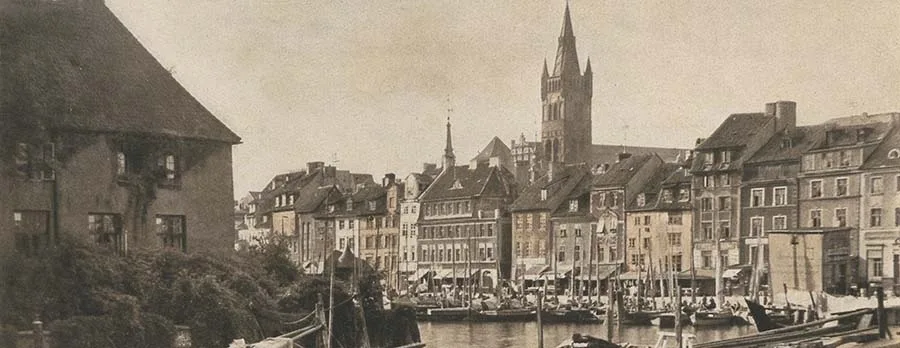
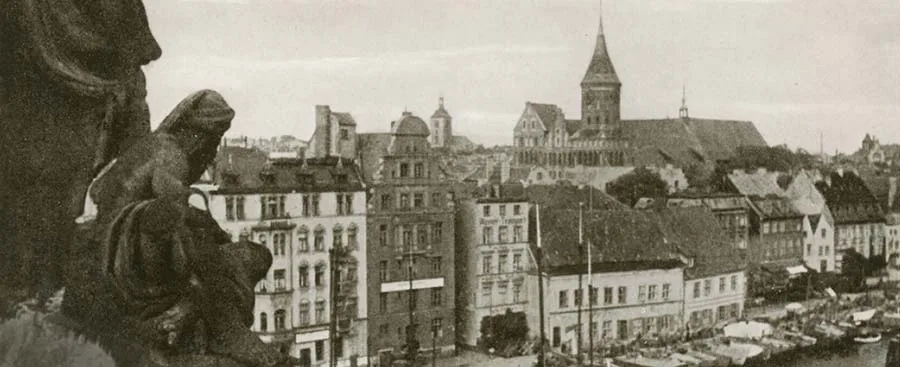
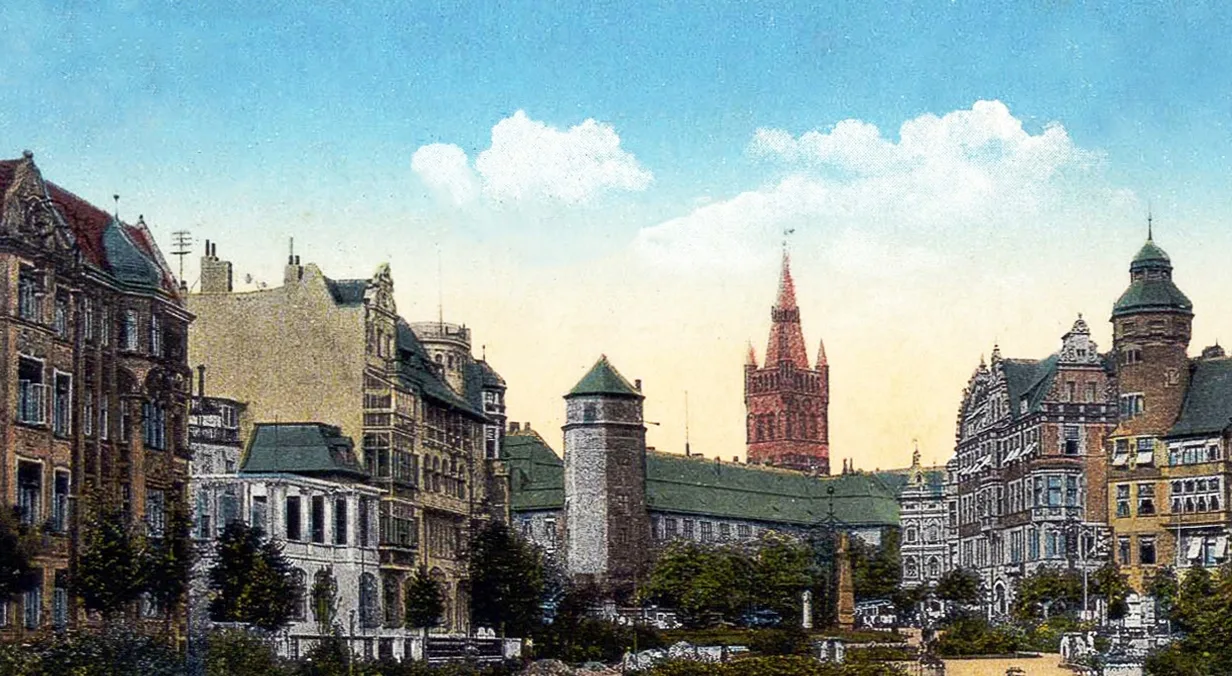
 Architectural landmarks of the historic centre in the early 20th century.
Besides the castle, we count among them: the New University building on Paradeplatz, which survives but has been simplified beyond recognition; the town halls of Altstadt and Kneiphof; the Main Post Office; the Löbenicht Gymnasium; Kneiphöfische Langgasse, Französische Straße and Steindamm; the Altstadt Market, the Fish Market and the Cabbage Market; the Altstadt, Löbenicht and Steindamm churches; all the historic bridges leading to Kneiphof (Kant Island); and the ensembles of Münzplatz and Cathedral Square. On top of that, there is every chance of recreating the most interesting buildings on the former Königstraße (now Frunze Street) and on the Right Embankment (I am thinking of the mill and the grain elevator). This list may turn out to be either too long or incomplete. Beautiful buildings live forever — even when they cannot be saved, we go on studying the history of architecture through them. In the course of restoring architectural masterpieces, a new generation of architects will have the chance to touch history with their own hands.
Like a Phoenix from the Ashes
The city's historic centre, an innocent victim of armed conflict in the mid-20th century, must and will be brought back to life, at least in part. It is only a matter of time. Kaliningrad quite plainly lacks this component! We say so with a project in hand that has been worked out down to the finest detail. If anyone has alternative proposals, we would very much like to see them — so that we can understand what is being proposed, compare and discuss, and choose the best option together, as a community.
Of course, it is impossible to please everyone, but urban planning has long had an effective way of resolving stylistic disagreements: zoning. Let one part of the city once again become what we see in old photographs (which, for some reason, still inspire tourists to come to Kaliningrad), while another — of glass and concrete — reaches for the future and the sky. Let Oktyabrsky Island (its main part, east of the Second Estakadny Bridge), Selma, the Vostochny district and some areas on the south bank of the Pregolya be built up with the most modern, breathtaking skyscrapers — we have nothing against it.
Moscow is a telling example: there is the Kremlin with the historic buildings around it, and there is Moscow City, where contemporary architects astonish the whole of Russia as they compete to outdo one another in originality — plus a host of other, very different districts.
And Moscow, to everyone's satisfaction, keeps on expanding, absorbing neighbouring territories that only gain from their new status. Let people in Kaliningrad have a choice, too — of where to live and work. I am not reinventing the wheel: this is how the whole world lives, and Kaliningrad is no exception. Everywhere there are innovators and conservatives, those who crave novelty and those who prefer a time-tested style. Both should feel at home here. We are not proposing to extend the architectural regulations of the historic centre to the entire city.
Perhaps this hardly needs stressing, but I am saying it publicly for the first time: a Königsberg Castle recreated by our own hands, from local materials and with modern technology, could never become a sacred symbol for the Germans, however much anyone might want it to.
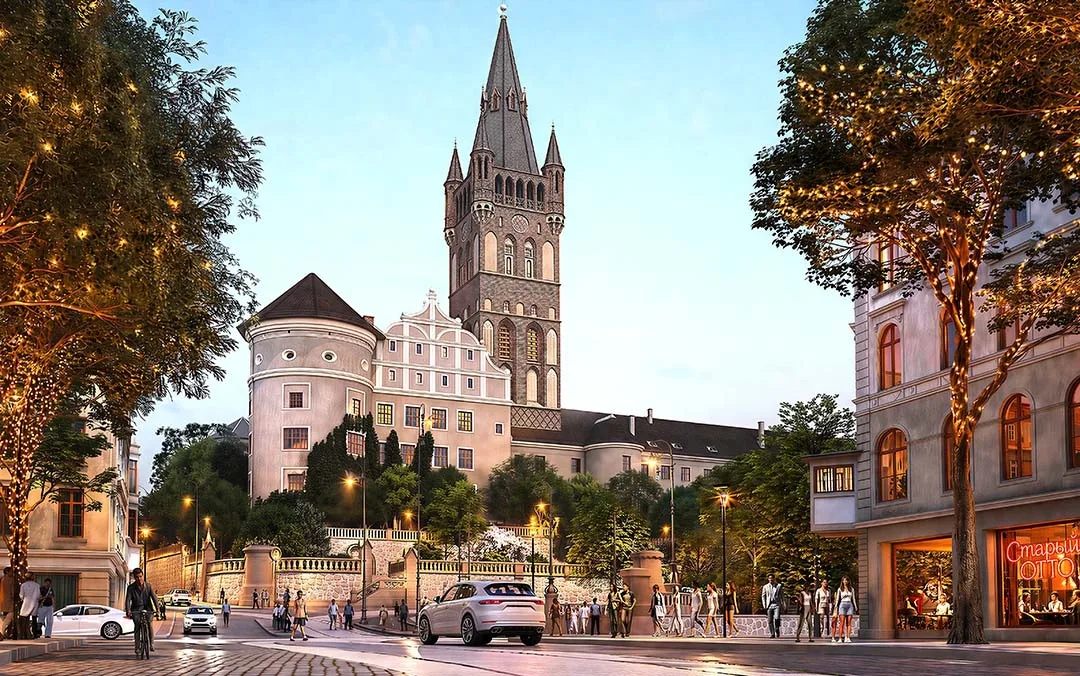
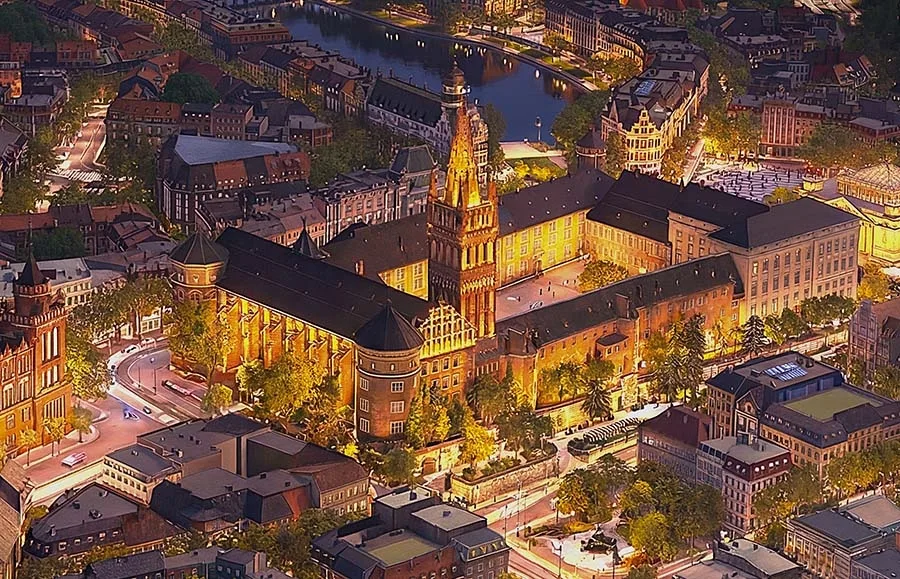 Königsberg Castle with architectural lighting.
I say this as a professional: we will not be able to make the new castle a copy of the lost one, in which the Prussian monarchs were crowned. At best, it will be a successful replica — one that allows Kaliningrad to substantially increase its income from inbound tourism.
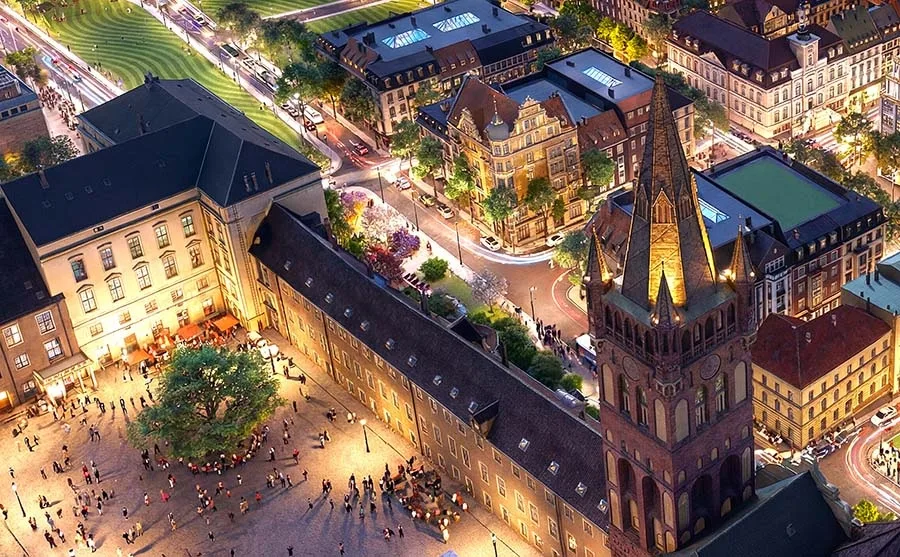 The courtyard of Königsberg Castle in the evening.
Simple calculations based on open data show that building the castle would pay for itself very quickly. Tourists spend around 30 billion roubles a year in our region in card payments alone. Even if cash adds another 5–10 billion or so, these are substantial sums that make a strong case for investing in the tourism industry.
Tunnels and Canals, Marinas and Bridges
One of the problems of modern Kaliningrad is that it is “cut off” from the river on whose banks it once grew up. On this point we agree with practically all of the city's civic activists: traffic must be diverted around the historic centre or taken underground.
In the central part of the city, we propose putting Moskovsky Prospekt, which runs along the Pregolya, into a tunnel roughly one and a half kilometres long, so that the cosy grid of streets and lanes of the historic centre can run unhindered from the Hotel Kaliningrad down to the riverbank.
Building this thoroughfare was one of the biggest urban planning mistakes of the Soviet era. We need to admit this honestly and set about putting it right.
We also consider the major overhaul of the Estakadny Bridge a questionable decision, one that will postpone the inevitable revival of the historic centre by another fifteen to twenty years. Noise, dust, the aggressive energy of cars rushing past at high speed — none of this adds to the city's charm. That is why we also propose sinking Leninsky Prospekt into a tunnel that would carry it on to the Second Estakadny Bridge.
Tunnelling technology has now reached a level that would have been unimaginable in the past. And here, once again, we can look to the Russian capital.
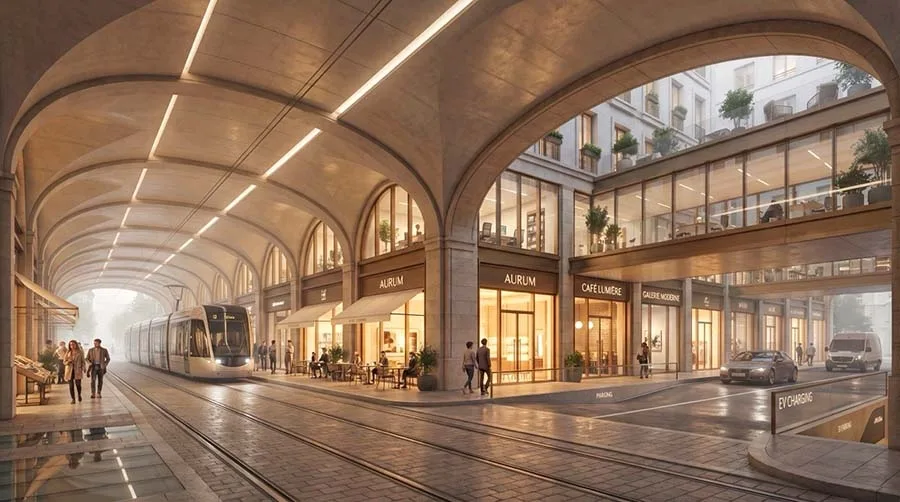 A boutique arcade along the tram line in the tunnel beneath Leninsky Prospekt.
I am not suggesting that Kaliningrad build a metro, but designing and building two or three tunnels that would relieve central Kaliningrad of through traffic is well within our capabilities and our means.
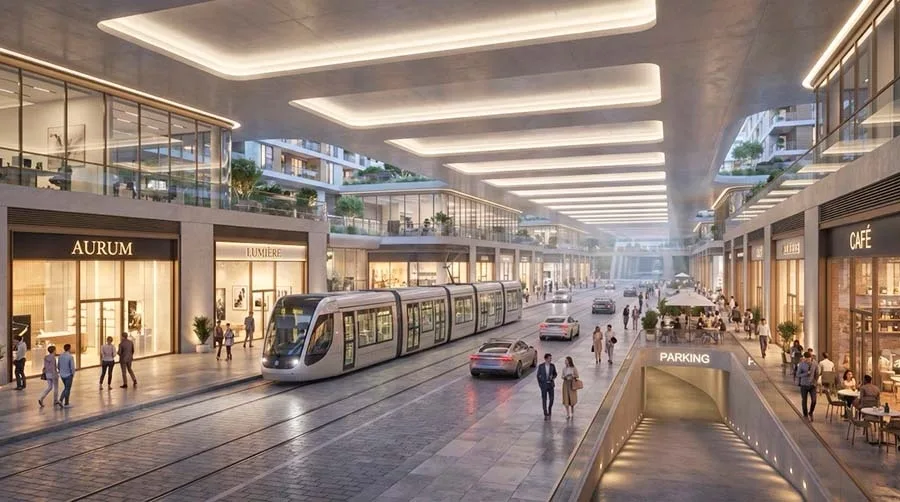 A tram runs through the tunnel beneath Moskovsky Prospekt.
When I visited Seoul, I was struck by how well developed its “underground city” is. The tunnels themselves are bright and are essentially a continuation of the streets — their lower tier. Convenient parking runs along the entire length of the underground roads, and beyond it gleam the shop windows of shopping centres, cafés and restaurants. Let us not forget that in the coming decades electric vehicles will continue to push petrol-powered “dinosaurs” out of the market, and in a hundred years' time there will most likely be no private or public transport with internal combustion engines at all. (Whether there will still be a place for a human behind the wheel — now that is the question!)
In place of the Estakadny Bridge, whose traffic will be taken over by the new road bridge duplicating the Double-Deck Bridge, we propose building several small, handsome bascule bridges. Ideally, every block of the historic centre along the river should have its own bridge. Together with the four large bridges, this would give the crossings over the Pregolya enough capacity to fully meet the city's needs.
The predecessor of Leninsky Prospekt, Kneiphöfische Langgasse — which the Estakadny Bridge now “replaces” for us — was one of the most beautiful streets in the city.
If it ever returns to its rightful place, I would like to see the façades of its houses recreated together with the Wolme lost back in the 19th century. (Wolme were sizeable front extensions with steps leading up to the front doors, which stood well above the level of the pavement. At door level the Wolme had terraces where, in summer, tables were laid and the owners liked to chat with their neighbours and receive visitors. Anyone who has been to the famous Mariacka Street in Gdańsk will know what I mean. Königsberg got rid of its Wolme in 1864, when it widened the carriageway of Kneiphöfische Langgasse.)
Look closely at old maps and you will see that the central part of the city had considerably more water — various streams, channels, canals and ponds. Living on the coast, at the mouth of a large river between two lagoons, we have grown used to an abundance of water and often fail to make proper use of it.
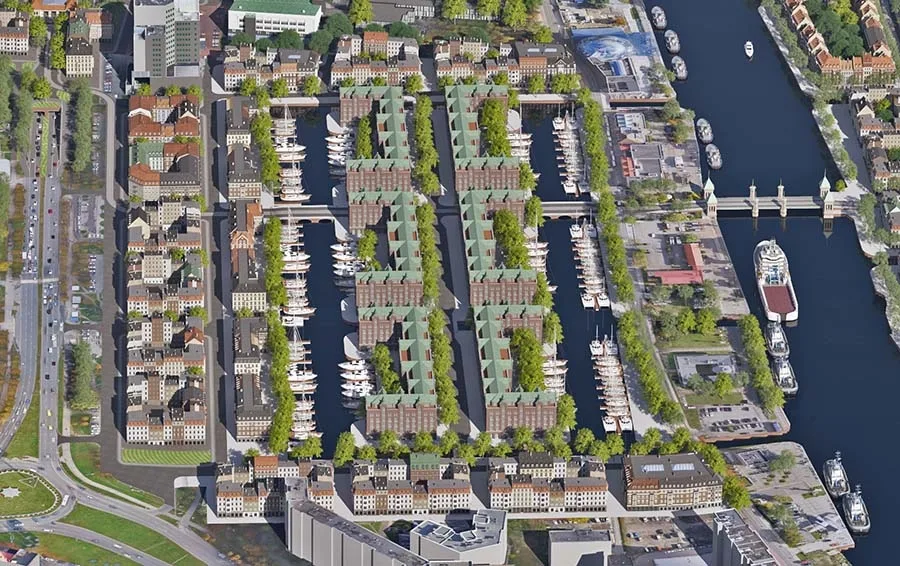 Marinas in a revitalised Laak.
Our project envisages building several marinas in the former Laak district, whose entire waterfront is now occupied by the Museum of the World Ocean. We also propose restoring the encircling moat, filled in during the Kaiser's time and better known in Kaliningrad as the Zuggraben.
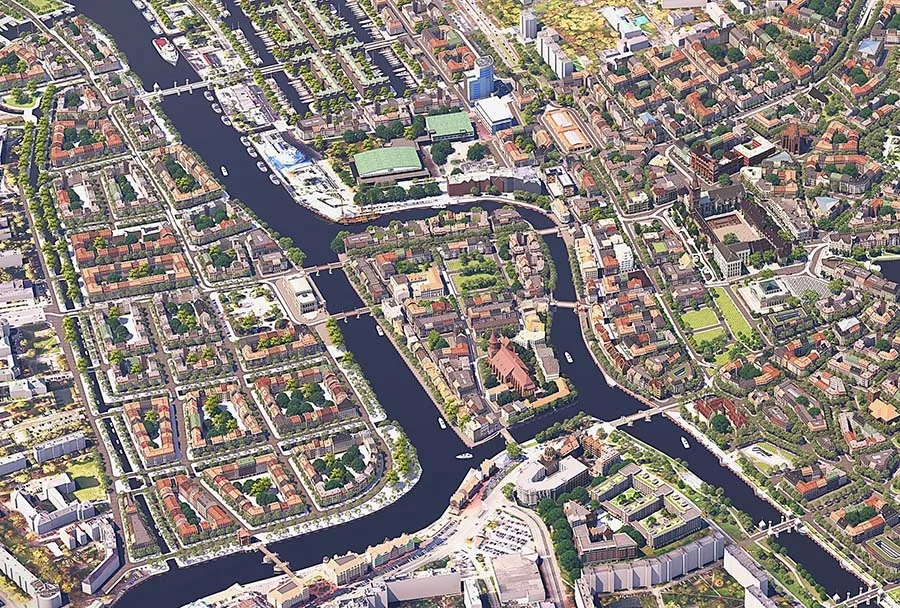 The Zuggraben (left). In the centre is Kant Island (Kneiphof); Altstadt and the castle are on the right.
It could also make the former Vorstadt more attractive — the district opposite the historic centre on the south bank of the Pregolya, which is itself in dire need of radical renewal.
Separately, I feel I must once again voice my concern about how devastating the consequences for the city could be if a storm surge were to cause a flood. Rather than waiting for the next natural disaster, we need to start designing protective structures at the mouth of the Pregolya, much as this problem has been solved in London, for example.
Public Transport and the Renewal of the Innenstadt*
Over the past ten years, Kaliningrad has taken a big step forward in the quality of its public transport. Buses and minibuses that belched smoke like steam engines and had long outlived their service life have disappeared from the city's streets. At the same time, something rather puzzling is happening with the trams. In many places the tracks have been removed for good, and on some streets, central ones included, you have to cross the roadway to board a tram. On Chernyakhovskogo Street, that means crossing four lanes! The rolling stock is being renewed slowly, and half of the fleet still consists of very old cars.
In our view, the tram should become the main mode of public transport in the historic centre. In some places it could be partly taken underground, drawing on the experience of cities that have already gone down this path.
We would like to see all the radial routes (Chernyakhovskogo, Gorkogo, Nevskogo, Gagarina, Dzerzhinskogo and Suvorova streets, Mira, Pobedy and Moskovsky prospekts, and Alleya Smelykh) included in a strategic plan to restore the tram network linking the centre with the outlying districts. Kaliningrad should also be connected to its nearest suburbs by tram. Guryevsk, for example, could serve as a pilot route — all the more so since the city streets leading towards it (Shevchenko, Frunze and Gagarina) have enough room to lay tram tracks alongside the roadway.
Another pressing problem for our city is that, in the second half of the last century, practically all of it was hastily built up with apartment blocks that were drab on the outside and not very comfortable inside, even for undemanding new settlers.
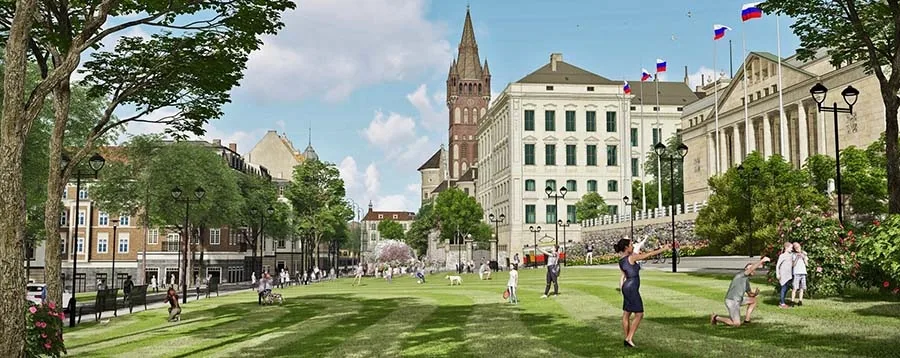
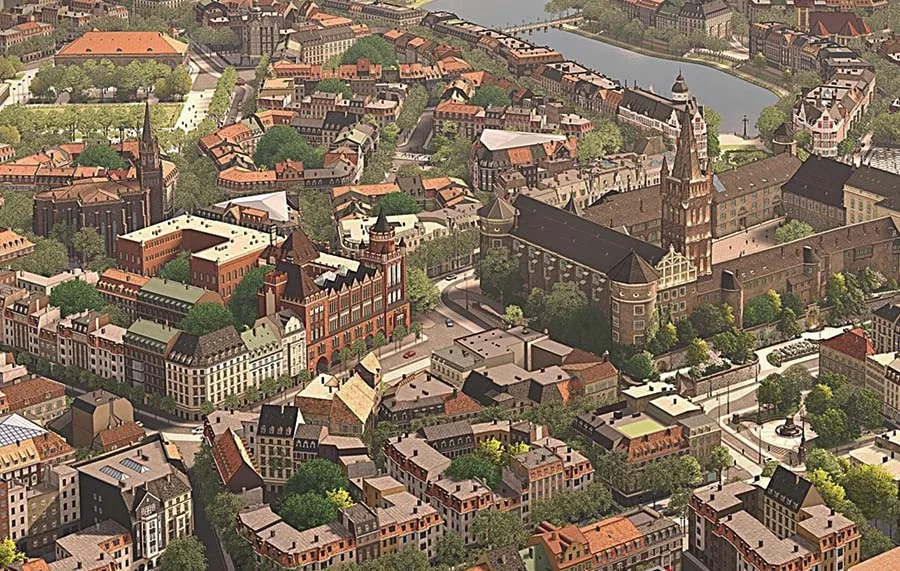 The urban environment in the recreated historic centre.
Most of the five-storey “Khrushchyovka” blocks have already reached the end of their service life. The sturdiest may hold out for another quarter of a century at most, but sooner or later we will have to rid ourselves of this legacy of the era of “developed socialism” and put up new buildings in their place.
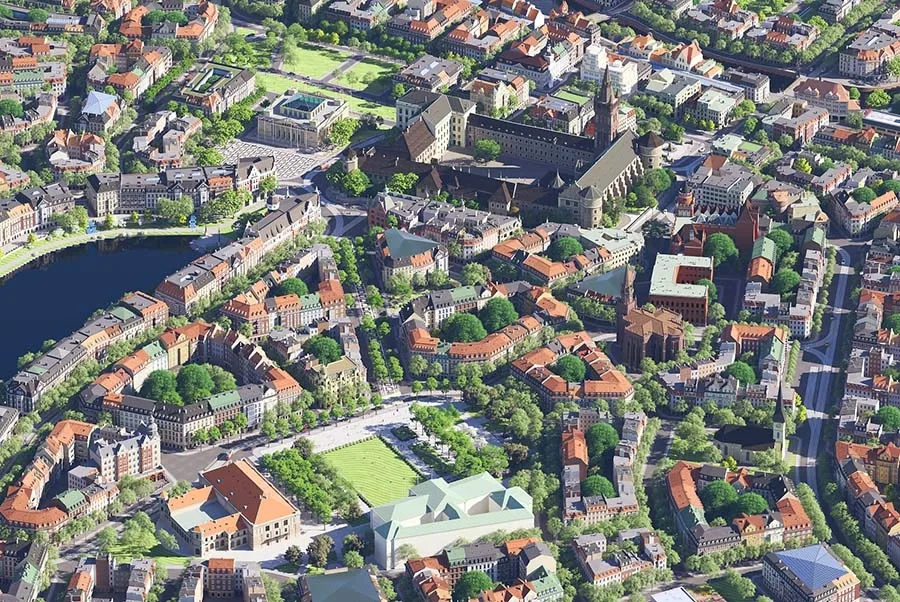 The castle and the area to its north up to and including the university.
It is high time to start working out the architectural answers: what should the centre of Kaliningrad become as a result of a renewal that, unless planning begins right now, will at some point turn into a serious headache for the city authorities — a case of “winter came unexpectedly”. We can and must recognise the problems we face and start solving them well in advance.
As part of our project, we propose starting this process with the former Paradeplatz (now Universitetskaya Street), turning it into a kind of “testing ground” for organisational and technological solutions. This experience will later prove invaluable in the inevitable renewal that will sweep through entire districts like an avalanche. The area surrounding the historic centre needs its own architectural regulations, limiting building heights and setting out, as specifically as possible, what is required of construction companies regarding the appearance of new buildings. (Our proposals on this matter were published two years ago right here.)
Beauty Will Save the World
At present, local residents do not see Kaliningrad's historic centre as a place where they would like to spend their free time. Indeed, our whole city is a patchwork of residential districts of varying comfort around a retail and business hub, to which radial streets lead from every corner of the city. The two practically identical old outlying villa districts, Amalienau and Maraunenhof, make little difference. The city barely looks after its parks. And let's not even mention the environment...
The historic centre, once the most beautiful place in the city, is now criss-crossed by avenues on two levels. The capital of a region that markets itself as a notable tourist destination does not even have a pedestrian street!
The entire centre is built up with nondescript apartment blocks that have long since failed to meet the demands of the times, both practically and aesthetically.
I live in the hope that one fine day those on whom Kaliningrad's fate depends will accept the arguments of the architectural “council of experts” (see above). The capital of a Baltic resort region deserves a better fate! We have everything we need for it; all that remains is to take a number of strategic decisions in concert, with the aim of turning battered post-war Kaliningrad — once in such a hurry to give all its new residents some kind of roof over their heads — into a harmoniously developing modern city where everyone will find a place that matches their boldest dreams!
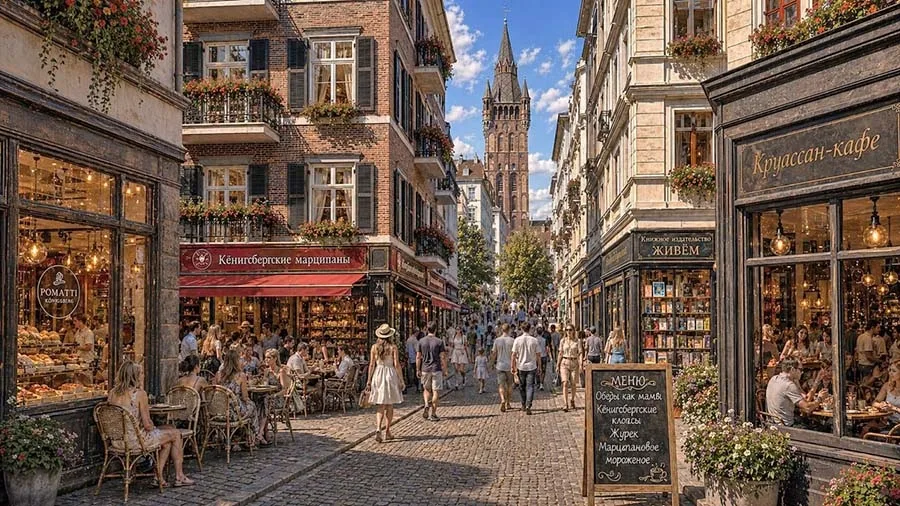 The year 2125. View from the Fish Market towards the castle.
A business district on Oktyabrsky Island with a grand branch of the Russia National Centre, the historic centre, and attractive neighbourhoods around them and on the outskirts — let all these flowers bloom, starting today, none at the expense of another!
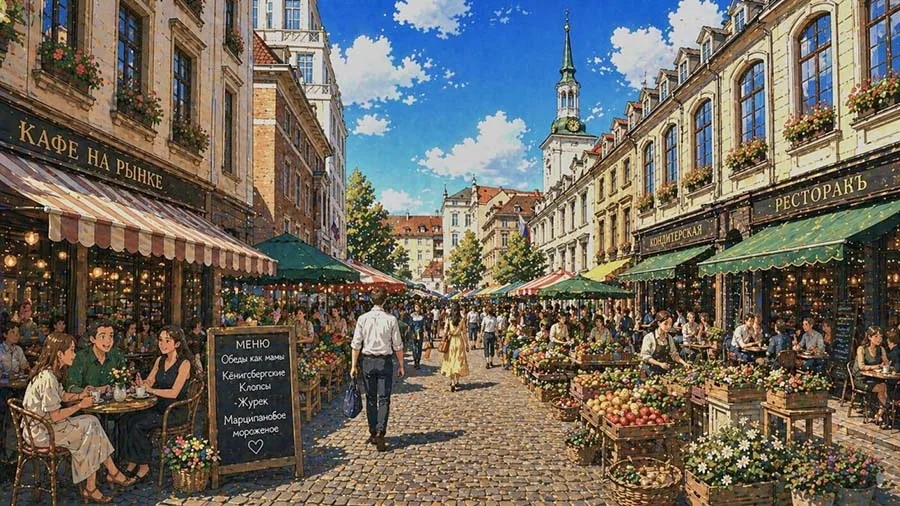 The recreated Altstadt Market in the next century.
I hope that within a hundred years we will manage to reach agreement and find the best solutions to all the contentious issues. Personally, though, I would like to bring that bright future closer if at all possible. Resigning ourselves to a hundred-year wait is not our way. We prefer to act here and now.
If our project is realised, the city's residents will gain something to love — something that becomes a daily dose of positivity, the very foundation of a sense of happiness. It was Kant, I believe, who said that a person reveals himself through his attitude towards things. Right now, what we have is a void. Often a very fragile one. The shadow of a phantom that has sunk into oblivion.
We propose to create an object of adoration, empathy, pride and admiration.
It will be an environment that brings out the very best in people and nurtures talent — a tangible presence that engages the heart, the soul and the mind alike. Ideally, a field in which to apply one's energies as well. There will be façades that people will be glad to care for constantly, windows they will want to wash before every holiday, and entrance halls — in one of which, I hope, a new Alexander Sergeyevich Pushkin will one day be born, to awaken kind feelings with his lyre in the generations that follow us.
All illustrations: © Arthur Sarnitz (2026)
* — Innenstadt was the name given to the part of the city inside the fortress wall, which in the 17th century was transformed into the first ring of ramparts. The second ring, which replaced the first, was built in the mid-19th century.
Translated from Russian with the help of AI (Claude, Anthropic), October 2026.