Any discussion of the mystery of the Amber Room's disappearance must touch on the history of the object of the search itself and on the events that preceded its arrival in our city. The Amber Cabinet was the creation of Prussian amber craftsmen, who in the 18th century were considered the finest in Europe. It was made for the first King in Prussia, Frederick I, whose ambition anyone who mentions him in a story is bound to note. Frederick I wanted his court to be compared with Versailles, and so, sparing neither effort nor treasury, he filled it with costly pieces and luxuries. There is also every reason to assert that the very idea of a room made of amber belonged to Frederick I's consort, Queen Sophia Charlotte, while the design was the work of her favourite architect, Eosander.
As the king conceived it, the Amber Cabinet was to become a unique creation that all Europe would talk about and that other monarchs would dream of in vain.
This explains the exacting scrutiny with which Eosander supervised the work on the cabinet. From the moment the design was approved in 1701, the master Wolfram worked on polishing the amber panels. In 1706 Eosander dismissed him for working too slowly, and in his place two masters from Danzig, Schacht and Turau, were brought in to make the cabinet. Alas, Queen Sophia Charlotte did not live to see the work completed. She died in 1709, and the inconsolable Frederick ordered that Lietzenburg Palace, where the amber panels were to be installed, be renamed Charlottenburg in her honour, and that all its rooms be left exactly as they had been in the queen's lifetime. The cabinet was ready by 1713, but just then Frederick I himself died, and Frederick William I, who succeeded him on the throne, was the complete opposite of his father.
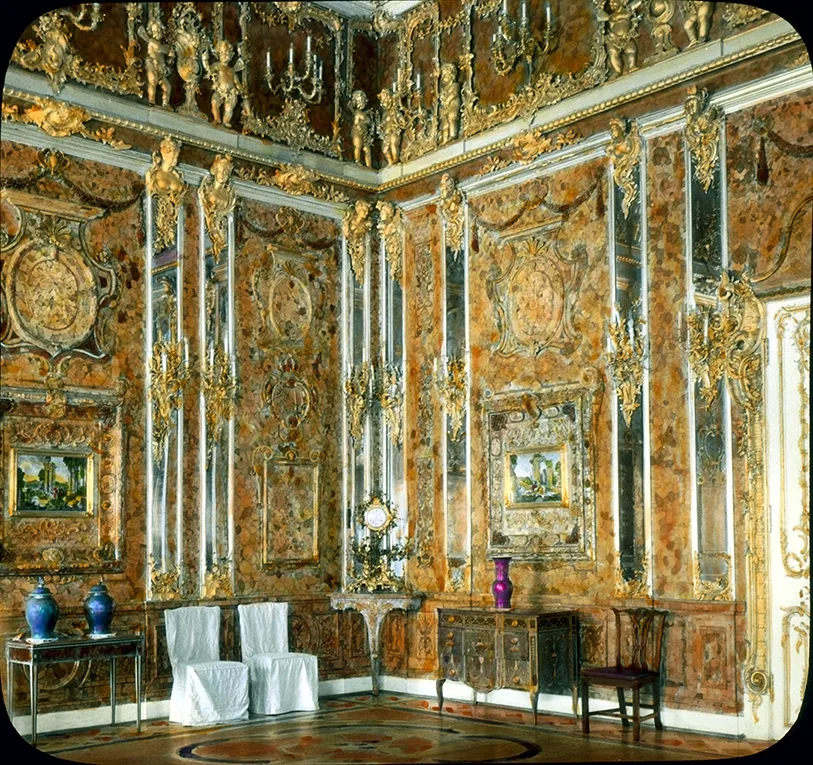
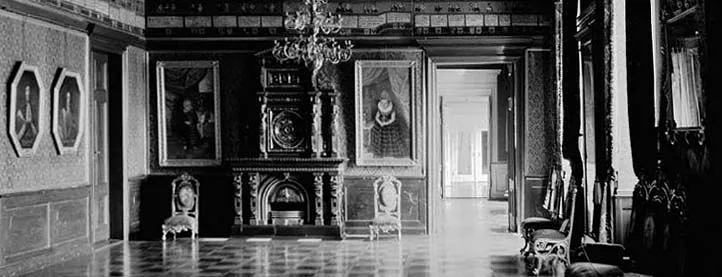
Pre-war colour photograph of the Amber Room.
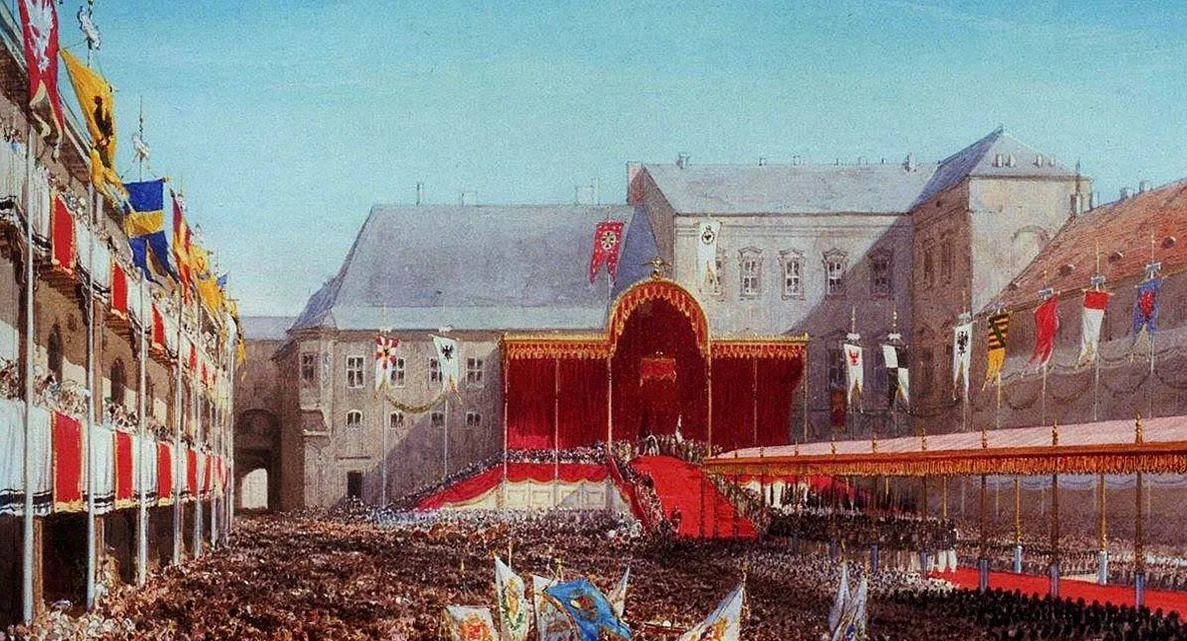
The new king's interests lay in giving Prussia the best army in Europe, and he considered any expenditure on luxury beyond the bare minimum (including his own coronation) unacceptable. Nevertheless, the Amber Cabinet was assembled in the Berlin Royal Palace, because it was entirely finished and the cost of storing it dismantled was comparable to the cost of assembling it. The "sergeant on the throne", who once said of Leibniz, "I consider him a good-for-nothing who is not even fit to stand sentry", took no pleasure in the Amber Cabinet; more likely it was even a burden to him, since servants had to be kept to look after it. And so he was only too glad to include the curiosity among his gifts to the Russian Tsar Peter I, who had already admired the cabinet before it was even assembled.
The panels were delivered to St Petersburg, but there, too, they lay in their crates for a long time, waiting for their hour. They were not installed until the reign of Elizabeth Petrovna.
The Italian master Martelli, who supervised the work, noted that the original had been seriously damaged, and he replaced some of the amber with glass backed with foil. Since the room allotted in the third Winter Palace was too large, the architect Rastrelli supplemented it with mirrors and pilasters, as well as several imitation panels. In 1746 the Amber Room was assembled, but only nine years later it was moved to the Great Palace at Tsarskoye Selo. The new room turned out to be even larger than the previous one, so the same Martelli and Rastrelli once again added mirrors and imitations. In 1763 the Room's fate took a decisive turn: Empress Catherine II ordered all the imitations to be replaced with natural amber from Prussia. Prussian amber craftsmen were summoned for the purpose, and 450 kilograms of first-class amber were used. The Room was complemented by four Florentine mosaics: "Sight", "Hearing", "Taste", and "Smell and Touch". (At the time no one could have guessed what role they would play in its fate many, many years later!) In 1770 the work was completed, and the Amber Room assumed the appearance it would retain right up until 1941.
After the Germans captured the town of Pushkin, Wehrmacht soldiers discovered the Room, which had been draped over but not evacuated.
Some of the amber was immediately stolen as souvenirs, but special trophy units stepped in: the room was dismantled, packed into crates and taken to Königsberg. The choice of destination owed much to the personal acquaintance and correspondence between Alfred Rohde, director of the Königsberg municipal art collections, and von Leeb, commander of Army Group North, with the active assistance of Gauleiter Erich Koch. In the "Donation Book of the Königsberg Museum", the Amber Room from Russia appears under the round number 200.
Alfred Rohde found a room for it in the south wing of the castle. It was smaller and lower than the one in which the Amber Room had been installed in the Catherine Palace. This was no accident. Rohde believed that only the original Amber Cabinet was of historical value, and that all the later additions distorted a genuine German work of art. This is a very important detail that may explain a great deal: the former Amber Room was divided into parts, and the part that remained in the crates was regarded by the museum director as being of secondary value.
It is reliably known that part of the former Amber Room, referred to as the "German Amber Cabinet", was on display in the castle from 1942 until February 1944.
After that the panels were dismantled once again and stored in crates. This was prompted by a strange fire that broke out in the adjoining room, where Nazi propaganda materials were on display. Rumour had it that it was arson committed by anti-fascists. Whether or not that was so, this incident undoubtedly saved the Room from the carpet bombing that followed in August 1944. Through Rohde's oversight, the fire door between the rooms had not been closed. The amber panels did not burn, but they were covered with soot and a film of burning, and given that instructions had been arriving from Berlin for a long time to send the amber treasure to the capital of the Reich, Rohde's desire to keep the room under his own supervision could have been regarded as a crime. That is why he ordered the room to be removed to the castle cellars, out of harm's way. From then on, the Amber Room can only be spoken of as panels in crates. The last eyewitness testimony that the crates were in the castle dates from 5 April 1945. Since then no one has ever seen them again.
Archaeology in the Field of War
As is well known, most crimes are solved while the trail is still hot. That is precisely why the mission of Professor Aleksandr Yakovlevich Bryusov, sent in May 1945 to track down cultural treasures looted from the USSR, had the best chance of establishing the fate of the Amber Room. However, those who sent Bryusov to Königsberg to search for it made two unforgivable mistakes: they chose entirely the wrong person to lead the search, and they failed to make the search for the Amber Room a separate operation in its own right. This, in fact, sealed the outcome of the mission. By analysing the course of the search, we will understand why these mistakes proved so fatal.
And so, at the very end of May 1945, Bryusov, invested with broad powers to search for valuables, arrived in Königsberg.
His powers were backed up by a colonel's shoulder boards, since a civilian's authority might not have sufficed in a city full of military men. It is hard to say what Moscow was guided by, but it appointed a professor of archaeology to organise the search operation. A good archaeologist, as it happens, but, alas, criminal investigation and museum work were not at all his field. Everything seemed to be falling into place wonderfully: even before Bryusov's arrival, at the end of April 1945, the "Donation Book of the Königsberg Museum" had been found, listing all the valuables that had come to the museum after being removed from the USSR by the special units.
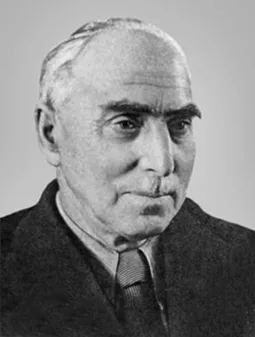
Aleksandr Yakovlevich Bryusov,
professor.
In the very first days of the commission's work, when Bryusov, acting more on intuition than anything else, was spending most of his time observing the excavations at Königsberg Castle, he happened (!) to meet the key witness in the case of the missing room, Dr Alfred Rohde, who had drawn attention to himself by wandering about the ruins of the castle. It is worth stressing once again that had Rohde sat quietly in a cellar with the other Germans, no one would have suspected that this man was the official who had personally directed the packing and shipment of cultural treasures both to western Germany and to hiding places within East Prussia. A few days later, again by chance (!!!), Bryusov caught Rohde on the castle grounds at night just as he was burning some important papers, and by the same stroke of luck most of those papers survived. Bryusov failed to take full advantage of any of these fortunate coincidences.
Alfred Rohde deserves a description of his own. His career as an art historian began in 1912. In 1926 he became director of the municipal art collections of Königsberg.
Rohde was a fanatic of museum work and one of the world's foremost authorities on amber, the author of brilliant studies on the history of amber art in Prussia.
And this is how Bryusov describes Rohde in his notes:
“Rohde looks like an old man, with a trembling right hand. Slovenly dressed (deliberately?). An art historian. Has a number of scholarly works to his name. An alcoholic. Does not inspire trust. I keep feeling that he knows more than he says, and when he does speak, he often lies. If you don't look at him but watch him from a distance or on the sly, his hand stops shaking. He insists that the best collections were evacuated but that he does not know where; when I asked him whether they had gone to Rastenburg [now Kętrzyn in Poland — ed.], he immediately exclaimed: ‘So you've found them?’ And so on.”
“Rohde was in charge of protecting museum treasures throughout East Prussia. He shipped items from here to the ‘castles’. He prepared the removal of the Amber Room to Saxony. But you can get nothing out of him. He doesn't lie, but he says very little, and only when we have already discovered something without him. I simply cannot get anyone to have a serious talk with Rohde instead of patting him on the head and coaxing him with the ‘carrot approach’. He will say nothing of his own free will. In my opinion, he is a hardened fascist.”
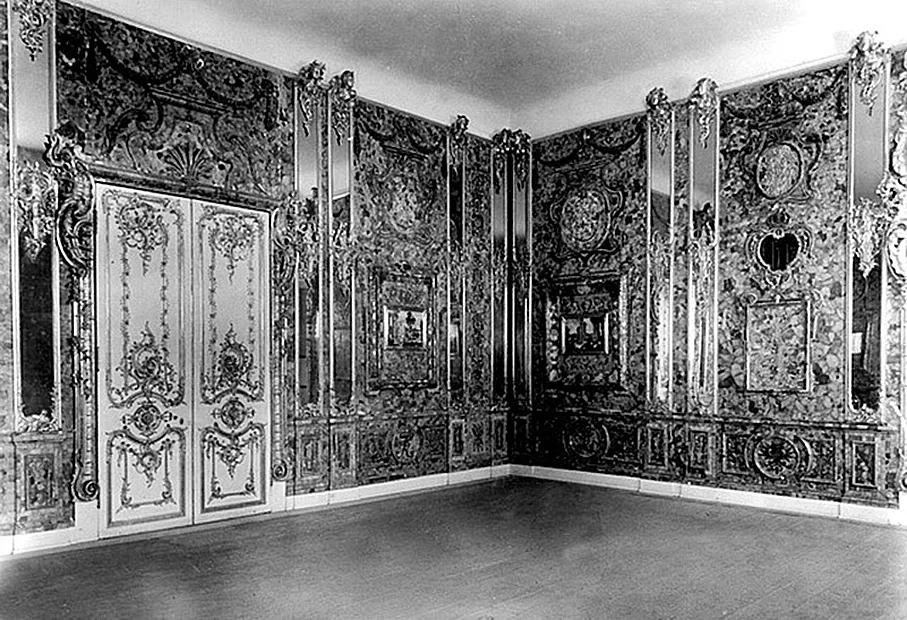
The Amber Cabinet in the castle in 1943.
In reality Rohde was no fascist, nor did he sympathise with the left, as his close acquaintance Feyerabend, the manager of the Blutgericht restaurant, claimed. Bryusov failed to grasp what was going on in the mind and heart of the director of the Königsberg museums at that moment, and so he was unable to use him as the surest means of locating the Amber Room. Rohde was a fanatical servant of art. Nazism and the war it unleashed had enabled him to enlarge the collections of the museums in his charge considerably. In effect, he had reached the very pinnacle of his career and fulfilled his most cherished dreams. Then came two British bombing raids, the siege and the storming of the city, and nothing remained of Rohde's former grandeur. Nothing, that is, except the secrets he undoubtedly possessed and was therefore in no hurry to give up. One can only guess at what motivated his strange and ambiguous behaviour, but one thing is clear: none of the Soviet military or civilian personnel who “worked” with him managed to find the “key” to him.
From the very outset Rohde behaved as follows: he did not refuse to cooperate, but he disclosed anything important only under the pressure of facts and circumstances that had already come to light.
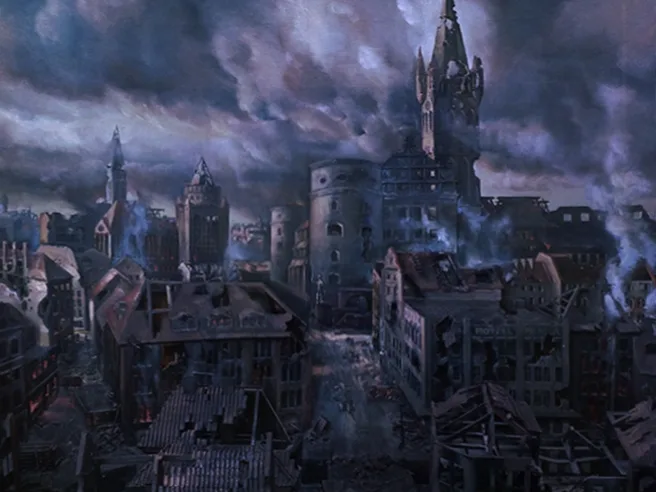
Remarkably, the information obtained from Rohde revealed nothing new; what is more, it neither confirmed nor refuted the working hypotheses. Thus, he first pointed to the place where the Amber Room had been assembled and displayed — the completely destroyed south wing of the castle. When it was objected that the room was known to have been packed into crates and moved elsewhere even before the bombing raids, Rohde pointed to the Knights' Hall (or, to be precise, the Marschallsremter, as a refectory was called in the Middle Ages), which had survived both the bombing and the assault. It was there, in a small corner above a heap of charred embers, that on 12 June 1945 the notorious report was drawn up stating that the Amber Room had been destroyed in a fire that broke out on 9–11 May of that year. The fire started for unknown reasons when the castle was already under the control of units of the Moscow-Minsk Division, and it destroyed much of what had miraculously survived the fighting. After this report was drawn up, Bryusov turned his attention entirely to other treasures. And then came the most mysterious episode of his mission in Königsberg...
Bryusov's Bunker
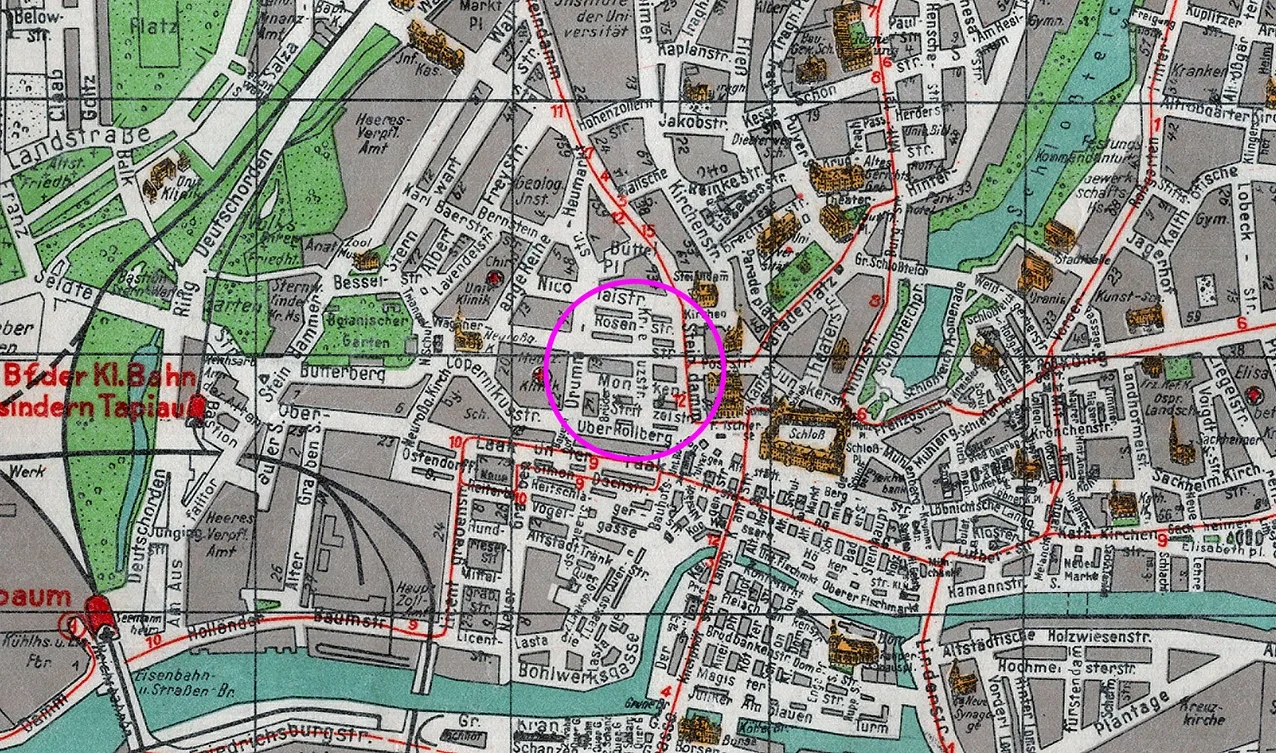
From the papers seized during Dr Rohde's attempt to burn them, Bryusov learned of the existence of a certain Hoffbunker (literally “courtyard bunker”), about which Rohde had written that “its key has been lost”. Bryusov reprimanded Rohde for having kept quiet about this bunker. Rohde replied that the key had long since been found and that he had meant to take the professor to the bunker, but the military had set up camp nearby and access was difficult. Rohde can hardly have failed to realise that a professor with a colonel's shoulder boards would have no trouble getting to the bunker, so this explanation can safely be regarded as a pretext. According to Bryusov, the Hoffbunker was located “on Rosenstraße, in the first or second house from the intersection with Steindamm”. Rosenstraße no longer exists; all that remains of it is a nameless passage between buildings 2–4 and 6–8 on Zhitomirskaya Street, which runs up against the five-storey block at 2–8 Wagnera Street. It was somewhere here that the subsequent events took place. Rohde led Bryusov and his companions to a ruined house, in whose cellar lay the entrance to the bunker. They descended a steep staircase four or five floors down and found rooms prepared for people to stay in and for valuables to be stored. In the underground chambers there were beds, including children's beds, and belongings lay scattered about, among which Bryusov noted some sculptures and paintings. It was evident that people had already been there. In his notes Bryusov described the objects as “of little value”, though they did take a couple of worthwhile items back up to the surface with them. With that, the inspection of the bunker was over.
Only back in Moscow did it suddenly dawn on Bryusov that Rohde had not needed a single key to reach the lower floors of the bunker.
The two upper floors, on the other hand, had locked doors leading to unknown rooms, which the commission did not bother to open and inspect. Bryusov also notes that Rohde was absent during the inspection of the bunker. No one knows where he was, nor why he had so readily agreed to take the commission members to the bunker when he had carried out all his other assignments with undisguised reluctance. Bryusov surmised that Rohde needed to visit the bunker in order to check on something, and that he could not get into it without Bryusov accompanying him.
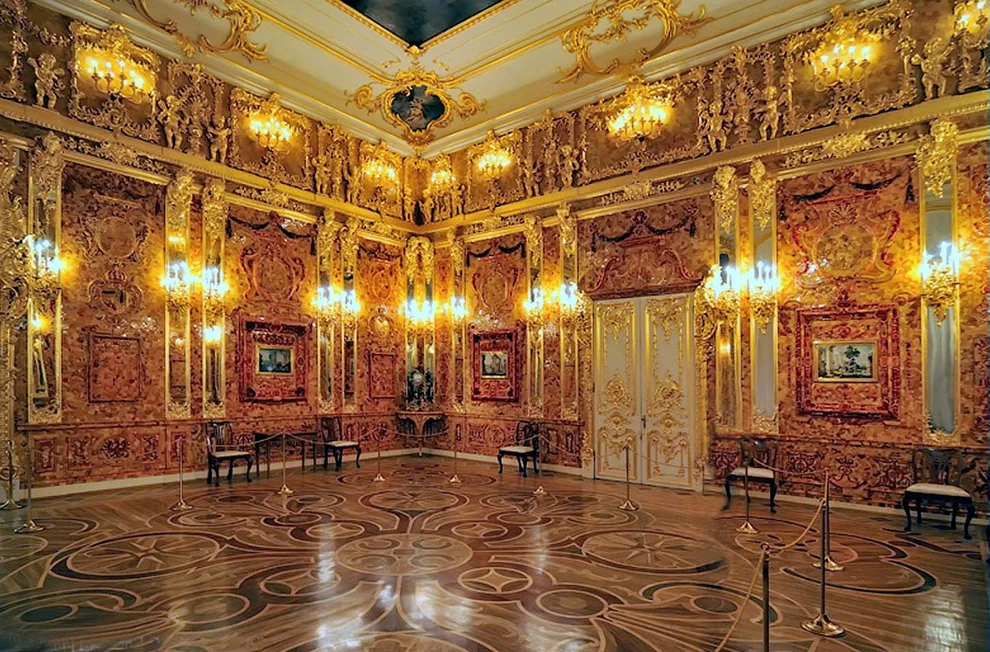
The restored Amber Room in the Catherine Palace (Pushkin).
From here on, things grow stranger still. In his memoirs, Bryusov states that the bunker held not items of little value but paintings by Italian masters of the 16th–17th centuries, "stacked in piles". If so, "Bryusov's bunker" was the greatest find of all! Yet what the expedition leader did next is baffling: he locked the entrance to the bunker and handed the key to some soldiers, ordering them to let no one in until an official team arrived from the commandant's office. What happened after that, nobody knows. No documents, inventories or orders have ever been found showing that the valuables were removed from the bunker. After Bryusov's death, during attempts to locate the bunker, every surviving member of his search team was questioned, but none could remember visiting it with him. Nevertheless, in 1976 a serious attempt was made to find the underground repository. The only find was a cellar covered by a heavily reinforced concrete slab 55 cm thick. Beneath it, however, lay just a single-storey room containing rusty household items, plank bunks, a safe built into the wall that had already been opened, and a couple of small strongboxes, also opened. It was then decided to regard "Bryusov's bunker" as a figment of the professor's imagination and to halt all work on it. That, however, will not stop us from returning to it at the end of this article. I would add only one thing: the people who hastily dismissed Bryusov as a "strange old man losing his memory" never even bothered to check that he wrote all his major works after the events in Königsberg, which would hardly have been possible had the professor been prone to dementia and groundless fantasies.
The Patient Is More Alive Than Dead
It might seem that the Amber Room case had been closed, the final word being the official report on the destruction of the amber panels in the fire of 9–11 May in the Knights' Hall of the castle. Fortunately, however, there was one man for whom finding the masterpiece from the Catherine Palace became a matter of honour. It was he who had directed the evacuation of the museum collections from Pushkin in 1941, and so he never stopped blaming himself for the fact that the Room had not been dismantled in time and sent to the east of the country. His name was Anatoly Kuchumov. In the post-war years he became famous for tracking down, identifying and returning home thousands of priceless exhibits.
And although Bryusov's search had led to the official conclusion that the Amber Room had burned in Königsberg Castle, he was in no hurry to regard this version as beyond doubt.
It is hard to say how the whole story of the search for the Amber Room would have turned out had the art historian Kuchumov, rather than the archaeologist Bryusov, been sent to Königsberg in 1945. But one thing can be said with confidence: Anatoly Mikhaylovich possessed all the qualities that Bryusov lacked in the hunt for the treasures of Soviet museums. Having received his official assignment to search for exhibits from the Tsarskoye Selo museums, Kuchumov acted like a real investigator: he went to Moscow to see Bryusov and questioned him in detail about every circumstance of the search for the Amber Room in Königsberg, receiving from him in the process the notebook in which the professor had recorded the progress of the search. On arriving in Königsberg, Kuchumov immediately set about tracing Rohde, as he had not the slightest doubt that Rohde held all the keys to the mystery of the vanished Room. Imagine his disappointment when it turned out that Rohde and his wife had died back at the end of 1945. The cause of the couple's death remains unknown to this day. At first the main version was death from typhus (or acute dysentery); this was later replaced by the version of suicide. And it was always added that the possibility could not be ruled out that Rohde had been "removed" because he knew too much.
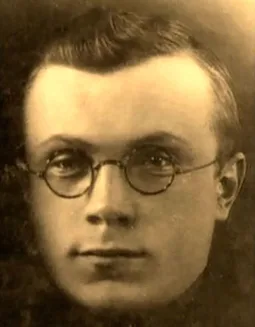
Anatoly Mikhaylovich Kuchumov,
art historian.
But Kuchumov's main discovery awaited him when he examined the castle. Inspecting the spot where, according to Rohde, the Amber Room had perished, he recognised in the charred pieces of wood already mentioned by Bryusov the Keyserlingk furniture suite from Tsarskoye Selo (his thorough knowledge of the subject paid off). And further down, beneath a layer of ash, he found fire-damaged mosaics from the decoration of the Amber Room. Three of the four. Kuchumov was unable to find the fourth mosaic, which he took as proof that the Amber Room had been stored in parts. Here he was mistaken, since the story of the theft of the "Smell and Touch" mosaic, before the crates with the amber panels ever reached Königsberg, has only become fully known in our own day. On the other hand, three further pieces of evidence for this claim – that no traces of burnt amber were found, nor any remains of mirror glass or the mirrors' bronze frames, and that the room was not large enough to hold the entire packed Room – remain key to this day in a number of theories according to which crates holding some of its panels are stored somewhere deep underground. Nor was Anatoly Mikhaylovich aware of another fact we discussed earlier: that Dr Rohde sought to recreate precisely the historic German part of the Amber Room, and that it had therefore been divided into parts even before it was last packed and prepared for storage.
All this gives serious grounds for hope that the German part of the Amber Room – the most valuable part in Alfred Rohde's view – has survived intact.
The Steindamm Triangle
Why, then, in discussing where the crates with the amber panels might be, have we examined only the "Steindamm version" in detail? The answer is simple: this version is supported by a range of testimonies, logical arguments and the technical conditions needed to carry it out. There is a wealth of independent testimony that here, in the area of the "Steindamm Triangle", formed by Steindamm (today's Zhitomirskaya Street and part of Leninsky Prospekt), Lange Reihe (Barnaulskaya Street) and Kopernikusstraße with Oberrollberg (Kopernika Street), some large, long, yet not particularly heavy crates were hidden away. Other witnesses (such as Bryusov) observed substantial underground structures in this area. Their accounts differ on only one point: the exact location of the bunker itself or of its entrance. For the German Bilke, it is a secret passage into the cellars of the Steindamm Church; for the Pole Jabłoński, the underground vaults of the SS garage on Heumarkt square (at the start of Barnaulskaya Street); for another German, Wiest, a certain bunker "B-III" on the same square. Add to this the testimony of our own servicemen about an underground vault containing amber objects in the KEPA department store (Leninsky Prospekt, 18) and an underground passage beneath Barnaulskaya Street with an entrance near the building of the former eye clinic (Barnaulskaya Street, 8), and it becomes very hard simply to dismiss the theory that a single large underground facility or a series of smaller bunkers exists here.
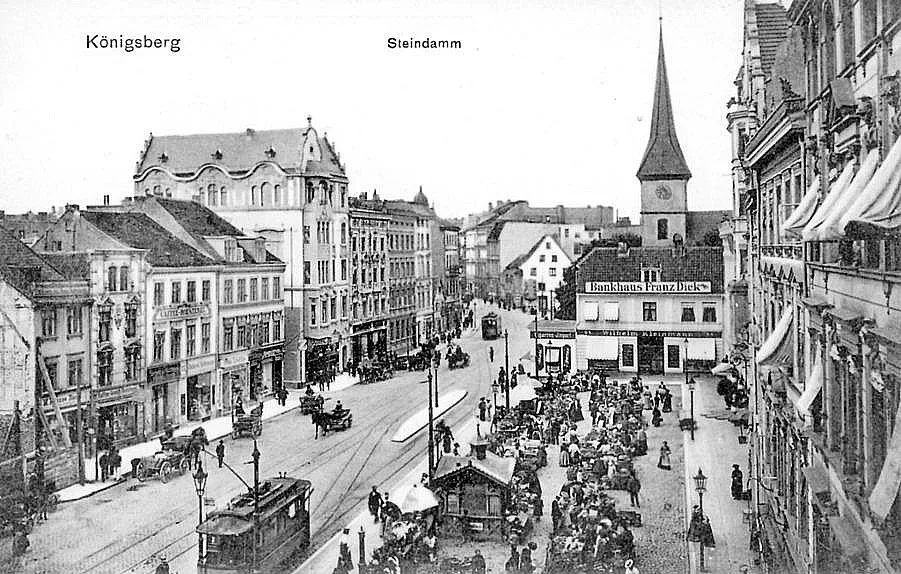
Steindamm. To the left of the traffic island dividing the tram tracks, the turning into Rosenstraße can be seen – leading to the part of the city where the Amber Room may still lie hidden underground.
Moreover, the searches carried out so far (as their participants themselves admit) have not, in essence, definitively and conclusively ruled out a single one of the suspected sites. Every time one analyses how they went, one gets the impression that had the shaft been drilled a little deeper or the trench dug a little to one side, the mysterious underground facility would have opened up before the searchers' eyes. But neither deeper nor to one side proved possible, owing to limited funds and time, and sometimes to a lack of sufficient faith in success. The witness testimony is echoed by logic and geology: the Rollberg hill and the area around Steindamm lie not far from the castle, which made it easier to transport valuables there, while their considerable elevation above the level of the Pregel offered better conditions for building underground repositories.
And given the information about the fate of the Amber Room that is freely available to us, it is premature, without further searches in this area, to say that there is no prospect of finding traces of the masterpiece in Kaliningrad.
As I was finishing this article, I found time to walk once more through the courtyards of the former Steindamm, across the Heumarkt, the old Hay Market that has long since lost its status as a square, and along Lange Reihe and Kopernikusstraße. With every step, some inner sense told me that I might be standing just a few metres from the solution to the greatest mystery of the 20th century, and now of the 21st as well. The huge boulders in the courtyard of the five-storey block on Zhitomirskaya Street, the old manhole covers set in the Russian asphalt of Vagnera Street, the mound of the air-raid shelter near the long-destroyed Neuroßgärter Kirche, where the sports ground of School No. 23 now stands, the granite kerbs of the vanished Heinrichstraße… Like Dr Rohde in a world that had become alien to him, they keep, in age-old secrecy, everything they have seen and everything they know. Until we find the key to them.
Translated from Russian with the help of AI (Claude, Anthropic), October 2026.