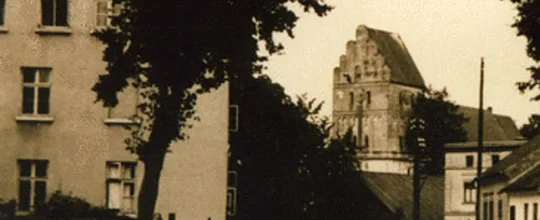
In the 14th century (presumably between 1320 and 1330) the first church was built in the village of Balga. In the days of the Order, services in it were traditionally held by priests and chaplains from the castle. But since the common mortal does not live by spiritual food alone, an inn is mentioned in the village from 1430. And in 1447 a windmill was built there.
As is well known, German surnames originally indicated the place a person came from. Natives of Balga are mentioned as early as the 14th century. The best known of them were Günther von Balga, a town councillor in the Altstadt (1339), and Naki von Balga, a notary of Warmia (1349). Johann von Balga is mentioned as a monk of Oliva Abbey (1337). Heinrich and Johann von Balga (1339) and the merchant Barthold von Balga (1350) lived in Thorn (Toruń, Poland). In Braunsberg (Braniewo, Poland) there was Klaus von der Balga (1361).
The village of Balga was repeatedly devastated by the Poles and their allies during the Thirteen Years' War (1454–1466). In 1518 the local church unexpectedly found itself under threat: the authorities ordered it to be moved further away from the castle and the parishioners to be buried elsewhere. But the war between the Teutonic Order and Poland that began in 1519, known as the Cavalry War (Reiterkrieg), made everyone forget these plans, and they were never taken up again. During this war the village of Balga was attacked by the Poles. In 1520 they burned down the mill. However, it was soon rebuilt on the same spot.
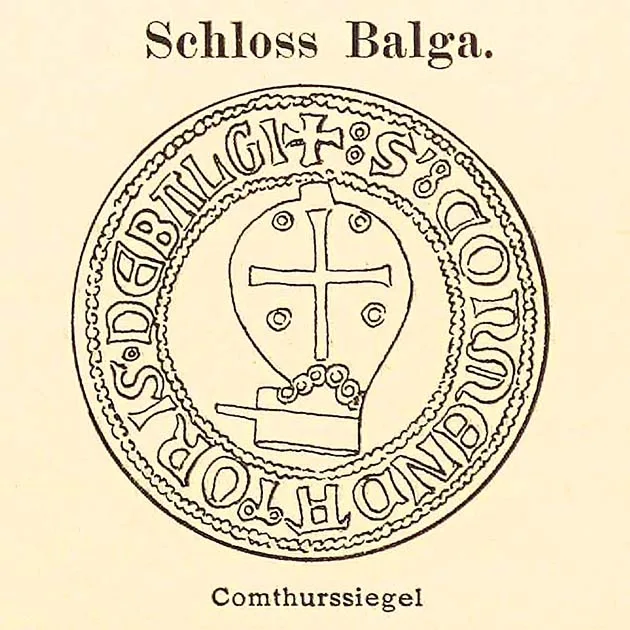
Seal of the Komtur of Balga.
After the formation in 1525 of the secular state of the Duchy of Prussia, where Lutheranism became the state religion, Balga Castle became the property of the first Protestant Bishop of Pomesania, Georg von Polenz (c. 1478–1550), and in 1546 a Lutheran pastor was appointed to the Balga church.
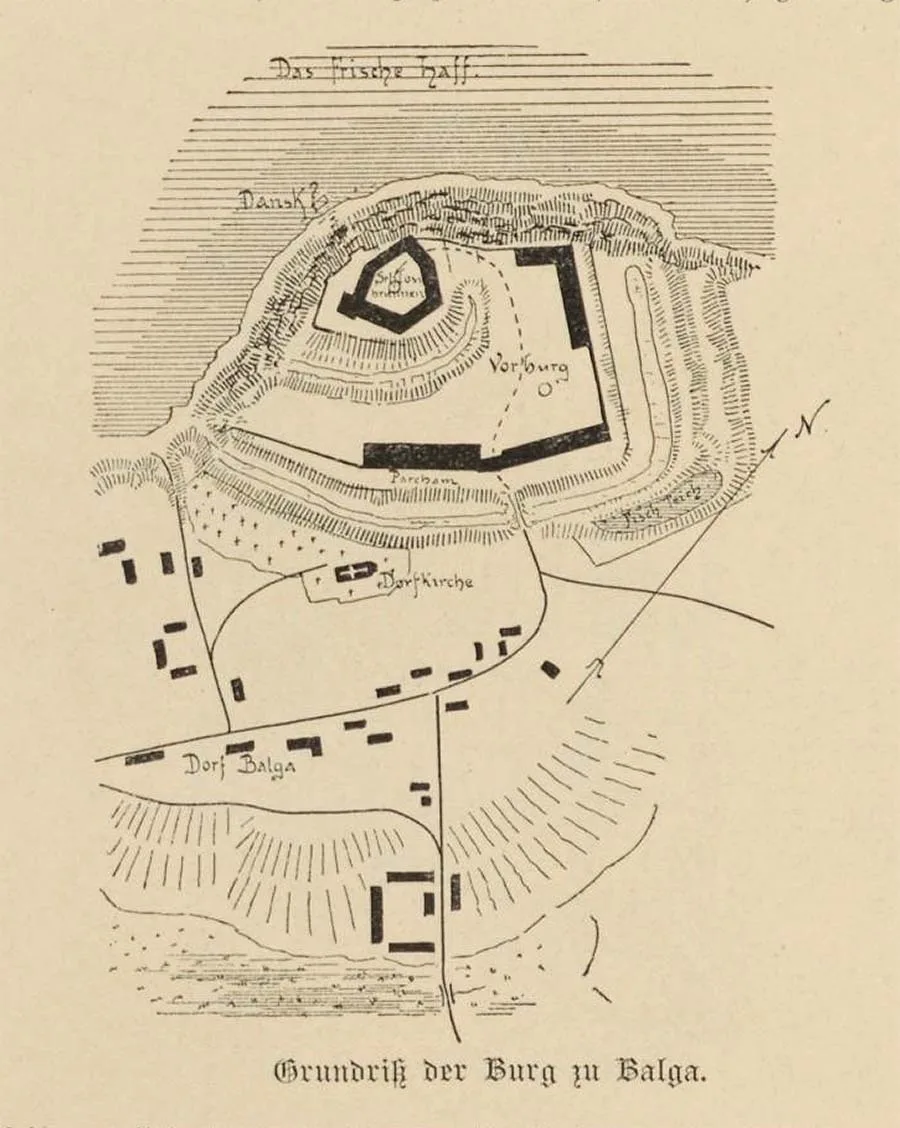 Plan of the settlement around Balga Castle from Adolf Boetticher's book "The Art and Architecture of Natangen".
A school was opened at the church, where children (mostly boys) from Balga and the nearby villages were taught. Since the clergy no longer lived in the castle, a pastor's house was built in the village for the first time. In general, the pastor of Balga Church was a rather wealthy man in those years: his annual salary in 1575 amounted to 70 marks. It is quite difficult to compare old monetary values with modern ones, but for a general idea one may assume that one mark at that time would buy a cow. True, at first the pastor was not allotted any plot of land for his own farming. But later he was given an allotment of 2 Kulm Hufen, 19 Morgen and 294 Ruten, which came to roughly 210 hectares. Such a plot was considered enough to feed about two and a half peasant families.
The life of townspeople and peasants in the pre-capitalist era consisted of endless regulations and restrictions. Everything was strictly limited: the number of homesteads in a settlement, the size of the cultivated plots, the length of the working day, the quantity and quality of craft goods produced, the prices of agricultural produce and non-food goods. The landlords and officials of that era did not yet know the laws of the market, but long experience told them that this was the way to avoid a crisis of overproduction, unfair (and fair!) competition, rising and collapsing prices, too rapid a devaluation of the coinage, and social upheaval as whole strata of the population became impoverished. Almost every kind of activity required a licence, a patent or special privileges.
You could brew beer for your own needs without a patent, but if you wanted to trade your surplus beer for your neighbour's earthenware pots, you had to buy the privilege to open a brewery, and if your beer was so good that the whole village was ready to buy and drink it, you had to obtain a patent to open an inn.
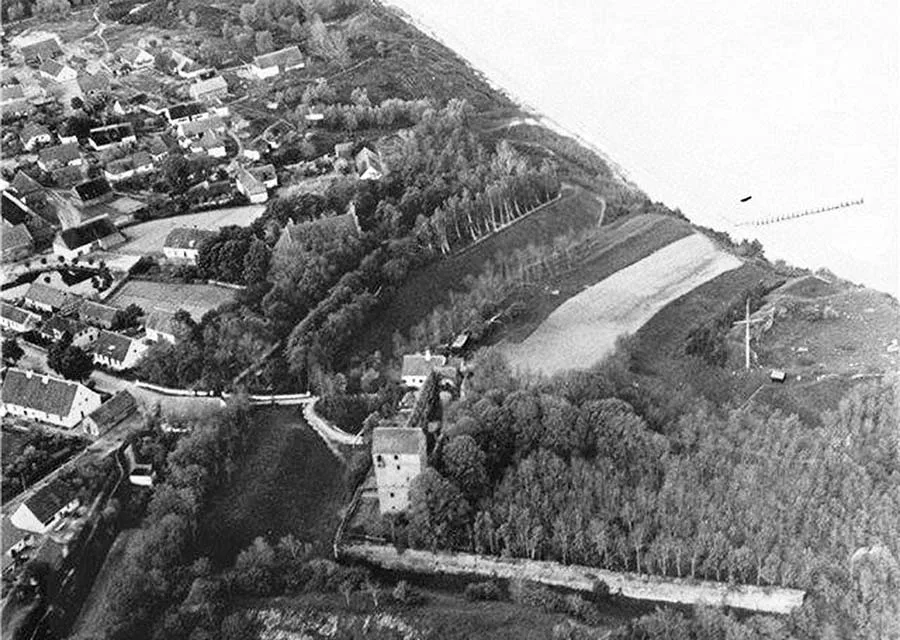
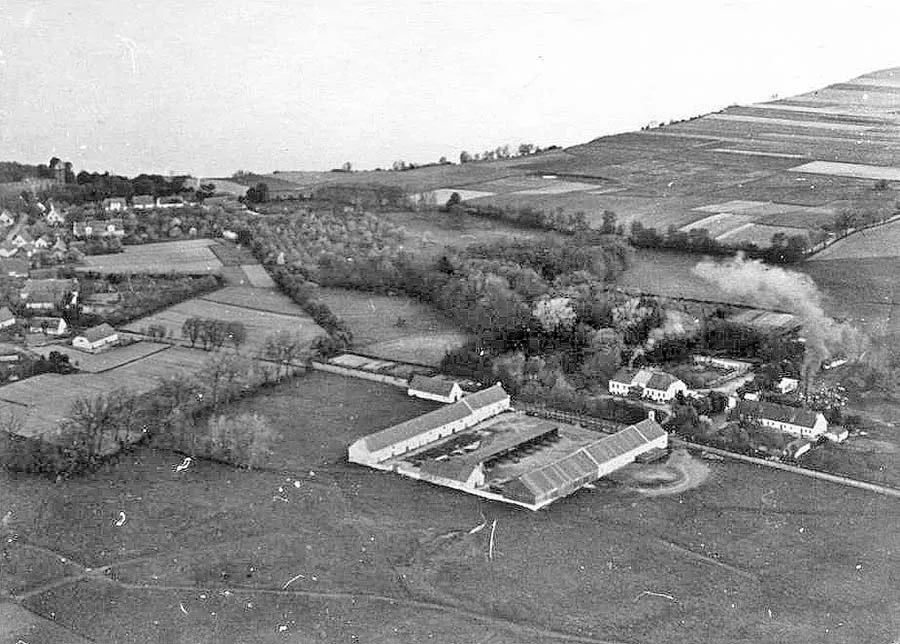 The village, the castle and the estate from a bird's-eye view.
But these privileges were not freely on sale: if someone had already opened an inn in the village, it sometimes happened that a second patent could not be bought at all. At least not honestly, without bribing an official. Since the days of the Order there had also been restrictions for the settlements attached to towns and castles. It was held that the inhabitants of such settlements should tend the gardens of the towns and castles. That is why they came to be called "gardeners" (Gärtner). It is fitting to recall here the names of the suburbs of Königsberg, which were also called "gardens": Roßgarten (Horse Garden), Alten Garten (Old Garden), Nasser Garten (Wet Garden). The "gardeners", of course, often did other work and provided other services to the inhabitants of the castles and towns, but as land allotments they could only have small plots. At the same time, the castle was obliged to allot pasture to the workers and fodder for their own livestock.
In 1617 a special rescript permitted the "gardeners" at Balga Castle to keep no more than two horses, two cows, one calf and four pigs. This was supposed to curb demand for hay and oats and their prices, while also keeping meat prices from falling. In 1669 a visiting commission even came to Balga and established that the local "gardeners" were grossly violating the law. Nobody confiscated the livestock, but a tax had to be paid on it. In general the population of Balga lived rather poorly at that time. Many of the "gardeners" were in debt bondage; only one peasant was a free Kölmer (or Köllmer), that is, a free farmer cultivating his allotment under Kulm law, i.e. a tenancy paid in money and in kind.
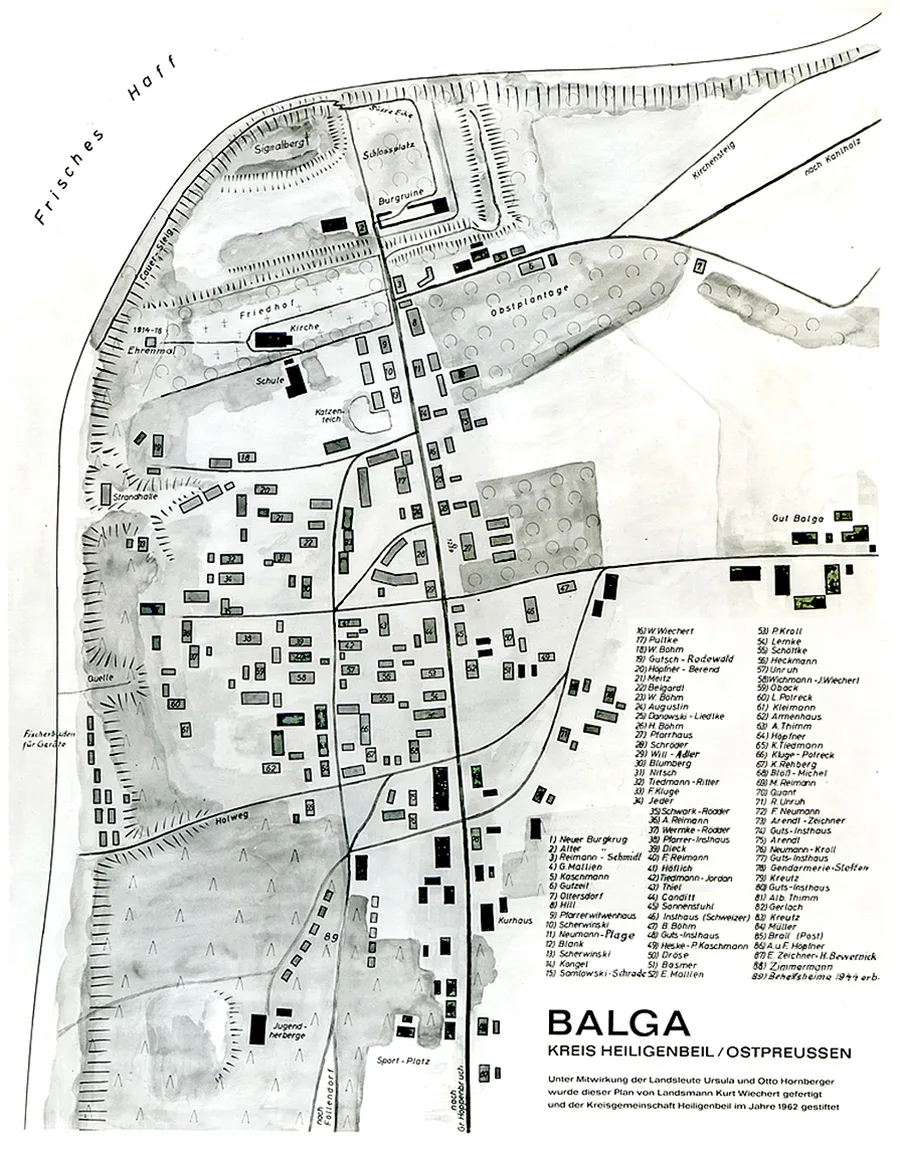 Plan of the village of Balga.
This Kölmer, named Krüger, was a rather remarkable figure. His ancestors are mentioned as privileged persons as far back as the time of the Teutonic Order. Members of this family invariably held the post of village headman. In 1536 he alone received the right to catch fish for his own table, and in 1559 this right was extended to a catch of 30 sacks of fish using six nets.
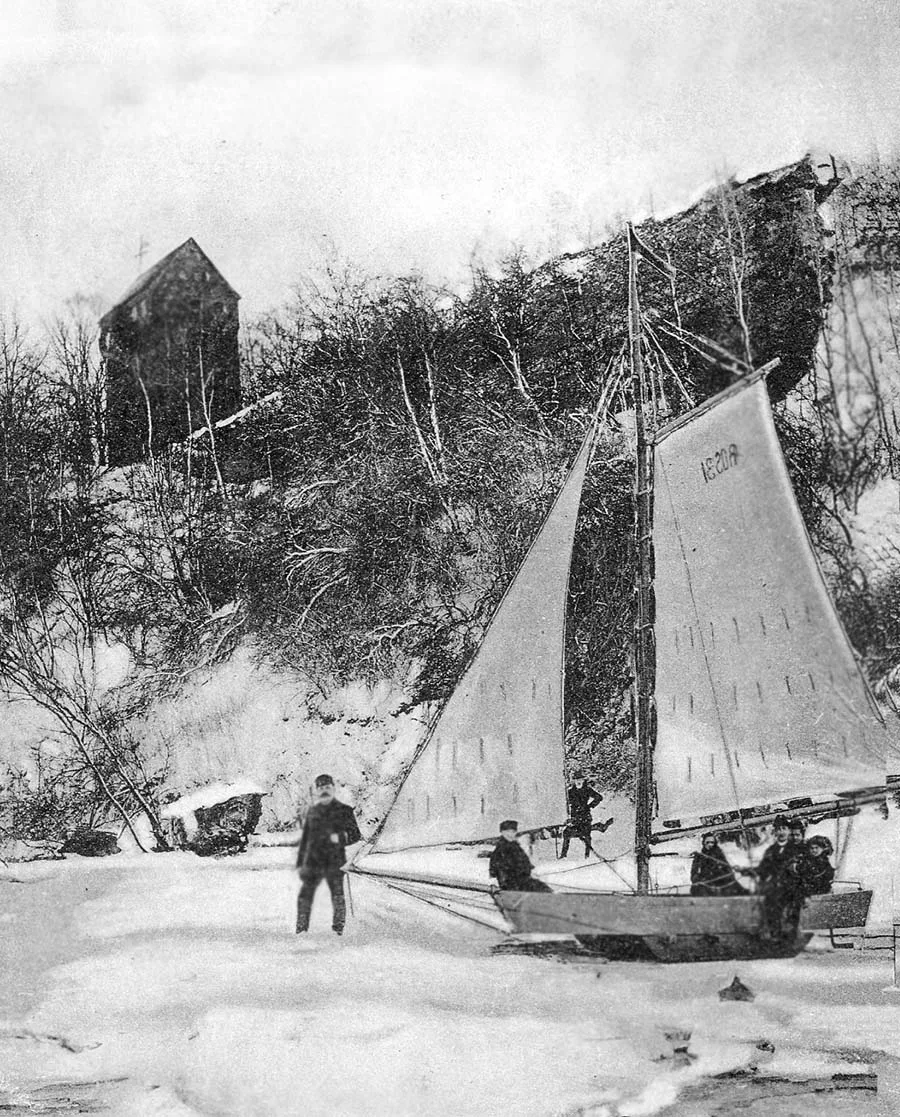 Local inhabitants on a sail-sledge off the shore at Balga.
And yet, despite its location on the shore of the lagoon, the village of Balga was never a fishing village. Perhaps this was due to the excessively strict conditions for obtaining fishing licences, but it is difficult to name with certainty the reasons why the local people gave up fishing.
In 1642 an organ was installed in the Balga church. The resident organist was also the leader of the church choir, the cantor, and the schoolteacher. He was allotted a school plot of land for a smallholding. In addition, he was paid for his work as a teacher. As a result, the Balga schoolteacher had a rather decent income. In 1654 the Balga parish, which had always been considered quite small, was enlarged by three more villages: Newecken (Timiryazevo), Rensegut (54°31'31'' N 20°01'24'' E) and Romansgut (54°30'10'' N 20°01'28'' E)
In 1736 the old windmill was rebuilt once again, and for the last time. After this rebuilding it would stand for another 174 years and would be destroyed by a hurricane only in 1910.
In the 18th century the number of property owners in Balga increased. Those wishing to take up farming in the district were issued charters granting hereditary possession of a plot. They then had to begin cultivating virgin land and abandoned state and church lands. By 1785 there was only one Kölmer in the village, Krüger, who was the village headman. Besides him, the village had 43 owners in 39 houses, a pastor, a cantor, three workers at the inn, 18 workers at the winery, two workers at the church, 16 peasant women and one miller. Among the inhabitants were a carpenter, a joiner, a mason, a cooper, a baker, a wheelwright, a linen weaver (without a licence), two tailors and a shoemaker.
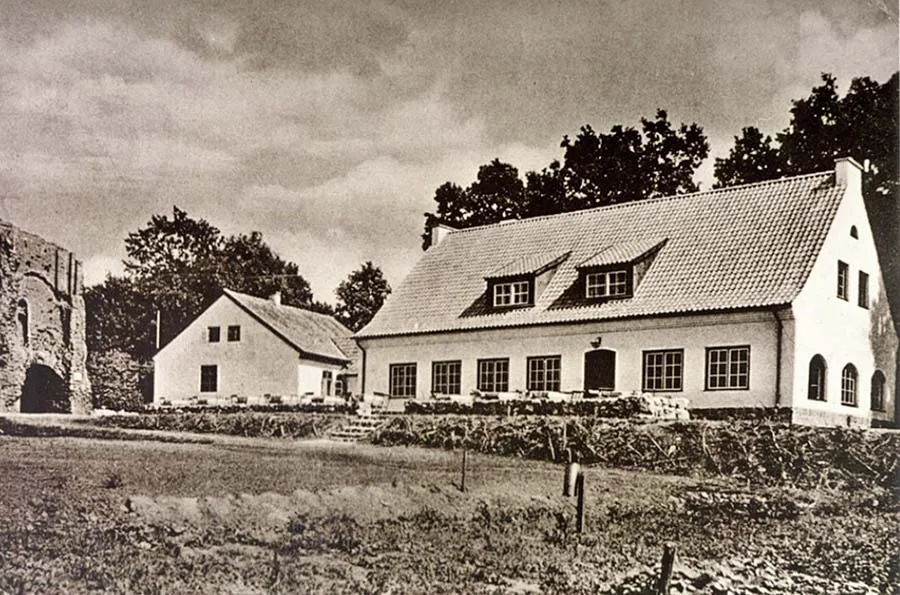 The guesthouses zur Haneda ("At Haneda", the name of the Prussian fortress on whose site the Teutonic Order built Balga Castle) and Burg Krug ("Castle Tavern") at the entrance to the Vorburg of Balga.
On the whole, the description of the village leaves a rather dreary impression. It notes that the soil here is sandy and very poor, the harvests are low, and the meadows for grazing and haymaking are of mediocre quality. There is no forest at all in the area, and the inhabitants have to buy timber from the neighbouring estates, which owned extensive "noble forests". The village farms had 51 horses, 7 foals, 10 oxen, 62 cows, 9 calves and 73 pigs.
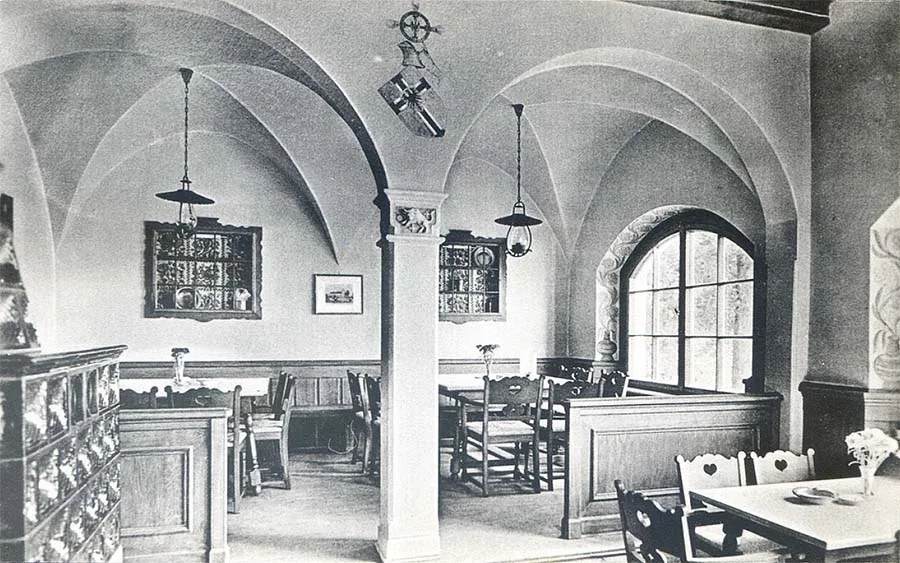 Interior of the Burg Krug tavern.
From about 1800, shipowners, ship captains and sailors began to settle in Balga. Their vessels mostly remained nearby, at the moorings of the village of Rosenberg (the settlement of Krasnoflotskoye, part of the town of Mamonovo). Towards the middle of the 19th century, sailors from Pillau (Baltiysk) began buying houses in Balga. By that time there were no longer any medieval bans on fishing, but the toilers of the Frisches Haff (Vistula Lagoon) traditionally preferred to settle in places where piers and harbours had been established long ago.
In the 19th century there were two administrative units next to Balga Castle: the rural community of Balga Flecken and the Gutsbezirk of Balga Estate (Vorwerk). In Prussia, Flecken was the name for large rural settlements that brought together the nearest villages around them. They always had parish churches, schools and markets. Some Flecken reached the size of a small town in population, but their inhabitants traditionally engaged in agriculture. If there were small industries there, they were geared to processing agricultural produce. In addition, a Flecken might have sawmills and small workshops producing basic necessities for the local market. The provincial and district authorities supported the development of Flecken, since this made it possible, with relatively small investment, to make the basic social amenities more accessible to the rural population.
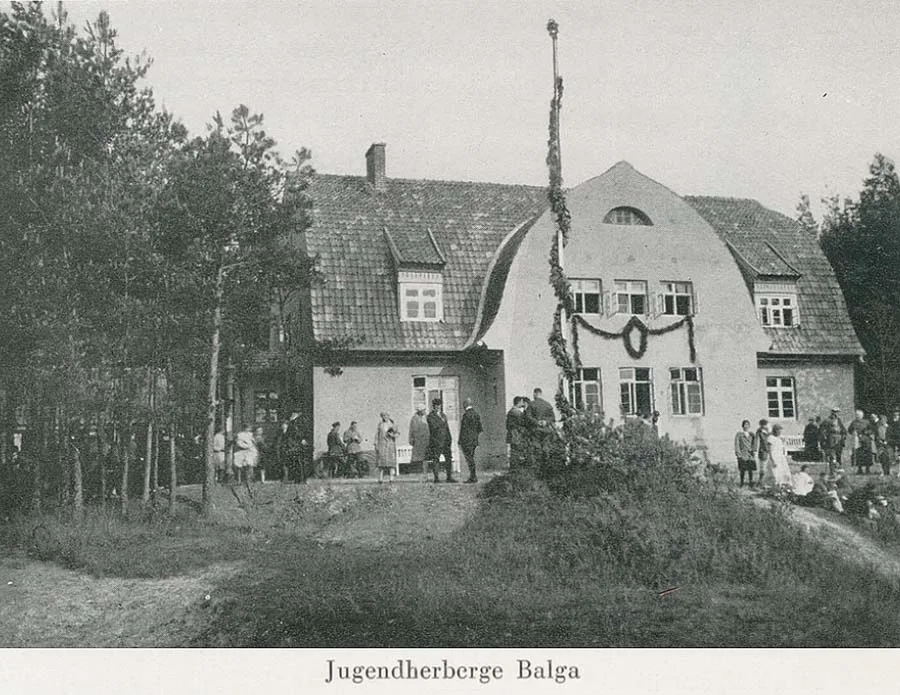 The youth hostel in Balga.
It was precisely in the middle of the 19th century that the number of people wishing to move to this picturesque place grew. By 1846 the estate and Flecken of Balga had 65 dwelling houses.
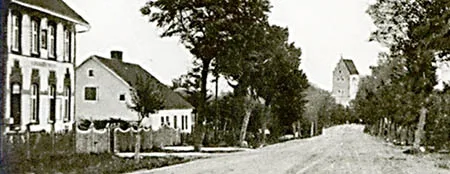
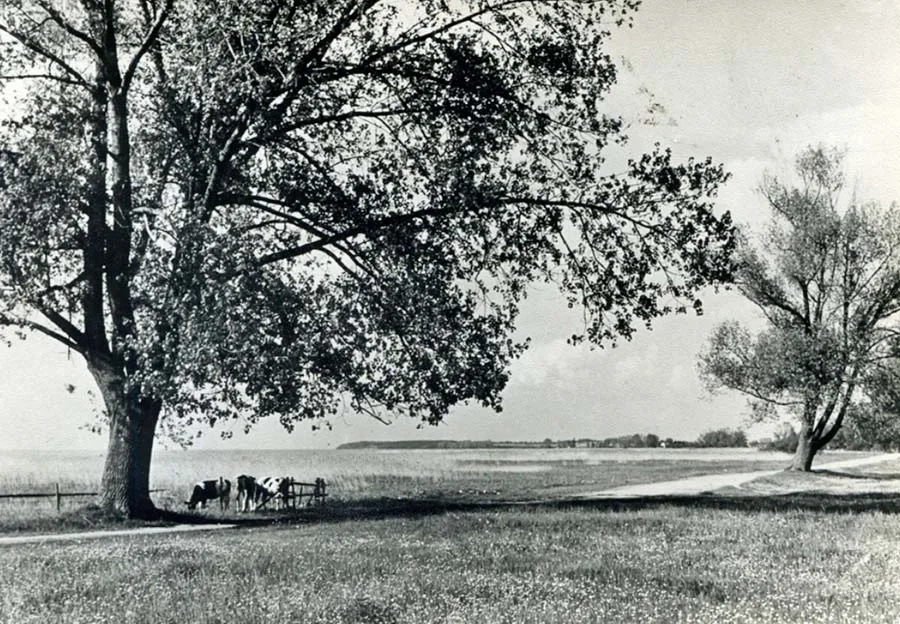 The road along the shore of the Frisches Haff from Rosenberg to Balga.
Balga Flecken formed a rural community in Kreis Heiligenbeil (Mamonovo) from 1818. The Balga church was the parish church for the surrounding villages and estates — the parish comprised 12 localities in all. In 1871 Balga had 61 dwelling houses, with 183 families and 5 single people living in the village. On 11.06.1874 the rural community of Balga Flecken was incorporated into the newly established Amtsbezirk of Balga.
Balga Estate formed a Gutsbezirk in Kreis Heiligenbeil from 1867. The estate belonged to the Balga parish. In 1871, besides the estate itself, the Gutsbezirk of Balga also included the forest house Waldhaus Lokehnen (Yablochkino) and unnamed outlying farmsteads (Abbauten). In all, in 1871 the Gutsbezirk of Balga had 17 dwelling houses (including 5 in the Abbauten and 1 in Lokehnen), housing 45 families and 1 single person. On 11.06.1874 the Gutsbezirk of Balga was incorporated into the newly established Amtsbezirk of Balga. From 1883 the heads of the Amtsbezirk of Balga were invariably members of the von Glasow family, the owners of the Balga Vorwerk (estate).
In 1905 the Gutsbezirk of Vorwerk Balga comprised: New Vorwerk Balga, Old Vorwerk Balga, the village of Schneckenberg and the ruins of Balga Castle. No later than 1908 the Gutsbezirk of Balga was converted into the rural community of Balga Gut (Balga Estate).
On 30.09.1928 the rural communities of Balga Flecken and Balga Estate were merged into the community of Balga. Accordingly, the community of Balga now consisted of the village of Balga Flecken, Balga Estate, the new and old Vorwerks of Balga, the village of Schneckenberg and the ruins of Balga Castle.
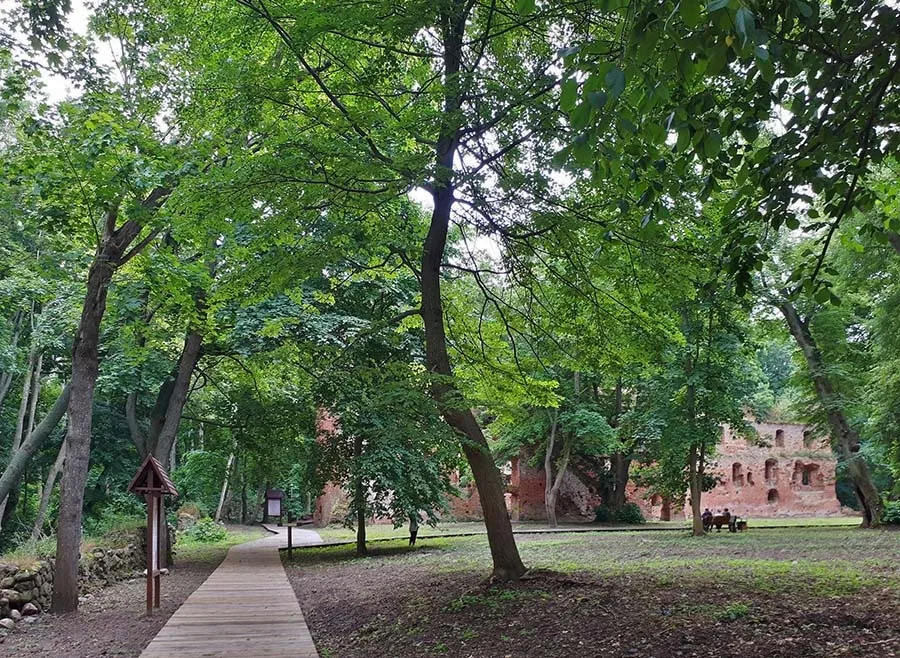 The landscaped grounds of the Vorburg of Balga Castle.
From the end of the 19th century Balga came to be regarded as a tourist attraction. The road from Groß Hoppenbruch (Znamenka), where the railway station nearest to Balga was located, was repaired and lined with trees. On 25.05.1925 the innkeeper opened a bathing establishment on the shore of the lagoon. In 1929 a local history museum telling the story of the castle and of Kreis Heiligenbeil was opened in the tower of the Vorburg.
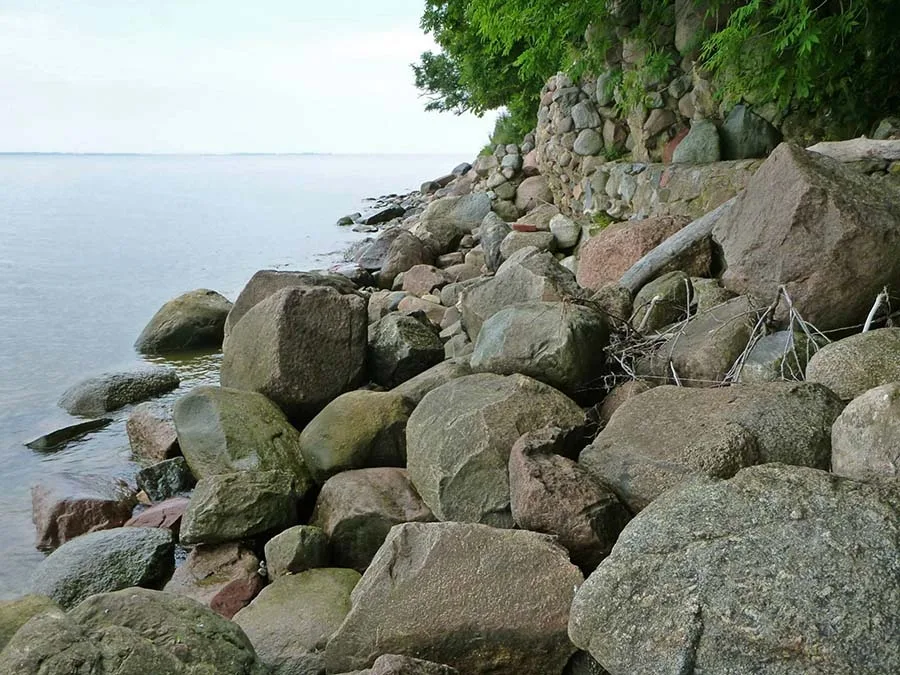 Stones from the fortress walls of Balga Castle rest on the beach after centuries of military labours.
Tourists were fond of the paintings of the Berlin artist Kurt Malz, who moved here specifically to paint the picturesque local landscapes. Next to the museum there was a restaurant that offered visitors above all dishes of local fish — eel and pike-perch. During the tourist season the people of Balga earned extra money as carters with horse-drawn wagons, taking visitors from the railway station to the castle. A ticket cost 50 pfennigs, but many visitors to the castle preferred to walk along the picturesque road. In 1931 the owner of the Haus Balga hotel opened a bus service between Groß Hoppenbruch station (Znamenka) and the village of Balga.
Before the Second World War the peasants of Balga mainly grew potatoes and rye, and the harvests were on the whole rated as good. But livestock farming was especially well developed. There was an orchard of about 6.8 hectares. In Balga Flecken there were a building contractor's office, a painting firm, a slaughterhouse, a grocery, a coal shop, a fish shop and a haberdashery, two shoemaker's workshops, two tailor's studios and a clothing repair workshop. There was also an apiary.
In 1939 a memorial stone marking the 700th anniversary of the founding of Balga was set up before the entrance to the castle plateau.
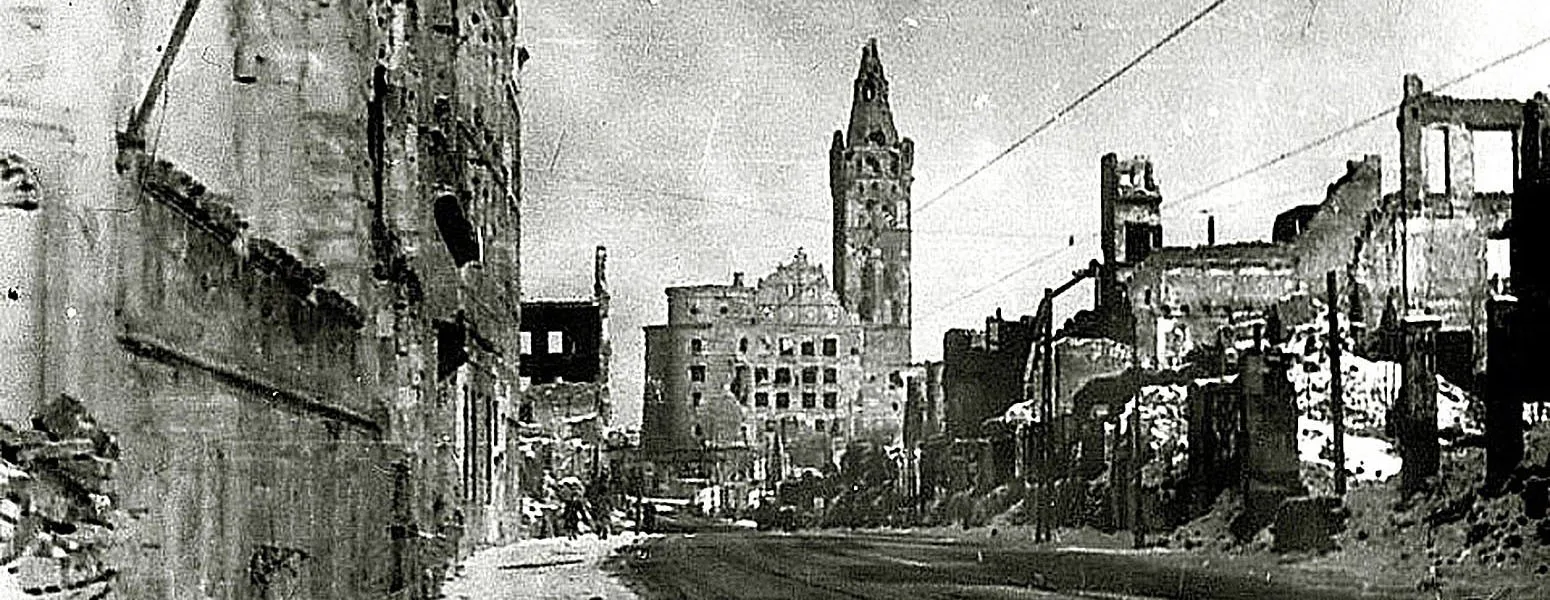
After the bombing of Königsberg by the British Royal Air Force on 27–28 and 29–30 August 1944, Balga took part in rehousing the people of Königsberg who had been left without a roof over their heads. Twelve small houses were built in the forest near the village for those who had lost their homes. In March 1945 a large German force found itself pinned against the lagoon in the Balga area. Civilians trying to cross the lagoon to the Vistula Spit also gathered there. As a result of massive artillery fire, the Vorburg building, the church and houses in the village of Balga were damaged. The Wehrmacht formation suffered heavy losses. Balga was finally taken on 29.03.1945 after fierce fighting.
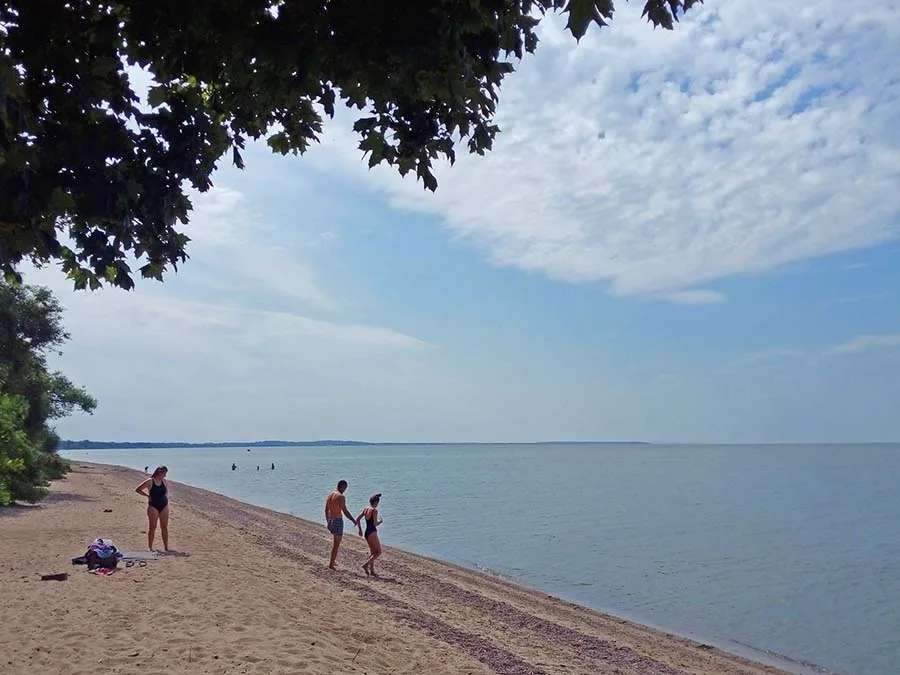 The beach below the walls of Balga Castle.
On 17.11.1947 the village of Balga was renamed the settlement of Veseloye. At first Veseloye was part of the Mamonovo village council. In 1978 the settlement had four houses, three of them on the grounds of the Portovik holiday camp that had been opened in Veseloye.
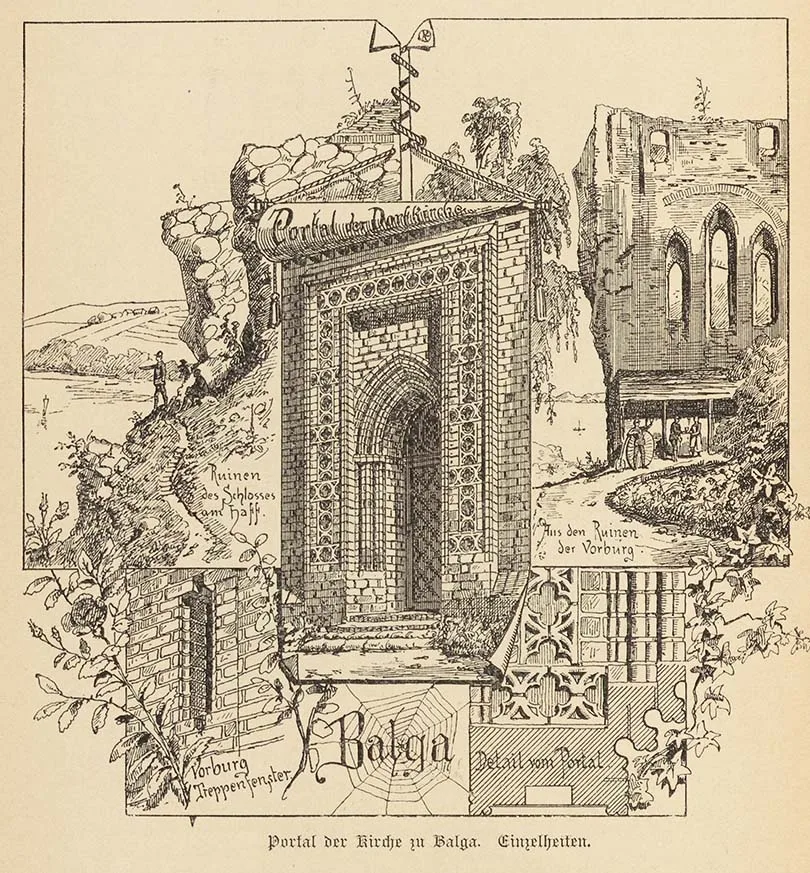
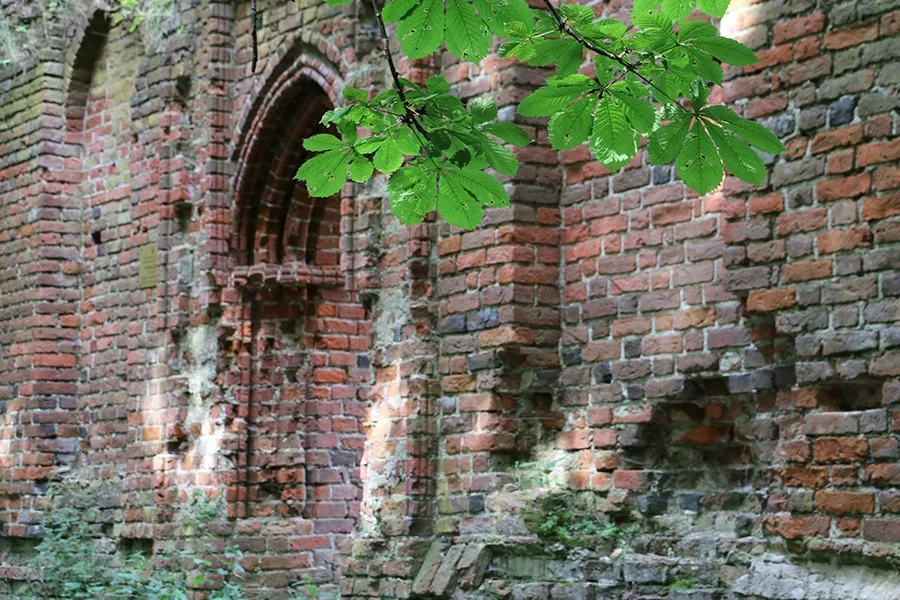 The portal of Balga Church.
On the site of the former Schneckenberg a fuel station (Znamenka-Novaya-3) was built — a military facility designed to receive, store and transfer fuel from tank cars on the Soviet gauge to tank cars on the European gauge. On maps it was marked as a dairy farm.
Around 1988 the settlement of Veseloye was struck off the register, although some buildings still remained there. In the 1990s a dacha (summer cottage) association was set up on the site of the Balga Vorwerk and estate and in the surrounding area. The fuel station was mothballed. As of 2018 the fuel station is used by a commercial company, and next to it there is a residential settlement for its workers. The dacha association is partly built up with houses whose residents live there permanently, but officially the settlement of Veseloye does not exist.
In 2021 the ruins of Balga Castle were leased by the autonomous non-profit organisation "Fortification Heritage of the Kaliningrad Region", headed by the Kaliningrad architect Arthur Sarnitz and his business partner, the builder and restorer Valery Shcherbatykh. The site has been completely cleared and is being prepared for archaeological excavations. By now (end of 2024) it has been put fully in order: a network of safe tourist trails has been laid out, information boards on the history of the place have been installed, and design work is under way. The Kaliningrad volunteer movement "Guardians of the Ruins" has repeatedly come to the aid of the leaseholders.
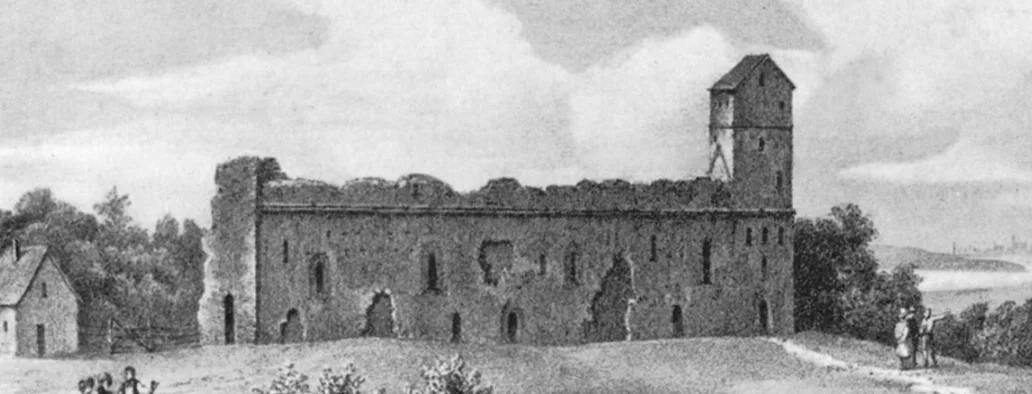
Sights: the ruins of the Vorburg of Balga Castle (14th century), the ruins of Balga Church (14th century), remains of the castle moats and ramparts (1239), remains of the embankment, remains of 18th–19th-century gravestones, old cobblestone paving in the forest. The site is an archaeological monument and a natural and historical reserve.
For reference
Population of the estate and village of Balga (from 1928 the combined community of Balga): 1508 – 80, 1817 – 539, 1845 – 937, 1867 – 928, 1871 – 953, 1890 – 857, 1905 – 699, 1925 – 734, 1933 – 729, 1939 – 753 inhabitants.
Population of the community of Balga Flecken: 1867 – 685, 1871 – 699, 1885 – 635, 1905 – 504, 1910 – 483 inhabitants.
Population of the Gutsbezirk of Balga: 1867 – 243, 1871 – 254, 1885 – 237, 1905 – 195, 1910 – 219 inhabitants.
Population of Old Vorwerk Balga: 1905 – 16 inhabitants.
Population of Schneckenberg: 1905 – 11 inhabitants.
Population of the ruins of Balga Castle: 1905 - 4 inhabitants.
Composition of the population of Balga Flecken in 1871: Protestants – 693, Catholics – 3, other Christians – 3, children under 10 – 191, literate – 444 (of 459 surveyed, 97%), deaf-mute – 1, insane – 1.
Composition of the population of the Gutsbezirk of Balga: all 254 – Protestants, children under 10 – 47, literate – 175 (85%), blind – 1, insane – 1.
Number of dwelling houses in the village and estate of Balga: 1785 – 39, 1846 – 65, 1871 – 78, 1905 – 81, 1925 – 86, 1939 – 91.
Farms by plot size in 1939: 0.55 ha – 8, 5-10 ha – 4, 10-20 ha – 6, 20-100 ha – 4, over 100 ha – 1.
The Balga parish
Balga (Veseloye), Follendorf (Rybakovo), Groß Hoppenbruch (Znamenka), Kahlholz (Lozovoye), Lindenberg (54°31'05'' N 19°58'32'' E), Newecken (Timiryazevo), Rensegut (54°31'31'' N 20°01'24'' E), Ritterthal (54°30'40'' N 20°00'12'' E), Romansgut (54°30'10'' N 20°01'28'' E), Schneckenberg (Veseloye, part), Schrangenberg (54°30'47'' N 20°00'30'' E), Wolitta (Utkino).
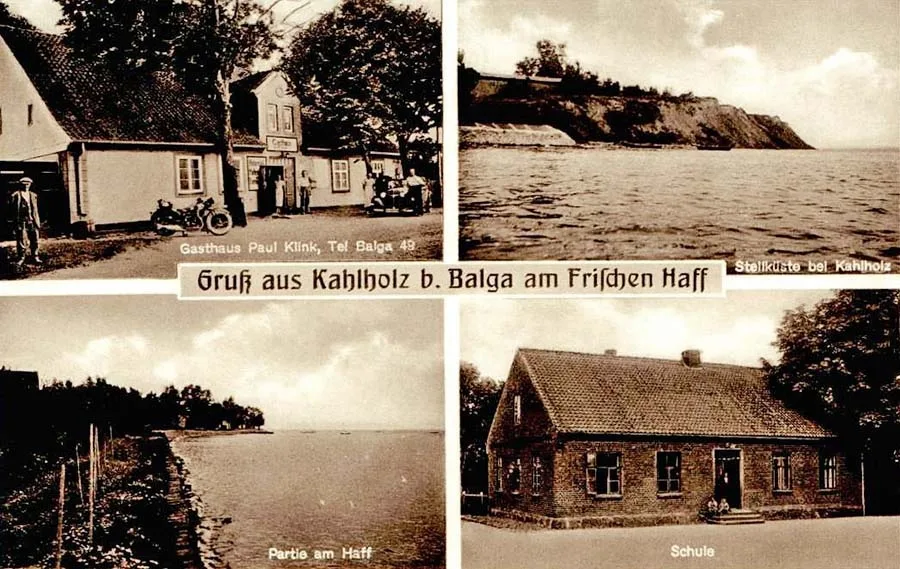
The Amtsbezirk of Balga
On 11.06.1874 Amtsbezirk No. 29 Balga was established in Kreis Heiligenbeil. It comprised three rural communities: Balga Flecken (Veseloye), Kahlholz (Lozovoye) and Wolitta (Utkino), as well as eight Gutsbezirke: Balga Vorwerk (Veseloye), Lokehnen (Yablochkino), Mükühnen (Nekrasovo, now part of Moskovskoye), Partheinen (part of Moskovskoye), Wangnieskeim (54°32'12'' N 20°04'43'' E), Weßlienen (Kuntsevo), Wolittnick (Primorskoye) and Wolittnick Mühle (Primorskoye). After the administrative reform of 1881 the Amtsbezirk of Balga consisted of five rural communities (Balga Flecken (Veseloye), Balga Gut (Veseloye), Kahlholz (Lozovoye), Lindenberg (54°31'05'' N 19°58'32'' E), Wolitta (Utkino)), five Gutsbezirke (Lokehnen (Yablochkino), Mükühnen (Nekrasovo, now part of Moskovskoye), Partheinen (part of Moskovskoye), Weßlienen (Kuntsevo), Wolittnick (Primorskoye)) and part of the Födersdorf forestry (the Rohrbruch forest, 54°33'32'' N 20°01'16'' E). On 30.01.1914 the rural community of Follendorf (Rybakovo) was incorporated into the Amtsbezirk of Balga.
On 30.09.1928 the rural communities of Balga Flecken and Balga Estate were merged into the community of Balga. The Gutsbezirk of Lokehnen (Yablochkino) became part of the new rural community of Fedderau (54°32'52'' N 20°05'07'' E) in the Amtsbezirk of Pohren (Razdolnoye). The Gutsbezirke of Mükühnen (Nekrasovo) and Partheinen (Moskovskoye), together with the Gutsbezirk of Stuthenen from the Amtsbezirk of the same name, formed the rural community of Partheinen (Moskovskoye). On 12.07.1929 the community of Groß Hoppenbruch (Znamenka) joined the Amtsbezirk of Balga. As a result, the Amtsbezirk of Balga came to consist of five rural communities: Balga (Veseloye), Follendorf (Rybakovo), Groß Hoppenbruch (Znamenka), Kahlholz (Lozovoye) and Wolitta (Utkino). Its composition did not change again until 1945.
Illustrations: Bildarchiv Ostpreußen, bildarchiv-ostpreussen.de, Mikhail Ogorodnikov
Emil Johannes Guttzeit's article "Balga" in Russian: LINK (PDF)
Translated from Russian with the help of AI (Claude, Anthropic), October 2026.