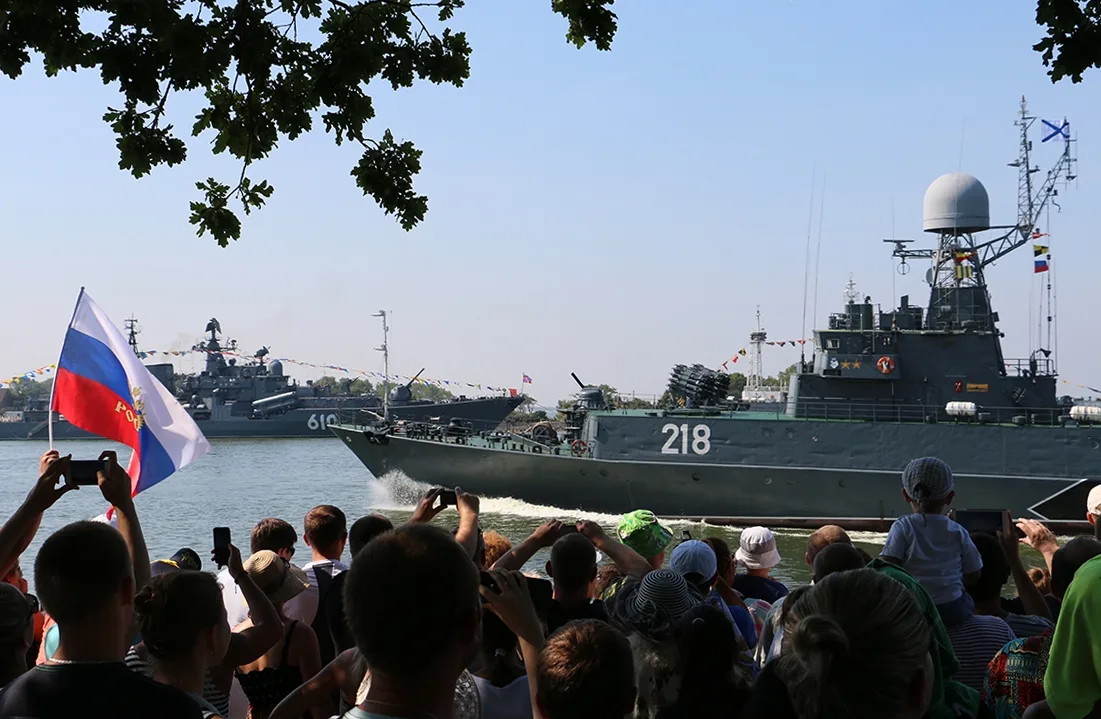
The Kaliningrad Region became part of the Baltic Military District, which was in the second strategic echelon on the main central axis of the war between NATO and the Warsaw Pact that never happened. The westernmost region of the USSR turned out to be one of the most militarised in the country. At the same time, however, the importance of the Baltic Fleet began to decline.
From the time of Peter the Great up to and including the Great Patriotic War, the country's main fleets were the Baltic and the Black Sea Fleets, while the Northern and Pacific Fleets were frankly secondary; for a long time they were not even considered fleets at all. From the 1950s the situation changed radically. The Northern and Pacific Fleets, with direct access to the open ocean, became the main ones, while the Baltic and Black Sea Fleets found themselves "in bottles whose corks are in NATO's hands", i.e. in enclosed sea basins of limited size from which breaking out in the event of war would have been difficult, to put it mildly.
As a result, most of the new equipment went to the two ocean fleets, while the two sea fleets received neither nuclear submarines nor large surface ships (with a few isolated exceptions). During the arms race of the 1970s–80s, in the event of war the role of the Baltic Fleet was limited to defending the coasts of the USSR, the GDR and Poland and carrying out tactical landings in support of advancing ground forces. The Baltic Fleet would not have been able to force the Baltic straits on its own; a far more likely scenario was the seizure of Denmark by land (if the warring sides had not already completely destroyed each other with nuclear strikes beforehand).
By the time the Warsaw Pact and then the USSR collapsed, the Baltic Fleet was very large (more than 300 units) but rather outdated. The mass decommissioning of ships in the 1990s was to a large extent justified by objective factors; the only problem was that it happened without any replacement.
The main problem, though, was geographical: the Kaliningrad Region, together with the Baltic Fleet's main base, was cut off from mainland Russia by the Baltic states. A considerable part of the basing and ship-repair facilities was lost, those that remained in the Baltic states.
One positive aspect of the Baltic states' actions was that, regarding their time as part of the USSR as illegal, they did not demand a share of the Soviet Armed Forces. Because of this their armies are still, in essence, in an embryonic state. True, Russia faced a new problem in withdrawing units of the Baltic Military District to its own territory, but it did manage to preserve them.
Nothing had to be withdrawn from the Kaliningrad Region; the local force began to be reduced on the spot. From the late 1990s all the troops in the region were placed under the commander of the Baltic Fleet (a similar measure was taken with the force at the other end of the country, in another de facto enclave – Kamchatka). In 1999 Poland, the region's neighbour, joined NATO, and five years later the Baltic states joined the alliance. This caused panic in the region; there was even the idea, shameful from every point of view, of withdrawing all troops from the region to the "mainland". Fortunately, after a while the panic more or less subsided, and outright madness was avoided.
Today it has turned out that the Baltic Fleet is, in a sense, the best-off of the country's fleets. Firstly, it is based in the calmest, most comfortable and most developed regions of the Russian Federation (compared with the other fleets). Secondly, its area of responsibility contains the main shipbuilding base of post-Soviet Russia (which is why it gets the newest and most modern ships).
Thirdly, although formally the Baltic Fleet sits in NATO's very "lair", in reality it is in its theatre of operations that the geopolitical situation is calmest, and the probability of war is, in fact, zero.
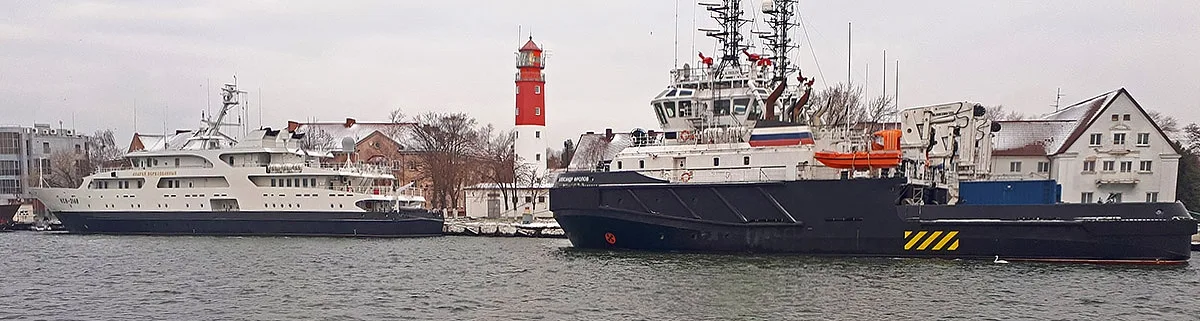
Today the Baltic Fleet lists 2 Project 877 submarines (one of them under repair), 2 Project 956 destroyers (one of them in reserve, and it is by no means certain that it can be returned to service), 2 Project 11540 patrol ships (frigates) (both under repair), 4 Project 20380 patrol ships (corvettes), 6 Project 1131M small anti-submarine ships (which, however, are based not in Baltiysk but in Kronstadt), 4 Project 1234.1 small missile ships, 7 Project 1241 missile boats of several modifications, 5 Project 1265 base minesweepers, 9 roadstead minesweepers (5 Project 10750, 4 Project 13000), 4 Project 775 large landing ships, 2 Project 12322 landing hovercraft, and 9 landing craft (3 each of Projects 1176, 11770 and 21820). The small anti-submarine ships and small missile ships are obsolete; the submarines, destroyers, missile boats and large landing ships are not particularly new, but can nevertheless serve for a long time yet. The patrol ships are among the most modern units of the Russian Navy, especially the Project 20380 corvettes, construction of which continues (although there are serious doubts as to how successful these corvettes are).
The force of ground and coastal troops in the region comprises five brigades (the 79th Motor Rifle, 152nd Missile, 244th Artillery, 336th Naval Infantry and 25th Coastal Missile) and the 7th Motor Rifle Regiment. Their equipment includes 12 Tochka-U tactical missile launchers (soon to be replaced by Iskander operational-tactical missiles), 4 Redut coastal anti-ship missile launchers (to be replaced, presumably, by Bastion), 41 T-72 tanks, 208 BMP-2 infantry fighting vehicles, 134 BTR-82A armoured personnel carriers, 59 MT-LBs, 22 2S9 and 2S23 Nona self-propelled guns, 18 2S1 Gvozdika, 18 2S3 Akatsiya, 36 towed 2A36 guns, 12 2B16, 24 2S12 mortars, 36 BM-21 Grad multiple rocket launchers, 6 Strela-10 short-range surface-to-air missile systems, 15 Tunguska gun-missile air defence systems and 9 Shilka self-propelled anti-aircraft guns.
Ground-based air defence in the region comprises the 22nd (32 Tor surface-to-air missile systems), 183rd (1 battalion of S-300PS, 2 battalions of S-400, with 8–12 launchers per battalion) and 1545th (6 battalions, 36 S-300V launchers) anti-aircraft missile regiments.
The air component is combined in the 72nd Air Base, which comprises 12 Su-24 frontline bombers, 12 Su-27 fighters, 6 An-24, An-26 and An-140 transport aircraft, 12 Mi-24P and Mi-35M attack helicopters, 8 Mi-8 multi-role helicopters and 14 Ka-27, Ka-29 and Ka-32 naval helicopters.
A special word is needed about the Iskanders. The ground forces of the Russian Armed Forces have 11 missile brigades that were equipped with Tochka-U tactical missiles. These missiles are obsolete, as sooner or later any weapon becomes. They are being replaced with Iskander operational-tactical missiles, and this replacement naturally has to cover all 11 brigades; seven of them have been re-equipped so far. Eventually the re-equipment must also reach the 152nd Missile Brigade stationed in the Kaliningrad Region. In this light, both NATO's hysterics — "Iskanders must not be deployed in the Kaliningrad Region!" — and Moscow's menacing statements that it "reserves the right to deploy Iskanders in the Kaliningrad Region in response to the deployment of missile defence in Poland" sound strange, to put it mildly. Russia has every right to deploy Iskanders in the Kaliningrad Region; moreover, it is a natural process of re-equipment that has nothing whatsoever to do with any missile defence.
Translated from Russian with the help of AI (Claude, Anthropic), October 2026.