
Exactly what plant the king brought back from his distant travels is not specified. Most likely it was the bean, which was – and still is – considered one of the most popular vegetable crops in the world.
In East Prussia, too, it put down strong roots in its day and flourished for a long time. The crop proved undemanding as regards weather and soil, easy to cultivate, and gave astonishingly large yields. Lentils and peas were no less loved than beans. Growing legumes played an important part in feeding the population of East Prussia.
Legume dishes added variety to the local diet. They were used to make everything – from soups to patties and salads – and served both as dishes in their own right and as an addition to side dishes. And although there are a great many ways of cooking legumes, East Prussian housewives brought their own national touch to them: smoked bacon or smoked fatback gave them a special aroma.
Beans with Sour Cream
750 g young bean pods, 300 g smoked bacon, 500 g potatoes, 1 cup (1/8 l) buttermilk, 1 cup sour cream (30%), a sprig of savory, 1 tbsp butter.
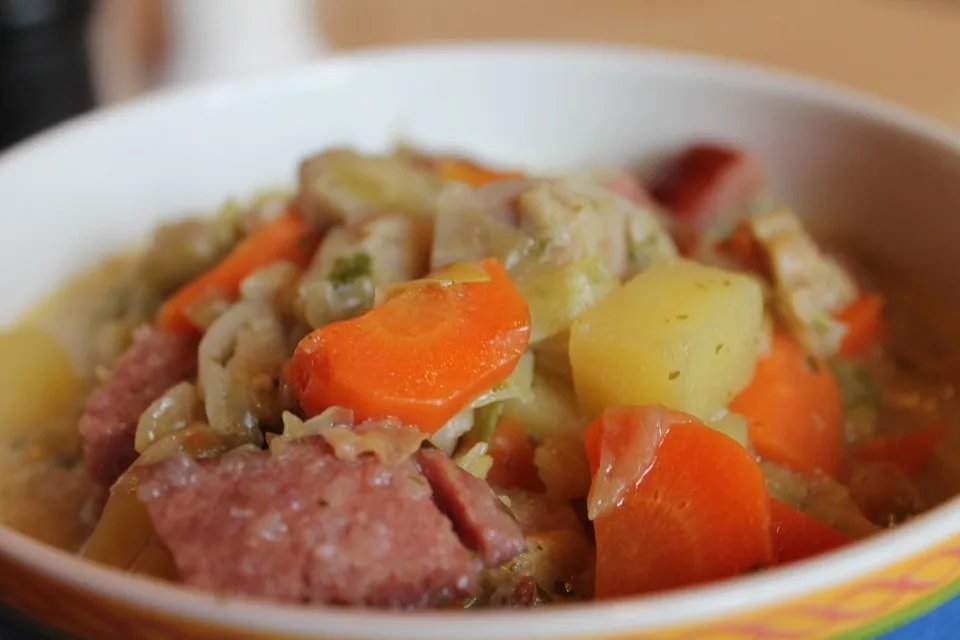
Chop the bean pods finely and put them in a sauté pan together with the savory and the piece of bacon, cover with boiling water and cook for 25 minutes, then add the diced potatoes. When the dish is ready, add one finely grated potato, the buttermilk, the sour cream, a pinch of sugar and the butter. Take the bacon out of the pan, cut it into small pieces and return it to the pan. If you like, this dish can also be made with boiled sausage and carrots.
Green Beans with Vegetables
500 g green bean pods, a sprig of savory, 1 cup (1/8 l) vegetable stock, 2 tbsp butter, 1 tbsp flour, 125 g sour cream (30%), salt and sugar to taste.
Wash the bean pods, cut them into pieces, put them in a sauté pan and add just enough water to barely cover them. Add the savory, bring to the boil and cook for 20 minutes. Then strain off the stock and set it aside for a while. Make a roux from the butter and flour, pour in a cup of the vegetable stock and mix everything with the sour cream. Dress the beans with this sauce, braise briefly, stirring often, and add salt and sugar.
Mock Goulash
375 g green bean pods, 2 onions, 2 tbsp fat (or butter), 500 g tomatoes, salt, sugar and sweet paprika to taste, 125 g sour cream, vegetable stock as needed, 1 tbsp chopped parsley.
Cut up the bean pods, put them in a saucepan and add just enough water to barely cover them. Cook for 20–30 minutes. Lightly fry the finely chopped onion in a sauté pan and add the tomatoes, peeled and cut into small pieces. Salt well. Season with pepper and braise briefly. Drain the cooked beans in a colander (keep the cooking liquid) and mix them with the tomato and onion mixture. Braise a little longer, then add the sour cream, sugar and, if needed, some of the stock. Sprinkled with chopped parsley, this goulash was usually served with boiled potatoes.
Broad Beans
750 g young broad beans, 250 g smoked bacon, 2 tbsp butter, 1 tbsp flour, 2 cups stock, savory to taste, 1 tbsp chopped parsley.
Cover the young beans and the piece of smoked bacon with stock and cook for 30 minutes. Lightly fry the butter with the flour, dilute with two cups of stock, season with salt and add a pinch of sugar. Pour this sauce over the cooked beans and the bacon cut into small pieces, sprinkle with parsley and serve with boiled potatoes.
White Bean or Pea Purée
625 g dried beans or dried peas, a little meat stock or water, marjoram, 1 small onion, salt and pepper to taste, 40 g butter, 1 chopped onion.
Cook the soaked beans or peas together with the onion and marjoram until tender, rub them through a sieve, return to the heat and cook the purée over a low heat, stirring constantly. If it is very thick, add a little stock, and season with salt and pepper. Pile the finished purée in a mound on a platter, make a hollow in the middle and fill it with onion fried in smoked fatback. This dish was usually served with braised sauerkraut, fried potatoes, salt pork or fried bacon.
If any purée was left over for the next day, it was successfully "revived": it was put into a baking dish, 2 chopped onions were fried in 60 g of butter and spread over the top, sprinkled with breadcrumbs – and into the oven it went.
Westphalian Blind Hen
250 g white beans, 1 l water, 250 g smoked fatback or bacon, 1 onion, 250 g green bean pods, 250 g carrots, 250 g potatoes, 2 apples, 2–3 pears, a little marjoram, salt and sugar to taste.
Cook the beans for an hour to an hour and a half in the water in which they were soaked. Dice the fatback, brown it together with the chopped onion and add it to the beans, followed by the finely chopped carrots, potatoes and bean pods. About 15 minutes before the end, add the marjoram, the chopped fruit, salt and a pinch of sugar.
Bean, Pea or Lentil Patties
250 g beans, peas or lentils, water as needed, salt to taste, bicarbonate of soda on the tip of a knife, 1–2 eggs, 2 tbsp butter, 1 small onion, 2 tbsp breadcrumbs, 100 g fat, a mixture of flour and breadcrumbs for coating.
Cook the prepared beans (peas, lentils) until soft in a small amount of water, rub them through a sieve and leave to cool. Fry the onion in butter and mix it with the purée, eggs and breadcrumbs, and season with salt. Shape the mixture into 6–8 patties, coat them in the breadcrumb and flour mixture and fry. Make a sauce from the stock and butter. Braised (boiled) vegetables or a salad were usually served on the side.
Bean Salad
750 g bean pods, 2–3 tbsp vinegar with two to three tbsp water, 1 finely chopped onion, salt and sugar to taste, 2 tbsp vegetable oil, chopped parsley.
Cut the cooked bean pods into pieces and mix them with the ingredients listed in the recipe.
Lentil Soup with Prunes
250 g lentils, 1 l water, soup greens, 250 g dried prunes, salt to taste, 250 g black pudding.
Soak the lentils for a whole day and cook them in the same water with the soup greens for about 30 minutes. Then add the softened prunes and the black pudding and simmer for another 30 minutes. At the end of cooking, season the soup with salt, add a pinch of sugar and a splash of vinegar.
"Beans" is a general term. Besides beans, peas, lentils and broad beans, there is a whole host of other legumes. Among them are grass peas, chickpeas, peanuts and cocoa beans, as well as fodder crops – lucerne, lupin, clover… It is a known fact that the Prussian kings took great care over the fertility of the soil. In 1784 Frederick II even issued a decree ordering lupins to be grown as green manure.
Legumes are an integral part of many national cuisines – Mexican, Indian, Georgian, Chinese… In ancient times their seeds, which were regarded as the "food of the gods", were treated with respect and reverence. Bean dishes, for example, were offered as gifts because they were valued as especially filling and tasty. Incidentally, archaeologists have found fossilised beans in excavated Aztec and Maya burials. According to historians, however, the bean appeared even earlier – and not in South America, as was commonly thought, but in the East, presumably in India or China.
As for peas, they were already known in the Stone Age. The Chinese revered this crop and considered it a symbol of wealth and fertility. In Greece peas were thought of as poor man's food, while in France they were served at royal banquets. For the Slavs, peas were one of the most important ritual attributes. There was a custom of showering the bride and groom with peas as they came out of church. However many peas got caught in the folds of the bride's dress, that was how many children the couple would have.
Lentils enjoyed great honour and respect: in Ancient Egypt they were the basis for baking bread. The Romans and Greeks used them to make medicinal tinctures. And in Rus a famous Christmas porridge was cooked from lentils. It was eaten on Christmas Eve to bring wealth into the home. Among the ancient Romans and Greeks lentils had a reputation as a medicinal plant. Lentil broth was used to treat stomach ailments. It was also believed that lentil dishes helped people keep their wits into deep old age and stay calm even in the most difficult situations.
The soybean is considered the oldest legume on earth. It reached France from China to be sown experimentally in a botanical garden. Thus began its "gastronomic tour" of Europe. At first soybeans were eaten roasted. Their use as an additive in many foods and as the basis for sauces came much later.
Sources:
Alte Familienrezepte aus Ostpreußen. H. Saul.
Doennigs Kochbuch.
Rezepte aus der guten ostpreußischen Küche. M. Haslinger, R.M. Wagner.
Spezialitaeten aus Ostpreußen. M.Lindt.
Translated from Russian with the help of AI (Claude, Anthropic), October 2026.