Today it would be a perfectly ordinary fantasy plot: ruins, material traces of bygone times, large artefacts and personal belongings whose purpose you try to guess, and advertising posters too. On Kashtanovaya Alley in Kaliningrad an enamel advertising sign for Persil has survived to this day. Now any housewife knows that it is an ordinary washing powder, but in the era of developed socialism, when household soap was in short supply, it was something mysterious and very, very old. Though there were also the "initiated": sailors who called at foreign ports and military men who had served in what were then socialist countries. Their children were filled with self-importance at being party to the secret.
But the local boys always stood out — they climbed around the ruins looking for all sorts of things, not always harmless, but always mysterious. In every home there was some object recalling the history of this land: a picture, a plate, a tool. Often it was the house itself, or what the settlers had "inherited" — furniture or some belongings. The boys who came to the region quickly joined this underground and likewise acquired their own material token of history. Very often these were ceramic beer-bottle stoppers, coins or military insignia. All of it was either traded, dug up, or hunted out in the houses that were slated for demolition.
Digging, and all the other kinds of looting, deserve a story of their own.
In the first years the region served as a source of building materials. That is, first the ruins were dismantled, and then entire houses. The bricks were sent to Moscow and Leningrad.
So the state itself was not above it back then... Naturally, the region's new inhabitants also wanted to cash in on its opportunities. The problem of perfectly serviceable objects and pieces of urban infrastructure being handed in as scrap metal arose, if the stories of the first settlers are to be believed, the moment they appeared on this land. A man whose youth fell in the early 1960s recounted that he and his peers earned money by handing in lead sewer pipes and all sorts of non-ferrous metal items. Rumour had it that the original monument to Kant also vanished in the depths of Vtortsvetmet.
The boys rarely made digging a source of income; rather, this part of life was a source of adventure, and also a chance to touch a mystery. In all the books, newspapers and magazines the history of the region began in 1945. Even now journalists sometimes let slip the "liberation" of Königsberg in April. It is simply that everyone has settled into the city so deeply, and it has become so much their own, that this feeling of it being "ours" has, as they say, soaked into the blood.
In the Soviet Union, the Kaliningrad region played the role of a mixer, blending people together. Even now it is hard to find a native Kaliningrader. There are no family trees here with roots going back centuries. The history of our society begins in 1946.
New batches of people kept arriving and still keep arriving. The sea needed fishermen, the fleet was growing. Sailors caught fish, called at exotic countries, brought back all sorts of curiosities. Today it is impossible to understand what chewing gum meant back then, when it became a subject of discussion and condemnation at Komsomol meetings. Jeans and trainers, practically a sailor's uniform, looked like symbols of prosperity and success. In terms of clothing, whatever stood out from the dreary grey mass was commonplace in our city.
Another travelling group was the military. They came and went. The military's geography ran through every hot spot, and many finished their service in the region after the socialist countries. And judging by the fact that some of them tried to stay here in retirement, they considered the region a good place to live. But it all began with the settlers, who were given a flat or a house, sometimes while the former owners were still there. Everything was left to them. Some of the settlers, brought from areas badly damaged by the war — and these were rural areas — encountered for the first time a level of housing comfort that included running water and sewerage.
Signs of a vanished civilisation can still be found in the city today.
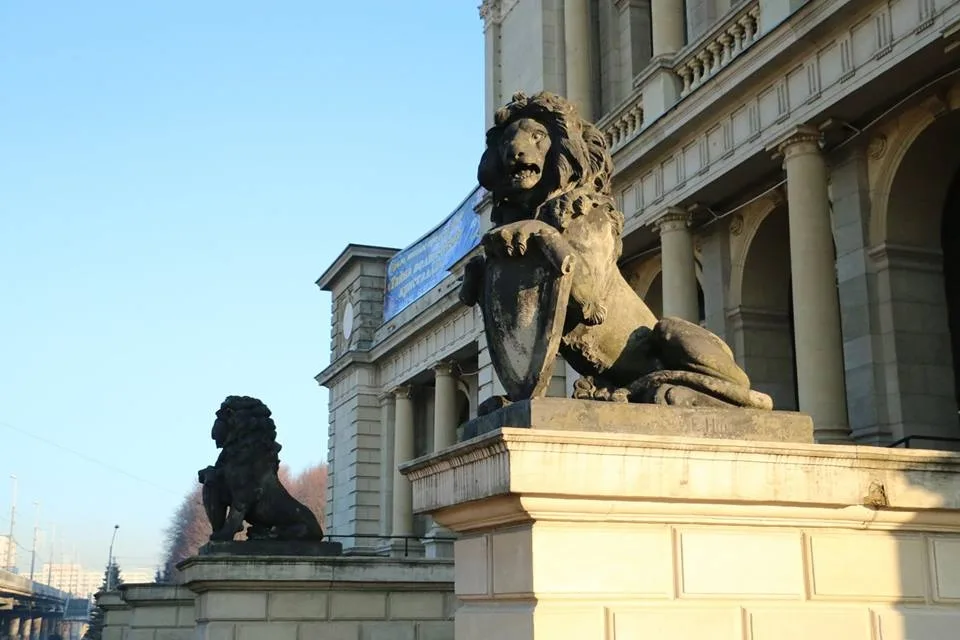
There are fire hydrants and manhole covers with German inscriptions. And it is not very surprising that water-main covers are marked H, from the word Hydro. A few fire pumps remain, which are no longer utilitarian objects but small architectural forms. Paving setts are another element of material culture characteristic of our region. If you pay attention, there are not actually that many proper setts. Setts are a sign of a city's wealth. Much more common is rubble stone, and it may have lain on the road since the days of the Order. People lived here prosperously, but not richly. They simply saved up their wealth and increased it. There are houses whose entrances are decorated with sculptures and whose landings are laid with patterned ceramic tiles. These are not mansions but old apartment buildings. Probably it was this sense of belonging to another civilisation, reinforced by a great number of artefacts, that made the region's inhabitants stand out from the mass of "Soviet people".
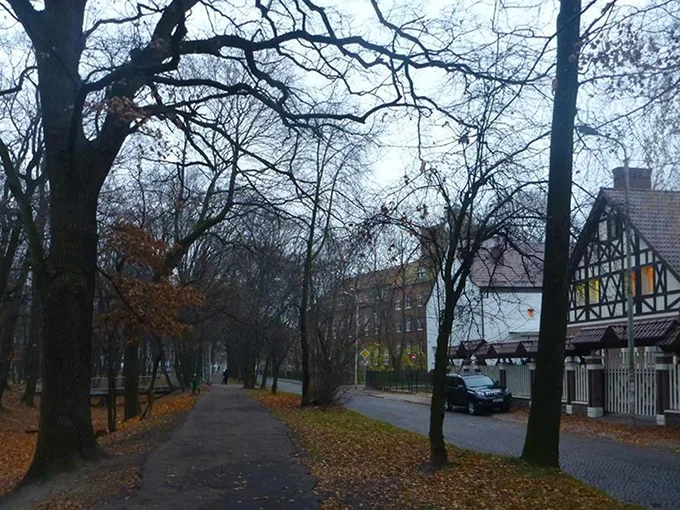
I don't know why, but after East Prussia turned into the Kaliningrad region, parks were preferably laid out on cemeteries. Kalinin Park in Kaliningrad, the park in Gusev. Old trees — for some reason most often maples — created a mysterious atmosphere. Or perhaps the maples stuck in the memory as a picture of golden autumn. You know, when there is a kind of raw chill in the air, but neither rain nor wind. And only here and there a yellow or red leaf sadly glides down from a tree like a forgotten parachutist.
The square pits of graves that surprised no one — dug up by looters, or stripped of their granite slabs by the notorious "strong managers" for important economic needs.
Then again, what difference does it make what these people were called. The subject of plundered German cemeteries surfaced during the repair of the monument to the leader of the world proletariat in Kaliningrad. Restorers discovered that part of the facing of the bronze Lenin's pedestal consisted of gravestones stolen for the needs of the Party from the graves of people who had once lived on this land.
Perhaps that is why the parks of the Kaliningrad region, their layout and vegetation, had an unhurried rhythm. A rhythm suited not so much to entertainment as to reflection. The little avenues were good for an unhurried stroll and a quiet conversation.
Over time the trees grew decrepit and began to be replaced by new plantings. The charm and mystery of these places were lost. Generations changed, it was gradually forgotten that these had been cemeteries, and new buildings began to encroach on the parks.
Of course, the world has changed, and the Kaliningrad region, once closed to foreigners, now lies inside the territory of the European Union. Many things have become available. Online shopping lets you choose what you want rather than what the shops impose on you. The urban environment is changing too, gradually becoming somehow uniform and faceless. A new, averaged-out standard is taking shape. And that is why you begin to value all the more the little that remains of the past. Hence the Kaliningraders' desire to preserve the paving setts — connected not so much with an unwillingness to change the material environment as with a desire to preserve the spirit of the city, the visible signs of its (and their own!) distinctiveness. And in this the region's inhabitants are no different from the inhabitants of any other region.
Everyone wants to preserve their uniqueness (their identity!), whatever will set Kaliningrad apart from the ranks of typical Russian cities with their standard housing designs, and make Kaliningraders unlike the inhabitants of other cities and regions.
Of course, all sorts of people live in our region. But the active part of the population wants to live in its own way, to be non-standard, better informed, more relaxed, freer. The foundation of such behaviour, it seems to me, lies in that very past, which influences the present through the surviving examples of material culture — in other words, being shapes consciousness.
Translated from Russian with the help of AI (Claude, Anthropic), October 2026.