The first part of the word Bönhasen (depending on the dialect — Bön, Böhn, Boden) denoted the garret floor (in Russian, the "cherdak", the attic), where an unlicensed craftsman or, more rarely, a master expelled from the guild plied his trade, thereby breaking the municipal regulations. The second part — Hase (hare) — referred to the almost hare-like nimbleness of these unlicensed workers when fleeing their pursuers, which had become proverbial; the pursuers might be either representatives of the authorities or members of the official guilds.
If the eaves of the house where the "hare" worked faced the street (most streets in old European towns were very narrow — their roofs often almost touched one another), the poor fellow could escape from unwelcome visitors by running through the attics and jumping from roof to roof…
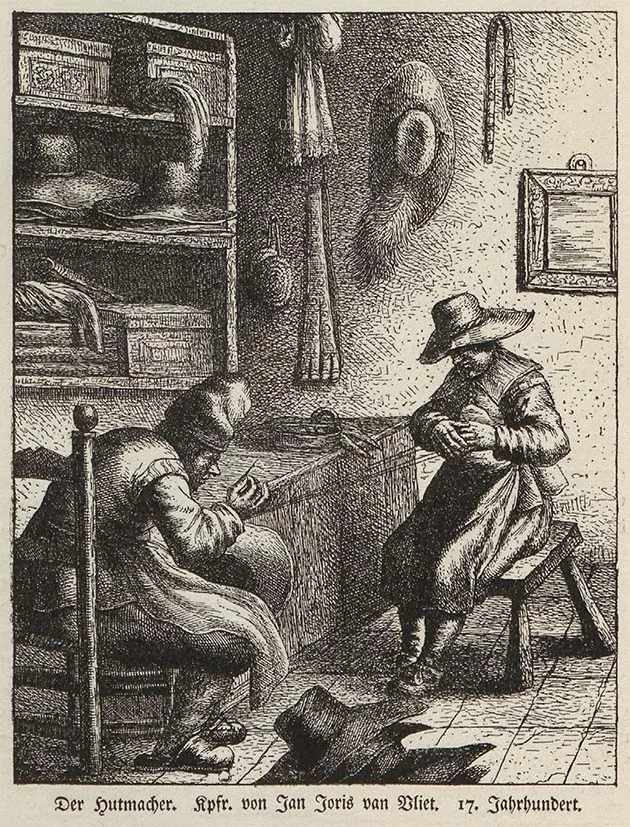
Because there was no quality control and the working conditions in the half-dark garrets were poor, the goods produced by "attic hares" often left much to be desired, so popular opinion held that Bönhasen were clumsy, unskilled botchers.
In some North German towns of the 17th–18th centuries, the duty to prosecute such unlicensed workers was written into the statutes of the Chamber of Commerce (Krameramt).
Very often the nickname stuck to tailors, since all they needed to fulfil orders was a box of sewing things and cloth, and in former times they worked mostly at home. "Attic hares" was also a frequent name for unlicensed "advocates" who helped conclude deals without any legal basis.
Butchers had their own unlicensed workers too. They were called Gassenschlächter, or Bückser — "alley butchers". These fellows hired themselves out at a reasonable price for so-called "home slaughtering". Their earnings were very good, as numerous records have survived showing that journeymen of the butchers' guild who for some reason had grown tired of working for their masters went off to become "street butchers".
The guilds gave their members access to scarce raw materials while curbing the appetites of unofficial craftsmen. Thus, in the guild of amber workers, journeymen were not allowed to take on outside orders for amber goods or even to buy amber on their own.
A journeyman could usually become a member of a guild only by marrying a master's daughter. Other conditions for admission to the guilds of North German towns were: possession of capital, high social standing, a respectable way of life, birth to parents in lawful wedlock, and the making of quality pieces under the supervision of a senior master.
Telling in this respect is the story of the 17th-century German painter Hans von Hembsen (late 16th century, Lübeck – 1673, Reval). After moving to Reval he worked there together with his assistant Hans Deters. In 1637 Hembsen lodged a complaint with the local council against the town's guild masters: they claimed that, being a "foreigner", Hembsen was depriving local masters of their honest earnings and their daily bread by selling his works privately: "he intends to do harm to our guild and deprive us of our livelihood". Hembsen, for his part, declared that the guild was persecuting him and his journeyman as "attic hares" and asked for protection for himself as a free artist against the arbitrariness of the official town painters. (It is known that Hembsen did not succeed and died in poverty…)
● Editor's note: Read on VisitPrussia.com an interview with the translator of German and, in particular, Prussian fairy tales, our regular contributor Tatyana Kolivay, who runs her own blog, where countless other parables, legends and fairy tales in her translations have been published.
Translated from Russian with the help of AI (Claude, Anthropic), October 2026.