One of the most remarkable gardens of Königsberg was the university garden. Its history began in 1809, when a chair of botany and the post of professor of botany were established at the medical faculty of the Albertina university. A young physician and botanist, Doctor of Medicine Friedrich Schweigger, was given the task of creating a botanical garden.
Once a typical medieval town, densely built up, with defences on its outskirts and surrounded by a rampart and moat, Königsberg had almost no greenery.
The first gardens appeared in the 16th century thanks to the interest of wealthy people in landscaping their private grounds1.
What really changed the face of Königsberg, however, was the founding in 1875 of the Society for the Greening of the City, whose moving spirit was the physician Friedrich Kessel. The society's activists restored old neglected parks and planted new trees in the city's streets, having first made an inventory of all its green spaces. Königsberg's transformation into a garden city was also helped by a change in the nature of urban planning at that time: the old defensive belt had lost its military significance, and the expansion of the city made it possible to plan new parks, avenues, ponds, public gardens, flower beds and gardens beside houses.
An important milestone in these landscape changes was the creation of the first university botanical garden. Its history began when the war councillor and poet Johann George Scheffner bought a house with a neglected garden in the north-western part of the city in 1796. Having laid out a formal park on the site, he sold the property to King Frederick William III, who a few years later in turn presented the estate to the Albertina, the university of Königsberg. At the same time, in 1809, a chair of botany and the post of professor of botany were established at the university's medical faculty.
The task of founding the first university botanical garden was entrusted to a young botanist and zoologist, Doctor of Medicine August Friedrich Schweigger. He enlarged the botanical garden by annexing neighbouring land and increased the range of plant species. By 1818 the garden covered 6 hectares.
Four greenhouses and a gardener's cottage were built at the same time. Combining his work at the department with expeditions, Schweigger was killed2 on one of his journeys. To this day, on a rise in the garden surrounded by old limes and beeches, there stands a monument erected by friends in memory of the young scientist, with a German inscription that translates as: "To the memory of August, founder of the gardens, a man of special merit, dedicated by his friends. 1824."
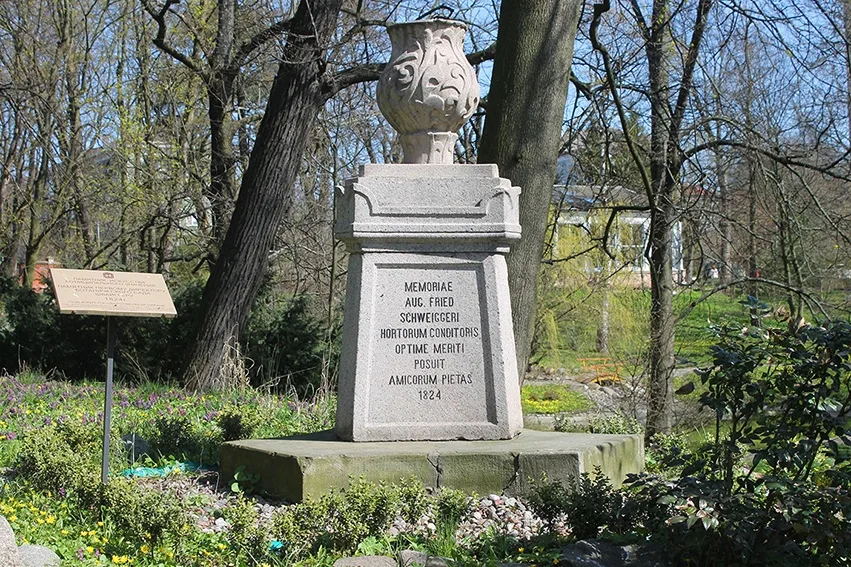 Monument to August Friedrich Schweigger.
At first there was no particular system in the planting, but it was soon decided to draw up an annual list of plants that had to be purchased, and plants began to be laid out in strict order. Each successive director of the university garden made his own contribution to improving its appearance. Under Professor Robert Caspary, for instance, the Königsberg University Botanical Garden expanded still further, and a conservatory3 was built for tropical and subtropical plants. Later a pond with a small island and a fountain appeared in the garden's landscape, greatly adorning it, and pharmacological and chemical laboratories were built.
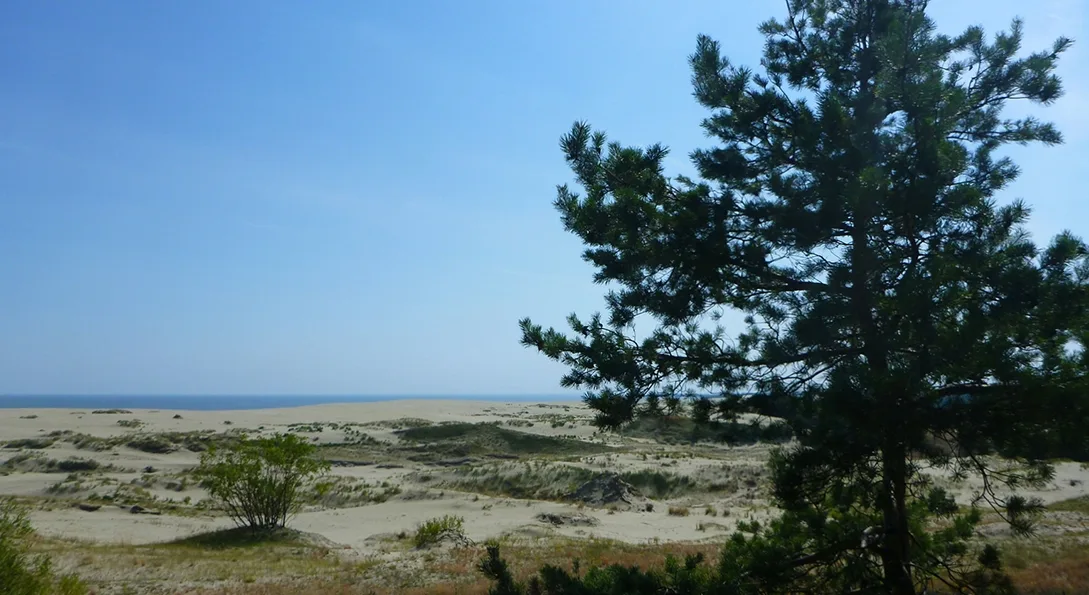
Used not only for townspeople's recreation but first and foremost as a research base, the garden acquired new features under Dr Carl Christian Mez4: an alpine garden appeared, resembling a mountain landscape, where plants typical of the mountain regions of America and Europe were planted among artificial rocks. An artificial bog appeared near the pond, with the moisture-loving plants characteristic of such a landscape. But most astonishing of all, sand dunes were recreated in the garden's landscape.
Introduced plants brought back from expeditions or obtained through exchange settled in the garden for a long time, since excellent care and the favourable Prussian climate encouraged the growth and development of exotics such as ginkgo, katsura, Caucasian wingnut, Japanese walnut and others.
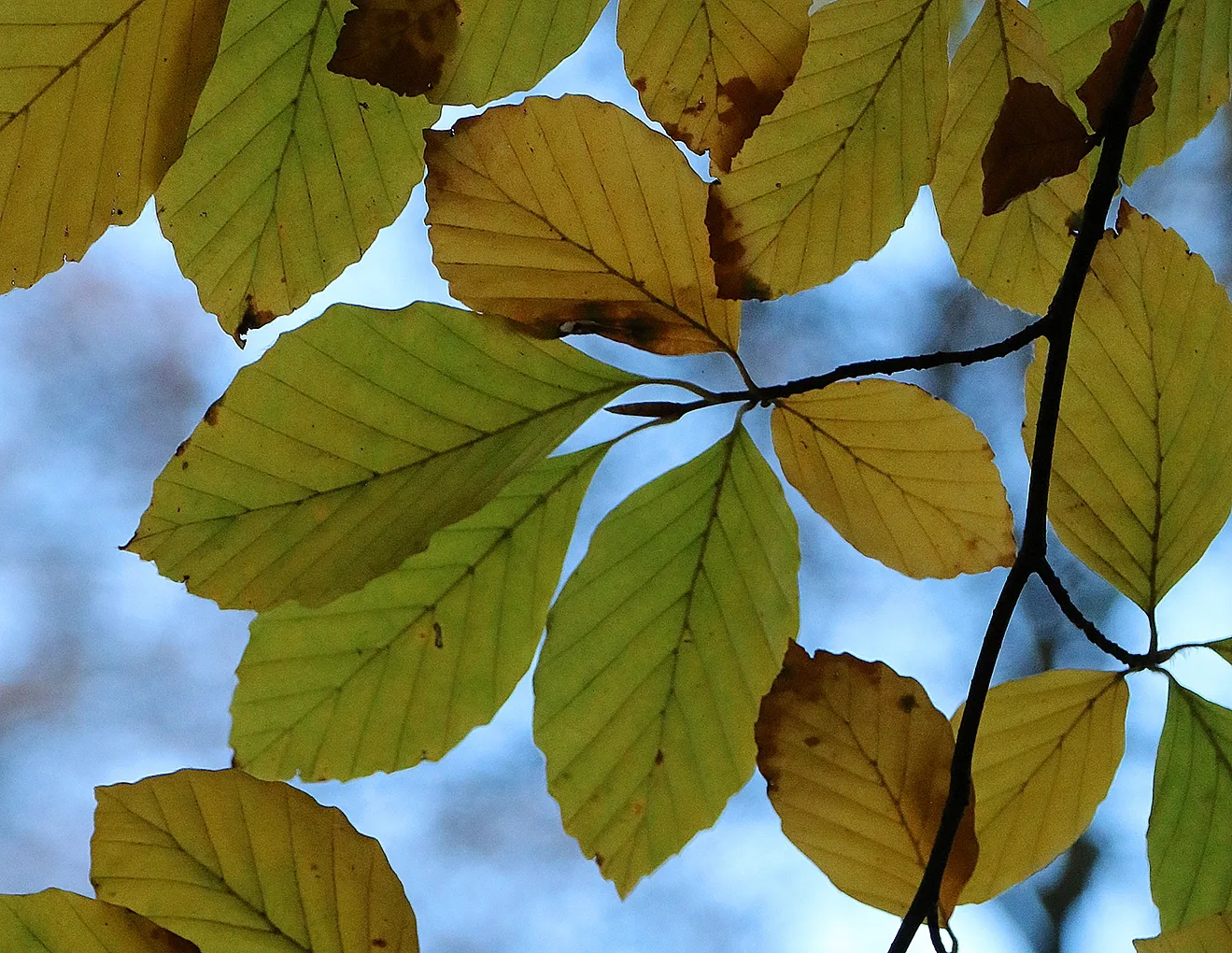
Specimens of native European beech and small-leaved lime, which had been growing here even before the garden was founded, also fitted beautifully into the landscape. The garden's greenhouse plants, represented by various species of palms, cacti and other succulents, flowered and bore fruit. Thanks to the efforts of its scientists, the Königsberg University Botanical Garden became one of the best in Europe, a fine example of the talented realisation of the ideas of landscape architecture.
The war changed the university garden beyond recognition: the botanical institute, the chemical and pharmaceutical laboratory and the zoological institute with its museum were destroyed. The hostilities hit the greenhouse plants hardest, and the garden itself was left without proper care for some time and fell into neglect. In 1951 the grounds of the former university garden were handed over to the Regional Young Naturalists' Station. Thus began the gradual restoration of the garden. Today it houses the Kaliningrad Regional Children's and Youth Centre for Ecology, Local History and Tourism. Through the joint efforts of the garden staff and the children, the natural character and cleanliness of this beautiful corner of living nature within the city limits are being preserved.
In 1965 the park was declared a natural monument; it is of great scientific and historical value5. Today it covers 3 hectares. It is an arboretum in the landscape style with a pond in the centre. The total number of species is about 50.
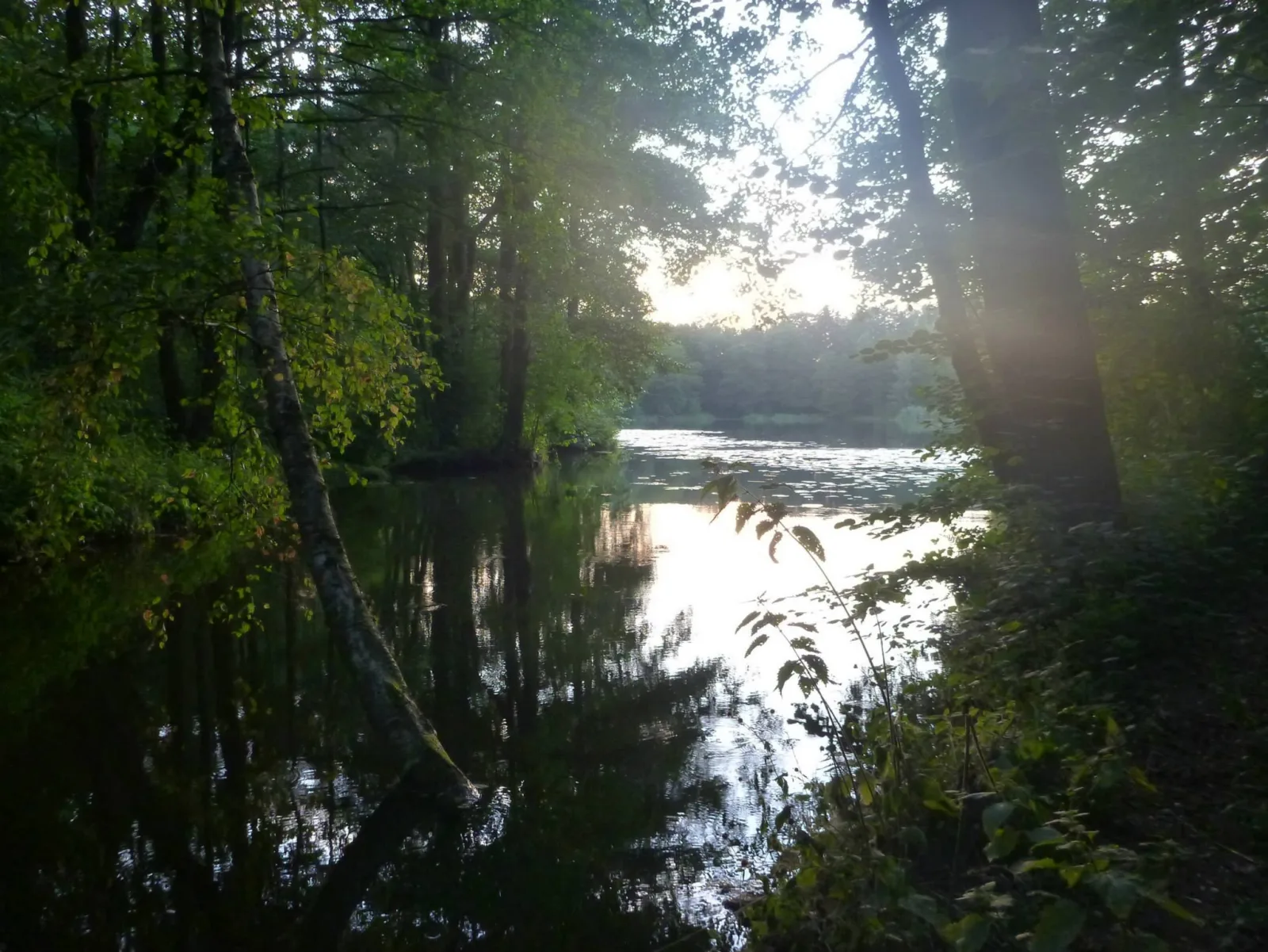
To see how beautiful the garden is, come on a sunny spring day. In some parts trees and shrubs grow densely, but there are also large open areas where in mid-spring the ephemeroids bloom: lilac and white bird-in-a-bush corydalis, blue squills, glory-of-the-snow. Lesser celandine covers the whole garden in a thick carpet; its golden flowers look especially beautiful by the pond, in the middle of which a weeping willow grows on a small island. At this time the first leaves are only just beginning to appear on the trees: the lacy leaves of the staghorn sumac are still delicate as spring, and the katsura is strewn with small round pinkish-red leaves. The main ornament of the garden at this time of year, as in the cold winter months, is its conifers, among them one that is rare in our region: the Oriental arborvitae (formerly called Oriental thuja), a native of the Far East. In Buddhist philosophy this plant symbolises long life and inexhaustible energy, which is probably linked to the tree's longevity and to its keeping its bright green colour in all conditions, even unfavourable ones. The grounds of the eco-centre also have specimens of common yew, European larch, eastern white pine, black pine, Douglas fir and others.
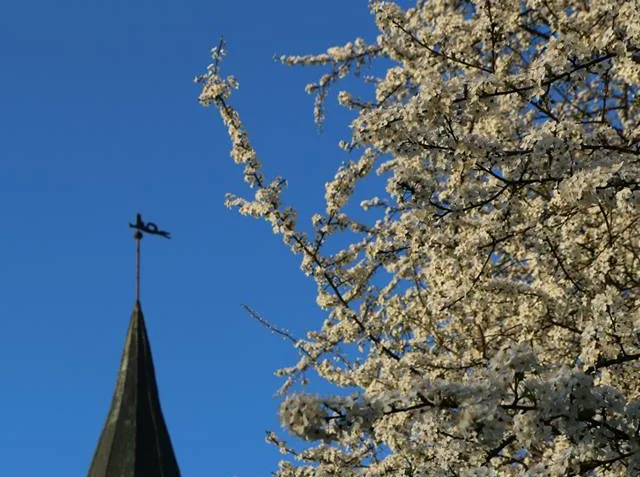
At the end of April bright spring accents are provided by the flowering of forsythia and Nanking cherry: a beautifully shaped small tree of this ornamental cherry is skilfully set into the landscape, so that its blossom can be admired from various points. Nanking cherry is grown mainly for its impressive early blossom, but it does produce perfectly edible fruit, provided several specimens of the species are planted nearby. The flowering of shrubs continues in late spring and early summer with Amur lilac and Hungarian lilac, as well as false indigo. At the same time the rhododendrons bloom, various cultivars and species of which are gathered on a small plot near the gazebo.
Old ginkgo trees adorn the part of the garden that, unfortunately, the city authorities allotted to a heating main, which runs right over the roots of these remarkable plants. It is worth looking out for the cutleaf form of the grey alder and the cut-leaved form of elder.
Plants with lacy, deeply cut leaves are a hallmark of the region's flora: cutleaf European beeches growing in the Kaliningrad Botanical Garden and near Tsentralny Park, a cutleaf lime in Moritz Becker Park in the village of Yantarny, and cutleaf forms of maple can also be found in Kaliningrad.
Rare plant species are gathered under the roof of the eco-centre's arboretum, which has few visitors mainly because the city's main botanical garden at present is the IKBFU Botanical Garden, the former Königsberg municipal horticultural garden founded in 1904 by Professor Paul Kaeber.
Address of the landscape park: 2 Botanicheskaya St.
Photos: Mikhail Ogorodnikov, Natalya Andreyeva.
___________
1. Next to every wealthy house there was a garden for spending the summer. In the 18th century these gardens began to be donated to Königsberg. Thus the following became city property: the Royal Garden (the square near today's Universitetskaya St.), the People's Garden (the Eco-centre garden), Münzplatz (the southern end of the Lower Pond), and the eastern section of the promenade along the Castle (Lower) Pond. In the suburbs: Luisenwahl park, Walter-Simon-Platz (Baltika stadium) and the Zoo.
2. During an expedition to Sicily in 1821, the 38-year-old August Friedrich Schweigger was murdered by his guide.
3. In the garden's greenhouses fan palms and date palms, as well as various cacti, flowered and fruited every year.
4. Carl Christian Mez was a well-known German botanist who wrote a fundamental monograph on the bromeliads.
5. The ginkgo, listed in the international Red List, fruits here regularly. Among plants in the Red Book of Russia: Japanese walnut, Virginia creeper, Hungarian lilac. From the Red Book of the Baltic region: European beech. Rare exotic plants: katsura, Amur cork tree, Zvyagintsev's lilac, Kentucky coffeetree, eastern white pine. Rare ornamental tree forms: one-leaved locust, silver maple and its cutleaf form.
Translated from Russian with the help of AI (Claude, Anthropic), October 2026.