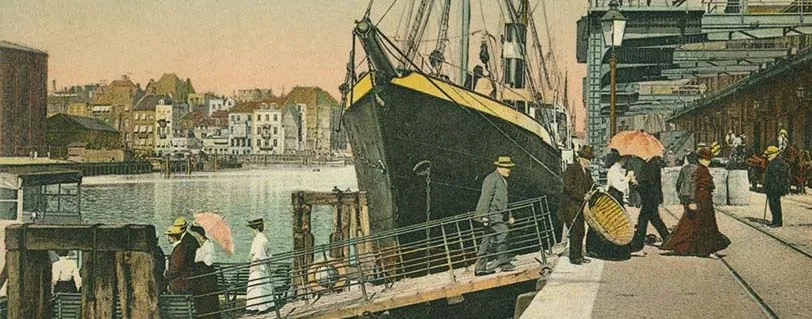
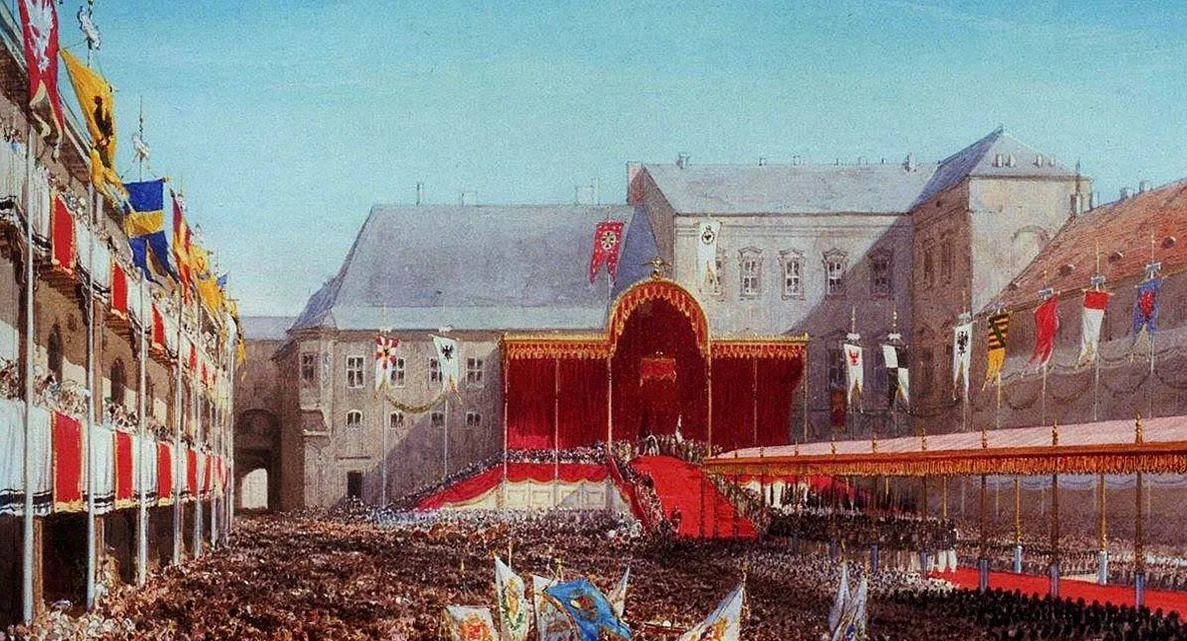
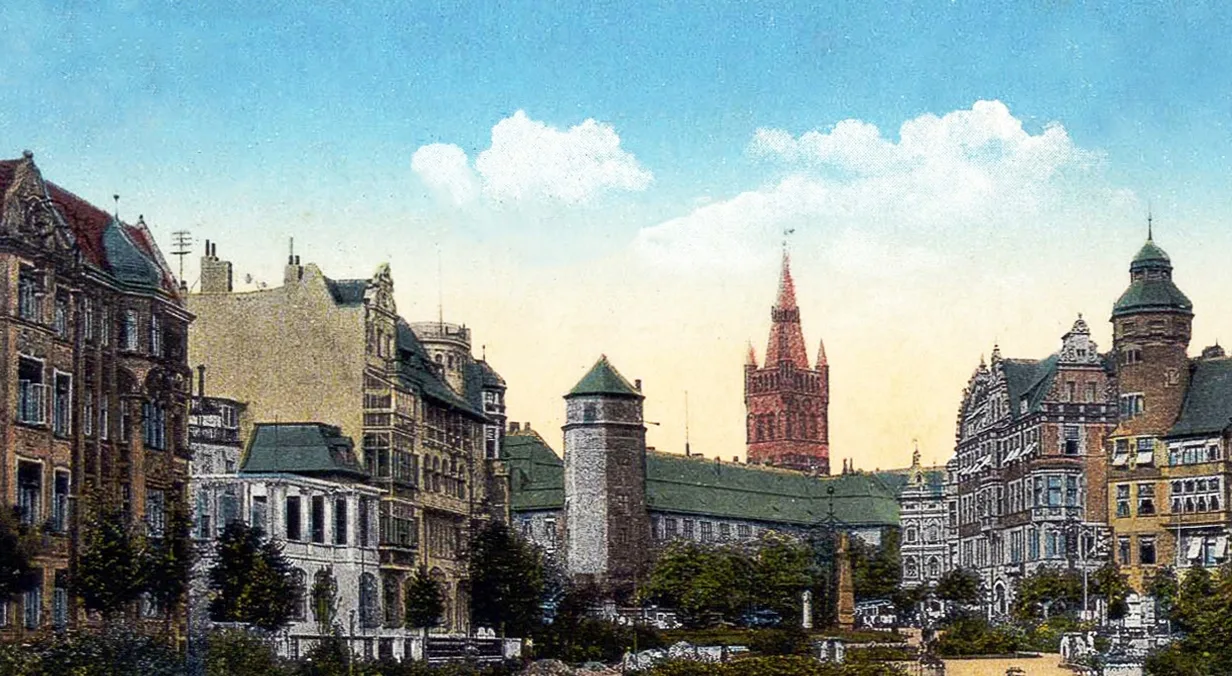
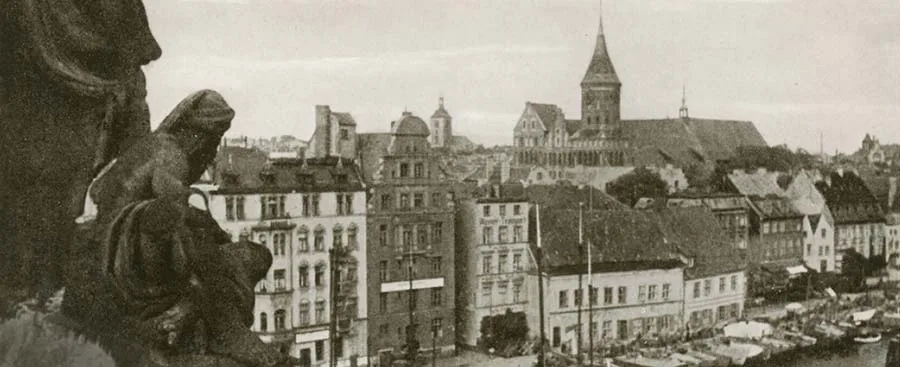
So what happened? What happened is this: the city authorities have ordered a major reconstruction of two of the three surviving Königsberg bridges. So major that absolutely nothing will be left of the bridges. The design documentation states in black and white: "demolition of a linear structure — bridge over the Pregolya River". And so it says twice, in each of the projects.
The bridge spans, piers and railings will be dismantled. Even the old, disused piers of the High Bridge, which have stood for almost 500 years, will be removed. It is true that they promise to mount the old railings on the new Wood Bridge, but most likely they will be replaced by newly made stamped copies.
This is not in the project, but it follows from conversations with a representative of the design firm. The bridges will become wider, will be positioned somewhat differently and will look nothing like the originals. Such bridges could adorn many cities of our Motherland, but as replacements for historic bridges they are like the Fishing Village set against the Cathedral. Then again, some tourists like the Fishing Village very much.
How did it all begin?
There were many bridges in Königsberg, but it was precisely seven of them that were known all over the world, and it was these that were known as "the bridges of Königsberg". They were built in different years.
First to be built was the Shop Bridge (German: Krämerbrücke), in the very year when the settlement on the south side of the castle, called Altstadt, received town rights — in 1286. The bridge was located exactly beneath today's overpass bridge and led from Altstadt to the island of Kneiphof (now Kant Island).
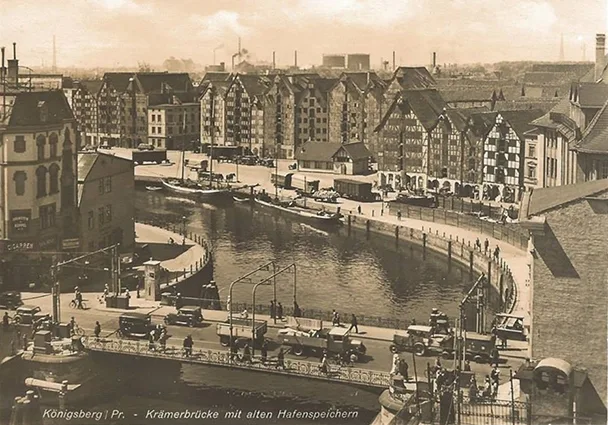
The Shop Bridge.
Next, in 1322, the Green Bridge (German: Grünebrücke) was built. It too stood beneath today's overpass and led from Kneiphof to the Vorstadt — the district between the Pregel and today's Krasnooktyabrskaya Street. Crossing these two bridges, one could travel on to the south of the Teutonic state and further into Poland.
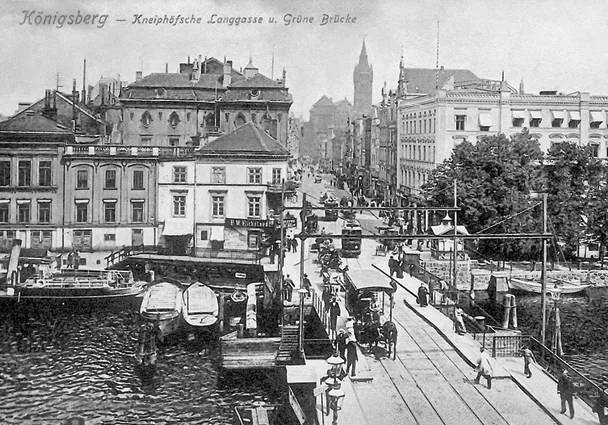
The Green Bridge.
In 1377 and 1397 two more bridges appeared — the Giblets Bridge (German: Koettelbrucke) and the Smiths' Bridge (German: Schmiedebrücke). They ran parallel to the already built Shop and Green Bridges, but closer to the Cathedral.
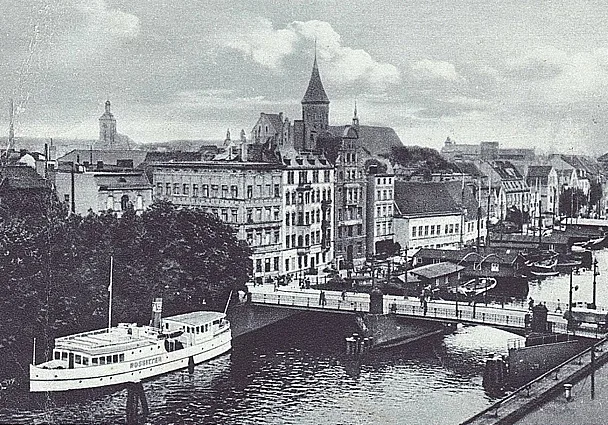
The Giblets Bridge.
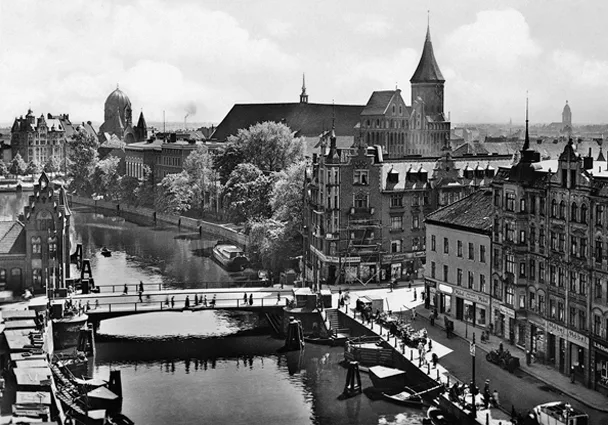
The Smiths' Bridge.
In 1404 a new bridge was erected — the Wood Bridge (German: Holzbrücke). At that time the development of the island of Lomse (now Oktyabrsky, or simply the Island) began, and the new bridge replaced a ferry crossing that could no longer cope with the goods and people. And when the High Bridge (German: Hohebrücke) was built in 1520, it became possible to transport goods bypassing the island town of Kneiphof, with which Altstadt was not always on friendly terms.
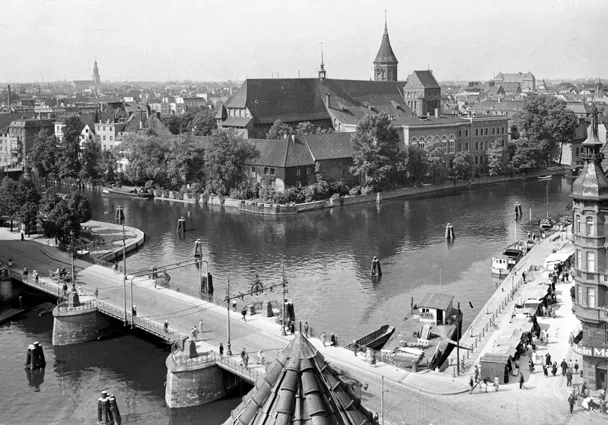
The Wood Bridge.
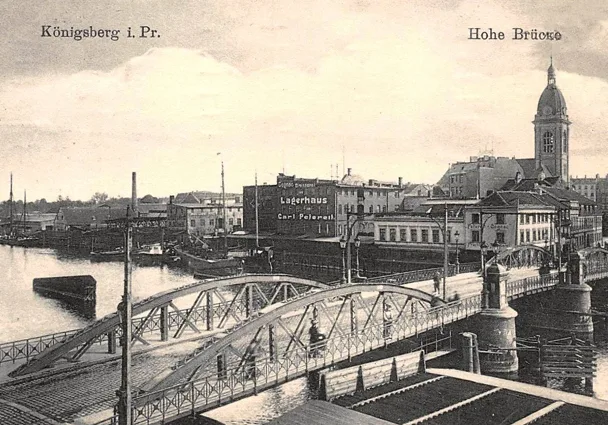
The High Bridge.
Finally, the last to be built was the Honey Bridge (German: Honigbrücke), the one that today leads from island to island and on which the mass of locks and padlocks will soon reach a critical point. It was erected just before the opening of the university in 1544.
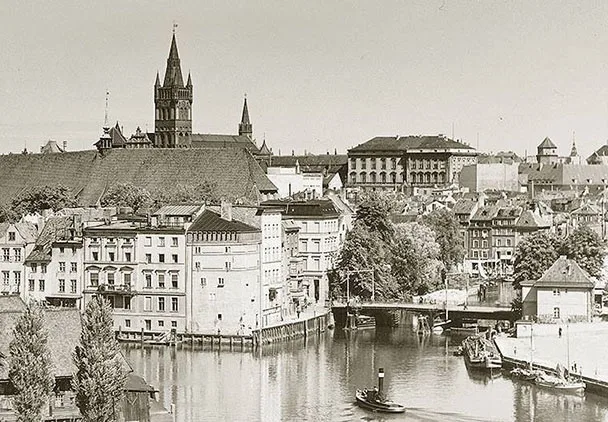 The Honey Bridge.
There are no fewer than three legends about how it came to be and how it got its name. According to one, the most reliable, it was built in exchange for handing over part of Kneiphof's land for state needs — the construction of the University of Königsberg. Another says that permission to build it was obtained from the official in charge in return for a bribe in the form of a barrel of honey. And the third says that the name "Honey" has another meaning too — "mocking", which sounds very similar in German. And the islanders were mocking the greedy people of Altstadt, who now lost their toll for passage across their bridges from island to island.
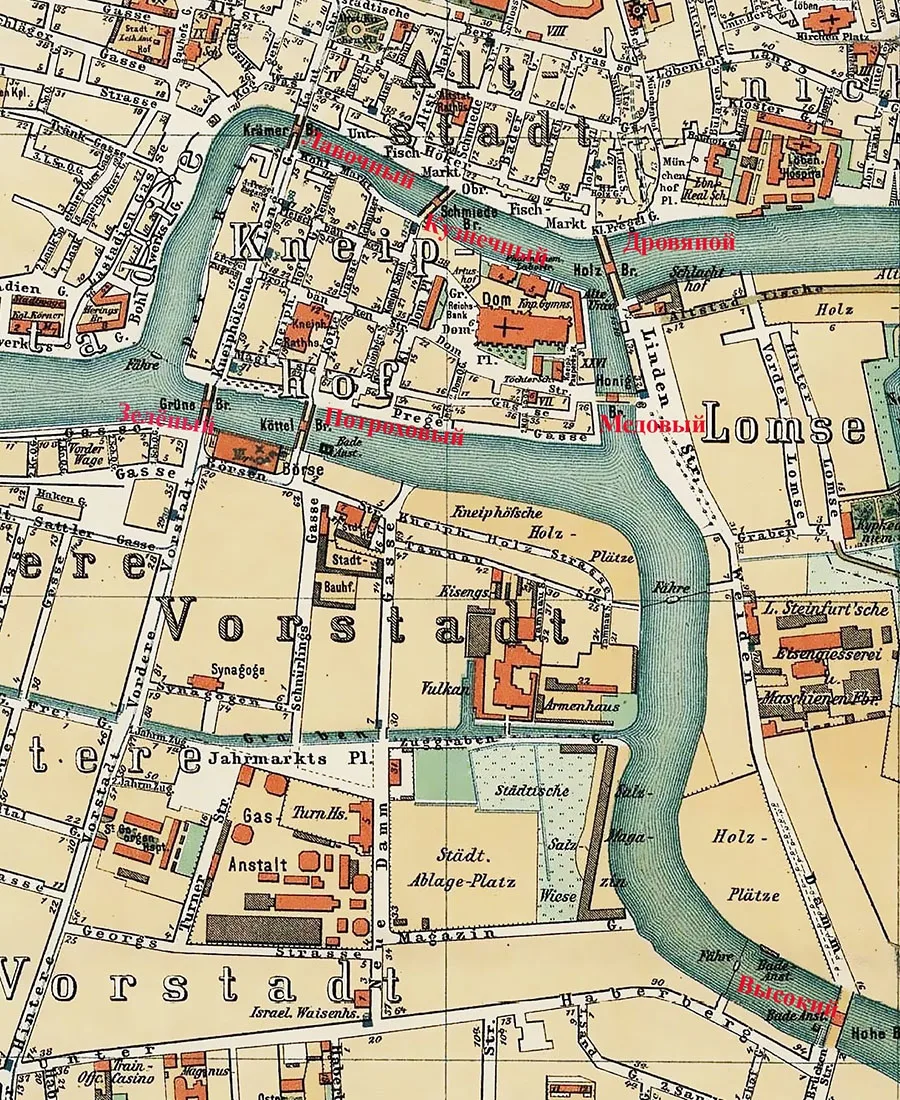
So seven bridges had been built, but they became famous throughout the enlightened world a little later.
The Seven Bridges of Königsberg problem
I first came across it back in the days when officials mentioned the very word "Königsberg" only on the anniversary of the storming of the city in April 1945. In one of the best books for inquisitive children, Yakov Perelman's "Entertaining Problems and Experiments", this problem was published under its original name. True, only three of the bridges remained after the war, but a diagram of their former layout was given right there, in the problem. And the task was simple:
Walk across all seven bridges without missing a single one and without crossing any of them twice. There are only seven bridges, so it would seem easy to go through all the possible options.
But since one could start from any of the banks or islands, move in any direction and finish wherever one pleased, the problem could hardly be called elementary. In olden days it was said that the people of Königsberg wore out more than one pair of shoes trying to solve it. Thousands of people also tried to solve the problem on paper; it was published in books and journals all over Europe, posed in society salons and university lecture halls. So it went on until a man was found who delivered the final verdict on the problem of the Königsberg bridges. His name was Leonhard Euler.
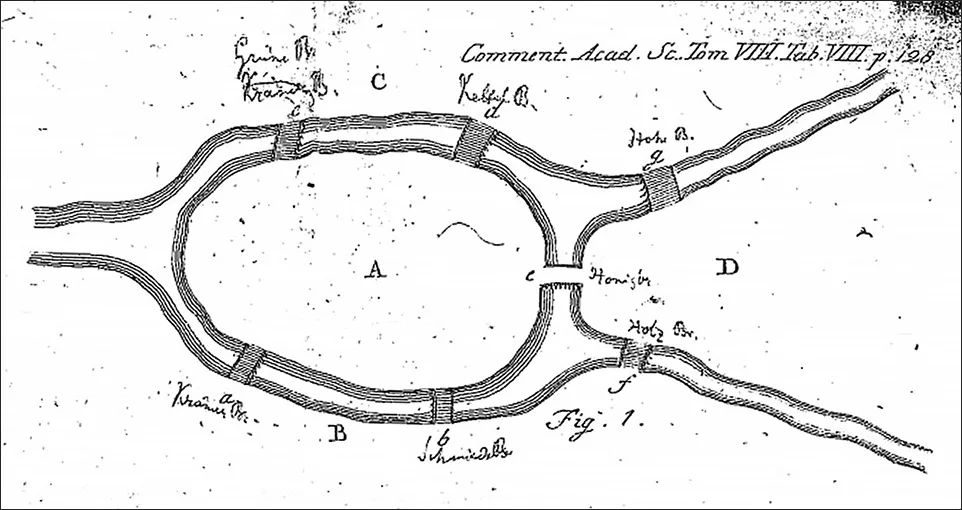
The bridges of Königsberg. Drawing from Leonhard Euler's treatise.
The problem of the Königsberg bridges, which no one had solved, led the great scientist not merely to a particular solution but to the creation of graph theory. From then on the number of bridges could be anything, as could the number of banks — Euler's theory made it possible to calculate within minutes whether a given route across the bridges was possible or impossible. It found wide practical application much later. And today it is used everywhere that optimal logistics, orderly traffic and short routes are needed — from road management to the design of computer networks. Incidentally, Euler's theory proved that the problem of the Königsberg bridges has no solution.
What happened next?
The bridges across the Pregel existed for more than five centuries. Of course, they were repaired after ice drifts and storms, painted, their railings and decking replaced, but in essence they were the same medieval bridges. Only at the turn of the 19th and 20th centuries did they undergo substantial reconstruction. Different bridges underwent it to different degrees. In 1881–82 the High Bridge was even moved a few metres upstream, but in memory of the old bridge from the days of the Order the city architects left the old piers and the bridge-keeper's house. The technical solution for driving the bridges' lifting mechanisms deserves special mention: it was based on using the water pressure in the city water mains: water entered a special cylinder and pressed on a piston, which moved and set the gears of the mechanism in motion.
In 1903–04 it was the turn of the Wood Bridge. After the reconstruction it became a bascule bridge, the number of spans was reduced to three, and the wooden structures were replaced with stone and metal.
Yet in every case of rebuilding the bridges, the architects tried as far as possible to preserve the spirit and style of old Königsberg.
And in the same traditions, in 1905, an eighth bridge across the Pregel was built — the Imperial Bridge (German: Kaiserbrücke), which exactly 100 years later was recreated "after the original" on the same spot and today bears the name "Jubilee Bridge". Wits even said that in this way the Emperor solved the problem of the Königsberg bridges in his own fashion.
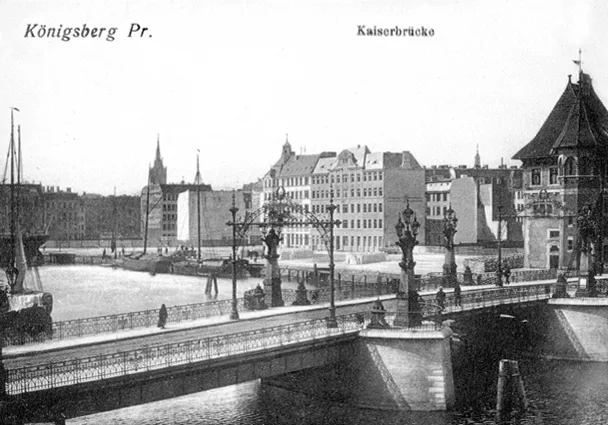
The Imperial Bridge.
All the efforts of Königsberg's architects and builders were wiped out at a single stroke in April 1945, when the bridges suffered fatal damage during the storming of the city. The defending side did not stand on ceremony and acted according to all the rules for the garrison of a besieged fortress: the bridges across the river were destroyed first of all, before the soldiers of the advancing Red Army could use them.
In the post-war years, five of the seven bridges that made up the famous problem were gradually restored. The Smiths' and Giblets Bridges were not restored. In 1972 the overpass bridge was opened, after which the Green and Shop Bridges were dismantled "as no longer needed".
The three remaining bridges, the Wood, Honey and High Bridges, received "resounding" names: Bridge No. 1, Bridge No. 2, Bridge No. 4.
Incidentally, in 1964 the Wood Bridge "played" a cameo role in the finale of the film "Father of a Soldier". It was on its span that the words were written: "Here the tanks of Hero of the Soviet Union Senior Lieutenant Makharashvili were the first to pass". Judging by the film, the bascule mechanisms were still working in those years, and the shots clearly show the bridge operator's cabin, which survived until the 1990s, when it was dismantled for scrap metal. A small consolation was that in those years the bridges' original names began to return in people's conversations; true, the Wood Bridge is more often mistakenly called the "Wooden" Bridge, but that is not so important.
What is the upshot?
Alas, the project for the "reconstruction" of the Wood and High Bridges has been drawn up, as they say, "head-on". The total cost of the two projects is about two billion roubles. That is what it costs to build a small residential neighbourhood for some 2–3 thousand people. For this impressive sum we are offered the loss of the remnants of our historical past, with the added remark that the original bridge designs with pseudo-historical decoration and spectacular lighting may be considerably simplified if there is not enough money for everything. An expert assessment of the bridges found that "there is nothing especially valuable in them"; the only thing designated as worthy of protection was the old elements of the Wood Bridge railings, which, if the funding works out well, will be transferred to the new bridge. True, the representatives of the design firm were unable to give a clear answer to the question of how the railings are to be transferred if they were assembled from different bridges and, moreover, their length will still not be enough for the enlarged new bridge. Most likely there will be no transfer at all. The bridge will get a standard railing, and the elements of the old one (with acorns and the coats of arms of Kneiphof on the posts) will be stored in a museum's reserve collection. Because they are not fit for display without restoration work. Meanwhile, a simple option suggested itself: to let only pedestrians and trams use the old bridge and to send cars over a new bridge, which could well be built next to the historic one. Besides, the interchanges from the second overpass should considerably relieve the car traffic over the two old bridges.
But this could have happened only if the client for the project had from the outset set the condition of preserving the old bridges, instead of trying to justify the primitiveness of its strategy by the supposed absence of any historical value in this structure.
As the saying goes, some simplicity is worse than theft. I am convinced that if the problem of preserving the Königsberg bridges is approached in a balanced and purposeful way, a solution can be found within the proposed budget, so that in twenty years' time we will not have to avert our eyes at a simple question from our descendants: "It could have been saved, couldn't it — so why wasn't it?"
Translated from Russian with the help of AI (Claude, Anthropic), October 2026.