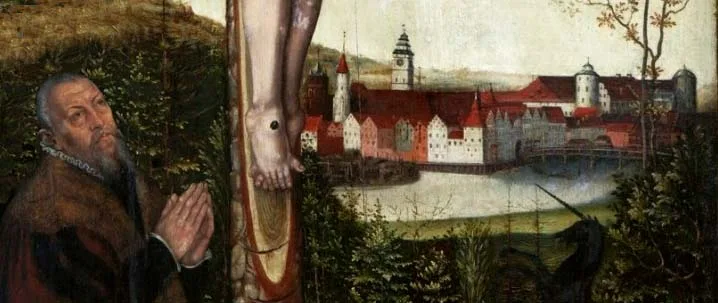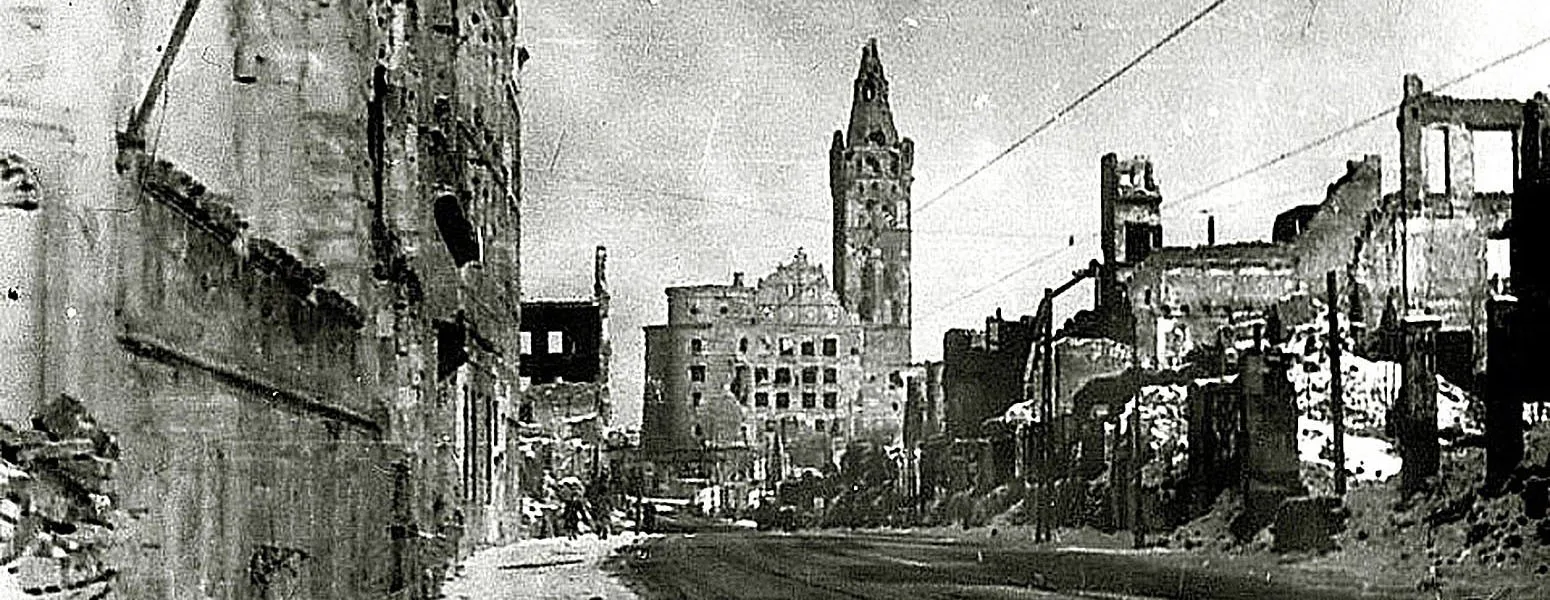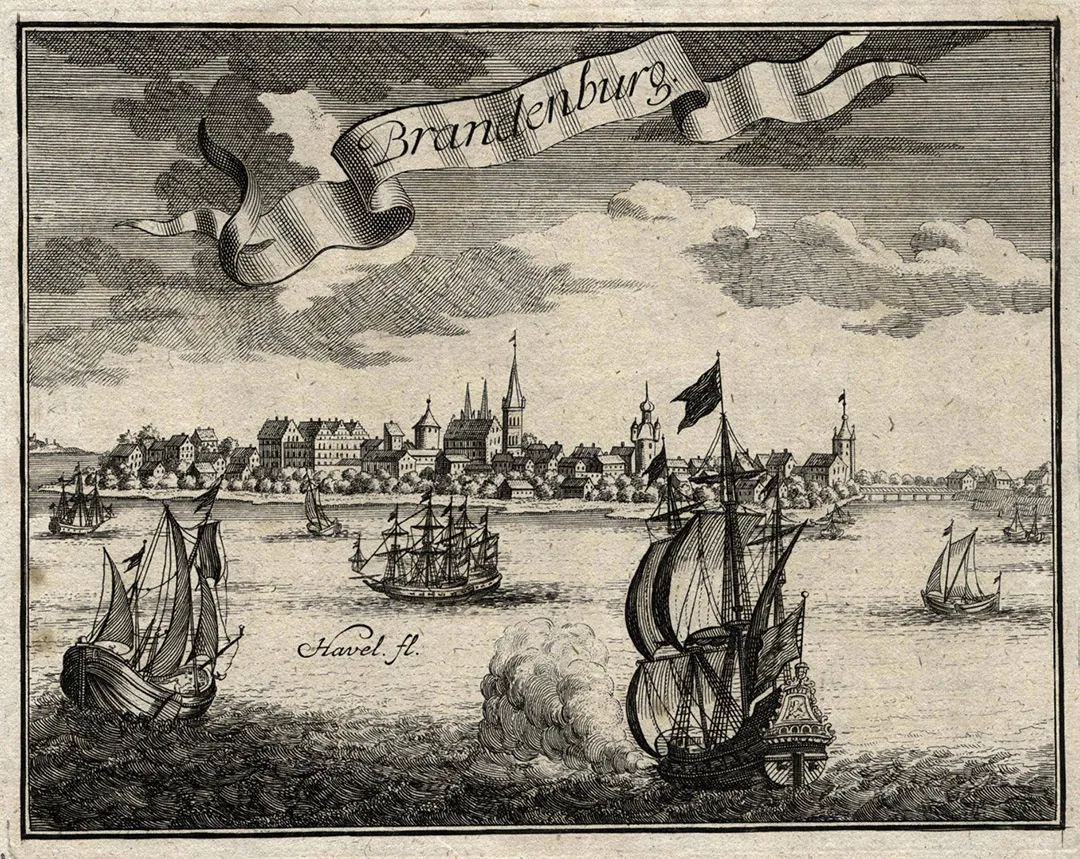
Brandenburg stood on the shore of what is now the Kaliningrad Lagoon, at the mouth of the Frisching (Prokhladnaya) River, and, lying between the existing Komtur castles of Königsberg and Balga, was meant to strengthen the link between them. The first Komtur of Brandenburg was the serving Marshal of the Order, Friedrich von Holdenstete. During the Prussian uprising he left the castle with a detachment and set off towards Kreuzburg (Slavskoye), a castle the Prussians had burned. At the same time a Prussian captive escaped from Brandenburg and told Glappo, leader of the rebel Natangians, that only a small garrison remained in the castle.
The Prussians attacked the wooden castle and slaughtered almost the entire garrison; only a few managed to take refuge in the tower. Holdenstete learned of the attack, picked up reinforcements in Königsberg on his way back to Brandenburg and, with the combined forces, routed the Prussians and freed those besieged in the tower.
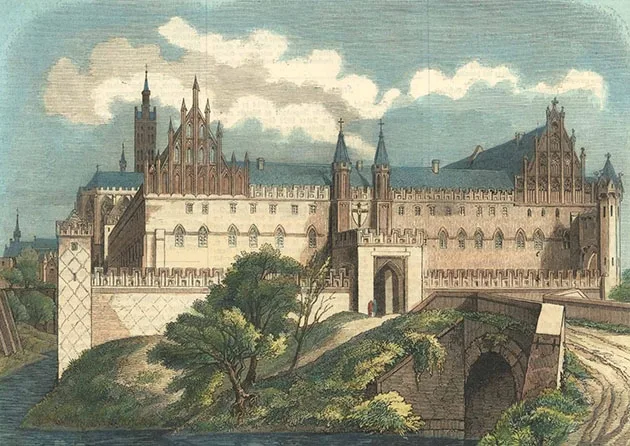
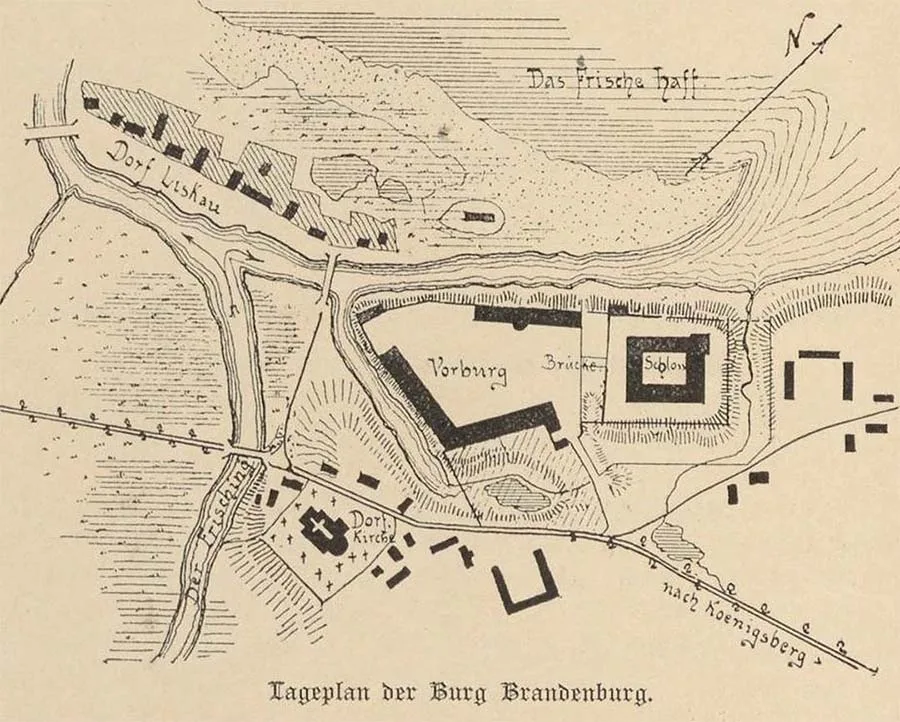
Nevertheless, the castle was soon attacked by the Prussians again and burned down, most likely in 1267 or 1269. Immediately afterwards Margrave Otto III of Brandenburg landed in Prussia once more and rebuilt the castle. Once the Prussian uprising was over, work began on rebuilding the castle in stone. The new castle was a “full-scale” four-winged structure forming a 65 x 52 m rectangle around a spacious courtyard. Adjoining it to the south-west was an extensive outer bailey (Vorburg), separated from the castle by a moat. The outer bailey consisted of two large buildings standing right next to each other and a defensive wall that closed off the quadrangle on the other two sides. It had several towers of various sizes. The castle itself contained all the rooms typical of a Komtur's castle: the Remter (refectory), the infirmary, where elderly brethren of the Order spent their last days, the chapter hall, the castle chapel and the Danzker (latrine). The ground floors housed the service and storage rooms.
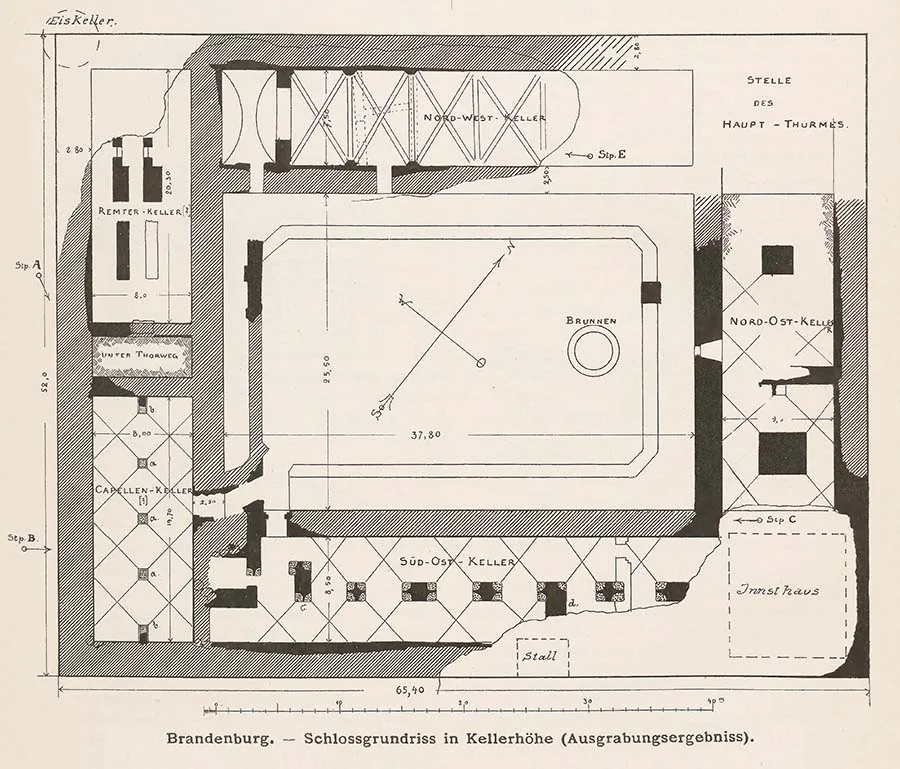
As befitted a Komtur's castle, Brandenburg played an important military, economic and political role in the Order's state. Günther von Hohenstein, its Komtur in the 1370s and 1380s, distinguished himself as a diplomat, while another Komtur of Brandenburg, Markward von Salzbach, was taken prisoner at the Battle of Grunwald and executed by Prince Vytautas.
Komturs of Brandenburg repeatedly went on to hold high office in the Order. Meinhard von Querfurt (Komtur in 1284–88) and Ludwig von Schippen (Komtur in 1290–91) became Landmeisters of Prussia, while Heinrich Dusemer von Arfberg (Komtur in 1334–35) and Johann von Tiefen (Komtur in 1480–89) rose to the office of Grand Master.
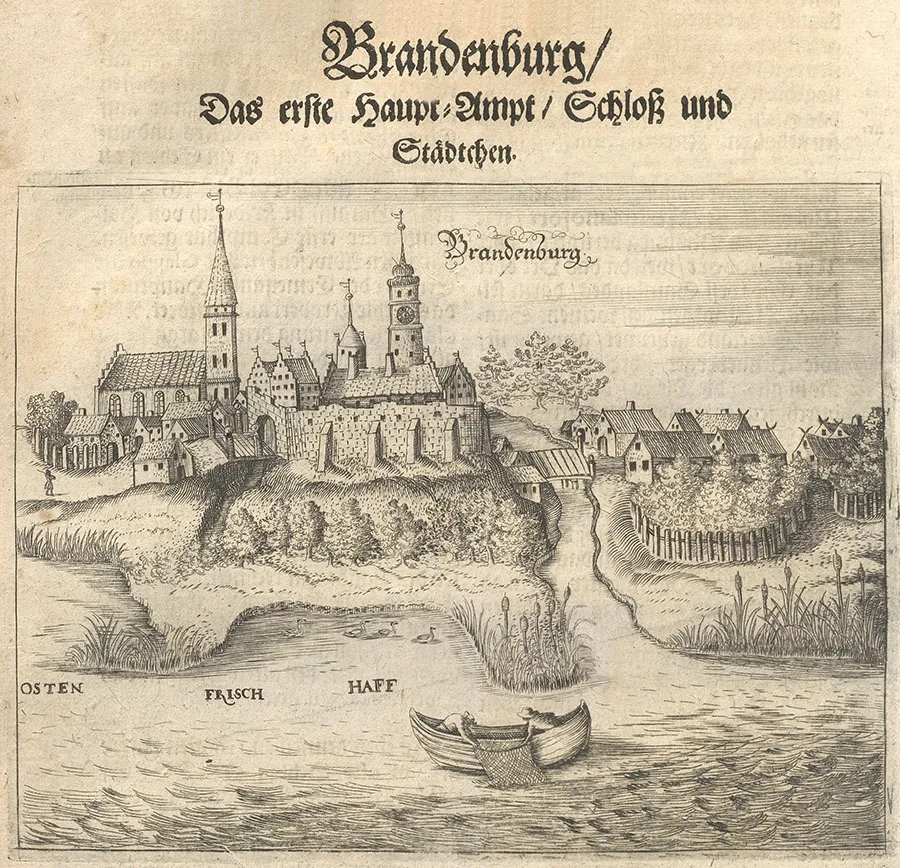
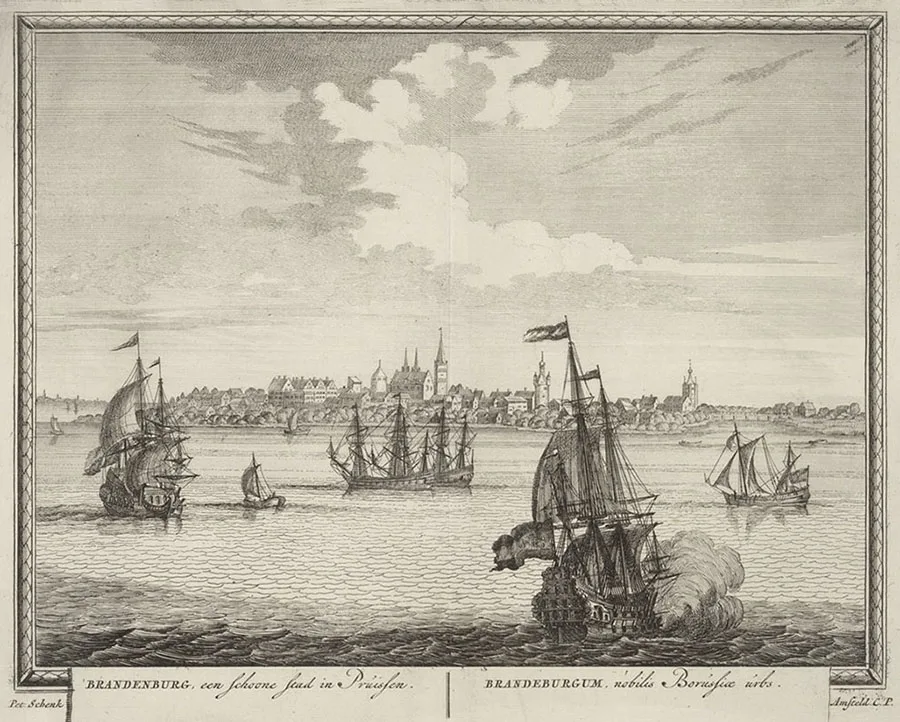
During the Thirteen Years' War (1454–66), Brandenburg was seized at the very outset of hostilities by the town militia of Kneiphof, which had joined the Prussian Confederation of towns. The rebels took advantage of the temporary absence of the Komtur and a strong garrison. As early as 1455, however, Brandenburg was retaken without a fight by a detachment led by the Komtur of Elbing, Heinrich Reuss von Plauen. At the very end of the war the castle came under artillery fire from the sea, from ships of the city of Danzig. A fire broke out in the outer bailey, but the enemy did not dare to storm the castle itself. The war-ravaged surroundings left the Brandenburg commandery in dire financial straits.
No sooner had life in the commandery begun to recover than a new war broke out in 1520–21, known as the Horsemen's War. It was caused by the Grand Master Albrecht of Brandenburg's attempt to avoid swearing an oath of fealty to the Polish king.
Fierce fighting took place around Brandenburg. In 1520 the castle was taken by the Poles twice. The first time, following all the rules of the military art of the day, they bombarded the castle with artillery and breached the wall where the two buildings of the outer bailey met, whereupon the garrison capitulated on honourable terms and marched out with its weapons and banners unfurled. During the second capture a major fire broke out in the castle.
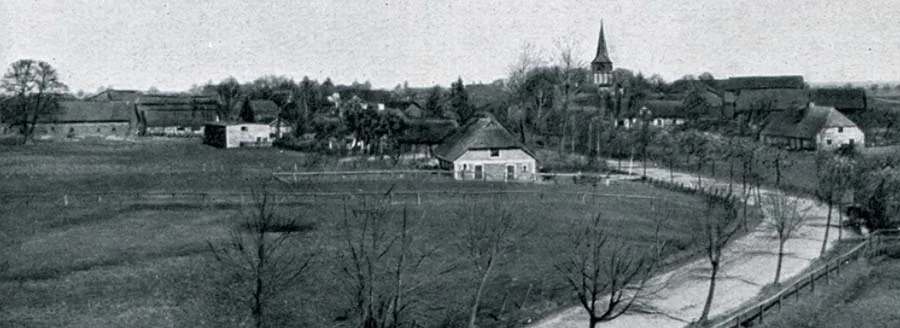
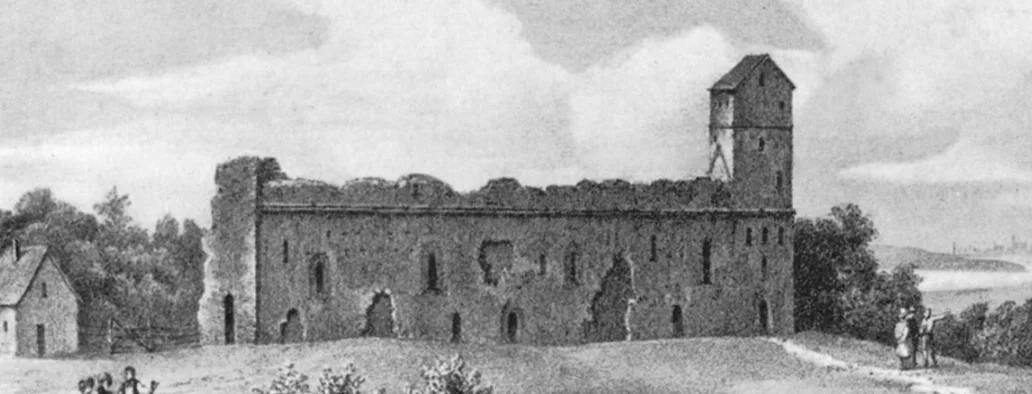
After the war the castle was restored, though not completely. In the Duchy of Prussia it served (like many other castles) as the administrative centre of an Amt for more than 200 years. Over time the buildings deteriorated as necessary repairs were neglected. Even so, in 1629, when the court of Elector George William moved here to escape a plague epidemic, Brandenburg was still in good condition, and in the 1650s the wife of the Great Elector Frederick William lived here. But by the 1750s demolition of the castle's main building had begun, and by the early 19th century only its foundations remained. The buildings of the outer bailey survived and were turned into a leased state domain. On 5 January 1813 Macdonald's retreating French X Army Corps halted at the castle, pursued by a detachment under Ivan Ivanovich Diebitsch-Zabalkansky, who waited for reinforcements and then drove the French out of Brandenburg.
The two buildings of Brandenburg Castle's outer bailey survived intact until the Second World War, but in March 1945 they found themselves in the midst of heavy fighting and were badly damaged. Nevertheless, from 1946 Soviet settlers lived in the southern wing of the outer bailey.
This building was used as housing until around the early 1980s, when, for lack of repairs, it became uninhabitable. In the 1990s a project emerged to convert the outer bailey into a hotel complex, but it all ended in even greater destruction: the roof was now gone entirely, and some of the walls were dismantled for their bricks. The outer bailey remained in this state until 2015, when another attempt was made to clear and restore the buildings. However, the work was carried out without a proper scientific restoration plan (which the allocated funds would hardly have covered anyway) and was, on the whole, sporadic and haphazard. As a result, by 2020 the courtyard had at least been cleared of self-seeded growth and rubbish, access to the buildings of the western wing had been closed off, basic conservation had been carried out, and part of the masonry of the southern wing had been rebuilt. By all accounts, that is where the allocated money ran out.
Translated from Russian with the help of AI (Claude, Anthropic), October 2026.