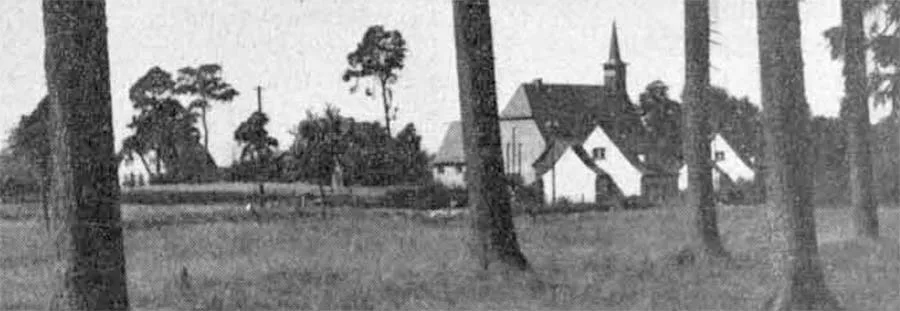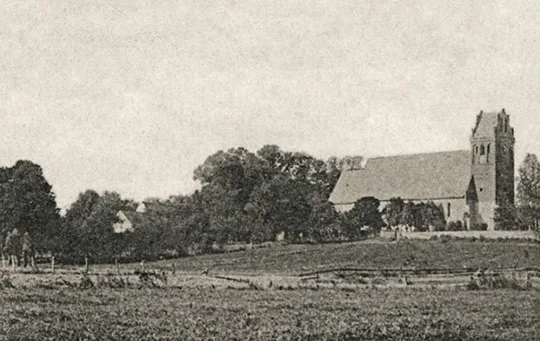
The wooden castle, named Schonewik, was not yet finished when the rebellious Prussians appeared beneath its walls. According to legend, there was only one knight and his servant in the castle, and the gates could be opened from the outside, but some unknown force struck the Prussians blind, and they abandoned their attempt to seize Schonewik. That, however, was where Fischhausen's run of good fortune came to an end.
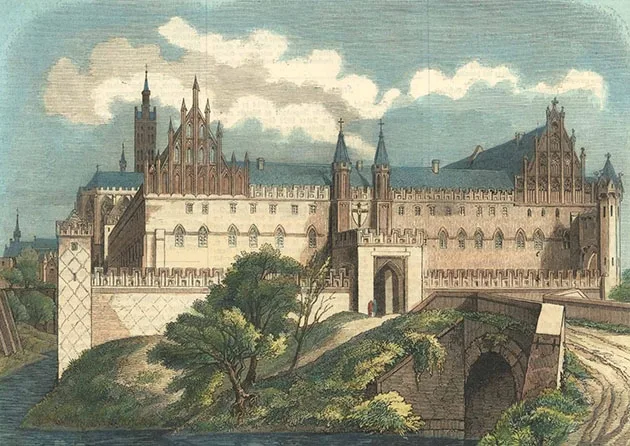
After the Prussian uprising was crushed, the area was handed over to the Order for its use, on the understanding that the Order would build a stone fortification here. The exact date of construction of the brick castle is unknown, but in all likelihood work began between 1280 and 1285. The result was a “complete” four-winged castle with an extensive outer bailey and water-filled moats. Through the efforts of the Bishop of Samland, a settlement called Bischofshausen (literally “the bishop's houses”) was founded at the castle walls, and on 19 August 1305 it received town rights. By the 15th century, the name Bischofshausen had gradually evolved into Fischhausen.
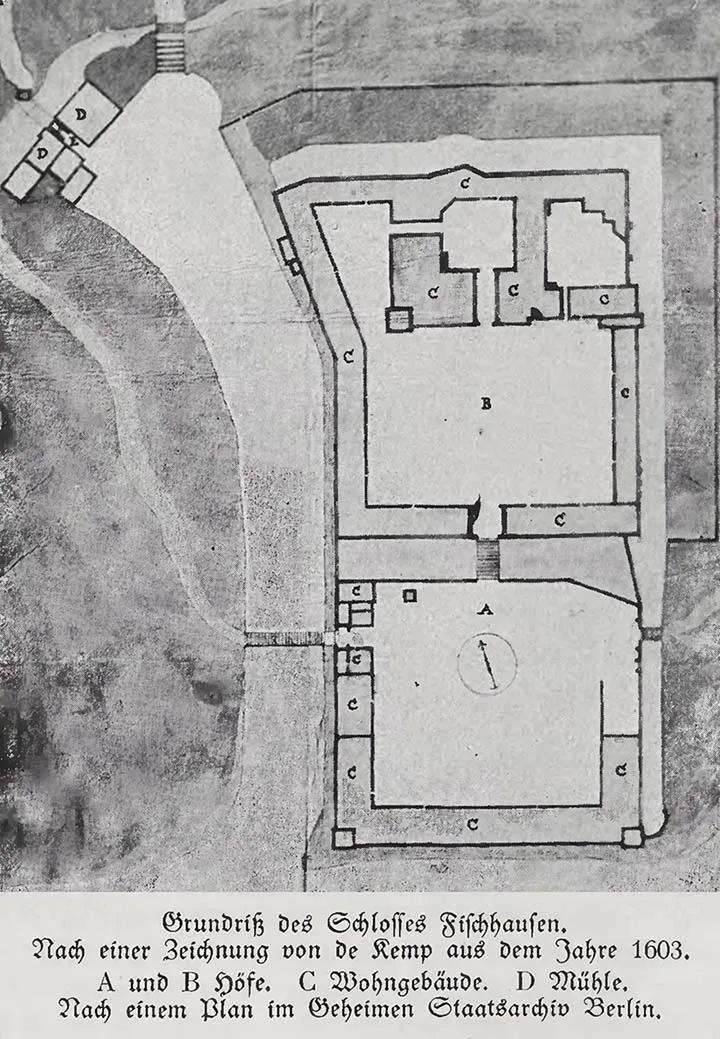
Originally the castle occupied a highly advantageous position, since at that time the strait between the mainland and today's Baltic Spit lay directly opposite it, which meant that merchant ships passed right by. The castle's status as an episcopal residence also had a favourable effect on the development of the town and the surrounding area. Moreover, the castle was never attacked by the Lithuanians, as it lay deep in the rear, shielded by Königsberg.
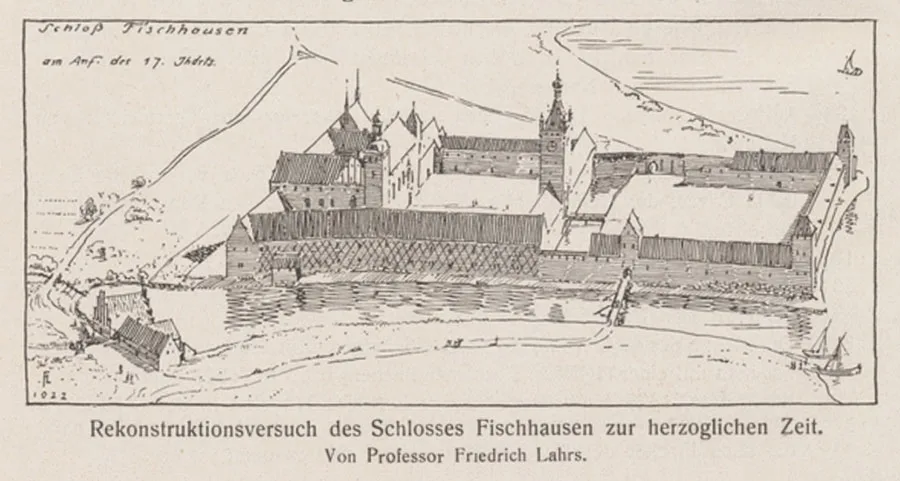
Later, however, the old strait silted up with sand, and a new one opened where it is today, and Fischhausen immediately lost its strategic importance. After the Great War of 1409–1411 and the defeat at the Battle of Grunwald, the townspeople of Fischhausen, like other burghers, were burdened with heavy taxes to pay off debts and indemnities. On top of that, in 1416 the plague swept through the town, claiming the lives of many residents, including Bishop Heinrich IV von Schauenburg himself. The Thirteen Years' War (1454–1466) brought new misfortunes to the castle. Bishop Nikolaus II von Schöneck decided that the Bishopric of Samland would fare better under the Polish crown and so joined the Prussian Confederation, but a detachment of the Order under Hans von Gleichen, sent to the walls of Fischhausen, forced Bishop Nikolaus to swear allegiance to the Order, which then assigned a small garrison to defend the castle. A hundred years earlier Fischhausen had been deep in the rear, but now it found itself on the very front line, since the Teutonic Order's most active opponents were based in Elbing and Danzig.
In 1456 a Danzig force landed from ships near Fischhausen, attacked the town, plundered it and burned it. The force was too small to take the castle by storm, but quite large enough to blockade the garrison inside and lay waste to the surrounding countryside. And although the attackers were soon defeated near Lochstädt, they had already managed to get their booty onto the ships.
Four years later, in 1462, while the main forces of the Order were besieging Frauenburg (Frombork), a combined force of Poles and townsmen from Elbing and Danzig, to the complete surprise of the Teutonic Knights, landed near Fischhausen once again, captured the town, plundered it and burned it to the ground. Once again the castle held out, but by the end of the war the surrounding lands had been utterly devastated.
After the secularisation of the Order, the Bishop of Samland, Georg von Polentz, resigned his office and handed over the church's property to the duke. The episcopal residence, Fischhausen Castle, was adapted for administrative purposes and became home to the administration of the Hauptamt (district) as well as the amber court and the coastal court. The castle left its mark on history at least three more times: in 1526 Duke Albrecht married Dorothea of Denmark in the castle chapel, and from 1567 Albrecht's mentally ill son and heir to the Prussian throne, Albrecht Friedrich, lived here. He remained in the castle until his death in 1618. Finally, in 1629, Fischhausen Castle hosted negotiations between King Gustavus II Adolphus of Sweden and Elector George William. To the satisfaction of both sides, the talks ended with the signing of a treaty under which Prussia maintained armed neutrality in the Thirty Years' War (1618–1648).
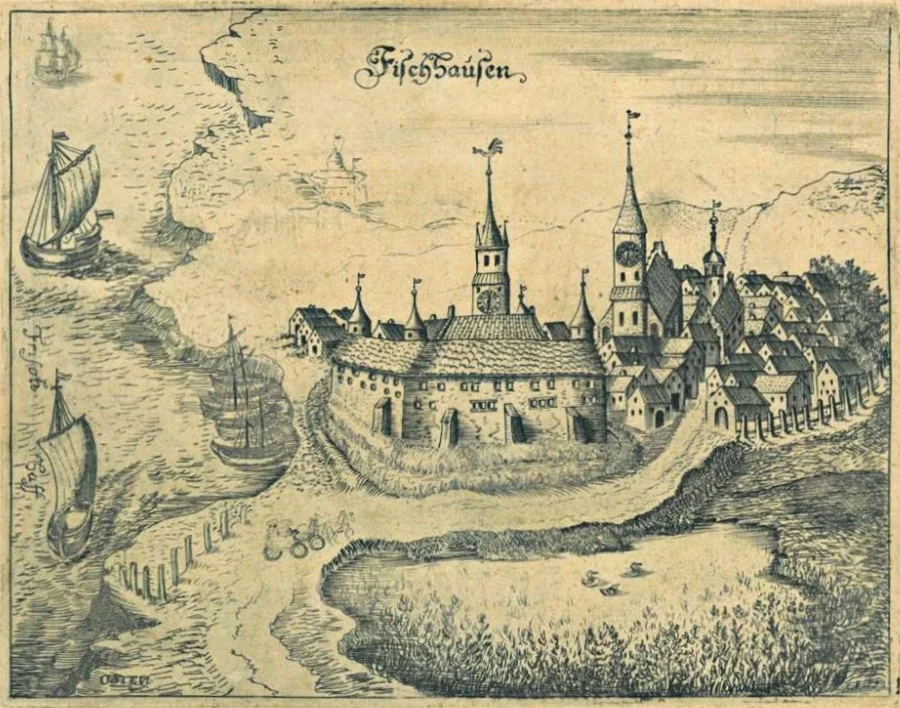
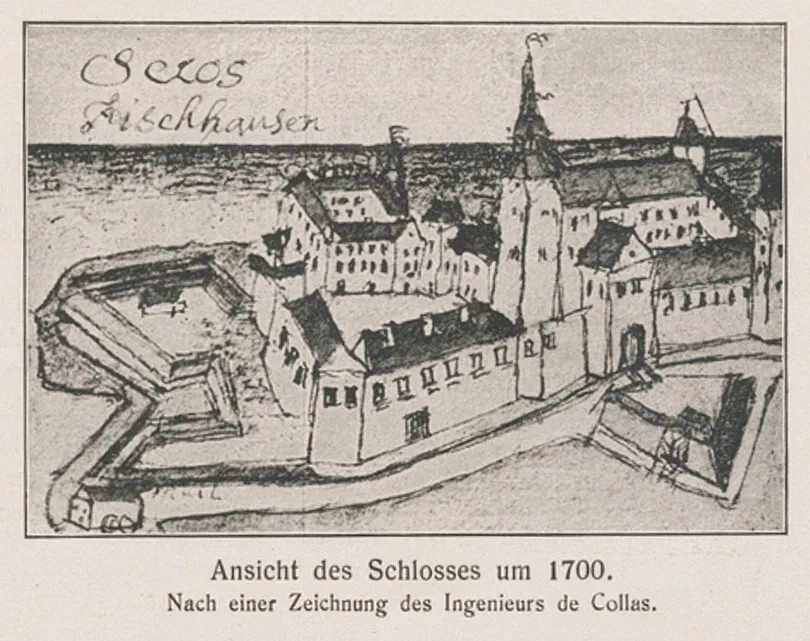
At around the same time, bastioned earthen ramparts were built around Fischhausen Castle, which had by then lost its military significance, turning it into a small fort in which the old building of the Order served as the citadel.
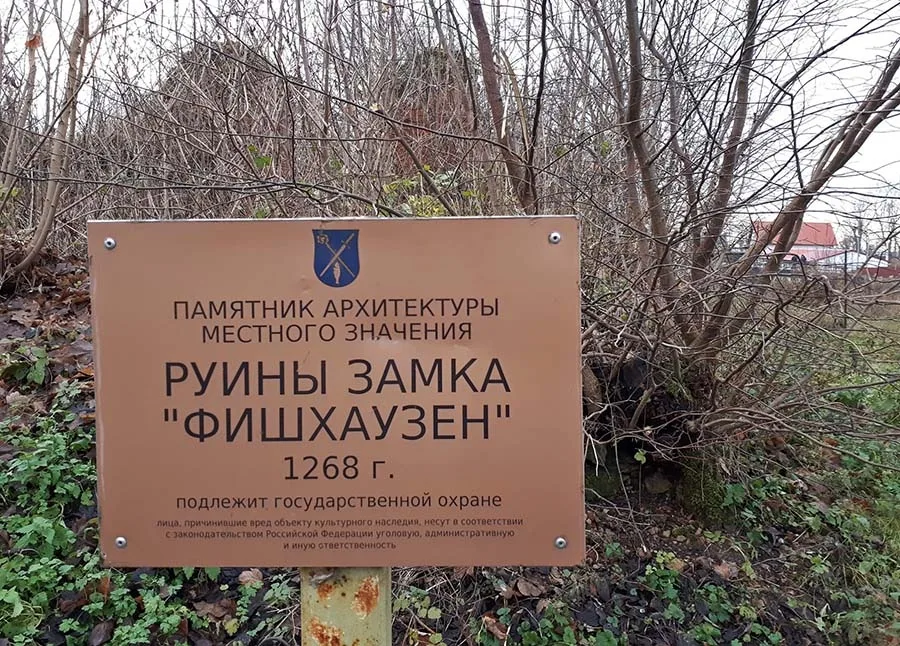
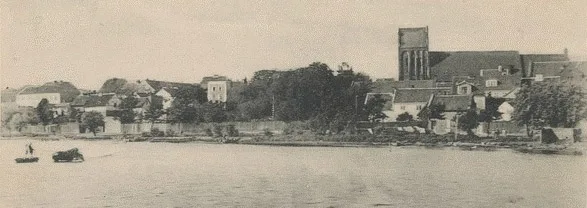
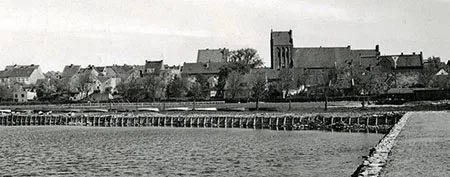
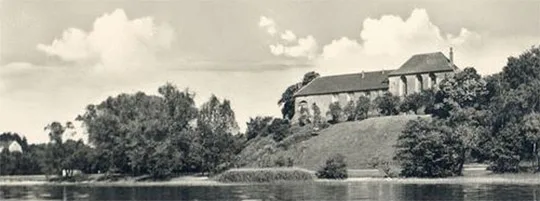
Yet by that very time the castle itself had begun to deteriorate rapidly. Some building work was carried out, such as replacing parts of the roof, all the more so since members of the ruling Hohenzollern dynasty often stayed at the castle while hunting. Nevertheless, from the beginning of the 18th century, by order of King Frederick I, the castle buildings began to be dismantled, and the salvaged masonry was used to strengthen the fortress of Pillau and the banks of the moats around it. Thus Fischhausen shared the fate of Balga Castle. All that remained of the castle was the clock tower and the south wing, or only part of it. Moreover, in 1776 the tower burned down after being struck by lightning and then collapsed. In the 19th century new buildings were erected on the castle grounds to house the leaseholder, while the surviving south wing was used for farm purposes and as living quarters for workers. From the late 19th century these structures were protected as historical monuments. The Second World War brought the history of Fischhausen Castle to a close. The castle lay in the path of the main thrust of the 3rd Belorussian Front during the offensive on Samland in April 1945. The castle buildings came under heavy fire, after which only shapeless ruins were left of the south wing. After 1945 the castle was “picked at” a little more by people quarrying bricks and searching for mythical treasure. Today it survives as the ruin of a single wall of the wing, up to a storey and a half high. It is quite possible that intact cellars lie beneath the heaps of construction and household rubbish.
Photos on this page: Bildarchiv Ostpreußen, bildarchiv-ostpreussen.de
Translated from Russian with the help of AI (Claude, Anthropic), October 2026.