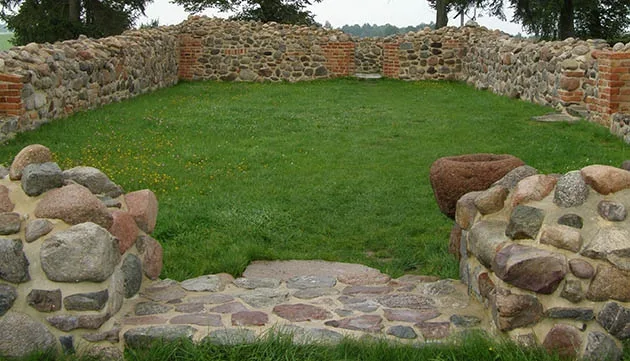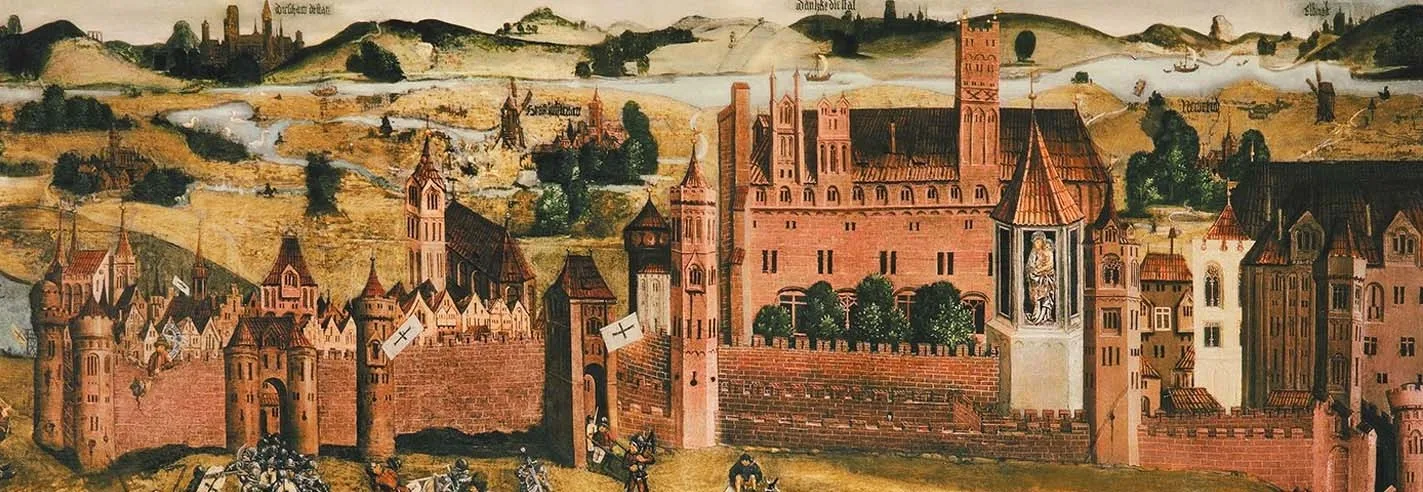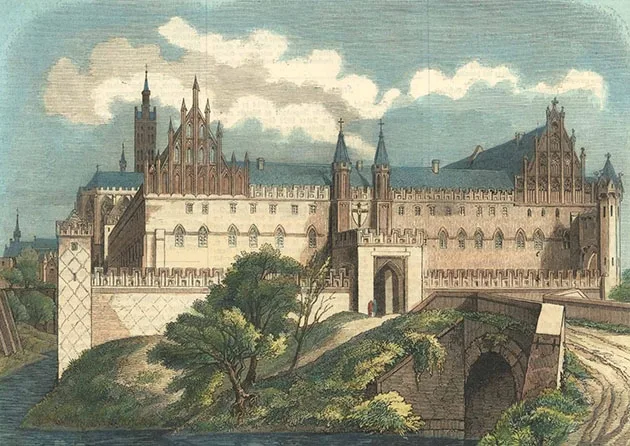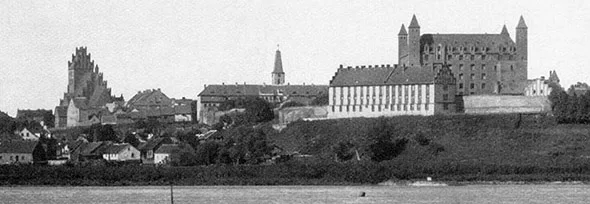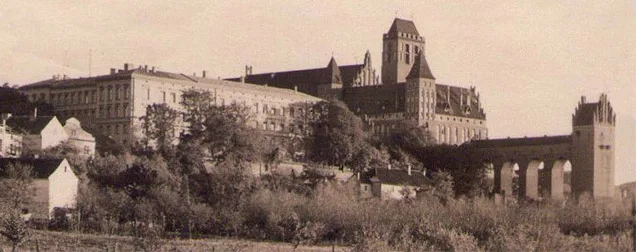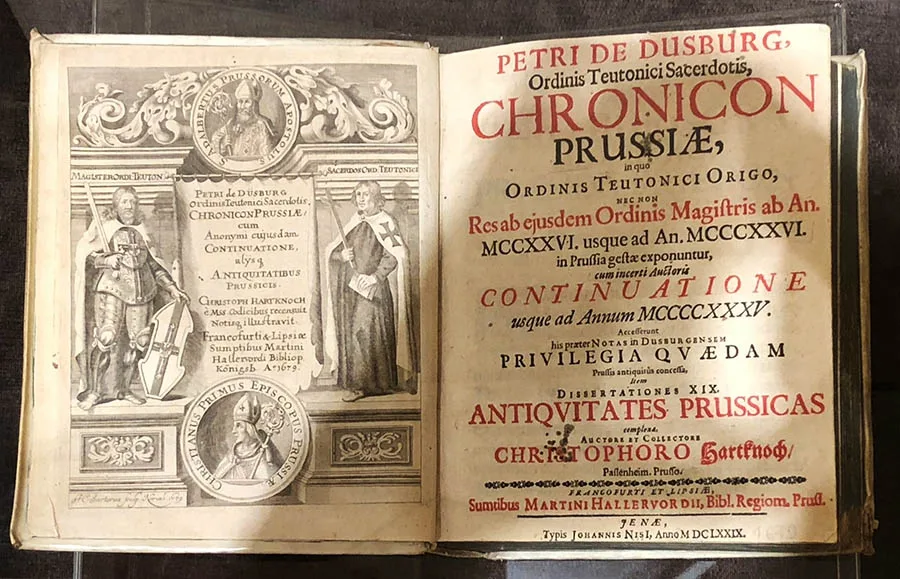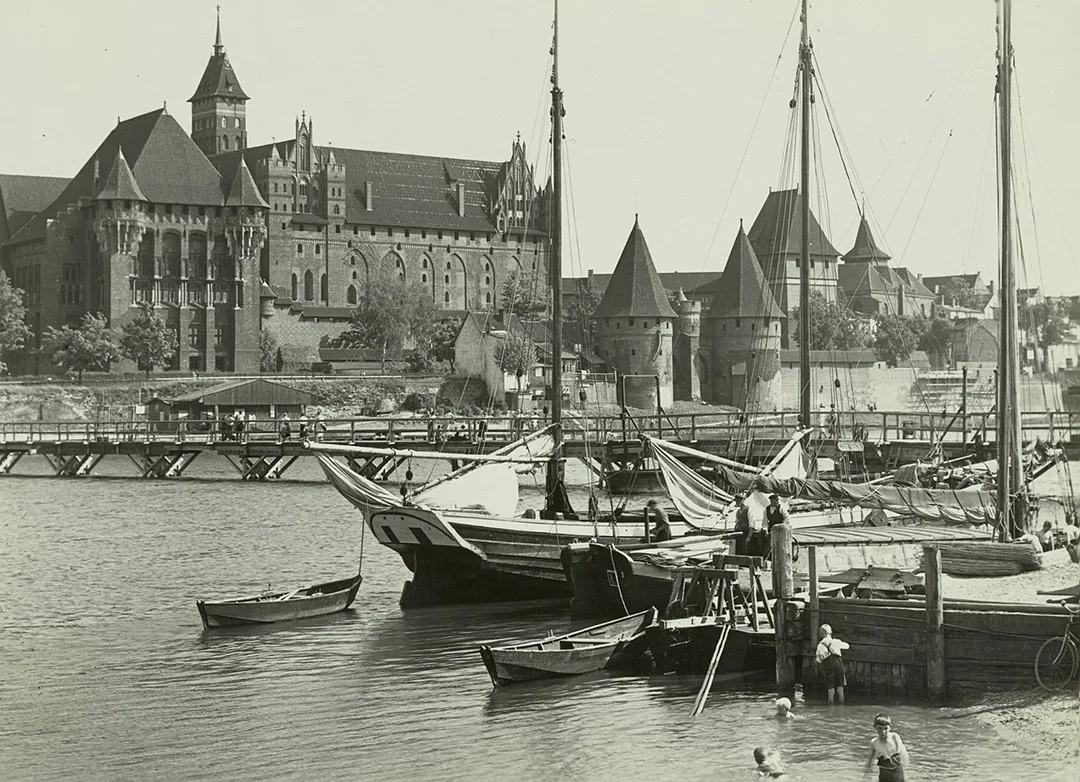
Had some noble feudal lord from France or Northern Italy visited the future capital of the Order at that time, he would have noticed that Marienburg Castle was fairly large but insufficiently fortified by Western European standards. The castle's towers were too cramped to accommodate a significant number of defenders, and their design did not allow full control of the ground beneath the walls. The wings had massive, tall walls, but lacked the machicolations then coming into fashion, overhanging openings that allowed defenders, without risk of being hit by an enemy arrow, to drop stones on the attackers' heads or pour boiling pitch or sewage on them. However, the castle's komtur would have answered such a reproach by saying that everything had been built in the most rational way. Additional defensive features required first-class architects, which would have made construction considerably more expensive. Moreover, even among the neighbouring Poles the art of properly storming a castle, with the building of counter-fortifications, the erection of siege towers and the use of various throwing engines to batter the walls, was poorly developed, while among the Lithuanians and Prussians it was entirely absent. Therefore even a small garrison in a stone castle whose walls could not be set on fire could, with adequate provisions and a working well, hold out against the pagans for a very long time. And here spacious storerooms mattered more than the number of towers a castle had.
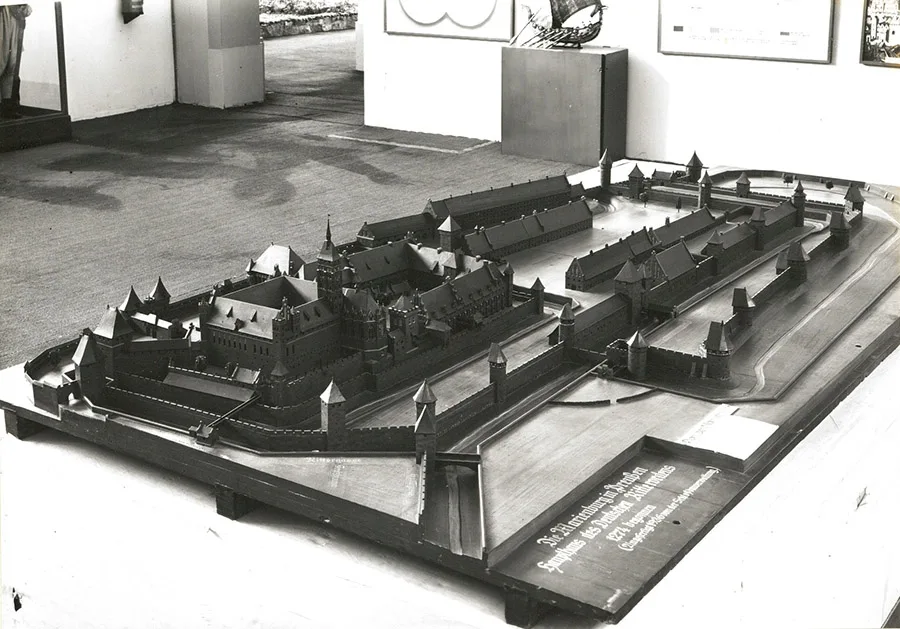
If the garrison numbered at least a dozen or two knights and a hundred foot soldiers (Knechte), the brethren of the Order preferred to settle matters with an inexperienced enemy in open battle on the ground in front of the castle, since the advantage of heavy armour and combat training was even greater than the protection offered by brick walls.
In the 1280s the castle was surrounded by a defensive wall. At the same time the convent was moved into the castle, and the convent cemetery was laid out within the defensive wall. As early as 1276 a settlement had arisen near the castle, and in 1278 it was granted town rights. Before the end of the 13th century a danzker and a large defensive tower were added to the square of the four wings. A Vorburg (outer bailey) was built onto the castle on its north-eastern side. On the whole, until 1309 Marienburg developed as a typical commandery castle. After Danzig was captured in 1308, and the whole of Eastern Pomerania was subsequently annexed under the Treaty of Soldin, it became clear to Master Siegfried von Feuchtwangen that the Order was faring well only in Prussia, all the more so since the Landmeister of Prussia, Heinrich von Plotzke, a figure of great authority within the Order, was urging him to focus more closely on Prussian affairs. And so in 1309 the Order's capital and the residence of the Grand Master moved from Venice to Marienburg.
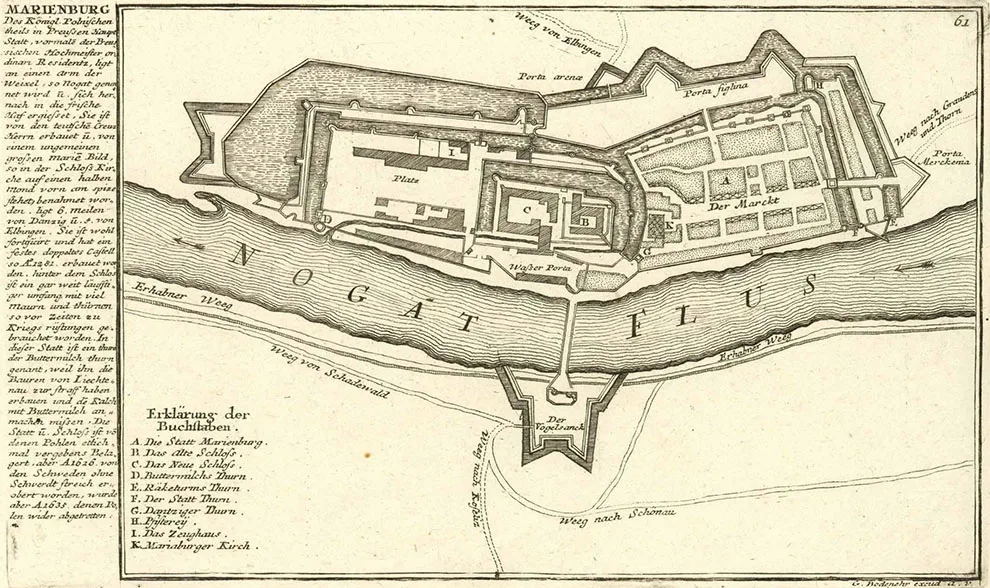
The choice of Marienburg as the Order's capital was justified, since the castle lay, on the one hand, beyond the reach of the Lithuanian pagans who raided the Order's lands and, on the other, in the busiest part of the state. Marienburg was officially proclaimed the capital of the Order on 14 September 1309.
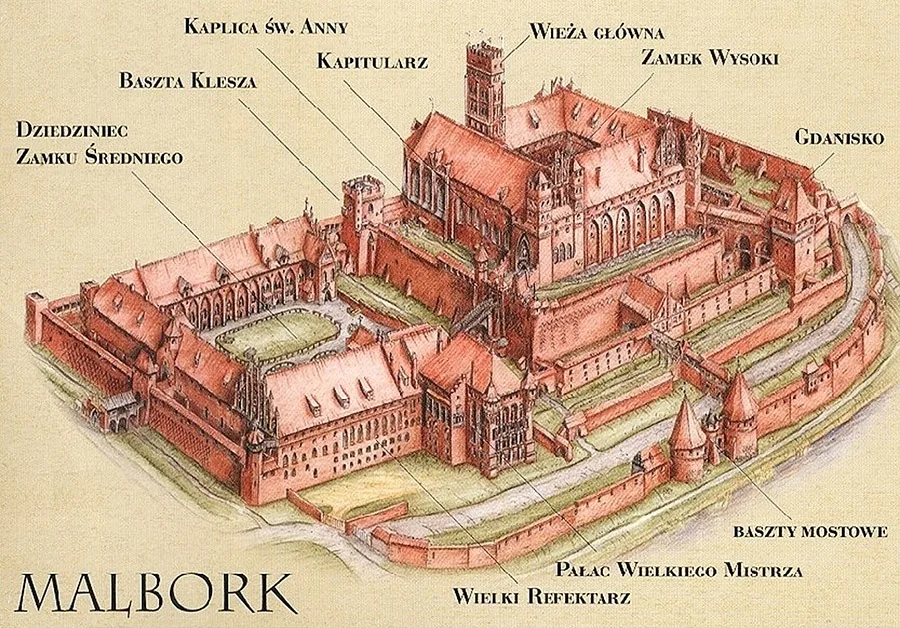
Naturally, its status as the capital was bound to affect the castle itself. The need to house a considerable number of officials, servants and soldiers, and to receive official delegations and embassies, meant that the rebuilding of Marienburg began in that very year, 1309. By the 1330s the castle had acquired its three-part structure: the High Castle, made up of the reconstructed oldest buildings; the Middle Castle, which occupied the site of the former outer bailey; and the Low Castle, which took over from the old outer bailey as the area for workshops and storehouses. In the High Castle the Chapel of St. Anne was built, the future burial place of almost all the grand masters. Yet the tradition of burying the Order's leaders there did not take hold at once. Siegfried von Feuchtwangen, who had himself initiated the transfer of the capital, was buried in 1311 at Kulmsee (Chełmża). His successor, Karl von Trier, was laid to rest in his native Trier in 1324. Werner von Orseln and Luther von Braunschweig found their rest in the cathedrals of Marienwerder (1330) and Königsberg (1335). Only in 1341 was Dietrich von Altenburg buried in the Chapel of St. Anne. And burial at Marienburg became a tradition only ten years later, with the funeral of Heinrich Dusemer, since his predecessor, Ludolf König, had found his final resting place in Marienwerder.
Life at Marienburg centred on the Middle Castle, which housed the master's residence itself, also known as the Grand Master's Palace. This part of Marienburg was built mostly during the rule of Heinrich Dusemer (1345–1351), who spared no expense to give Marienburg castle buildings of grand scale and lavish interiors. The Great Refectory of the Middle Castle could seat up to 400 people. The walls of the Chapter Hall were painted with a fabulously expensive green pigment, which in the Middle Ages was made from molluscs. All in all, the sheer mass of the complex and its decoration were meant to underline the might of the Order. And, tellingly, Marienburg Castle grew in grandeur together with the grandeur of the Teutonic Order itself, and lost it together with the Order as well.
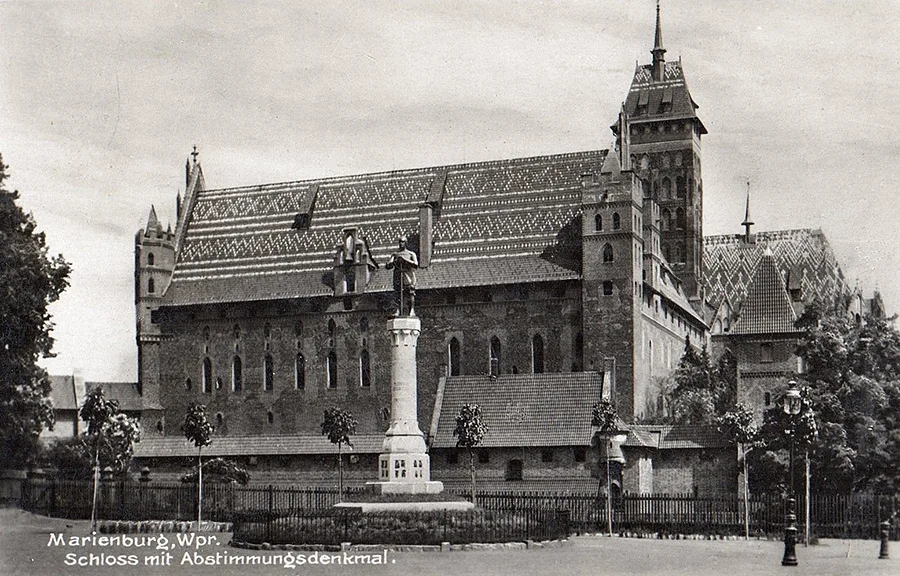
Curiously, from foggy Albion to the shores of the Baltic, medieval castles were laid out on one and the same principle: attackers had to storm obstacle after obstacle and take one line of defence after another. Thus an armed force that dared to capture Marienburg Castle from the west, its least protected side, would have had to get through some fifteen fortified gates and four drawbridges and break through three portcullises.
Something else is interesting, too: in the centuries-long history of assaults on thousands of castles across Europe, the situation in which the attackers really did take obstacle after obstacle and, in the end, besieged the remnants of the garrison in the citadel — the donjon or Bergfried — occurred only a handful of times. So was this a miscalculation on the part of those who devised the castle defence system? Hardly. Most likely it was a psychological weapon: after all, those same Polish envoys were granted audiences with the grand master on many occasions. Each time they were led along a tortuous route, with bridges and portcullises lowered and raised, locks opened on iron-clad doors, under the eyes of guards in numerous towers and turrets. And on their return from Marienburg they would report to the king that this castle was a veritable brick trap that simply could not be taken by storm. Oh, and by the way: in 1361 all these many obstacles failed to keep the Lithuanian prince Kęstutis in the castle dungeon. For a single traitor in a castle's garrison can undo all the ingenuity of its builders.
By the Great War of 1409–1411 the castle had been completed. After the Order's defeat at the Battle of Grunwald, the Polish-Lithuanian army decided to end the war at a single stroke and marched on the Order's capital. By every reckoning, taking Marienburg was no longer an impossible task. Left in Marienburg was a small garrison of Teutonic knights and Hungarian noblemen, some 50 knights in all, who, on receiving news of the utter rout of the Order's army and the death of Grand Master Ulrich von Jungingen, lost heart and practically ceased to be a fighting force. But the Polish king Władysław deigned, as was the custom of victors, to spend three days on the battlefield. Then came the burial of the fallen Poles and Teutonic knights. Only on 18 July 1410 did the royal army approach Marienburg. But by then a force led by Heinrich von Plauen, the komtur of Schwetz, had already arrived there: barely had he received word of the Order's defeat than he guessed the enemy's plans and set out with his troops to defend Marienburg. He was in the castle as early as 18 July, and his first order was to burn the town so that the Poles and Lithuanians could not use it for quarters. Władysław, meanwhile, was in no hurry, occupying minor castles along the way and receiving envoys from castles and towns that wished to surrender voluntarily to the Polish crown. Only on 25 July did Władysław's army approach Marienburg. The next day a first attempt to storm it was made, without success. After that the castle came under artillery fire. Even the primitive artillery of the early 15th century showed that brick fortifications could not withstand its fire for long. Because the Poles had few guns, their stone cannonballs did not do fatal damage to the castle buildings, but they did strike fear into the defenders. One of the stone balls, which damaged the Summer Refectory of the Middle Castle, was later set into its wall in memory of those events. The Order's artillery, however, did not stay silent either, firing stone balls at the Polish army with varying success. The siege dragged on. Through a parish priest, the Teutonic knights managed to smuggle the Order's treasury out of the castle and use the money to hire mercenary troops.
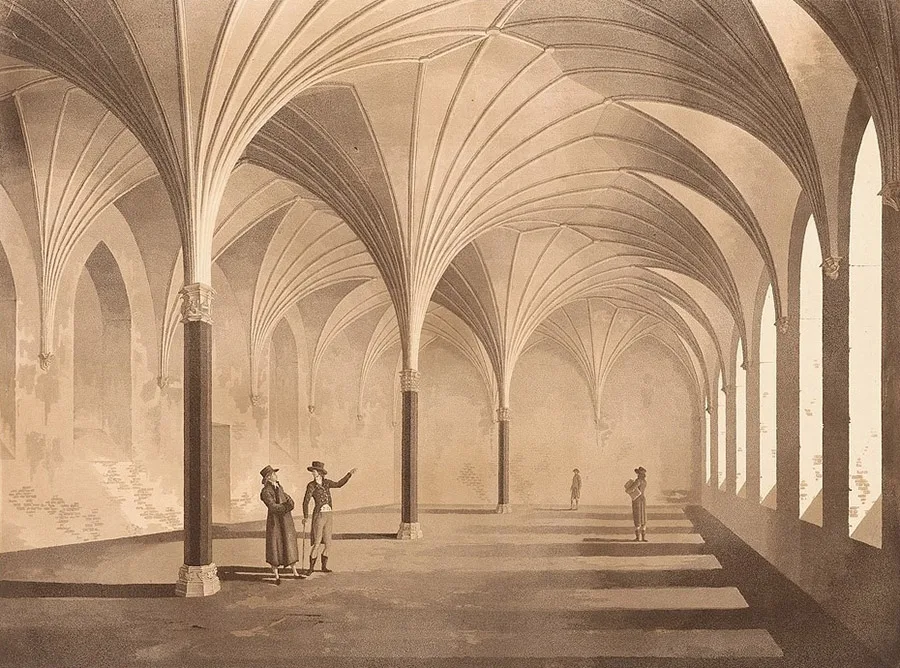 The interiors of Marienburg are simply breathtaking! As early as the 15th century it already had underfloor heating! And what ceilings!
On 9 September 1410 the Lithuanians left the combined besieging army. Then, no longer believing in success, the Polish princes began to depart as well. The king had no choice but to lift the siege and begin the return to Poland. Thus Heinrich von Plauen earned the title of “saviour of Marienburg”, while Marienburg itself could be regarded as the saviour of the Order, because had it fallen, the outcome of the Great War would have been quite different.
And that outcome, as has often been noted, was tolerable enough, given that militarily the Order had been crushed and further hostilities held out no promise of success. In territorial terms the Order lost only its very latest acquisition, Samogitia, and even that only for the lifetimes of King Władysław of Poland and Grand Duke Alexander of Lithuania. Meanwhile, the indemnity of 100,000 Prague groschen payable to the king seemed to the Order's leaders an altogether secondary clause of the peace treaty. Yet it was precisely this money that in the end achieved what the entire Polish-Lithuanian army could not: it destroyed the Order as an independent state and shattered its integrity, both territorial and social.
The period between the Great War and the Thirteen Years' War (1411–1454) was, for the Order and its capital Marienburg, a succession of political, financial and civil crises. When the time came to pay the first third of the indemnity, it turned out that the Order had no money: the treasury, the towns and the peasantry had been ruined by the war, and on top of the indemnity the Order was also burdened with domestic and foreign loans. Master Heinrich von Plauen did what European rulers had done for centuries: to pay off the debt he introduced a special tax that affected the entire population of the state, but above all the towns and the knights of the Order themselves. In response, predictably, he faced opposition both within the Order and in the towns. Danzig, the Order's most important source of revenue, rose in revolt; Rehden then joined the rebellion, and the anti-Teutonic Lizard Union stepped up its activities. The master had a single answer to all this: a military expedition, a trial and the execution of the ringleaders. But after the komtur of Rehden was convicted, the master lost the support of the Order's leadership as well. Plauen then took an unprecedented step: he began holding councils with townspeople and the lesser nobility, and in 1412 he established the “Council of the Lands”, the first attempt to bring representatives of the towns into the system of state government.
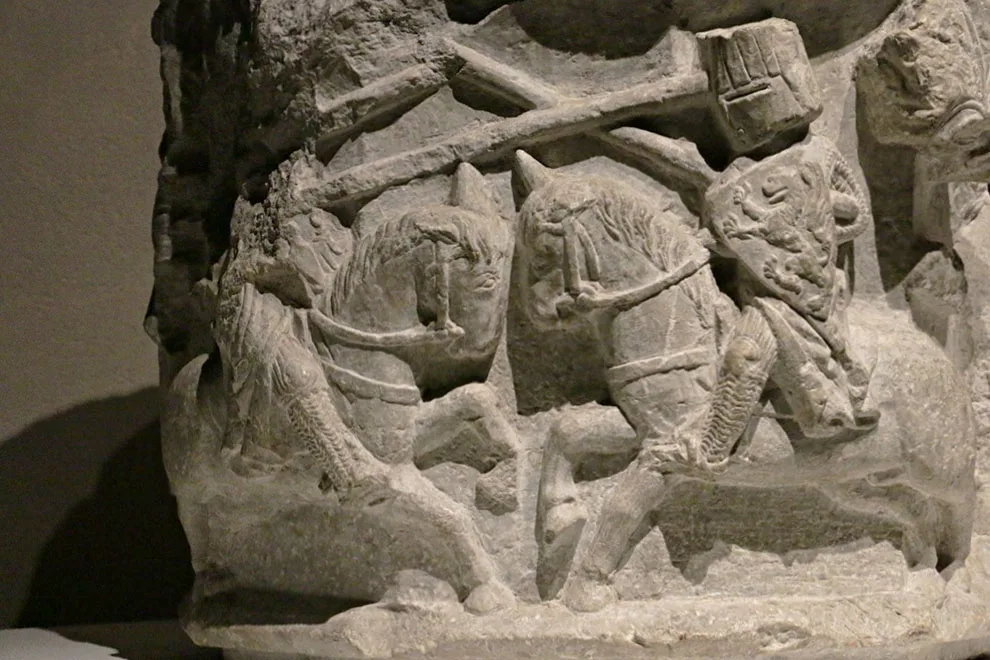 The columns in the courtyard of Marienburg's High Castle are adorned with numerous bas-reliefs and high reliefs.
Yet this "democratic step" in fact undermined the Grand Master's authority: now everyone was dissatisfied with Heinrich von Plauen – the brethren of the Order, the Livonian Landmeister, the urban patriciate and the clergy. The Polish king added fuel to the fire by sending letters to the Pope and the Emperor proposing that the Order be abolished altogether, since it no longer had any tasks left in the Baltic.
The Grand Master was bound to respond to such a provocation and launched premature military action against Poland. Being ill, he himself remained in Marienburg, which did nothing to raise his standing in military circles. In the end, the military leadership turned the army back, and the chapter convened at the Grand Master's own initiative rose against him, accused Plauen of treason and unforgivable blunders and ultimately forced him to abdicate "voluntarily". Von Plauen was sent to prison in Danzig, and the leader of the conspirators, Michael Küchmeister von Sternberg, became Grand Master. Thus Marienburg witnessed the first and last coup d'état in the history of the capital. The story of Heinrich von Plauen's subsequent burial remains unclear to this day. He was fully rehabilitated shortly before his death and, according to the Order's chronicles, laid to rest in St. Anne's Chapel in Marienburg. This fact appears in every biography of Heinrich von Plauen. However, when the crypt was opened, von Plauen's grave turned out to be empty. Then, in 2007, Polish archaeologists opened a crypt in the cathedral of Kwidzyn (Marienwerder) containing the burials of three men from the time of the Order. In one of them, anthropologists identified the 27th Grand Master of the Teutonic Order. His burial in Marienwerder is now considered an established fact.
Internal strife within the Order, high taxes and constant Polish pressure led to the Thirteen Years' War (1454–1466). On one side fought the Order and the towns loyal to it, on the other the Prussian Confederation – towns that wished to break free of the Order's rule – actively supported by Poland. Some towns even switched sides several times, depending on whose troops happened to be at their walls. The staunchest opponents of the Order and the backbone of the Prussian Confederation were Danzig (Gdańsk) and Elbing (Elbląg).
From a modern statehood perspective, the actions of the Prussian Confederation, aimed at breaking up the Teutonic state and passing under the Polish crown, look like outright betrayal. But at the time this was quite normal, since vassal allegiance meant far more than nationality. Besides, the population of the Prussian towns was a colourful mix that included Poles, Lithuanians and ethnic Prussians.
Whereas the three Grand Masters who succeeded Heinrich von Plauen – Michael Küchmeister (1414–1422), Paul von Rusdorf (1422–1441) and Konrad von Erlichshausen (1441–1449) – pursued cooperation with the towns and later with representatives of the Prussian Confederation, the next Grand Master, Ludwig von Erlichshausen, insisted on the Order's monopoly on power and dealt with the municipalities solely by dictate. In response, representatives of the Prussian Confederation sent a letter to the Polish king Casimir IV asking him to take them under his wing. On 6 March 1454, the Polish side issued an act of incorporation under which the towns of the Prussian Confederation and the territories belonging to them became part of Poland. The rebellious townspeople surrounded the Order's castles nearest to their towns, demanding that the knights leave them and surrender them to the insurgents. The Order responded by opening hostilities at a time when it was completely unprepared for them. From the very outset, the Order suffered defeat after defeat. Mercenary troops were needed, but there was not enough money to pay for them. Marienburg was besieged by the Poles as early as 1554. By then the castle had acquired outer earthwork fortifications housing artillery. This reflected the spirit of the age: in an era when artillery and hand-held firearms were developing, Europe's military engineers were still not ready to abandon the old castles, so they surrounded them with outer earthen ramparts with redoubts, basteis and bastions, which withstood the besiegers' firepower. The siege of Marienburg also involved gunpowder weapons.
Gradually the Order began to turn the tide on the battlefields. Now, however, the main problem was the empty treasury. The Order began selling off its possessions to raise at least some funds for mercenaries. By 1456 matters had gone so far that the Grand Master pledged the capital itself – Marienburg Castle – to Bohemian mercenaries against the debt he owed them, and left for Königsberg. In 1457, when Polish troops approached Marienburg, the mercenaries simply sold it, which they were formally fully entitled to do. In 1466 the Order was utterly exhausted and sued for peace. The Polish side, and especially the towns involved in the war, had also been badly ruined by the fighting and military expenditure. That same year the Second Peace of Thorn was signed, under which the Order lost its sovereignty and most of its territories. The former capital of the Order, Marienburg, also went to Poland.
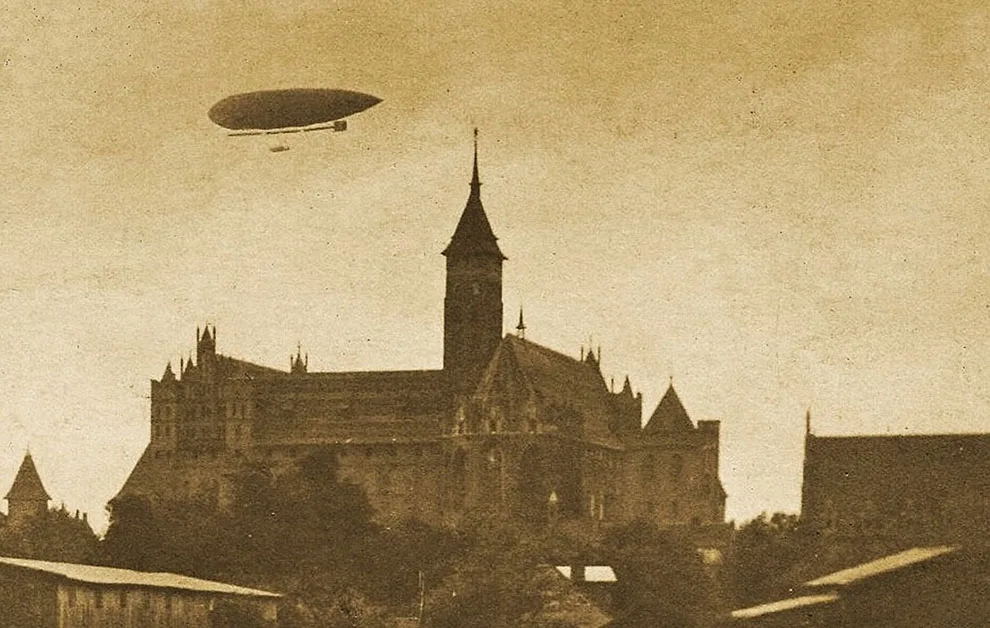 A zeppelin over Marienburg. Once upon a time in Prussia, they flew between cities the way aeroplanes do today.
After passing into Polish hands, Marienburg Castle, now called Malbork, lost its former grandeur. The castle itself remained unchanged, but its status was considerably diminished. It became merely one of many royal residences, a venue for meetings of delegations and receptions of embassies, for balls and festivities. The castle grounds also housed a workshop, an arsenal and a sizeable garrison.
In 1618 the church in Malbork was handed over to the Jesuits. In 1626 and 1656 the castle was captured by the Swedes. It was here, on 29 June 1656, that Frederick William, Elector of Brandenburg and Duke in Prussia (the "Great Elector"), in the course of settling the question of Prussian sovereignty, signed the Treaty of Marienburg, under which the duchy became a fief of the Swedish king (a temporary arrangement, as Frederick William intended). During the long period of the Polish-Swedish wars, Malbork found itself in the war zone several times but suffered no damage.
After the Partition of Poland in 1772, Marienburg Castle faced a new danger: it came to be used extensively for economic purposes, with some of its rooms rebuilt and others dismantled for bricks. Its destruction was officially prohibited only in 1804, after Max von Schenkendorf, a student in Königsberg, had appealed to the public through the press the year before, demanding that the medieval monument be preserved. Prussia's wars with Napoleon disrupted the plans to save Marienburg. But once they were over, restoration of the castle began in 1816, funded mainly by donations. The restoration was completed in 1850, and the castle regained its former beauty. In 1872 it even hosted the celebrations of the centenary of West Prussia's incorporation into Germany, attended by Kaiser Wilhelm I. Reconstruction of the castle continued after these festivities. The work was directed by Conrad Steinbrecht, an expert on the castle's history.
In Nazi Germany, attitudes toward the Teutonic Order and the buildings it left behind were ambivalent. On the one hand, the ideologues of German Nazism drew direct historical parallels between the Third Reich and the State of the Teutonic Order, used the Order’s symbols and mythologised its history. On the other hand, they kept their distance from the Order, mindful of its rather inglorious end and its vassal dependence on Poland. Moreover, the Nazis believed that it was far more useful for young people to study present-day realities than to dig into an ambiguous past. Nevertheless, Nazi organisations made quite active use of the surviving buildings of the Order, and with an ideological subtext. The Grand Master’s Palace in Marienburg, for instance, repeatedly hosted members of the Nazi Party for various ceremonies, while the castle grounds served as a summer camp for the local branches of the Hitler Youth and the League of German Girls. Such use of historic buildings was by no means rare in other parts of the Reich either.
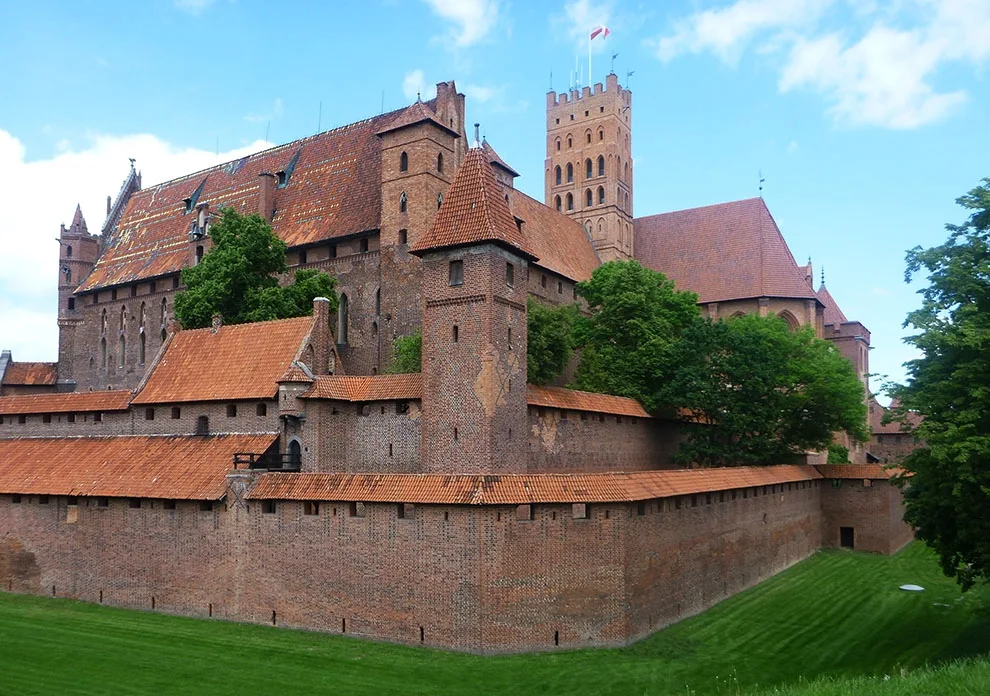 Marienburg is the largest brick castle in the world.
As units of the Red Army approached Marienburg, the Nazis declared the castle a fortress. It was a decision with plenty of propaganda value but little military sense. Unlike Königsberg, Marienburg was first bombed by Soviet long-range aviation, which should be described as tactical rather than strategic, as in the case of the British. This was followed by artillery shelling and an assault, again supported by aircraft.
As a result, by the end of the fighting for Marienburg the castle was a heap of ruins in which the former castle buildings could barely be made out. Yet as early as the late 1940s, the Polish side cleared the site of mines, removed some of the rubble and shut the castle off to scavengers hunting for building materials. In the late 1950s, a public committee for the restoration of the castle was set up in Malbork, made up of local historians, cultural figures and local history enthusiasts. In 1961, the Castle Museum was founded. The reconstruction of the castle went on for many years and is still not finished. In 1997, Malbork Castle was inscribed on the UNESCO World Heritage List. Experts noted the high degree of authenticity of the restored castle buildings. In 2014–2016, restorers completed the restoration of the castle cathedral, or, as it is now called, the castle Church of the Blessed Virgin Mary. The reconstruction of the castle complex is not yet fully complete. But even in its present state, the Marienburg Castle museum complex is a site astonishing for the sheer scale of its buildings and the richness of its exhibitions, attracting hundreds of thousands of tourists from many countries every year.
Illustrations: Bildarchiv Ostpreußen, bildarchiv-ostpreussen.de, Mikhail Ogorodnikov
Translated from Russian with the help of AI (Claude, Anthropic), October 2026.