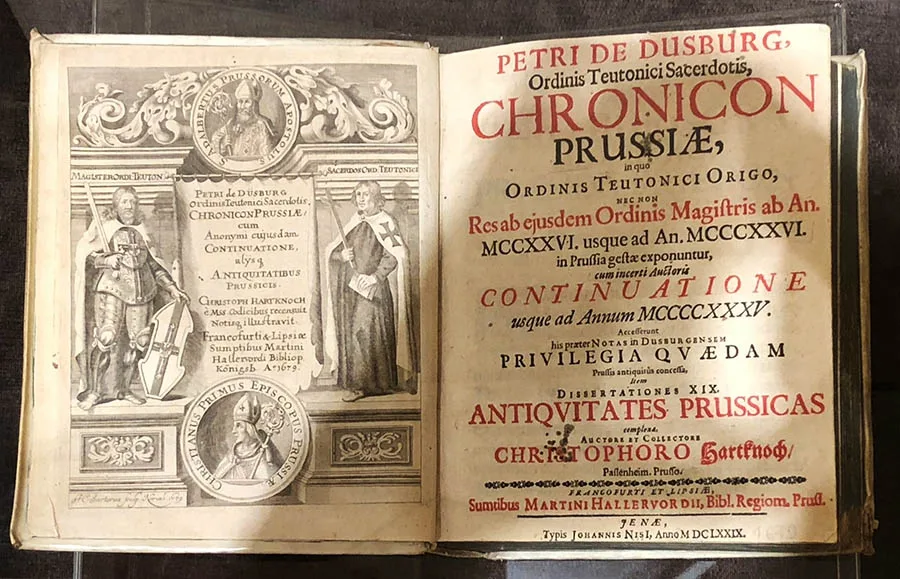
This is how these events are described in the "Chronicle of the Prussian Land" by Peter of Dusburg:
OF THE BRETHREN'S WAR WITH THE POMESANIANS AND OF THE BUILDING OF MARIENWERDER CASTLE
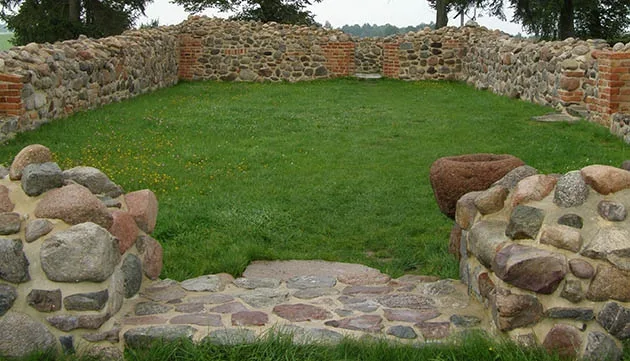
“After … by the grace of God… the bounds of the land of Kulm had been purged of the old leaven of vice and the guile of the heathens, so that God our Saviour might grant us success on the road into the lands of the neighbouring heathens, as some confidently believe, the master and the brethren, having made ready all that is required for the building of castles, crossed unnoticed to the island by Quidin, which now lies almost opposite Marienwerder, and there, in the year of Our Lord 1233, raised a castle upon a hill and named it Marienwerder. But when that noble man and valiant knight from Saxony, the burgrave of Magdeburg, called ‘with the little hand’, came to the castle of Kulm surrounded by many knights and squires, in the course of the year he spent there he went forth with the master and the brethren and moved the aforesaid castle of Marienwerder from the island of Quidin to the place where it now stands, in the Pomesanian district called Reisen, changing its site but not its name.”
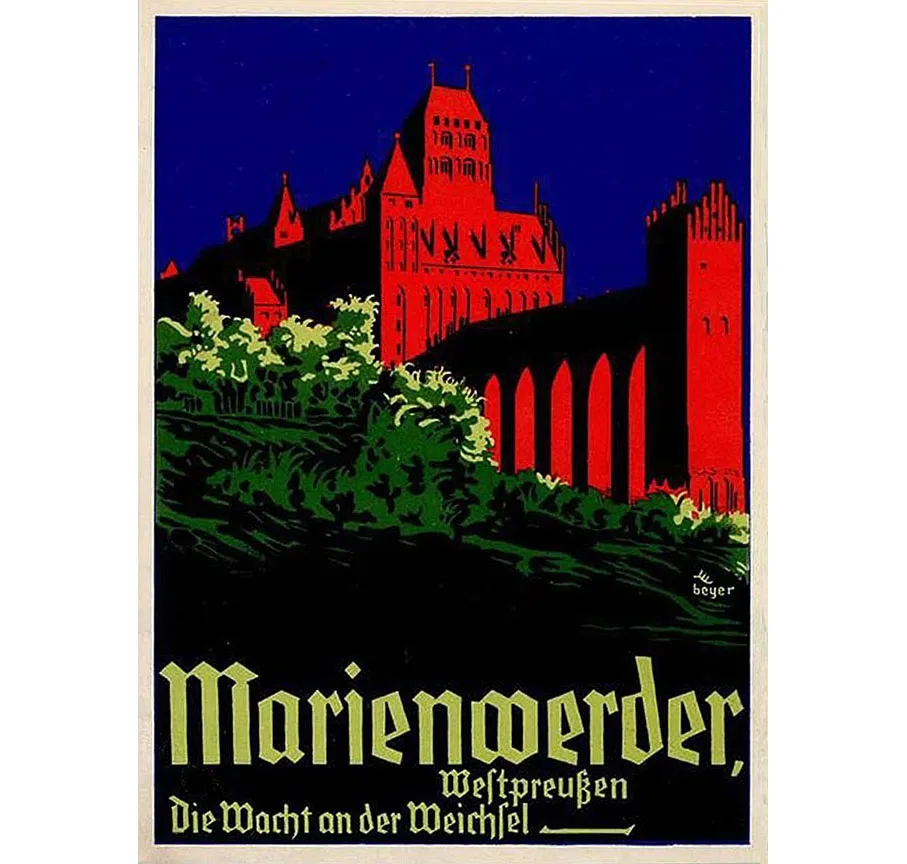
In 1234 the settlement by Marienwerder Castle received town rights. Nine years later, in 1243, the question arose of dividing the Prussian land of Pomesania between the Order and the Bishopric of Pomesania.
The point is that the papal bull blessing the Teutonic Knights' conquest of Prussia and granting them the lands they seized provided for a third of those lands to be handed over to the Church, that is, to the local bishop, under his full administrative and economic control. In the remaining two thirds, the bishop retained full ecclesiastical authority. The charter of 29 July 1243 states, among other things: “The second diocese we delimit thus: it is bounded by the Ossa, the Vistula and the Drausensee, and from there upstream along the river Pasaluk, so that Werder, Marienwerder, Zantir and Groß Werder shall belong to this diocese…”. In December 1248 the Dominican friar Ernst became the first Bishop of Pomesania, and representatives of the Order took part in confirming his candidacy. Because of the Prussian uprising, however, he was only able to take up his duties in 1249. The actual division of Pomesania between the Order and the bishopric took place in 1250: the Order's Vice-Landmeister, Ludwig von Queden, divided all the conquered lands into three roughly equal parts and invited the future bishop to choose one of them. The bargaining over the land was evidently quite tense, since the charters confirming the final partition of the territory were not signed until 1255. The bishop chose the western part of Pomesania, with the castles of Marienwerder, Riesenburg (Prabuty) and Schönberg (Szymbark). After Bishop Ernst died in 1258, the second Bishop of Pomesania was Albert, a brother of the Order (whose appointment to the post was, naturally, promoted by the Order's authorities). Then came the second and most powerful Prussian uprising. Bishop Albert was forced to leave his domains. He returned only in 1276 and settled in Riesenburg Castle, not far from Marienwerder. Here his former membership of the Order made itself felt: when the time came in 1284 to establish the bishopric's highest collegial body, the cathedral chapter, it was made up (with the Order's approval) exclusively of brothers of the Teutonic Order. Since the chapter itself was empowered to elect the bishop, from then on all the heads of the Pomesanian bishopric and all the members of its cathedral chapter came from the Teutonic Order. In subsequent agreements the bishop reserved for himself the unconditional right to ecclesiastical and administrative authority (the collection of taxes and dues) in his domains. Matters of defending the lands against external and internal enemies, however, remained within the competence of the Teutonic leadership. Marienwerder Castle was given over as the residence of the Pomesanian cathedral chapter, which was also granted full authority over the town of Marienwerder and the surrounding area. In this way the Bishopric of Pomesania was in effect incorporated into the Teutonic Order. Marienwerder Castle can therefore be called both an episcopal castle (which is perfectly correct) and an Order castle, since it was just as much a stronghold of the Teutonic Order as the “purely Order” castles.
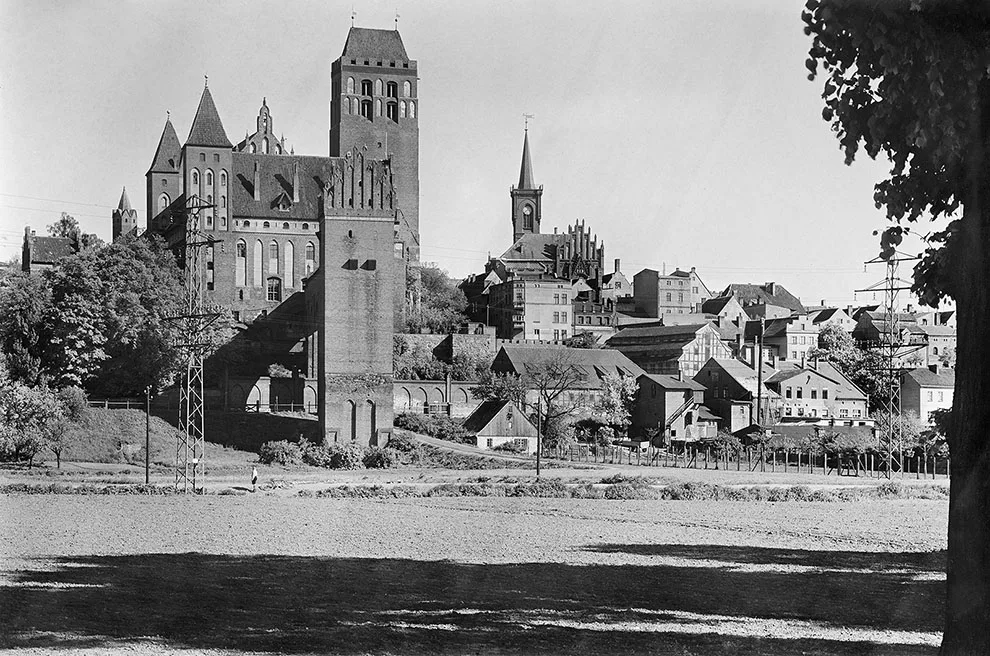
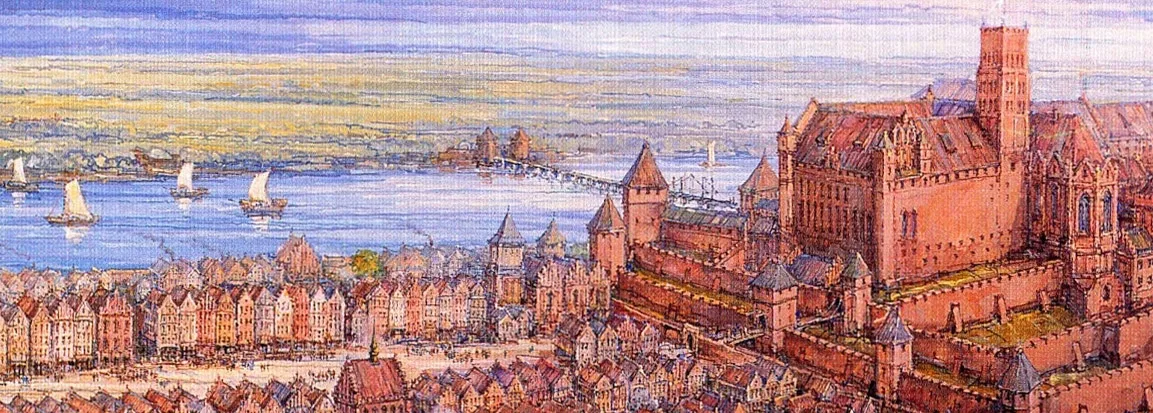
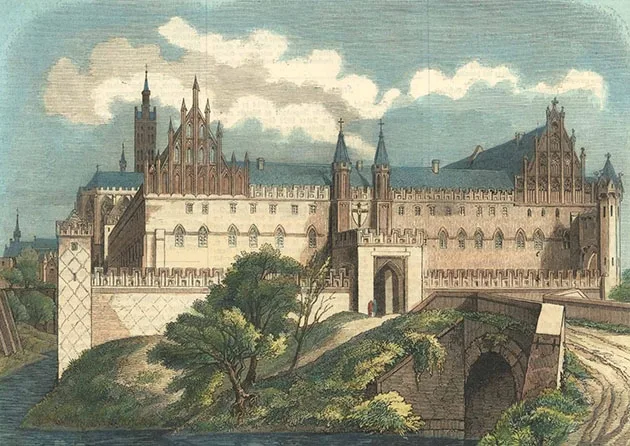
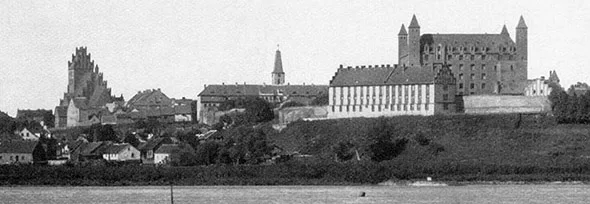
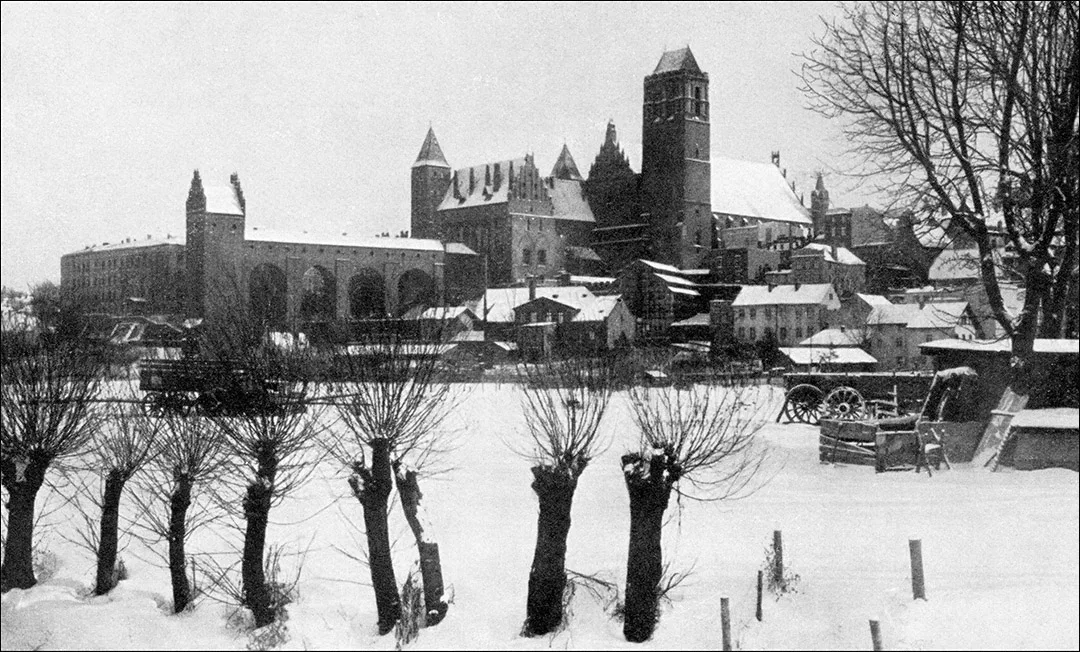
Construction of the stone castle of Marienwerder began in 1285, after it had been confirmed as the residence of the Pomesanian cathedral chapter. The building work lasted more than 50 years and was completed around 1340. The finished castle was a classic square of four wings enclosing a courtyard.
Square towers rose at the corners of the quadrangle. The functions of the buildings largely resembled those of a commandery castle: the east and south wings served mainly administrative purposes and housed the chapter house, the archive, the apartments of the head of the chapter, the treasury, the library, classrooms for the pupils of the cathedral school and an infirmary. The north wing was given over to domestic needs, its rooms occupied by the kitchen and storerooms, as well as the winter refectory and a chapel. The west wing contained the dormitories. Adjoining the castle to the north was an extensive outer bailey (Vorburg). Around 1393 a danzker was added, known today as the “Gdanisko tower”. The danzker projected far beyond the castle walls and was linked to it by a 50-metre brick arched bridge. Polish historians maintain that the Marienwerder danzker was (and still is!) the largest danzker of all the castles of the Teutonic Order and the Kingdom of Poland.
Around 1325, construction of a cathedral began near the castle. It was decided to join the new cathedral and the castle into a single complex, and to this end the castle's south-eastern tower was converted into a bell tower. In 1330 Grand Master Werner von Orseln, murdered by a mentally ill brother of the Order, was buried in the cathedral. There was in fact nothing unusual about this choice of burial place: the burial site of the Order's grand masters in St. Anne's Chapel at Marienburg came into being later, after the death of Master Dietrich von Altenburg in 1341. Moreover, St. Anne's Chapel apparently became the sole last resting place of the Order's leaders only with the death of Heinrich Dusemer (1351), since Master Ludolf König von Wattzau was once again buried in Marienwerder Cathedral in 1345. Looking ahead, I will add that the third grand master to be buried in Marienwerder Cathedral, in 1429, was Heinrich von Plauen. Why the master, removed from power in 1413, found his rest here rather than in Marienburg is still unknown. By the time of his death the disgraced master had been fully rehabilitated and had even gained renown as the “saviour of Marienburg”. Perhaps there were, after all, some reservations about his person; perhaps the very story of his arrest, which cast a shadow on the morals of the Teutonic leadership, played its part. In any case, Marienwerder holds the remains of three grand masters of the Order whose fates were out of the ordinary: one was murdered by a brother of his own Order, the second resigned because of mental illness, and the third was removed from power by a rival contender for the Order's highest office.
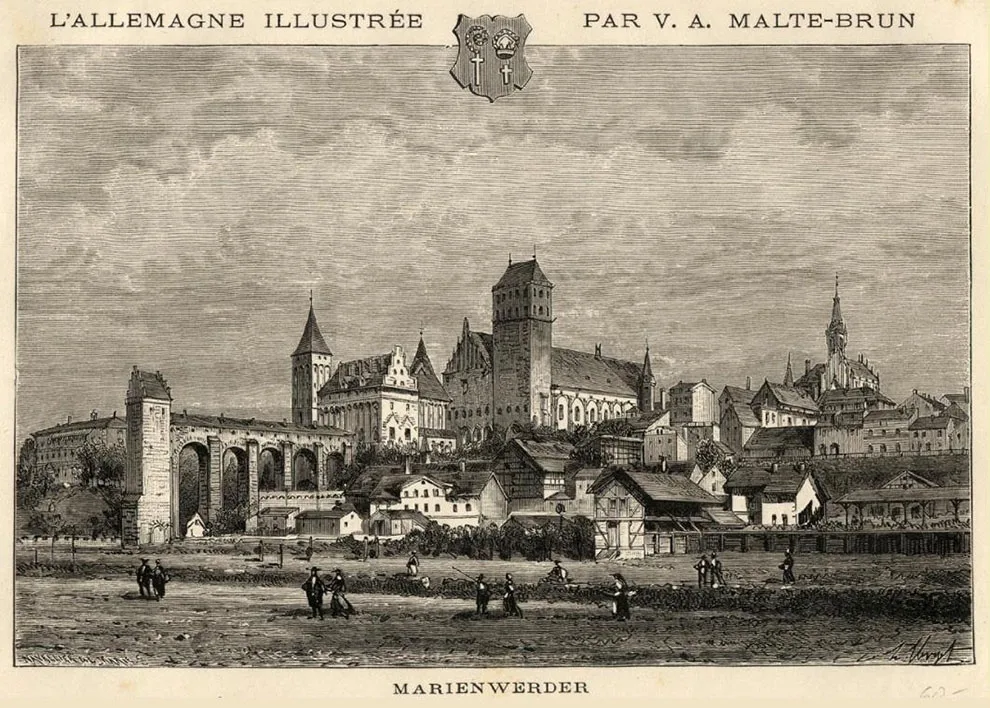
From the time it was built until the Great War (1409–1411) between the Order and Poland and Lithuania, the new castle of Marienwerder took part in no military action whatsoever. After the Battle of Grunwald, however, sieges and assaults became a fairly regular occurrence for it.
In the autumn of 1410, after its unsuccessful siege of the Order's capital, Marienburg, the Polish-Lithuanian army took Marienwerder Castle “on the way back” to Poland. When the war ended, the First Peace of Thorn left Marienwerder in the Order's hands. The sharp deterioration of the economic situation in the Order's state that followed, together with the discontent of the secular nobility and the burghers with the Order's rule, led to the creation of the Prussian Confederation of towns, which was founded in Marienwerder on 14 March 1440. Naturally, the town of Marienwerder itself joined the Confederation.
During the Thirteen Years' War, which broke out in 1454, Marienwerder Castle was threatened with attack more than once; the fiercest confrontation was the siege of the castle in 1460 by the Polish voivode Andrzej Puszkarz. The next time a Polish army appeared beneath the walls of Marienwerder was in 1478, during the so-called War of the Priests (1478–1479). This time the Poles took the town, but the castle, where the townspeople had taken refuge, held out. The next war in the chronology, the Horsemen's War (1519–1521), did not pass Marienwerder by either. In March 1520 a Polish army besieged and captured it. These military ordeals inevitably took their toll on the castle. At least two major repairs are known to have taken place, in the 1480s and the 1520s, during which the corner towers damaged in the assaults were dismantled.
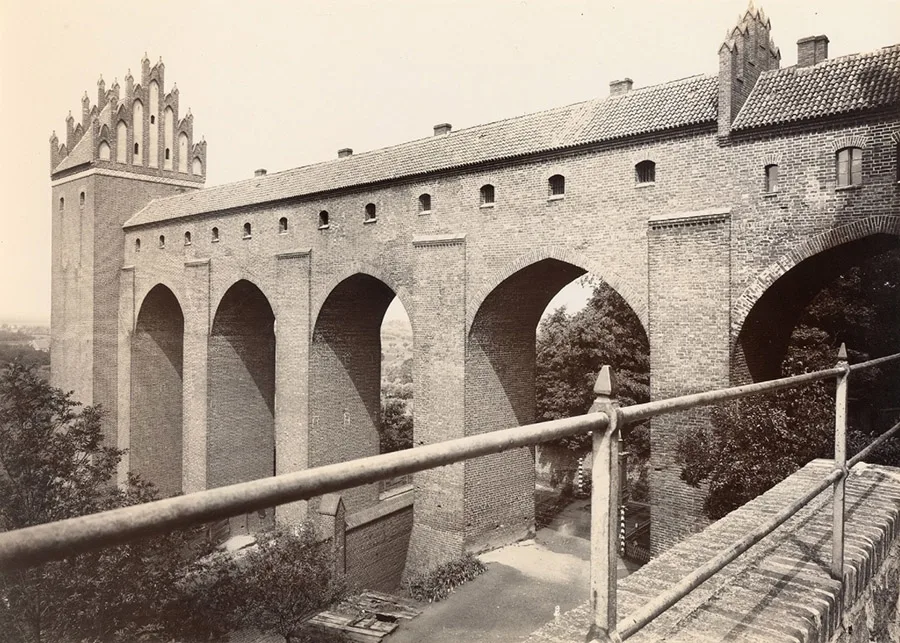 The surviving danzker of Marienwerder Castle (pictured) is unparalleled in Prussia.
After the signing of the Treaty of Kraków (1525) between the Teutonic Order and the Polish Crown, the secularisation of the Order and the creation of the secular Lutheran Duchy of Prussia in that same year of 1525, the castle became the residence of the now Protestant Bishop of Pomesania.
The first such bishop and master of Marienwerder Castle, from 1530, was a truly remarkable man, Paul Speratus, one of Martin Luther's earliest companions, a court counsellor to Duke Albrecht, and the author of Protestant writings and hymns. In the second half of the 16th century Marienwerder Castle lost all military significance and became the administrative centre of an Amt. Its rooms were now filled with administrators, tax collectors and judges. Like many other castles, Marienwerder could be used for official receptions, since it had spacious halls and its very appearance lent itself to affairs of state. Thus in 1709 Tsar Peter I stayed at Marienwerder Castle during one of his visits to Prussia. Under Frederick II, after the annexation of West Prussia, the province's supreme court (together with a prison) was established in Marienwerder. The castle underwent a major reconfiguration for this purpose. However, the building apparently suited the provincial judges very much, which is why by the end of the 18th century a new building was erected for them, using material from the dismantled south wing.
It is quite possible that Marienwerder Castle, like a number of others, would have been completely dismantled for building materials, but by the middle of the 19th century interest in the historical heritage began to grow in Germany. The castles of the Teutonic Order were surveyed at that time, and drawings and plans of them were made. In the case of Marienwerder Castle, King Frederick William IV ordered restoration work to be carried out so that the castle would regain its former medieval appearance.
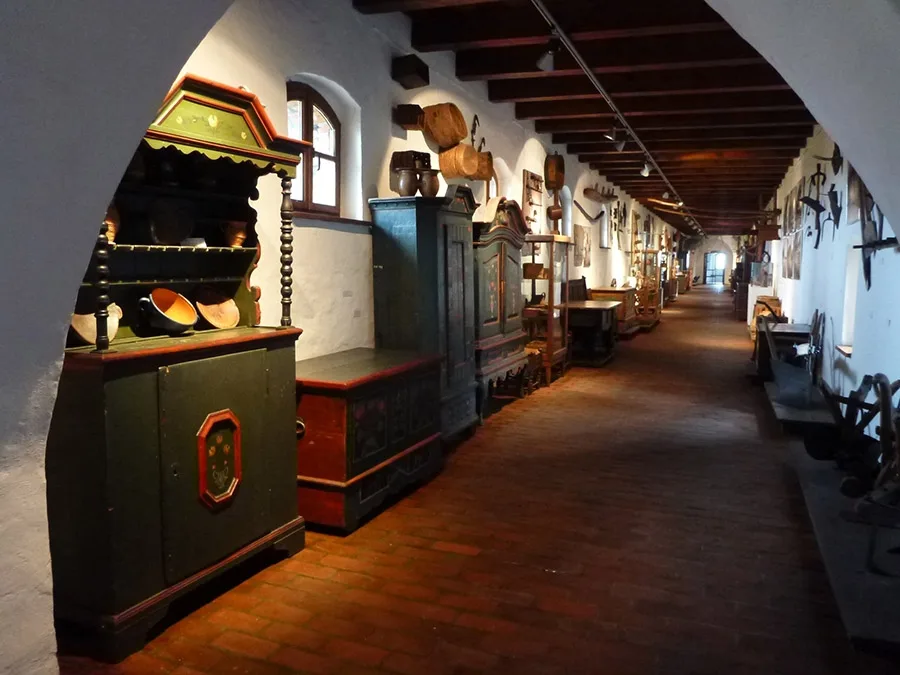 Today the castle houses a local history museum.
After the reconstruction, the castle's rooms were used for state and public purposes: soldiers were quartered here, pupils of a vocational school were taught here, and various officials held their sessions here. The Nazis also made use of the surviving medieval buildings: in 1936 a local branch of the Hitler Youth opened here.
After the war and the division of Prussia between the USSR and Poland, Marienwerder became the Polish town of Kwidzyn. As early as 1949 it was decided to convert the castle, whose walls had suffered almost no damage in the fighting, into a museum. Today it houses a rich collection of objects telling the story of the Teutonic Order and the Kingdom of Poland. The danzker of Marienwerder Castle is undoubtedly unique. In most other castles that have survived to our day, these medieval "defensive latrines" were demolished as early as the turn of the Middle Ages and the early modern period, as structures that had lost their original purpose, and so they can most often be seen only in pictures.
Illustrations: Bildarchiv Ostpreußen, bildarchiv-ostpreussen.de, Mikhail Ogorodnikov
Translated from Russian with the help of AI (Claude, Anthropic), October 2026.