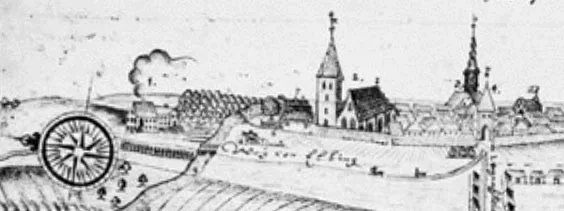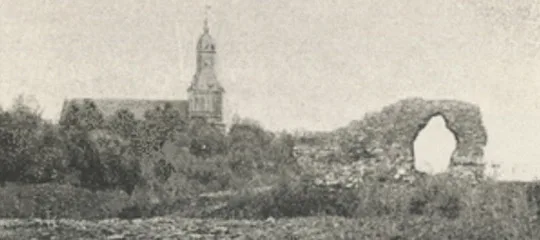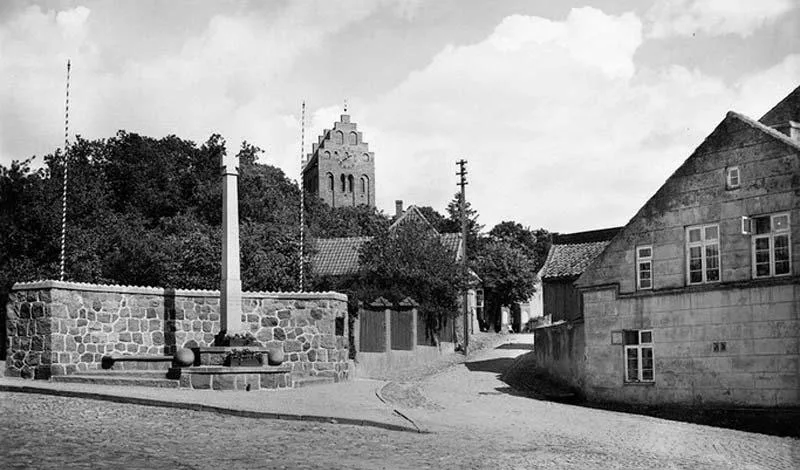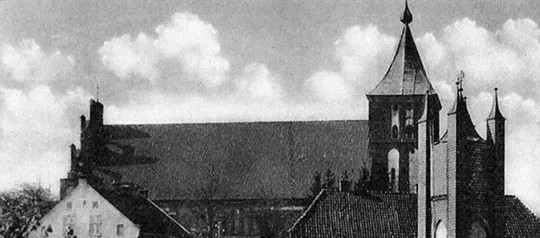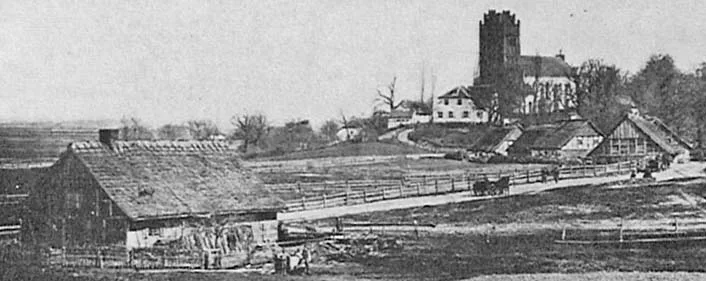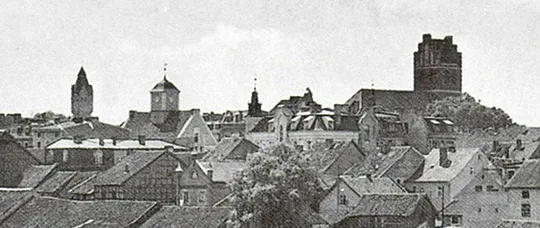
The construction was initiated by Grand Master Werner von Orseln, who entrusted the task to Dietrich von Altenburg, Komtur of Balga. The castle's main purpose was to serve as an intermediate stronghold between the castles of Kreuzburg (Slavskoye settlement, Bagrationovsk District) and Bartenstein (Bartoszyce, Poland).
In its early days the castle was called Ile or Ilaw. The name later evolved into Eylau.
Unlike many other castles, Eylau was built of stone and brick from the very beginning. History has even preserved the name of the man who directed the building work: the master builder Arnolf von Eulenstein. The castle itself was a four-wing structure, a quadrangle measuring 43 x 41 m in plan. An extensive outer bailey adjoined it on the east. The south wing housed the castle chapel, an indispensable feature of any Order castle.
Until 1347 Preußisch Eylau Castle served as the residence of an Order Pfleger; from 1347 it housed the administration of a Kammeramt. One of the Pfleger of Preußisch Eylau was Konrad von Wallenrode, a future Grand Master of the Order. By 1348 there was already a settlement called Neuhof by the castle, with twelve taverns; it later took the castle's name and grew into a town.
Preußisch Eylau played an active part in the Thirteen Years' War (1454–1466). At first fortune favoured the Prussian Confederation, whose forces took Preußisch Eylau without much difficulty, along with other castles in Natangia. Then it was the Order's turn, and the castle was recaptured from the insurgents. The Order's garrison of up to twenty knights, together with 60 militiamen fighting for the Teutonic Order, repaired the damage to the fortifications and prepared to repel enemy attacks. At that time a 2,000-strong force of the Prussian Confederation under Remschel von Krixen was marching on Königsberg. Learning that Preußisch Eylau was held by such a small garrison, von Krixen decided to take the castle in passing. The assault began on 24 May 1455. Every attempt by the insurgents to storm the castle met with stubborn resistance.
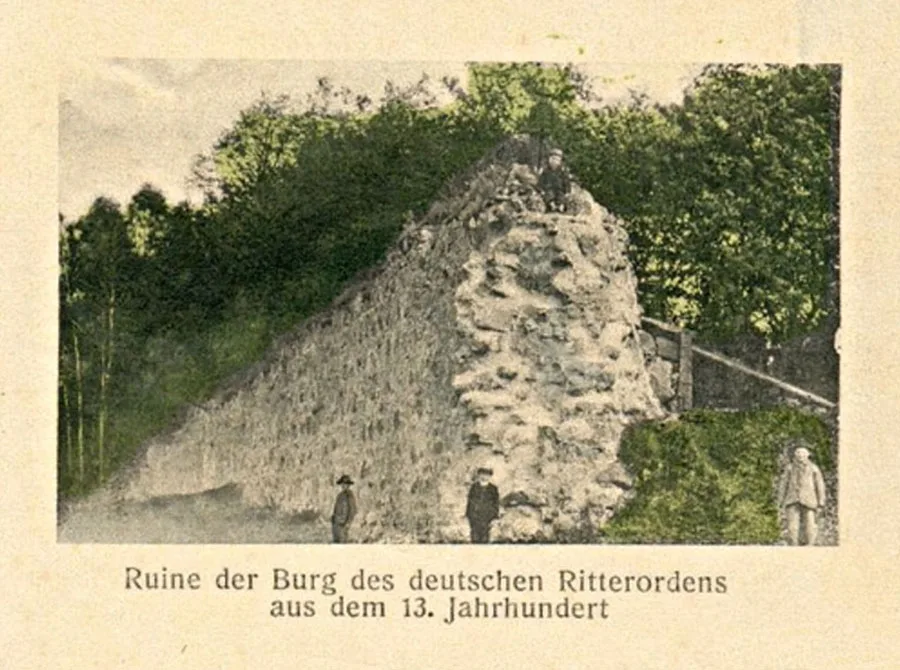
The events that followed are the stuff of legend, and their reliability is doubtful. Seeing that the garrison was clearly too small to hold the castle, the Teutonic Knights sent a messenger towards Königsberg, using an old underground passage that came out far behind the attackers' lines.
Heinrich Reuß von Plauen, the Order's Grand Hospitaller, gave the messenger the troops of Count Ludwig von Helfenstein and Captain von Blankenstein. On 26 May 1455, under cover of the morning fog, the Order's reinforcements launched a surprise attack on the enemy army. The outcome: 600 supporters of the Prussian Confederation of towns killed, 300 taken prisoner, and the siege of Preußisch Eylau lifted.
Preußisch Eylau came under serious attack twice more during the war. In October 1455 the enemy burned the outer bailey but failed to take the castle, and in March of the following year a sudden and powerful counterattack by the garrison thwarted an attempt to besiege it.
After the war ended and the Polish Crown's feudal overlordship of the Prussian lands was formalised, in 1492 Preußisch Eylau Castle was granted to Heinrich Reuß von Plauen. At about the same time the castle received a coat of arms featuring a lion, the same as the one on the arms of the von Plauen family.
Preußisch Eylau saw military action for the last time in the age of the Order in 1520, during the Riders' War (1519–1521), the open conflict between Master Albrecht and the Polish King Sigismund. Once again the Poles burned the settlement, but the castle held out.
Immediately after the Reformation in Prussia, Preußisch Eylau Castle became the residence and estate of a Hauptmann. On 30 November 1585 the settlement at Preußisch Eylau was granted town rights by Regent George Frederick.
After the Napoleonic Wars, in 1814, the Preußisch Eylau estate (the castle and the surrounding land) changed hands once more, bought by one Heinrich Valentini, who built a manor house on the site of the outer bailey and named it Henriettenhof after his wife, while the castle itself slowly fell into ruin without care or repair. The Valentini family owned the estate until 1945.
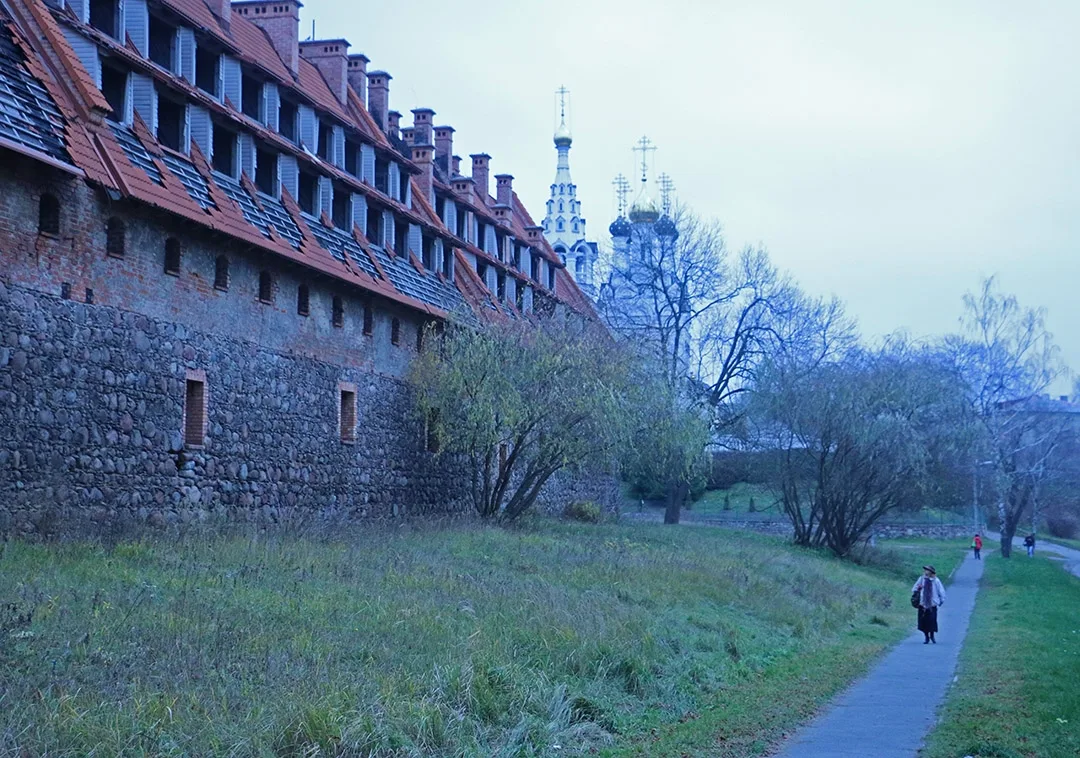
In 1961 the grounds of the castle and the outer bailey were formally transferred to the Bagrationovsk office of the district consumer cooperative union. In 1964 an expedition from the Central Scientific Restoration Workshops of the USSR Ministry of Culture worked on the site and recorded an extreme state of neglect and destruction. For some time afterwards a shooting range operated in the west wing. In 1990 the surviving building of the outer bailey burned down. In the mid-1990s there was a project to convert the outer bailey into a hotel, and work began on it, but it did the building more harm than good.
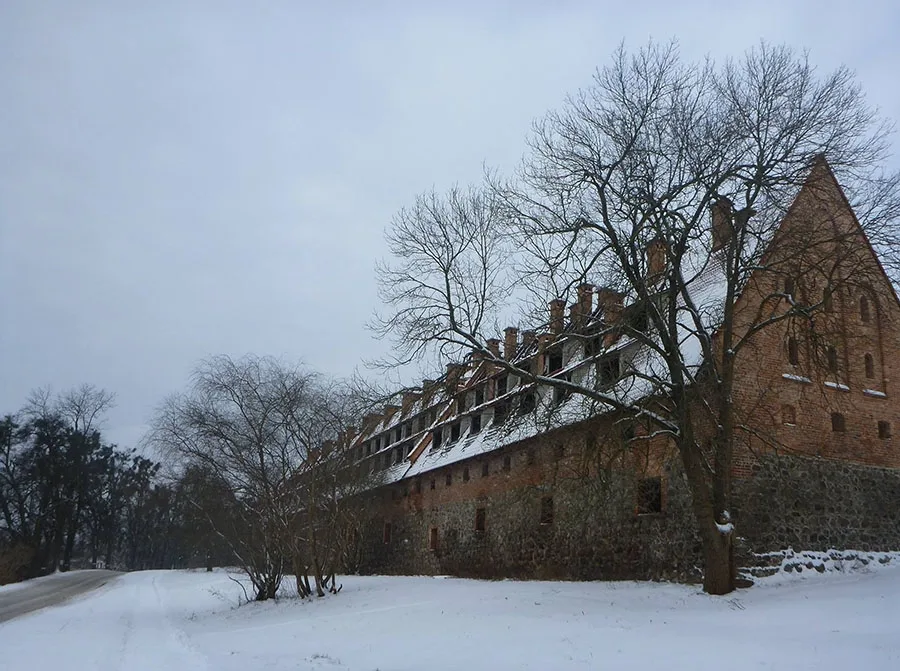 The outer bailey is all that remains of Preußisch Eylau Castle. Winter 2017.
Along the coast of the Baltic Sea and the Curonian Lagoon ran the northern chain of castles: Germau (Russkoye), Pobethen (Romanovo), Rudau (Melnikovo), Laptau (Muromskoye), Powunden (Khrabrovo) and Schaaken (Nekrasovo). The castle of Kaymen (Zarechye), described earlier, can also be counted among them, as can Labiau (Polessk). They were originally built for the usual purposes: to control the surrounding territory and to counter Prussian armed uprisings. But after the conquest of Prussia was completed in 1283, these castles took on other tasks.
From the 14th century onwards, the castles in the north of Prussia served as a barrier against Lithuanian raids on the Königsberg area and as a refuge for the local population during such raids. In the relatively short intervals between hostilities they performed an administrative function. These castles stood on the sites of old Prussian strongholds or very close to them. This location, and the reuse of the former Prussian ramparts, accounts for their characteristic rounded shape.
When the territory of Sambia was divided, the castles of Laptau and Powunden ended up on land belonging to the Bishop of Samland, and Laptau soon passed into the possession of the cathedral chapter.
Around the 1320s–1370s these castles were rebuilt in stone, which made them reliable defences against the Lithuanians, who were not particularly skilled at taking fortresses. In 1370, near Rudau Castle, a famous battle was fought between a large Lithuanian army led by the princes Algirdas and Kęstutis, together with allied Russian and Tatar detachments, on one side, and the Order's army, reinforced by the Königsberg militia and by crusaders from Danish Livonia and the German lands, on the other. The garrison of Laptau Castle also took part in the events: like Rudau, it withstood a siege and pinned down the Lithuanian army until the Order's troops arrived.
As already mentioned, the castles also served an administrative function: they housed the Order's local administrators (chamberlains) or the bishop's officials, depending on who owned the castle. However, after the Great War (1409–1411), when the Order began paying huge indemnities to Poland, maintaining its numerous castles became too costly. Those of the Order's buildings that had not been sold off to pay its debts to mercenaries were repaired only selectively and incompletely. And once the Order had been secularised and the castles were rapidly losing their military importance, their complete destruction became only a matter of time.
Rudau was partly dismantled, and one of its wings was converted into a church, whose ruins survive to this day. Germau met a similar fate. At first it found a use in the duchy: in 1581 the amber administration was moved here from Lochstädt, and in 1586 the castle was even repaired for the purpose. From 1644 to 1693 Germau housed the Amber Court, which sent illegal amber gatherers to the gallows. But the castle was never repaired again and gradually fell into decay; the amber administration and the court were moved to Palmnicken (Yantarny), and by the 18th century Germau had been partly dismantled for road-building fill and for the construction of farm buildings. Around 1760, however, one of its buildings was converted into a church. Sadly, only a small part of its tower remains. Laptau was dismantled at the beginning of the 18th century to provide fill for the Königsberg–Kranz road. Even earlier, in the 16th century, Powunden Castle was taken apart for building material, and its bricks were used to repair Laptau Castle, which outlived Powunden by some 150 years. Pobethen, too, was abandoned and dismantled for its bricks in the 17th century.
Photos on this page: Bildarchiv Ostpreußen, bildarchiv-ostpreussen.de, Mikhail Ogorodnikov
Translated from Russian with the help of AI (Claude, Anthropic), October 2026.