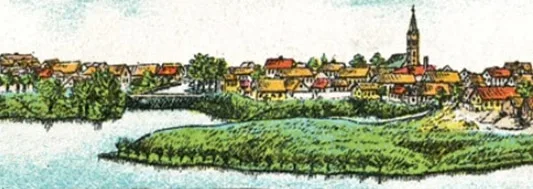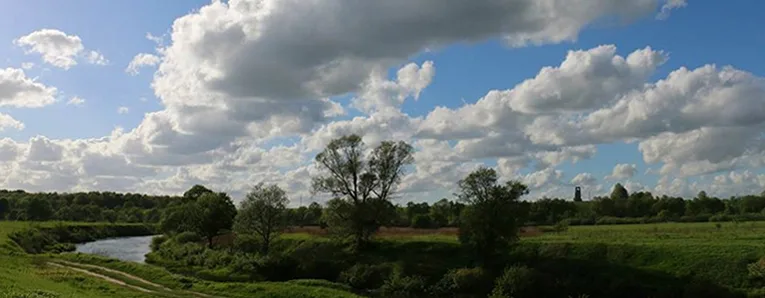
The first of them arose at a time when the Order had only just finished subjugating the Prussian tribes. In 1277 a force under Vogt Dietrich von Liedelau, after whom the oldest of the Königsberg Castle towers to survive into the 20th century was named, was advancing into Samogitian (Lithuanian) lands across the lagoon and up the Memel (Neman) River, on whose bank it attacked the Prussian stronghold of Raganita. After a siege and assault, the stronghold was taken and burned. In 1289 a timber-and-earth fortification called Landeshut was built on the site of Raganita. Later it came to be called Ragnit in honour of the Prussian stronghold. Brick buildings most likely appeared there a little later as well.
This fortress was originally intended to administer the surrounding region of Skalovia. But since the conquest of Prussia was followed by an onslaught on Lithuania, its role changed somewhat: Ragnit now became an outpost, a mustering point for the knightly forces setting out on campaigns into Lithuania.
Ragnit Castle itself became the centre of an entire system of fortifications that the Teutonic Knights built with great energy to defend the banks of the Neman, for the Lithuanian response was not long in coming, and their raids on Prussian lands became a regular occurrence. Seen from today, the situation looked like a stalemate. The Order clearly lacked the strength to defeat the Lithuanians in open battle. Nor could it successfully pursue a policy of dividing the Lithuanian people, as it had done in Prussia, because Lithuania had already entered the stage of early feudal relations, and its tribes were therefore united under princely rule. Yet the Lithuanian raids, for their part, succeeded only when they could rely on surprise. An encounter with the Order's organised army on its own territory boded nothing good for them, as the Battle of Rudau in 1370 demonstrated. Even so, such Lithuanian incursions were highly ruinous for the Order's economy. For this reason, at its forward position in the fortress of Ragnit the Order kept a strong permanent garrison of 40 knights and around a hundred foot soldiers, regularly reinforced by combined contingents of Teutonic Knights and the Order's guests who arrived in Ragnit to launch attacks on Lithuanian territory. Three times – in 1290, 1295 and 1315 – the castle came under major attack, but it was never taken, although the surrounding area was plundered mercilessly.
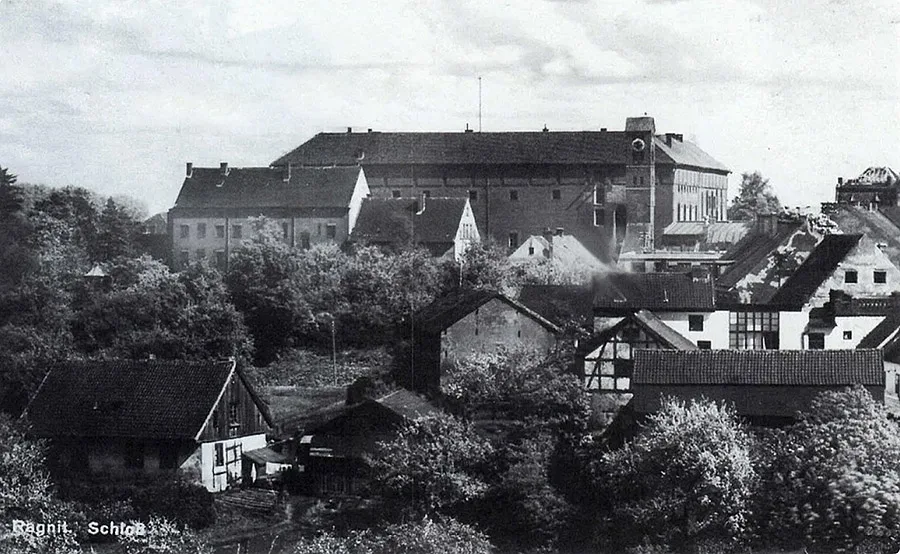
Later, however, the growing strength of Lithuania and its union with Poland under the Union of Krewo in 1385 forced the Order to fortify its outpost on the Memel considerably.
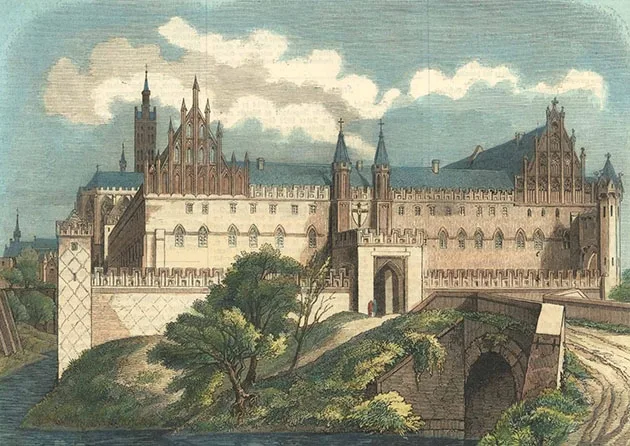
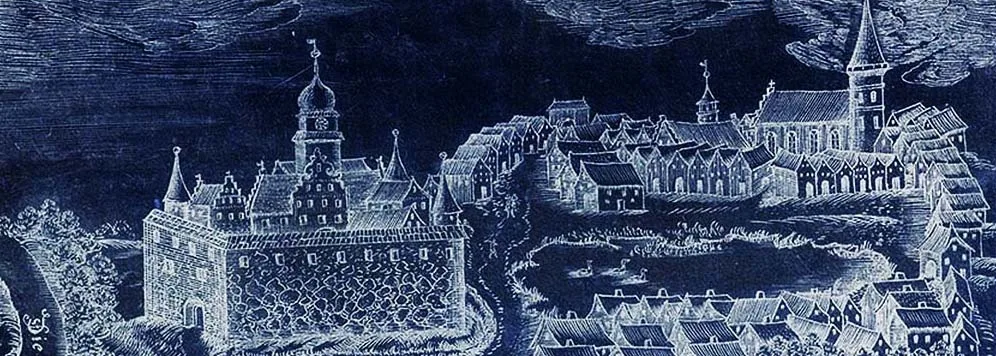
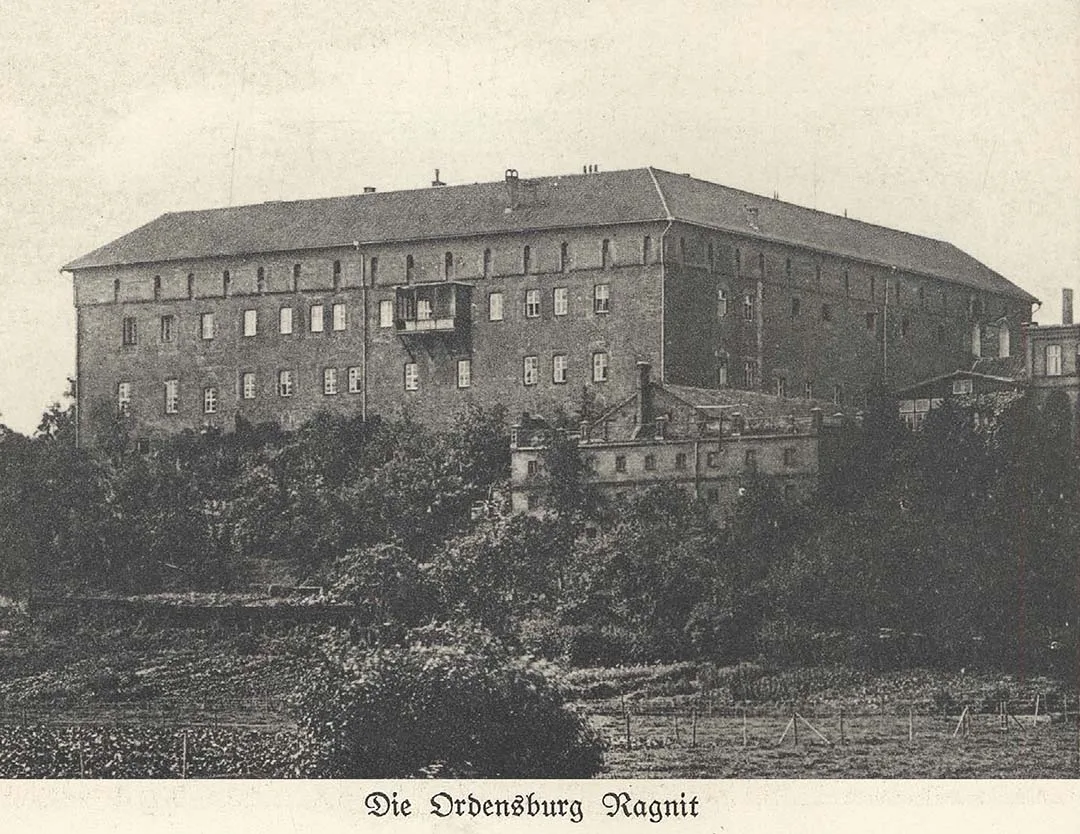
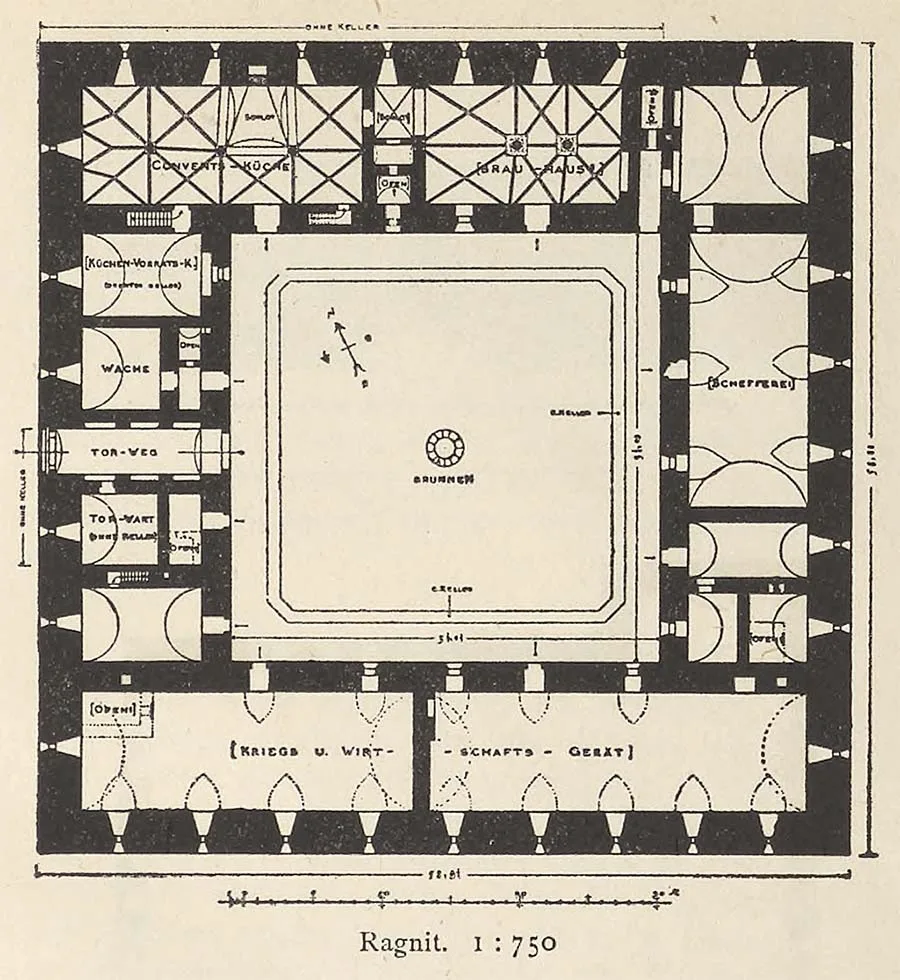
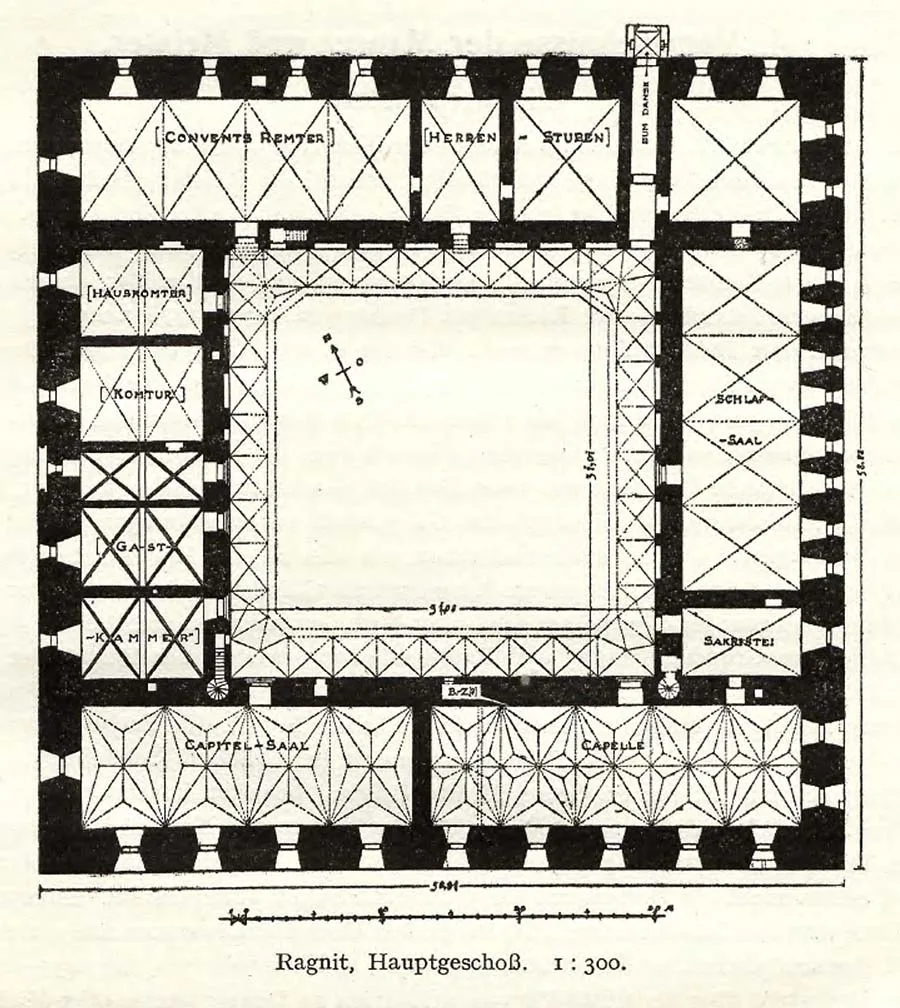
All the more so because the small castles built in Skalovia were regularly captured and burned by the Lithuanians, which meant that they had to be countered by a truly powerful fortress – and that is precisely what the new Ragnit Castle was designed to be. On the old site, however, it was impossible to expand and strengthen it significantly. It was therefore decided to build a new castle further downstream on the Memel, two kilometres from the old one. The construction is documented in detail in the Order's records, which state precisely how much money, material and food for the workers was spent, how many people were employed, and so on. We know, for instance, that as many as 30 master masons (with their assistants and journeymen) worked on Ragnit Castle at the same time, while 1,200 local inhabitants were employed as labourers. The walls took five years to build, from 1397 to 1402, after which the roofing and finishing work followed. Glazing the castle's windows took two and a half tonnes of clear and coloured glass. The castle itself, consisting of four wings arranged in a square measuring 59 by 59 metres, was rivalled in size only by Marienburg Castle before its rebuilding. The walls were three metres thick, and the castle was surrounded by a moat up to four metres deep and up to 12 metres wide. In keeping with new developments in warfare, Ragnit was well equipped with firearms: in 1407 the castle had 11 guns of various calibres and 18 case-shot pieces. Before the Great War of 1409–1411, a Vorburg was built on the western side of the castle, with a large round tower and a tall, narrow "watch" tower. The latter was probably intended for keeping an eye on the area around the castle.
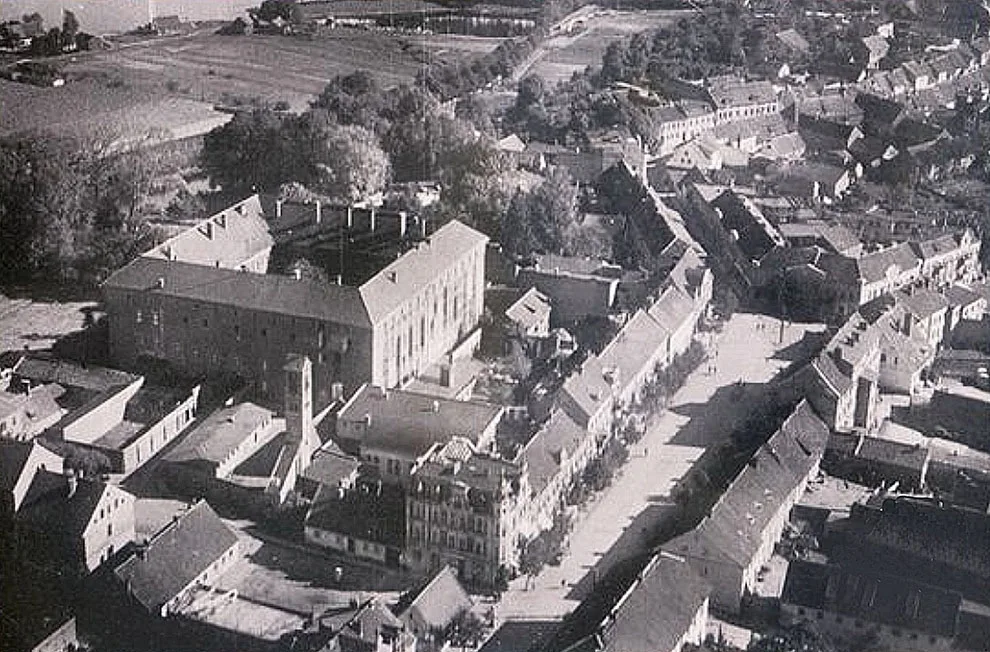 First half of the 20th century. A bird's-eye view of Ragnit Castle.
The main events of the Great War passed far from Ragnit, but the Thirteen Years' War (1454–1466) did touch it briefly: when hostilities broke out, the castle was seized by supporters of the Prussian Confederation, but the Teutonic Knights soon managed to win it back.
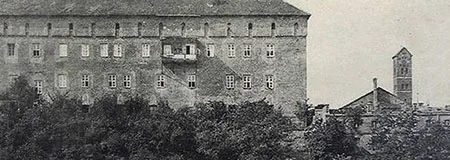
After the secularisation of the Order, Ragnit, in line with the ducal administrative reform, became the seat of a large Amt covering practically the entire north-east of today's Kaliningrad Region. A settlement grew up around the castle and received town rights by 1722. In the early 19th century it was decided to use the huge castle building as a prison and courthouse, which entailed extensive alterations. The vaulted ceilings of the upper floor were lost and replaced with ordinary flat ones; new doorways were cut, windows remodelled, interior partitions torn down and staircases installed. In 1828 a major fire broke out in the castle, after which it was restored with even greater changes. The Vorburg was demolished and built over, leaving only the "watch" tower. In this form the castle building survived until the beginning of the Second World War.
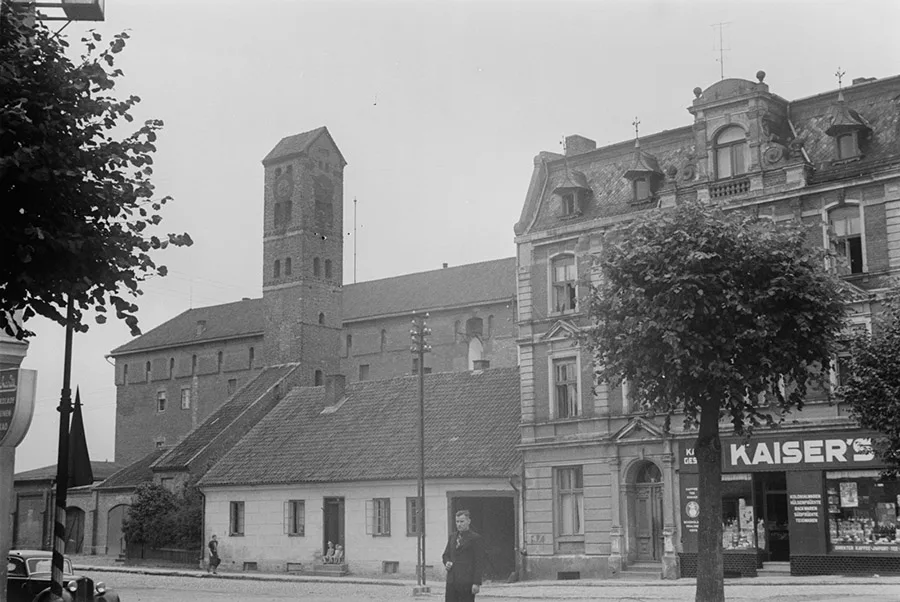
After 1945 Ragnit Castle passed to the USSR intact, though in need of care and repair. The castle courtyard was used as a market and the ground-floor rooms as warehouses. Nobody had any intention of repairing anything; the war trophy was exploited mercilessly.
By 1955 the castle was already in a dangerous state of disrepair: the roof was missing almost everywhere and the upper floors had begun to collapse. By the time filming of "Twenty Days Without War" (1976) began at Ragnit Castle, the ancient citadel was already badly ruined, as can be seen in the footage. Blowing up the castle's inner wall during the shoot added considerably to the destruction and can hardly be justified by the director's artistic vision. After that, Ragnit Castle, while remaining in effect the main sight of the town of Neman, served at the same time as a supporting structure for a heating main, a source of building materials, an illegal rubbish dump and a hangout for teenagers. Timid attempts were made to clear and conserve the ruins. Later, the windows and gates were fitted with bars and doors, but this only kept out the most well-mannered part of the population. Finally, in 2020, a local cheesemaker who had leased Ragnit Castle from its current owner, the Russian Orthodox Church (Moscow Patriarchate), carried out with the help of volunteers the most extensive works in the castle's entire post-war history to turn it into a tourist site open to the public.
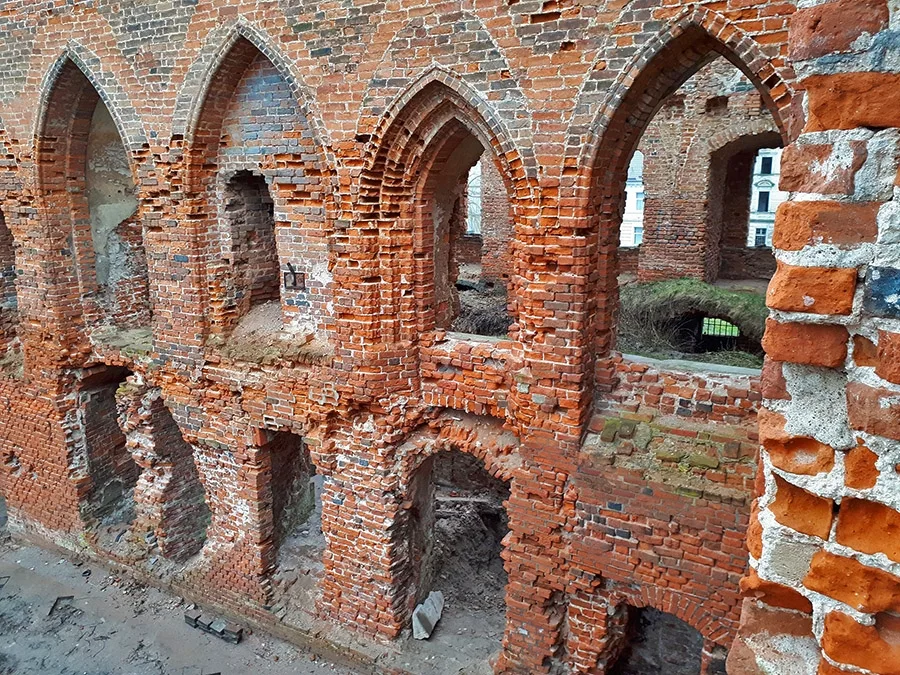
Today the castle courtyard has been paved with cobblestones, the clearing of the cellars is continuing, and new gates have been installed. Every week there are volunteer clean-up days that bring together enthusiasts from among the local residents, who are often joined by volunteers from other towns of the region, Kaliningrad first among them.
The work is still far from finished, but its brisk pace gives cause for hope. And even in its present state the castle is undoubtedly worth a visit for lovers of historical tourism, all the more so since guided tours are already being held there. If there is anything "genuinely Teutonic" in our region, it is, of course, the ruins of Ragnit Castle.
Illustrations: Bildarchiv Ostpreußen, bildarchiv-ostpreussen.de, Mikhail Ogorodnikov
Translated from Russian with the help of AI (Claude, Anthropic), October 2026.