LEGENDS OF PRUSSIA in the blog of Tatyana Kolivay.
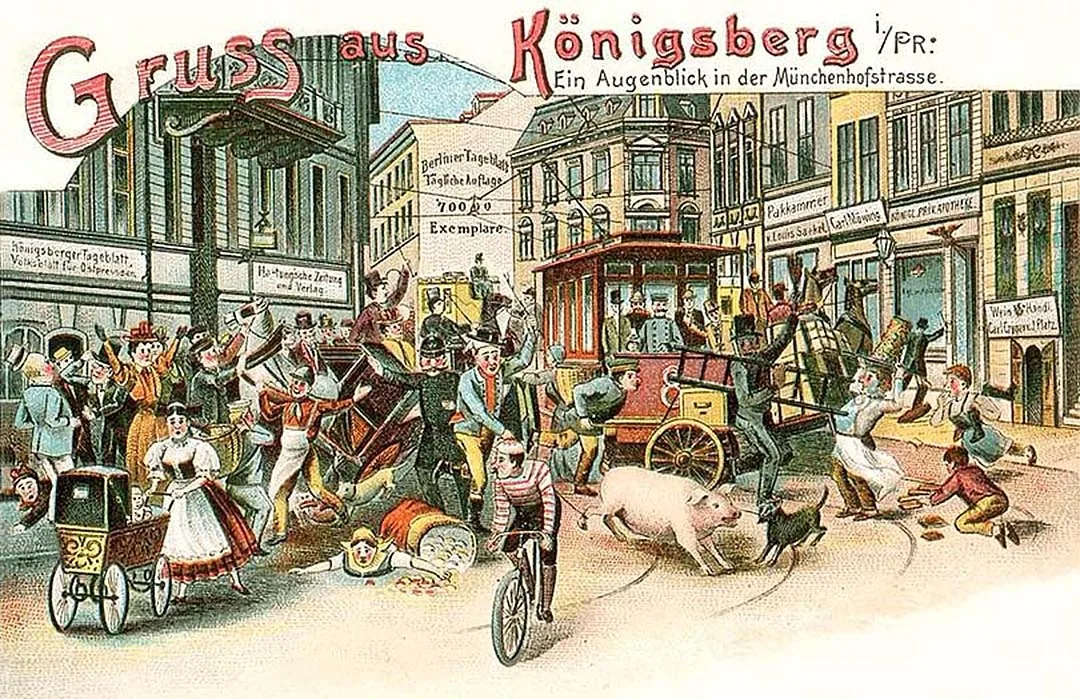
It is rather difficult to define the character of a particular city, yet we venture to remark that the main feature of Königsberg is its universality. Here you can find everything: every trade, every kind of art, every branch of science; you can see every way of life and encounter a multitude of political and religious currents. However, owing to the city's somewhat isolated position, this universality is a little deficient. Königsberg can therefore be described as a city in which everything exists in the form of "almost".
It is almost a court residence, because dukes, electors and kings have lived here, sometimes for long periods. It is almost an industrial city, because there are several large factories here. It is almost a major seaport, because two- and three-masted sailing ships can come into its centre, although the real port, Pillau, lies seven miles away. It is an almost rich city, because many very well-to-do townspeople and very wealthy merchants live in it. It is almost a fortress, since at least a small fort near the river customs post of Holländer Baum bears that name, and so on.
So the character of Königsberg is universal. It still cherishes and nurtures many archaic customs, but is equally open to the boldest innovations.
Thus, here one can still observe physiognomies dating from the period before the French invasion: ruddy faces with grey-blue eyes and grey, often powdered hair. These gentlemen have an air of solidity; they wear very respectable suits, very comfortable and recognizable by a not very wide white neckcloth with a simple little bow. They are sensible, taciturn, reliable people, Kantian rationalists of a sort in both religious and political matters. Their wives match them, the only difference being that in their dress the women do try to follow the current trends of fashion. Otherwise the faces are just as red, the eyes just as grey-blue, the manners just as artless, the character just as businesslike, and the way of thinking thoroughly practical.
But at the same time we also have young men dressed according to the latest cry of the fashion journals: they wear long, tight trousers, as if ready for riding, short coats and yellow gloves; they have white cuffs, black ties and the indispensable lorgnette hanging over an equally obligatory silk waistcoat. Some of them have their hair cut in the latest fashion, while others change their appearance every four weeks: now a full beard, now a luxuriant moustache, now a mass of tight curls on the head, soon replaced by a tousled lion's mane. No innovation should embarrass a young man who wishes to be worthy of the nineteenth century!
But Königsberg, with its Nordic mentality, is on the whole in no hurry and will not be carried away at once by something new. Haste is not in its nature.
Oh, this city is in no hurry with its judgements and conclusions. It takes some time for Königsberg to accept something and call it its own. And if the novelty contradicts sensible simplicity in any way, you will be sure to hear a saying much loved by Königsbergers: „Ach, maake Se mi doch nich tom Narre!" — "Don't make a fool of me!"
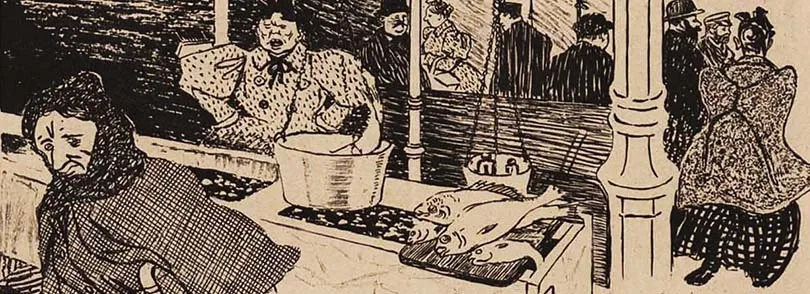
This phrase is heard everywhere in Königsberg; everyone here repeats it with pleasure: the market woman at the Fish Market, the beggar at the Tragheim Gate, the eminent professor, and the pretty little maidservant who wants to show the soldier trying to start a flirtation with her that she was not born yesterday.
A Königsberger is not so easily taken in: „Ach, maake Se mi doch nich tom Narre!"
Lithuanian traits
Along with the Jewish and Polish features of Königsberg, Lithuanian notes were quite noticeable here in former times, but now they have almost disappeared. In Lithuania itself Germanization is proceeding rapidly, so that there too the distinctive Lithuanian language and the folk songs, the dainos, are gradually dying out; many of them were collected and translated by the late Consistorial Councillor Rhesa (Jalrath Rhesa) of Königsberg.
However, the university still has a Lithuanian seminary, attended not only by Lithuanians but also by Masurians. On the map, the location of Lithuania Minor can be determined by its capital, Gumbinnen [now the town of Gusev, Kaliningrad Region]; the chief town of the Masurians' homeland is Lyck [now the town of Ełk, Poland]. The Masurians are not a Prussian or Lithuanian but a Slavic tribe which, like the Lithuanians, has a pronounced identity of its own.
Even today a Lithuanian is still easy to recognize by his costume.
He wears a fairly long, lined dark blue or white coat with a light blue or light green sash, the so-called "Pass" (der Paß). He usually has thick, long chestnut hair and a small moustache. In summer he wears a hat, in winter a helmet-shaped cap with ear flaps, which is very practical. Here it is customarily called a Lithuanian cap. The Lithuanian carries his things either in a wicker basket called a "Lischke" (Lischke), which hangs on a rope wound round his body, or in a box carried in his hands, called a "Pandel" (Pandel). Such boxes are made by the thousand in dugouts on the Pregel by the Blue Tower. The image of a Lithuanian can be seen in the city on the signboards of soap makers, probably because they get most of their raw materials from Lithuania, or perhaps because their customers are Lithuanians.
I have not been able to make any observations about the influence of the Lithuanian language on German. I remember only one amusing incident. In the Polish church a divinity student was preaching a sermon in Polish. He himself was a Lithuanian. He began the sermon in Polish. But then the student warmed up, inspiration came over him, and he switched to Lithuanian, in which he read the whole sermon to the end. The Polish parishioners thought that their young preacher had probably been speaking French.
LEGENDS OF PRUSSIA in the blog of Tatyana Kolivay.
Translated from Russian with the help of AI (Claude, Anthropic), October 2026.