EPISTLE
To the venerable man and Christ-loving brother Werner von Orseln, master of the hospital of the Blessed Mary of the Teutonic House of Jerusalem, Brother Peter of Dusburg, servant of the sacred calling of that same [house. — V. M.], offers due obedience and greeting. It is plain to anyone who sees with what careful reflection and reflective care the ancient and holy fathers described in detail the wondrous deeds of our Lord Jesus Christ, wrought by Himself or through His servants, to His praise and glory and for the edification of the present and future generations. They also heeded those words of Tobit, that it is praiseworthy to declare the works of God. I have followed in their footsteps, so as not to be cast into the outer darkness like the worthless and unprofitable servant who kept for himself the talent entrusted to him by his master; and the battles that were victoriously fought by us and by our predecessors, the brothers of our order, I have written down and gathered in this book, which I send specially for your examination, humbly asking (for no one can fully judge himself) that you examine it as far as possible, and that, should anything in it be found worthy of correction, it be corrected, and that, thus corrected, it become the possession of all, so that the events of each year contained in it may remain in the memory of posterity. Written and Completed in the year of the Lord's Incarnation 1326.
PROLOGUE
The Most High hath wrought signs and wonders toward me. Therefore it behoveth me to proclaim His signs, for they are great, and His wonders, for they are mighty. Daniel. III.
These words belonged to Nebuchadnezzar, king of Babylon; after Daniel and his companions, who had yielded up their bodies rather than serve or worship any god except the God in whom they believed, had been cast bound into the furnace, in which a fire burned seven times greater than usual, he, seeing that the flames, rising 49 cubits above the furnace, had burned his servants, while Daniel and his companions were not touched at all and suffered no harm, said: signs and wonders, etc. These words, however, befit the author of this book, who, after he had seen in the person of the holy community of the brothers of the hospital of the Blessed Mary of the Teutonic House of Jerusalem such great signs and such extraordinary wonders, unheard of since the beginning of the world, which the Most High in His mercy deigned to work in the Prussian land through the said brothers, who did not fear to give up their bodies to death in defence of the faith, could say: the Most High hath wrought signs and wonders toward me, etc. But since it is written in the Gospel: that they may see your good works and glorify your Father which is in heaven, so, to the praise and glory of the name of Jesus Christ and for the edification of the present and future generations, it pleased him to proclaim the signs of God, for they are great, and His wonders, for they are mighty. Great signs: it is said in the Acts of the Apostles that Stephen, full of faith and power, did great signs. And let there be no doubt that the brothers of the Teutonic House were also full of faith and power when they, few in number, subdued so strong, wild and countless a Prussian people, which even many rulers, though they tried more than once, could in no way enslave. Nor let that great sign be passed over in silence, that the war was waged by the aforesaid brothers so successfully that within eleven years from the day of their entry into the Prussian land they mightily subdued and converted to the Christian faith the heathens who occupied the land of Kulm and Lubovia, and the peoples who lived in the lands of Pomesania, Pogesania, Warmia, Natangia and Barta, erecting there many fortifications, towns and castles, the number and names of which will be given below. Behold what a great sign appeared in the heaven of the Church militant. Signs, good Jesus, to the servants devoted to Thee, through whom Thou didst deign to work such great signs, that the heathens dwelling at the ends of the earth might tremble and be afraid of Thy signs. It befits him also to proclaim His wonders, for they are mighty. The gracious and bountiful Lord made His wonders memorable through the said brothers, as though one could truly say of them what is written of the people of Israel after the exodus from Egypt: let them praise the Lord for His mercy and for His wonderful works to the children of men, for He satisfieth the thirsty soul and filleth the hungry soul with goodness. To understand why the soul, that is, the life of the brothers, once thirsty and hungry, is now satisfied with earthly goods, it is necessary to show something of what was lacking in the past and is abundant in the present, so that, set against each other, they may make much clear. From the very beginning the brothers, in order to overcome the enemies of the faith more easily, strove with all the strength of their souls to obtain strong horses, sturdy armour and mighty fortifications, and no one gave them these; for clothing and food they cared only so far as was necessary to stay alive. Following the example of the life and teaching of our Saviour, who said: "If any man will come after me, let him deny himself, and take up his cross, and follow me", they denied themselves in this: that if they were of noble birth, possessed riches, were free in spirit, they nevertheless thought little of the honour of their noble blood, humbly loving the lowly and the lowliest, and therefore did not adorn their station according to worldly dignity; and, having chosen true poverty, they renounced their own desires; and so, in the name of Christ, they bound their lives to various countless hardships, dangers, cares and anxieties. And they bore their cross and followed Christ, for every day and hour they were ready to accept abuse and a death penalty in defence of the faith. To dress in fine clothes, wherein lies the vice of pride, was considered a disgrace among them. Some of them wore a hair shirt instead of a shirt, others a coat of mail, so that any of them could say with the prophet: "As for me, when they, that is, the heathens, were sick, my clothing was sackcloth." And from the linen sacks in which flour was shipped to them by sea they made linen garments, which they joyfully put on. Their food and drink were extremely meagre. For it was given out by weight and by measure, so that truly they could say with the prophet: "Thou feedest us with the bread of tears, and givest us tears to drink in great measure." In them was fulfilled what the Lord spoke through Isaiah: "The Lord shall give thee the bread of adversity and the water of affliction." Their relatives, who in the brothers' habitual abstinence could not render them due service, more than once compelled them to take meat as food, from which they, at the appointed time, abstained with mortified soul and joyful face. The drink and food of the brothers and their retinue were so meagre that the colour and smell of the bread or beans could scarcely be made out by human sight and smell. This and much else, which it would take long to write about, they patiently endured in their huts and hovels. But how many hardships and privations they bore on campaign, when they set out to war against the heathens, He knows to whom all things are known. In them was fulfilled what the apostle, speaking of the holy martyrs, wrote to the Hebrews: and others were tortured, others had trial of mockings and scourgings, yea, moreover of bonds and imprisonment; they were stoned, they were sawn asunder, were tempted, were slain with the sword, they wandered about in sheepskins and goatskins, being destitute, afflicted, tormented; of whom the world was not worthy, they wandered in deserts and in mountains, and in dens and caves of the earth.
Here are named the privations which the brothers once endured, in which their soul was thirsty and hungry. If you wish to know how they attained a sufficient abundance of buildings, horses, weapons, food, drink and an increase of everything necessary for the human life of the brothers and their people, open your eyes and see; everything will be revealed to your gaze. And let them praise the Lord for His mercy and for His wonderful works to the children of men, for He hath broken the gates of brass, and cut the bars of iron in sunder. Behold the mighty wonders: how by the said brothers all the heathens who inhabited the Prussian land, of whose countless multitude more will be said below, were destroyed, and the brazen gates of their towns and fortresses were broken and the bars of iron were cut asunder; and so the Lord led them away from the path of unrighteousness and they were brought low because of their iniquity. And let them praise the Lord for His mercy and for His wonderful works to the children of men! Let them offer Him the sacrifice of praise. Behold how the brothers, like Judas Maccabeus, cleansed the holy places of the Prussian land, which the heathens had earlier defiled with idolatry, and in them the sacrifice of praise and honour is offered to the Lord daily. Accept then, good Jesus, this sacrifice for all Thy people, and preserve this portion and sanctify it. And, like David, they also appointed priests and glorified God daily. Thus it is evident what great signs and mighty wonders the Most High wrought through the said brothers in the Prussian land; and what has been said about them will be shown below. But since in the last days perilous times shall come; and men shall be lovers of their own selves, seeking what would belong to them and not to Jesus Christ, then because iniquity shall abound, the love of many shall wax cold. Therefore, most merciful Jesus, instil sound judgement in them, so that they may not grieve the spirit with which they are sealed; renew Thy signs and work new wonders, and deliver them by the power of Thy wonders, and give glory to Thy name; and let all who do evil to Thy servants be ashamed, and let them be ashamed with all their might, and let their strength be broken; and let them know that Thou art the Lord, the only one, and glorious over the whole world.
ON THE ARRANGEMENT OF THIS BOOK
The arrangement of this book will be as follows. First, I shall describe at what time, by whom and how the order of the Teutonic House was founded; second, when and how the said brothers entered the Prussian land; third, the battles and other things that were done in the said land; of these events I saw a few, of others I heard from those who saw them and took part in them, and the rest are those whose accounts I judged trustworthy. Fourth, at the end I shall mention the popes and emperors who reigned at the time of the founding of this order, and certain noteworthy events that happened in that time. But since I am aware that my strength will not suffice to accomplish this work, especially because such an event has already almost vanished from the memory of the people now living, and without God I can do nothing , therefore I pray Thee, good Jesus, in Whom are hid all the treasures of wisdom and knowledge, that Thou mayest reveal secrets not only to come, but also present and past. Enlighten my mind by the grace of Thy spirit and give me eloquence and wisdom for the speedy completion of this work, so that those who hear of Thy great signs and mighty wonders contained in it may hope in Thee, glorify and praise Thee, so that Thou, from Whom are all things, through Whom are all things, in Whom are all things, mayest be exalted above all, Who livest and reignest for ever and ever. Amen.
Part I
ON THE BEGINNING OF THE ORDER OF THE TEUTONIC HOUSE
PREFACE TO THE FOUNDING OF THE ORDER OF THE TEUTONIC HOUSE
Wisdom hath builded her house, she hath hewn out her seven pillars. The Book of the Proverbs of Solomon, IX. Although these words belonged to Solomon, who calls the Son of God the wisdom of the Father, in connection with which the apostles say: "But unto them which are called, both Jews and Greeks, we preach Christ the power of God, and the wisdom of God"; and in the psalm: "In wisdom hast Thou made them all", that is, in the Son, who, having taken human form, raised after His death, to His own glory and honour, the house of the Church militant and hewed seven pillars, that is, the seven commandments by which it is supported; they may, however, be the words of the holy mother Church, which calls the lord Pope Celestine III wisdom, for on earth he acts in place of the Son of God, according to the saying of Ecclesiasticus: "Wisdom is according to her name." For to him the universal Church flows, to hear and see his teaching, as the Queen of Sheba came to the wisdom of Solomon. This lord Pope Celestine III built, that is, founded and confirmed, for himself and for the benefit of the holy Church a house, namely the sacred Teutonic hospital of Jerusalem of the Blessed Mary, and hewed seven pillars, that is, seven brother commanders, or preceptors of the lands, namely of Livonia, Prussia, Teutonia, Austria, Apulia, Romania and Armenia, by whom the brothers of the said order are supported, like a true house resting on erected pillars, so that the grand master and the chapter are the foundation of this house, the commanders, or preceptors of the lands, are the pillars, and the other brothers are everything that rests upon them. And so the lord pope is likened to the wise man who built his house upon a rock and can say: "I bear up the pillars of it." But since it is said in Scripture: it is the spirit that quickeneth, the flesh profiteth nothing, therefore seven such spiritual pillars must also be set up in this temple, three of which, namely humility, poverty and chastity, create a constant order, while the four others, namely sorrow, repentance, forgiveness and love, which covers a multitude of sins, remove all negligence in observing the sacred rite in the name of inviolable justice. Behold them, the spiritual pillars hewn by the hand of wisdom in this house of holy piety, which the lord pope raised, so that if the rain of avarice should pour down, and the rivers of luxury overflow, and the winds of pride blow and beat upon it, it could not fall; for it is founded upon a firm rock; and that rock is Christ.
1. ON THE FOUNDING OF THE ORDER OF THE TEUTONIC HOUSE
In the name of the Lord, amen. In the year of His Incarnation 1190, at the time when the city of Acre was besieged by the Christians and by the grace of the Lord won back from the hands of the infidels, there were in the Christian army certain pious men from the cities of Bremen and Lübeck who, being men unable to look without mercy and compassion upon the various unbearable privations and hardships of the sick in the said army, set up a hospital in their tent, made from the sail of a ship called in Teutonic a "cog", where, having gathered the said sick, they devotedly and humbly served them and, frugally using the goods sent to them by God, mercifully healed them, believing that in the person of every sick or poor man they were receiving Christ Himself, who will say to those who on the Day of Judgement stand on His right hand: "For I was an hungred, and ye gave me meat: I was thirsty, and ye gave me drink: I was naked, and ye clothed me: I was sick, and ye visited me", etc.; and when they say: "When saw we thee sick?", He will answer: "Verily I say unto you, inasmuch as ye helped one of the least of these my brethren, ye helped me." Behold how Christ calls all the sick, the crippled and the outcast brothers; and rightly, for He is our flesh and our brother. But since the apostle says: "I have planted, Apollos watered; but God gave the increase"; although it is clear from these words that neither he that planteth is anything, neither he that watereth, but God that giveth the increase is all; yet human diligence, together with concern over privations, must surround with care the plants which to this day bear new abundant fruit and in their time promise more abundant still. That is why, when the lord patriarch of Jerusalem, the glorious King Henry of Jerusalem, the archbishops of Nazareth, Tyre and Caesarea and the bishops of Bethlehem and Acre, the master of the hospital of St John and the master of the house of the Templars and many brothers of both houses and many barons of the Holy Land, namely Rudolph of Tiberias, and lord Hugh, his brother, and Reynald, lord of Sidon, and lord Aymar of Caesarea, and lord John of Ibelin, and many others from the Kingdom of Jerusalem, and from Alemannia Conrad, archbishop of Mainz, Conrad, bishop of Würzburg and chancellor of the Roman Empire, Wolfer, bishop of Passau, Gardulf, bishop of Halberstadt, and the bishop of Zeitz, Frederick, duke of Swabia, Henry, count palatine of the Rhine and duke of Brunswick, Frederick, duke of Austria, Henry, duke of Brabant, who was then at the head of the army; Hermann, count palatine of Saxony and landgrave of Thuringia, Margrave Albert of Brandenburg and Henry von Kalden, marshal of the empire, Margrave Conrad of Landsberg, Margrave Dietrich of Meissen, as well as counts and magnates and a multitude of nobles from the said army, beholding with a gracious eye that this newly planted hospital was bearing the fruits of honour and glory in overflowing abundance, and hoping unshakeably that, with the Lord giving the increase, it would spread its branches and in the future yield the richest abundance of fruit, the council of all the aforesaid rulers resolved that lord Frederick, duke of Swabia, should send official envoys to his brother, the most serene lord Henry VI, king of the Romans, the future emperor, so that he might request permission from the lord pope for the founding and confirmation of the aforesaid hospital. And so the pope, hearing this and approving the petition of the embassy with its pious requests, established in the said hospital, after the manner of the order of the Templar brothers, the order of the hospital of Jerusalem over the poor and infirm, over clerics and knights and the other brothers, and confirmed it in the name of the Lord, allowing the brothers of the said hospital to wear a white mantle with a black cross, and granted all the liberties, immunities and indulgences bestowed by the apostolic see as a mark of respect upon the said houses of the hospital and the temple, so that they might use them as freely as those did. For it was fitting that those who with pious intent wished to become equal in deeds of valour should also become equal in receiving the apostolic blessing. And so this venerable knightly order of the brothers of the hospital of the Blessed Mary of the Teutonic House of Jerusalem was founded and confirmed and received many privileges. This is the chosen vine of the Lord of Sabaoth, which Thou, Jesus Christ, didst plant and wast the guide on the way in its sight. Thou didst establish its roots, and it filled the land; afterwards Thou didst transplant it and cast out the heathens from the land of Prussia and Livonia and plant it there, and behold, it sent out its boughs unto the sea and its branches unto the river. This venerable knighthood was not only established by men on earth, but was also in many ways foreshadowed after the image of heaven and the manifold variety of the earth. For we read in the old histories that the great patriarch Abraham fought with his servants for the liberation of his God-fearing brother, and when he had freed the innocent man from captivity and was returning after his victory over the kings, Melchizedek, king and priest, brought him a gift of bread and wine with the blessing of the most high God, by whose protection his enemies had fallen into his hands. From that time the struggle of Christians against the rebellions of the nations began to be carried on, revealing from then on through the Holy Spirit how many such champions must, by the grace of those who occupy the highest place in the Church, be maintained for the defence of the Church's blessing, supporting them with special favour and confirming with their indulgences and privileges the hallowing of the inheritance of the Crucified, granted to these knights. It seems that this knighthood, created after the image of heaven and earth, is the only and foremost one which, in place of Christ, will suffer at the outrage done to His cross and will devote itself to the cause of winning back the Holy Land of promise from heathen oppression. For John saw the Church militant in the image of the new Jerusalem, coming down from God out of heaven, in which they fight together with the other hosts of the heavenly powers, repelling every opposing force. Surely this vision reminds us what knights must enter the Church militant, whose calling must be to repel the tyranny of the infidels hostile to the Church, establishing above all the aims of the orthodox nations according to the number and duties of the angels of God. The testimony of the earth also accords with it. For under Moses and Joshua and the other judges of Israel the warriors of God, in the new war which the Lord chose, utterly destroyed the race of Anak and the other inhabitants hostile to the Holy Land, united by great malice, falling upon them like lions, except only those to whom, for the schooling of the people of God, it fell to live under the yoke of bondage. And with the passing of time the foreshadowings of this religion grew at the same time. For David, a man after the Lord's own heart, who rose to power in the kingdom of the orthodox, as a far-seeing prophet of things to come, giving clearer predictions of this host, intended to make the legions of the Cherethites and Pelethites members of his household, whose servants they would become, since according to the literal meaning of their names they were considered the guards of his head, evidently so that, by destroying those who made attempts on David's life, they might protect his subjects by miraculous deliverance. It is explained that the Cherethites were wondrously destroyed and the Pelethites saved. For since David was a prophet and the heart of the Holy Spirit, foreseeing both the present and the future in the writings of truth, he in his clairvoyance declared to the multitudes that at the very end of history Christ would set guards at the head of the Church who, not reserving their precious souls for themselves, would gird His holy sword upon their thigh, so that, surrounding the bed of Solomon, the valiant of the valiant of Israel would drive the fears in the night of gloomy unbelief from the borders of Christendom. There also appeared to this soul, worthy of praise and prized by God, the war of the Maccabees, who, feeding on herbs in the wilderness so as not to become partakers of defilement, for the sake of the law and full of faith, with God's help trampled down Antiochus Epiphanes and the root of sin, who sought to incline the people of God to heathen rites and a den of debauchery, in order to cleanse and renew the sanctuaries, win back the land of Zion and restore peace to the land. Zealously imitating their wars, this holy knightly order, namely the Teutonic House of the hospital of the Blessed Mary in Jerusalem, earned the right to be adorned with glorious members, diverse and destined to glory in fulfilling diverse duties pleasing to God. For they are chosen knights and warriors, crushing enemies with a firm hand in the name of the law of the fatherland. They are also an eternal source of the benefactions of love, giving shelter to strangers, pilgrims and the poor. Moreover, they are those who, being the embodiment of mercy, with ardent souls give shelter in their convents to the exhausted and the sick, not shrinking from filth. Among these members an honourable and very useful place is held by the clerics, so that, like sparks running through life in time of peace, they may urge the laity to observe the rites and to attend divine services and celebrate the sacraments, and, when they take up arms, give them communion, that is, a reminder of the life and death of the crucified Lord, and prepare them for martial valour; and so, from the most valiant knight to the sickest patient, whose peace of soul they guard and whose passing they strengthen, being strengthened in the sweetness of the spirit, they perform their service. Thus this spiritual order, which spreads swiftly for the benefit of the holy Church, being under the watchful eye of various supreme prelates, was strengthened and exalted by many privileges, immunities and liberties.
2. ON BROTHER HEINRICH WALPOT, FIRST MASTER OF THE HOSPITAL OF ST MARY OF THE TEUTONIC HOUSE
Brother Heinrich, called Walpot, first master of the hospital of the Blessed Mary of the Teutonic House of Jerusalem, headed it for many years and died on the nones [calends] of November and is buried in Acre. When the citizens of Bremen and Lübeck, who, as has been said, were the first founders of this order, were about to return home after fulfilling their vow of pilgrimage, then on the advice of lord Frederick, the said duke of Swabia, and of the other nobles of Alemannia who took part in the siege of the city of Acre, they handed over to him the said hospital with all the donations and possessions, of which there were then not a few, where he and his brothers humbly served the said infirm and did what was required. But after the capture of the said city of Acre this Brother Heinrich chose a place within the walls before the gate of St Nicholas, on which he erected a church and a hospital and various buildings, and there he served God with his brothers and the infirm. In this church Duke Frederick of Swabia, who died on the way of pilgrimage, is also buried, for while still alive he had chosen a place of church burial there.
3. ON BROTHER OTTO, SECOND MASTER
Brother Otto, second master, headed the order for many years and died on the 4th nones of June and is buried in Acre.
4. ON BROTHER HERMANN, THIRD MASTER
Brother Hermann, called Bart, third master, headed the order for many years and died on the 13th calends of April and is buried in Acre.
5. ON BROTHER HERMANN VON SALZA, FOURTH MASTER
Brother Hermann von Salza, fourth master, headed the order for many years, died on the 9th calends of August and is buried in Barletta. He was eloquent, affable, wise, prudent, far-sighted and renowned in all his deeds. When after his election he saw how precarious the state of the order was, he swore in the presence of some of the brothers that he would give an eye if only his order would in time grow so as to be able to have at least ten knight brothers. But what didst Thou do in this case, O all-good Jesus, who always furtherest the righteous desires of those who pray and never weariest of graciously hearkening to pious vows? Was he deceived in his desire? By no means. On the contrary, Thou gavest him more than his heart desired. For in the course of time the order he headed prospered so much that soon after his death there were two thousand brothers from noble families of the kingdom of Alemannia in the aforesaid order. Indeed, that illustrious landgrave of Thuringia, lord Conrad, from whose family he had come when he was in the world, entered the said order with numerous nobles of his court. And under his brother Hermann new privileges, both papal and imperial, were granted to the order. For wonderful gifts in Apulia, Romania, Armenia, Alemannia, Hungary, namely the region called Burzenland, in Livonia and in Prussia were bestowed upon the order in his time. Indeed, the order was so raised up through him that it was unheard of since time immemorial that any other religion or order had prospered so in this world through one man. And no wonder. For God was so gracious to him that he was loved by all, and truly it could be said of him that he was beloved of God and men. He held in his hand the lord pope and the emperor, not to speak of other rulers and magnates, and so won their hearts that he obtained everything he asked of them for the honour and benefit of his order. That is why it came about that, after the Venetians had been severely punished for the rebellion raised against the empire, they presented a large part of the Holy Cross as a special gift to Emperor Frederick II; and this emperor gave it to the said master, who sent it to the borders of Prussia, to Elbing Castle, where to this day it abides in great veneration on the part of the Christians because of the many miracles wrought through it by the Lord. It also came about that, when certain hidden disagreements arose between the lord Pope Honorius III and Emperor Frederick II and both acquainted this Brother Hermann with the matter so that he might judge between them, he, on hearing this, declined, assuring them that it would be most unseemly for him to take upon himself the cause of the lords of the whole world, for he himself was a modest man who did not abuse the advantages of his position. That is why it came about that the lord pope himself and the emperor, in order to surround this Brother Hermann with still greater honour, granted him and his future successors, the masters of the established order of the Teutonic House, the dignity of princes, and as a sign of this principate the lord pope presented him with a ring, while the emperor granted royal insignia for his banner; and so more than once he brought about friendly reconciliations between them.
Part II
ON THE COMING OF THE BROTHERS OF THE TEUTONIC HOUSE TO THE PRUSSIAN LAND
1. ON THE DEVASTATION OF THE LAND OF KULM BY THE PRUSSIANS
At the time when that noble and glorious, most Christian ruler Duke Conrad ruled in Masovia, Kuyavia and Poland, there was a bishop from Prussia named Christian, of the Cistercian order, who more than once sowed the seed of the word of God among the Prussians, exhorting them to abandon idolatry and worship the true God Jesus Christ. But since this seed fell on poor soil, it bore no fruit. For they had so hardened in their vices that no sound exhortations could lead them away from the error of their unbelief. But one thing in them was praiseworthy and in many respects attractive: although they were heathens and worshipped various gods, they nevertheless lived in peace with their Christian neighbours and did not hinder them from worshipping the living God and did them no harm in anything. But that enemy of the human race, the envier of peace, having waited a little while, sowed tares. For he incited them to the most cruel persecutions, so that after a few years, having killed some of the Christians and captured others and led them away into perpetual slavery (only a few of them escaped by flight), the Prussians utterly devastated the land of Kulm and turned it into a wilderness.
2. ON THE DEVASTATION OF THE POLISH LAND
And since this duke did not hinder the instigators and found no suitable remedy against their hostile raids and assaults, they, going on from bad to worse, invaded the Polish land with a great force of warriors so many times and did it such damage that, having burned the houses, they ran the grown men through with the sword and led the women and children away into perpetual slavery; and if it happened that some pregnant woman, giving birth, could not follow them, they killed her; and, tearing children from their mothers' arms, they often put them to death by impaling them on stakes. And so they devastated the land to such an extent that of all the fortifications and castles of his principality he had only one castle left, standing on the river Vistula, called Płock. Besides this, they set fire to 250 parish churches, not counting the monasteries of regular and secular clergy, chapels, and monasteries of monks and nuns. Killing priests and other clerics, both regular and secular, some outside the church, others inside, many at the altar while they were serving the holy body and blood of our Lord Jesus Christ, they threw the sacred things themselves irreverently to the ground in contempt of God and trampled them underfoot. Carrying off chalices, ampullae and other church vessels and the vestments intended for divine service, they treated them in a blasphemous manner; maidens consecrated to God they shamelessly used for their lust. And for brevity's sake I shall say that words would not suffice to describe fully how much evil and abomination they wrought against the faith and the Christians.
3. ON THE GIFTS PRESENTED TO THE PRUSSIANS TO MODERATE THEIR CRUELTY
Before the said Polish land was so thoroughly devastated, while something of it still remained, this duke was put by them in so desperate a position that, however many times the said Prussians sent their envoys to him demanding horses and beautifully dyed garments, he in no way dared to refuse them. But when he no longer had the means to satisfy them, he invited the nobles and others with their wives to a feast, and when they were sitting merrily at table, eating and drinking, he secretly ordered their clothes and horses to be given to the aforesaid envoys of the heathens. And this did no one any good and could not moderate their malice, for they devastated the said land, as has already been said above.
4. ON THE BROTHERS OF THE ORDER OF THE KNIGHTS OF CHRIST
And so, when the aforesaid duke saw that his land had fallen into such wretched decline and that he could in no way defend it, then on the advice of Brother Christian, bishop of Prussia, and of certain nobles, he established for the defence of his land the brothers called knights of Christ, with a red sword and a star on a white mantle, who were then within the borders of Livonia and had mightily subjected many lands of the heathens to the Christian faith; and the aforesaid bishop admitted into the said order an eminent man named Bruno, and with him fourteen others. Then this duke built for these brothers a castle called Dobrzyń, from which they later came to be called the brothers of Dobrzyń, and gave them an allod, or estate, in the land of Kuyavia, called Sedlec. This duke and the brothers agreed on the terms that they would divide equally between themselves the land of the heathens which they might subsequently, with the Lord's help, subject to themselves. When the Prussians learned of this, they became even more enraged and more than once attacked the said castle of Dobrzyń with a huge multitude of warriors, and were so hostile to these brothers that rarely did any of them dare to appear outside the castle. And it came at last to the point that four or five Prussians dared to commit robbery in the vicinity of this castle.
5. ON THE GRANTING OF THE PRUSSIAN LAND AND THE LANDS OF KULM AND LÖBAU TO THE BROTHERS OF THE ORDER OF THE TEUTONIC HOUSE
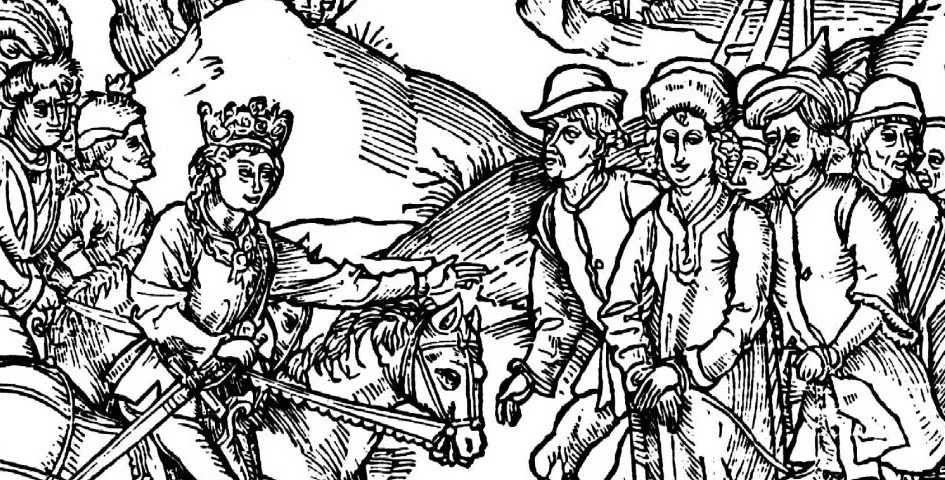
At the same time the order of the Teutonic House, thanks to Brother Hermann von Salza, its master, greatly prospered in increasing the number of brothers, its wealth, power and honour, so that the report of its good fame, spreading everywhere, at last reached the knowledge of the said duke as well. This put into his heart a divine inspiration that he wished to invite the said brothers to defend his land, the faith and the Christians, from which it is evident that the brothers knights of Christ, whom he had established for this purpose, had not succeeded in this task. And, having summoned his bishops and nobles, he opened his mind to them, asking them to give him sound counsel in this. They unanimously supported his will, adding that they had learned from truthful reports that the said brothers were valiant knights, hardened in battles from their youth, and that, moreover, they were recognised and received by the lord pope, the emperor and the rulers of Alemannia, so that they hoped unshakeably that, out of favour towards them, the lord pope would come forward as the inspirer of a crusade in aid of the said land. That is why he sent official envoys with his letters to the said Brother Master Hermann; when they had set out before him and his brothers the reason for their coming, that master, after many deliberations and various discussions held with his brothers about this difficult matter, at last, at the direction of the lord pope and Emperor Frederick II and the rulers of Alemannia, who promised in word and deed to help him in this, granted the request of the said duke. And so the said master sent Brother Konrad von Landsberg and another brother of his order to this Polish duke, so that they might travel through the land of Kulm and find out whether the embassy had come by his will. When they arrived in Poland in the duke's absence, an army of Prussians came and laid waste the Polish land with fire and sword. Against this army the said brothers, at the command of Lady Agafia, the duke's wife, having gathered around them a multitude of Poles, bravely joined battle; but the Prussians, offering resistance on their side (and the Poles fled after the very first clash), mortally wounded the said brothers and, having captured and led away the leader of the Polish army, killed many people. But the aforesaid lady after the battle ordered the half-dead brothers left on the battlefield to be carried back and handed over to the care of physicians. When these brothers had recovered, they sensibly completed the embassy entrusted to them. Hearing of this, the aforesaid lord Conrad, duke of Poland, after mature reflection, as was said above, on the advice, with the united will and ardent consent of his wife Agafia and his sons Bolesław, Casimir and Siemowit, gave the said brothers of the Teutonic House, present and future, the land of Kulm and the land of Löbau, and the land which they might subsequently, with God's help, win back from the hands of the heathens, with all the rights and usufructs which he and his ancestors had held in perpetual possession, reserving to himself no rights or property in them, but renouncing in word and deed everything to which he himself or his wife, or his children, or his descendants might lay claim. And so that this gift should be firm and perpetual and that no one could subsequently revoke it, he gave them charters sealed with his seals. This took place around the year 1226 from the Nativity of Christ in the presence of the undersigned witnesses, namely: Gunter of Masovia, Michael of Kuyavia, Christian, bishops of Prussia, Provost Gernulf, Dean William, the elder and younger counts Pakosław of Dirsovia, Chancellor John, Vice-Chancellor Gregory and many other eminent ecclesiastical and secular persons.
6. ON THE CONFIRMATION OF THE FOREGOING AND ON THE LORD POPE'S ADDRESS TO THE BROTHERS
When news of this devastation of the Polish land, thanks to the loud declaration of the said duke, reached the Roman Curia, the most holy father and lord Pope Gregory IX, feeling compassion for him and guarding against dangers in the future, confirmed in the name of the Lord the whole arrangement established with the brothers of the Teutonic House wisely and according to accepted rite, enjoining the said brothers, for the remission of their sins, to avenge the outrage done to the crucified Lord and to win back the land promised to the Christians and occupied by the heathens. And, inspiring them to battle, he said: "Gird yourselves, and be valiant men, and be ready to fight with these heathens who are assembled against us to destroy us and our sanctuary, for it is better for us to die in battle than to behold the calamities of our people and our sanctuary." And, strengthening them in steadfastness of soul, he comforted them with the words of the Lord, who said, addressing the children of Israel: "When thou goest out to battle against thine enemies, and seest horses, and chariots, and a people more than thou, be not afraid of them: for the Lord thy God is with thee"; and a little further on he continued: "Ye approach this day unto battle against your enemies: let not your hearts faint, fear not, and do not tremble, neither be ye terrified because of them; for the Lord your God is he that goeth with you, to fight for you against your enemies, to save you. For the battle is not yours, but God's." This supreme steadfastness of spirit was in Judas Maccabeus, who, standing with a handful of men against a great multitude of heathens, encouraged his own, saying: "Fear ye not their multitude, neither be ye afraid of their assault. Remember how our fathers were delivered in the Red Sea, when Pharaoh pursued them with an army. Now therefore let us cry unto heaven; perhaps He will have mercy upon us, and remember the covenant of our fathers, and destroy this host before our face this day, and all the heathen shall know that there is One who delivereth and saveth Israel. Fear not the words of a sinful man, for his glory shall be dung and worms. Today he is lifted up, and tomorrow he shall not be found. Wherefore, ye my sons, be zealous for the law, and give your lives for the covenant of your fathers. Call to remembrance what acts they did in their time, and so shall ye receive great honour and an everlasting name. Be valiant and show yourselves men in the behalf of the law, for by it shall ye obtain glory. Take also unto you all those that observe the law, and avenge ye the wrong of your people, and recompense fully the heathen."
7. ON THE NEW WAR OF THE BROTHERS OF THE TEUTONIC HOUSE AGAINST THE PRUSSIAN PEOPLE
Many wars had long been waged against the Prussians, as the old histories relate: by Julius Caesar, also by nine brothers from Sweden who were called Gampti, also by Hugo surnamed Potyre, and finally by Brother Christian, bishop of Prussia, and the brothers knights of Christ, called the brothers of Dobrzyń. But, seizing the moment, the Prussians killed or put to flight the leaders and the others who commanded them, and so threw off the yoke of slavery from their necks and fell back into their former errors. Now new wars have been begun against them by the brothers of the hospital of St Mary of the Teutonic House of Jerusalem. These are the new wars which the Lord chose to overthrow the gates of the enemy, for if they kill or destroy one or many leaders or prefects in a single day, then on that same day or the next, in place of those killed, others will rise up, better than them or their equals. There is not so much that is new in the war as in the new way of waging war, for victory over enemies is achieved not only with carnal but also with spiritual weapons, namely prayer. That is why it is said in Scripture of Moses that when he prayed, Israel prevailed over Amalek, but when he ceased to pray, Israel was defeated. For it is written of the same Moses in the Book of Wisdom that he overcame the destroyer not by bodily strength nor by force of arms, but by the word, namely by prayer. And of him it is said in the Book of Judges: "Remember, servants of God, that Amalek, who trusted in his strongholds, he overcame not by fighting, but by uttering prayers." It is also written of the Maccabees that they raised prayers in chorus and put hosts to flight. And of Judas Maccabeus it is said that in two battles he did not pray: namely against Antiochus Eupator, and then he did not win but retreated; in the second, against Bacchides and Alcimus, and then he himself fell in battle and the host of the children of Israel was put to flight. There is also another new way of conquering, namely humility, by which the martyrs of Christ saved their souls, of which the Poet speaks:
A noble way to conquer is humility; he conquers
Who suffers; if you would conquer, learn to suffer.
And elsewhere:
The greatest of the virtues, humility, conquers the unarmed,
And, as it happens, not seldom conquers armed men.
Of this humility Gregory says: "Without iron and fire we can become martyrs if we truly keep humility in our souls." And of the same Jerome: "What saint has received the crown without humility?" Since the appearance of the Church there has been no lack of unrighteousness triumphing and righteousness being trampled down. And so we have a new war and a new way of waging war, when we overcome the enemies of the faith and the Church with spiritual weapons.
8. ON CARNAL AND SPIRITUAL WEAPONS
It is written in the Song of Songs that upon the tower of David hung the armour of mighty men, and in the Book of Wisdom that 60 valiant men of the valiant of Israel, all holding swords and expert in war, surrounded the bed of Solomon, every man with his sword upon his thigh because of fear in the night. From this it may be observed that the guards of the head of Jesus Christ must have weapons with which to defend the bulwark of the faith after driving out the assailants and to guard the bed of peace and quiet of the holy mother Church. But Judith is famed for having slain Holofernes not by force of arms, but by virtue; who trusted in his bow and was saved by his sword? Or who gained the land by his own sword? Therefore, as the apostle teaches, we too must put on the whole armour of God, that is, the virtues, which alone, as Macrobius says, make a man blessed and by their strength protect their possessor. With this armour of virtue we must also guard ourselves against enemies, as Boethius says: "We have brought you such armour as, unless you cast it away prematurely, will guard you with invincible strength." Of the individual kinds of weapons, carnal and spiritual, symbolically corresponding to one another, which Holy Scripture mentions and with which one must fight in this new war of the Lord, an account is given here.
On the long shield
Of the shield it is said that Solomon made 200 large shields and 300 smaller shields, and Ecclesiasticus says that faith will defend you against the enemy better than a strong shield. By the shield understand faith, of which Paul says: "Above all, taking the shield of faith", which is the foundation of all virtues; without it, as Augustine says, every virtue withers, like a branch without the virtue of the root; and as Paul says: "But without faith it is impossible to please God"; but when it is present, all good things come to us with it. That is why the Lord says: "Have faith in God; for verily I say unto you, that whosoever shall say unto this mountain, 'Be thou removed, and be thou cast into the sea', and shall not doubt in his heart, but shall believe that those things which he saith shall come to pass, he shall have whatsoever he saith." Behold the power of faith. This is the invincible shield with which Jehoshaphat, king of Judah, encouraged the trembling people, saying: "Believe in the Lord your God, so shall ye be established, and ye shall prosper"; that is why it came about that the Ammonites and Moabites, turning against one another, perished from the wounds they dealt each other, for not one survived who could escape death. A word full of great faith was spoken when David, before the battle with Goliath, said: "Thou comest to me with a sword, and with a spear, and with a shield, but I come to thee in the name of the Lord", and the Lord delivered him into his hands. O, what faith there was in Jonathan and Judas Maccabeus when they said: "There is no restraint to the Lord to save by many or by few." Here 20 men were slain by Jonathan and his armour-bearer within half of a field that a yoke of oxen might plough in a day, and there was a trembling among the people of the Philistines. And Seron was smitten by Judas and his army. This is the victory that overcometh the world: who is he that overcometh the world but he that believeth that Jesus is the Son of God; He says: "He that believeth in Me, though he were dead, yet shall he live." Therefore ponder again and again the whole text of the Gospel, and you will find, as it were the twofold salvation of flesh and spirit, that the Lord's verdict affirms: "Thy faith hath saved thee."
On the sword
It is said of the sword that Jeremiah stretched forth his right hand and gave Judas a sword, saying: "Take this holy sword, a gift from God, with which thou shalt wound the adversaries of my people of Israel." This sword, O mighty knights of Christ, like the sword of Saul, will never return empty, for it will be filled with the enemies of the cross of Christ: without, the sword shall destroy them, and terror within the houses, both the young man and the virgin, the suckling also with the man of grey hairs, so that whenever any of the enemies meets them, they will always say: "This is nothing else save the sword of Gideon", that is, of Christian knighthood. By the sword understand righteous deeds, for faith without works is dead. If other weapons protect the body from the enemy's blow, the sword is directed at the deed by which the adversary is struck down; and since it is two-edged, so righteous deeds, on the one hand, protect the one who does them from mortal sin, and on the other, lead to eternal joy.
On the spear
It is said of the spear that Jehoiada the priest gave spears to the captains over hundreds who kept watch over the house of the Lord. These are the spears which Joab, the captain of the host, thrust through the heart of Absalom, who was pursuing his father David. By the spear, which is straight, understand a sincere intention, and according to the teaching of the apostle: "And whatsoever ye do in word or deed, do all in the name of the Lord; and whether ye eat, or drink, or whatsoever ye do, do all to the glory of God." Therefore the spear stands for the reward and merit of every deed, for an evil intention never gives birth to a good deed, and vice versa.
On the round shield
Of the shield Isaiah commands: "Arise, ye princes, and anoint the shield." And the Lord said unto Joshua: "Stretch out the spear that is in thy hand toward Ai, for I will give it into thine hand", and there further on: "Joshua drew not his hand back, wherewith he stretched out the spear, until he had utterly destroyed all the inhabitants of Ai." Let the chosen warriors act thus, and not like Saul, of whom it is said in Scripture that the shield of the mighty is vilely cast away, the shield of Saul, as though he had not been anointed with oil. By the shield understand the word of God, which instructs us in all good works, of which it is said: "The word of God is a fiery shield unto all them that put their trust in Him." It is called fiery because it protects from all the fiery darts of the devil. It is said of this that Judas Maccabeus armed each of his men not with shields and spears, but with persuasive good words. And they are called persuasive and good because the word of God accomplishes what is pleasing to God and prospers in the thing whereto it is sent. If it does not reward one, it benefits another; it never returns void.
On the breastplate
It is said of the breastplate that Judas Maccabeus put on a breastplate as a giant and protected his host. By the breastplate understand righteousness, of which the apostle says: "Put on the breastplate of righteousness." This righteousness renders to each his own: to God, the humility of obedience, of which the Lord says: "Thus it becometh us to fulfil all righteousness"; to one's neighbour, compassion, which is why Gregory says: "True righteousness has compassion, false righteousness, indignation; to oneself, the mortification of the flesh, for it is right that the flesh be like a handmaid under the yoke of the soul", which is why Ecclesiasticus says: "My son, if thou come to serve the Lord, prepare thy soul for temptation", and a little further on continues: "To strive for the truth is to make a sacrifice for the sake of your soul, and strive for the truth unto death, and the Lord God shall fight for thee." And then it will be completed in the psalm: "Righteousness and peace have kissed each other"; otherwise there will be no peace, but the flesh always lusteth against the spirit, and the spirit against the flesh.
On the bow and quiver
Of the bow and quiver Isaac said to his son Esau: "Take thy weapons, thy quiver and thy bow."
On the arrow
Of the arrow Isaiah says: "The Lord hath raised up the spirit of the kings of the Medes against Babylon; fill the quivers with arrows"; let the word of the Lord be fulfilled upon the enemies of the cross of Christ: "I will heap mischiefs upon them; I will spend mine arrows upon them." By these three understand the three things that lie at the foundation of every religion, namely humility, chastity and poverty. The bow signifies humility, for just as it bends, curves and straightens without breaking, so the devout man, among the fortunate and among adversaries, must bend and straighten in humility, calmly and without murmuring. Of this flexibility of humility Isaac, blessing his son Jacob, says: "Be lord over thy brethren, and let thy mother's sons bow down to thee"; as the humble man may say with Isaiah: "The Lord hath bent His bow and set me as a mark for the arrow." O, how tautly the bow of this humility is drawn when the believer in battle, seeing that death threatens him, does not dare to retreat. Here obedience is better than sacrifice, for, as Gregory says, by sacrifice another's flesh is honoured, by humility one's own. By the arrows chastity is meant, for just as the arrow, they say, comes from sagio, sagis, that is, "to act wisely" or "to prophesy", so it befits a man, in order that he may live in chastity, to direct wisely, in accordance with his soul, his natural strength against the sense of the flesh, which always has an inclination to evil, and it behoves him to prophesy, that is, to be filled with God, for one can become chaste only by the will of God. Just as an arrow is moved by two feathers like a bird in order to strike the enemy swiftly, so chastity, in order to strike the enemy with chastity of old, makes use of two feathers, which are the renewal of the old life and the benefit of renewal. Of these two feathers Isaiah says: "They that wait upon the Lord shall renew their strength", namely they shall exchange the carnal for the spiritual, they shall mount up with wings as eagles, which, when they wish to renew themselves, shed their old feathers and cover themselves with new ones. To this the apostle calls us, saying: "Put off concerning the former conversation the old man, which is corrupt according to the deceitful lusts, and put on the new man, which after God is created." And so your youth will be renewed like the eagle's, and you will fly in the perfection of chastity and will not perish, for the arrow of Jonathan never turns back. And so the flesh of a chaste man may say with Job: "The arrows of the Almighty are within me, the poison whereof drinketh up my spirit", namely the poison of luxury. What the revolt of chastity against luxury is, and how it revolts, only he knows who has experienced it. Of the benefit of renewal Bernard says: "What is more beautiful than chastity, which makes a pure man of one conceived from unclean seed, a friend of an enemy, and finally an angel of a man?" Judith, too, acted courageously and slew Holofernes and delivered the people of God from dangers, because she loved chastity. O how beautiful and beneficial is a chaste generation! The quiver, which is meant for keeping arrows, signifies poverty, for just as the arrow is hidden and kept in the quiver, so chastity is kept in poverty, for the widow who liveth in pleasure is dead while she liveth. That is why chastity may say the same as Isaiah: "And the Lord hath made me a polished shaft; in His quiver hath He hid me." And this poverty is not enough for the devout, of which Bernard says: "They want to be poor on condition that they lack nothing, and they honour poverty in such a way as to suffer no want"; but that voluntary poverty, full of privations, of which the Lord says: "Blessed are the poor in spirit", which, according to Bernard, means with spiritual intention and desire, solely for the good pleasure of God and the salvation of the soul. These were the quivers of the servants of Hadadezer, which means "the chief divider", for it separates poverty from riches. These quivers David carried before the face of the Unforgettable One, Christ, into whom the angels desire to look, that is, he carried them into this world and brought them to Jerusalem, where He was crucified naked on the cross, so that we might follow in the footsteps of His poverty. This poverty is healing, for, as Gregory says, those whom the disease of pride strikes, the medicine of poverty cures: for poverty kills pride and strangles the two leeches of hell, avarice and luxury.
On the sling
Of the sling it is said in Zechariah: "The Lord of hosts shall defend them; and they shall devour, and subdue with sling stones." We also read in the Book of Kings that the souls of David's enemies He shall sling out, as out of a sling. This is the sling from which David cast a stone and smote the Philistine in his forehead, and the stone sank into his forehead, and he fell upon his face to the earth; and David prevailed over the Philistine with a sling and with a stone, and slew the stunned Philistine.
On the staff
Of the staff the Lord says through Isaiah: "O Assyrian, the rod of Mine anger! and the scourge"; and a little further on He continues: "He shall smite thee with a rod, and shall lift up his staff against thee, after the manner of Egypt." Of the spiritual meaning of the staff and the sling it is written that David, preparing to fight Goliath, carried a staff which he always had with him, and chose five smooth stones, which he put in a shepherd's bag, and carried the sling in his hand, and slew the armed Philistine. By the armed Philistine understand the devil, ready for temptation. Be then a David with a strong hand, a penitent, and always have with you the staff of the Holy Cross, and choose five stones, that is, the five wounds of Christ, and put them in the shepherd's bag, that is, in your soul, and wind the sling about your hand, that is, the remembrance of all this, and strike him, so that he does not overcome you in temptation. Moreover, if only this staff of the Holy Cross, on the advice of the prophet Elisha, is laid upon the face of a dead child, that is, one who lives like a child, in sin, he will come back to life.
On the helmet
Of the helmet it is said that Saul armed David with his own garments and put a helmet of brass upon his head. And the Lord said through Jeremiah: "Join battle; harness the horses, and get up, ye horsemen, and stand forth with your helmets." The helmet signifies the salvation which man receives from God from this armour of virtues. Of which the apostle says: "And take the helmet of salvation"; and Isaiah: "For He put on righteousness as a breastplate, and a helmet of salvation upon His head." O, in what safety you will abide in battle if you fence yourself with this armour, and the Lord God of your salvation will be your salvation unto the ends of the earth. This is the armour with which the patriarch Jacob took a portion out of the hand of the Amorites with his sword and with his bow and gave it to his son Joseph, with which the children of Israel too gained the Holy Land laid waste by invaders, and David defeated the enemies of his kingdom, and the Maccabees restored the ruined holy city of Jerusalem and cleansed the temple of God, defiled by the uncleanness of the heathens, having slain the enemies. O most valiant knights and glorious warriors, put on this armour and avenge the outrage done to the crucified Lord and win back the Holy Land, promised to the Christians and occupied by the heathens! Be strong, and let not your hands be weak in battle. For there is a reward for your deeds, that reward of which the Lord said to Abraham: "Thy reward shall be exceeding great." If hardships frighten you, look upon the reward, knowing that just as vices never go unpunished, so virtues do not remain without reward, and the reward of virtue will be He who gave virtue.
9. ON THE USE OF CARNAL AND SPIRITUAL WEAPONS
There are six reasons why we use carnal and spiritual weapons. The first is for the sake of exercise, so that we may exercise ourselves in battles by the will of God, who sent many heathens among the children of Israel to prove by them Israel and all who had not known all the wars of Canaan, and that their children might learn to fight against enemies and know how to wage war. Who indeed will survive in battle if not he who handles his weapons skilfully? That is why in time of peace tournaments and other martial games are held for the sake of exercise, so that in case of war, when the enemies stand at the gates, there would be no one who, not knowing how to handle weapons, would say like David: "I cannot go with these", and could not go out against the enemies, being unarmed. But since the life of man upon earth is a warfare, as soon as a man comes into the world he enters the battlefield to fight against the airy powers of hell, and the weapons of our warfare are not carnal, but mighty through God. Therefore, according to the teaching of the apostle, we must put on the armour of God, that is, the virtues, which come from the one God, who gives virtue and strength to His people, and exercise ourselves in them, so that we may be able to withstand in the evil day of temptation and so that virtues may multiply in us through exercise, as Chrysostom says: "Just as every bodily art is sustained, increased and perfected by exercise, so every virtue is increased by exercise and diminished by idleness." The second reason why we use carnal weapons is because of the snares of the enemy. That is why the children of Israel, fearing the snares of the enemy, took their weapons of war, sat in places near the roads and kept watch all day and all night. It is also written of Judas Maccabeus that he set armed children of Israel in readiness in the necessary places, lest some villainy should suddenly come from the enemies. It is precisely for this that we use spiritual weapons, as the apostle says: "Be strong in the Lord, and in the power of His might; put on the whole armour of God, that ye may be able to stand against the wiles of the devil", who lies in wait for us like a lion in his den. This is that lion, our adversary the devil, who seeks whom he may devour, and whom we must resist steadfast in the faith. The third reason why we use carnal weapons is because of the open attack of the enemy. That is why it is said in the book of the Maccabees that when Lysias, relying on the number of his warriors, gave no thought at all to the power of God, but, possessing an unbridled spirit, set out to destroy the holy city of Jerusalem and the temple of God and had already besieged the stronghold, Maccabeus, having taken up arms, and all who were with him, learning of this, with weeping and tears cried out to the Lord that He would send them a good angel for their salvation. They were strengthened in spirit and in strength and, rushing upon them, destroyed 11 thousand of their foot soldiers and one thousand six hundred horsemen, and put all the rest to flight; many of them, being wounded, escaped naked, and Lysias himself escaped by shameful flight. This is the reason why the brothers of the Teutonic House, from their coming into the Prussian land to this day, constantly use the sword, so as to have at hand the means of defending themselves if open or secret snares should suddenly arise against them on the part of the enemies. In just the same way we use the weapons of virtue against the open snares of the devil. That is why the apostle says: "For though we walk in the flesh, we do not war after the flesh; for the weapons of our warfare are not carnal, gloss: that is, transient, but mighty, that is, strong through God, that is, by means of God, to the pulling down of strongholds, that is, the snares of the devil, casting down imaginations, namely the evil deeds of demons, and every high thing, that is, the depth of the mind, that exalteth itself against the knowledge of God, that is, the faith." Therefore always be ready in the full armour of virtue against the snares of the devil, for, as Bishop Paulinus wrote to Augustine, "this enemy of ours has a thousand ways of doing us harm; we must fight him with weapons as varied as those with which he pursues us." If he attacks you openly or secretly with the vice of pride, set up the virtue of humility in your defence, and he will flee from you. And so act in all transgressions. If you set up the weapons of virtue for your defence, you will come out the victor. The fourth reason why we use carnal weapons is for the sake of peace, so that we may possess our estates in safety. That is why the Lord says: "When a strong man armed keepeth his palace, his goods are in peace. So only when we use the weapons of virtue do we live in peace, but there is no peace unto the wicked." That is why Ecclesiasticus says: "Rich men furnished with ability, living peaceably in their habitations. All these were honoured among their tribes, and were the glory of their times." That is why Baruch says: "If thou hadst walked in the way of God, thou shouldest have dwelled in peace for ever." Wherefore Solomon also says: "When a man's ways please the Lord, he maketh even his enemies to be at peace with him." The fifth reason is that we may win back what was lost. Thus the children of Israel, fully armed, entered the promised land which God had given to their fathers and won it back, occupied by enemies, out of the hands of the enemies. So the kingdom of heaven, which we lose through our sins, is taken by the force of virtue, and the violent take it by force and possess it for ever. The gloss is this: great effort is required to be born on earth and by virtue to gain heaven, which by nature we cannot possess. The sixth reason is for intimidation, so that the enemies, seeing the weapons, may be afraid, as Judith said after slaying Holofernes: "When the sun rises, let every man take his weapons of war, go forth swiftly, not to go down to the plain, but as if making an onslaught, so that the guard of Holofernes may hear it and, waking him, find him wallowing in his own blood, and therefore fear will fall upon them and they will flee." So we too use the weapons of virtue to show that we are in the service of Him who is King of kings and Lord of lords. To this the apostle exhorts us, saying: "In all things approving ourselves as the ministers of God, in much patience, etc., by the armour of righteousness in the power of God." The armour of the power of God is righteousness, which teaches us to render to each according to his deserts, namely to leave the world and everything worldly and cleave to God, who on His banner, which He has left for us to carry, set the sign of which the angel spoke to the magi at the birth of the Lord: "This shall be a sign unto you; ye shall find the babe wrapped in swaddling clothes, lying in a manger." By this three virtues are marked, namely humility (infancy) as opposed to pride, poverty (swaddling clothes) as opposed to avarice, and austerity (the manger) as opposed to the licentiousness of the flesh. Raise this banner and display it before the devil, and fear will seize him and he will flee.
10. ON THE FIRST CASTLE OF THE BROTHERS OF THE TEUTONIC HOUSE, WHICH WAS CALLED VOGELSANG
Having determined the weapons necessary for battle, we must turn to the matter at hand. Since the said brothers of the Teutonic House, namely Brother Konrad and his companion, in the Prussian land long since given to them by the said Polish duke, did not know where to lay their heads, they resolved to approach from afar, so as to have the river Vistula between themselves and the said Prussians for safety. They asked the said duke to build them a castle, and he, being a thoroughly pious man and zealous for the faith, heeding this poetic saying: "Well begun is half done", gathered his people and, opposite the present city of Thorn, built them on a hill a castle called Vogelsang, which in Latin translation means "song of birds", where the brothers with a handful of squires, resisting a countless multitude of heathens, sang a song of sorrow and grief.
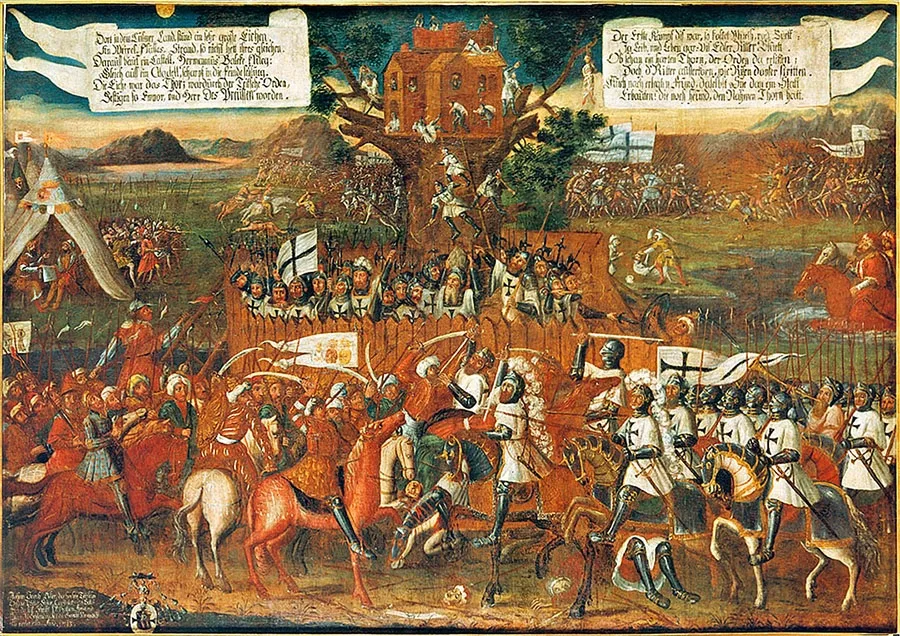
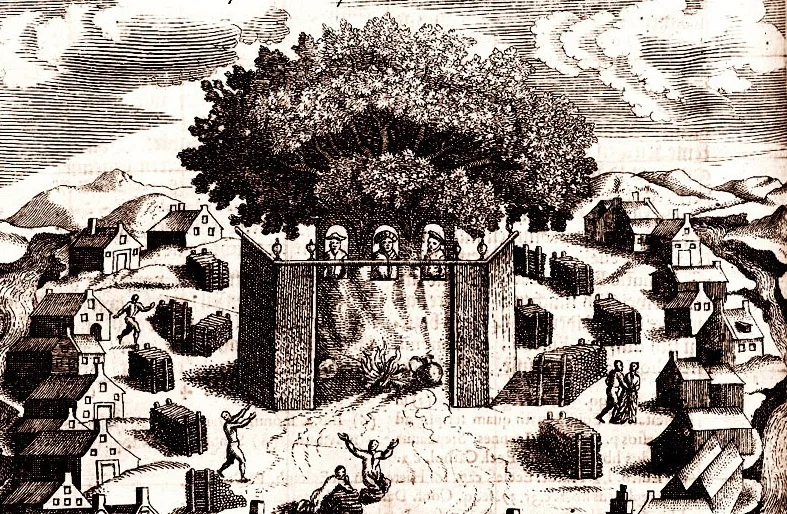
"The Arrival of the Teutonic Knights in the Chełmno Land" (1713). The work is on display in the Old Town Hall of Toruń and is a literal illustration of this episode of the Chronicle. The painting shows the meeting of Duke Conrad of Masovia with Emperor Frederick II and the defence of the legendary fortress in a mighty oak against the Prussians (who are depicted by the artist as Saracens).
For they had left the sweet land of their homeland and entered a foreign land in which many years of humiliation awaited them, and there was then no hope that in the fourth or sixth generation they would return from there. They left a land that was abundant, peaceful and quiet, and entered a land full of horrors, untilled expanses and cruel battles. In conclusion I shall say that, having left, of all worldly things, luxury, freedom, comforts and honours, they, hungry and thirsty, humbly going to meet hunger and every kind of contempt and humiliation, bound themselves to endless burdens, privations and dangers. They could say with Peter: "Behold, we have forsaken all, and followed Thee, Christ; what shall we have therefore?" If the crown of Thy glory is in heaven, O all-good Christ, crown of all the saints, then they deserve to be crowned by Thee, who have suffered so much for Thee. Truly in them was fulfilled what God said through Isaiah: "For the Lord shall comfort Zion: He will comfort all her waste places; and He will make her wilderness like Eden, and her desert like the garden of the Lord; joy and gladness shall be found therein, thanksgiving, and the voice of melody."
11. ON THE COMING OF MANY BROTHERS OF THE TEUTONIC HOUSE AND ON THE BUILDING OF NESSAU CASTLE
When this castle had been built, the aforesaid Brother Konrad sent messengers to the venerable and pious Brother Hermann von Salza, grand master of the Teutonic House, informing him of everything that had been done regarding the task entrusted to him, humbly and most respectfully asking him to send him more brothers and squires. He, heeding his entreaties, sent him as master Brother Hermann, surnamed Balk, saying to him, as the Lord to Joshua: "Be strong and of a good courage, for thou shalt bring the children of Israel, that is, thy brothers, into the land which the Lord sware unto them, and God will be with thee." He also gave him as helpers Brother Dietrich von Bernheim as marshal, Brother Konrad von Teutleben, once chamberlain of St Elizabeth, Brother Heinrich von Berg, a Thuringian, and Brother Heinrich von Kitz from the village of Wittkendorf, with many squires and horses. When they arrived at Vogelsang Castle, they built Nessau Castle on the lower course of the Vistula. And while the brothers were living in this castle, the Prussians made a hostile incursion into Poland and, when they saw that armed brothers were pursuing them, were exceedingly surprised as to where they had come from and why. They were answered by a Pole whom they were leading as a captive that these were pious men and valiant knights, sent from Alemannia by the lord pope to wage war on them until they subjected their stubborn and unyielding necks to the holy Roman Church. Hearing this, they withdrew, smirking.
12. ON BROTHER HERMANN, FIRST MASTER OF THE PRUSSIAN LAND OF THE ORDER OF THE TEUTONIC HOUSE
Brother Hermann, surnamed Balk, first master of the hospital of the Blessed Mary of the Teutonic House of Jerusalem in the Prussian land, headed it for 12 years. He was also the first master of the Livonian land, where he stood at the head of the order for almost 6 years, and, having brought both lands into a good state and waged war very successfully, as will be told below, burdened with old age and labours, he returned to Alemannia and there died and is buried. How glorious he was in all his deeds is attested by his wondrous works.
13. ON THE CROSS AND THE REMISSION OF SINS OF THE CRUSADERS OF THE PRUSSIAN AND LIVONIAN LAND
Meanwhile Brother Hermann von Salza, the grand master, a far-sighted man and prudent in all things, came to the lord pope and among other requests asked for and obtained the cross, to be preached on behalf of the apostolic see in the kingdoms and provinces then designated to aid the Prussian land; and that pope, and afterwards Pope Innocent IV, granted to the pilgrims visiting Prussia and Livonia privileges and indulgences such as were given to those going to Jerusalem.
Part III
ON THE WARS OF THE BROTHERS OF THE TEUTONIC HOUSE AGAINST THE PRUSSIANS
1. AND FIRST, ON THE WAR AGAINST THE INHABITANTS OF THE LAND OF KULM
Brother Hermann Balk, master of Prussia, striving to pursue the cause of the faith, together with the aforesaid duke and the strength of his army, crossed the Vistula into the land of Kulm and on the bank, on the lower course of the river, built Thorn Castle in the year 1231. This structure was made in a certain oak tree, in which fortifications for defence were arranged; on all sides they surrounded themselves with abatis; there was only one approach to the castle. These seven brothers kept boats with them so that, in the event of an attack by the Prussians, they could retreat by boat to Nessau if desperate circumstances forced them to do so. In time they raised a town around the said castle, which later, abandoning the castle, they moved because of the constant floods of the river to the place where both the castle and the town of Thorn now stand.
2. DESCRIPTION OF THE PRUSSIAN LAND
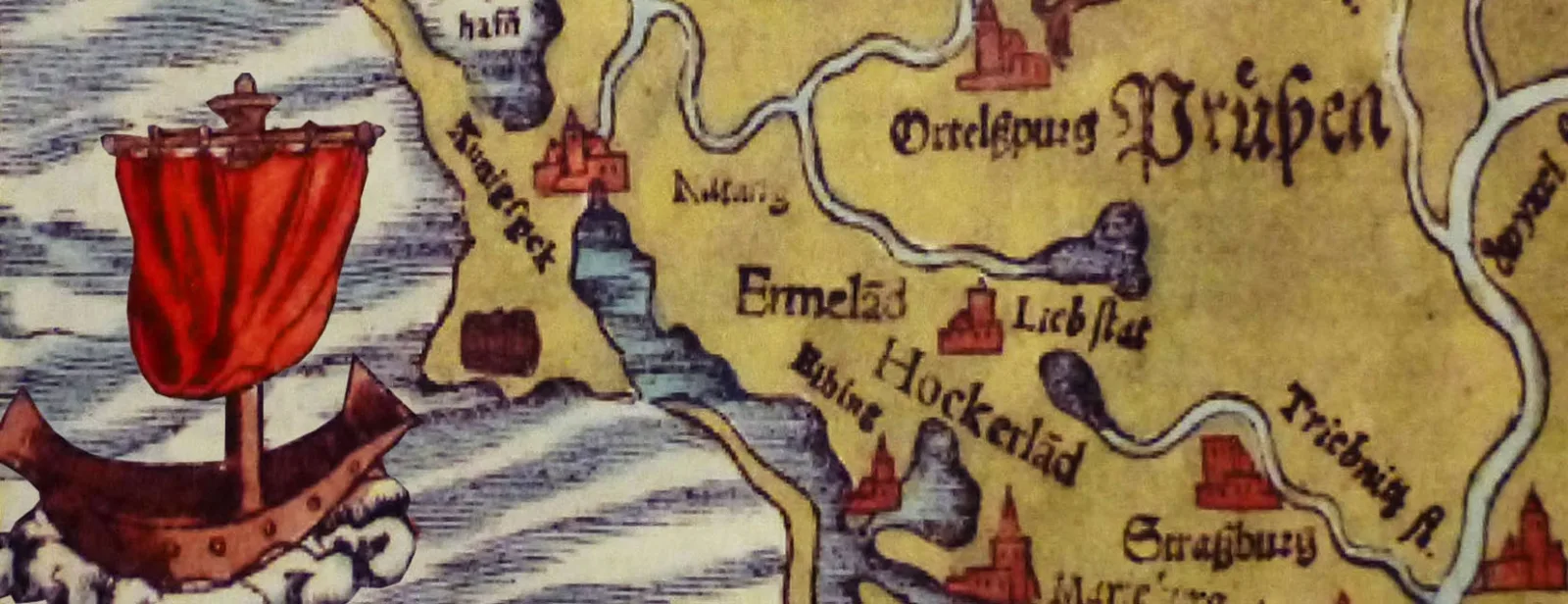
The Prussian land has as the borders within which it lies the Vistula, the Salt Sea, the Memel, the land of Russia, the duchy of Masovia and the duchy of Dobrzyń. The Vistula is a river flowing from Cracovia into the Pomeranian land, falling into the sea at the fortress of Danzig, separating Poland and Pomerania from Prussia. The Memel is also a river, flowing out of the kingdom of Russia, falling into the sea near the castle and town of Memelburg, and also separating Russia itself, Lithuania and Curonia from Prussia.
3. ON THE DIVERSITY AND STRENGTH OF THE PRUSSIANS
The Prussian land was divided into 11 parts. The first was the land of Kulm and Lubovia, which before the coming of the brothers of the Teutonic House was almost uninhabited. The second was Pomesania, in which the Pomesanians lived. The third was Pogesania, in which the Pogesanians lived. The fourth was Warmia, in which the Warmians lived. The fifth was Natangia, in which the Natangians lived. The sixth was Sambia, in which the Sambians lived. The seventh was Nadrovia, in which the Nadrovians lived. The eighth was Scalovia, in which the Scalovians lived. The ninth was Sudovia, in which the Sudovians lived. The tenth was Galindia, in which the Galindians lived. The eleventh was Barta and Plika Barta, which are now called Great and Little Barta, in which the Bartians, or Bartenses, lived. There was scarcely a single one of these peoples that did not have two thousand horsemen and many thousands of warriors for battle. Rich and populous Sambia could field four thousand horsemen and 40 thousand warriors. The noble Sudovians, just as they stood out among the others for the nobility of their manners, so they surpassed them in wealth and strength. For they had six thousand horsemen and an almost countless multitude of other warriors. Each of these heathen peoples had many strong castles, which it would take too long to list. Behold, then, the great sign of God and mighty wonders! Seven brothers of the Teutonic House with a handful of squires, having built a fortification in the land of Kulm in an oak, as has been said, first dared to come out against such a huge and countless multitude of heathens, and in time, over 53 years, slaughtered them so that not one remained who had not bowed his neck under the yoke of the faith, with the help of the Lord Jesus Christ, blessed for ever and ever. Amen.
4. ON THE DESOLATION OF THE LAND OF GALINDIA
The Galindians were fruitful, and multiplied, and increased, and waxed exceeding mighty, and their land was filled with them, so that it could no longer hold them. That is why, just as Pharaoh said to the midwives in order to destroy the people of Israel: "If it be a son, then ye shall kill him: but if it be a daughter, then she shall live", so these people thought it reasonable to kill every newborn of the female sex and to keep the male for war. And since they did not succeed with this decree, for the women, seeing the charm of the newborns, secretly left them [the girls. — V. M.] alive, then by common counsel and consent, so that they could not nurse a single child, they cut off the breasts of all their wives. After this base and abominable deed the indignant women came to a certain lady, who was revered according to their custom as a saint and prophetess, by whose will all deeds in that land were done, asking her to give a sound judgement in this matter. She, feeling compassion for her sex, summoned the best men of the whole land to her and said to them: "Your gods wish that you all, without weapons and armour or other means of defence, go out to war against the Christians." Hearing this, they at once obeyed, and all who were fit for military service went with joyful hearts into the neighbouring Christian land. From there they carried off a multitude of people and cattle, not to speak of the other misfortunes they caused. On their return, some of the captives who had secretly escaped, returning to the Christians, told them that in the whole army of the heathens there were no weapons and nothing at all with which they could defend themselves, adjuring them by faith and truth to go out boldly and fight them. Encouraged by these words, the Christians, pursuing them in a huge crowd, fell upon them and killed them all, meeting no resistance; learning of this, the Sudovians and the other neighbouring peoples entered the aforesaid land of Galindia and led away into perpetual slavery the women and infants and the others who remained alive, and so this land remains desolate to this day.
5. ON THE IDOLATRY AND RITES AND CUSTOMS OF THE PRUSSIANS
The Prussians had no knowledge of God. Since they were fools, they could not comprehend Him with their reason, and since they had no writing, they could not contemplate Him in Scripture either. At the very beginning they marvelled greatly that someone who was absent could explain his intentions by letters. And so, since they did not know God, it came about that in their error they worshipped all of nature instead of God, namely the sun, the moon and the stars, thunder, birds, and also four-footed beasts, down to the toad. They also had sacred groves, fields and waters, so that they did not dare to cut trees in them, or to plough, or to fish. And in the midst of this people steeped in vice, namely in Nadrovia, there was a place called Romow, deriving its name from Rome, in which there lived a man named Kriwe, whom they revered as a pope, for just as the lord pope rules the universal Church of the Christians, so by his will or command were governed not only the aforesaid heathens, but also the Lithuanians and the other peoples of the Livonian land. Such was his authority that not only he himself or any of his kinsmen, but even a messenger with his staff or with another distinguishing sign, travelling through the territories of the aforesaid heathens, was held in great honour by kings, nobles and common people. He also kept, according to ancient custom, an inextinguishable fire. The Prussians believed in the resurrection of the flesh, but not as they should have. For they believed that whoever was noble or common, rich or poor, mighty or powerless in this life would be the same after the resurrection in the life to come. That is why it happened that with deceased nobles their weapons, horses, menservants and maidservants, clothing, hunting dogs and birds of prey and other things belonging, in their view, to warfare were burned. With commoners, what belonged to their occupation was burned. They believed that everything burned would rise again with them and serve them as before. Around these dead there was such a diabolical delusion that, when their parents died, they went to the said pope Kriwe, asking him to see on such and such a day or night whether they had passed into their house; this Kriwe, without any hesitation, would show even how the dead man disposed of his clothing, weapons, horses and household servants, and, for greater persuasiveness, would say that on the lintel of his house he [the deceased. — V. M.] had left such and such a mark with a spear or another implement. After a victory they offered sacrifice to their gods, and of everything that had fallen to them by victory they presented a third part to the said Kriwe, who burned it. Nowadays the Lithuanians and the other heathens of those parts burn the said sacrifice in some sacred place according to their rite, but before the horses are burned they are ridden so hard that they can barely stand on their feet. The Prussians rarely undertook any important matter until they had learned from their gods, by casting lots according to their custom, whether good or ill would follow for them. They did not care for spare or fine clothing, and they still do not care; as a man takes it off today, so he puts it on tomorrow, paying no heed to whether it is inside out. They do not use soft beds or delicate dishes. For drink they take plain water and mead, or ale, and mare's milk; and this milk they drink only when it has been consecrated. Other drinks they have not known since time immemorial. They show their guests every hospitality they are capable of, and there is no food or drink in their house that they would not share with them on such an occasion. It seems to them that they care poorly for their guests if these do not drink their drink until they are drunk. It is their custom that at drinking bouts they all take part equally and drink immoderately, from which it comes about that all the hosts offer their guest a certain measure of drink on condition that, after they have drunk themselves, their guest should also drain the same amount, and such offering is repeated until guest and hosts, wife and husband, son and daughter are all drunk. According to ancient custom the Prussians still follow the practice of buying their wives for a certain sum of money. That is why he [the husband. — V. M.] treats her like a servant, and she does not eat with him at the same table, and every day she washes the feet of the household and the guests. No one among them is allowed to beg for alms; a beggar walks freely among them from house to house and eats whenever he pleases without any shame. If a murder is committed among them, reconciliation comes only after the murderer or his kinsman has been killed by the relatives of the murdered man. When, through an unexpected turn of circumstances, they face insurmountable difficulties, they usually commit suicide. They had neither a distinction nor a count of days. That is why it happens that, when a date is set for holding a council or negotiations among themselves or with foreigners, one of them on the first day makes a notch on some tree or ties a knot on a cord or belt. On the second day he adds a second mark, and so one by one until he reaches the day on which the agreement is to be concluded. Some of them go to the bathhouse every day in honour of their gods, others do not recognise bathhouses at all. Men and women must spin, some flax, others wool, by which, it is believed, they please their gods. Some do not dare to ride black horses, others white ones or horses of another colour, because of their gods.
6. ON A CERTAIN MIRACLE
There was a Prussian in the land of Sambia, in the locality of Skoken, named Dorge, who abhorred white horses; Brother Dietrich, the Vogt of Sambia, wanted to lead him away from this error and bought him a white horse; when it had stood in his stable for one night against his [Dorge's. — V. M.] will, in the morning he found the said horse slaughtered and all his cattle dead. This was done three times, and each time it ended the same way. And a fourth time that Vogt bought him a white horse and assured him that he would repeat this until he led him away from this error. And so, at last, when the fourth horse was not destroyed by the devil like the three before it, that Dorge believed and humbly repented of his error and became a great zealot of the faith and a Christian and an ardent servant of God and the saints, and strengthened in the faith the hearts of many erring converts.
7. ON THE DESTRUCTION OF TWO CASTLES AND THE DEATH OF PIPPIN
Some relate that, when the brothers were living in the said wooden castle, the Prussians had above Thorn, on the bank of the Vistula, a castle called Rogow, and below it, on the lower course of the river, another one, near the place where the old castle now stands. There was also in these parts a certain nobleman from Pomesania, Pippin, who lived in a fortified place near a lake which is called Pippin's Lake after his name, committing robbery with many heathens: no Christian could leave the castle without his seizing or killing him. Some from behind, others from the front, and still others from between attacked them. At last the brothers went out to battle against the inhabitants of Rogow Castle and, since it so pleased God, they killed many of them and, seizing their chief, led him away; this chief, to save his life, gave them his castle, and in time, when the inhabitants of the other castle lay drunk after some carousal, he led the brothers there with an army, and they, bursting in with a mighty onslaught and killing and capturing everyone, reduced the castle to dust. Soon afterwards he delivered into the hands of the brothers Pippin, his brother-in-law, whom they brought to Thorn tied to a horse's tail and hanged on a tree. This Pippin was the father of that nobleman from Pomesania who was called Matto, and as much harm as the father did by persecuting the faith and the Christians, so much good did the son, being zealous for the faith and the Christians, for until his very death he stood unshakeably in defence of the Christian faith.
8. ON THE PILGRIMS AND ON THE BUILDING OF THE CASTLE AND CITY OF KULM
When the sound of the preaching of the cross of Christ had spread through all the land of the kingdom of Alemannia and the new war which the Lord had chosen in the Prussian land had been proclaimed, together with the remissions of sins and the liberties of the new war, those whose hearts God had touched were stirred, namely the chosen and glorious warriors of Alemannia, and, fixing the cross to their shoulders, they began to arm themselves to avenge the outrage done to the crucified Lord, casting off from themselves everything that might hinder them in this holy intention. They pondered that salutary exhortation of Jerome in which he said: "If your father stands on the threshold, and your brother throws himself on your neck, and your mother bares the breasts that nursed you with milk, leave your grief-stricken father, leave your grief-stricken mother and hasten to the banner of the Cross." When they came with these pilgrims to Thorn, Brother Hermann, the master, built the castle and city of Kulm in the year 1232 from the Nativity of Christ, at the place where the old castle now stands.
9. ON THE WAR OF THE BROTHERS AGAINST THE POMESANIANS AND ON THE BUILDING OF MARIENWERDER CASTLE
After these castles had been built by the grace of God and the borders of the land of Kulm had been purged of the old leaven of the vices and wickedness of the heathens, in order that God our Saviour might send us good fortune on the way into the lands of the neighbouring heathens, as some confidently believe, the master and the brothers, having prepared what was required for building castles, crossed unnoticed to the island at Quedin, which is now almost opposite Marienwerder, and there in the year 1233 from the Nativity of Christ erected a castle on a hill, calling it Marienwerder. But when that noble man and valiant knight from Saxony, the burgrave of Magdeburg, surnamed "with the little hand", came to Kulm Castle surrounded by many knights and squires, during the year he stayed there he went with the master and the brothers and moved the aforesaid Marienwerder Castle from the island of Quedin to the place where it now stands, in the district of Pomesania called Reisen, changing the place but not the name.
10. ON THE BUILDING OF THE CITY OF MARIENWERDER
The burgrave of Magdeburg, who was still in Kulm, for he had not yet fulfilled his vow, was joined by many rulers, namely from Poland: Duke Conrad, the duke of Kuyavia, the duke of Cracovia, and from Wrocław Duke Henry, later killed by the Tatars, as well as Odovius, duke of Gniezno, and many other noble and powerful men who lived from the river Oder to the river Vistula and from the river Biebrza to the river Neisse, and also Swietopelk, duke of Pomerania, with his brother Sambor. They came in with a huge multitude of knights and warriors such as had never been seen in Prussia, and, having built the city of Marienwerder, they strengthened the castle built earlier.
11. ON THE VICTORY OF THE CHRISTIANS WHEN FIVE THOUSAND PRUSSIANS WERE KILLED
After this the master, Brother Hermann, and the other brothers, in winter, when everything was bound by hard ice, taking with them the aforesaid pilgrims, whose desire was to begin to tame the insolence of the Prussians, reached the district of Reisen and, having killed and captured many people there, set out for the river Sirgune, where they accomplished what they had long desired. For they found a large army of Prussians fully armed and already ready for battle. When they boldly advanced against them, they [the Prussians. — V. M.] took to flight. But the duke of Pomerania and Sambor, his brother, very experienced in war with the Prussians, occupied with their squires the paths around the abatis so that they could not get away, and from there smote the wicked in their wrath. There the gleaming sword of the Christian host was sated with the flesh of the heathens; here the spear did not return without wounding, for the Prussians could not escape the face of their pursuers either here or there, and a great slaughter of the Prussian people was wrought, for on that day more than five thousand fell. After this all the pilgrims joyfully returned home, praising the mercy of the Saviour.
12. ON THE BUILDING OF REHDEN CASTLE AND A WONDROUS VISION OF A CERTAIN BROTHER THERE
In the year 1234 from the Nativity of Christ, when the Prussians had already been driven out of the land of Kulm, the master, Brother Hermann, having gathered an army of brothers and squires, built Rehden Castle in front of the wilderness that lay between the land of Pomesania and the land of Kulm, at the place where there were constant raids by the Prussians and an access into the land of Kulm. In this castle there was a brother who, deceived by the wiles of the devil, truly believed that in the order of the Teutonic House he could not attain the salvation of his soul, and harboured in his heart the desire to enter a stricter order. After this he saw in a dream Saints Bernard, Dominic, Francis and Augustine walking at the head of their brothers, and he, turning to them, tearfully begged them to receive him into their brotherhood, and they refused one after another. The very last came the Blessed Virgin Mary with many brothers of the Teutonic House; he began humbly to implore her, asking her to allow him at least to remain in the fellowship of her brothers. The Blessed Virgin said to him: "This is impossible, for it seems to you that your order is so lax that there is nothing in it that you could endure according to your desire." And, taking the mantles off each of the brothers, she showed the wounds that had been inflicted by the heathens and from which they had died in defence of the faith, and said: "Does it not seem to you that these brothers of yours have endured something in the name of Jesus Christ?" And with these words the vision vanished. And this brother, waking and coming to himself, went to the chapter where the brothers had gathered, and what he had earlier frivolously revealed to them of his intention, he now, as a wise and experienced man, humbly rejected as mistaken, and told them all of the vision that had appeared to him. This brother, following the path of serving God, was killed by the heathens soon afterwards.
13. ON THE COMING OF THE MARGRAVE OF MEISSEN
At that time that noble and glorious God-fearing ruler Henry, margrave of Meissen, came to the Prussian land with 500 noble men hardened in battles and with a multitude of various riches. All the efforts and thoughts of this man were directed towards the destruction of the heathens and the extension of the borders of Christendom.
14. ON THE DESTRUCTION OF MANY CASTLES AND THE SUBJUGATION OF THE POMESANIANS
In the Pomesanian land there was once a district called Reisen, where glorious men and valiant warriors lived, upon whom the said ruler, having put his hand to the plough and not looking back, bravely fell and often laid it waste with fire and sword, shedding no little heathen blood. Their castle standing near the river Mokere, and all the fortifications they had in this place called Stumo, near Postelin, near Riesenburg and Riesenkirch, near Lake Drusin and Wildenberg, he destroyed with a mighty blow and, having reduced them to ashes, razed them to the ground, and the heathens he killed or captured. But no one can worthily either say in words or describe with a calamus how mightily and how courageously the aforesaid margrave, like a lion that turneth not away for any, fought with the said heathens. So terrible was he to them in war that they submitted to the faith and to the brothers. And according to the treaties and liberties that were then granted to them, the other converts were later guided.
15. ON CERTAIN WARSHIPS AND THE DEPARTURE OF THE MARGRAVE
A wise man always acts wisely and foresees many difficulties in advance. That is why that lord margrave, as a far-sighted and prudent man, ordered two warships to be fitted out for him, the smaller of which was called "Pilgerim" and the larger "Fridelant", which in Latin translation means "Pilgrim" and "Land of Peace". And truly they were rightly so called. For they wrought many blessings of peace for the Christians of the Prussian land. By the men from the said ships two castles were built: Elbing and Balga, and the Frisches Haff was cleared of the onslaught of the heathens, which in itself could not be compared with anything else. These ships sank many years later in Lake Drusin. Having thus fulfilled the vow of his pilgrimage, that ruler, leaving many warriors in Prussia for the building of Elbing Castle, returned home.
16. ON THE WAR AGAINST THE POGESANIANS AND THE BUILDING OF ELBING CASTLE
Having subdued the Pomesanians by the grace of God, the master and the brothers turned the point of war against the Pogesanians. That is why the master with the brothers and the pilgrims left by the lord margrave of Meissen, leading those ships with everything necessary for building, set out for the land of Pogesania, to that island, as some say, which lies in the middle of the river Elbing, at the place where the Elbing flows into the Frisches Haff, and erected there a castle, which he named Elbing after the river, in the year 1237 from the Incarnation of Christ. Others report that this castle was later captured by the heathens and was then moved to the place where it stands now, and a town grew up around it.
17. ON A CERTAIN MIRACLE
Many glorious battles, which it is impossible either to write about or to relate in full, were fought against the Pogesanians by the brothers of Elbing. I shall, however, cite one remarkable fact. Once the brothers of Elbing with a handful of squires were pursuing a large army of Prussians that was plundering in their district, and, when they were already ready to join battle, all the Prussians fled except one, whom they took prisoner. When he saw so few warriors in the brothers' army, he asked where the others were. He was answered that there was no one else. And he said: "We clearly saw that the whole field was filled with armed men, dressed exactly like the brothers and with the same weapons, and that is why our army took to flight." The Pogesanians who had been in that army acknowledged the same before everyone after their conversion to Christianity. And the Pogesanians, however firm they were in battle against the brothers, seeing this miracle and also unable to withstand the persistent pressure of the brothers, gave hostages and bowed their stubborn heads and unyielding necks before the faith and the brothers.
18. OF THE WAR OF THE BRETHREN WITH THE WARMIANS, BARTIANS AND NATANGIANS, AND OF THE DEATH OF MANY BRETHREN AND CHRISTIANS
It is impossible to tell fittingly to how many hardships, how many dangers and how many difficulties the master and the brethren constantly exposed themselves, so that through them the faith of Christ might be duly spread and the bounds of Christendom enlarged. Hence it came about that, after the Pomesanians and Pogesanians, by the will of God, without whom no good is done, had submitted to the faith and to the brethren, the same master and brethren made ready to fight the Warmians, the Natangians and the Bartians. At the master's command, several brethren and squires crossed the Frisches Haff in the aforementioned ships to see where a castle might be raised against the said Prussians. When they sailed up to the land of Warmia, they went ashore and, near the place where the castle of Balga now stands, saw a certain castle of the Prussians, which, however, they did not dare to attack because of their small number. But so as not to return empty-handed, they fell upon the nearby villages, laying them waste with fire and sword. Seeing this, the Prussians attacked them and killed all the brethren and squires, except those who had been left to guard the ships. These, seeing the death of their comrades, quickly departed and reported to the master what had happened.
19. OF THE CASTLE OF BALGA
Hearing this from the sorrowful embassy, the master was greatly troubled, but he took as his example David, who said to Joab, his captain, who grieved no less over the death of his men, as if to encourage him: "Let not this thing trouble thee; the issue of battle is various, for the sword devoureth one as well as another. Encourage thy warriors and exhort them to slay those who attack the kingdom." At length, having calmed himself, he sent a great army by sea to avenge those slain without guilt; arriving at Balga, they went ashore and, having placed archers at the proper spots and set ladders against the walls, they boldly attacked the said castle of the Prussians and, with the help of Kodrun, the leader of the besieged, took it by a mighty assault, capturing some of the people and killing others. After this the brethren, giving thanks to God, settled with their squires in the said castle in the year of the Nativity of Christ 1239, and from there waged the battles of the hosts of the Lord God against the said Prussians still more gloriously.
20. OF THE SIEGE OF THE CASTLE OF BALGA
When this reached the ears of the Prussians, a certain Prussian, Piopso, a Warmian chieftain, gathered all the strength of his army and besieged the said castle of Balga; and since he was at the head of the others, he wished, as a commander, to go into battle himself ahead of the rest, and at the approaches to the castle, pierced by an arrow shot by one of the brethren, he fell to the ground and gave up the ghost; whereupon the others took fright and withdrew with nothing.
21. OF THE BUILDING OF A MILL AND ITS DESTRUCTION
At this time many noble and powerful men of Warmia, seeing that God was on the side of the brethren, were ashamed and went over with all their house and household to the brethren of Balga; having gained new strength by their coming, the brethren built a mill beyond the bridge across the lake, near the ford, now common to all, over a certain river, and, fortifying it like a castle, left two brethren and many squires there to guard it. Afterwards the Prussians besieged this castle with a strong army, took it, killed the brethren and squires, and turned it to ashes.
22. OF THE PIOUS LIFE OF THE BRETHREN OF BALGA
What purity of life, what virtue of abstinence and what strictness of discipline there was among the brethren of Balga and of the other aforementioned castles is known to no one but Him to whom every heart is open and from whom nothing is hidden. The oratories were almost never without someone at prayer, and there was no corner in the said castle where, after vespers and matins, some brother was not to be found scourging himself. To the castle of Engelsberg there came certain pious people who, seeing the state and manner of life of the brethren there, asked what the castle was called. And when they were told that it was called Engelsberg, that is, "the mountain of angels," they answered: "Truly it does not bear this name in vain, for its inhabitants lead the life of angels."
23. OF THE BUILDING OF THE CASTLE OF PARTEGAL AND THE FORTIFICATION OF SCRANDONA
In the land of Warmia there were certain men, surpassing all others in power, called the Gobotins, who were most hostile to the brethren. Having gathered many warriors, they built one castle, called Partegal, in a field of that name, and another fortification on the hill of Scrandona, and placed armed men in them. They attacked the brethren of Balga daily, so that thenceforth no one dared show himself outside the castle.
24. OF THE BUILDING OF THE CASTLE OF SCHNICKENBERG
The field in which the castle of Balga stands is surrounded by lakes, so that in summer it can be reached only by a bridge; before this bridge, on a certain hill, the brethren built a castle called Schnickenberg, placing in it many brethren and a nobleman, Gertwig, father of Gertwig of Pokarwis, and many other warlike men, who defended it against the inroads of the heathen.
25. OF THE COMING OF THE DUKE OF BRUNSWICK
At this time, as cold water to a soul parched with thirst and as good news from a far country, so came this noble and God-fearing Otto, the illustrious lord and duke of Brunswick, also called of Lüneburg, with a great multitude of pilgrims into the land of Prussia to help the brethren, who had fallen into the direst straits.
26. OF THE SLAUGHTER OF THE HEATHEN AND THE DESTRUCTION OF THE CASTLE AND FORTIFICATION OF PARTEGAL
From the said castles of the Prussians so many warriors came out to fight every day that all paths for attacking the enemy were barred to the brethren and every possibility of fighting them was entirely cut off. Troubled by this, the brethren met in council more than once, pondering a fitting remedy. At last Christ himself, who never ceases to console mercifully those devoted to Him who suffer torments, by the grace of His spirit called a certain Pomanda, a nobleman who had once been held in great esteem among the Prussians but had only just turned to the faith of Christ and to the brethren, that he might thus take part in the cause of the faith and of the faithful. This Pomanda set out from the castle of Balga to his fellow Prussians, pretending to be an enemy of the faith and of the Christians; seeing him, the Prussians rejoiced with exceeding great joy, for they hoped through this man's doings to weaken all the might of the brethren. And so, on the advice of this Pomanda, all the best men of Warmia, Natangia and Barta, and others able to fight, gathered and encamped, besieging Balga; but the brethren, who had long foreseen such a turn of events, having already joined with the said lord of Brunswick and the other pilgrims, engaged them in full armour and slew them all, so that not a single one of them remained to bring word of this event afterwards. After this the duke and the brethren went with their army against the castle of Partegal and the fortification and took them, killing or capturing all the people and turning the castle and the fortification to ashes. The same lord fought many other battles in the one year that he spent in the said castle of Balga, and he attacked the Prussians so often that they could not catch their breath. And when the year was over and he had fulfilled the vow of his pilgrimage, he returned home with joy.
27. OF THE SUBJUGATION OF THE WARMIANS, NATANGIANS AND BARTIANS AND THE BUILDING OF MANY CASTLES
And since the Prussians of Warmia, Natangia and Barta, deprived of their strength by God's will through the brethren and the said duke, could no longer resist, they made a virtue of necessity and, giving hostages, submitted to the faith and to the rule of the brethren. And the brethren, to avoid dangers in the future and to deprive the Prussians of the possibility of renewing hostilities, built in the land of Natangia, near the river called Kaustera, Kreuzburg, and in the land of Barta three castles: Bartenstein, Wiesenburg and Rössel. Some say that in time they built Braunsberg and Heilsberg in the land of Warmia, and a certain town in the land of Galindia, placing many brethren and squires in them for their defence. Many other castles were built by the nobles and feudatories who came from the bounds of Alemannia with all their house, servants and household to help the said land; their names God alone knows. From that time the Christians in the land of Prussia began to multiply and the divine teaching to spread, to the praise and glory of Jesus Christ.
28. HOW THE LAND OF LIVONIA PASSED TO THE BRETHREN OF THE TEUTONIC HOUSE
At that time Brother Volkwin, the second master of the Order of the Knights of Christ in the land of Livonia, had for six years been pressing Brother Hermann von Salza, grand master of the Teutonic House, through official envoys, to incorporate his order into Hermann's. For this purpose Brother Hermann, the aforementioned master, came to the lord pope together with Brother Johann von Medeborg, envoy of the said Brother Volkwin. Meanwhile Brother Gerlach the Red arrived from Livonia, reporting that Master Volkwin had fallen in battle with many brethren and pilgrims and people of God. Hearing this, the lord pope ended the said matter and received the aforementioned Brother Gerlach and Brother Johann into the Order of the Hospital of St Mary of the Teutonic House, giving them the white mantle with the black cross, and enjoining them and the other brethren of this Order of the Knights of Christ who were in Livonia, for the remission of all their sins, to observe the rule of life of the Order of the Teutonic House. After this Brother Hermann, the grand master, sent Brother Hermann, called Balk, master of the land of Prussia, with 40 brethren and many squires into the land of Livonia; when the said Brother Hermann Balk, as was said above, had stayed there almost six years, he returned to Alemannia and rested in peace.
29. OF BROTHER POPPO, SECOND MASTER OF THE LAND OF PRUSSIA
Brother Poppo von Osterna, second master of the land of Prussia, headed the order for 7 years, and, having laid down his office, returned to the bounds of Teutonia and soon afterwards was elected grand master.
30. OF THE VARIOUS HARDSHIPS OF THE BRETHREN AND THE CHRISTIANS IN PRUSSIA
At first the brethren and all the Christians in the land of Prussia suffered many and incredible privations in food, drink and clothing and in everything else needful for human life. If they wished to till any fields, they could do so only by night, and what they had sown with great risk and toil others broke in and destroyed. And behold, the wondrous grace of God came down upon them. For they were on the way to blessedness when they endured such things for Christ's name, and also when they drank the cup of saving suffering.
31. OF THE FIRST APOSTASY OF THE PRUSSIANS. OF THE WAR OF SWANTOPOLK WITH THE BRETHREN OF THE TEUTONIC HOUSE IN THE YEAR OF THE NATIVITY OF CHRIST 1242, AND FIRST OF THE DEVIL'S HATRED OF THE FLOURISHING OF THE FAITH
It would be long, and beyond my small understanding, to tell one by one how mightily and majestically, how skilfully and valiantly the master and the aforementioned brethren, like new Maccabees, applied their strength to extending and widening the bounds of Christendom, to fighting the enemy and taking fortifications; of their battles and victories the whole church of the saints will tell until the end of the world. And after, by the grace of God, the aforementioned castles had been built to the praise and glory of Christ, and the surrounding heathen had bowed their most stubborn necks to the faith and to the brethren — not, however, without great slaughter of these heathen and no little shedding of Christian blood — and the faith of Christ had become firmly established among them, the ancient serpent, the venomous dragon, the enemy of the human race, unable to bear for long such a flourishing of the faith and of the Christians — namely, that holy church had reached the bounds of Prussia, the divine rite had spread, the heathen were in turmoil, the Christians rejoiced, signs were renewed and new wonders were wrought — as if struck within by the mortal wound of his own malice, began to plot in a thousand ways and to lay various snares, how he might secretly pour in his poison, destroy the vineyard of the Lord and sow tares in the Lord's field. At last he stirred up a most cruel wave of persecution against the faith and the Christians, and this is how.
32. OF SWANTOPOLK'S PERSECUTION OF THE FAITH AND THE CHRISTIANS IN PRUSSIA
There was in the land of Pomerania a certain prince named Swantopolk, a son of iniquity and a son of perdition, as Scripture says, with a heart full of all guile and craft, who began to conduct peace talks with ulterior motives with the people of the Prussians, who had only just been converted to the faith of Christ, entering into an alliance with them on condition that with a mighty blow they would drive the brethren of the Teutonic House and the other Christians out of the bounds of Prussia; and the word seemed good in their eyes, and many came, and almost all entered into the agreement with him. After this the same prince fortified his castles standing on the bank of the Vistula and placed in them an ungodly people, lawless men, who became a great hindrance to the brethren. For they came out of the said castles and, whenever they saw any of the brethren's subjects sailing past, they fell upon them suddenly and wrought great slaughter among them, carrying off much booty; some they took captive, and others, to our sorrow, they killed, and so shed Christian blood round about; and this was done so many times that thenceforth no one even hoped to do business with the brethren or, in time of need, to bring them provisions from Elbing and Balga and other places. All this the brethren preferred to bear with meekness and humility rather than, in defending themselves, raise their hands against the Lord's anointed.
33. OF THE LEGATE OF THE APOSTOLIC SEE
At that time the pope was Innocent IV, who in the first year of his pontificate, that is, in the year of the Nativity of Christ 1243, learning from the loud complaint of Brother Hermann von Salza, grand master of the Order of the Teutonic House, that the new planting of the faith in the land of Prussia had suffered considerable harm through the treachery of Swantopolk, the aforementioned prince, sent to the said lands the legate William, formerly bishop of Modena, who afterwards became Pope Alexander IV, so that he might divide the said lands into four bishoprics and, if he found anything worthy of correction, correct it and set it in proper order. This legate wrote to the said prince and demanded of him by apostolic authority that he cease his persecution of the faith and the Christians. But he, heedless of his own salvation, hardened in his stubborn soul like a gnarled tree that cannot bend, did not listen to the fatherly admonitions, which truly sprang from the root of love; disobedient, he sank deeper and deeper into vice and did harm to the faithful of Christ now on land, now on water, and simply wherever he could, robbing some of their goods, taking others captive and killing yet others. The legate, seeing that no signs of amendment appeared in this prince and that he in no way wished to return to the bosom of holy mother church, gave first the appropriate admonition that as stubbornness grows, punishment too deservedly grows, and then ordered that, to curb the vices of the said tyrant and his accomplices, the cross be preached by apostolic authority in the kingdoms and provinces assigned for this, instructing the crusaders and the brethren of the Teutonic House, by the virtue of holy obedience and for the remission of their sins, that henceforth they should defend the faith of Christ and the Christian church in the bounds of Prussia, for the sake of its people, against such cruel and unjust persecution by the said prince.
34. OF THE DEVASTATION OF THE INNER PARTS OF THE LAND OF PRUSSIA
And so, after all this, Swantopolk, casting off the fear of God and adding crimes worse than the first, made manifest the vice of persecution that had before been almost unseen. For he ordered that the new converts, who easily slid back into their former errors, should one day renew the war against the brethren from every corner of the land of Prussia, in order to throw off what they held a despised and lowly creed. And all the Prussians gathered as one; that Swantopolk became their prince and leader, and with a strong hand and a high arm they entered the inner parts of the said land and, to our sorrow, slaughtered all the old Christians who had come from Alemannia to help the land of Prussia, and led away the women and children into everlasting captivity. They also killed Brother Konrad von Dortmund, a righteous man skilled in warfare, with all his company, and, taking all the castles except Balga and Elbing, they destroyed them to the ground, killing every last one of the brethren and Christians.
35. OF THE DEVASTATION OF THE OUTER PARTS OF THE LAND OF PRUSSIA
Soon after this the same Swantopolk, son of the devil, again gathered the said apostate converts, and, attacking under arms, they ravaged the outer parts, namely the land of Pomesania and the Kulm land, with sword and fire, capturing and razing to the ground all the castles and fortifications except three, namely Thorn, Kulm and Rehden. Of the people of God living there to His praise and glory they killed four thousand, so that the whole land of Prussia seemed stained with Christian blood.
36. OF THE TAKING OF THE CASTLE OF SARTOWITZ 134 AND THE FINDING OF THE HEAD RELIQUARY OF ST BARBARA, VIRGIN AND GREAT MARTYR
No one in his right mind can think or hear without trembling of soul and rightful compassion that the cause of the faith in the aforementioned bounds, advanced so majestically with immense privations and hardships to the glory of God, was about to be brought to ruin by the villainy of a single tyrant. That is why the brethren, troubled in spirit at the sight of this, chose rather to die in battle than to see the calamities of their people and of the holy things. One of them, namely Brother Dietrich von Bernheim, the old marshal, the very embodiment of courage (for he was an Ulysses in mind and no weaker than Hector in arm), with four brethren and 24 squires, on the night before the feast of St Barbara, virgin and great martyr, came to Swantopolk's castle of Sartowitz and, setting ladders against the walls and entering quietly, found 50 men left to guard it, men of uncommon strength and tried in war, whom the brethren with the 24 squires boldly attacked. They, for their part, resisted and defended themselves bravely. Now one side, now the other gained the upper hand; a most fierce battle began between them, and it lasted from dawn until three o'clock. At last God himself, who does not forsake those who hope in Him, sent the brethren help and victory from heaven, so that, having killed all but a few who escaped by flight, they bound 40 women with children who were taken there. After this they found in a certain storeroom a chest, or ark, and in it a silver casket, and in the casket the head reliquary of St Barbara, virgin and great martyr; seeing this, they fell prostrate on the ground, praising God for the finding of so glorious a gift. And, lifting up these holy relics, they came out of the storeroom with great joy. Seeing this, an old woman who stood bound together with the others said to the brethren: "You may rightly rejoice, and truly you must, for now that you possess the relics of St Barbara, good fortune is destined for you." The brethren turned to her: "Who told you this? [66] And how can you know it?" She answered: "I have always venerated St Barbara with special devotion, and that is why this night she appeared to me three times, girded and as if ready for a journey, and I said to her: 'Where are you going, Holy Virgin?' She answered: 'I am going to the town of Kulm to hear mass there'; and when she appeared to me the third time and said: 'Farewell, my dear,' I sprang up from my bed and accompanied her to the threshold of the house, where, when she vanished, I saw you armed in the castle. From this I know for certain that by her relics and prayers this castle has been given to you, so that you might carry her relics away with you into the land of Prussia, where they will be held in greater veneration than here." After this Brother Dietrich, appointing several brethren and squires to guard the said castle, returned with a few of them and brought these holy relics to Kulm, where the clergy and the people, meeting them with a solemn procession, carried them into the church and placed them in the old castle, where to this day they rest in unceasing veneration because of the miracles often wrought through them by the Lord.
37. OF THE SIEGE OF THE CASTLE OF SARTOWITZ AND THE SLAYING OF 900 POMERANIANS
When this reached the ears of the said prince, he was exceedingly angry and, turning all his efforts into the poison of revenge, he summoned all the apostate converts of the land of Prussia, besieged the said castle of Sartowitz and stubbornly attacked it for five weeks with engines of war, arrows and every other possible means, while the brethren and the others besieged offered them manly resistance. But since this prince was the embodiment of every guile, he always acted deceitfully. At last, so as to bring down the wrath of God by his malice, he gathered the greater part of his army, leaving the other part in ambush, secretly led it by night across the ice of the Vistula and ravaged the Kulm land in many places. Brother Dietrich, the marshal, came out against him with a handful of men, trusting in the mercy of God, for whom it is easy to give judgment to few or to many, and, joining battle, inflicted a great defeat on them. For he killed 900 men, putting the rest to flight, and besides other booty, which was great, captured 400 enemy horses. The prince, confounded, returned with a handful of men to the other part of his army, which he had left at the siege, so stealthily that the besieged in the castle could not make out what had happened in the battle. Therefore they sent a brother to the marshal to find out the truth of the event; the marshal sent him back with the news, instructing that, when he began the battle with the said army of Swantopolk, they should come out of the castle and help, adding that the castle should afterwards belong to whoever won the victory here. And so, when the marshal was about to engage the prince's army again, Swantopolk, having received from the first defeat sure signs and clear tokens that God was terribly angry with him, and not doubting that God's shield had been withdrawn from him, took fright, and his heart so trembled that, with many warriors, he still did not dare to await the few, but turned to flight and shamefully withdrew. Seeing this, the marshal advanced little by little with his army and destroyed the enemy's camp. Fearing the treacherous villainy of the said prince and that cunning fox's craft which often deceives the mind of the hunter, he did not dare pursue the fugitives, but kept his army in readiness all day, strengthening the breaches in the castle made by the assault. At last, in the evening, leaving many squires there, he withdrew.
38. OF THE FALL OF THE CASTLE OF NAKEL AND THE RAVAGING OF THE LAND OF PRUSSIA
The legate of the Apostolic See, beset by constant cares and anxieties for the cause of the faith, that it might grow strong and that the enemy of the faith, the prince of Pomerania, might perish, and seeing that success in the war was beginning to pass into the hands of the brethren, summoned to himself from Poland Prince Casimir, the prince of Kalisz and the brethren, and took counsel with them about marching with an army against Swantopolk. Following his instructions, they went with a large army against his castle of Nakel and pitched their camp there; and when they had encamped there according to the rules of the art of war, set up various war machines and engines and prepared everything needed to attack the town, the inhabitants of the castle, afraid that they would not be able to come out safe and sound, surrendered the castle to the brethren. These, placing brethren and squires in it as a garrison, invaded the land of Pomerania with the other part of the army, spreading out from one end to the other and doing everything not in jest but in earnest, for they burned everything that could be given to the fire and, having killed many and seized women and children, returned with enormous booty.
39. OF THE RESTORATION OF PEACE BETWEEN SWANTOPOLK AND THE BRETHREN
And so, when this had been so ordered and mercifully settled by God with Prince Swantopolk, who before had been so stubborn and obstinate in his ungodliness that neither by prayer nor by punishment nor by pangs of conscience could he be softened so as to wish to return to the bosom of holy mother church, now this misfortune taught him a lesson, and he, seeing that henceforth he could not resist the brethren, came to the legate and the brethren and humbly confessed before them that he had erred in his actions against the faith and the Christians, begging on bended knee that they take pity on him and pardon him, and surrendering himself with his people to the correction of the brethren. The legate, having heard them, deliberated and debated the matter with the brethren, saying that it is hard to trust one who has often broken peace treaties. On the other hand, he judged that one who asks forgiveness should not be denied the embrace of mercy, and chose from this what he thought best, namely peace, for only in time of peace is the peacemaker honoured. That is why, on the advice of the brethren, he received him into the grace of the church on these terms. That the reconciliation between him and the brethren might be lasting, Swantopolk gave the brethren as pledges his castle of Sartowitz and his firstborn son Mestwin, Wimar the burgrave, and Woyak, his commander, and swore on the holy Gospel of God, laying his hand upon it, that he would help the brethren in the struggle with the heathen as often as circumstances required, and that henceforth he would not attempt such vile actions against the faith and the Christians as before; and he gave the brethren his charters sealed with his seal in confirmation of the foregoing. After this the brethren returned to him all the prisoners they had been able to take, among whom were 70 noble and honourable matrons and, besides, other women, men and children; and the brethren kept the said peace so strictly that, apart from everything needed to keep the peace, they no longer intended to begin any military action against the heathen without the counsel of the said prince.
40. OF SWANTOPOLK'S NEW WAR AND THE BATTLE AT RENSEN
But since the human spirit is ever inclined to evil, and a man will not depart, even when he is old, from the way to which he has been accustomed from his youth, this vicious prince of Pomerania, the embodiment of evil, could not long conceal the inborn vices he had shown from his youth; a year after the peace was concluded, forgetting his salvation and the oath with which he had sealed the said peace, and unmindful of his own blood, namely his son and the other hostages he had given as pledges, he broke the peace treaty and, with the apostate converts of the land of Prussia and with the Sudovians, gathered a very large host, which turned the whole Kulm land, except three castles — Thorn, Kulm and Rehden — into a wilderness, doing other harm as well in captives and slain and countless spoils of war. After this they came with their army to the castle and town of Kulm and stood there until evening in pride and scorn. Then they withdrew to a lake called Rensen and spent the night there. Learning of this, the brethren of Kulm went after them with 400 men, and while half the heathen army was crossing the aforementioned lake, Brother Dietrich, the old marshal, intended to attack those coming behind, asserting that before the others returned these would be killed. His counsel was opposed by Brother Berlwin, the new marshal; and although the older brethren acted unwillingly, for it seemed to them that by attacking too soon they would rally the enemy to resist, they nevertheless followed his counsel and fell upon them from the rear with a mighty blow, and the enemy at once turned to flight. Pursuing them, the Christians killed many, and when the Christian army had scattered, the marshal with 24 squires went to a certain hill on which there turned out to be 4 thousand heathen ready to fight him. And since the Prussians saw so few brethren around the banner, they gathered their strength and courage, suddenly attacked them and killed the marshal and all the brethren with 400 men; only ten men remained, who escaped by flight. At last the brethren from Thorn came with 200 men to the place and at the hour appointed by the marshal and, seeing the brethren slain, fled. Chasing them, the Prussians killed many; the rest escaped. And, taking the booty, which was very great, they led away many women and children with great joy. Among them was Martin of Golin with his pregnant sister; when, because her labour had begun, she could not keep up with the hurrying army, the man leading her into captivity ripped open her belly with his sword, and the living infant fell onto the sand, and she herself died. This loathsome deed so horrified Martin, and such hatred did he harbour against the heathen, that after he was freed from their captivity he more than once wrought great slaughter among them, as will appear below. After the enemy had withdrawn, when the brethren saw the evil they had done to the people, they said to one another: "Woe to us! Why were we born to see the ruin of our people and the ruin of our land, and to remain here when it is delivered into the hands of the enemy? Its old men are slain, its young men have fallen by the enemy's sword. She who was free has become a slave. Behold, our holy places, our beauty and our glory are laid waste, and the heathen have defiled them. Why should we live any longer?" And they rent their clothes and put on sackcloth, and with them all the people present, filled with great fear, wept bitterly.
41. OF A MIRACLE
When after the battle a certain woman went with other inhabitants of Kulm to the battlefield to bury the bodies of the fallen and wished to carry her half-dead husband into the town, he refused; and when she asked why he so wished to remain there, he answered that that day the Most Holy Virgin Mary with a censer, accompanied by two virgins with burning candles, had censed all the slain with incense, and when she came to him and saw that he was still alive, she said: "On the third day you will die; and rejoice, for your soul, like the souls of the others who were slain, will soar to eternal joy." And so, brought with the others to the town of Kulm, he died on the third day, as he had foretold, and all the people believed his words.
42. OF THE QUARREL OF TWO WIDOWS OVER ONE MAN
When after this battle the bishop of Kulm saw that there were no men left in the town of Kulm, for they had all been killed in the aforementioned battle, he enjoined the widows, for the remission of all their sins, to take their servants as husbands, so as not to doom the cause of the faith there to ruin. Hence it came about that, when two women were going to church, they saw, among others playing dice in the square, a certain servant, strong and handsome of face, though poorly dressed; so one of them quietly told her maid to bring him to her house. The other, seeing him, secretly charged her own maid to take him to her chamber and not let him go until she returned. After this she dressed him fittingly and married him, being wed in church. The first woman, learning of this, was angry with the other for a long time. This servant was a native of Halle and was so honest and clever that there was none equal to him in merit in Prussia.
43. OF THE SUFFERINGS OF THE BRETHREN AFTER THE BATTLE
Because of this slaughter of the brethren Swantopolk rejoiced with exceeding great joy and, heaping evil upon his evil and adding sorrow to the brethren's sorrow, strove by any means he could to turn against them the people subject to them and in straitened circumstances, and to bend them to his evil will with flattery and gifts. And although some were seduced by him and secretly inclined to his favour, the providence of God and the foresight of the brethren kept strict watch that no one could show this openly. And so his evil designs came to nothing, and he did not succeed in his evil intentions.
44. ----
When Swantopolk, the aforementioned prince of Pomerania, did not succeed in this cunning temptation, he found another, more evil, firmly believing that the fitting and long-desired time had come when he could, without any resistance, completely extinguish and destroy that small spark of the Christian faith which still glimmered after the last battle. And he gathered two thousand men, excellent warriors, and, crossing the Vistula in boats, entered the Kulm land, and, when everything that still remained had held out for two days and two nights, he turned the rest to dust and ashes. While this was happening, the brethren of Kulm, gathered with the nobles and inhabitants of the town of Kulm, seeing the evil Swantopolk had wrought with his army, sobbed and, watering their breasts with tears, cried to God, saying: "Spare, O Lord, spare Thy people and give not Thine heritage to reproach." The brethren thought that if they attacked this army again and were defeated, they would lose the land of Prussia without hope of recovery, and consequently the faith of Christ would perish there too. And the nobles and townsmen of Kulm said that it would be better for them to fall honourably in battle than, living thus, to die miserably day by day. And the Spirit of God came down upon the brethren and upon all present, and although they were very few compared with the enemy, yet, trusting in the Lord, they attacked the enemy fiercely and bravely near the town of Kulm, and a great battle was fought between them, and many fell on each side. At last the Father of mercies and the God of all comfort, who comforts His people in every tribulation, strengthened the brethren so much that Swantopolk, frightened by this, fled with all his people and made for the place where he had left the ships, hoping to escape in them. But not so, the ungodly, not so: but they are like the dust which the wind driveth away from the face of the earth! Behold, a strong wind blew and drove all these ships far from the shore, and it happened to them with these ships as it did to the heathen Saracen king when, defeated, he fled from Charles. And since they did not find the ships, they went into the Vistula, and, except for Swantopolk and a few others, all those who were retreating with him, who had earlier escaped the sword, were drowned. And thus the Lord comforted His people, who had been on the brink of ruin.
45. OF THE PEACE AGAIN RESTORED AND BROKEN, AND OF THE BUILDING OF THE CASTLE OF ZANTIR
And so the brethren, pressed by need on every side, among the other counsels they sought everywhere, at last received the advice of a brother named Rabe of Rehden, a prudent man and judicious in difficult matters, to hand over Mestwin, son of Swantopolk, as a pledge to the duke of Austria 166, and to make known in the bounds of Alemannia, Bohemia, Kraków and Poland the state of the land of Prussia and of the brethren, warning that the cause of the faith and of the Christians here would soon perish unless help were quickly given to it by the power of the Lord and by theirs. After this Brother Poppo the master came with four brethren, and six brethren from the March, Meissen and Thuringia. The duke of Austria also sent 30 mounted archers to help the said land. At their coming the brethren rejoiced greatly, while Swantopolk, on the contrary, was so alarmed and frightened that, begging mercy out of fear, he again obtained it from the brethren, and the former peace was renewed. Yet because of his inherent vices he did not cease his treacherous and secret persecution of the brethren and their people, and paid no heed when the brethren reproached him for it. At last, so that his secret malice might become manifest, he gathered a strong army and fiercely invaded the Kuyavian land of Prince Casimir to ravage it in every way with fire and sword, and, having captured and killed many Christians there and done other deeds, he returned with enormous booty. After which, when he was again taken to task, he said that neither for the sake of the pope, nor of the emperor, nor of anyone else living would he cease persecuting his enemies, and he added: "Give me back my son, if you wish to live in peace with me." And since the brethren did not give him back his son, he began to persecute them openly, as before. And at the confluence of rivers, namely the Vistula and the Nogat, he built a castle called Zantir, in which he settled ungodly men; they prevented the brethren's subjects from sailing up or down the river in peace, or robbed them of their goods, or took them captive, or killed them.
46. OF THE BUILDING OF THE CASTLE OF SCHWETZ AND ITS STORMING
And so the brethren, seeing that a new war lay before them, made over the castle of Sartowitz, with everything belonging to it, to Sambor, Swantopolk's son, who was loyal to them. Behold a wondrous and most astonishing thing: the sons went against their father because of the cruelty that he shamefully turned against the faith and the Christians. After this the brethren sent envoys to the legate of the Apostolic See and to the grand master, who informed them of the new war and of the state of the land of Prussia. Hearing this, the legate himself proclaimed the cross against the said tyrant and ordered it to be proclaimed in various kingdoms and provinces by apostolic authority. But since the perverse vices and vicious perversity of wicked men delight in doing evil and revel in evil depravity, so he too, greatly delighted with the castle of Zantir, which he had built as a threat to the faith and the Christians, began to build another castle, now almost opposite the town of Kulm, called Schwetz, so as to close altogether the passage of ships on the river Vistula, both upstream and downstream, which was very necessary for the brethren. When the master heard of this, he ordered the brethren of Kulm to come with their people in boats, while he himself, with the brethren of Thorn and Prince Casimir, prepared to go to the said places with an army on horseback. For he wanted to prevent the building of the said castle. Swantopolk, seeing that the brethren's ships had put in to shore, broke camp, destroyed the bridge by which the castle could be reached, and fled. At length, looking back and seeing that the brethren on horseback with their army could not get close to those who had come from Kulm in boats, because of the depth of the river that separated them, he took heart, returned with his people and, when he saw that the master intended to take the castle, quickly restored the bridge and sent 300 men into the castle to defend it. The attacking brethren and Prince Casimir fell upon the castle with a mighty blow, and so fierce was the battle between them that many people on both sides were mortally wounded, and many from the castle fell; but since the castle was so fortified that it could not easily be taken, when the brethren withdrew with nothing, Swantopolk returned and fortified this castle still better.
47. OF THE BUILDING OF THE CASTLE OF POTTERBERG
Master Brother Poppo, seeing the cunning of the said prince in prudently fortifying himself with castles everywhere, built a castle on the hill between the present town of Kulm and the old castle, and named it Potterberg after the hill, placing in it 12 brethren with many squires. This building was made so that Swantopolk would not build on the said hill, and so that a second sin worse than the first would not be committed.
48. OF THE STORMING OF THE CASTLE AND TOWN OF ELBING
Swantopolk, prince of Pomerania, learning that the brethren and townsmen of Elbing were absent, gathered a large host and set out to storm the castle and the town. Seeing this, the women, taking off their womanly finery, put on a manly spirit and, girding swords upon their thighs, went up onto the walls, showing themselves so valiant in the defence as the weaker sex had never before shown itself there. That is why the prince, thinking that the army of the brethren and townsmen had returned, withdrew in confusion. Do not think that this happened only here; it happened in many other places too, where, in the absence of the men, the fortifications might have fallen had the enemy not run up against the courage of the women.
49. OF A WARRIOR OF SWANTOPOLK
There was a certain warrior in Swantopolk's retinue who was so afraid of the brethren of the Teutonic House that at the mere mention of them his heart sank into his boots. Hence it happened then that this prince withdrew to rest in a certain village and, with the greatest boisterous merriment, called some of the warriors to him and said: "Let us send a servant into the fields, and after the first course he will quickly come back and announce that the brethren are approaching with an army, and we shall see how this coward behaves." They liked this very much, and a messenger was sent for this purpose. But when the brethren, who had been informed of this, came close to the said village, the messenger had already gone out and, seeing the brethren coming with their squires, stunned and pale with great fear, all in tears and with his sword drawn, he returned to Swantopolk and said: "Get up quickly and go, for the brethren really are coming with an army." Those who had devised the jest laughed, but the cowardly warrior, hearing of the brethren, at once leapt over the table and ran away. But the messenger repeated his words and, confirming them with an oath, said that the brethren with their army were already near. That is why the prince, while the others were laughing, left with one servant; and this servant was chased by a brother sent for the purpose and drowned in a river, since the brother could not overtake the prince; the other brethren seized and killed all of his retinue who had remained there.
50. OF THE BATTLE ON THE SHIPS
Master Brother Poppo, zealous for the safety of the faithful, sent Brother Konrad, called Bremer, with many squires to take three ships laden with provisions to Elbing; when he came near Zantir, he found Swantopolk and many of his people waiting with 20 ships. When Brother Konrad saw them, he was not afraid like a coward, but, like a brave man trusting in the Lord, while his ships sped swiftly on the oars of courage, he fell upon them swiftly and with a mighty blow, so that many of the prince's ships were sunk and the rest smashed. That is why the enemy, seeing them close, came down from the shore throwing stones. They knocked out one of Brother Konrad's teeth and wounded many others; the rest arrived in Elbing unharmed.
51. AGAIN OF THE SAME
The brethren of Elbing, who had waited agonisingly long for these ships to arrive, learning of the state of the Kulm land, sent ships in their turn with their messengers. And when they were passing near the castle of Schwetz, Swantopolk with many squires and 10 ships attacked them again. The said prince's commander attacked Brother Friedrich von Weide, who led the others, and pierced his chin with a spear, but Brother Friedrich, striking back in his turn, killed him. On the ship of the townsmen of Elbing, which, having come swiftly to shore, stuck fast on the sand, two brethren were killed, but Brother Friedrich, coming to the rescue, freed the rest and took them onto his own ship, so that, apart from two brethren and three men killed, and 20 killed on the enemy's side, the rest survived.
52. OF A NOBLEMAN RECEIVED INTO THE ORDER OF THE TEUTONIC HOUSE
Soon after, when food began to run short in the castles, the brethren and their people, already almost exhausted by hunger, cried out for help to the Lord, who always mercifully satisfies the downcast. That is why He moved the soul of a certain nobleman from the land of Kraków to take the monastic habit; and he filled three large ships with wine and mead, or braga, and other things needful for sustenance, and brought 300 oxen and cows and much other livestock to the castle of Thorn; in return he was received with great honour, took the monastic habit of the Order of the Teutonic House, and delivered the brethren from great privation.
53. OF THE VICTORIOUS BATTLE IN WHICH THE BRETHREN KILLED 1500 POMERANIANS
Master Brother Poppo, having sent ahead scouts who carefully found out what Swantopolk was doing, met the army of Prince Casimir near the castle of Wyszogród, and camps were pitched there. The returning scouts said that Swantopolk with a great host was standing at the castle of Schwetz and fortifying it. And it seemed wise to all to attack him there, and 10 horsemen were sent ahead from Kulm to harass the enemy army; meeting 20 of the enemy, they killed one warrior, and the other 19 fled at the sight of the brethren's banner; and when they ran into Swantopolk's army, everyone turned to flight; of them only a few survived, who reached the castle; all the rest either drowned or fell by the sword. Thus on that day 1500 men of the Pomeranian people were killed by the brethren. From this victorious battle the brethren returned, giving thanks to God, with enormous spoils of war, rejoicing in the Lord.
54. OF A MIRACLE
A certain crusader from Meissen, having spent a year in the land of Prussia, was returning home on completing the vow of his pilgrimage, and died on the way. His son, troubled by his father's long absence, searched for him in Prussia and did not find him, but on the way back came to a certain village where a bishop was consecrating a cemetery. When, at this consecration, the bishop sprinkled holy water on the graves of the departed, the body of a dead man rose and leaned against the wall of the church; at first only the bishop saw this, but at last by prayer he brought it about that all the people present at the consecration saw it clearly too. Then the bishop prevailed upon this dead man to say who he was and why he had risen from the grave. He answered that for a year he had been a pilgrim in the land of Prussia, had died on the way back and had been buried here, and that because of a field which in his lifetime he had unjustly taken from his neighbour he had been damned; but thanks to the vow of pilgrimage Christ himself, whose dishonour he had avenged, had turned the eternal punishment into a temporal one, namely that he should suffer punishment in purgatory until one of his kin returned the said field. After this the bishop asked whether anyone recognised him. The son answered that this dead man was his father, and promised faithfully to return the said field. When he had said this, the bishop ordered the said dead man to return to his grave, which he did. Behold what grace Christ himself sends to pilgrims, both living and dead, who, like Him, suffer from the reproach of His cross and are not afraid to defend holy church against the oppression of the infidels, labouring tirelessly and sparing not their lives.
55. ALSO OF A VICTORIOUS BATTLE OF THE BRETHREN, IN WHICH AGAIN 1500 MEN FROM POMERANIA WERE KILLED
After the legate of the Apostolic See had himself proclaimed the cross and had ordered others appointed for this to proclaim it in the kingdoms and provinces, the lords and nobles of Alemannia grew concerned about the ravaging of the land of Prussia, and the duke of Austria sent to help Drusiger, his seneschal, with a multitude of knights and men hardened in battle; the knight Heinrich von Liechtenstein also went, and with him many pilgrims. With them and with Prince Casimir the master and the brethren with their people invaded the land of Pomerania and, passing through it with a mighty and fearsome onslaught, laid it waste with a great host for nine days and nights, so that there was not a corner in it where they had not been with fire and sword. Meanwhile Swantopolk with his subjects and the converts of the land of Prussia gathered a very great horde and, following on the heels of the retreating brethren with his army, every night halted where the brethren had pitched their camps, tethering his warhorses where the brethren's horses had stood before; and from the number of tents and the multitude of tracks he concluded that his army was twice as large as the brethren's, and he rejoiced with exceeding great joy and, encouraging his people, comforted them with these words: "Tomorrow we shall see to it that the Pomeranians and Prussians are freed for ever from the Teutonic yoke." When morning came, as the brethren were retreating, some men from Swantopolk's army seized the booty, which was exceedingly great, for it stretched over two leagues, and killed 30 of the men assigned to guard it. But Drusiger, sent by the master to help them, seeing that many had already been killed, fled like a coward. Learning this, Lord Heinrich von Liechtenstein at once attacked the enemy and brought the booty they had seized back to its former place. Learning of this, Swantopolk went with three troops to help his men; seeing them, the frightened Poles all fled, except one knight — Martin of Kruszwica, the standard-bearer — and Prince Casimir, on whose advice Lord Heinrich von Liechtenstein was at once sent for. Meanwhile the brethren made ready for battle. But Swantopolk, supposing that the brethren did not intend to flee, ordered a thousand of the best men of his army to dismount, instructing them to attack the brethren with a great noise and din and, standing behind under cover of their shields, to pierce the horses of the Christians with their spears, saying: "They wear heavy armour and cannot fight on foot." After both armies had made ready for battle, Lord Heinrich returned and, looking at the enemy, said to the brethren: "Delay is like death. So let us attack them." And they rushed upon the foe, and a fierce battle broke out between them, and of Swantopolk's army 1500 men fell on the field of battle; of the Christians no one was mortally wounded; only 10 of their warhorses fell, pierced by enemy spears. And so the brethren and the pilgrims returned with 1600 horses of the enemy and other very great booty and a glorious victory, by the will of our Lord Jesus Christ, blessed for ever and ever. Amen. Drusiger the seneschal, who had earlier fled the battlefield with his men like a coward, announced in the town of Thorn that the brethren and the pilgrims and the whole Christian army had fallen in battle, and the Christians in the Kulm land and in Poland broke into such weeping as had not been heard from time immemorial. But on the next day, towards evening, when the brethren returned victorious with their army, there was great joy among the Christian people, so great that the sorrow of the day before faded before it.
56. OF THE RESTORATION OF PEACE BETWEEN SWANTOPOLK AND THE BRETHREN
And so, when the land of Pomerania had been emptied of people by the righteous judgment of God, Prince Swantopolk, who before, like a roaring lion, had gone about with head held high, seeking how to destroy the brethren and the new faith planted in the land of Prussia by the great bloodshed of many Christians, now, like a meek lamb, with downcast eyes and his face to the ground, humbly begged the brethren that they would be pleased, as usual, to receive him with kindly mercy. The brethren, believing that, when in straits, he always hid under an innocent look and a sheep's skin a wolf's heart full of malice and guile — which had been proved in deed, for he had now broken a peace sealed by his oath for the third time — feared that they would be deceived by him again. But since a good peace must always be preferred in the name of Him who is the peacemaker and lover of peace, Jesus Christ, after various negotiations they concluded between themselves and the said prince the former peace in the old form, on the advice of the crusaders.
57. OF BROTHER HEINRICH, THIRD MASTER. 1247.
Brother Heinrich von Weide, third master of the land of Prussia, headed the order for 8 years. He brought with him into the land of Prussia a nobleman, the lord of Weide, his kinsman, with 50 most valiant warriors (they were so brave that the common people said of them that their spears never missed and their arrows always hit the mark), and many noble pilgrims from Alemannia. This Brother Heinrich, with his wife's consent, entered the Order of the Brethren of the Teutonic House, and she went into a convent at Kronowitz, which convent he had founded and established and endowed with wondrous gifts. And in it, after many battles which he gloriously fought as master, as we shall show below, he — summoned to a chapter by the grand master and falling ill on the way — died and was buried.
58. OF THE TAKING OF A CASTLE AND OF THE CASTLE OF CHRISTBURG
This master, Brother Heinrich, after learning from the brethren how much evil Swantopolk and his allies, the apostate converts of the land of Prussia, had done to the faith and the Christians, began with all the ardour of his soul to strive for their destruction and the exaltation of the faith. And so, gathering brethren and pilgrims, he set out for war, and on Christmas Eve, in the dead of night, when people were asleep, he came to a castle of the Pomesanians which then stood in the place now called Old Christburg; and, setting ladders against the walls, they entered noiselessly and, capturing or killing everyone, took it, placing brethren and squires there to guard the said castle. This is why it was given the name Christburg, that is, "the castle of Christ," because it was taken by the Christians on that night of the Nativity of Christ; and it had been so named at an angel's bidding before the master or the other brethren had conceived of it.
59. OF THE TRANSFER OF THE TOWN OF KULM
At that time the noble and illustrious lord of Anhalt came into the land of Prussia with many knights and, besides the many good deeds he did there to strengthen the faith and the Christians, he moved the town of Kulm from the old castle to the slope of the hill where it now stands, and by this transfer the Kulm land was saved.
60. OF SWANTOPOLK'S VARIOUS NEGOTIATIONS AND COUNSELS
Hearing of the master's arrival, Swantopolk asked him to send Lord Heinrich von Liechtenstein to him, and when he came to him, Swantopolk, laying many complaints against the brethren before him, said: "I am ready to stand before any court and do whatever the brethren command, if my son, whom I gave them as a pledge, is returned to me." Lord Heinrich, believing that truly everyone must be guided and taught, said to him: "You can by no means get your son back, for the peace for whose keeping you gave him as a pledge to the brethren you have broken not once but many times, joining the apostates and the heathen, with whose army you laid waste the land of the Christians and the brethren with fire and sword; and the cause of the faith, majestically advanced at the cost of endless Christian losses, you have destroyed by your malice, lamentably putting some of the faithful to death and leading others away into everlasting slavery; that is why you should ask not for judgment, but for mercy." But since truth begets hatred and words of truth constantly provoke it in the wicked, this treacherous Swantopolk, like the deaf adder, stopping his ears against the truth, turned away his hearing and, unwilling to heed such words of his, let the said Lord Heinrich go safe and sound to the town of Kulm, where he told the master and the brethren what he had heard. Soon afterwards the same prince proposed to the master that they meet on an island in the Vistula, where, after a multitude of various negotiations endlessly held between them, they parted on friendly terms.
61. OF THE BREAKING OF THE PEACE AND THE RAVAGING OF THE LAND OF KUYAVIA
Not long afterwards Swantopolk, again ungrateful for the benefits and various favours shown him in his straits, more than once harmed the brethren, secretly robbed the brethren's people, killed some, led others into captivity and vexed them in various ways. At last, openly breaking the peace, he began, as before, a hostile persecution of the Christians and, gathering a strong army, suddenly invaded Kuyavia, the land of Prince Casimir, ravaged it with fire and sword and, having killed many Christians, carried off women and children with other enormous booty.
62. OF THE TAKING OF THE CASTLE OF CHRISTBURG
Still not sated with Christian blood, this Swantopolk set himself to sin until he once more brought down the wrath of God Most High. For he could not bear the joy of the brethren that they [Swantopolk's supporters. — V. M.] had never taken the Pomesanian castle, and he began to think how to win the victory. And so he gathered all the strength of his army and of the converts of Prussia, and since, as was said above, he was the embodiment of every guile, he always acted deceitfully. That is why he divided his army into two parts, so that one would attack the castle from the front and the other from behind. And so he went with one part of the said army to the near and less fortified part of the castle, and so fearsome was he in the onslaught that the brethren barely managed to hold this part. Hence it came about that the other part of the army, meeting no resistance, got into the castle from the other side. And so, some from the front and others from behind attacked them, so that, to put it briefly, they put all the brethren with their people to the sword.
63. OF THE RESTORATION OF THE CASTLE OF CHRISTBURG
Deeply troubled by this grievous event, the brethren and the master decided that they could bring the unruly necks of these heathen under the faith only if they had a castle among this depraved people from which they could attack them daily. Having again summoned a multitude of pilgrims, who constantly streamed from the bounds of Alemannia in response to the preaching of the Holy Cross, and having prepared everything needed for building castles, they set out for the land of Pomesania. Changing the site, but not the name, they built the castle of Christburg in the place where it stands to this day, to the praise and glory of Jesus Christ, furnishing it with everything needed for the defence of castles and leaving a great host there as well. Later, in time, they built a town around the castle, and a multitude of Christians flocked to settle in it, who, labouring tirelessly and sparing not their lives, fearlessly defended the Christian faith every day.
64. OF THE HOLY LIFE OF THE BRETHREN OF CHRISTBURG
In this castle of Christburg lived God-loving men, remarkable for their purity and their observance of the rites, and, moreover, they were valiant knights, so that one may truly say of them that in the cloister and on the battlefield they led a soldier's life. Among these brethren was one, called "of Gleissberg," distinguished by such holiness that on a Friday, when service was being held in the church and he knelt, as is the custom, to kiss the cross, the wooden image of the Crucified rose and stretched out its arms, wishing to embrace and kiss him. Considering himself unworthy of this, the brother said: "It is not fitting for Thee, Lord, to embrace so wretched a sinner." There was also another brother who, until his death, constantly wore heavy iron chains on his bare body instead of a night girdle.
65. OF THE DEATH OF MANY POMERANIANS AND PRUSSIANS
When the castle of Christburg had been raised, the madmen — the converts and Swantopolk — were troubled at heart and all as one began to think how to destroy and annihilate it, weighing various ways of attack. At last they made a pact to besiege the castle of Christburg together and not to lift the siege until they had levelled it with the ground. And so the Prussians gathered a huge army and sent ahead many warriors to guard the four-wheeled carts and wagons carrying provisions and weapons. Those sent ahead were attacked by the brethren and all killed in the fight, and the carts and wagons were taken into their castle. Learning of this, the angered Prussians went back home. But Swantopolk went with his army to the castle of Zantir and encamped there and sent ahead many warriors to find out most thoroughly whether the castle of Christburg could be besieged. These knights too were attacked by the brethren of Christburg, and when many of them had been killed, the rest, fleeing with loud cries, came to the army of their lord Swantopolk. This army of Pomeranians was so frightened by this that they all turned to flight. Seeing this, the brethren gave chase and killed some, took others captive, and the rest drowned in the Vistula; but the prince with a handful of men barely escaped in boats. And so Swantopolk, defeated, since all the strength of his army had been broken, thenceforth kept quiet.
66. OF THE BATTLE IN NATANGIA, WHERE 54 BRETHREN WERE KILLED WITH MANY CHRISTIANS
After that son of damnation Swantopolk had risen against the brethren and incited the converts of the land of Prussia to apostasy, a safe way by land or by water, whether into the interior of the country or out of it, was open only with a great multitude of knights. That is why the master sent many brethren and squires, who took with them the brethren of Elbing and Balga, and, invading the land of Natangia in full armour, they ravaged it with fire and sword; and when, having wrought great slaughter, they were about to withdraw, they found that all the roads were held by the enemy and the way back was entirely cut off, so that the brethren were forced to retreat into a village called Krucke. Seeing this, the Prussians besieged them, so that neither side dared to attack or to give battle. At last, when the throng of Prussians grew, the brethren were forced to accept the following terms. For they gave Brother Heinrich, called Botel, the marshal, and three other brethren as hostages, as the Prussians demanded, so that the others taken captive would remain safe and sound. These terms did not please only that brother beloved of God, Johann, vice-commander of Balga, who wisely counselled that the brethren, trusting in God, should boldly give battle; but when the majority sided with the others and, as was said, gave the hostages, the Prussians, breaking the terms of the agreement, attacked the rest and killed 54 brethren and all the others, in the year of the Nativity of Christ 1249. After this slaughter a man from Natangia raised the head of Brother Johann, the aforementioned vice-commander, on a spear and, holding it high, said: "If your sound counsel had pleased your brethren, they would at least not have been killed." Among them one brother suffered this torment: the Prussians tied him alive by the hand to a tree and, slitting open the middle of his belly, to which the entrails are joined, fastened them to the tree; then, beating him, they made him run round the tree until all his entrails were left on the tree, and so, departing to God in the confession of the true faith, he gave up the ghost. Leaf through and through all that is written of the martyrs, but you will not find such a martyrdom. Even Tarquin the Proud, the first inventor of all tortures, did not devise anything like it. From which it is clear that it was unusual and unheard of from the beginning of time. Thus the Lord delivered His people to the sword, for the heathen shed their blood like water throughout the land, and there was none to bury them, but their remains were left to the beasts of the earth. How long, O Lord, wilt Thou be angry? Have mercy on us at last, O Lord, have mercy on us, that the vengeance for the shed blood of Thy servants may come before Thy sight. Pour out Thy wrath upon the nations that know Thee not, and upon the kingdoms that call not upon Thy name, and for the glory of Thy name have mercy on us; wherefore should the heathen say: "Where is their God?"
67. OF THE PILGRIMS AND OF THE PEACE RESTORED TO THE LAND OF PRUSSIA
News of this great defeat, inflicted by God upon the brethren and the people, reached the lords of Alemannia and filled them with compassion. Hence it came about that Christ himself, who wounds and heals, touched with the grace of His spirit the hearts of certain lords, namely the margrave of Brandenburg, who in the year of the Nativity of Christ 1251, and the bishop of Merseburg and Count Heinrich of Schwarzburg, who in the year following, invaded the land of Prussia with many knights, each of whom fiercely crossed the borders of the said apostates to destroy with fire and sword, to kill and to lay waste until they wiped them out altogether, so that afterwards they could not recover. Thenceforth the Pomesanians, Pogesanians, Warmians, Natangians and Bartians, by the will of the Lord Jesus Christ, in whose right hand lie all the power and laws of all kingdoms, returned to the faith and, giving hostages, again submitted to the rule of the brethren. At the same time and for the same reason Swantopolk, prince of Pomerania, worn out by battles and losses and no longer able to resist the brethren, strictly kept, until the very end of his life, the treaty between him and the brethren drawn up by Jacob, archdeacon of Modia, who later became Pope Urban IV. And so, from the day when Swantopolk's war began, 11 years had passed, and the land of Prussia came to rest in peace.
68. OF THE WAR OF THE BRETHREN WITH THE SAMBIANS. OF THE RAVAGING OF THE DISTRICT OF GIRMAU
Many wars were waged against the Sambian people, and to list them one by one would take very long, but some must be told. Brother Heinrich, called Stange, commander of Christburg, with a large army entrusted to him by the master, set out for war against Sambia and in winter invaded it near the place where the castle of Lochstedt now stands, killing and capturing many people and laying waste with fire and sword on all sides as far as the village of Girmau, where the Sambians met them in full armour. This commander joined battle with them like a fearless lion and, to hold them back while his army retreated to a safe place, wounded many with his spear. At last the Prussians treacherously surrounded him and, dealing him many blows, threw him from his horse. Brother Hermann, the said commander's brother, saw this, and love for his brother boiled up in him. Unable to bear his undeserved death, he entered the fight and, after long beating back the onslaught, when he had mortally wounded many, they both fell; the other brethren with their army escaped.
69. OF A MIRACLE
Of this Brother Heinrich Stange, commander of Christburg, it is reliably related that once, when in the chapel, kneeling before the altar, he prayed to God to show him some sign if He deemed him worthy of His grace, the wooden figure of the Crucified before which he was praying stretched out its hand and, making the sign of the cross, blessed him; and he, seeing this sign, went away content. This was seen, and reported to all, by Brother Heyndrich, a priest of the same castle, who was praying at the time in a corner of the chapel.
70. OF THE PREDICTION OF THE OUTCOME OF THE SAMBIAN WAR
After the castle of Balga had been built, the Sambians, curious to learn the brethren's way of life and wishing to know their state more fully, sent one of their elders to Balga; the brethren, learning the reason for his coming, received him gladly and showed him everything they had in the refectory, the dormitory and the church. When he had learned everything about the state of the brethren, he returned to the Sambians and said: "Know that the brethren are people just like us; they have broad and soft bellies, such as you see on us too; in weapons, food and other things they are quite like us, but in this they differ from us: they have a custom of a certain practice which will undoubtedly destroy us. Every night they rise from their beds and gather in the oratory, and many times during the day as well, and pay honour to their God, which we do not do. That is why in war they will beyond all doubt overcome us." And since he had seen that the brethren ate cabbage, which the Prussians did not know, he thought it was grass, and therefore added: "And they also eat grass, like horses and mules; who then can resist those who find their food in the forest without effort?"
71. OF THE SUBJUGATION OF THE SAMBIANS
When the aforementioned heathen had returned to the unity of the faith, there still remained the Sambians, for whose subjugation Christ, in the year of His Incarnation 1254, sent Ottokar, king of Bohemia, a man both pious and hardened in battle; Otto, margrave of Brandenburg, who was marshal on this pilgrimage; the duke of Austria; the margrave of Moravia; Heinrich, bishop of Kulm; Anselm, bishop of Warmia; and the bishop of Olomouc, with a great multitude of pilgrims, and barons, knights and nobles from Saxony, Thuringia, Meissen, Austria, the Rhine and other parts of Alemannia, whose souls were inflamed with a thirst to avenge the dishonour of the crucified Lord. So great was the multitude of this army that it numbered more than 60 thousand knights; of the number of carts and wagons with weapons and provisions I have not heard. And so this army came in winter to Elbing, and the cause of the faith, which God in His providence had marked out for salvation, the enemy of the human race, the devil, wished to hinder; for he brought it about that between a man from Saxony and another from Austria such a quarrel flared up at a mill over which of them should grind first that not only the knights and foot soldiers but also the king and the other lords took up arms; but the man of God, the bishop of Olomouc, a lover of peace, cut short the root of the quarrel and restored the former peace. And so, when agreement had been reached, the king of Bohemia led his army as far as the castle of Balga, where, as the brethren had arranged, he met an old man named Gedune, father of Wissegaud of Medenau, of the kin of those called Kandeim, who knew thoroughly all the strength of the warriors of Sambia. When, at the appearance of the first small part of the army, the king asked him whether it was possible to make war with so many knights, he answered no. Then came an army twice as large, at the sight of which he answered as before; next came an army three times as large, but even this was not yet enough for him; at last the whole remaining part of the army arrived, covering the ice as locusts cover the earth, and when the king asked whether it was possible to make war in the land of Sambia with such an army, he answered: "Enough. Go wherever you please, and you will achieve what you desire." After this the king gave him his banners, so that he might set them up on his estates and houses and those of his subjects, and so that at the sight of the royal standards no one would do him harm. But he tarried too long, not knowing how swift the Teutons are in war; that is why, when he returned home, he saw that his house and the houses of his people had been burned, and his household, his people, his brother named Ringel and all his blood kin had been killed. And so the king entered Sambia with his army near the district called Medenau and, having burned everything that fire could take and having captured and killed many people, spent the night there. On the next day he came to the district of Rudau and there took the castle by a mighty assault, and such a slaughter of the Sambian people was wrought there that the nobles offered the king hostages, asking that he do them the honour of receiving them mercifully and not destroy the whole people. After this he came to the districts of Quedenau, Waldau, Kaymen and Tapiau, and, so that he would not inflict on them the same slaughter as on the others, each of them gave their sons as hostages, pledging on pain of death to obey humbly the demands of the faith and of the brethren. When all this had been duly done, the king handed over the aforementioned hostages to the brethren, having advanced as far as the hill on which the castle of Königsberg now stands, planning with the brethren to raise a castle there for the defence of the faith, and leaving them wondrous royal gifts to help in its construction. And when the labour of his pilgrimage was accomplished, the king returned to his kingdom without suffering great losses.
72. OF THE BUILDING OF THE CASTLE OF KÖNIGSBERG, OR TUWANGSTE
After the departure of the lord king of Bohemia, the master and the brethren duly prepared everything needed for building and, taking with them Prussians loyal to them, went with a large army in the year of the Nativity of Christ 1255, and in the place that is now called the old castle they built the castle of Königsberg, naming it in honour of the king of Bohemia the King's Castle (among the Prussians it is called Tuwangste, after the name of the forest that was in this place), and leaving Brother Burchard von Hornhausen there as commander with many brethren and squires. Later this castle was moved to the place where it now stands, on that hill, and surrounded by two walls with nine stone towers.
73. OF THE RAVAGING OF THE LAND OF SAMBIA AND THE RAISING OF THE CASTLE OF WILOW
In the same year in which Königsberg was built, the Nadruvians, Scalovians and Sudovians, neighbouring heathen, were indignant that the Sambians had submitted to the faith and to the brethren (for they feared that because of them they too would have to submit to the faith, as was later confirmed in deed); that is why, having gathered a large host by their own strength, they passed through the land of Sambia with fire and sword, capturing and killing many people, and on their withdrawal they resolved to build the castle of Wilow, so as thenceforth to prevent the brethren and the Sambians from sudden and easy access to the land of Nadruvia. Accordingly, having raised the aforementioned castle and left Tirsko and his son Maudel there with many armed men, they went back home. But behold the wondrous providence of God, unerring in its designs; it ordained that what the Nadruvians had then done for their defence should afterwards become for them a great snare and ruin. For God touched the heart of the said Tirsko, the chief of the said castle, and of the people who were with him, so that, abandoning idolatry, they turned to the faith of Christ and to the brethren and became bold warriors of the Christian faith.
74. OF THE WAR WITH THE LAND OF WOHNSDORF AND THE TAKING OF THE CASTLE OF KAPOSTETE
And since this Tirsko knew thoroughly the ways into the neighbouring lands, the commander of Königsberg, with an army of Sambians and with the said Tirsko as guide, suddenly invaded the land of Wohnsdorf and, setting ladders against the walls and arranging properly everything needed for the assault, took the castle of Kapostete by a mighty onslaught and turned it to dust, capturing and killing many people in the said castle and its domains and laying the whole land waste with fire and sword.
75. OF THE CAPTURE OF OTHER CASTLES AND THE SUBJUGATION OF THE LAND OF WOHNSDORF
The following year the same commander of Königsberg again gathered a strong host and set out against the said land of Wohnsdorf, and they encamped to besiege the castle of Ochtolite and, having taken it in the aforementioned way and captured and killed many people there and in the adjacent lands, burned it to the ground. And those who lived in three other castles, namely Unsatrapis, Gundau and Angetete, seeing that the Lord was fighting for the brethren and that they could no longer resist them in war, gave hostages and humbly bowed their necks to the Christian faith and to the brethren.
76. OF THE RAVAGING OF ONE PART OF NATANGIA
From these people of Wohnsdorf and others at the disposal of this commander he gathered an army and attacked one border area of the land of Natangia that did not wish to recognise the peace at last reached with the rest, and ravaged it with fire and sword. The leader of the said area, named Godukke, with his two sons and many others, he killed; his wife and all his household, with the women and children and other booty, he carried off.
77. OF THE COMING OF THE MARGRAVE OF BRANDENBURG
In that year, namely in the year of the Nativity of Christ 1255, Lord Johann, margrave of Brandenburg, a man well versed in warfare, came in winter with many knights and various weapons into the land of Prussia, but, as the winter was mild, he could not cross over to the enemies of the faith who were in the vicinity. For there were between them marshes and other perilous places, which can be crossed when they are covered with very solid ice; and since they were not covered with it, the passage to them proved impossible. That is why circumstances forced him to return home, and he was rewarded for his zeal, though he did not accomplish what he strove for.
78. OF BROTHER GERHARD, MASTER OF PRUSSIA
Brother Gerhard von Hirzberg, fourth master of the land of Prussia, headed the order for two years. After he had done many good deeds in the land of Prussia, he returned to Alemannia and became master of the Teutonic land, and there he died and was buried.
79. OF THE PRAISEWORTHY LIFE OF A BROTHER OF KÖNIGSBERG
At that time among the company of the brethren of the castle of Königsberg was Brother Hermann, called Sarracenus, a native of Swabia, who, while still in the world, so loved the Most Holy Virgin Mary that he never refused anyone who asked in her name. Hence it happened that, when he was demanding from a knight he had taken captive in battle a certain sum of money which the knight could not pay, and threatening to kill him, the said knight, prompted by someone, asked him to spare him out of reverence for the Most Holy Virgin Mary; and he, heeding this plea, at once let him go, taking nothing from him.
80. AGAIN OF THE SAME
When this Brother Hermann had already been accepted into the Order of the Teutonic House and was on his way to the place where he was to take the habit, he came upon a multitude of knights gathered in a field for a tournament, one of whom, already mounted and in full armour, had a challenge proclaimed: was there anyone who dared to meet him in single combat for horse and arms and the love of his lady? Hearing this, Brother Hermann, trusting in his Virgin Mary, whom he had vowed to serve, rode up to him and with the very first blow threw him to the ground, and gave the horse and arms to the poor.
81. AGAIN OF THE SAME
With this Brother Hermann, who had already proved himself in the order and was wondrously advancing from virtue to virtue, the Most Holy Virgin Mary more than once spoke secretly in private; and it happened once that the Most Holy Virgin appeared to him with a sorrowful face, and when he courteously asked the reason for her sorrow, she answered: "What has saddened me is that my dear children, your brethren of the Teutonic House, once spoke in their sermons only of my Son and of me and of the deeds of the saints; now they speak only of the deeds of kings and lords and of worldly vanity, so that they almost never read of my Son and of me and of the lives of the saints."
82. OF BROTHER HARTMANN, MASTER OF PRUSSIA
Brother Hartmann von Grunbach, fifth master of the land of Prussia, headed the order for three years. He bore his name not without reason, for he was of a very stern temper. Hartmann means "a stern man." He was called Watmal, as that woollen cloak was called which he introduced as clothing for the brethren. He also ordered two brethren of his order to be burned in Elbing before a multitude of people, for having conspired with the Prussians during the apostasy after the battle in Curonia, of which more will be said below. The lord pope was so shaken by this deed that he ordered the master himself to be removed from his office and to undergo a year's penance, he and all those on whose advice it had been done.
83. OF THE BUILDING OF THE CASTLE ON ST GEORGE'S HILL IN KARSOVIA
At that time the master in the bounds of Livonia was Brother Burchard von Hornhausen, who had been given to the brethren of Livonia as master from the land of Prussia. Since he knew both lands thoroughly and, being a sociable man, had won the goodwill of all, he ordered that, with equal expenditure of forces and means by the brethren of Livonia and of Prussia, a castle be built in the year of the Nativity of Christ 1259 in the land of Karsovia, on St George's Hill, which was then extremely necessary for the strengthening of the Christian faith. When it had been built, pious men, excellent warriors, brethren and squires from Prussia and Livonia were left to guard the said castle.
84. OF THE BATTLE IN THE LAND OF CURONIA, WHERE 150 BRETHREN AND A MULTITUDE OF CHRISTIAN PEOPLE FELL
In the year of the Nativity of Christ 1260 the brethren of Livonia and Prussia gathered with strong armies to bring provisions to the brethren of the castle of St George, and when they drew near this castle, a messenger arrived saying that four thousand Lithuanians were ravaging a certain part of the land of Curonia with fire and sword, shedding the blood of many Christians, and had carried off captive women and children with much other booty. When, hearing this, the brethren and the whole army were preparing for battle in order to free from the hands of the enemy the souls redeemed by the blood of Christ, a nobleman of Pomesania named Matto, son of Pippin, asked by Brother Heinrich the Marshal how they should attack the enemy, said: "Let us leave our horses well away from us, so that we shall not be tempted to go back to them, and let us approach the enemy on foot; thus the people, deprived of the help of the horses, will stay in the battle; otherwise they will undoubtedly turn to flight." His counsel was opposed by the knights of the king of Denmark from Reval and many others, who asserted that because of the weight of their armour they could not hold out in battle without horses. After this the Curonians came, humbly asking that, if God granted the Christians victory, they would give them back their women and little children. Although the brethren were quite inclined to grant their requests, the common folk of Prussia and Livonia objected, declaring that they would treat their captives according to the custom hitherto observed in war. Because of this the Curonians harboured such malice against the faith and the mass of Christians that, when the brethren began to fight the Lithuanians, they, like apostates, fell upon the Christians from the rear; and since the Lithuanians were fighting in front and the Curonians behind, almost all the people of both lands abandoned the brethren and those loyal to them there and left. From then on some nobles of Prussia faithfully joined the brethren; one of them, the Sambian Sklodo of Quedenau, father of Nalub, summoning his kinsmen and friends, said: "Today call to mind the beauty of the garments the brethren have so often given you, and in memory of their colour let the garment of your body be stained today with the blood of wounds; and in memory of the sweetness of the mead, or braga, so often received by you from their hands, drink today the bitterness of a dire death, confessing the true faith of the eternal Trinity." After this they went out bravely to battle and fought like new Maccabees, and a great battle was fought there, and many fell on each side. At last, after long hand-to-hand fighting between them, the brethren, by the will of the Lord, were defeated, for all the strength of their army had been broken by the flight of the foot soldiers; and there fell in this battle, on the day of St Margaret, in the land of Curonia, in a field near the river Durbe, Brother Burchard, master of Livonia, and Brother Heinrich Botel, marshal of Prussia, and with them 150 brethren, and of the people of God such a multitude that I have not heard their number. After this slaughter the enemy pursued the fleeing people, who had become so cowardly that three or four of the enemy killed a hundred Christians, or they fled in great timidity. Thus our enemies grew strong through the abundance of spoils of war, horses and weapons plundered from so many thousands of the slain, and now they triumph in their might. Exhaust, O Lord, their strength and scatter them, that they may know that none other fights for us but Thou, our Lord.
85. OF THE PREDICTION OF THIS BATTLE
When Brother Hermann, called Sarracenus, was to go out from the castle of Königsberg with the other brethren to the said battle in Curonia, the Most Holy Virgin Mary appeared to him and said: "Hermann, I invite you to the feast of my Son." That is why this Brother Hermann, as he was leaving, said to some of the brethren: "Farewell; from now on you will not see me, for the Virgin, the Mother of God, has invited me to eternal joy."
86. ON THE SAME
There was in the bounds of Alemannia, in a certain convent, a pious woman who was the sister of Brother Konrad von Feuchtwangen, who later became grand master of the Teutonic House; the Lord, appearing to her, revealed this slaughter to her in a vision. For she saw that the brethren and their squires were fighting the heathen and perishing, and that their souls were being carried up to heaven by angels.
87. AGAIN OF THE SAME
A vision in every way like this one was beheld by a village thresher in the land of Prussia, a simple man, guileless and God-fearing. As he stood at the gate of his house, he clearly saw in the air the brethren fighting the Lithuanians, and he called his household to him and said: "Do you not see how the brethren of our Lord are fighting the heathen? Look, the Prussians and the Livonians are fleeing; look, the brethren are fighting with a handful of knights, defending themselves bravely, surrounded by enemies on all sides; alas, now they are perishing; now I see the Most Holy Virgin Mary and the holy virgins and the angels of God ascending to heaven with their souls." Among these souls, as both he and she saw, two were more conspicuous than the rest, and these were the souls of Brother Hermann, called Sarracenus, and of a brother called "of Gleissberg," whose part in the building of the castle of Christburg was mentioned above. The two visions also agreed in this, that all the souls whose bodies fell in this battle in Curonia were saved, except one. What the cause of its damnation was I do not know; God knows. And from this one must conclude and firmly believe that Christ himself, who does nothing on earth without cause, let this past and future plague of apostasy break out among His people, so that those who perished might obtain their deserved reward in heaven, and those who survived, having withstood dangers, might be still more strengthened in the faith, and so that the unbelievers might be confounded; for the strength of faith is threatened in safety, while in dangers nothing threatens it — and understand the same of good works.
88. OF THE BURNING OF THE CASTLE OF LENZENBERG AND MANY PRUSSIANS
At the time when the Prussians were suspected of apostasy, Brother Volrad, advocate of Natangia and Warmia, called Volrad the Wondrous (and so indeed he was), was present at a feast with the nobles of the said land in the castle of Lenzenberg, and presently someone put out the light and threw himself on Brother Volrad and would certainly have killed him had he not been armed. When the light was lit again, he pointed to his torn clothing and asked the nobles what such a murderer deserved. All answered that he deserved to be burned. Another time the same Brother Volrad invited to the same castle many of the nobles who had been there the previous time, and when, having grown drunk, they began whispering among themselves, plotting to kill him, he went out and, locking the gates, burned the said nobles to the ground together with the castle.
89. OF THE SECOND APOSTASY OF THE PRUSSIANS, WHICH LASTED 15 YEARS
In the same year, on the eve of St Matthew, apostle and evangelist, the Prussians, seeing that the brethren had suffered losses in this battle in brethren, squires, horses, weapons and everything else needed for fighting, heaping evil upon evil and misfortune upon misfortune, again fell away from the faith and the Christians and slid back into their former errors; and the Sambians chose a man named Glande, the Natangians Heinrich Monte, the Warmians Glappe, the Pogesanians Auttume, and the Bartians Diwan as the leaders and chieftains of their armies.
90. OF THE GREAT BLOODSHED OF CHRISTIANS
These leaders and chieftains of the armies set a fixed day on which all, gathered under arms, were to kill and utterly destroy every last preacher of the Christian faith. And this they carried out, for of all the Christians whom they met outside the fortifications in the land of Prussia, some, to our sorrow, they put to death, and others they took captive and led away into everlasting slavery; they burned the churches, chapels and oratories of God, treated the holy things of the church blasphemously, used the church vestments and vessels in an impermissible manner, and killed priests and other ministers of the church without mercy. The Sambians seized a priest, a brother of the Teutonic House, who had been sent to baptise them, and squeezed his neck between two poles until, losing consciousness, he gave up the ghost; and they declared that this kind of martyrdom befitted holy men, whose blood they did not dare to shed.
91. OF THE BATTLE AT POKARWIS, WHERE MANY CHRISTIANS WERE KILLED
In the year of the Nativity of Christ 1261, when the report of persecutions of this kind had spread across Alemannia, the lords and barons grew alarmed. That is why the lord of Reider and many members of the nobility from other parts of Teutonia, grieving for the faith and the Christians because the new planting of the church in the bounds of Prussia, grown on the blood of many Christians, was to perish so lamentably, came to help the said land. With them the brethren and their squires invaded the land of Natangia and, having laid it waste with fire and sword and captured and killed many, they returned to the place where the castle of Brandenburg now stands and pitched camp there. And the brethren and pilgrims agreed that one part of the army would go back into the said land, once more emptied of people, while the other part would remain in the said place. After this the Natangians, supposing that a handful of men would not dare to plunder their land, gathered and attacked the part of the army that had remained, at Pokarwis; and the pilgrims and the brethren for their part offered them manly resistance, especially a knight from Westphalia named Stenkel von Bentheim, who had heard in a bishop's sermon that the souls of Christians killed in Prussia would ascend to heaven, bypassing purgatory; spurring his steed and levelling his spear like a true knight, he swept through the ranks of the enemy, striking the heathen right and left, and they fell under his blows to one side and the other. But on the way back, when he found himself in the thick of them, he was killed; and a fierce battle broke out between them, and on both sides many were mortally wounded and killed. At last, by the will of God, it came about that the lord of Reider himself, with a large part of the army and the brethren who were with him, was killed; some were taken captive, the rest turned to flight. Meanwhile the brethren with the other part of the army, approaching the battlefield, saw that the Christian army had been crushed, and they could not save them because of the multitude of the enemy, and they went back home by another road. After this battle the Natangians, wishing to offer a sacrifice to the gods, cast lots among the Teutons taken captive there, and the lot fell twice on a burgher of Magdeburg, noble and rich, named Hirzhals; finding himself in such distress, he begged Heinrich Monte to remember the kindnesses he had often shown him in the city of Magdeburg and to rescue him from this misfortune. Hearing this, Heinrich, out of compassion, twice saved him. But when the lot fell on him again for the third time, he did not wish to be saved, but at once, offering himself in good confession as a sacrifice to God, was tied to his horse and burned. Note that the same Heinrich and many others afterwards affirmed on oath that, when this burgher, burned on his horse, gave up the ghost, they saw a snow-white dove fly out of his mouth.
92. OF THE PREDICTION OF THIS BATTLE
There was in the bounds of Alemannia, in a certain convent, a woman of holy life who, hearing a multitude of demons burst into her cell with great noise and din, adjured them and asked where they were rushing. They said: "To Prussia. Tomorrow there will be a great battle there." She answered: "When you return, tell me what happened there." They, on their return, said that the Christians had been defeated and that the souls of all who had fallen there had obtained salvation, except three, who had taken part in this battle not out of piety but to test their knightly prowess.
93. ON THE DEATH OF MANY PILGRIMS
In the same year Count von Barby came to Prussia with a multitude of knights and entered the land of Sambia. After it had been laid waste, the Sambians gathered and fell upon him on the feast of the holy virgin Agnes, and, when he had been gravely wounded, some of his men turned to flight, while others were taken captive or killed.
94. ON THE DESTRUCTION OF THE CASTLE OF HEILSBERG
Soon afterwards the Prussians, with three armies, three stone-throwers and other engines of war, besieged Heilsberg, the castle of the Bishop of Warmia. Hunger forced those besieged in it to eat 250 horses, hide and all. At last, utterly bereft of supplies, they abandoned the castle and secretly made their way to the town of Elbing, where they put out the eyes of all 12 Prussian hostages whom they had brought with them and sent them back to their kinsmen.
95. ON THE SIEGE OF THE CASTLES OF KÖNIGSBERG, KREUZBURG AND BARTENSTEIN
And the sons of Belial, seeing that everything was going as they wished, devised and agreed upon a base deed. They have taken crafty counsel against Thy people, O Lord, and consulted against Thy hidden ones. They have said: Come, and let us cut them off from being a nation, that the name of Israel may be no more in remembrance. And they came together to destroy the people of God utterly, and they besieged the castles of Königsberg, Kreuzburg and Bartenstein. Around each of them they built three strong forts surrounded by ramparts, manned by many soldiers, men of war hardened in battle, so that the besieged were completely cut off from the outside world. No words would suffice to tell in full how many assaults, how many dangers, how much hunger, how many unbearable privations the besieged brothers and the other people in those castles endured. For when they had no more sheep and oxen, pigs and cows and horses left, they were forced to eat their hides; their desperate plight compelled them to it. And so tough were the hides, this unaccustomed food, that many of the brothers and others who ate them lost their teeth.
96. ON BROTHER HELMERICH, MASTER OF THE LAND OF PRUSSIA. 1262.
Brother Helmerich, the 6th master of the land of Prussia, headed the order for three years and is buried in the church of Kulm. At that time the marshal of the land of Prussia was Brother Dietrich, a man hardened in battle and devoted to Christ.
97. ON THE DESTRUCTION OF THE CASTLE OF RÖSSEL
The brothers of the castle of Rössel, hearing that the castles of Königsberg, Kreuzburg and Bartenstein were besieged by the Prussians, were greatly afraid, and after much deliberation and many discussions they burned the castle to the ground and went off by secret paths into the wilderness.
98. ON THE VICTORIOUS BATTLE IN WHICH THE COUNTS OF JÜLICH AND OF THE MARK SLEW THREE THOUSAND SAMBIANS
Shaken by all these upheavals, the brothers and the Christians of the land of Prussia, already on the brink of ruin and troubled in spirit, wept bitterly until they had no more strength to weep and could no longer comfort one another, for they feared to bring upon themselves still greater wrath of God. For two years now they had fought and always been defeated, while the enemies of the faith celebrated victory. Therefore, with humble and troubled souls, lifting their eyes to heaven, they cried to the Lord in tears for help, and He heard them. For He sent the Count of Jülich and Count Engelbert of the Mark with a great force of knights, who in the year of the Nativity of Christ 1262, on the eve of the feast of Saint Vincent, towards evening, came to the castle of Königsberg. And they wished to take that same day the forts of the Sambians by which Königsberg was besieged, but the brothers advised against it, for only a few days remained until so glorious a battle. In the morning, when the Christian army was about to set about taking the forts, not a single Sambian was left there; they had gone, abandoning the forts, and had blocked the pilgrims' road. Alarmed by this, the Count of Jülich withdrew with his army, not knowing whether there were ambushes on his way. To that end, on the brothers' advice, he sent messengers ahead to search out the roads that lay before them; one of them, namely Stanteko, ran into a Sambian guard and came back gravely wounded, with his sword drawn and stained with blood, and pointed out the ambush. Therefore the pilgrims prepared for battle, and the Count of the Mark on horseback and the others on foot fell upon them with a mighty blow, so that, protected by divine power, they triumphed over the enemy; some they cut down with the sword, others turned to flight, and still others withdrew into a village that was once called Kalige and is now called Sklunien, from which they were driven out with great difficulty. For all the brothers and their soldiers had to be summoned from Königsberg. They attacked them bravely and, after a long battle in which many were wounded and killed on both sides, destroyed them all. And so, by the will of God, more than three thousand Sambians and other Prussians were killed that day, on the very same day as a year before, when the battle of Pokarwis had taken place.
99. ON THE PREDICTION OF THIS VICTORY
This slaughter of the Sambians was foretold by a certain Prussian, and he asserted with such certainty that it would come to pass that he was heard to say to the brothers of Königsberg, swearing by his own head, at whose prompting I do not know: "On the feast of Saint Vincent the Sambians will perish." But when the army of pilgrims left on that day, he was reproached with lying; yet he, still persisting in his assertion, said: "All the same, today the Sambians will perish, or the earth will open and swallow them alive, like Dathan and Abiram." And as he foretold, so it came to pass.
100. ON THE CHRISTIAN SAMBIANS WHO JOINED THE BROTHERS OF KÖNIGSBERG
And yet this defeat did not bring the Sambians to their senses so that they would return to the bosom of holy mother church; rather, raising their heads proudly, they grew indignant against the scourge of the Lord and challenged the brothers to a most fierce battle; only a few men of noble birth and nobles were not among them, who, leaving their fathers' houses, came one after another to the castle of Königsberg with all their households and faithfully joined the brothers.
101. ON THE WAR OF THE BROTHERS OF KÖNIGSBERG WITH THE SAMBIANS DURING THE SECOND APOSTASY, AND FIRST WITH THE DISTRICT OF QUEDENOW
Nalubo, son of Sklodo of Quedenow, a man of fearless spirit and indomitable heart, yet presumptuous, thinking it shameful to bow his neck to the brothers so quickly, would not follow his kinsmen. Therefore, when the alarmed brothers were preparing to march against him with an army, his brother, namely Wargulo, vexed that in his youth he was so stubborn, came with the brothers' permission and said to him: "Accursed Nalubo, rise now and be an exile and a wanderer from your land, for you did not heed my words and those of your kinsmen; otherwise the brothers and their soldiers, who are already on the way, will kill you." He fled to the neighbouring district of Skoken and escaped all alone, but all his household and his property were destroyed by the brothers. At last that Nalubo, worn down by frequent attacks, submitted to the faith and became a man worthy of praise in faith and baptism.
102. ON HOW DIFFICULT IT WAS TO BRING PROVISIONS TO THE CASTLE OF KÖNIGSBERG
The Prussians, hardened in their vices, schemed how to destroy the castle of Königsberg, namely the place which the Lord had destined for the praise and glory of His name. Therefore, avenging all their schemes, He brought to nothing every action they undertook. And so the Prussians, thinking that they could not take the castle of Königsberg by force, yet being experienced men and well versed in the subtleties of war, fitted out many vessels and from them smashed and destroyed the brothers' ships carrying provisions to that castle, so that, having thus deprived the brothers of food, they might kill them as well. Alarmed by this, the brothers and the komtur secretly sent a man who bored holes in those vessels with an auger, and he did this so many times that the Prussians, worn out by the struggle and by their losses from the onslaught of the brothers' ships, which broke up many of their vessels, capturing and killing their men, were forced to withdraw.
103. ON THE DESTRUCTION OF THE BRIDGE BUILT BY THE PRUSSIANS ON THE RIVER PREGEL
And when the Prussians had not succeeded in this way, they gathered again and, devising various means of carrying out the villainy they had begun, at last all agreed with one mind to build a bridge across the river Pregel, with a strong tower-like fort at each end of the bridge, so that they could seize everything sent along the river to the castle of Königsberg. When the brothers in that castle, already half dead from hunger, learned of this, they preferred to die in battle rather than perish so wretchedly from hunger, and set out fully armed in ships; and when they drew near the place and had already dropped anchor, a strong wind rose and swiftly carried them to the bridge, which was done by the providence of God; and coming up to the bridge they found many armed men on it in the forts at its ends; those on the bridge and in the forts offered them manly resistance; and there arose between them so fierce a battle as had never been seen in this age between so few fighters. At last God sent them help and protection from on high, which must undoubtedly be believed, for it was almost impossible for human strength to withstand such a multitude; so that, when the enemy fled, the brothers razed and destroyed the bridge and the forts to their foundations. In this battle a certain Brother Gebhard, a native of Saxony, pursuing some fleeing Prussians, cut off the head of one of them with a single stroke of his sword; and the man, struck by this blow, did not fall to the ground at once, but ran on headless with the others for a short distance and only then fell. The brothers and the others who saw it were exceedingly amazed, declaring that they had never seen such a thing before.
104. ON THE ASSAULT ON THE CASTLE OF KÖNIGSBERG
Soon after this Heinrich Monte, leader of the Natangians, having gathered a huge host, came to the field of Königsberg to storm the castle. The brothers with their soldiers came out to meet him, offering manly resistance on their side. But the aforesaid Heinrich Monte, seeing from afar that Brother Heinrich Ulenbusch was loading a ballista, quickly rushed up to him, saying: "Today I will send you to heaven," and pierced him with his spear, wounding him gravely; this wound, however, was later healed. Seeing this, a servant wounded the said Heinrich with a short spear and thus avenged him. Weakened by this wound, he withdrew with his army, having achieved nothing.
105. AGAIN ON THE SAME, AND ON A MIRACLE THAT HAPPENED WITH SOMEONE'S BALLISTA
No one has words enough to tell in full by how many and how varied and ingenious means the Sambians and other Prussians repeatedly stormed the castle of Königsberg, so that on both sides many were killed and mortally wounded. And so it happened once that the Sambians, storming that castle with an army, became so fearsome in this battle that one brother among the other defenders was forced to abandon a loaded ballista and barely escaped by flight. Picking up this ballista, a Sambian hung it around his neck. The others, surrounding him, marvelled greatly at what it might be, for they had never seen such a thing before, and touched it with their hands in various places; at last, when someone pressed the trigger, the string of the ballista cut his throat, so that he soon died. Therefore the Prussians were from then on very much afraid of ballistas.
106. ON THE DESTRUCTION OF THE TOWN OF KÖNIGSBERG STANDING ON THE HILL OF SAINT NICHOLAS
Around the parish church of Saint Nicholas on the hill near the castle of Königsberg the brothers had founded a town, and since it was not well fortified, the Sambians suddenly descended upon it and, capturing and killing many people, subjected it to lamentable destruction. Therefore it was afterwards moved into the valley between the Pregel and the castle, to the place where it stands to this day.
107. ON THE DESTRUCTION OF THE VILLAGE OF DRAMENOW AND THE DEATH OF MANY SAMBIANS
No one could describe, and if he wrote it down he would hardly be believed, how anxious the brothers were, under the onslaught of the Sambians, to convert them once more to the Christian faith. Therefore, having weakened and put to flight those who lived in the districts of Waldow, Quedenow and Wargen and other neighbouring districts, the brothers marched with an army against the district of Pobethen, and when they were withdrawing with huge booty, having destroyed a village called Dramenow and captured and killed many, the enemy who were pursuing them attacked them and nearly put them to flight. But Brother Heinrich Ulenbusch, a brave man, stood against them and offered such manly resistance that the others, gathering their strength and taking heart, returned to the battle and killed a great multitude of the aforesaid Sambians.
108. ON THE VICTORY OF THE BROTHERS OVER THE SAMBIANS IN THE DISTRICT OF BETHEN
In the land of Sambia there is a district called Bethen, inhabited by warlike people so strong that 500 men can go out to battle from a single village; the brothers of Königsberg did not dare to attack them on their own. Therefore they asked the master of Livonia to send them brothers and soldiers from his territories to help them, fixing a day and a place when and where they were to meet for battle. And so the brothers, having come from Königsberg with their army at the appointed time to the agreed place, began to lay waste that district with fire and sword before they had joined the Livonians. Therefore the Sambians, roused, gathered and fell with a mighty blow upon the brothers' army, and when they were already about to turn to flight, forced to it by the overwhelming strength of the enemy, the army of the Livonian brothers arrived with numerous and strong cavalry, and, attacking the enemy together, they put that whole army of Sambians to the sword, taking the women and children captive. The inhabited places of this district and of the neighbouring ones they reduced to ashes.
109. ON THE RESTORATION OF PEACE BETWEEN THE BROTHERS AND THE SAMBIANS
The Sambians, whom the Lord had chastened through the brothers and other Christians with these and other hardships, being no longer able to resist, gave their children as hostages and returned once more to the Christian faith.
110. ON THE RETREAT OF THE SAMBIANS FROM THE DISTRICT OF RINOW
But the enemy of the human race, the devil, to whom the peace and tranquillity of Christians are always hateful, prompted those people of Sambia who lived in the district of Rinow to fall once more into the vice of apostasy. Therefore they gathered and with an army stormed Fischhausen, the castle of the Bishop of Sambia, in which on that occasion there were only two people, namely one brother and his servant. And behold a miracle. Striking the pupils of their eyes, their malice blinded them, so that they did not see the belt or strap hanging before their eyes with which they could have opened the gate of that castle; for they had only to move their little finger and the castle would have been razed to its foundations. And so after a short assault they withdrew, having achieved nothing.
111. ON THE DEVASTATION OF THE DISTRICT OF RINOW AND THE DEATH OF ITS INHABITANTS
When this came to the ears of the brothers of Königsberg, they were outraged by it and gathered an army with the other Sambians, and, invading that district of Rinow, they killed all the men and carried off the women and children with all their possessions; and so the land of Sambia once more rested in peace, as before.
112. ON THE BUILDING OF THE CASTLES OF TAPIAU AND LOCHSTEDT IN THE LAND OF SAMBIA
After the second apostasy they built the castle of Tapiau, which the Prussians call Surgurbi, and in time the castle of Wiklantsort, now called Lochstedt, after a Sambian named Laukstiete who lived there, and fortified them so that it would be easier to curb the treachery of the Sambians.
113. ON THE DESTRUCTION OF THE CASTLE OF GIRDAW
At that time a man named Girdaw, whose family is still called Rendalia, a zealot of the faith and of the Christians, held in the land of Barta a castle called Girdaw after his name. When, after many battles and assaults which he had withstood from his apostate countrymen, he had no provisions left at all, he burned the castle and with all his children and household went to the brothers in Königsberg.
114. ON THE DEATH OF SIX BROTHERS AND MANY CHRISTIANS AT THE CASTLE OF WAISTOTEPILA
In the same land of Barta, as some relate, the brothers had a castle called Waistotepila, standing on the bank of the river Gobriona. Once these brothers were pursuing an army of Prussians that had laid waste two villages there. But the Prussians, breaking through the ambushes the brothers had set, killed six brothers and many Christians.
115. ON THE DESTRUCTION OF THE CASTLE OF WAISTOTEPILA
Not content with the hardships of the brothers, the Prussians gathered a huge host and, besieging the castle of Waistotepila, stormed it mightily all day until dusk, while the brothers on their side defended themselves manfully. But when the Prussians withdrew having achieved nothing, the brothers, judging that the castle was not strong and could in no way stand whole and unharmed against such mighty assaults, burned the castle and departed unnoticed.
116. ON THE CASTLE OF WIESENBURG AND THE DEATH OF 20 BROTHERS AND MANY CHRISTIANS
The castle of Wiesenburg, called Walewona by the Prussians, stood in the land of Barta, on the bank of the river Gobriona; an army came against it from Sudovia and other heathen territories and, having laid waste the surrounding country, departed. After this someone from the brothers' retinue advised them to cast off fear and pursue them. The brothers, agreeing with him, swiftly set off after them with their army, but since they did not find them at once, they wished to turn back. But this traitor would not allow it, promising on oath that near the river called Wangrapia they would certainly overtake them. When they drew near that place, the enemy suddenly attacked them, as if it had been prepared. Seeing this, the brothers climbed a hill nearby and from it defended themselves manfully for a long time, and many fell on both sides. At last, by the will of the Lord, the Prussians prevailed, killed 20 brothers and slaughtered their whole army.
117. ON THE FALL OF THE CASTLE OF WIESENBURG
This castle of Wiesenburg was besieged by the Prussians for almost three years, and they set up three stone-throwers with which they assailed the castle daily. At last the brothers, swiftly seizing one of them, brought it into the castle and defended themselves with it for a long time. Soon afterwards, when their supplies ran out, the brothers with their soldiers abandoned the castle and departed unnoticed, in the year of the Nativity of Christ 1263, making their way to the duchy of Masovia. When this became known, Diwan, then leader of the Bartians, pursued them with many soldiers but could not overtake them, for their already weary horses refused to go on; taking with him 13 men on swifter horses, he led them on, and when they drew near they found the brothers already exhausted by hunger and too weary to fight, and he fell upon them with a mighty blow and killed three in the first clash. The others, defending themselves, gravely wounded the said Diwan, and then he broke off the battle, and the brothers with their people departed in peace.
118. ON THE DESTRUCTION OF THE CASTLE OF KREUZBURG
In the same year of the Nativity of Christ, namely 1263, when the castle of Kreuzburg had been besieged by the Natangians for three years with three stone-throwers and three forts, the brothers with their retinue, after many glorious battles fought there, when their supplies had run out, secretly left the castle by night. When the Prussians learned of this, they pursued them and put all of them to the sword except two brothers.
119. ON THE ASSAULT ON THE CASTLE OF BARTENSTEIN
During the siege there were 400 brothers and other soldiers in the castle of Bartenstein, while the Prussians built three forts around the castle, in which 1,300 excellent warriors were constantly stationed. They also had three stone-throwers with which they assailed it. But before its fall, to say nothing of the many wondrous deeds performed there by the brothers, there was in that castle of Bartenstein a man named Miligedo, who was so bold that the Prussians would have reckoned that by killing him they had killed half of the besieged. Therefore they took counsel how to lure him out by cunning and kill him, and, devising various cunning ways, they began as follows. Having first laid ambushes, they sent out one man, a valiant warrior, to put to shame the military strength of the besieged, as Goliath was sent against the hosts of the sons of Israel. He cried out with a loud voice, saying: "If there is anyone in the castle who dares to fight me in single combat, let him come out!" Hearing this, Miligedo asked the brothers' leave and, having received it, went out and chased him. But when he saw a huge horde of enemies come out of the ambush, he killed the man, fled into the forest and returned by secret paths to the castle of Bartenstein. Again and again they approached him in one way and another, until at last they deceived and killed him. In the same way they killed a man named Troppo, the embodiment of courage and a zealot of the faith. Their death caused great joy among the Prussian people and, by contrast, great grief seized the brothers. But to turn the Prussians' joy into grief and sorrow, the brothers hanged on a gallows set up at the castle gate 30 Prussian hostages whom they held captive. And so it happened that when the Prussians saw their sons and kinsmen hanged, they too wept bitterly.
120. ON THE DESTRUCTION OF THREE FORTS AND THE DEATH OF MORE THAN A THOUSAND PRUSSIANS
After this there was a clash between the brothers' retinue and the Prussians besieging them over a cauldron which was to be carried from one fort to another; in it the Prussians used to cook their sacred offerings according to their custom. The brothers came out to this fight with 150 warriors, and a great battle broke out between them. At last the brothers, by the will of the Lord, took the cauldron by force and, pressing on, razed those three forts to their foundations, so that of the 1,300 men assigned to defend them hardly anyone survived, while on the brothers' side only the marshal fell.
121. ON HOW THE BROTHERS ABANDONED THE CASTLE OF BARTENSTEIN
When the forts had been rebuilt, and the brothers in the fourth year, that is, in the year of the Nativity of Christ 1264, deprived of supplies, could no longer resist the Prussians, they deceived them three times, and this is how. The brothers with their whole retinue hid in silence behind the castle walls from morning until the ninth hour, and when the Prussians saw that no one showed himself in the castle, they thought the besieged had fled and stormed the castle with a mighty blow. But the brothers, coming out of hiding, drove them back, killing many and mortally wounding them with arrows and blows of stones. At last, after endless clashes and battles, a pious brother called upon God to reveal to him what ought to be done in such circumstances. A heavenly voice answered him: "O Judah and Jerusalem! Fear not, nor be dismayed. Tomorrow go out, and the Lord will be with you; be steadfast; you will see that the help of the Lord is with you." Hearing this, on the next day the brothers divided themselves and their retinue into two parts (one of which went to the castle of Königsberg, the other to Elbing) and, taking the holy relics and leaving in the castle one brother, old, decrepit and blind, who could not go with them, departed. And the brother who remained in the castle rang the bell, as usual, at every canonical hour. At last, when he could no longer stay hidden, the enemy crept up to the castle and, seeing that no one resisted them, entered, killed the brother and, keeping the castle for themselves, waged many battles from it against the brothers.
122. ON THE ASSAULT ON THE CASTLE OF WILOW
At that time a mighty host of Prussians, Sudovians and Lithuanians invaded the land of Sambia and, placing the Lithuanians with one stone-thrower on one side and the rest with another on the other side, besieged the castle of Wilow for eight days, assailing it daily. At last, one day, when all came together for battle, the archers with arrows, the stone-throwers, the others with wood and straw to burn the castle, and the rest harassing the besieged in other ways, Heinrich von Taupadel, who afterwards became a brother of the order of the Teutonic house, a valiant man and perfectly skilled in the art of the ballistarii, called the besieged people to the defence and with them put out the fire that was lit again and again to burn the castle. In this most fierce battle many heathens were killed and mortally wounded; and the aforesaid Heinrich, shooting from a ballista, pierced with an arrow and killed a noble and powerful man, a leader of the Lithuanians, and on the other side he shot a craftsman who had climbed to the top of a stone-thrower to repair it, and pinned his hand to the stone-thrower with an arrow; seeing this, the frightened heathens lifted the siege.
123. ON THE DEATH OF BROTHER HELMERICH, THE MASTER, AND OF 40 BROTHERS AND MANY CHRISTIANS
In the same year Heinrich Monte, leader of the Natangians, invaded the land of Kulm with a strong army and, to say nothing of the multitude of people and other countless booty he carried off, he burned all the buildings standing outside the fortifications and stained that land with Christian blood. When this reached the ears of the master, Brother Helmerich, he summoned the whole strength of his army, pursued them as far as the land of Löbau and, drawing up his army for battle, valiantly attacked them. The Prussians, surrounded by abatis, at first offered determined resistance but at last fled, and the Christians, pursuing them, scattered; and although in this flight they killed many, yet when the Prussians saw a handful of men at the banner, they rallied, returned to the abatis and, beginning a new battle that lasted a long time, in the end, by the will of the Lord, whose ways are unsearchable, killed the master and Brother Dietrich, the marshal, and 40 brothers and the whole Christian army; and such a slaughter of the people of God was wrought that it is reckoned greater than the one that had happened earlier in the Curonian battle, for although there were not as many killed here as there, nearly all the eminent and outstanding men perished, by whose wisdom and diligence the land of Prussia was governed and the war was waged. Afterwards a recluse living at the place of this battle many times saw burning candles at night, clear evidence that those who fell there had already received the crown of thorns from the King of martyrs.
124. ON BROTHER LUDWIG, THE 7TH MASTER OF THE LAND OF PRUSSIA
Brother Ludwig von Baldersheim 323, the 7th master of Prussia, headed the order for six years in the year of the Nativity of Christ 1265. At that time the marshal was Brother Friedrich von Holdenstete.
125. ON THE ARRIVAL OF MANY PILGRIMS
When the news of the destruction of all the castles mentioned above spread through the lands of Alemannia, kings and princes were alarmed, and so that the church of God in the lands of Prussia, flooded to the brim with Christian blood, should not perish utterly but should rather grow stronger through their joyful coming, in the year of the Nativity of Christ 1265 the Duke of Brunswick and the Landgrave of Thuringia, in the year of His Nativity 1266 Otto, Margrave of Brandenburg, with his son and his brother in the flesh, and in the year of His Nativity 1268 Ottokar, King of Bohemia, accompanied by many knights and in full armour, came to Prussia to help that land, namely to crush the rebellion of the Prussians. But since the hour had not yet come when it pleased God to have mercy on His people, and He continued to chastise them, these princes could not fulfil their cherished desire because of the mild winter, but, leaving the Christians of the land of Prussia in great danger, returned home.
126. ON BROTHER ULRICH AND THE DEATH OF 50 PRUSSIANS
At that time there was in the retinue of Königsberg Brother Ulrich of Magdeburg, who was so strong in body that he surpassed the strength of many men. For he would take any two soldiers by the belt from behind with one finger and lift them high, though they resisted. He, with several brothers and soldiers, was assigned to guard the Christian ships that had come by sea to the land of Prussia, which until then had often been ravaged by the Prussians. And so it happened that when he remained with a handful of men by those ships, armed Prussians came with five ships, and when they drew near to break up the Christian ships, Brother Ulrich seized the mast of his ship and, holing their ships, sank them all, so that 50 Prussians drowned with their ships. The others, seeing this, withdrew in fear.
127. ON THE BUILDING OF THE CASTLE OF BRANDENBURG
In the year of the Nativity of Christ 1266 the Margrave of Brandenburg, as was said above, came to the land of Prussia with a multitude of knights, and since he could do nothing else, on the advice of the master and the brothers he built the castle of Brandenburg and wished it to be so named, as an everlasting memorial in honour of his margraviate.
128. ON THE DEATH OF SWANTOPOLK, DUKE OF POMERANIA, AND ON THE REBELLION OF HIS SON MESTWIN AGAINST THE BROTHERS
In that year Swantopolk, Duke of Pomerania, fell ill and, feeling that he was dying, called his sons to him and, as a last testament which he confirmed by his death, gave them this instruction, saying: "Ever since war began between me on the one side and the brothers of the Teutonic house on the other, I have kept growing weaker; by fair means and foul, this way and that, I attacked them, and I had no success, for God is with them and He fights for them. Therefore I advise you never to go against them, but to honour them with all reverence." Mestwin, his firstborn son, did not heed this instruction. But after his father's death, when he became Duke of Pomerania, out of some reckless audacity, following in his father's first ominous footsteps, he prompted the Prussians to lay waste with an army, by fire and sword, the land of Kulm and the bishopric of Pomesania opposite his castle of Neuenburg; and they, the Prussians on one side of the Vistula and the warriors from the castle of Neuenburg on the other, mightily attacked 15 ships of the brothers, laden with everything needed for the defence of the faith and the Christians, until the shipmen had to leave (for they could not save themselves otherwise), throwing everything off the ships.
129. ON THE VENGEANCE FOR THIS REBELLION
Learning of this, the master with the brothers, having gathered a large host, invaded the land of Pomerania near the castle of Neuenburg on the feast of the holy apostles Peter and Paul, and afterwards, with the coming of autumn, burned to ashes the districts near the town and castle of Dirschau and another castle, seizing many people and cattle. After this Mestwin, Duke of Pomerania, who before had hurled himself at the brothers and their subjects like a lion, now, humbled by such a blow, abasing himself with many entreaties, obtained from the master that the former peace between him and the master and the brothers be restored.
130. ON THE DESTRUCTION OF THE CASTLE OF BRANDENBURG
Brother Friedrich von Holdenstete, komtur of Brandenburg, with his brothers and soldiers marched against a district of Natangia called Solidow, near the castle of Kreuzburg, and laid it waste with fire and sword, killing and capturing many. On the way back a messenger met him and said that the castle of Brandenburg had been destroyed, and this is how. A Prussian woman of low station, a daughter of Belial, left that castle and told Glappo, the Warmian leader, of the brothers' absence; he came with many warriors and took it. Hearing this, the angered komtur went with his people to Königsberg and, returning by ship to Brandenburg, led away with him, alive and unharmed, out of the assault and onslaught of the Prussians, the brothers and others of his retinue who were defending themselves in the wooden tower of that castle.
131. ON THE RESTORATION OF THE CASTLE OF BRANDENBURG AND ON THE PRAISEWORTHY LIFE OF A BROTHER IN IT
The Margrave of Brandenburg, learning that the castle he had built had been destroyed by the Prussians, grew angry and, gathering a large army once more, returned to Prussia and, on the advice of the master and the brothers, set up another castle of the same name on the same spot. In this castle there was a noble brother, Hermann von Lichtenburg, who constantly wore a coat of mail on his bare body instead of a shirt, to say nothing of the other mortifications of the flesh and abstinences he imposed on himself. And so it happened that when he hastily went out to battle, having put on the rest of his armour as was proper, his flesh was so covered with sores that it seemed eaten away by scorpions. When the priest Brother Peter, his confessor, urged him that during battle he should take off the mail because of the weight of the rest of the armour, he replied that no circumstances could compel him to take it off while he lived. But that same night the Most Holy Virgin Mary appeared to him and healed him with a light touch of her hand, so that when the aforesaid Brother Peter saw him again, there were no unhealthy marks on his skin.
132. ON BROTHER DIETRICH, THE 8TH MASTER OF PRUSSIA
Brother Dietrich von Gatersleben, the 8th master of the land of Prussia, headed the order for 6 years, in the year of the Nativity of Christ 1271. And the marshal at that time was Brother Konrad von Thierberg the Elder.
133. ON THE DEVASTATION OF THE LAND OF NATANGIA BY LORD DIETRICH, MARGRAVE OF MEISSEN
In the year of the Nativity of Christ 1272, when the Lord looked and saw the suffering of His people in Prussia, and the fullness of time had already come when He wished to have mercy on His people, Lord Dietrich, Margrave of Meissen, son of the glorious prince Lord Heinrich, of whom mention was made above in the Pomesanian war, came to Prussia with a multitude of warriors, and when, together with the master and the brothers, he was about to attack the enemy, he found on the border of the land of Natangia a fort defended by many soldiers who were barring that prince's invasion. But the brothers Dietrich and Günther, brothers of Regenstein, together with the brothers and soldiers, destroyed that fort, killing or capturing everyone. After this the said prince, following in the holy footsteps of his father, like a fearless lion that turns away before none, marched with his army into the land of Natangia as far as the market place called Gerkin, where he stayed three days and three nights, going through Natangia every day with fire and sword. And he inflicted such a slaughter on them that the following year they submitted again to the faith and to the brothers. Having accomplished this, the lord margrave returned to his own lands, though having suffered losses in men, for of his people 150 fell at the hands of the Prussians in the first assault on the fort, and 50 men in the destruction of the castle of Natangia. This pious prince, besides the many other benefits he conferred on the brothers for the strengthening of the land of Prussia, received into the order of the Teutonic house 24 noble and valiant men of his retinue and, having taken care that they should lack nothing required for sacred and military service, left them in the land of Prussia.
134. ON BROTHER KONRAD, THE 9TH MASTER OF PRUSSIA
Brother Konrad von Thierberg the Elder, the 9th master of the land of Prussia, headed the order for 6 years, in the year of the Nativity of Christ 1273. Being summoned to the chapter by the grand master, he died on the way. [108]
135. ON THE DEATH OF HEINRICH MONTE, LEADER OF THE NATANGIANS
After the departure of this prince, the Natangians began to fear where there was no fear. Nowhere was there a place so well fortified that they did not dread imminent danger. And so it happened that Heinrich Monte, their leader, went off into the wilderness with some of his accomplices, and when he was sitting alone in his tent while his companions were out hunting, the brothers Heinrich von Schönenberg, komtur of Christburg, and Brother Helwig von Goldbach with a few soldiers suddenly came upon him, and, seeing Heinrich, they rejoiced greatly and, seizing him, hanged him from a tree and pierced him, hanging there, with a sword.
136. ON THE DEATH OF GLAPPO, THE WARMIAN LEADER, AND ON THE SUBJUGATION OF THE WARMIANS AND NATANGIANS
Glappo, the Warmian leader, had a subject named Steinow whom he loved most tenderly. More than once he had saved him from death. But that man, unmindful of the benefits shown him, repaid good with evil and love with hatred. For he plotted how to bring about his death, and to accomplish this he proposed to him that he take a castle in the land of Sambia near the shore of the Fresh Sea, almost opposite the castle of Brandenburg, fixing the day when he was to come with his army. Meanwhile this Steinow came to the komtur of Königsberg and told him of it, advising him to go with him with his army. The komtur, heeding his advice and taking many brothers and soldiers with him, came and found Glappo with his army besieging that castle and, falling upon them suddenly, killed them all. But Glappo he took with him to Königsberg and hanged him on a hill which to this day is called Glappo's Hill after his name. And when the leaders and all those who waged the war had been killed, the Natangians and Warmians submitted once more to the faith and to the brothers.
137. ON THE SEPARATE BATTLES OF ALL THE CASTLES AND TOWNS OF THE LAND OF PRUSSIA DURING THE SECOND APOSTASY, AND FIRST ON BALGA
Having told in general terms of the war of the second apostasy, we must now pass on to an account of the battles of the individual castles and districts of the land of Prussia. Therefore let it not trouble the reader if he finds some battle of the second apostasy, set out above or below, not in the order in which they took place, for they have already faded from the memory of people now living, so that none of them can arrange them properly. For for the most part what happened is set out, but the order of events is broken. That is why you will find that much here is placed and described out of turn. After the Warmians, Natangians and Bartians had fallen away from the faith and the Christians in the year of the Nativity of Christ 1260, they went about their lands under arms, and however many Christians they found they killed, and the women and children they seized they carried off into captivity. After that they went to Balga and stole the brothers' horses and cattle, and this was done not once but many times.
138. ON THE KILLING OF THREE BROTHERS AND 40 MEN
Soon afterwards two noble and powerful men, Skumo and Stuche, came to Balga with a large army. The brothers with their people came out to meet them and killed two noble Prussians. That day there was such a fog that one man could not see another at a distance. And so it happened that when the brothers were about to attack the retreating Prussians, for half of their army had crossed a marsh, those lying in ambush ran out and killed three brothers with 40 warriors.
139. ON THE DEATH OF SEVERAL PRUSSIANS
From its very foundation there were brothers and soldiers in the castle of Balga so manly and brave that hardly any enemy army could escape them whole and unharmed. And so it happened that when Pobrawo, having gathered an army of Natangians and Warmians, sent many foot soldiers by night onto the field of Balga, and himself, following them in the morning with cavalry, seized the brothers' cattle, killing three men who were guarding it, Brother Gerhard of the Rhineland and many other brothers with soldiers pursued them, killed the said Pobrawo and six men and took the booty back from them.
140. ON THE BATTLE OF THE BURGHERS OF BRAUNSBERG DURING THE SECOND APOSTASY AND THE CAPTURE OF THE CASTLE AND TOWN
Lord and Brother Anselm of the order of the Teutonic house, Bishop of Warmia, built the castle and town of Braunsberg on that island in the lower course of the river Sergia, hardly two stone's throws from the place where they stand today; in the first year of the second apostasy the Prussians besieged them with a large army, storming them mightily all day. The inhabitants of the town and castle on their side offered them manly resistance, blocking with carts and four-wheeled wagons and other timbers those places of the castle and town where the enemy might find a way in. In this assault many were wounded on each side and some fell. At last, having had no success, they withdrew. Afterwards, forced by circumstances, 40 men from that castle and town went out for hay and firewood, and all of them were killed by the enemy. Frightened by this, the inhabitants of the town and castle fell into despair, seeing that they could in no way resist if a new assault began. And so, having burned the castle and town, they left with all their households, taking with them no goods or utensils except what they could carry on their backs. As they were leaving, they met on the way 60 Christians sent by the brothers from Elbing to help them. But when these heard that the castle and town had been burned, they all went together to Elbing. Later, in the year of the Nativity of Christ 1297, Lord Heinrich, Bishop of Warmia, set up the town and castle of Braunsberg on the place where they now stand. When this bishop first entered his bishopric after his consecration, he received there, as the annual income of the whole bishopric, only one mark from one mill.
141. ON THE BATTLE OF THE BROTHERS OF CHRISTBURG IN THE SECOND APOSTASY, ON A MIRACLE, AND ON THE DESTRUCTION OF MANY PRUSSIANS
Brother Dietrich, called Rode, komtur of Christburg, during the second apostasy went out with brothers and pilgrims numbering a hundred men and laid waste the land of Pogesania, after which a countless multitude of Prussians pursued them; since he could not avoid battle with them, he trusted in the mercy of God and attacked them, and because he advanced valiantly in the battle, they turned to flight, and the brothers and pilgrims, pursuing them, killed them all, so that never in a single day had so many people been killed by a handful of men. The captives, who had been brought in bound by the brothers, said that during the battle they had seen a maiden of wondrous beauty carrying the brothers' banner through the air; at this vision they became so cowardly and their hearts trembled so that no one dared to defend himself.
142. ON THE CAPTURE OF A FORT
The Pogesanians gathered, wishing to start the war again, and, reaching Christburg, fell with a mighty blow upon a castle near it in which Christian Pomesanians lived; at last they broke into it and, capturing and killing all the people except those who managed to flee to the castle of Christburg, razed that fort to its foundations.
143. ON THE DEATH OF 12 BROTHERS AND 500 MEN, ON THE DESTRUCTION OF THE TOWN OF CHRISTBURG, THE CASTLE OF THE POMESANIANS AND THE BROTHERS' SUBURB, AND ON THE SLAUGHTER OF MANY CHRISTIANS
Diwan, called Klekine, leader of the Bartians, and the Pogesanian Linko invaded the land of Kulm with a large army, and while, at the noise of this army, the brothers of Christburg and others were gathering in the land of Kulm, the Pogesanians, as Diwan had ordered beforehand, came with a strong army of horsemen and foot soldiers to a castle called Tranpere, standing between Christburg and Marienburg, leaving the foot soldiers to besiege it and placing a man named Kolte as their leader. But the cavalry went on as far as the district called Algent, in which the castle of Marienburg now stands, and as far as Marienwerder, killing, seizing and burning everything that came in their way. Learning of this, the brothers from the castles of Pusilia and Wischow 360 with their soldiers came to the aid of the brothers and burghers of Christburg, who were already fully armed. And when the brothers, advancing, drew near the besieged castle, the Prussians broke off the assault and turned to flight. In this flight and in the assault on the castle many Prussians were killed and mortally wounded, and Kolte, their leader, also fell by the sword, and then the fleeing foot soldiers met the cavalry. Frightened by this, both cavalry and foot gathered and made camp on the bank of the Sirgune, and opposite them the brothers took up position with their army. The Prussians, seeing that they could not avoid battle, seized a moment when the Christians, as if forgetting fear, were without a reliable guard and had even unsaddled their horses, secretly brought half of their army across the river, and, some from behind and others from the front, forced a most fierce battle on the Christians, and before the Christians could prepare to resist, 12 brothers and 500 men were killed near the village of Pogansten. They pursued the rest as they fled into the town and after a short assault took by force and completely destroyed the town, the castle of the Pomesanians and the brothers' suburb, capturing and killing everyone except those who managed to flee to the brothers' castle. At that time only three brothers and three servants remained in the castle of Christburg, and one Pomesanian named Sirenes, who had been put in chains for some offences he had committed. He broke his stocks and, with a sword and spears, like a fearless lion, stood on the bridge of the brothers' castle and barred the enemy's way until the gate was lowered. After this a brother struck down with an arrow a Prussian who had been charged with guarding 40 Christian children, taken captive and bound, and the children, running into the castle, were saved from eternal captivity.
144. ON THE DEATH OF MANY PRUSSIANS
The aforesaid Diwan, again embittered against the Christian race, gathered a strong host and once more plundered the districts near Christburg and Marienburg, thinking that now, as before, everything must go according to his whim. For he had already killed and captured so many brothers and other Christians that he did not believe anyone had survived who was able to resist him. Therefore, sending his army ahead with the booty, he followed it with a handful of men. But the brothers of Christburg and Elbing with a small army, trusting in Him by whose power one chases a thousand and two put ten thousand to flight, came to the river Howar. There they manfully attacked Diwan and killed a kinsman of his named Dabore and all his men. But Diwan escaped, fleeing in great confusion with a handful of men. And so the brothers, having recovered the booty taken from them, returned home giving thanks.
145. ON HOW DIFFICULT IT WAS TO BRING PROVISIONS TO THE CASTLE OF CHRISTBURG
Since the brothers of Christburg were surrounded on all sides by the forces of the enemy, they could seldom bring what they needed from Elbing without great risk and toil. And so it happened three times that, when supplies were being carried along the river Sirgune, the brothers and servants lost their goods and their lives, so that such a famine began in the castle of Christburg that, had not Samile come to their aid, a certain noble of Pomesania, father of Tussin, who lived among the enemy but secretly honoured the faith and the brothers, the castle would have been left empty of people. When the Prussians learned of this, they grew angry, seized the said Samile, poured boiling water into his mouth and, having roasted him naked over a fire so that, half alive, he could barely breathe, sent him to the brothers; and after a long illness he survived. At last famine again set in at that castle, and such a famine that the brothers were forced by hunger to tell and advise their faithful Pomesanians who had joined them to leave them for other places, without prejudice to their rights and liberties, so that they might find food rather than die of hunger there. And so a few stayed while the others left. Behold the miracle of God and the highest love, mercifully turned upon these brothers and the other Christians, not only in this castle but in the whole land of Prussia, that they bore with such humility and meekness such almost unbearable privations, wholly contrary to the conditions of human life, that without sorrow, but almost always rejoicing, they deemed themselves to be amid the bliss of paradise.
146. ON BROTHER ENGELKON, A MAN OF CHRISTBURG WHOSE LIFE IS WORTHY OF PRAISE
At that time there was in the said castle of Christburg Brother Engelkon, a native of Westphalia, a man of wonderful piety and abstinence, wholly devoted to God. Besides his other virtues he was distinguished by wearing an iron coat of mail on his bare body instead of a shirt, and so until his death he wore out four such coats of mail, eaten away by time and rust.
147. ON THE BATTLE AT THE TOWN OF MARIENWERDER AND ITS DESTRUCTION DURING THE SECOND APOSTASY
And still not sated with Christian blood, the Prussians armed themselves again to kill, scourge and crucify Christians, so that upon them might come all the righteous blood shed in the land of Prussia for the defence of the Christian faith. And so, having gathered a huge multitude of warriors, during the second apostasy they marched against the town of Marienwerder and, setting ambushes in a suitable place, showed themselves in small numbers. The brothers and burghers with their soldiers attacked them in hostile fashion, driving them into the field between the town and the mill, killing and mortally wounding many, and when they thought they had routed them utterly, the Prussians who had been lying in ambush appeared and killed all the brothers and burghers except a few who fled into the town. They pursued them in hostile fashion and after a short assault took the town; some of the people were captured, others killed, and the rest fled into the castle and were saved. And so, having burned the town to the ground, they departed with huge booty.
148. ON THE SECOND DESTRUCTION OF THE SAID TOWN OF MARIENWERDER
When the town of Marienwerder had been rebuilt by the brothers with great toil and hardship, it happened that the Prussians with a large army, having laid waste the land of Kulm, went against the castle of Belichow, belonging to a noble of Pomesania named Jonas, son of Sargan, which stood on the Ossa. From this castle Brother Konrad Schwab of Elbing came out with many soldiers and engaged them in knightly combat, in which many were wounded on both sides. After this they came to the town of Marienwerder and after a long and fierce assault again razed it to its foundations; some fled into the castle, others were saved by taking refuge in one of the town's fortifications, and the rest were captured or killed. In these two Prussian battles they did great damage to the images of the saints, the church vestments and other things intended for the service of God, and to the church's holy objects.
149. ON THE BUILDING OF THE CASTLE OF STARKENBERG AND THE DEATH OF MANY CHRISTIANS
At that time Brother Anno, grand master of the order of the Teutonic house, commanded the master and brothers of Prussia to build a castle within the dioceses of Kulm and Pomesania on the Ossa, and he himself intended to endow the inhabitants of the castle generously with everything they needed. For its construction the master summoned many people, and when each was busy there with the work assigned to him, an army of Prussians suddenly arrived and slaughtered that whole multitude of people. But a long time passed, and the master again summoned people and then, by the grace of God, completed the building of that castle, naming it Starkenberg 369, which translated into Latin means "strong mountain", and assigned many brothers and soldiers to guard it.
150. ON THE CAPTURE OF THE CASTLE OF STARKENBERG AND THE DEATH OF MANY BROTHERS AND CHRISTIANS
The Prussians, hearing of the building of that castle, were indignant and besieged it with a strong army. But Brother Konrad von Blindenburg, going out to battle against them, received five wounds, like the five wounds of Christ, and was killed, which he had many times tearfully begged of God. Then the Prussians, surrounding the castle on all sides, began the assault. The brothers, resisting on their side, killed and mortally wounded many with arrows. Yet the Prussians, enraged, all preferred to die rather than lift the siege having achieved nothing, and, coming closer, after many had fallen on both sides, took that castle and, killing the brothers with all its inhabitants, reduced the castle itself to dust. Many years later that castle was moved across the Ossa into the bishopric of Kulm, and it stands there to this day.
151. ON THE DESTRUCTION OF THE CASTLE OF SPITTENBERG DURING THE SECOND APOSTASY
In the land of Pomesania there was a castle called Spittenberg in which brothers lived. But since during the second apostasy they were harassed so many times by the Prussians and could in no way resist them for lack of necessities, they burned the castle and left with their soldiers, and so it lies desolate to this day.
152. ON THE WAR OF THE LAND OF KULM IN THE SECOND APOSTASY, AND FIRST ON BROTHER HEIDENREICH, BISHOP OF KULM
Brother Heidenreich of the Order of Preachers was Bishop of Kulm during the second apostasy. It is related of him on good authority that the Most Holy Virgin Mary appeared to a poor man and gave him a letter for that bishop; while the bishop was reading this letter, he saw that his whole life was described in it, and it was said besides that the Christians in the land of Prussia would henceforth have to suffer many calamities and oppressions at the hands of the Prussians.
153. ON THE SIEGE OF THE TOWN OF KULMSEE
After this an army of Prussians came and besieged the town of Kulmsee. Alarmed by this, the bishop summoned the nobles and the feudatories and enjoined upon them, for the remission of their sins, to go and reconnoitre most carefully the numbers and strength of the army. On the way they met several Prussians, with whom they fought, and one of them, a very tall man who stood more than a head above all the others, they wounded and brought back half alive to the town. Greatly alarmed that he had been taken captive, the leader of the Prussians promised to lift the siege and to harm no Christian if this wounded man were returned to him, and this was done by each side.
154. ON THE DEATH OF MANY BURGHERS OF KULMSEE
At harvest time an army of Prussians came and hid for 13 days in the forest near a place called Vogelsang, but in such a way that every day small groups appeared in the field and drove the burghers away from the harvest. At last, since the crops were ripe and could not stand any longer without damage to the harvest, the burghers, thinking that the army had gone, all went out to reap. Seeing this, the Prussians fell upon them with a strong and terrible blow, killed the men and carried off the women and children into eternal captivity.
155. ON THE BATTLE OF THE BROTHERS OF REDEN AND THE DESTRUCTION OF THAT TOWN
No one can describe or tell in full how much the brothers and burghers of Reden suffered from the Prussians during the second apostasy for the defence of the Christian faith, for at this place there was almost constantly their going out and coming in to the land of Kulm. It is said that the town of Reden was twice taken by storm and that all the people in it, to the last man, were captured and killed.
156. ON THE DEATH OF SEVERAL HEATHENS
A brother from Reden and Martin of Golin, riding in the wilderness and watching to see whether they might chance upon anyone, began to lose their way and, having gone astray, met three Prussians, two of whom they killed and spared the third so that he would lead them by the right way, but he led them into the land of the enemy. When they saw his deceit, they killed him, and as they were hurrying away, five Prussian horsemen who had pursued them seized and bound them and left them under guard of two men. But the three other Prussians went after the horse of that brother, which had galloped off. After this, when these two wanted to behead the bound Martin with a drawn sword, he asked them first to take off his clothes so that they would not be stained with blood. When they agreed and untied Martin's hands, he snatched the sword from them and killed them both, and when that brother had been freed from his bonds, the two of them went out against the three others and killed them too, and then, without losing their way, returned to the castle of Reden.
157. AGAIN ON MARTIN OF GOLIN AND HIS WONDROUS BATTLE
At the same time 20 Prussians were ravaging Poland. At the command of the brothers of Reden the aforesaid Martin of Golin went after them with 17 companions. These Prussians, returning from Poland, found Martin's sentries asleep and, killing one, tied the other to a tree after he had told them the number of the companions and where they were. After this they attacked them; Martin and his companions, on their side, defended themselves manfully, and many on both sides were badly wounded. When one of Martin's companions, who had undressed and swum across a nearby river to catch crayfish, saw this, he came back, seized the sword and shield of one of the dead and joined the battle naked. He was terribly hacked and wounded by them, so that in many places large shreds of flesh hung from his body. So harsh was the battle between them that, growing tired, by good agreement of both sides, they rested three times and as many times, gathering their strength, began a new fight. At last, when all the Christians and Prussians had already perished, the sentry who had been tied to the tree freed himself from his bonds, came to the place of the battle and found only Martin, half alive; laying him on a cart, he brought him to Reden together with the horses, weapons and other goods of the Prussians.
158. ON THE BATTLE OF THE BROTHERS AT THE CASTLE OF WARTENBERG AND THE DEATH OF MANY CHRISTIANS
There was a castle in the land of Kulm, on a hill called Wartenberg in the middle of a lake, which took its name from that hill, and in it lived brothers with many soldiers. And there came a Sunday when the people of the neighbouring villages were making merry and dancing; suddenly an army from Sudovia appeared and slaughtered all these people, and the women and children they carried off with them.
159. ON THE CAPTURE OF THE CASTLE OF WARTENBERG
However many times and in whatever numbers these heathens shed Christian blood, still they did not cease their persecution. For they strained every effort to destroy them utterly. Therefore the Sudovians, again gathering a most enormous host, went to the castle of Wartenberg and after many fearsome assaults (while the brothers resisted them as far as they could) at last razed it to its foundations, burning it and killing all the brothers with their whole retinue, and so that castle lies desolate to this day.
160. ON THE DESTRUCTION OF THE CASTLE OF BIRGELAU 375
Trinota, son of the King of Lithuania, joining to himself many other heathen warriors, gathered almost 30 thousand men for battle and, approaching the land of Prussia, divided his army into three detachments, one of which he sent against Masovia, another against Pomesania, and both lands he laid waste with fire and sword. The rest invaded the land of Kulm and, besides the other evil they did there, took the castle of Birgelau, carrying off the cattle and all the property of the brothers and of those who had fled to that castle. The brothers and the other people saved themselves by taking refuge in a tower.
161. ON THE WAR OF THE WHOLE LAND OF KULM DURING THE SECOND APOSTASY. ON THE DEATH OF MANY CHRISTIANS
When Brother Heidenreich, Bishop of Kulm, was consecrating the chapel of the hospital for the infirm in Thorn, which stood outside the town walls, the Prussians, having learned the news of its consecration, gathered an army, attacked the people returning from the consecration and, killing the men, carried off the women and children whom they had taken captive.
162. ON THE BURNING OF THE HOSPITAL OF THORN, THE ASSAULT ON THE TOWN OF KULM AND THE DESTRUCTION OF THE CASTLE AND TOWN OF LÖBAU
At the same time the Sudovians, with the greatest army ever seen in Prussia, entered the land of Löbau and razed to its foundations the castle and the town of that name. Then, entering the land of Kulm near the castle of Straisberg and dividing their army, they first occupied many castles in order to kill and capture the people fleeing to them. After this they came to Thorn and burned the hospital and everything that was outside the walls and could be caught by fire. At last, coming to the town of Kulmsee, they stormed it day and night with the mightiest blows, but in vain, since the burghers on their side defended themselves manfully. And so after four days of ravaging that land they departed with huge spoils of war: people, horses, cattle and other things. A strong man from Sudovia in this army chased a Christian woman who was then fleeing towards a lake, and when he wanted to kill her, she, forgetting the weakness of her sex, put up a manly resistance. Enraged by this, he bit off her thumb with his teeth; she in turn, flying into a fury, stuffed his mouth and ears with clay and choked him to death.
163. ON THE DEATH OF MANY PRUSSIANS
Soon afterwards an army of Prussians invaded the land of Kulm and laid it waste with fire and sword and with a great slaughter of Christians. At last they came to the town of Kulmsee, where the burghers met them fully armed and, joining battle, killed their leader and many other men, and so the whole Christian people they had taken captive was saved.
164. ON THE DEVASTATION OF THE LAND OF KULM AND THE DEATH OF SEVERAL BROTHERS AND SOLDIERS
After this Skumand with the Sudovians, entering the land of Kulm, divided his army into two parts, one of which marched on Thorn and the other on the town of Kulmsee, killing, seizing and burning everything that came in their way. But towards evening they came together at the castle of Birgelau and made camp there. That same night the brothers of that castle came out with their soldiers and, alarming the sleeping army, killed and mortally wounded many; a great outcry arose, and those keeping the night watch of that army, hearing it, came up already armed and killed two brothers with a half-brother and many soldiers.
165. ON THE ASSAULT ON THE CASTLE OF SCHÖNSEE 383 AND THE DEATH OF DIWAN, LEADER OF THE BARTIANS
At last Diwan, leader of the Bartians, with 800 warriors besieged the castle of Schönsee and swore by the power of his gods that if they did not surrender the castle to them at once, he would hang both the brothers and the soldiers at the castle gate. In this castle there were only three brothers and a handful of soldiers; the brothers put their cloaks and shields on these soldiers to frighten the besiegers, so that it would seem there were many brothers. After this, when everything needed for storming castles had been prepared on each side, they began the assault, and when many of the enemy had been wounded and killed, Brother Arnold Krop shot the said Diwan through the throat with a ballista. When he died, the rest went away having achieved nothing. With this blasphemer Diwan it went as with Heliodorus, who, when he set out to plunder the treasury in the temple of the Lord, was struck down by God and fell to the ground as if dead, and he, who had entered with a great retinue and bodyguards, was carried out helpless on a litter.
166. ON THE CAPTURE OF TWO CASTLES OF SOME FEUDATORIES OF THE LAND OF KULM, NAMELY CHEMSOT AND ANOTHER
Afterwards Skumand, leader of the Sudovians, with a huge army of Sudovians and Ruthenians, laid waste the land of Kulm with fire and sword for 9 days. In the course of these 9 days, when the army began to approach the town of Kulmsee, a knight from Poland named Nineritz entered the aforesaid town, which this knight had promised to deliver into the hands of the said Skumand. Therefore, when the burghers, catching sight of the enemy, climbed onto the walls, he did the same and, like the traitor he was, gave them a signal: once and again he blew his horn. Hearing this, the frightened burghers seized that knight and, having made sure that he had intended to betray them, hanged him, his son and a servant at the town gate. Skumand, seeing that he had been deceived, marched on the castle of Chemsot, took it by a mighty onslaught and killed the 40 men assigned to guard it. Then he fell with a mighty blow upon the castle of another feudatory knight, called Zippel, and when all who were there had been killed or captured, both castles were reduced to ashes.
167. ON THE TREACHERY OF PRUSSIANS WHO KNEW THE TEUTONIC LANGUAGE
Heinrich Monte, leader of the Natangians, and many other Prussians who had been brought up among the brothers from childhood did much harm to the Christian people during this persecution, for it very often happened that, when an army of heathens passed through the brothers' territories, the Christian people who could not flee to a castle hid in forests, bramble thickets and marshes. Learning of this, the aforesaid Heinrich would gather many soldiers and come to the places he suspected for this reason, and, cloaking his treachery with peaceful words, would say in the Teutonic tongue: "If anyone is here, let him come out without fear, for the army of the heathens has already gone." When they believed his words and came out, he would attack them with his men and capture or kill them all.
168. ON THE BATTLE OF THE BROTHERS AND BURGHERS OF ELBING DURING THE SECOND APOSTASY AND ON SOME POGESANIAN CHRISTIANS WHO JOINED THE BROTHERS
When the persecutions of the second apostasy began, some nobles of Pogesania, though only a few, not being ungrateful for the benefits shown them by the master and the brothers, left their fathers' inheritance, came to Elbing with all their children and households and became faithful supporters of the brothers.
169. ON THE DESTRUCTION OF THE CASTLE OF WECKLITZ AND OF ANOTHER FORT
The Pogesanians, with the Sudovians and other heathens of Prussia, having gathered a strong host, passed through the whole of Pogesania and Pomesania at the beginning of the second apostasy, and however many Christians they met there they killed, carrying off the women and children into captivity. Then, going further, they stormed the castle of Elbing and raged so furiously that they would certainly have taken the suburb had not a man named Wirtel pierced their leader with a spear. After his death they fell back in confusion to a fort lying between the rivers Rogow and Weseka, at the place where the Weseka flows into Lake Drusin, and after a short assault they burned it, capturing and killing everyone except those who escaped by crossing the Drusin in boats. After this, when they saw that everyone submitted to them without demur, they came to the castle of Wecklitz, standing on the river Rogow, and after a long and hard assault and a manly defence by the besieged, at last reduced it to ashes, capturing or killing everyone.
170. ON THE CAPTURE OF LIEFARD'S MILL AND THE DEATH OF MANY BURGHERS OF ELBING
In the year of the Nativity of Christ 1273, when the Sambians, Natangians, Bartians and Warmians, exhausted by war and losses, had already submitted to the faith and to the brothers, the Pogesanians, still persisting in their obstinacy, gathered their army near Elbing and encamped in a forest, riding out of which small groups of horsemen would show themselves at the town of Elbing; chasing them, the burghers of Elbing, who always kept their weapons ready, killed some of them. But when the burghers, in pursuit, had gone too far from the town, the Pogesanians lying in ambush came out and occupied the road leading to the town. After this the burghers, fearing that in the open field they would be unable to resist such a multitude of warriors, went up into Liefard's mill, which was fortified like a castle. And so the Pogesanians who came up furiously stormed that mill. But since the burghers, not yet very tired by then, defended themselves resolutely and many were wounded on each side, they soon broke off the fight and quieted down. When the Pogesanians were about to go into battle a second time, they called on the Christians to surrender the castle and themselves, or else they would kill and destroy them all. At last they agreed on the condition that the burghers would hand over to them 25 of their best men, so that the rest might thus be saved. After this the Pogesanians, breaking the peace agreement, began the assault again, and since the burghers no longer had anything to defend themselves with, they lit a fire and set the castle ablaze; some, seeing this, tried to escape from the fire and were killed, others, leaping out of the fire, fell onto the spears the Prussians held up, and the rest were burned. So much Christian blood was shed there that the nearest river, losing its natural colour, seemed to be blood. Many trustworthy people relate (and this must be believed without question) that while this was happening, some of those standing on the walls of the town of Elbing saw with their own eyes the heavens open and the souls of the slain being carried up by angels.
171. ON THE SUBJUGATION OF THE POGESANIANS, ON THE GREATEST SLAUGHTER OF THEM, AND ON THE PEACE RESTORED TO THE CHRISTIANS
And so the master and the brothers, alarmed by so grievous an event, gathered the whole strength of their army to avenge the outrage done to the slain, and, entering the land of Pogesania and laying it waste with fire and sword from end to end, killed the men and carried off the women and children they had taken captive. Besides this they also took the castle of Heilsberg, which was then in the hands of the Pogesanians, capturing or killing everyone, and from that time the land of Prussia was at peace.
172. ON THE CONSTANT ONSLAUGHT OF THE ENEMY AND THE VARIOUS TORMENTS OF THE CHRISTIANS OF PRUSSIA DURING THE SECOND APOSTASY
So many burdens, so many privations and so many alarms did the brothers and the other Christians endure from the enemy in this persecution, which lasted more than 15 years, in all the towns, castles and other places, and held out only through faith in God, that no man now living can set it out in full. There was hardly an hour when they could eat their fill of bread without rushing into battle once or twice or more to beat off the enemy. Truly, there was fulfilled in them what is said of the Jews who wished to rebuild the holy city of Jerusalem against the opposition of the heathens, that half of them worked while the other half held spears from the rising of the dawn until the stars appeared; with one hand they did the work and with the other they held a sword. But these servants of God, as the apostle teaches, in all their afflictions, in necessities, in distresses, in stripes, in prisons, in exile, in labours, in watchings, in fastings, lived on the edge between life and death in much patience; as sorrowful, yet they always rejoiced. Therefore I ask those who chance to read this book not to be dismayed by these calamities, and to understand that these sufferings serve not for the destruction but for the correction of our race. For the very fact that the wicked are not given much time, but are soon punished, is a sign of great benefit. For not as with other nations does the Lord patiently forbear, so as to punish them when they have reached the fullness of their sins; not so did He judge of us, to punish us afterwards, when we have reached the end of our sins. He never withdraws His mercy from us, and, though He chastens with misfortunes, He does not forsake His people.
173. ON THE SECOND DESTRUCTION OF THE CASTLE OF BARTENSTEIN
The Sudovians, hearing that the Bartians, Warmians and other Prussians had again submitted to the faith and to the brothers, were indignant, and, gathering together with a huge army, they suddenly besieged the castle of Bartenstein, which the Bartians had kept for themselves after the brothers left, destroyed it and turned it into ashes, capturing or killing everyone.
174. ON THE SIEGE OF THE CASTLE OF BESELEDA AND THE DEATH OF TWO THOUSAND SUDOVIANS
The following year the Sudovians, Nadrovians and Scalovians came with a huge army and besieged the castle of Beseleda, which lies in a forest called Kertene near Bartenstein, storming it most fiercely. When Nameda, mother of Posdraupot, of the Monteminen family, saw this, she said to her sons: "To my sorrow I bore you. Why will you not defend your life and your people from the enemy?" Moved by these words, her sons and the other inhabitants of the castle went out to battle and killed more than two thousand men of the heathen army. After this the brothers rebuilt the castle of Bartenstein and have lived there to this day.
175. ON THE WAR WITH THE NADROVIANS AND THE BAPTISM OF MANY FROM THAT LAND
In the year of the Nativity of Christ 1274, when the Pogesanians, Warmians, Natangians, Bartians and Sambians had returned to the one holy mother church and had given hostages, as was proper, that henceforth they would undertake nothing unlawful but would humbly submit to the faith and to the authority of the brothers, the master and the brothers, zealous for the widening of the Christian borders, took up arms against the tribe of the Nadrovians. For after Tirsko, father of Maudelo, castellan of Wilow, of whom mention was made above, had submitted with all his followers to the faith and to the brothers, many powerful and noble people of Nadrovia came in time to the brothers with all their households and, reborn in the font of baptism and abandoning their idols, served the living God Jesus Christ.
176. ON THE CAPTURE OF TWO CASTLES OF THE LAND OF NADROVIA IN THE DISTRICT OF RETOW
Brother Konrad von Thierberg, the master, taking into account the prudence and loyalty of these Nadrovians, and that their departure would greatly weaken the land of Nadrovia, sent Brother Dietrich, vogt of the land of Sambia, and an army with them into that land of Nadrovia. Entering it, they laid waste the district of Retow with fire and sword and, going further, to two castles of that district, after a long battle that flared up between them, at last, with God's help, took them both and, killing and capturing many people, gave them over to the flames together with their suburbs; and they seized so much booty in horses, cattle and other goods that they could barely carry it all away.
177. ON THE CAPTURE OF THE CASTLE OF OTOLICHIA
Soon afterwards the same Brother Dietrich, the vogt, at the master's command, together with many brothers and 40 horsemen and many foot soldiers travelling in boats, came to a district of Nadrovia called Kattow and, placing archers in suitable spots and setting ladders against the walls, began the assault on the castle of Otolichia. But since the inhabitants of the castle had heard that the brothers had earlier taken two other castles by so mighty an onslaught, in despair and fear they could not hold out for long; after a short assault, in which many in the castle were mortally wounded and others fell, the brothers swiftly broke into the castle and, killing the men and taking the women and children captive, burned it to the ground.
178. ON THE CAPTURE OF THE CASTLE OF KAMENISWIKE
Then the master with a large army went through the land of Nadrovia with fire and sword, and when he came to the castle of Kameniswike, standing on the river Arse, having placed everything needed for the assault, as was proper, he attacked the castle, and many were wounded on both sides, for there were 200 brave warriors in the aforesaid castle. At last, after a long and very hard battle, the brothers swiftly burst into it and, killing all the aforesaid men, taking the women and children captive and seizing huge booty, burned the castle itself entirely.
179. ON THE DEVASTATION OF THE LAND OF NADROVIA
Many battles were gloriously waged against this land of Nadrovia that are not described in this book, for it would take too long to tell of each one separately. Therefore the Nadrovians, though until then they had possessed great military strength and many fortifications, abandoned all their wildness and submitted to the faith and to the brothers, except a few who went away to the land of Lithuania; and so the aforesaid land of Nadrovia lies desolate to this very day.
180. ON THE WAR WITH THE SCALOVIANS. ON THE PRELUDE TO THE WAR
When by the grace of God the Nadrovians had been conquered, the brothers sent armies to fight the Scalovians, considering that they had done nothing as long as something still remained to be done; and note that everything that follows was done during the war with the Nadrovians, for access by water to the Scalovians was possible, and the Nadrovians, who lived far from the river Memel, could not prevent it.
181. ON THE LONG SIEGE OF A CASTLE AND ON A WONDROUS THING
The Scalovians had a castle near Ragnit, on a hill, which the Ruthenians besieged with a huge army for nine years before the brothers of the Teutonic house invaded the land of Prussia. At last the Ruthenians, worn out by war and losses, asked the besieged what food they lived on. They answered that it was fish. For in the middle of the castle they had a pond 20 paces long and almost as many wide, which then teemed with fish, enough to feed all the besieged. Behold a wonder: when the Scalovians were heathens, it teemed with fish; but now that they have become Christians, frogs live in it; and there is not enough water in that pond for fish to live in it. Why this is so, I do not know; God knows, whose judgements are incomprehensible and whose ways are unsearchable.
182. ON THE CAPTURE OF THE CASTLE OF RAGNIT
Brother Dietrich, vogt of Sambia, at the master's command, leading with him many brothers and a thousand men, all skilled in storming fortifications, came in boats to the land of the Scalovians, which lies on both banks of the Memel, and, suddenly approaching the castle that then stood on the spot where the castle of Ragnit now stands, began to storm it. Some strove to climb up ladders set against the walls. But when the Scalovians were about to come out in their turn, the brothers' archers drove them back with a rain of arrows. And so, when they swiftly burst in, some over the walls, others through the gates of the castle, they put to the sword all that multitude of heathens, of whom there were more in the castle than men in the brothers' army, and carried off the women and children with huge other booty. After this they burned the castle, its suburb and the other buildings nearby.
183. ON THE CAPTURE OF THE CASTLE OF RAMIGE
A man who trusts in the Lord dares to undertake what is difficult and almost beyond human nature when by certain signs and clear tokens he feels that God is gracious to him. Therefore the aforesaid Brother Dietrich, coming with his army to the opposite bank of the Memel, stormed the castle of Ramige in the same way, and although in that assault some of his people were wounded and killed, still on the same day he swiftly took it and destroyed it, capturing some of the people and killing the rest.
184. ON THE DESTRUCTION OF THE CASTLE OF LABIAU
When this came to the ears of the Scalovians, their bones were shaken, and the elders of the people, gathering together, decided how to avenge themselves. And with one accord they chose 400 excellent warriors, who, coming in boats to the brothers' castle of Labiau, suddenly at dawn, while people were still resting on their beds, took it, killing every last male in it but sparing the women and children, whom, after first burning the castle, they carried off with them with great booty.
185. ON THE DEVASTATION OF THE LAND OF SCALOVIA
But since the ease of forgiveness encourages the committing of offences, it was necessary to punish the Scalovians severely for committing such an offence, so that henceforth they would not dare to do it again. And so the master and the brothers gathered a strong army to punish the instigators; when they came to the land of Scalovia, they went through it with fire and sword from end to end in the part that adjoins the land of Prussia, and, having slaughtered many people, carried off the women and children bound. Meanwhile Stinegota, leader of the Scalovians, was pursuing them with a large army; noticing this, the master and the brothers, secretly laying ambushes, attacked the advancing army of the Scalovians, killed many of them and put the rest to flight.
186. ON AN ACT OF TREACHERY COMMITTED AGAINST THE BROTHERS
There was a powerful man, a Scalovian named Sareka, castellan of the castle of Sareka, so named after him, in the part of Scalovia that adjoins the land of Lithuania. Having no host that could strike a blow at the brothers, he devised a crafty betrayal and set out, feigning goodwill, to deceive them. For he sent his messengers to the komtur of Memelburg, humbly and devotedly asking him to come with his soldiers and at once lead away him who intended, with all his children and household, to abandon idolatry and receive the grace of baptism, for only with a strong hand could he be led out of the hands of the heathens. The komtur, hearing this embassy, rejoiced with great joy and, although he could not be entirely sure of the matter, still wished, in the hope of benefit for so many souls, to undertake a dangerous and risky enterprise in the name of God. And so he set out together with several brothers and soldiers, and on the way he met a man who warned him of this treachery, declaring that the said Sareka was waiting on the road with many warriors to kill him and the brothers. Hearing this, the komtur, not wishing this Sareka to profit from such villainy, went round him, attacked him suddenly and, taking him captive with eight of the best men on his side, led him away, while the rest fled in fear. On the very first night, when the brothers were asleep in their tents, this Sareka, being a strong man, freed himself from the bonds by which he had been tied standing to a tree, seized a sword and killed one brother and three soldiers, and cut off the hand of another; in this fight he himself was killed.
187. ON THE CAPTURE OF THE CASTLE OF SASSOWIA
Brother Konrad von Thierberg, the master, learning of this, grew angry and gathered an army of 1,500 horsemen, while others went in 15 boats; they met near the Scalovian castle of Sassowia and, resolutely setting about storming it, after a long fight took it with a mighty blow and turned it into ashes, capturing some of the people and putting the rest to the sword.
188. ON THE DEVASTATION OF THE LAND OF SCALOVIA
Many other battles were waged by the brothers against the Scalovians, of which it would take long to write. And so, after the best men of that land, namely the lords Surbanch, Swisdeta and Surdeta, saw that God was terribly angry with them and wonderfully gracious to the brothers, no longer daring to resist the divine power, they gradually came over to the Christians with all their children and households, leaving the inheritance of their ancestors. The common people, hearing that the leaders of their army who had waged the war had laid down their arms, also submitted to the Christian faith. And so that land remained deserted for many years.
189. ON THE THIRD APOSTASY OF THE PRUSSIANS AND THE CAPTURE OF THE KOMTURS OF CHRISTBURG AND ELBING WITH THEIR RETINUE
When, with countless losses and endless alarms, not without the greatest sacrifices among the Christians, the brothers had for the second time subjected this wild and untameable tribe of Prussians to the yoke of the faith and thought that peace and tranquillity would come, ruin suddenly befell them. For the adversary of the human race, the enemy of the faith, the devil, jealous of peace, entered their hearts and incited them to take once more the path of rebellion and, hardened in vice, to kick against the pricks. Agreeing with his counsel, all of them except the Christian Pomesanians formed a conspiracy and intended to commit the evil of apostasy. Yet no one dared to come out openly against the brothers except the Pogesanians, who, attacking with weapons in hand the komtur of Elbing and Helwig von Goldbach, komtur of Christburg, and their companions, took them captive. But a man named Powida immediately freed them. Their chaplain, their priest, they hanged from a tree, and they killed one of their servants; the remaining part of the retinue, put to flight, barely escaped.
190. ON THE KILLING OF MANY POGESANIANS
At that time Brother Dietrich von Liedlau, vogt of Sambia, returning from Alemannia, led the Sambians, who loved him tenderly, away from such error. When the Natangians and Warmians learned of this, they too drew back from the evil they had planned, promising in good faith to join the brothers loyally. And so, having gathered a large army, Brother Konrad von Thierberg, the master, and the brothers invaded the land of Pogesania and, killing countless men and laying the land waste with fire and sword, carried off the women and children into captivity. When they had done this, both men and women reviled a Sambian named Bonse, chamberlain of the district of Pobethen, believing that he had committed this terrible crime and was its first cause and source. This Bonse wished openly to have two wives, and since the brothers forbade it, he grew angry and incited almost all the Prussians to apostasy. Therefore, as his sins deserved, he was condemned to death.
191. ON THE SAME
In the same year, in autumn, the brothers again invaded the aforesaid land of Pogesania under arms and, again laying it waste with fire and sword, capturing and killing everyone except a few who went off with their households to Lithuania, to the district of the castle of Garthen, turned it into a wilderness.
192. ON THE DEVASTATION OF THE LAND OF KULM AND OF THE DISTRICTS OF THE CASTLES OF GRAUDENZ, MARIENWERDER, ZANTIR AND CHRISTBURG, AND ON THE DESTRUCTION OF THE CASTLE OF KLIMENT
At that time there was in the land of Kulm a brother, Berthold von Nordhausen, komtur of the province, who, though a careful administrator in matters of peace, was less fit for the business of war (for men's abilities for different things are not the same); therefore he did not withstand the onslaught of the heathens as he should have. And so the Sudovians repeatedly invaded the land of Kulm and, after a great slaughter of the people of God and laying the land waste with fire and sword, departed, and when they felt that no one was resisting them, they dared to penetrate that land of Kulm in hostile fashion with a small army. At last the master appointed Brother Hermann von Schönenberg, a man hardened in battle, komtur of the province in that land, and he put up a manly resistance to them, for however many times the Sudovians invaded the land of Kulm with a small army, he boldly went out to meet them with his soldiers and, attacking them, defeated them in battle and, killing many, put the rest to flight; and this he repeated so many times, and so many were killed, that the Sudovians no longer dared to come without a large army. And so, because of such a slaughter of their people, and of the very many calamities that had poured upon the land of Kulm, Skumand, leader of the Sudovians, with four thousand of his heathens and the strength of an army of Lithuanians, invaded the land of Kulm with a mighty onslaught on the day of the 11 thousand virgins and avenged his people many times over. In the first onslaught they fell with a mighty blow upon the castle of a feudatory called Plowist, standing on the river Ossa, and would certainly have destroyed it, but at last they agreed on the terms that the inhabitants of the castle would provide two knowledgeable men to lead the heathen army through the territories of the Christians and back, and so they remained whole and unharmed. After this they went against the castles, namely Reden and Lipa, then against the castle of Welsais, whose suburb they burned to the ground. After this they fell with a most mighty blow upon the castle of Turnitz, belonging to a feudatory, and the inhabitants of the castle on their side came out against them, and although that day they stormed it without success, they spent that night besieging it. But the next day, when they felt that the castle was guarded by a greater number of soldiers than before, they withdrew without attempting another assault. After this they came to the castle of Kliment, belonging to a feudatory, and, surrounding it on all sides, stormed it; at last, kindling a fire, they burned it to the ground, and a hundred Christians were burned in it, besides the women and children whom they carried off into captivity. At last they marched against these castles and towns, namely Graudenz, Marienwerder, Zantir and Christburg, and whatever came in their way they either killed, or captured, or reduced to ashes. Then with huge human booty, consisting of Christians, and other spoils, they departed. No sane man can think without tears of how much evil and how great a slaughter of the people of God this army wrought and how much damage it did to the holy things of the church and to its servants.
193. ON THE WAR WITH THE SUDOVIANS AND ON THE LAST WAR OF THE LAND OF PRUSSIA
When, with the help of the Lord Jesus Christ, all the tribes of the land of Prussia had been defeated, there still remained one, namely the Sudovian, the strongest of all, which the brothers, not by human strength nor by a multitude of warriors, but trusting that the Lord would protect and help them, manfully attacked, considering that not only the head and other parts of the body, but also the tail of the enemy, according to the Lord's precept, was to be offered in sacrifice. And so, in order to destroy their enemy completely, the brothers began the war with the land of Sudovia, and this is how.
194. ON THE DEVASTATION OF THE DISTRICT OF KIMENOW IN THE LAND OF SUDOVIA
Brother Konrad von Thierberg, the master, and many brothers with 1,500 horsemen invaded the land of Sudovia and in the district called Kimenow destroyed all the people, and, besides those killed, who were a multitude, they carried off into captivity a thousand people with other, almost countless, spoils of war. On the next day, when the brothers' army, withdrawing, came to a forest called Winse, the Sudovians pursued them with three thousand excellent men; the brothers, manfully attacking them with their people, killing and mortally wounding many, drove them back to the very border of their land. In this battle only six men of the brothers' army fell; the rest returned unharmed.
195. ON THE DEVASTATION OF THE LAND OF POLAND
At that time a strong army of Lithuanians invaded Poland and, laying waste with fire and sword the borderlands of Brześć, Łęczyca and Dobrzyń, wrought such a slaughter of Christians, killing and taking captive, that no one could establish their number exactly.
196. ON THE SAME; ON THE DEATH OF 800 LITHUANIANS
Soon afterwards 800 horsemen from Lithuania destroyed 10 villages in the part of Poland called Kersow and, having killed many Christians, departed with great booty. Meanwhile the pious man Leszek, Duke of Kraków, having gathered many thousands of men, went up onto a hill and said: "Whoever is not fainthearted, let him come up to me, that we may now avenge the outrage done to the Crucified." In a word, like Gideon, out of many knights he obtained only 300 men, with whom he went into battle and manfully attacked the enemy by the grace of God, who forsakes no one who trusts in Him, and, having first freed the Christian captives, he wrought a great slaughter of the enemies of the faith, so that out of 800 men hardly ten escaped by flight.
197. ON THE DEVASTATION OF THE SUDOVIAN TERRITORY OF MERUNISKA
Brother Konrad, the master, who strove ever for the crushing of the heathen, gathered a great force, an army of horsemen and foot soldiers, and with the horsemen invaded the territory of Sudovia called Meruniska, leaving the rest at the entrance to that land; he killed 18 lords of this territory. Of the other people of both sexes he killed and took captive 600, and laid waste the said territory with fire and sword.
198. ON THE MERCENARIES
Wondrous and extraordinary deeds were done by the Christian mercenaries, namely Martin of Golin, Konrad called the Devil, a certain man named Stovemel, Kudar of Sudovia, Nakam of Pogesania and many others; it is impossible to list them all. This Martin, with four Teutonic men and 11 Prussians, seized a village in the land of Sudovia, taking the people captive and killing them. And when after a long march he came to a place where, casting off all fear, he sat at table with his companions and refreshed himself after the fight, the enemy suddenly fell upon him and killed four of his Teutonic companions; the rest escaped, abandoning there all the weapons and provisions they had. At this the Sudovians rejoiced greatly; but Martin, enraged, wandered through the forest until he had gathered his surviving companions, and since they had lost all their weapons, he managed, while the enemy slept, to steal their shields, swords and spears; having taken these, he crept up with his men and killed them all in their beds, except one, whom Martin killed by standing in his way when he thought to flee; and so he returned with the earlier booty, the weapons of the said heathen and everything else.
199. ON THE SAME
The same Martin, with a handful of others, again entered a village in the land of Sudovia, and at dusk, when some were in the bathhouse, others at their meal and the rest busy with various tasks, they fell upon them and killed them all. Martin killed 10 men in the bathhouse, and so they took away the horses, the cattle and everything else, as well as the women and children.
200. ON THE FLIGHT OF THE SUDOVIANS
At the same time the Sudovians, having gathered to avenge what had happened, invaded the land of Natangia with a small army, and when a small part of it had been emptied of people, they withdrew. The brothers with their squires pursued them resolutely, killing many and wounding them mortally; the rest fled in terror.
201. ON BROTHER KONRAD, MASTER OF THE LAND OF PRUSSIA, IN THE YEAR OF OUR LORD 1279
Brother Konrad von Feuchtwangen, the X master of Prussia, headed the order for one year. When, after the death of Brother Konrad von Thierberg, master of the land of Prussia, and of Brother Ernst, master of the land of Livonia, who was killed by the heathen, envoys from both lands came to the grand master, he was given as master to the brothers of both Prussia and Livonia in the year of Our Lord 1279. But when, after a year had passed, he felt that he lacked the strength to govern both lands, he resigned his office in Prussia and remained master of the land of Livonia only.
202. ON THE DEVASTATION OF THE TERRITORY OF POKIMA IN THE LAND OF SUDOVIA
At this time, by order of the master, Brother Konrad von Thierberg the Younger, marshal of the land of Prussia, gathered the whole strength of his army and invaded the territory of the land of Sudovia called Pokima; and as he was leaving, having wrought great destruction with fire and sword and having taken captive and killed many people, he crossed with his army at nightfall over the ice of the lake called Nogotin. When morning came, the ice melted, so that the tracks left by his army vanished.
203. ON BROTHER MANEGOLD, MASTER OF PRUSSIA, IN THE YEAR OF OUR LORD 1280
Brother Manegold was the XI master of Prussia for two years. He had previously been komtur at the castle of Königsberg, where he did many good deeds, and he became master of the land of Prussia; when he had headed the order for almost two years, he was summoned to the chapter and, after the solemn election of Brother Burchard von Schwanden as grand master of the order of the Teutonic house, died on the way back.
204. ON THE DEVASTATION OF THE LAND OF SAMBIA
Under this master, Brother Manegold, the Sudovians, punished by the brothers for the misfortunes set out above and others besides, were exceedingly angered, and nursing a great resentment against them, they took counsel as to how they might avenge such oppression; and since they could not do it themselves, they enlisted the help of the Lithuanians and boldly invaded the land of Sambia. The brothers had secured themselves against this in advance. That is why they could do nothing else, but only for 10 days went about the borders of that land and burned the houses and everything that lay outside the castles and fortifications, and so, having lost five men of their army killed, they withdrew.
205. ON THE ATTACK ON THE LAND OF SUDOVIA AND THE CAPTURE AND DEATH OF MANY SUDOVIANS
While this army of the heathen was in the land of Sambia, Brother Ulrich Bauwar, komtur of Tapiau, with 12 brothers and 250 horsemen entered Sudovia, and besides the other harm done to it with fire and sword, he took captive and killed 150 people and took captive the wives of the nobles, their children and households, so that the Sudovians lost more here than they had gained in Sambia.
206. ON THE BATTLE OF BROTHER ULRICH WITH THE SUDOVIANS
This Brother Ulrich was the very embodiment of courage. For he ventured upon difficult deeds which a coward would have been afraid even to look at. He inflicted endlessly great harm on the Sudovians. He made war on them so many times that the master, fearing that it might end in some serious misfortune for him, forbade him to attack them henceforth without his special permission. And when he was asked why he was so harsh with them, he replied: "It did not matter to me what I did, so long as I received five wounds from them, as Christ received for me." And so it befell him, for the Sudovians at last killed him, dealing him five wounds in battle.
207. ON THE CONVERSION OF A SUDOVIAN TO CHRISTIANITY AND A WONDROUS DEED
At that time a nobleman from Sudovia named Russigen came with all his children and household to the komtur of Balga and, having expressed a wish to be present at the service, was refused. Learning the reason for the refusal, he was baptised together with all his household, and immediately after his baptism he fell ill; and having taken to his bed, he sent for one of the brothers, a priest from Balga who had baptised him, humbly asking him to administer the last rites. This the priest carried out with all diligence, and, looking about him, he saw at his feet a cross made of wood, which this Sudovian had ordered to be made for himself. The priest, marvelling that this man, baptised only that day, had conceived such a love for the faith of Christ, began to ask whether he had done any good deed before accepting the faith. He replied that he had killed many Christians; of anything else he remembered no other good deed except only that, when he had entered Poland with a large army, a Sudovian had carried off an image of the Most Holy Virgin Mary with her son in her arms, and when, on the way back, they began to hurl their spears at this image, he, taking pity, took it from them by force and gave it to a Christian, saying: "Take this image of your God and carry it to a place where it would be held in due reverence." After this the Most Pure Virgin appeared to him in a dream, fair of face and in the most beautiful raiment, and said: "For the service you rendered me in my image, you will be rewarded in the kingdom of my Son." When this Sudovian had told this to the priest, he passed away happily in the Lord almost that same day.
208. ON THE BUILDING OF THE CASTLE OF MARIENBURG
In the year 1280 the castle of Zantir, changing its name and its site, was moved to where it stands today, and it was given the name Marienburg, that is, the castle of Saint Mary, to whose praise and glory this transfer was made.
209. ON THE DEVASTATION OF THE SUDOVIAN TERRITORY CALLED KRASIMA
Brother Manegold, the master, so that the Sudovian war, courageously begun by his predecessor, should not die down in his time but should spread every day, gathered the whole strength of his army, and on the feast of the Purification of Our Lord entered the territory of Sudovia called Krasima, laying it waste with fire and sword. The house of that mighty man Skumand, leader of the said territory, he turned to ashes, and having taken captive and killed 150 people, he returned with great booty. When this army was about to enter the said territory, it lost its way, and in this wandering, which happened by the providence of the Lord, by whom nothing is done without cause, it scattered, and entering thus, it occupied and ravaged the whole territory. In this fighting fell Brother Ulrich Bauwar, komtur of Tapiau, and four men, and Brother Ludwig von Liebenzell was taken captive.
210. ON THE FIRST CAPTIVITY OF BROTHER LUDWIG VON LIEBENZELL
Brother Ludwig von Liebenzell, a man of noble birth and hardened in warfare from his youth, performed wondrous deeds in his life, of which more will be said below. When he was taken captive, he was handed over to Skumand, who came to love him greatly, for in his courage he resembled him; that is why it came about that he took him, now his captive, with him to a place where the best men of the land of Sudovia had gathered for a feast. At this feast a noble and powerful man tried with insults and abuse to provoke Brother Ludwig. So he said to Skumand: "Have you brought me here so that this man may darken my soul with his insolent words?" Skumand answered him: "I regret your distress, and if you dare, answer the insult done to you, and I will help you." Hearing this, Brother Ludwig took heart and killed his adversary with his sword. Later Brother Ludwig was freed from captivity by a servant of the said Skumand and returned to the brothers.
211. ON THE CONVERSION OF SKOMAND, LEADER OF THE SUDOVIANS, TO CHRISTIANITY
This Skumand was a mighty and rich man in the territory of Sudovia called Krasima, and since he could not withstand the constant attacks of the brothers, he left his land with all his household and friends for the land of Ruthenia. Having lived there for some time and grown weary of exile, he returned to the land of his birth. Learning of this, the brothers again made war on him, harassing him so many times that at last, with all his children and household, he submitted to the faith and to the brothers.
212. ON THE DEVASTATION OF THE SUDOVIAN TERRITORY CALLED SILIA AND ON THE SECOND CAPTIVITY OF BROTHER LUDWIG
While Brother Manegold, the master, summoned to the chapter, was on his way, Brother Konrad von Thierberg, the marshal, with many brothers and a very great army invaded the territory of Sudovia called Silia. So numerous was this army that it stretched over many leagues. There they turned all the buildings of the said territory to ashes, killed a nobleman named Vadole, the local leader, and many others, and carried off countless booty. In this campaign Brother Ludwig von Liebenzell, having received many mortal wounds, was left half-dead in the snow. Later the Sudovians found him and laid him across a horse, so that his head and arms hung down on one side and his legs on the other, and carried him in such an awkward way that the blood from his wounds, which had already clotted inside his body, willy-nilly gushed out, and so he was healed, as he himself truly believed. This Brother Ludwig, taken captive once more, was handed over into the custody of a nobleman named Kantegerd.
213. ON THE DESTRUCTION OF THE CASTLE OF POTTENBERG AND THE BUILDING OF THE CASTLE OF MEWE
Swantopolk, once duke of Pomerania, of whom mention was made above, had four sons: the eldest, Mestwin, whom, as has been said, he gave as a hostage, Sambor, Wartislaw and one more. This Wartislaw became a brother of the order of the Teutonic house, and the part of the aforesaid duchy that he held he granted to the brothers of the Teutonic house in Prussia. Sambor, seeing that he could not live honourably on his share in keeping with the dignity of his station, gave it to the aforesaid brothers, so that they would help him and his retinue when need arose. The fourth brother did the same, and so that this gift would be firm and everlasting, these three renounced all claims to rights and property that might be put forward by them or their successors in the said duchy, giving the brothers their charters to this effect, firmly sealed with their seals. Mestwin, however, hearing of this, seized these three parts of the duchy of Pomerania by force and held them against the will of the brothers for many years. At last there came the lord Philip, Bishop of Fermo, legate of the apostolic see, sent to the land of Poland, to whom Brother Konrad von Thierberg, the master, complained of the violence done by the said Mestwin to the brothers of Prussia in these three parts of the aforesaid duchy, and as proof that he and the brothers had a genuine right to them, he presented the said privileges. Having heard the arguments of both sides and annulled the aforesaid privileges of the brothers and of all who had rights to these lands, the legate ended the dispute between them in this way: that the brothers of the Teutonic house should possess the territory called Wanzeke in the said duchy of Pomerania, where the castle of Mewe now stands, and thereby he put an end to all disagreement between them. That is why, in the year of Our Lord 1283, the brothers moved the castle of Potterberg from the land of Kulm, and from its buildings they built the castle of Mewe at the place on the Vistula where it now stands, to the praise and glory of Jesus Christ.
214. ON BROTHER KONRAD VON THIERBERG, MASTER OF PRUSSIA
Brother Konrad von Thierberg the Younger, the XII master of Prussia, headed the order for five and a half years. This Brother Konrad was the own brother of Brother Konrad von Thierberg, the master mentioned above, and both were valiant men, renowned in warfare and in all their deeds, and the war against the heathen went so well in their hands that everything they willed succeeded for them.
215. ON THE DEVASTATION OF ONE PART OF THE LAND OF SAMBIA
In the year of Our Lord 1283, 800 horsemen from Lithuania invaded the land of Sambia in winter by way of the Curonian Spit and laid waste two of its territories, namely Abenda and Pobethen, with fire and sword, killing 150 Christians; and since no one resisted them, they all went away safe and sound. It is held for certain that this happened because the master and the brothers, knowing in advance of the coming of these Lithuanians, had waited for them with an army for several days; at last, weary of the long wait, which kept them in the field longer than usual, they dispersed and went home. And the next day the Lithuanians invaded Sambia and, meeting no defensive obstacles, did what has been told above.
216. ON THE BUILDING OF NEUHAUS IN THE LAND OF SAMBIA ON THE SHORE OF THE SALT SEA ON THE CURONIAN SPIT
Brother Konrad, the master, as a wise and far-sighted man, believing that along the Spit, a road seen from nowhere, many alarms and troubles might again arise for the brothers and the land of Sambia on the part of the heathen, founded on the said Spit, on the shore of the Salt Sea, a strong castle called Neuhaus, so that the Lithuanians would not suddenly invade the land of Sambia.
217. ON THE TAKING OF THE CASTLE OF KIMENOW AND THE CONVERSION OF 1600 SUDOVIANS TO CHRISTIANITY
At this same time Brother Konrad, the master, zealous for the task entrusted to him, spent many sleepless nights thinking how to lead the enemies of the faith, the Sudovians, onto the path of truth. That is why, when, having gathered a great multitude of brothers and other warriors for this purpose, he was making his way to Sudovia, he was met by Brother Ludwig von Liebenzell, who was bringing with him Kantegerd, who had held him captive, and 1600 people of both sexes from Sudovia whom he, while in captivity, had converted to the faith of Christ. Seeing them, the master rejoiced and ordered them to go on to the land of Sambia. After this, the next day, the master with his army entered the territory of Sudovia called Kimenow and stormed the castle of the same name so fiercely that the people of the castle, on condition that he spare their lives and property, at last surrendered to him, promising to accept the faith of Christ. So, giving them a guide, he ordered them to proceed without delay to the borders of Sambia. But the next day, when the brothers, having ravaged the aforesaid territory of Kimenow, were leaving with their army, it became known that the said people of the castle of Kimenow had killed their guide and gone by another road to the land of Lithuania. But Brother Ludwig with his company set out for the land of Sambia, where all were reborn in the font of baptism.
218. ON THE DEATH OF BROTHER FRIEDRICH HOLLE AND 30 MEN
In the same year Brother Friedrich, called Holle, own brother of Brother Markward von Röbling, set out against Sudovia with 100 horsemen from the castle of Brandenburg, and when, having seized great booty in the territory of Kersow, he was withdrawing, the enemy who pursued him killed him and 30 men. But I think it should not be passed over in silence that this Brother Friedrich, before he was killed, dealt a valiant warrior with whom he was fighting such a mighty blow of the sword on the head that the man, unable to keep his seat, fell with his horse to the ground; yet from this blow he had not a single wound on his body, nor did even a bruise appear, as he himself and other Sudovians who took part in that fight and saw it publicly confirmed after they had been converted to the faith of Christ.
219. ON THE CONVERSION TO CHRISTIANITY OF A NOBLEMAN AND 1500 PEOPLE FROM SUDOVIA AND THE DEVASTATION OF THAT LAND
Many endless wars were waged with the Sudovians; I will pass over them for the sake of brevity. And after a certain man, Jedet, noble in birth and character, mighty and rich, leader of the Sudovians of Kimenow, could no longer bear the frequent and harsh attacks of the brothers, he came to the brothers with all his children and household and with 1500 people of both sexes and was baptised. But Skurdo, leader of another part of Sudovia, scorning the true faith, went with his people to the land of Lithuania; and so the land of Sudovia remains desolate to this day.
220. ON THE MERCY SHOWN TO HEATHEN WHO HAVE TURNED TO THE FAITH OF CHRIST
Whoever turns to the faith of Christ, abandoning idolatry, is treated mercifully by the brothers, and in this way. If he is of noble birth and comes from a family of nobles, he is given lands in free possession, and in such quantity that he can live as befits his station; if he is not noble, he serves the brothers according to the custom of the land of Prussia observed to this day; except that those who deserve reward or blame are dealt with otherwise. For example, commoners who, in times of apostasy or in other circumstances, faithfully held to the faith of the brothers — do their glorious merits not demand that their low birth be turned into noble rank, and their servitude into deserved freedom? Certainly, Lord. And understand the reverse accordingly. That is why in the land of Prussia there are many converts whose ancestors came of noble stock, yet who, because of the evil they had done against the faith and the Christians, were declared commoners; while others, whose parents were commoners, were granted freedom for their faithful service to the faith and to the brothers.
Part IV
ON EVENTS
1. ON POPE CELESTINE III AND EMPEROR HENRY VI
At the time when the order of the Teutonic house arose, namely in the year of Our Lord 1190, Pope Celestine III and Emperor Henry VI reigned (Dusb. I, c. 2).
2. ON POPE INNOCENT III 1 AND EMPERORS OTTO IV 2 AND FREDERICK II 3
Afterwards reigned, respectively, Pope Innocent III and Emperors Otto IV and Frederick II (Ptol. 21, 1; Mart., p. 385).
3. ON THE CAPTURE OF THE CITY OF CONSTANTINOPLE
In the year of Our Lord 1200 the city of Constantinople, of which it had been foretold that it would be taken only by an angel, was taken by the Franks and the Venetians, who entered over a wall bearing the image of an angel. The townspeople were deceived by the double meaning of "angel". And Baldwin, Count of Flanders, became emperor there, and the Latins ruled there for 57 years (Ptol., 21, 4; Mart., p. 387).
4. ON THE PUBLIC PENANCE OF CHRISTIANS
Under this Pope Innocent almost all Christians underwent public penance, and since they scourged themselves, they were called Geißler in the Teutonic tongue.
5. ON THE BEGINNING OF TATAR DOMINION
In the year of Our Lord 1202 the dominion of the Tatars began (Ptol., 1. c.; Mart., 1. c.). [188]
6. ON THE TURNING OF WINE INTO BLOOD AND OF BREAD INTO FLESH AT THE CONSECRATION OF AN ALTAR
At that time, in Rozay-en-Brie, at the consecration of an altar, the wine visibly turned into blood and the bread into flesh (Ptol., 21, 4; Mart., p. 395).
7. ON THE RAISING OF A DEAD KNIGHT
In Vermandois a dead knight rose again, foretold many things about the future to many people, and lived for a long time without food or drink (Ptol., 1. c.; Mart., 1. c.).
8. ON THE HONEYDEW THAT COLOURED THE GRAIN
In Gaul, on the eve of the feast of Saint John the Baptist, a honeydew falling from the sky coloured the ears of grain, so that many, taking them into their mouths, clearly tasted honey (Ptol., 1. c.; Mart., 1. c.).
9. ON A HAIL OF GREAT STONES
Near Arras in July a violent storm broke out, and such a multitude of stones fell from the sky that they utterly destroyed the grain, the vineyards and the orchards (Ptol., 1. c.; Mart., 1. c.).
10. ON THE DEATH OF MANY TATARS IN SPAIN
At the same time Almimolin, the Saracen emperor 6a, came into Spain with a countless multitude and declared war on all who venerate the cross. He was defeated by the assembled kings of Spain, and there was such a slaughter that streams of blood of the slain Saracens flowed. Put to shame, Almimolin escaped with a handful of men (Ptol., 21, 9; Mart., p. 392).
11. ON THE CONVERSION OF THE LAND OF LIVONIA TO CHRISTIANITY
In the year of Our Lord 1204 the land of Livonia, namely the province of Riga, was converted to the faith of Christ through the zeal of Pope Innocent 7 (Ptol., 21, 10; Mart., 1. c.).
12. ON THE BIRTH OF SAINT ELIZABETH 8
In the year of Our Lord 1207 Saint Elizabeth was born.
13. ON HONORIUS III 9 AND EMPEROR FREDERICK II
Pope Honorius III and Emperor Frederick II reigned.
14. ON THE BEGINNING AND ORIGIN OF THE RELIGIOUS ORDERS
The Order of Saint Benedict arose in the year of Our Lord 500 under Pope Felix III (Ptol., 8, 13?).
The Cluniac Order, in the year of Our Lord 900 under Pope Adrian III (Ptol., 16, 23-24).
The Carthusian Order, in the year of Our Lord 1082, under Pope Victor III (Ptol., p. 1078).
The Cistercian Order, in the year of Our Lord 1097.
The monastic Order of Saint John, in the year of Our Lord 1104, under Pope Urban II 18.
The Order of the Templars, in the year of Our Lord 1112, under Pope Paschal II; it was abolished by Pope Clement V at the Council of Venice in the year of Our Lord 1312, on the XI Kalends of April, in the 7th year of the pontificate of the said pope, not by a definitive sentence but by the provision of the apostolic see, under Emperor Henry VII.
The Order of the Teutonic house, in the year of Our Lord 1190, under Pope Celestine III and Emperor Henry IV (Dusb. I, 2).
The Order of Friars Preachers, in the year of Our Lord 1216, under Pope Honorius III (Ptol., 21, 20 and 25; Mart., p. 399-400).
The Order of Friars Minor, in the year of Our Lord 1223, under Pope Honorius III.
The Order of the Hermits of Mount Carmel and the Order of the Brothers of the Scholars were established by the same lord Pope Honorius.
15. IN WHAT YEAR SAINT ELIZABETH MARRIED
In the year of Our Lord 1221 Elizabeth married the Landgrave of Thuringia.
16. ON THE MOVING OF A MOUNTAIN BY THE FORCE OF AN EARTHQUAKE IN BURGUNDY
In the year of Our Lord 1225 in Burgundy, in the salt mountains, by the force of an earthquake one mountain broke away from the others, moved to the mountains opposite, filled the whole valley and crushed 5 thousand people (Ptol., 21, 26; Mart., p. 400).
17. ON THE DEATH OF THE HUSBAND OF SAINT ELIZABETH
In the year of Our Lord 1227, on the III Ides of September, the Landgrave, husband of Saint Elizabeth, a crusader, died on his pilgrimage in a city of Sicily called Otranto.
18. ON POPE GREGORY IX AND EMPEROR FREDERICK II
Pope Gregory IX and Emperor Frederick II reign.
19. ON THE GHIBELLINES AND GUELPHS
In the year of Our Lord 1228 the parties of the Ghibellines and Guelphs were formed in Italy, named after two brothers who had quarrelled. Ghibellin stood on the side of the empire, Guelph on the side of the church (Ptol., 21, 27).
20. ON THE CAPTURE OF THE ISLANDS OF MAJORCA AND MINORCA
In the year of Our Lord 1230 the King of Aragon captured in Spain the islands called Majorca and Minorca, which were held by the Saracens (Ptol., 21, 33).
21. ON THE DEATH OF SAINT ELIZABETH
In the year of Our Lord 1231, on the XIII Kalends of December, Saint Elizabeth died.
22. ON THE DEVASTATION OF HUNGARY AND POLAND
In the same year the Tatars devastated Hungary and Poland (Ptol., 21, 31).
23. HOW FERDINAND, KING OF CASTILE, DEFEATED THE KING OF GRANADA
At the same time Ferdinand, King of Castile, defeated the Saracen King of Granada, so that for a long time now the latter has paid him every day a tribute of 1000 marabotins of gold (Ptol., 21, 33).
24. ON THE DISCOVERY OF A BOOK INSIDE A STONE IN TOLEDO
In the year of Our Lord 1232, in Toledo in Spain, a Jew found in a cave a book enclosed inside a stone, which supposedly had wooden leaves written in Hebrew, Greek and Latin. There was as much written in it as in the Psalter, and it spoke of three ages of the world from Adam to the Antichrist, revealing the properties of men. Of the third world it said thus: in the third world the Son of God will be born of the Virgin Mary and will suffer for the salvation of mankind. The Jew who read this was baptised with his whole family. And it was written there that it was to be found in the time of Ferdinand (Mart, p. 400; Ptol., 21, 34).
25. ON THE CANONISATION OF SAINT ELIZABETH
In the year of Our Lord 1235 Saint Elizabeth was canonised in Perugia, in the monastery of the Friars Preachers, by Pope Gregory IX, where the same pope consecrated an altar in her honour.
26. ON THE TRANSLATION OF THE LORD'S CROWN OF THORNS
In the year of Our Lord 1239 the Lord's crown of thorns was brought by Louis, King of France, from Constantinople to Paris (Ptol., 21, 36).
27. ON THE DEVASTATION OF HUNGARY AND POLAND AND THE DEATH OF KÁLMÁN, BROTHER OF THE KING OF HUNGARY, AND OF HENRY, DUKE OF WROCŁAW
In the same year the Tatar race from the eastern regions invaded Hungary and Poland, and there they killed in battle Kálmán, brother of the King of Hungary, and Henry, the Polish duke, and all the other folk who fell into their hands, and turned their lands into a wilderness, so that many used the dust of a certain mountain instead of flour (Mart, p. 399).
28. ON A TOTAL ECLIPSE OF THE SUN
In the same year, on the third day of June at noon, there was a total eclipse of the sun, so that one could even see the stars, as at dusk (Ptol., 21, 37).
29. ON POPE CELESTINE IV AND EMPEROR FREDERICK II AND POPE INNOCENT IV AND EMPEROR FREDERICK II
In the year of Our Lord 1240 Pope Celestine IV and Emperor Frederick II reigned.
In the year of Our Lord 1243 Pope Innocent IV and Frederick II reigned.
30. ON THE INSTITUTION OF THE OCTAVE OF THE NATIVITY OF THE BLESSED MARY
In the year 1245 the same pope held a council in Lyon, where he instituted the celebration of the octave of the Nativity of the Blessed Virgin Mary (Ptol., 22, 3).
31. ON THE CANONISATION OF SAINTS EDMUND, STANISLAUS AND PETER
He also canonised Saint Edmund, Archbishop of Canterbury, Saint Stanislaus of Kraków, killed by a hostile ruler, and Saint Peter the Martyr of the Order of Preachers (Ptol., 22, 4; Mart., p. 409).
32. ON THE ELECTION OF THE LANDGRAVE OF THURINGIA AS KING OF THE ROMANS
In the year 1246 the Landgrave of Thuringia was elected King of the Romans (Ptol, 22, 5; Mart., p. 303, 309).
33. ON BROTHER KONRAD, ONCE LANDGRAVE OF THURINGIA, THE V GRAND MASTER OF THE ORDER OF THE TEUTONIC HOUSE
Brother Konrad, once Landgrave of Thuringia, the V grand master of the order of the Teutonic house, died on the IX Kalends of August and was buried in Marburg. While he was still in the world, he took the town of Fritzlar by force, of which, when he was about to enter the order, he repented, and he resolved to bear punishment for this offence: barefoot and bareheaded he walked at the head of a procession in that town and stood before the doors of the church, holding out to the people the staff he carried in his hand, so that anyone might beat him to his heart's content. No one, however, touched him, except one old woman, who dealt him many blows. This is how this Brother Konrad was consecrated to the order of the Teutonic house. Once, fleeing from the crowds of people and from vanity, he went with Hartmann von Heldrungen and Dietrich von Grüningen and a handful of his household to his castle of Tenneberg; while they were living there, a harlot came, and the Landgrave, addressing her, said: "Where are you coming from?" She answered: "I have sat all day in a bramble thicket, soaked and frozen." And he said to her: "You wretch, you suffer more for the sake of the torments of hell than another does for eternal joy." And she answered: "Honoured lord, I know no other way by which I could earn my bread." The Landgrave asked her: "Do you wish to live chastely if you have everything needful for life?" Hearing this, she sighed, burst into sobs and said with tears: "Truly, lord." Therefore the Landgrave, moved by the anguish of her soul, settled on her a fixed income which she could enjoy as long as she lived. After this he kept in his heart all the words of reproach with which he had scolded her, considering that they suited him better than her. For she had sinned driven by poverty, while he, occupied with a multitude of affairs, had thoughtlessly turned God against himself with his sins; and, absorbed in these thoughts, he spent the whole night without sleep. When in the morning he told this to the said Hartmann and Dietrich, who were occupied with the same reflections, he went with them barefoot and without linen to the church of Saint Nicholas in Goldbach, asking God's counsel in this matter. There a divine inspiration came to him that he should go with a handful of his household to the lord pope and confess all his sins to him. The pope enjoined him to enter the order of the Teutonic house as a religious. Whereupon, having returned, he refused to marry the daughter of the Duke of Austria, who had been intended as his wife, and, heeding the holy design, he told what had happened to his hermits, bidding them by God's grace to enter the said order with him. They all, swayed by his words, agreed. Meanwhile a knight with many squires ravaged the land of the said Landgrave, and as he was leaving, he was met by a servant from his castle, who told him that his wife had just had a difficult labour and had died together with a stillborn boy. Hearing this, the knight was alarmed and thought that God had punished him thus because with this ravaging he had wished to hinder the holy design of his lord the Landgrave. Then, returning all the booty he had taken, he came to his lord, asking to be punished for what he had done. The Landgrave said to him: "How did you dare to appear before my eyes?" And he said: "Trusting in the customary goodwill of your grace, I have come to you, for I have firmly resolved in my heart to enter the order of the Teutonic house, as you have." At these words the Landgrave rejoiced so greatly that he joyfully rushed to embrace and kiss him and dismissed him with love. After this, with the said knight and the aforementioned Hermann and Dietrich and many other knights and nobles, he came to the brothers of the Teutonic house in Marburg, where, when they were to take the habit and, as is the custom, had prostrated themselves before the altar, and the priest, after other prayers, began to sing in a loud voice: "Alleluia! Come, Holy Spirit!" — the Holy Spirit descended upon them visibly, like tongues of flame, and the more any one of them was inflamed with the love of God, the greater the aforesaid flame appeared in the eyes of all present. This Brother Konrad, Landgrave and master, was so enlightened by the grace of the Holy Spirit that he knew the secret deeds of men, and so he could not bear a single sinner with the vice of lechery near him. An abbot, learning of this, wished to test whether it was really so, and, bringing with him two young lechers, came to the master, who, at the very sight of these servants, ordered them to be driven out. But when the servants, tormented by true pangs of conscience and repentance, came back, the master, heeding them, said: "O most good Jesus, how merciful and good You are! These two servants were before children of the devil; now they are children of God."
34. ON THE ELECTION OF WILLIAM, COUNT OF HOLLAND, AS KING OF THE ROMANS
In the year of Our Lord 1249, after the death of the Landgrave, William, Count of Holland, was elected King of the Romans, but soon afterwards he was killed by the Frisians, and so both were deprived of the imperial crown (Ptol., 22, 9).
35. ON THE DEATH OF HENRY, KING OF DENMARK
In the year 1250 Henry, King of Denmark, was killed by his younger brother Abel, who wished to reign in his place; but by the righteous judgement of God, so that he should have no profit from his crime, he was killed by the Frisians in the second year (Mart., p. 404). This event had been foretold to the king by Saint Wenceslas, Duke of Bohemia, who in just the same way had been killed by his brother 300 years before, and he asked the said King Henry to have a church built in honour of his name, which he did, namely he erected a monastery of the Cistercian order in Reval, which lies in the land of Livonia.
36. ON THE DESTRUCTION OF THE CITY OF NAPLES AND THE DEATH OF CONRAD, SON OF EMPEROR FREDERICK II
In the year of Our Lord 1251 Conrad, son of Emperor Frederick II by the daughter of the King of Jerusalem, came into the kingdom of Apulia and to Naples. He razed the walls to the ground, but the following year he died of poison (Mart, p. 404).
37. ON POPE ALEXANDER IV AND THE VACANCY OF POWER
In the year of Our Lord 1253 Pope Alexander IV came to power, who had once been legate of the land of Poland and Prussia, since there was a vacancy. He was beneficent, merciful and God-loving towards the poor and (Ptol., 22, 13) did much good for the strengthening of the land of Prussia, for he had seen with his own eyes the hardships endured there by the brothers of the Teutonic house and other Christians.
38. ON BROTHER POPPO, THE VI GRAND MASTER OF THE ORDER OF THE TEUTONIC HOUSE
Brother Poppo von Osterna was at this time the VI grand master. After the many battles which, before taking office and after, he gloriously fought in the land of Prussia and Livonia, weary with old age and toil, he humbly resigned his office, and the aforesaid office passed from him to Brother Anno.
39. ON THE DISPUTED ELECTION OF ALFONSO, KING OF CASTILE 54, AND RICHARD, EARL OF CORNWALL, BROTHER OF THE KING OF ENGLAND, AS KING OF THE ROMANS
In the year of Our Lord 1256 the princes of Alemannia, in discord, elected two as King of the Romans, namely Alfonso, King of Castile, and Richard, Earl of Cornwall, brother of the King of England; this dispute lasted a long time (Ptol., 22, 15).
40. ON THE CANONISATION OF SAINT CLARE
In the year of Our Lord 1257 Pope Alexander canonised Saint Clare of the Order of Saint Damian, which later joined the Order of Friars Minor (Ptol., 22, 16).
41. ON ALBERT THE GREAT AND THOMAS AQUINAS
At that time lived Albert the Great, a cleric from Alemannia, of the Order of Preachers, who had no equal in learning. Having renounced the bishopric of Regensburg, he taught in the city of Cologne for 18 years, died at the age of 80 in the year of Our Lord 1280 and was buried in Cologne. Flourishing at that time too was Brother Thomas Aquinas, a pupil of Albert, of the Order of Preachers (Ptol., 22, 18-20), who was later canonised by Pope John XXII.
42. ON THE RECAPTURE OF THE CITY OF CONSTANTINOPLE
In the year of Our Lord 1259 Constantinople, which had been taken by the Gauls and the Venetians, was recaptured by the Greek emperor Palaiologos (Mart., p. 405).
43. ON THE DEATH OF SIX THOUSAND FROM FLORENCE AND LUCCA
In the same year more than six thousand from Florence and Lucca who were fighting the Sienese were taken captive and fell (Mart, p. 405, 406).
44. ON THE WAR OF THE KINGS OF BOHEMIA AND HUNGARY
In the year of Our Lord 1260 the King of Hungary made war on the King of Bohemia, having 40 thousand cavalry from various peoples. Against him came out the King of Bohemia with a hundred thousand horsemen and seven thousand horses, and when they clashed, such dust arose that in broad daylight a man could hardly make out another man. At last, when the King of Hungary was gravely wounded, he fled with his people, and 14 thousand men from Hungary drowned in a river, not counting the slain (Mart, p. 406, 407).
45. ON THE INSTITUTION OF THE FEAST OF CORPUS CHRISTI
In the year of Our Lord 1261 Pope Urban IV instituted the feast of Corpus Christi, which was later confirmed in Vienne by Pope Clement V at the Ecumenical Council of 1310 (Ptol, 22, 23-25). [196]
46. ON THE GRANTING OF THE KINGDOM OF SICILY TO CHARLES
In the year of Our Lord 1263 the same Pope Urban gave the kingdom of Sicily, which Manfred had seized by force, to Charles, Count of Provence, brother of the King of France, thus taking it away from him (Mart., p. 407; Ptol., 22, 26).
47. ON BROTHER ANNO, THE VII GRAND MASTER OF THE ORDER OF THE TEUTONIC HOUSE
Brother Anno, the VII grand master of the order of the Teutonic house, was at that time a man of unfailing piety, who did much good for the strengthening of the order and of the Holy Land. He died on the VIII Ides of July.
48. ON A COMET AND ITS PORTENT
In the year of Our Lord 1264 there appeared a comet so bright that no one then living had seen its like. Rising in the east in great radiance up to the middle of the hemisphere, it trailed a shining tail towards the west, and although in various parts of the world it portended many things, this alone is certain and true: since it was visible for more than three months, Pope Urban fell ill from the time of its appearance, and on the night the pope died the comet too vanished (Mart, p. 407; Ptol., 22, 26).
49. ON THE CORONATION OF CHARLES IN THE KINGDOM OF SICILY AND THE DEATH OF MANFRED, ILLEGITIMATE SON OF EMPEROR FREDERICK II
In the year of Our Lord 1265 Pope Clement IV crowned the aforesaid Charles in the kingdom of Sicily, which Pope Urban had granted him. This Charles deprived Manfred, the illegitimate son of Emperor Frederick II, of life and kingdom (Mart., p. 408; Ptol, 22, 30).
50. ON THE DEVASTATION OF SPAIN BY THE SARACENS
In the year of Our Lord 1266 many Saracens came from Africa and occupied Spain, but the Christians, after suffering considerable losses, nevertheless defeated them (Mart., p. 408).
51. ON THE DEVASTATION OF ARMENIA AND ANTIOCH BY THE SULTAN OF BABYLONIA
In the year of Our Lord 1267 the Sultan of Babylonia, having devastated Armenia, took Antioch, one of the most glorious cities on earth, and, killing or capturing everyone, turned it into a wilderness (Mart., p. 408; Ptol., 22, 33).
52. ON THE DEATH OF CONRADIN, GRANDSON OF EMPEROR FREDERICK II
In the year of Our Lord 1268 Conradin, grandson of the late Emperor Frederick II, was taken captive in battle by Charles, King of Sicily, and beheaded together with many nobles of Alemannia (Mart., p. 409; Ptol., 22, 34-38).
53. ON THE DEATH OF LOUIS, KING OF FRANCE, AND HIS SON AND MANY CRUSADERS FOR THE RECOVERY OF THE HOLY LAND
In the year of Our Lord 1270, on the VIII Kalends of September, Louis, King of France, with his two sons and many princes, set out for the recovery of the Holy Land, but he himself, with one son and many other people, died on the way. This most Christian king, after many prayers, offered up this one: "I will enter into Your house, I will offer prayer in Your holy temple and glorify Your name, O Lord." And having said this, he passed away in the Lord. Another part of the army went on, and when Charles, King of Sicily, came to them with his people, they rejoiced and pressed the sultan and his people so hard that they had to make peace on these terms: that this sultan would release all Christian captives, that he would allow churches of God to be built in all the cities of his realm, that the faith of Christ would be preached throughout his realm and those who wished to be baptised would be baptised, and that he would become a tributary of the Christians. After this came Edward, King of England, with a multitude of Frisians and pilgrims, and his army numbered 200 thousand warriors, and the Christians hoped to subdue not only the Holy Land but the land of the Saracens as well. But in expiation of sins the whole Christian army fell apart, so that it brought no other benefit, for the pope, the patriarch, the legate and the King of Navarre died (Mart., c. 414; Ptol., 22, 41, 42).
54. ON POPE GREGORY X 72 AND THE CANONISATION OF SAINT HEDWIG, DUCHESS OF POLAND 73
In the year of Our Lord 1272 Gregory X was pope. He canonised Saint Hedwig, Duchess of Poland (Mart., c. 413; Ptol., 23, 1).
55. ON THE ELECTION OF RUDOLF 74 AS KING OF THE ROMANS
In the year of Our Lord 1273 Rudolf of Habsburg was elected King of the Romans (Mart., c. 420; Ptol., 23, 3).
56. ON BROTHER HARTMANN VON HELDRUNGEN, THE VIII GRAND MASTER OF THE ORDER OF THE TEUTONIC HOUSE
At that time Brother Hartmann von Heldrungen was the VIII grand master of the order of the Teutonic house; he died on the XIV Kalends of September.
57. ON THE COUNCIL OF LYON AND THE DEATH OF CARDINAL BONAVENTURE 76 AND THOMAS AQUINAS
In the year of Our Lord 1274 Pope Gregory X convened a council in Lyon for aid to the Holy Land, at which the Greeks returned to the unity of the holy church and Tatar envoys were also baptised. The lord Cardinal Bonaventure of the Order of Friars Minor died... (Mart., c. 416; Ptol., 23, 2).
58. ON POPE INNOCENT V AND RUDOLF, KING OF THE ROMANS
In the year of Our Lord 1275 there reigned Pope Innocent V, formerly called Pietro di Tarantasia, of the Order of Preachers, and Rudolf, King of the Romans (Mart., c. 416; Ptol., 23, 17, col. 2).
59. ON THE DEATH OF THE ELDEST SON OF KING RUDOLF
At this time the eldest son of King Rudolf, having defeated the Count of Savoy, drowned in the Rhine (Ptol., 23, 18).
60. ON POPE ADRIAN V 81 AND KING RUDOLF
In the year of Our Lord 1276 there reigned Pope Adrian V and Rudolf, King of the Romans (Mart., c. 417; Ptol., 23, 20).
61. ON THE BUILDING OF THE CASTLE AND TOWN OF RIESENBURG
In that year Albert, Bishop of Pomesania, built the castle and town of Riesenburg in the land of Prussia.
62. ON POPE JOHN XXI 82 AND KING RUDOLF, KING OF THE ROMANS
In the same year Pope John XXI, a Spaniard by birth, composed a great book on the art of medicine, which is called "The Summa, or Treasure of the Poor"... (Ptol., 23, 21; Mart., c. 418). [199]
63. ON THE VICTORY OF RUDOLF, KING OF THE ROMANS, OVER OTTOKAR, KING OF BOHEMIA
At this time Rudolf, King of the Romans, killed Ottokar, King of Bohemia, in battle, gave the duchy of Austria to his son Albrecht, who later became King of the Romans, and gave his daughter in marriage to the son of the slain King of Bohemia (Ptol., 23, 25).
64. ON POPE NICHOLAS III 86 AND KING RUDOLF AND THE FLOODING OF THE TIBER
In the year of Our Lord 1277 there reigned Pope Nicholas III and Rudolf. At this time in Rome the Tiber overflowed and flooded so greatly that it rose more than four spans above the altar of the Rotunda of the Blessed Mary (Ptol., 23, 26; Mart, p. 420).
65. ON THE DISCOVERY OF THE BODY OF SAINT MARY MAGDALENE
In the year of Our Lord 1280 Charles, Prince of Salerno, who later became King of Sicily, discovered the body of Mary Magdalene (Ptol., 23, 25).
66. ON THE DEATH OF ALBERT THE GREAT
In the same year Albert the Great died in Cologne (Ptol., 22, 19).
67. ON THE MIRACLES OF SAINT JODOCUS 87 IN PRUSSIAN POMESANIA
In the same year Saint Jodocus began to work miracles in the diocese of Pomesania in Prussia.
68. ON POPE MARTIN IV AND KING RUDOLF AND A MARVELLOUS SEA FISH AND THE DEATH OF MANY GAULS IN SICILY
In the year of Our Lord 1281 there reigned Pope Martin IV and Rudolf, King of the Romans. At this time, in February, a sea fish resembling a lion was caught in the coastal country that lies opposite Monte Alto, and it was brought to the Old City, where a multitude of clergy flocked to see this monster, for its skin was covered with fur, its paws were short, its tail was a lion's, its head was a lion's, and its ears, mouth, teeth and tongue were like a lion's. It was said that when it was caught it let out a terrible howl, so that many saw in this a portent of the future. And indeed soon afterwards, in the region of Sicily, the inhabitants of Palermo, inflamed with anger and scorning the aforesaid king, killed all the Gauls living there, men and women alike, and, what is more abominable still, ripped open the bellies of some pregnant Sicilian women who were said to have conceived by Gauls, and killed them before they could give birth (Ptol., 24, 1; Mart., p. 422; Mart., p. 424).
69. ON THE DEATH OF 50 THOUSAND SARACENS AND 30 THOUSAND TATARS
At the same time the eastern Tatars killed more than 50 thousand Saracens, but the sultan, gathering his strength and courage, attacked the Tatars and, putting them to flight, destroyed 30 thousand (Mart., p. 426).
70. ON BROTHER BURCHARD, THE IX GRAND MASTER OF THE ORDER OF THE TEUTONIC HOUSE
Brother Burchard von Schwanden, the IX grand master of the order of the Teutonic house, headed the order at that time. When he was to set out for the defence of the Holy Land, he — I know not on what grounds — having asked for and received permission, left the Teutonic Order and entered the order of the Hospitallers, in which he later died.
71. ON POPE HONORIUS IV AND KING RUDOLF AND ON THE ESTABLISHMENT OF THE ORDER OF CARMELITES AND THE RAISING OF THE ORDER OF SAINT AUGUSTINE TO A PRINCIPAL ONE
In the year of Our Lord 1284 there reigned Pope Honorius IV and Rudolf, King of the Romans. This pope confirmed the order of Carmelites, the question of which had been left unresolved at the Council of Lyon, and the Carmelites exchanged their cloaks buttoned up to the chin for white capes. At the same time the Augustinian order was raised to a principal one in Paris (Ptol., 24, 13; Mart., c. 432; Ptol., 24, 14).
72. ON BROTHER GILES, THE GREAT DOCTOR OF THE ORDER OF SAINT AUGUSTINE, AND ON HIS DEATH
At the same time flourished Master Giles, the great doctor of the Augustinian order, who later, appointed Archbishop of Bourges by Pope Boniface VIII (Ptol., 24, 14), died in Avignon, when the Roman Curia was there under Pope John XXII, in the year of Our Lord 1316, on the Kalends of January, and was buried in Paris among the brothers of his order.
73. ON THE DEATH OF CONRAD, A PRIEST FROM ALEMANNIA, WHO WENT TO LITHUANIA TO CONVERT THE HEATHEN TO CHRISTIANITY
In the year of Our Lord 1285 Conrad, a priest from Alemannia, went to the land of Lithuania to convert the heathen there to Christianity. After two years of his stay there, the Lithuanians killed him. At the place where he was killed, burning candles were afterwards often seen.
74. ON POPE NICHOLAS IV AND KING RUDOLF AND THE DESTRUCTION OF THE CITY OF TRIPOLI
In the year of Our Lord 1288 there reigned Pope Nicholas IV of the order of Friars Minor and Rudolf, King of the Romans. In the second year of this pope's reign the city of Tripoli was destroyed, after the Christians living in it had been taken captive and killed (Ptol., 24, 20; Mart., p. 432; Mart., p. 421).
75. ON A MAIDEN IN THE DIOCESE OF LIÈGE WHO LIVED MORE THAN 30 YEARS WITHOUT FOOD OR DRINK
At this time in Alemannia, in the diocese of Liège, in a village called Erkel, a maiden began to live without food or drink and lived thus for more than 30 years. The priest of that village offered her an unconsecrated host on a day when she usually received the body of the Lord, and she could not swallow it; but when she had refused it, he gave her a consecrated host, which she swallowed at once, thereby confirming that she could in no way take material food.
76. ON THE BATTLE NEAR COLOGNE AT THE VILLAGE OF WORRINGEN
At this time a battle took place near Cologne, close to the village of Worringen, in which John, Duke of Brabant, defeated Siegfried von Runkel, Archbishop of Cologne, and on each side 1300 nobles fell, not counting the common folk.
77. ON THE DESTRUCTION OF THE CITY OF ACRE
In the year of Our Lord 1290, on the day of the virgin Potentiana, that is, on the XIV Kalends of June, the city of Acre was destroyed by the sultan, and a countless multitude of Christians were taken captive and killed (Mart, c. 421; Ptol., 24, 23, 24). [202]
Note that around the year 600 of Our Lord, at the time when Muhammad died, Emperor Heraclius, going to war against Khosrow, King of the Persians, won a victory, recovered the part of the Holy Cross which the latter had carried off from God's temple, and restored the churches of God and the Holy Land, which he had ravaged.
78. ON THE STATE OF THE HOLY LAND
Soon after Emperor Heraclius left the Holy Land, a certain Omar, an Arab ruler, who reigned third after Muhammad, invaded the Holy Land with war and occupied it, and so the Christians living in the holy city of Jerusalem and the adjoining regions bore for 490 years the heaviest yoke of the heathen and of cruel masters. At last, when the Lord had long been angry, remembering His mercy and seeing the sufferings of His people, He inspired a poor and devout man from the kingdom of France, who led a hermit's life in the diocese of Amiens and was called Peter the Hermit, to visit the Lord's Sepulchre and the holy places of the Holy Land. When he came to the holy city and saw how irreverently the godless treated the holy places, and how the venerable Simeon, patriarch of the city, was humiliated together with his subjects like the lowest slave and subjected with utter contempt to inhuman indignities, since he was a holy man and very compassionate, filled with pity for the humiliated, he began to grieve and mourn fervently and to ponder within himself various ways in which he might come to the aid of the oppressed. And when one night he kept vigil in the church of the Resurrection of the Lord, offering prayers to the Lord, and, wearied by the long vigil, dozed off on the floor of the church, Our Lord Jesus Christ appeared to him in a dream, entrusting him with an embassy to the lord pope and the western princes for the deliverance of the Holy Land. And he, strengthened by divine providence and inflamed with love, with letters from the aforesaid patriarch Simeon and other Christians living in Jerusalem, first went to Pope Urban II, by whom he was graciously received, and travelled through Italy and crossed the Alps in order to address with fervour both the eastern and western princes and the common people, and by various exhortations (for he was a clever man, strong in deed and word) he inclined the souls of many to undertake a pilgrimage to Jerusalem, with the help of the Lord, who rewards the prayers of His envoy with great grace. Soon after this the lord Pope Urban, following the said Peter into Gaul and convening an Ecumenical Council, told in detail to all whom the Holy Spirit had inspired to avenge the outrage done to the Crucified One and to free the Holy Land of the misfortunes and persecutions of the Christians in the Holy Land, and of the Lord's Sepulchre as well as the other holy places trampled and defiled by filthy dogs, calling for a holy and precious pilgrimage for the remission of all sins. And the seed of the word of God fell on good and fertile soil and bore rich fruit, so that many bishops, prelates of churches, princes, dukes, counts, barons, nobles and others, fixing the sign of the life-giving cross upon their shoulders, made to the Lord the vow of a crusade. And so in the year of Our Lord 1096 the aforesaid Peter, with the crusaders and a great multitude of Teutons, having crossed the Hellespont sea, took the city now called the Strait of Saint George, and also the city of Antioch and the holy city of Jerusalem, and in time, when other pilgrims came, countless and supposedly impregnable cities and castles, freeing them from the hands of the heathen, so that in the holy city of Jerusalem a patriarch was installed who stood over four archbishops, namely of Tyre with four suffragans, of Caesarea with one, of Nazareth with one and of Petra with one suffragan. When the church had been established, very many active monasteries, monastic brotherhoods, hermits' oratories and convents appeared. There was also a king in Jerusalem, who stood over many princes, counts and lords. Who could recount the wonders and great works of the Lord, accomplished with all His desire, which He made for His glory and our salvation! God saw everything that He had made, and it was very good, and He loved all that He had created. Only sin, which is nothing, He hated, drove out and destroyed. That is why, if in six days He created everything by a single word, He spent more than 33 years in the world on the destruction of sin. This is what is abhorrent to Him, what offends the eye of His majesty, what brings thorns to Him who is good and merciful to us; this is what makes a devil of an angel, a slave of a free man, of the immaculate a mortal and sinful one, of the blessed a humiliated one, of a citizen an exile and an outcast, of the children of God children of the devil; this is what never remains unpunished. That is why He who by nature is merciful and good became cruel, angered by the sins of the godless who had stained the Holy Land with a multitude of various crimes and had made attempts against Him. That is why they were made a laughing-stock to their neighbours, and their enemies mocked them before the eyes of all. Their harp was turned to mourning, and their strength to rags. She became as a widow; she that was great among the nations, a princess among the provinces, became a tributary. That is why God gave His people over to the sword and was wroth with His inheritance. That is why their enemies became the head and they the tail, so that their enemies took from them by force not only the promised land but almost all the regions, cities and fortresses from the beginning of the land of Egypt to Mesopotamia, on a road of more than 20 days, besides many other cities and coastal fortresses. Later many kings and princes, coming with a countless multitude of warriors, won back the Holy Land and lost it again once won, so that from the year of Our Lord 1250 it began to weaken noticeably until, in the year of Our Lord 1290, the city of Acre, the only one that had survived, was razed to the ground by the heathen. There were two causes of the destruction of this city: first, the multitude of lords, among whom quarrels broke out over its defence; second, the crusaders whom the lord pope had sent to its aid were without a leader, and unrest and mutinies constantly broke out.
79. LAMENT FOR THE DESOLATION OF THE HOLY LAND
And behold, you, O Holy promised Land, beloved of God, revered by the holy angels and admired by the whole world, chosen and appointed by God to make His presence visibly manifest through you, and in you, serving the holy things of our liberation, to redeem the human race, are turned to desolation and gripped by grief. The Lord has become as an enemy; He has destroyed all your palaces, ruined your strongholds and taken away your fence as from a garden, made the feasts and sabbaths to be forgotten; and in the indignation of His anger He has rejected the king and the priest 113. All your persecutors have overtaken you amid hardships, so that you wept bitterly in the night and tears are on your cheeks, and you have no comforter among all who loved you.
80. THE APPEAL OF THE HOLY LAND TO CHRISTIANS FOR ITS DELIVERANCE
I adjure you, hearken, all you Christian peoples, and behold my sorrow 115; remember what has come upon me, consider and behold my reproach 116; take hold of shield and buckler and rise up to help me; draw out the sword and stop the way against those who persecute me 117; deliver me, poor and forsaken, and rescue me out of the hand of the wicked 118.
81. ON POPE CELESTINE V 119 AND KING ADOLF OF NASSAU
In the year of Our Lord 1294 there reign Pope Celestine V and Adolf of Nassau, King of the Romans (Ptol., 24, 27, 29; Mart., p. 433).
82. ON POPE BONIFACE VIII AND KING ADOLF
In the year of Our Lord 1295 there reign Pope Boniface VIII and Adolf, King of the Romans (Ptol. app., p. 1217; Mart., p. 435).
83. ON THE CANONISATION OF SAINT LOUIS, KING OF FRANCE
In the year of Our Lord 1296 Pope Boniface canonised Louis, King of France (Ptol. app., p. 1217; Mart., p. 436).
84. ON BROTHER GOTTFRIED VON HOHENLOHE, GRAND MASTER OF THE ORDER OF THE TEUTONIC HOUSE
In the year of Our Lord 1297 Brother Gottfried von Hohenlohe was elected grand master of the order of the Teutonic house and headed it for 13 years. And yet he is not counted among the other masters, for after 13 years he resigned his post and again rashly took it up.
85. ON THE DEATH OF ADOLF, KING OF THE ROMANS
In the year of Our Lord 1298 Albert, Duke of Austria, killed Adolf, King of the Romans, in battle and reigned after him (Ptol. app., p. 1219; Mart., p. 433, 434-435).
86. ON ALBERT, KING OF THE ROMANS
In the year of Our Lord 1299 122 there reign Pope Boniface VIII and Albert, King of the Romans (Ptol. app., p. 1220; Mart., p. 434).
87. ON THE DEATH OF 200 THOUSAND SARACENS
In the year of Our Lord 1300 the Tatars, coming out of their own lands, attacked the Saracens: first Cappadocia, then the borders of Seleucia, or Antioch, from there Greater and Lesser Armenia, and from there the whole promised land, Damascus and Gaza, as far as the borders of Egypt; in all these lands they killed more than 200 thousand Saracens (Ptol. app., p. 1220).
88. ON THE INDULGENCE OF THE JUBILEE YEAR
That was a jubilee year, and the lord Pope Boniface granted to all who visited the shrine of the holy apostles Peter and Paul a full remission of sins (Ptol. app., p. 1220; Mart., p. 437).
89. ON A COMET
In the year of Our Lord 1301, in September, a comet appeared in the west in the sign of Scorpio, that is, in the domicile of Mars; it sometimes turned its tail to the east, sometimes to the south, and appeared in the evening (Ptol. app., p. 1221; Mart., p. 437). [206]
90. ON THE DEATH OF THE KING OF HUNGARY AND ON CHARLES, HIS SUCCESSOR
At this time Andrew, King of Hungary 124, died, and after many disputes between the King of Bohemia and the Duke of Austria 126, Charles Martel 127 obtained the kingdom of Hungary (Ptol. app., p. 1221).
91. ON THE WAR OF ALBRECHT, KING OF THE ROMANS, WITH THE DUKE OF BAVARIA AND THE ARCHBISHOPS OF MAINZ AND COLOGNE
In the same year Albrecht, King of the Romans, won a war against the Duke of Bavaria 128 and the Archbishops of Mainz and Cologne (Ptol. app., p. 1221).
92. ON A MIRACLE OF THE MOST HOLY VIRGIN
In the year of Our Lord 1302 a robber who venerated the Virgin Mary was beheaded in Perugia, in Italy; his head, already severed from his body, cried out in a loud voice: "Bring me a priest, for the Most Holy Mary, because at the end of every day I turned to her in prayer, will not let me die until I have confessed all my sins." And so it came to pass.
93. ON THE DISPUTE BETWEEN POPE BONIFACE AND PHILIP, KING OF FRANCE
In the same year a dispute began between Pope Boniface on the one side and Philip, King of France, on the other. For the pope declared that the King of France, among secular and spiritual persons, should be directly subject to the apostolic see, and the pope sent the King of France a rescript on submission with a bull, declaring that whoever disobeyed was a heretic. This rescript was read out and burned in Paris, in the king's palace, in the presence of a countless multitude of clerics and laymen. And the king set up 15 articles of accusation against the pope and appealed to a future council or pope. The pope, however, cleared himself of these accusations at a council in Rome (Ptol., p. 1221-1222; Mart., p. 438).
94. ON THE DEATH OF MANY GAULS AND FLEMINGS
In the same year, in July, the Flemings rose against the King of France, and three thousand counts, barons and nobles of the Gauls who had gathered for battle fell (Ptol., p. 1222).
In the year of Our Lord 1303 Pope Boniface made Albrecht, King of the Romans, emperor and subjected the kingdom of France to him, which, however, Pope Clement V later revoked (Ptol., p. 1222, 1227; Mart., p. 438, 442).
In this same year a great battle took place between the Gauls and the Flemings, and on each side many fell (Ptol., p. 1223).
95. ON THE CAPTURE OF POPE BONIFACE AND THE PLUNDERING OF THE TREASURY
In the same year, at the beginning of September, near Anagni, that is, in his native place, Pope Boniface was taken captive and the whole treasury of the church was plundered. But at last, freed by the inhabitants of that town, he was brought to Rome and seated on the chair of Saint Peter. Soon afterwards he died (Mart., p. 438; Ptol., c. 1223).
96. ON POPE BENEDICT XI 130 AND KING ALBRECHT
In the year of Our Lord 1303 there reigned Pope Benedict XI of the Order of Friars Preachers and Albrecht, King of the Romans (Mart., p. 1440; Ptol., p. 1224).
97. ON THE FLOODING OF RIVERS
In the year of Our Lord 1304, on the eve of His Nativity, there was such a flooding of the rivers that people thought they would perish in the deluge. In Paris both bridges were washed away, so that not a trace of them remained, and great damage was done to other provinces.
98. ON POPE CLEMENT V AND KING ALBRECHT
In the year of Our Lord 1305 there reigned Pope Clement V and Albrecht, King of the Romans (Mart., p. 1441; Ptol., p. 1226).
99. ON WHAT BEFELL THE POPE AND HIS CROWN AND ON THE DEATH OF MANY
When this Pope Clement, in the octave of Saint Martin 131, after his coronation, was coming out of the church of Saint Just on the hill near Lyon, a wall fell and crushed many, and the Duke of Brittany, who was leading the pope's horse, was killed. Charles, brother of the King of France, was badly injured, and the pope himself was hurt. For his horse fell and was buried under stones, and the crown fell from his head, and in the fall a priceless ruby set in the top of this uncommonly precious crown was lost; and all this was for him a portent of the future (Mart., p. 441; Ptol., p. 1226).
100. ON THE ACQUISITION OF THE CASTLE OF DÜNAMÜNDE
In the year of Our Lord 1305 the brothers of the Teutonic house from Livonia, on the eve of Saint James the Apostle 132, acquired the castle of Dünamünde 133 by lawful purchase.
101. ON THE MIRACLES OF SAINT RUPERT IN KÖNIGSBERG
In the year of Our Lord 1306 in Prussia, in the castle of Königsberg, the Lord began to work miracles through the relics of Saint Rupert, and many people, and dogs, and cattle were healed of various ailments.
102. ON THE DEATH OF WENCESLAS, KING OF BOHEMIA, AND THE PASSING OF HIS KINGDOM
In the year of Our Lord 1307 135 Wenceslas, King of Bohemia, died, and his son 136 was crowned in Buda and in the same year was killed by one of his knights (Ptol., p. 1227); and so the kingdom of Bohemia, for want of an heir, passed to foreigners, for Albrecht, King of the Romans, set up his son 137 in that kingdom.
103. ON THE CAPTURE OF THE ISLAND OF RHODES BY THE HOSPITALLERS
In the same year the Hospitallers captured the island of Rhodes, on which Turks lived, and five other islands (Mart., p. 442).
104. ON THE MURDER OF ALBRECHT, KING OF THE ROMANS
In the year of Our Lord 1308, on the day of Saints Philip and James 138, Albrecht, King of the Romans, was killed by Duke John, called Lackland, his nephew, because he had taken from him part of the duchy of Austria, although the latter was the lawful heir.
105. ON THE ELECTION OF HENRY, COUNT OF LUXEMBOURG 139, AS KING OF THE ROMANS
In the same year, on Saint Catherine's day 140, the princes of Alemannia who have the right of election unanimously elected Henry, Count of Luxembourg, King of the Romans (Mart., p. 444; Ptol., p. 1230).
106. ON HIS CORONATION IN AACHEN
In the year of Our Lord 1309 the king-elect was crowned in Aachen on the feast of the Epiphany 141 (Mart, p. 444; Ptol., 1. c.).
107. ON HIS CORONATION IN MILAN
In the year of Our Lord 1311, on the day of His Epiphany, Henry, King of the Romans, was crowned with the iron crown in Milan (Ptol., p. 1234; Mart., p. 446). [209]
108. ON THE KILLING OF TEN THOUSAND SARACEN HORSEMEN BY THE TATARS
And in that year the Tatars, with the Armenians and Georgians, came into Syria and Palestine and, driving out the sultan, killed more than 10 thousand horsemen (Ptol, p. 1235).
109. ON THE END OF THE ORDER OF THE TEMPLARS
In the year of Our Lord 1312, on the XI Kalends of April 142, under Emperor Henry VII, the order of the Templars was condemned at the Council of Vienne by Pope Clement V, not by a definitive sentence but by the provision of the apostolic see; it had been founded in the year of Our Lord 1112 under Pope Paschal II and Emperor Henry V (Mart., p. 445; Ptol., p. 1236).
110. ON THE CORONATION OF KING HENRY AS EMPEROR
In that year Henry VII, King of the Romans, was crowned emperor in the Lateran church in Rome, in the 62nd year after the death of Emperor Frederick II (Mart., p. 447; Ptol., p. 1238).
111. ON THE CANONISATION OF SAINT PETER, ONCE POPE CELESTINE V
In the year of Our Lord 1313, on the 5th day of May, Pope Clement V canonised Saint Peter the Confessor, who had been Pope Celestine V, and ordered his feast to be celebrated on the 14th day of June (Mart, p. 446; Ptol., p. 1240).
112. ON A COMET
In the same year, on the eve of the feast of Saint George, a comet appeared in the evening, turning its tail towards Italy for 10 days.
113. ON THE DEATH OF EMPEROR HENRY
In the same year, on Saint Bartholomew's day 143, Emperor Henry died in the county of Siena and was buried in Pisa. The 10 days during which the comet was visible signified the 10 days of the emperor's illness before his death (Ptol., p. 1240; Mart., p. 449).
114. ON THE CESSATION OF THE HERRING CATCH IN PRUSSIA
In that year there was no catch of herring in the land of Prussia, though from time immemorial it had abounded there. [210]
115. ON THE THREE SUN RAYS AND THE SCHISM OF THE COLLEGE
In the year of Our Lord 1314, on the Kalends of March 144, in Carpentras, where the Roman Curia then was, at about eight o'clock three suns appeared, one false, in the east, and two in the south: one true, the other unnatural; they were visible for a long time, and each sent out its own rays. This was a sign and wonder signifying the death of the pope and, soon after his death, a schism in the college. This schism lasted, however, for two years and four months before the cardinals came to agreement on the election of the next pope. For exactly the same sign appeared when Julius Caesar died, as Comestor writes 145, and after his death a split occurred in the senate (Ptol., p. 1241).
116. ON THE DEATH OF THE POPE
In the same year, on the XIV Kalends of May 146, Pope Clement died, exactly one year from the day the comet first appeared (Ptol., p. 1242).
117. ON THE DISPUTED ELECTION OF LOUIS THE BAVARIAN AND FREDERICK, DUKE OF AUSTRIA, AS KING OF THE ROMANS
In the same year, on the XII Kalends of November 147, Louis the Bavarian 148 and Frederick, Duke of Austria 149, were elected King of the Romans in discord, at a time when the apostolic see had been vacant for 28 months, and this dispute between them continued until 1322, when, on the eve of Saint Michael's day, Louis, Duke of Bavaria, after many battles, took Frederick, Duke of Austria, captive and held him prisoner for two years. From then on harmony reigned between them.
118. ON POPE JOHN XXII AND THE ELECTED KINGS
In the year of Our Lord 1316 Pope John XXII reigned, with these elected kings in discord.
119. ON THE CANONISATION OF SAINT LOUIS, BROTHER OF KING ROBERT OF SICILY
In the year of Our Lord 1317 Pope John canonised Saint Louis 150, brother of Robert, King of Sicily 151, of the Order of Friars Minor, and established the celebration of his heavenly birthday on the 5th day after the Assumption of the Blessed Virgin (Mart., c. 449).
120. ON THE BURNING OF LEPERS IN FRANCE
In the year of Our Lord 1320 lepers were burned in France. For it was said that they were poisoning the rivers, from which many people and cattle perished.
121. ON A MIRACLE
In the year of Our Lord 1321, in the borders of Sclavia, three men accused of bringing poison were thrown into boiling water; two of them suffocated at once, while the third, being innocent, came out unharmed.
122. ON THE RAISING OF A DEAD BOY IN THE LAND OF PRUSSIA, IN THE CASTLE OF BRANDENBURG
In the year of Our Lord 1322, in the land of Prussia, in the castle of Brandenburg, lived Thomas, son of Hertwig of Pokarwis, who died at the age of four and was raised to life by the power of the wood of the Lord's Cross, which a brother from Fleckenstein had earlier brought there from the Rhine, and which Brother Gebhard von Mansfeld threw into the fire, and it sprang back out, proving to many witnesses that this was the very wood of which the cross on which Christ was crucified had been made.
123. ON THE DROPS OF BLOOD THAT OOZED FROM BREAD IN THE LAND OF PRUSSIA IN THE CASTLE OF CHRISTBURG
In the year of Our Lord 1324, when Andreas, a carpenter in the castle of Christburg in the land of Prussia, was dining, drops of blood came out of the bread he was dipping in beer; his table companions, thinking that it was flowing from some wound, carefully examined his mouth, his face and his hands, but found no trace of a wound, at which many marvelled.
124. ON THE KILLING OF MANY THOUSANDS OF THE GUELPH PARTY IN ITALY
In the year of Our Lord 1325 many thousands of the Guelph party were killed in Italy by the Ghibellines.
125. ON THE DEVASTATION OF THE LAND OF HUNGARY AND THE KILLING OF 30 THOUSAND TATARS
In the year of Our Lord 1326 the King of Hungary 153 killed 30 thousand of the army of the Tatars, who had ravaged his kingdom.
126. [IN THE YEAR OF OUR LORD 1382 BROTHER WINRICH DIED].
End of the first chronicle of Peter of Dusburg
ADDITIONS
1. FROM THE GOSPEL: IN THE BEGINNING WAS THE WORD
In the same year Brother Werner, the grand master, decreed at the general chapter that, in veneration and glorification of the incarnation of Our Lord Jesus Christ, every day at the end of high mass the clerics should read the Gospel "In the beginning was the Word" with the verse "Show us, O Lord, Your mercy", and all together "Eternal and almighty God, direct our deeds to Your good pleasure", and that at the words "And the Word was made flesh" the brothers should kneel until the very end of the prayer.
2. ON THE BUILDING OF THE CASTLE OF MOHRUNGEN
In the year of Our Lord 1327 Brother Hermann, komtur of Elbing and hospitaller of the principal house, founded the town called Mohrungen near the town of Saalfeld, named after the lake on whose shore it stands.
3. ON THE DESTRUCTION OF THE CASTLE OF CHRISTMEMEL
In 1328 the castle of Memelburg, which the brothers from Livonia had built in the year of Our Lord 1252 and which until then had been subject to them, was handed over to the brothers from Prussia. Therefore the castle of Christmemel, which the master Brother Karl had built, was abandoned on the day of Saint Peter in Chains.
4. ON THE PORTENT OF THIS DESTRUCTION
The destruction of this castle was preceded by a portent. In the year of Our Lord 1327, at the same time of year as that at which, the following year, the destruction was carried out, three brothers were standing on top of the said castle at the onset of dusk, when only a few stars had yet appeared in the sky, and they saw a star in the northern quarter which, breaking its natural course, swiftly moved more than 100 paces in the opposite direction, stopped there and did not return, although the said brothers waited long for its return.
5. AGAIN ON THE SAME
In the year of Our Lord 1328 there was an earthquake, not anywhere else but in the said castle, and the earth shook so terribly that the old houses threatened to collapse, so that those inside were ready to rush out to escape death.
6. ON THE DEVASTATION OF THE TERRITORY OF THE CASTLE OF GARTHEN
At the same time 60 brothers and a retinue from Prussia set out against the castle of Garthen, and when they learned that warning had been given of their coming, they sent 400 men, who entered the territory of the said castle, ravaged it and returned to the brothers' army. The next day, when the Lithuanians, believing that the brothers had returned to their own land, went out to their fields, the brothers with their whole army burst into the said land in a mighty onslaught and laid it waste with fire and sword for six leagues. And many nobles of the said castle with all their children and households, as many as 94 souls, joined the brothers and, coming to Prussia, received the grace of baptism.
7. ON THE DESTRUCTION OF A SUBURB
Meanwhile the brothers from Ragnit with 80 men entered the suburb and made war on the people of the castle of Putenikka, into which, the day before, 200 local men had come without the brothers' knowledge. And entering in the morning, at dawn, while they were still lying in their beds, they suddenly fell upon them and killed the men, and the women, and the infants who could not escape, and then burned the suburb.
8. ON THE BURNING OF THE SUBURB OF THE CASTLE OF OUKAIM
Soon after this the brothers from Ragnit with their subjects entered the suburb of the castle of Oukaim while the people of the castle were asleep, and burned it to the ground; and except for four people who were in the castle and a few who fled, all the rest, with their wives, children, cattle and domestic animals, perished by fire or sword.
9. ON THE PEOPLE OF THE CASTLE OF MEDEWAGE
In the year of Our Lord 1329 John of Luxembourg, King of Bohemia, with the nobles of his kingdom and the Silesian duke Falkenberg, and with the counts of Leiningen, Öttingen, Neuenahr, Weilnau, Württemberg, Schauenburg and Falkenstein, and with the lords of Kerpen, Gera, Berg, Rotenstein, Dahme, Cottbus, Meissen and the burgrave of Dohna, and with many nobles of the kingdom of Alemannia and of England, entered the land of Prussia. With all of them Brother Werner, 200 brothers and 18 thousand warriors, not counting foot soldiers, went against Lithuania and on the eve of the Purification of Our Lord laid siege to the castle of Medewage; and after many assaults they submitted to the Christian faith, and six thousand people of the said castle were baptised in the name of the Lord, but soon afterwards they fell away from the faith.
10. ON THE DEVASTATION OF THE LAND OF KULM
While this was happening, and on the same day, Łokietek, King of Poland, committed a crime he had long been plotting: with six thousand warriors, by guile, untroubled by the truce he had concluded with the King of Bohemia and the master, he entered the land of Kulm and for five days and five nights laid it waste with fire and sword. Behold a strange and impious deed! This king had formerly been a duke, and had only just been made king by the apostolic see, so as to become an even more zealous and faithful and an even more valiant defender of the holy church, the faith and the Christians. Now, however, he not only does not defend the community of Christians but cruelly attacks those who defend it. And worse still, he committed the crime of which we spoke above at the very time when the King of Bohemia and the master and their army were attacking the heathen and avenging the outrage done to the crucified Lord.
11. ON A PORTENT OF WAR
In the year of Our Lord 1329, on the last day of January, in the night preceding the eve of the Presentation of the Most Holy Virgin Mary in the Temple, a Prussian keeping vigilant watch in the castle of Gerdauen heard peals of thunder and flashes of lightning, and after this he saw in the air a great multitude of people brandishing naked swords; then he saw a most brilliant light in the four quarters of the earth, and in its centre a gleaming cross, whose upper part, extending to the east, was the first to begin to rise, then little by little the adjacent part, to the west, after it the right part, to the south, and the left part, to the north. At last a great crowd appeared which, drawing all this after it, went off to the east, into Lithuania. And then everything vanished, etc.
12. ON THE DESTRUCTION OF THE CASTLE OF WYSZOGRÓD
Although the Lord says in Deuteronomy "To me belongeth vengeance and recompence", yet again, when the days of Mattathias's death drew near, he said to his sons: "Call to remembrance what acts our fathers did in their time, and you shall receive great honour and an everlasting name." And a little further on he added: "Avenge the wrong of your people and render recompense to the heathen." And elsewhere, when those were killed who, not resisting the heathen, died in their simplicity, one man said to his neighbour: "If we all do as these our brethren did, and fight not against the heathen for our lives and our laws, they will soon root us out of the earth." Happily, the master and the brothers, knowing these and other exhortations of Holy Scripture, resolved to defend the land of Prussia, wrested from the hands of the heathen with countless losses and hardships, and the faith planted there by the blood of many noble men, against the encroachments of the said king, sparing neither their hands nor their lives. And so the master, having gathered a large army, sent it into Poland in the summer of the aforesaid year, and it laid siege to the castle of Wyszogród belonging to the King of Poland, where criminal people lived, notorious for their evil deeds, who, having built a ship on the Vistula, robbed those passing by, took them captive and killed them, and no one could get away from them unharmed; and this went on for many years, causing grave harm to the brothers and their people; and after many assaults they at last mightily burst in and smote the wicked in their wrath, and, having taken captive or killed everyone, in their fury they burned the castle to the ground.
13. ON THE DESTRUCTION OF THE CASTLES OF NAKŁO AND OTHERS
In the same year and summer another army of the brothers came and laid waste with fire and sword the land adjoining the town of Brest. After this the army went further and laid siege to a castle, whose besieged defenders surrendered it on condition that they might leave without suffering material harm. Then the aforesaid army went on to two other castles and to the castle of Nakło; it took the three castles one after another and, having taken captive or killed everyone, reduced the castles to dust. In this castle there was a leader named Heinrich, a knight, who robbed clerics and laymen alike, monastics and seculars, and all who passed by, and treated them cruelly. He was taken captive by the brothers, and when he was asked why he had committed all these crimes, he answered: "Why, no one forbade or hindered me." This is how the impunity of crime encourages the urge to commit offences.
14. ON THE DEVASTATION OF THE TERRITORY OF WAIKEN
In the year of Our Lord 1330 the counts of the Mark and of Manda and the brother of the Count of Jülich, with many knights and nobles of Alemannia, came to the land of Prussia, and in winter the master came into the land and sent with them 100 brothers and three thousand horsemen, who, entering the land of Lithuania, burned the territory called Waiken; but since the people had been warned long in advance, they took little booty.
15. ON THE BURNING OF THE CASTLE OF GEDIMINAS AND ITS SUBURB
At the same time the brothers from Ragnit with their subjects stealthily, at dawn, while the Lithuanians slept, entered the suburb of the castle of Gediminas and burned it all to the ground with its men, women and infants and all their belongings, except for 12 people who, fleeing into the castle, escaped certain death.
16. ON THE DESTRUCTION OF THE CITY OF RIGA
In the said year, namely in the year 1330, at Easter, when the city of Riga had already been under siege for almost a year, the unappeasable (as has already been mentioned) discord between the burghers of Riga on the one hand and the brothers of the Teutonic house from Livonia on the other died down for a time, because, exhausted by hunger and the siege, which frightened both the rulers of the city and the common people, the burghers were forced to surrender and give their kinsfolk, and the city, and their liberties, and all their rights and privileges into the hands of Brother Eberhard von Monheim, master of the land of Livonia, and of the brothers, so that they might dispose of all this and order it according to their pleasure. And the master did not enter the city until the moats had been filled with the earth of the ramparts over a stretch of 30 ells. And a woman said: "This master must be very stout of body, since he demands such a width and does not enter by the other gates like the rest of Christians."
17. ON THE DEVASTATION OF THE LAND OF KULM
In the same year, in autumn, Łokietek, King of Poland, with all the horsemen of his kingdom and many tributaries and 8 thousand warriors whom the King of Hungary had sent to his aid from his own people, mightily invaded the land of Kulm and besieged the town and castle of Schönsee, and after this came to the castle of Lipe; yet he stormed it not for a few hours but for 10 days did harm to the aforesaid land with fire and sword. At last, when his provisions ran out and certain agreements had been concluded, he withdrew.
18. ON A MIRACLE
In this army there was a count, Master William, a Hungarian leader, to whom, in a vision at night as he lay on his bed, the Most Holy Virgin appeared and, sternly rebuking him, said: "Why do you ravage my land, watered with the blood of many Christians? If you do not leave, know that you will soon die a cruel death."
19. ON THE VENGEANCE OF THE LORD
While the Hungarians were ravaging the land of Kulm, the King of Hungary with a huge army marched against a certain king, his vassal. When he attacked his kingdom, the peasants of that territory sawed halfway through the trees in the forest through which the Hungarians were to pass on their way back, so that when one fell, it would strike another and bring it down, and so on. That is why it happened that when, on their retreat, the Hungarians entered the said forest and the aforesaid peasants pushed the trees, they fell one upon another, and so, all falling from every side, they crushed a great multitude of Hungarians. Behold, although God is by nature good, kind and merciful, long-suffering and abounding in mercy, yet, as the prophet Nahum says, the Lord is also an avenger and terrible in wrath; the Lord takes vengeance on His enemies and does not spare His adversaries. How then could the Lord, long-suffering and abounding in mercy, endure that this King of Hungary sent his people to ravage the land of Christ and of the Mother of God and of the brothers living there, who every day are ready to spare neither their hands nor their lives to avenge the outrage done to the crucified Lord? Surely the Lord could not leave this unavenged.
20. ON THE DEATH OF THE GRAND MASTER
In the aforesaid year, namely in the year 1330, in the octave of Saint Martin in winter, Brother Johann von Endorf, of the Saxon nation, of the order of the Teutonic house, incited by the devil and his own wickedness, killed Brother Werner, the grand master, as he was coming out of the church after vespers, because he had reproached him for his misdeeds. O Johann, fratricide, what have you done? Behold, the voice of your brother's blood cries out to God from the ground. Who has ever heard the like of this? For you have done an evil such as has not been committed since the very founding of the order. You do not live up to the meaning of your name; it is said that John is he in whom there is grace. But alas! There was no grace in you, for, since the master had punished you for your transgressions, you, had you been wise, should have honoured him like your own father. Now, however, like a fool, you came to hate him. Why were you not accustomed to kindness? Why, with the madness of Judas, did you eat of his food and drink that very day, and then, piercing his body with a dagger, shed his blood? He, in punishing you, strove to call your soul from death to life. But you, striking him down and taking his life, cruelly brought death. Oh that my head were waters and my eyes a fountain of tears! And I would weep day and night for the head of my people, so grievously slain.
Translated by V. I. Matuzova
Text reproduced from the edition: Петр из Дусбурга. Хроника земли Прусской. М.: Ладомир. 1997
© text – V. I. Matuzova, 1997
© online version – Thietmar, 2003
© OCR – Halgar Fenrirsson, 2003
© Ladomir, 1997
Translated from Russian with the help of AI (Claude, Anthropic), October 2026.