But they were driven out of there too, and they moved on to Cimbria, or Denmark. At that time a prince named Teudot ruled there. He feared the warlike Goths; and when they sent an embassy to him asking for a place to settle, for which they would pay him tribute, he answered that there was an island in his kingdom called Cimbria. People who had come from Scandia lived there. They lived there against his will and paid no tribute. If the Goths would acknowledge him as their lord, pay him tribute and drive out the Scandians, they could settle on that island.
The Scandians had formerly lived in Albion, but because they had not kept faith with King Drusius they were banished to Norway, then called Scandia, from which they took their name. From Scandia they moved to Denmark and lived there on the island of Cimbria.
The Goths accepted Teudot's offer, and their leader Wisbo sent a message to the Scandians on the island saying that Teudot had given him the land they lived on, since they had refused to acknowledge him as their lord, and that the Goths now owned this island, having paid a ransom for it. The Scandians were to decide whether they would leave the land of their own accord or wished to go on living on it and pay tribute for it. Or perhaps they wanted to fight for it?
The people of Cimbria had two leaders whom they regarded as their kings — Bruteno and Waidewut. The leaders gathered the elders and heads of clans to their council: what were they to do? They were not used to submitting to anyone; nor could they wage war, for they were not strong enough to stand against the mighty Goths.
Bruteno spoke with the gods, and they said that the Scandians must leave Cimbria, and that in their new home they would be a strong and mighty people. So spoke the gods through the mouth of Bruteno. And so they decided to leave the island, having made a treaty with the Goths, who swore that wherever the Scandians settled anew, they would not touch them in their new homes.
The island of Cimbria was later named Gotland by the Goths who settled it. They built a castle there, which they named after their prince Wisbo. Today it is called Visby1.
Bruteno and his brother Waidewut with their people boarded rafts, sailed across the Cronus2 and the Hailibo3 and came to Ulmigeria4, where they found utterly untouched tribes. It must be said that in the land between the Vistula and the Neman many peoples had lived since time immemorial, and each had its own name. But they had neither towns, nor villages, nor houses. They were wild barbarians. Their clothing was made of reeds, and they called their princes Mazos. They paid them tribute with their very best children. In their spare time they slept much and gladly. And they treated their wives very freely: they exchanged them as they pleased; they had many wives, but these bore few children.
Having arrived in Ulmigeria, the Cimbri pitched their tents here, then built castles and settlements in their own fashion and gradually — sometimes by kindness, sometimes by force, and sometimes by cunning — became the rulers of this country. In these lands they found honey, from which they began to make an intoxicating drink, whereas before that they had drunk whey. The native inhabitants of Ulmigeria also took to drinking mead, gradually adopted the way of life of the Cimbri, and became a single warlike and strong people.
HOW ULMIGERIA BECAME A KINGDOM
Even before the Cimbri appeared in Ulmigeria, the local inhabitants paid tribute to the Prince of Masovia, but the Cimbri did not want to submit to anyone except a king whom they would choose for themselves. Bruteno and Waidewut gathered all the elders and heads of clans to their council to choose a king. The choice at that council fell on Bruteno.
And Bruteno answered them: "I cannot possibly be your king, for I already serve our almighty gods according to their will. But my brother Waidewut is courageous and brave and will be a valiant war leader and a just king for us. And I shall be your intercessor before our gods, and whatever they tell me I shall hear and pass on to you within the hour."
All present agreed with these words and chose Waidewut, crowning him king. And King Waidewut, together with all the people, chose Bruteno as high priest and named him Kriwe Kriwaito, which means "the lord second only to the gods", and promised to do nothing without his will but to heed him as he would God himself.
They called their land Brutenia and resolved to submit to no one and to make sacrifices to no one but their own gods. Then, near an oak six ells thick, dedicated to the gods Patollo, Patrimpo and Perkuno, Bruteno ordered a settlement to be built for the Kriwe Kriwaito and the waidelots, or priests. He called it Rikaito. And Waidewut built a fortress between the Crono and the Hailibo on the Neringa5 and called it Noitto, later known as Naitenburg6. From there he ruled the country and was loved by his people. He had twelve sons, among whom he later divided the kingdom. Their names were Litwo, Samo, Sudo, Nadro, Skalawo, Natango, Barto, Galindo, Warmo, Hoggo, Pomeso and Chelmo, and all of them gave their names to the lands they ruled.
TRANSLATOR'S NOTES
1. Visby (Sw. Visby) — the main town of the Swedish island of Gotland, the administrative centre of Gotland County. The best-preserved ancient town in Scandinavia, a tourist centre and a World Heritage Site.
2. Crono — the Baltic Sea.
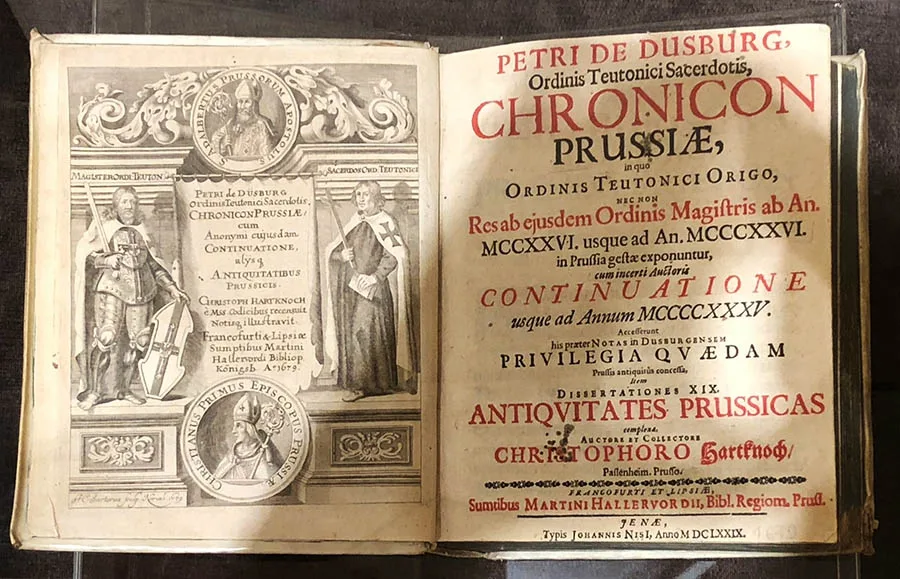
One of the puzzles of Simon Grunau's "Prussian Chronicle" is a number of hydronyms and toponyms of the Prussian land that he mentions. In particular, the chronicler reports that "Vistula... fliest in Crono, das gesaltzene mehr" ("the Vistula... flows into the Crono, the salt sea"), "Brudeno und sein bruder Witowudo... qwomen durch Crono, das wassir Hailibo..." ("Bruten and his brother Waidewut... came across the Crono, the water Hailibo..."), "Vitowuto im baute ein schlos zwischen Crono und Hailibo... und ist auffder Neringhe..." ("Waidewut built them a castle between the Crono and the Hailibo... on the Neringa (= spit)" (Grunau S., 1876, S. 56, 61, 62).
Temme/Tettau believe that Crono corresponds to the Baltic Sea and Hailibo to the Vistula (Kaliningrad) Lagoon.
3. Hailibo — the Kaliningrad/Vistula Lagoon.
4. The Prussians called their land the Island Kingdom (Ulmigania, Ulmigeria, Ulmerigia in the Gothic variant) — until the 12th century the Sambian Peninsula was considered an island bounded by the waters of the Baltic Sea and the rivers Pregolya and Deima. Overall, at the height of their power the Prussian lands stretched from the Vistula to the Neman.
5. On the Curonian Spit.
6. No information about this fortress has survived.
LITERATURE USED
"Prussian Chronicle", Simon Grunau. (Link. See p. 60 ff.)
● Editor's note: Read on VisitPrussia.com an interview with the translator of German and, in particular, Prussian fairy tales, our regular contributor Tatyana Kolivay, who runs her own blog, where countless other parables, legends and fairy tales in her translations have been published.
Translated from Russian with the help of AI (Claude, Anthropic), October 2026.