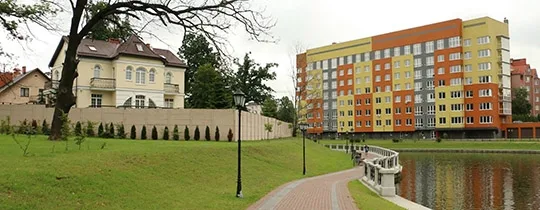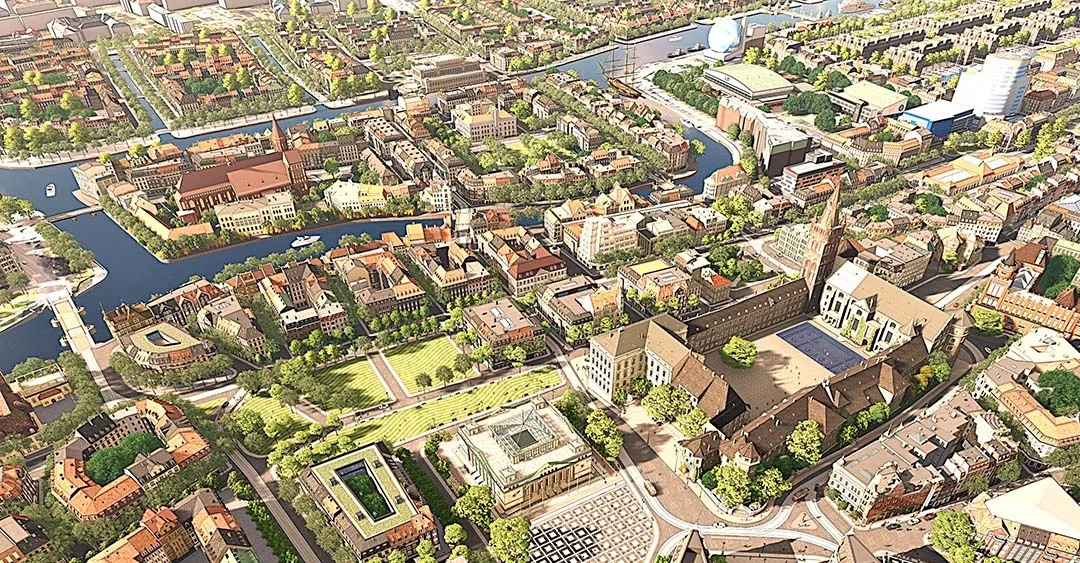
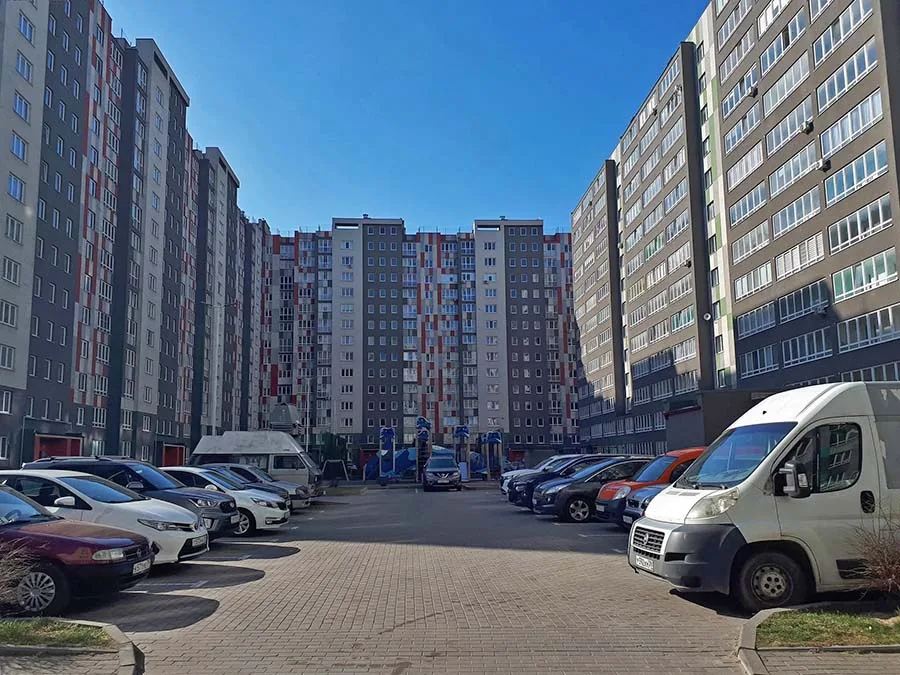
The city is gradually losing its last "ownerless" green spaces; buildings go up so tightly packed and on such small plots that there can be no question of car parks with an adequate number of spaces, of playgrounds and sports grounds, or of greenery. Not to mention the aesthetic side of "densification" construction. In short, as the Governor of the Kaliningrad Region Nikolay Tsukanov once said, "infill development has seriously killed Kaliningrad".
Although "infill" development has been "killing Kaliningrad" for more than ten years now, the city authorities are making no noticeable effort to solve the problem. Confrontations between active citizens and the city administration and developers usually end in defeat for the former, since the concept of "infill development" is enshrined neither in Russia's Urban Planning Code nor in regional legislation.
And so one has to fight not the development itself but the "procedures" that accompany it: illegal schemes for obtaining building permits, the felling of trees, violations of urban planning and sanitary standards, and so on.
The person most saddened by this fact is, of course, the head of the "City of Kaliningrad" urban district, Aleksandr Yaroshuk, who had earlier remarked as follows: "The city authorities are doing a lot about infill development. I don't understand at all what infill development is or who came up with it in the first place. I specifically asked the lawyers to give me a briefing. They went through the entire Urban Planning Code and concluded that there is no such term. There just isn't! So I don't understand what we're talking about."
Under such conditions it is practically impossible to fight infill development. You can delay the issuing of a building permit, draw public attention, sound every alarm about the corruption side of the matter, publicly censure officials and developers, and so on and so forth, but the chances of winning (in a standard situation) are vanishingly small.
Sometimes, however, unrestrained infill construction can affect not only the look of the city, its amenities and its residents' comfort, but also other issues to which the authorities are more vulnerable, and ignoring them entails a breach of federal law. It was precisely such a case that I came up against personally.
A couple of months ago I learned quite by chance that a high-rise was to be built on the scrap of land opposite my house. Or rather, I learned of public hearings on issuing a building permit for the house to a company with the promising name of Kremen LLC.
The story is a banal one: in the central district there remained an undeveloped scrap of land (neglected, of course) with a bit of grass, some little trees and a stream – one of the last refuges for dog owners. Next to this plot is the Regional Perinatal Centre.
But grass, little trees, doggies, a stream, women in labour – none of that interests anyone.
I decided to read the text of the resolution on holding the hearings. And what do you know: on this scrap of land stands a civil defence shelter (in the photo below), popularly known as a "bomb shelter", a mighty structure and – most importantly – protected by law (Federal Law No. 28-FZ of 12.02.1998 "On Civil Defence", Resolution of the Government of the Russian Federation No. 1309 of 29.11.1999, Resolution of the Government of the Kaliningrad Region No. 509 of 4 July 2011).
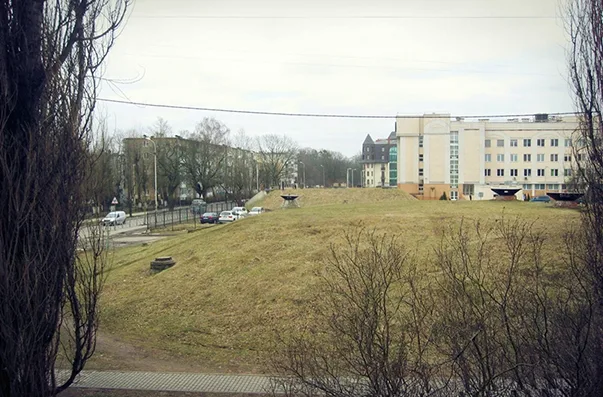
Civil defence shelter on Kashtanovaya Alley.
But here's the snag: the resolution on the public hearings says nothing about the bomb shelter. Nothing at all, not a single line. That can't be right, I thought – how could they forget about the structure? It's a civil defence facility, and how can anyone forget about defence, we're all supposed to be ready for defence these days. So I drew up a "petition" to the city administration: you're preparing a building permit, but there are gaps in the documentation – how could you forget the bomb shelter, surely that's not allowed?!
Unfortunately, the city administration answered questions I had not asked. I was told in the minutest detail about the exact location of the plot, about Article 39 of the Urban Planning Code of the Russian Federation, which the Committee for Architecture and Construction guards day and night, and about the regional Property Agency's kind consent to the granting of the building permit (between the lines one could read: love you, kisses, thank you for being so curious and for living in our city).
The hearings took place. Naturally, not a single serious objection was voiced against the construction company, apart from the reference number of my anxious letter and its subject.
I was upset and wrote another "petition", to the regional office of the Emergencies Ministry (MChS): I weep over the bitter fate of the defence structure, I said, but the city administration does not share my deep sorrow, does not recognise the federal laws on civil defence and protective facilities, and generally cannot grasp what this is about. I admit I was greatly surprised, but the office responded the very next day after my appeal. The bomb shelter is on the register, and the MChS remembers it and loves it no less than I do. A few days ago I received a written reply.
The regional MChS office learned from me that the administration had permitted a high-rise to be built on this site with the bomb shelter; no one had requested from them any data or requirements for implementing the relevant civil defence and emergency measures for the construction of the residential building.
After the MChS office wrote to Mayor Aleksandr Yaroshuk asking him to explain the situation, the administration showed incredible conscientiousness (which for some reason it had been unable to show in responding to my appeal) and announced that permission to use the land for building the house would be granted only once Kremen LLC had received the initial data and requirements for implementing the measures, or once the bomb shelter had been removed from the register.
It is too early to celebrate victory, however. The construction company will naturally be unable to meet any requirements approved by the MChS, since otherwise there would be no room left on this scrap of land for the house.
Clearly, every effort will be made to have the bomb shelter removed from the register. It comes down to this: either the bomb shelter, little trees, grass, doggies and children merrily sledging down the "defensive hill" in winter – or the high-rise.
And so it turned out that the bomb shelter, intended to protect the population from damaging factors, made it possible to attempt defensive action against infill construction. Had it not been there, a hideous construction fence would soon have been gracing this scrap of land, all the trees would have been cut down, lorries would have been squeezing along the narrow two-way road, and the noise and tremors of pile-driving would have cheerfully encouraged the women in labour and the newborns in the neighbouring Perinatal Centre. In short, everything would have been almost the same as always.
I harbour no great illusions about the future of this land: a construction company that has invested effort and (as we all understand) money is hardly going to back off because of some defence of some citizens. And, as it appears, if they do manage to get the bomb shelter removed from the register, building on this plot will be yet another example not only of the local authorities' couldn't-care-less attitude towards the look of the city, its amenities and the rights of its residents, but also a demonstration of how authorities at every level now treat matters of public safety.
Photos by the author.
Translated from Russian with the help of AI (Claude, Anthropic), October 2026.