LEGENDS OF PRUSSIA in the blog of Tatyana Kolivay.
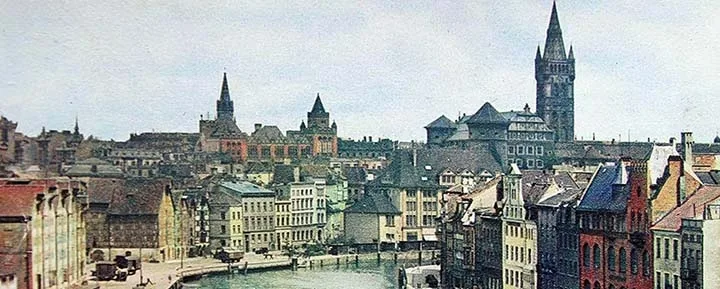
Königsberg has a great many excellent confectioneries. It is even claimed that the court confectioner Pomatty, whose shop stands on the Altstadt Market (Alistadtscher Markt), is the foremost master in the Prussian state, and that the famous Spagnapony in Berlin is merely his pupil. Many Königsberg confectioneries are splendidly situated. The windows of Pomatty's establishment look out onto the market with all its noise and bustle; those of the Meyer confectionery onto the parade ground in the Königsgarten. From the windows of Bertsch's one can see the Schmiedebrücke (Smiths' Bridge) and one of the arms of the Pregel. And Dölitscher's offers a fine view of the Castle Pond and the bridge across it.
Dölitscher's does not merely have large, bright rooms. The hall is tastefully decorated with exquisite flowers, and from it one can step out into a spacious pavilion under a tented roof and admire the garden, the broad expanse of the pond and the opposite shores. From the pavilion a flight of steps leads down into the garden, where one can sit on the bank of the pond watching the boats glide past and the townsfolk strolling in the garden on the far shore, and stay there, listening to the voices and strains of music drifting across from it.
Zappa's confectionery takes us into the liveliest part of the city, where the houses tremble dully with the constant rumble of carriages and the hustle and bustle of urban life scarcely ceases even after midnight.

But the very best establishment in Königsberg is undoubtedly the Siegel confectionery, in the very middle of Französische Straße.
It is not so much a matter of the comfort that reigns here or its excellent location as of the extraordinary atmosphere of the place. I am not speaking of the superb sweets and the elegant interior. In those respects other confectioneries are its equals and even surpass Siegel's (Dölitscher, Meyer, Janatzi, for example).
The point is that in Königsberg Siegel's is a confectionery and a coffee house at the same time. It is to us what Stehely and Spagnapony are to Berlin. If you want not merely to gratify all five senses, not only to read the newspapers, but to hear the latest town news and then discuss everything you have read and heard over a cup of fragrant coffee and pastries, Siegel's is beyond compare. Of course, it is not very large, but it is precisely the lack of space that so greatly encourages close conversation. I remember that the sheer size of the Berlin Café Stehely, especially its back room, reached by a few steps, often struck me as rather dreary, with patrons quietly sipping their coffee over newspapers at little marble tables, and the rustle of pages sounding like someone's sorrowful sigh in the ringing silence.

The front windows of Siegel's look out onto the street — and everything that walks, rides, runs and glides along it is of genuine interest to the patrons.
The windows of its reading room, meanwhile, overlook a large garden picturesquely enclosed by the back walls of fine houses. When you sit here absorbed in reading, this view has an infinitely soothing effect on the soul. In spring, when the trees turn green and the flowers bloom, and the smoke from the chimneys of the neighbouring houses rises above the fresh greenery in pale blue columns, it is best not to read at all, but simply to look, rest and listen to the merry songs sung by the workers of Schubert's hat factory nearby.
Yet the unique atmosphere of Siegel's is created by its patrons. It is possible only because everyone knows perfectly well who comes there and when, and what company may be met there at certain hours. Depending on the season and the time of day, the make-up of this company changes considerably. In summer the peak hours are from 11 in the morning until 4 in the afternoon, and in winter until 6 in the evening, when concerts and theatre performances usually begin. During these busiest hours different groups of patrons succeed one another, yet there is a certain unspoken bond and a sense of belonging between them.
Referendaries, doctors of medicine, teachers from various educational establishments, students, merchants, Justizkommissare, rentiers, retired soldiers, brokers, musicians, officers whose interests extend beyond dogs, horses and ladies, landowners who often come to town, civil servants and so on — when they come to Siegel's, they form a kind of close-knit community and a distinctive experience of sociability. A great many of the patrons here, who combine reading journals and newspapers with lively debate, have not the slightest connection with one another outside the confectionery and remain personal strangers, yet day after day they engage in absorbing conversation here.

The waiters in the local confectioneries are, as a rule, men.
I have sometimes wondered why there are so many confectioneries in Königsberg and why so many pastries, so much ice cream and chocolate are eaten in them, and so much coffee, tea, grog, punch, lemonade, liqueur and so on is drunk. There is nothing like it in southern Germany.
When I was studying in Heidelberg, I was very surprised that this city of the Muses had no confectioneries at all. And then, on returning to Magdeburg, I sorely missed the wine taverns and the wonderful Duprez coffee house by the bridge over the Neckar.
In Munich I liked to go to Café Tambosi beneath the arcades of the Hofgarten, but, leaving aside the peculiarity of its interiors, even the smallest confectionery in Königsberg can rival that famous Munich Italian in every respect. It must all be down to the climate. Winter cold, frequent fogs and rain dispose one to enjoy tea, grog and punch. Conversely, the scorching sun brings lemonade and ice cream to mind. And since cream and sour cream are among the main ingredients of all the local delicacies, countless dishes are made from them. Special mention should be made of the so-called meringue, which is much loved and consumed here in vast quantities. In short, the weather in our parts is very changeable, and so the body needs small rewards for the palate to indulge itself and restore its balance.

Lemonade alone, with which a Parisian refreshes himself during the intervals at the theatre, is not enough for a Königsberger — he needs something more substantial, such as a slice of cake and a liqueur.
I still remember very well my first visit to the local theatre, when I first had the chance to behold the local connoisseurs and admirers of the stage with my own eyes. On the third of October 1833 I spent my first day in Königsberg, and in the evening I went to hear the opera. They were giving "La Muette de Portici"1.
What struck me first of all was that almost the entire audience kept their hats on. There was, however, an explanation for this: it was cold in the auditorium. Only the officers, who have to wear caps or helmets almost all day long, were bareheaded. The gentlemen who wore wigs were also without hats. They, however, were sufficiently protected from the cold as it was. The performance began, and all around me paper bags of sweets, pastries and so on began to rustle as ladies and their escorts unwrapped them here and there. Everyone, from the stalls to the gallery, was munching apples and pears. The East Prussian and Lithuanian faces of the actors playing Neapolitan soldiers made a strange impression. In the opera they represented the prince's life guards and were therefore armed with soldiers' sabres reminiscent of the Seven Years' War a hundred years earlier, and with cartridge pouches. In short, cast out of our Prussian north into some brave new world, I stopped watching the performance after the second act and went to the theatre confectionery. There I saw the very same audience.

Fair-haired, blue-eyed and rosy-cheeked Königsbergers were consuming grog, punch and mulled wine in colossal quantities, and doing so in the evident conviction that this was a necessary, integral part of going to the theatre.
However, it is not only the harshness and changeability of the local climate that shape the tastes of the local people, but also the absence of the splendid fruit offered by the southern sun. True, there is no shortage of fruit here in general, but it is woodier, more watery, fleshier and less sweet than in the south, and by no means as varied. Here one has to do without fresh nuts, roast chestnuts, grapes and many varieties of apples and pears.
NOTE
1. "La Muette de Portici" ("The Mute Girl of Portici") is an opera by the French composer Daniel Auber (1782–1871).
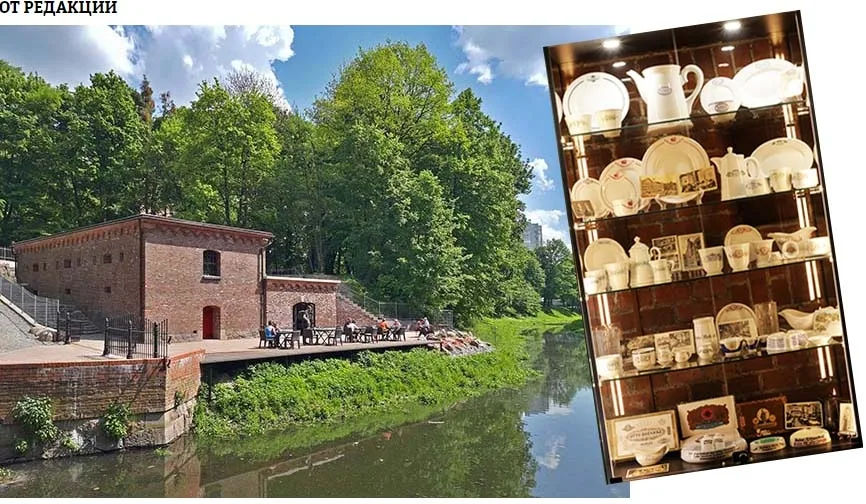
In 2023 a museum devoted to the restaurants, cafés and confectioneries of Königsberg and all of East Prussia opened in Kaliningrad at Litovsky Val 21d. The museum is open daily from 10.00 to 18.00. You can get acquainted with the project online beforehand: LINK.
LEGENDS OF PRUSSIA in the blog of Tatyana Kolivay.
Translated from Russian with the help of AI (Claude, Anthropic), October 2026.