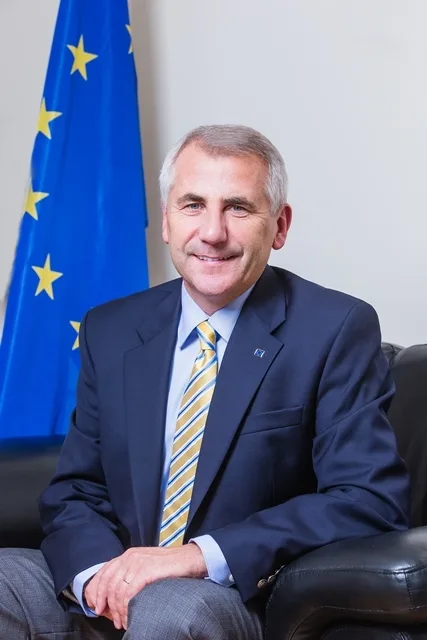
– Mr Ambassador, how has the cooling of relations between Russia and the European Union affected your work?
– Of course, any ambassador would like to create positive examples and projects in order to develop relations in a constructive direction. At the same time, an ambassador’s work is objectively a mirror image of whatever fills the relationship between Russia and the EU. The illegal annexation of Crimea and Russia’s destabilisation of the situation in Ukraine could not fail to affect the “handwriting” of my work. At the moment we are watching Russia’s steps regarding Ukraine. I also take into account that there are, after all, rather deep disagreements between us on various issues. Russia and the EU differ in how they understand the principles on which society is built, the relationship between citizen and state, the role of press freedom and civil society, and human rights. Unfortunately, we also cannot ignore the actions that certain countries take in the sphere of trade, which affect our common neighbours. On the other hand, the European Union remains Russia’s most important partner in trade turnover and energy trade.
The mission of the ambassador and of the EU Delegation in Russia is to work out how to overcome the disagreements. How to preserve the bridges of cooperation and contact between people. In this context my work is very interesting. It is difficult. It is not always pleasant. But I suppose that is fate.
I have been ambassador in Russia for three years and will serve for one more year. Probably, unfortunately, these four years in my biography and in EU–Russia relations will go down in history as a period of crisis management. I will go down in history as the “crisis ambassador”, the “ambassador for crises” [he says with an ironic smile – author’s note]. It is from this point of view that I approach my work, understanding the scale of the disagreements and aware that we must preserve the bridges of contact and cooperation wherever possible. Disagreements come and go. Whereas a diplomat’s job is to preserve the very best of what exists between us.
– You travel a lot around Russia, visit different cities and talk to people. Do you feel that ordinary Russians’ attitude towards the European Union is changing?
– An interesting question. Before leaving Moscow for Kaliningrad, I looked at the latest Levada Center survey data on how Russians rate different countries. I regret to say that the number of Russians who view the EU negatively has reached a record high – 62%. Although America leads this list with 70%. Given that most Russian media, especially the national ones, present information about the EU one-sidedly, Russian television viewers and radio listeners have no other choice. In the absence of alternative information and deeper analysis of the facts, these 62% hold the opinion they expressed. They do not have full information about the EU’s activities.
At the same time, during my visits from Sakhalin to Kaliningrad – I was on Sakhalin just two weeks ago – I have not met anyone who was not concerned about relations between the EU and Russia. Wherever I have been, in Siberia, in the Far East or in the Kaliningrad Region, the overwhelming majority of Russian businesspeople and investors believed, and continue to believe, that the European Union is Russia’s main economic partner.
This is confirmed by the facts: 46% of Russia’s trade turnover is with the European Union, 75% of foreign investment in Russia comes from the European Union, and 70% of Russian hydrocarbons are sold on the European Union market. So Russia’s dependence on the EU is perfectly obvious, as is our desire to maintain our position in the Russian market of 140 million inhabitants and consumers. We want to keep access to your market. Although, I have to admit, over the past few years Russia’s share of EU trade turnover has fallen from 10% to 6%.
– The European Union gives the Kaliningrad Region money from EU funds for various needs. Are you satisfied with how Kaliningrad and the local authorities are “absorbing” these funds, and do you plan to help the region in the future?
– I would like to repeat what I said during my meeting with Governor Nikolay Tsukanov. Given the political attention the EU has paid to the Kaliningrad Region since the end of the Cold War, and the financial resources we allocate to your region, the Kaliningrad Region can confidently be called a truly privileged region of Russia when it comes to cross-border cooperation with the countries and regions of the European Union. Since 1991 the EU has allocated more than 150 million euros to various cooperation projects between the EU and Kaliningrad. Of course, the process does not always go smoothly, and not only in Kaliningrad but in other regions of the Russian Federation as well. One of the important projects is the wastewater treatment plant in Kaliningrad, for whose construction the EU and the Nordic countries allocated 100 million euros. Albeit with a delay, the project is being implemented. When the treatment plant is fully operational – as I understand it, in the second half of this year – it will not only help modernise Kaliningrad’s water supply and wastewater treatment infrastructure but also make a significant contribution to the environment: 150 thousand cubic metres of dirty water [per day – editor’s note] will no longer be discharged into the Baltic Sea.
In addition, we are implementing a new package of financial assistance in the field of cross-border cooperation. During my visit to Kaliningrad I announced that by 2020 we will allocate 57 million euros to the Kaliningrad Region.
41 million euros will go to cooperation between Polish voivodeships and districts of the Kaliningrad Region, and 16 million euros to cooperation between the Kaliningrad Region and Lithuanian regions. It is very important that the responsible institutions and officials on all sides prepare the programme documents on time. Under European Commission regulations, they must be submitted by the end of June. We will review them, assess them and take a decision on funding.
Besides cross-border cooperation, the European Union is implementing projects to support civil society. I am pleased to note that since September the project “Sparks of Hope for Russian Villages” has been running in the Polessk District. It aims at the sustainable socio-economic development of rural communities through citizens’ participation in cooperation with local authorities. The EU’s financial support amounts to almost 600 thousand euros. Besides the Kaliningrad Region, the Arkhangelsk Region, Krasnodar Krai, Altai Krai and the Altai Republic are taking part in the programme. Together with Kaliningrad we are also implementing two projects aimed at improving the lives of people with disabilities. Under one of them, “Friendly Cities”, a comfortable and accessible urban environment is being created. Besides Kaliningrad, cities such as Pskov, Petrozavodsk, Vladimir, Arkhangelsk and Saint Petersburg are taking part in the project. The EU’s contribution is 400 thousand euros. Another project concerns the effective realisation of the right to inclusive education in schools. Fourteen Russian regions are taking part in the project; the EU’s contribution is 750 thousand euros.
Speaking of support for civil society, I must point out that we are surprised and disappointed that the Hanse Office, an organisation whose aim is to promote cooperation between the Kaliningrad Region and the German state of Schleswig-Holstein, has been put on the so-called list of “foreign agents” [Schleswig-Holstein and the Kaliningrad Region are partner regions – author’s note]. This step in no way helps the development of regional cooperation, and I hope that the responsible authorities will yet change their minds.
– Meanwhile, the press of our Polish and Lithuanian neighbours increasingly describes the Kaliningrad Region as a militarised region, a springboard for a Russian invasion of Europe. The Baltic Fleet and the very geography of the region cause concern. Does this worry you?
– First of all, I have devoted most of my 25-year diplomatic career to promoting the development of the Kaliningrad Region as an open region where there is trust between neighbours.
You are surrounded by peace-loving citizens of the European Union. We have allocated and continue to allocate financial resources to the Kaliningrad Region so that in times of geopolitical tension we – both the EU and Russia – do not lose this course.
But as an ordinary citizen of Lithuania, I cannot read the news without concern or watch the facts of Russian warships and aircraft violating the territorial space of neighbouring countries. This is an obvious violation, a lack of respect, and it does not help build relations based on trust.
– Russia, as is well known, denies these facts.
– What is there to deny? It is written about in open sources. They describe how outrageously the Russian pilots behaved when they flew over a warship [in April, Su-24 bombers performed low-level manoeuvres over the American destroyer Donald Cook, which was taking part in exercises in the Baltic – author’s note]. In mid-May it was reported that Russian aircraft had violated Estonian airspace. Sometimes Russian aviation violates the airspace of the Baltic states, flying in with transponders switched off and not responding to signals. Such incidents worry people, and there are grounds for that.
But the EU gives priority to cooperation. Even during the conflict in Ukraine and in an atmosphere of sanctions, we have never imposed sanctions on ordinary people or on cross-border cooperation. On the contrary, we are allocating additional money for this, including to the Kaliningrad Region. For example, the EU did not reduce but doubled funding for student exchanges between the EU and Russia. Last year the sum reached 27 million euros, thanks to which 3,583 students and teachers received EU scholarships, and about 30 Russian universities took part in 45 projects under the Jean Monnet Programme. Incidentally, just last week we closed the call for applications for this programme. A record number of Russian universities – 200! – expressed interest in taking part in exchanges with the EU.
– Despite the incidents mentioned, the Kaliningrad Region does not frighten you?
– No! But it is up to you to decide what your region will be – a platform for fruitful development or a platform for possible tension. I am nevertheless confident that the potential for cooperation between Kaliningrad and its neighbours speaks for itself. It is the greatest resource for advancing the economy, social development and cultural cooperation between the Kaliningrad Region and your neighbours.
– One of the telling examples of cross-border cooperation is local border traffic (LBT). An LBT regime exists between the Kaliningrad Region and Poland. The Polish Institute of International Affairs (PISM) has acknowledged that both sides benefit greatly from LBT and that the regime promotes the development of border areas and contacts between people. There were plans to establish LBT between the Kaliningrad Region and Lithuania, but they were frozen. What happened?
– As far as I know, Lithuanian visas are issued to residents of the Kaliningrad Region without any problems and very easily. Regardless of economic difficulties and the devaluation of the rouble, the number of visits by Kaliningraders to Lithuania remains at a record high. As for LBT, as Lithuania’s Minister of Foreign Affairs I myself advocated precisely that a corresponding agreement be signed between Lithuania and the Kaliningrad Region. Indeed, from talking both to Polish colleagues and to the Kaliningrad governor, I know that everyone rates LBT between Poland and the region positively. But we must bear in mind that we do not live in isolation from political events. That is why at the moment we have frozen the visa dialogue between the EU and Russia. But I hope the situation will calm down and return to normal.
– What must happen for LBT and similar projects to come back to life? Are global changes in “big politics” required, or can we reach agreement at the regional level?
– I have no recipes. As I understand it, the political context does not offer an opportunity for this at the moment. Let us wait. We will make sure that the Minsk agreements [on normalising the situation in eastern Ukraine – editor’s note] are implemented and our relations return to normal. I can only wish that the Lithuanian and Russian authorities would examine and take into account the positive LBT experience that has accumulated between Poland and Kaliningrad.
– If you could address the 62% of Russians who view the European Union negatively, what would you tell them? What images would you like them to associate with the EU?
– Kaliningraders, and Russians in general, must describe the image of Europeans for themselves. But I would wish that you try to travel to Europe more, and keep up friendly relations with the people you have met. I advise you to go into the details and broaden your sources of information about what is happening in Europe; what is happening in relations between the European Union and our partners (Ukraine, for example); what issues we are tackling; what way of life we promote; what values we share; what principles and laws, such as democracy and the free market, we respect. I am sure that then the overwhelming majority of Russians will perceive – and even now do perceive – Europeans as friends, good neighbours and partners ready to develop relations on the basis of respect and predictability. It is the image of Paris, Rome, Berlin, Warsaw, Vilnius and many other European cities that are always open to Russian tourists, students and investors. It is the image of more than 500 million Europeans who, like me, are ready to explore Russia’s 11 time zones, its rich history, culture and unique nature.
Translated from Russian with the help of AI (Claude, Anthropic), October 2026.