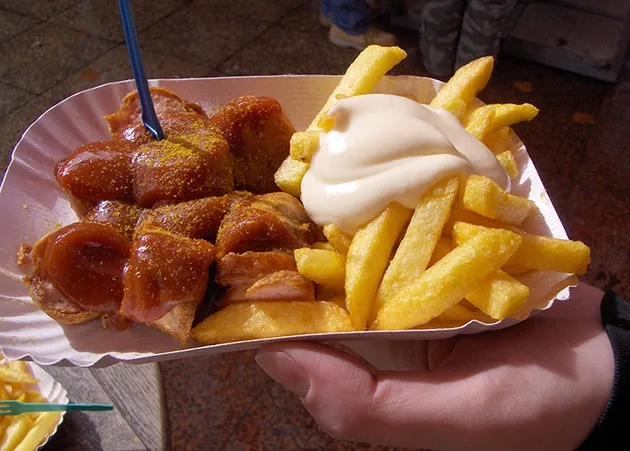
This woman's fate turned out far more fortunate than that of many of her contemporaries from the East Prussian province, who lost their homeland after the Second World War. The Pöppel family, in which Herta Charlotte was the sixth child, moved from Königsberg (from Heidemannstraße 25 in Sackheim, today the area around Cherepichnaya Street) to Berlin long before the war-torn years of the mid-20th century, at the end of 1929. Here Herta received a business education, then trained as a seamstress and also completed a cookery course, and in 1935 she married Kurt Emil Heuwer, a mechanic at Siemens & Halske AG. From 1936 to 1940 Herta worked as a sales assistant at the KaDeWe department store. After the war, like all the women of the German capital, she took an active part in rebuilding her district, Charlottenburg. It was here, in 1949, in the British sector of Berlin, on the corner of Kantstraße (how symbolic!) and Kaiser-Friedrich-Straße, that she bought a wooden kiosk and opened her first snack bar in it.
One rainy evening, on 4 September 1949, when there was not a single customer in her establishment, she was experimenting with curry and various other exotic spices that British soldiers had generously shared with her. “Out of sheer boredom I started mixing the spices with tomato paste, and suddenly it turned out wonderfully,” Herta later recalled.
The sauce gave the sausages a distinctive, piquant flavour, and her dish won popular acclaim. And so the famous Berlin fast food was born – currywurst.
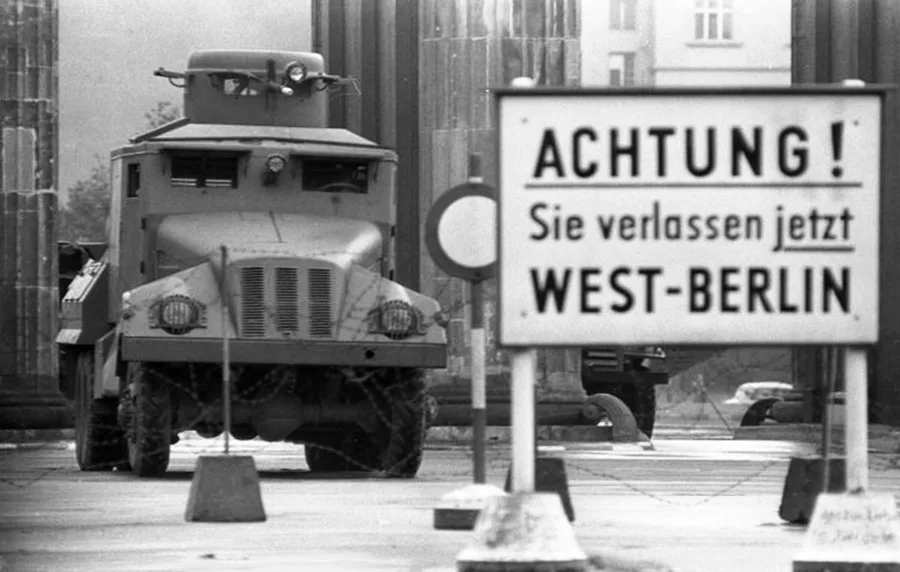
The harsh realities of post-war Berlin.
Ever since, the creator of currywurst – that is, the sauce combined with the sausages – has been considered to be Herta Heuwer from Königsberg. She bought the sausages themselves from Max Brückner, a meat producer from the Saxon town of Johanngeorgenstadt. In the late 1940s he had revolutionised their production by devising a recipe for sausage meat that held its shape during cooking without a natural casing – intestine, which was very expensive and scarce at the time. As a result, the product became much cheaper and more affordable for the German population, most of whom lived in great hardship and even went hungry.
Soon afterwards Max Brückner moved to West Berlin and opened his butcher's shop, called “Maximilian”, in the Spandau district. Together with his partner Frank Friedrich he improved the production process. The “Spandauer without skin” (Spandauer ohne Pelle), as their sausages came to be called, went down well with Berliners. Yet neither Brückner nor Friedrich thought of patenting the invention. They were more concerned with how to provide the people of Berlin with fast, filling and affordable food. Herta Heuwer, a close friend of Frank's family, became one of Maximilian's first customers.
The idea of making the sauce came to Herta Heuwer from her husband Kurt, who worked for the Americans. He had seen with what relish they devoured huge steaks generously doused in ketchup. For Herta this was a sign from above. Steaks, and ketchup too, were of course an unaffordable luxury for Berliners at the time. So she poured her new sauce over the same Spandauer sausages, which she then dusted with curry powder. At first the new dish did not have the hoped-for effect. She then turned for help to her friend Frank Friedrich, who lent her the spices she was missing. Together they perfected the sauce, mixing various ingredients until they achieved the desired (original and unforgettable!) flavour.
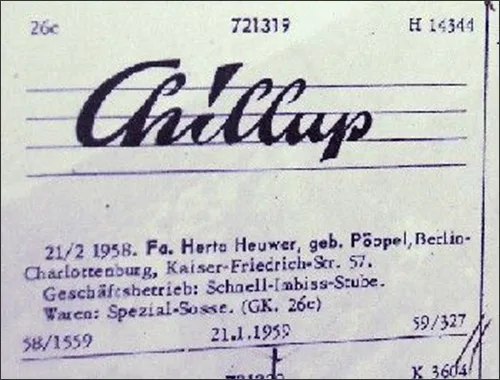
In 1959 Herta Heuwer patented her invention at the Munich Patent Office under number 721319 as Chillup.
Herta's business did so well that she opened a large snack bar with a kitchen at Kaiser-Friedrich-Straße 59, which soon grew into a substantial round-the-clock establishment. In its heyday it employed up to 20 sales staff. The German company KRAFT tried to buy the rights to currywurst from Herta Heuwer, but she refused.
Meanwhile, a heated dispute broke out among sausage makers. Some believed that sausages for currywurst had to have a casing, while others argued the opposite. In the end it was decided that both kinds would do, though skinless was still the more correct choice.
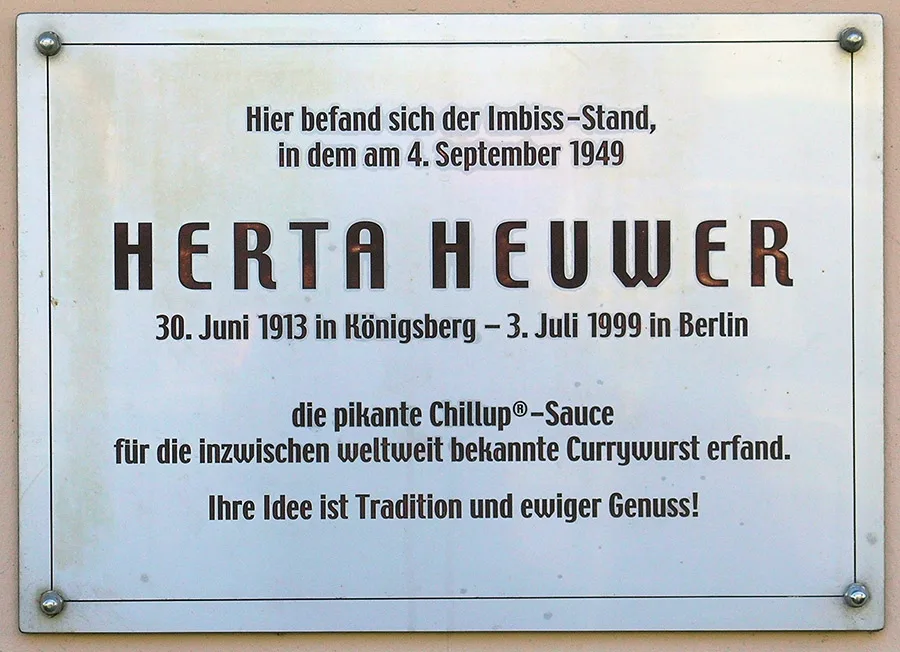
In 2003, a memorial plaque in honour of the snack bar's owner (pictured below) was installed in Berlin on the building at Kantstraße 101, next to which the snack bar had stood. Many of her regular customers gathered for the ceremonial unveiling, and Herta's niece and adopted daughter Brigitte Böhmer, together with the mayor of the Charlottenburg-Wilmersdorf district, Monika Thiemen, and the actress Brigitte Grothum, star of the television series “Three Ladies at the Grill” (Drei Damen vom Grill), treated everyone to sausages with Herta Heuwer's famous sauce, which had come to be produced by the Maximilian company under the name Chil-Max. In her speech, Monika Thiemen thanked the Böhme couple, on whose initiative the memorial plaque had been put up. Brigitte and her husband Olaf contributed 2,000 euros towards its installation.
More than 800 million curry sausages are eaten in Germany every year – with or without casing, sliced into pieces or whole. Some 70 million of them are consumed by the residents of the German capital alone.
Currywurst became so popular that in 2009 the German Currywurst Museum (Deutsches Currywurst Museum) opened in Berlin – though it recently (in 2018) closed because of the ever-rising rents in the German capital. In 1982 the well-known German rock musician, singer and actor Herbert Grönemeyer, winner of numerous gold records, included a song called Currywurst on his album Total Egal. There is even a film about the story of how currywurst came about, which, predictably enough, is called “A Story with a Taste of Curry”.
Over time, currywurst also gained political weight. Some candidates for high public office are happy to be photographed in front of a snack bar, holding a paper plate with sausages and a heap of chips, thereby demonstrating their closeness to the people. And former German Chancellor Gerhard Schröder, whose wife kept him on a vegetarian diet, had to eat currywurst on the sly – not for publicity – at a nearby little restaurant.
Every year, on a weekend in May, the town of Neuwied in Rhineland-Palatinate holds a festival in honour of the famous sausages, attended by representatives of many companies, who compete in making currywurst, each trying to surprise visitors with its own signature sauce. The cult of this fast food has gone so far that some restaurants decorate it with gold leaf or serve it with truffles.
Yet currywurst is first and foremost simple street food – or, as people now say in the American manner, fast food – which over 70 years has become a culinary phenomenon and one of the symbols of Berlin. Everyone eats it, regardless of social status.
Who knows – had Herta not left her native Königsberg, perhaps today currywurst, alongside Klopse and marzipan, would hold a place of honour on the menus of Kaliningrad's restaurants serving local cuisine. But in Kaliningrad there are no such restaurants.
Translated from Russian with the help of AI (Claude, Anthropic), October 2026.