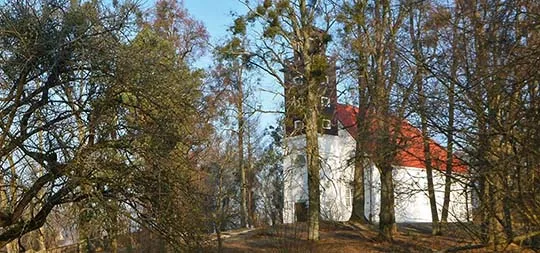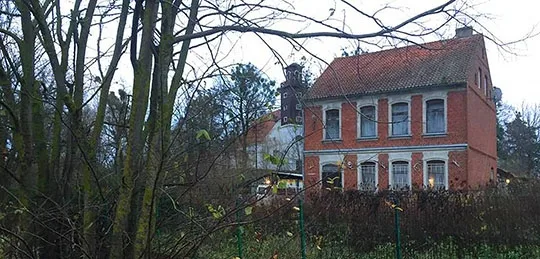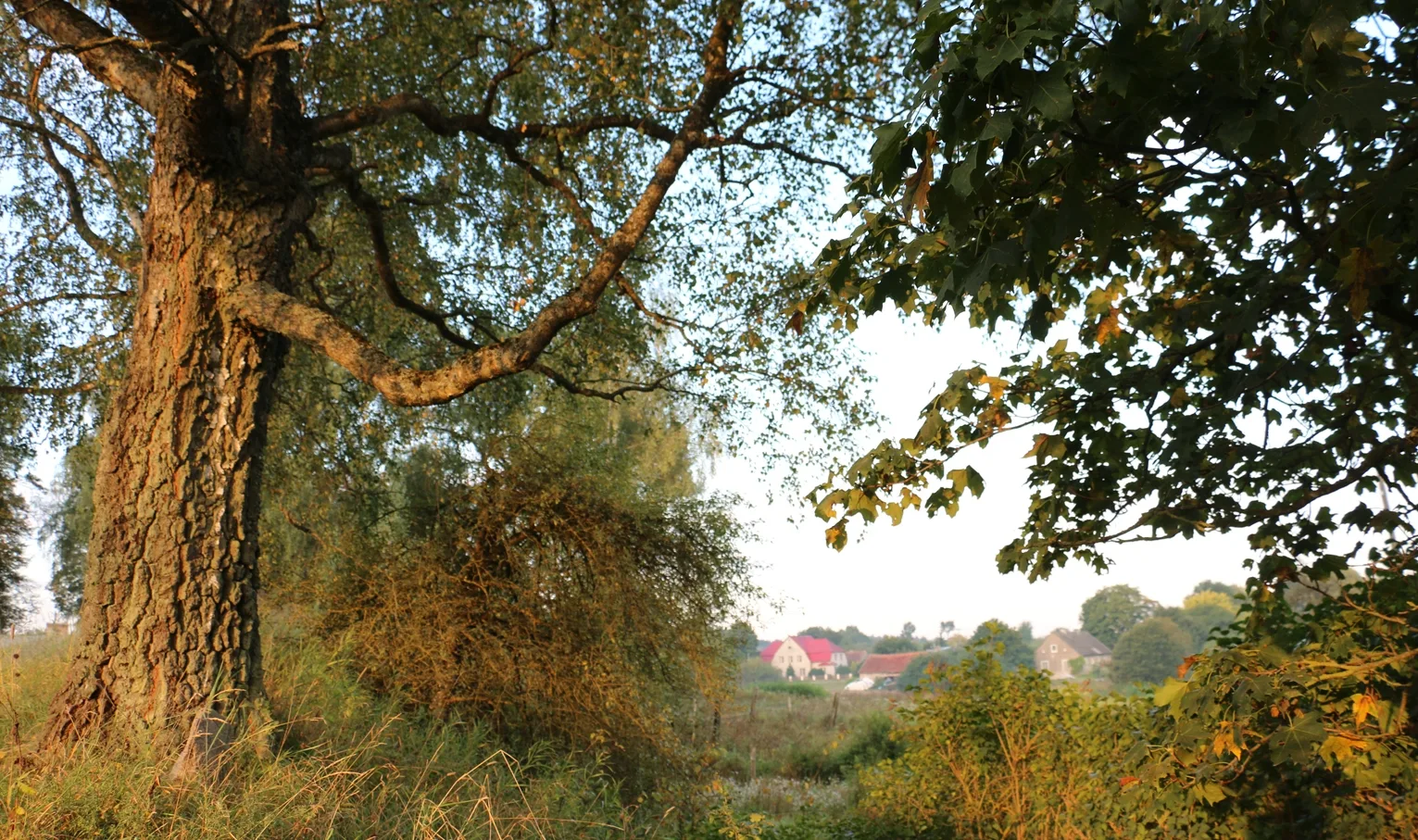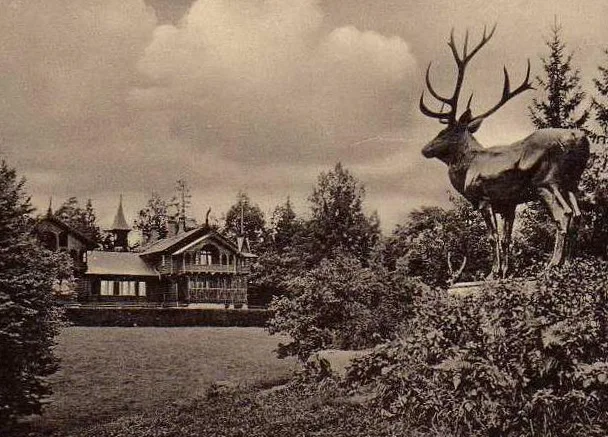
His name became widely known only a hundred years later. It was he who created a remarkable work of poetry, one of the first in the Lithuanian language, and became a classic of Lithuanian literature. Today his poem “The Seasons” has been translated into many of the world’s languages. It was written in one of the cosiest and most picturesque corners of East Prussia, on the edge of the Rominten Heath, in the village of Tollmingkemen.
High toward the clouds the crane rose up in its majesty,
Ringing as if it moaned and wept, then lost in the heavens.
Yet it is no lament at all, that ringing call of the crane!
No, it is living proof of the Lord’s almighty power,
Power that works its wonders, dwelling even in a bird’s small throat.
It was here that Kristijonas Donelaitis spent most of his life, and here, in 1780, he was buried beneath the vaults of the church in which, as its pastor, he had served both his people and the Lord. Today the restored church in the village of Chistye Prudy houses a memorial museum dedicated to the poet. This place, like the very name of Kristijonas Donelaitis, matters not only to the Lithuanian people but to all enlightened people. For us, who live in and around the Rominten Heath, it is the name of our great fellow countryman — one of those who loved their land and their people, one of those who keenly perceived the world around them.
But he was the only one who, in those distant times, was able to express his feelings in simple and truthful language, to set them down on paper and clothe them in verse.
The world of people, the world of nature and the world of the ancestors are interwoven in his verses in an extraordinary way. Reading the lines of the poem, one sometimes feels that scenes from the past are coming to life outside the window. The memory of the land, the memory of time, the memory of generations. It is a true literary monument, created a quarter of a millennium ago by an eyewitness.
Reading the poem, one can learn a great deal about the hard labour of the peasants and the food of ordinary people, what they wore, what they sowed, and how they rested and rejoiced when celebrating their feasts. Through the work of Kristijonas Donelaitis one can learn about the customs of the different peoples and social estates who lived on this land in the distant 18th century. And of course, in reading the poem you will discover great nature, its all-conquering power and the wisdom of the Creator, and time itself, which, year after year, repeats the cycle of the seasons and closes the circle of human life.
Hail to you, bright world, that has kept your festival of spring!
Hail to you too, O man, who has lived to see the sweet summer!
On the first of January, let us remember one of our great fellow countrymen, whose name was included in 1977 in a list of 240 authors whose pens produced the masterpieces of European literature from antiquity to 1940. On that same day, 1 January 2014, the poet’s 300th anniversary was celebrated. The Vištytis Ecological and Historical Museum opened its doors to all the residents of the village of Krasnolesye and their guests. Children and adults were treated to fragrant herbal tea with spiced Christmas biscuits, and by the fireplace they could try on traditional wooden clogs — klumpės — and hear the story of the life of Kristijonas Donelaitis and his times. At the festive table, with cranberry mors, cepelinai and other traditional dishes, just as in days of old, the poet’s verses rang out once more in different languages, painting pictures of the past and awakening the memory of our land.
Now cruel winter has come raging back once again.
The bristling north wind rushes on, striking fear into earth’s creatures.
Look: at daybreak the lakes and ponds have skinned over,
As though a glazier had skilfully set panes of glass in them all.
Look: the realm of the fish, where the frogs kept their summer,
Has walled itself off from quarrelsome winter as if with armour.
Every creature there now goes to its sleep in the darkness.
The angry north wind has so run riot over the fields that everywhere
The marshes have turned to stone, wrinkles have spread across the bogs,
And the autumn mud has suddenly ceased to squelch underfoot.
If a cart now goes galloping along the road –
It thunders and rumbles in the frost like a taut drum,
And that roar, rolling far away, echoes inside your head.
The time has come once more to meet and welcome the winter!
Photo from the archive of the Vištytis Eco-Museum.
This article quotes lines from Kristijonas Donelaitis’s poem “The Seasons” in the Russian translation by David Brodsky, rendered here into English
Translated from Russian with the help of AI (Claude, Anthropic), October 2026.