LEGENDS OF PRUSSIA in the blog of Tatyana Kolivay.
In Königsberg street vendors still walk the streets, loudly crying their wares. As a rule, this is small-scale retail trade in everyday necessities. In some German cities this kind of touting for customers and loud advertising of one's goods in public places is forbidden by the police, while in others it is superfluous in itself because of local circumstances.
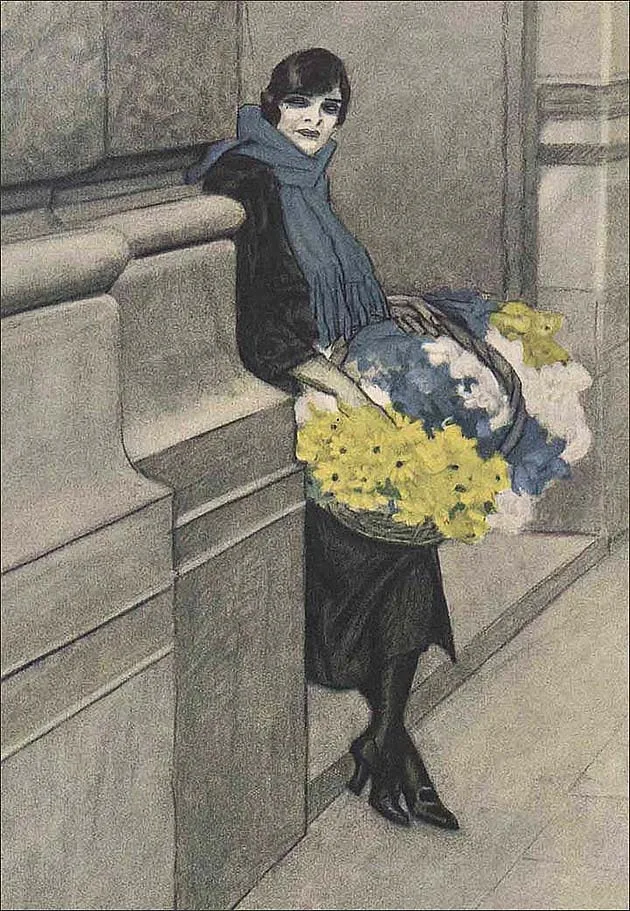
But in Königsberg the streets are in perpetual bustle. There is something picturesque about these figures who move from place to place at all hours of the day, giving their cries a singsong rhythm to which everything submits.
Sellers of butter, eggs and so-called curd cheese – a cheap kind of cheese sold in very small pieces, which is called "Botterdwarg" here (German "Butterquark") – are a constant sight in the streets of Königsberg. In just the same way, at any time of day and all the year round, one can hear the cry of the carter who hauls sand in a one-horse cart and calls out in a hoarse voice:
— Kököe, witt Sand!
( — White sand here! )
Among the street vendors who go about the city all year round is, of course, the milkman. In the mornings he drives his small two-wheeled cart, loaded with tin churns of milk and drawn by a little horse. In front of the houses of his regular customers he cries not "Milch" – "milk" – but the more resonant East Prussian "Schmand", although the skimmings he sells are often hardly worthy of the name of milk.
Almost at the same time in the mornings, but only on Saturdays and Sundays, children walk the streets, calling out in ringing voices:
— Danne, greene Danne, Danne!
( — Fir, green fir, fir! )
The thing is that in Königsberg and its environs there is a custom of decorating the steps in front of the entrance door, the staircases of houses, the corners of the hall and even the rooms themselves with greenery and flowers on Sundays and holidays. This is called "ausfliehen" here. The locals know how to do it very beautifully. In winter, when everything is covered with snow, the sight of such greenery, which seems to grow out of the very walls of the houses, is often indescribably comforting and at the same time touching. People try to recreate in their homes the sweet serenity of nature, which they have to do without for most of the year. Recently spruce greenery has become very popular, and the people of Königsberg decorate their houses with it inside and out.
Soon after the children, the tinker's wife appears in the street and cries out for the whole neighbourhood to hear:
— Töppke binde, Töppe!
( — Pans mended, pots! )
Then the itinerant knife-grinder goes from yard to yard with his wheel, loudly asking whether anyone has scissors, knives and the like to be sharpened.
He is followed by the Italian with his plaster knick-knacks on a wooden tray. His usual cry is:
— Figure kauf!
( — Buy figurines! )
His wares, however, sell poorly. They are the most vulgar products of that craft: busts of heroes of bygone days, brightly painted figurines of cats, dogs, parrots and other small creatures. Copies of famous sculptures, such as delight our eyes in renowned museums, he does not have for sale, as far as I have been able to observe.
Between 10 and 11 in the morning, when the kitchens grow busier, an old woman hobbles along the little houses of the Altstadt, leaning on a stick. In her other hand she holds a basket and cries in a plaintive, quavering little voice:
— Schwefellicht, Schwefellicht!
( — Sulphur light, sulphur light. )
She sells sets of sulphur-soaked cord and tinder. She is probably the last of her trade, since even in the smallest households everyone is beginning to use chemical lighters, thus displacing the age-old tinder, steel and flint.
Towards evening, when the first strolling townspeople appear in the streets, one hears the stentorian voice of a crippled beggar who has stood all day by the bridge whittling sticks of hazel, which he then blackened with army varnish or simply sanded down. Such sticks can come in handy about the house. He usually advertises his wares quite simply:
— Köp se Kloppsteek!
( — Buy your beating sticks! )
rings out deafeningly and drawn-out, and echoes far and wide around, competing with the stentorian voice of the tinker's wife.
And finally, at ten o'clock in the evening the night watchman blows his trilling horn for the first time and calls out very measuredly:
— Die Glock' hat zehn geschlagen, zehn ist die Glock!
( — The bell has struck ten times – it is ten o'clock! )
Lastly, there are street vendors who work only in a particular season.
In spring the fruit trade is opened by our guests from the south. As soon as the Frisches Haff (German: Frisches Haff, now the Kaliningrad Lagoon) and the river Pregel are free of ice, the first ships bring large consignments of lemons and oranges.
Girls and women, their heads wrapped in black kerchiefs, in long camisoles1, skirts and aprons, march through the city in crowds with narrow hand baskets curved in a figure of eight, crying:
— Na, Zittrone wollfeil, Zittrone! Appelzine goode Kop, Appelzine!
( — Come on, who wants cheap lemons, lemons! Oranges, good ones, buy them, oranges! )
Soon after them come the radish sellers:
— Reddis, Reddis, Fresche Reddis!
( — Radish, radish, fresh radish! )
At the same time boys sell bunches of sweet flag2. It grows by the fortress gates and, cut into pieces, is also used for the decoration of houses with greenery described above. These boys have a "chant" of their own:
— I—o, I, Kalmus, drei, Bund für einen Pfennig!
( — I—o, I, sweet flag, three, bunches for a pfennig! )
But then summer arrives with its strawberries, bilberries, cherries, pears, plums and apples. Nuts sell poorly here, so they are taken elsewhere. The nut trade is mainly in the hands of Jewish traders and their wives, who twice a year, during the fair in June and at Christmas, sell nuts on the bridges, standing by the railings. When they walk the streets they do not shout but rattle a sack, shaking it on their backs.
In autumn the true masters of street trading are the greengrocer women. Singing, they name many goods, both those they have and those they do not. Here too, of course, there are variations depending on the time of year. Cauliflower, asparagus, lettuce, peas and beans, for instance, are sold in their seasons. Only the end of the greengrocers' chants is always the same, although it exists in two variants. Some end their song with the word Peterkoli, others with Peterzilie. Both mean "Petersilie", that is, "parsley". It is by no means necessary for them actually to have parsley for sale – it is merely an aesthetic, sacred ornament, the necessary cadence that rounds off the whole performance. The melody of all this gibberish bears the greatest resemblance to the twittering of a swallow, except that instead of fine, trilling bird notes one hears coarse human voices.
No less noticeable are the fishwives:
— Dorsche, Dorsche, frische Dörsche!
( — Cod, cod, fresh cod! )
their cry rings out here and there, ringing in our ears almost all the year round. The cod is a small sea fish caught by the thousand by the people of the Samland coast. It is gutted right there on the shore and brought to the city in carts. A great deal of flounder is also sold, fresh and smoked.
Other fish appear for sale more or less seasonally, namely salmon and eel. Salmon is sold to the cry of:
— Fett Streem Laß, Fruus!
( — Fat river salmon, ladies! )
The fishwives as a rule always add the obligatory little words "fresh" and "cheap", for example:
— Na Karpe, Karpe, frische goode Karpe, wollfeel!
( — Here's carp, carp, fresh, excellent carp! )
Crayfish have their own season too:
— Fleet kraft!
( — River crayfish! )
The year's and the day's fish trade is rounded off by river lampreys, which are usually offered from December to the end of February, from seven to ten in the evening.
At Easter, figurines of Easter lambs are sold on the bridges. They are rather crude wood carvings. The figurines are wrapped in foulard and tied with a red silk ribbon.
Between Christmas and Easter is the time for selling fortune-telling sets of all kinds. Figurines of fired clay, painted in bright colours, are laid out in a circle. They are a man, a woman, a baby, a skull, a ladder, a key, a ring, a loaf of bread and a coin. The circle is blessed with the sign of the cross and is supposed to bring good luck.
The ladder is the way to heaven and signifies an easy, blessed death. The key is the key to the heart or to heaven. The other objects speak for themselves. These things are covered with a cloth, and on the days of New Year's Eve one must choose one of them, which is then given its interpretation; this is called "Seizing your luck".
At the fair little girls walk about with a clay bottle in one hand and a pot in the other, pouring for anyone who wishes a diluted beer called table beer, and singing:
— Na, Lüd', Drinke, wem derscht, Drinke, Drinke!
( — Come on, people, drinks, who's thirsty, drinks, drinks! )
In wintertime women sit on street corners in busy spots or wander there with covered trays, selling warm liver sausage. This product sells especially briskly at the little spot where the winding Steindamm begins, descending to the square in front of the Altstadt church. Rarely can one pass by here without hearing the hoarse cry:
— Na, rechte heete, fette Worscht, rechte heete!
( — Here's hot, fat sausage, piping hot! )
One should not think that such phenomena of our life are too insignificant, too petty and unworthy of mention. I do not think so. On the contrary, I believe that all these street chants, the noise of the streets of Königsberg, produce effects in our hearts which we may be unable to analyse while we are among them, but which sound directly in our souls when we are in foreign lands. Like the ringing of bells, like the thunder of heaven, they penetrate our minds, changing our mood.
And at midnight a deep silence reigns in the streets of Königsberg, broken suddenly by the mournful call of the night watchman:
— Die Glock' hat zwölf geschlagen, zwölf ist die Glock!
( — The bell has struck twelve times – it is twelve midnight! )
LEGENDS OF PRUSSIA in the blog of Tatyana Kolivay.
NOTES
1. Camisole (French camisole, "jacket"): here an item of 19th-century women's clothing, a long, loose-fitting shirt-tunic.
2. Sweet flag – popularly called sedge. It grows in damp places or in shallow water – on the banks of streams, rivers and lakes and at the edges of marshes.
Translated from Russian with the help of AI (Claude, Anthropic), October 2026.