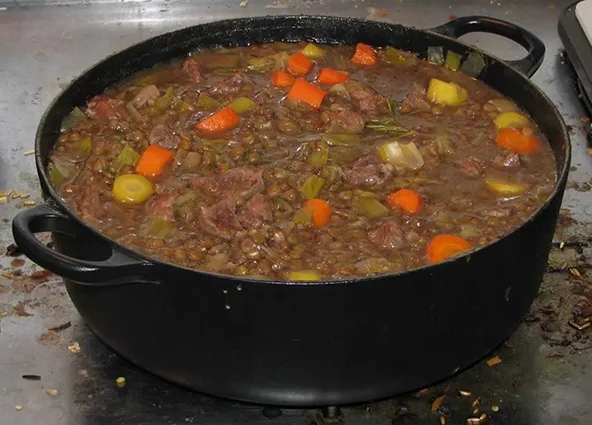
Eintopf (in German – "one pot") held one of the places of honour on the East Prussian table. The soup is thought to be of peasant origin: housewives cooked it for their husbands, who did hard physical work. Everything the farm produced went into it: potatoes, carrots, swedes, cabbage of every kind, turnips, celeriac and parsnips, beetroot, pulses, pears, plums, apples, meat, smoked meats, home-made sausage, and fish too, which teemed in the rivers and lakes of East Prussia. Mushrooms, grains, pasta, bread and even beer were added to the soups. The varying combinations of ingredients produced inimitable flavours.
There are several theories about how Eintopf came about. According to one, women cooked a very thick soup for their households on big washing days to save time.
To avoid cooking a first and a second course, everything that came to hand was put into one pot and left to simmer for about five hours. Very convenient and simple.
There are countless Eintopf recipes. The most popular, tasty and easy to make of them is...
Deutschtopf
The recipe is taken from Ella Brachmann's cookbook (c. 1925).
1 beef shank, 2 onions, salt, pepper, sweet paprika, thyme and caraway to taste, 1 kg potatoes, lemon zest, 2 slices of toasted rye bread.
Cut the meat from a hind beef shank into small pieces and braise together with the chopped onions (2), salt, pepper and sweet paprika. When it is half-cooked, add the diced potatoes. For 4 servings you need 1 kg of potatoes. Then add enough water to cover the potatoes. Once it boils, add a little salt, thyme, lemon zest and caraway and simmer for a long time over low heat. 10 minutes before the end, put 2 – 3 slices of toasted rye bread into the soup. Stir with a wooden spoon and let the bread cook down. The toasted bread gives the thick soup an inimitable flavour.
In the margin beside this recipe Ella Brachmann wrote a note: Uncle Ernst is not to be invited again until Aunt Ida agrees, and the beef shank should be bought from Stammbach's.
Lentil Soup with Blood Sausage
250 g lentils, 150 g dried prunes, 1 bunch soup herbs (parsley, dill, marjoram, chives – to taste), 1 onion, 200 g blood sausage, 1 tbsp lard, salt, vinegar and sugar to taste.
Pick over the lentils, cover with water and leave overnight. Do the same with the prunes to soften them. Chop the soup herbs and the onion. Cook the lentils in the water they were soaked in until soft. 15 minutes before they are done, add the herbs and onion and salt. Cook for another 30 minutes.
While the lentils are cooking, finely chop the prunes and blood sausage. Add them to the soup and cook everything together for another 30 minutes. As soon as the lentils have cooked down, add the lard, vinegar and sugar.
"Blind Hen"
250 g white beans, 250 g green beans, 250 g carrots, 250 g potatoes, 2 pears, 2 sour apples, 400 g smoked bacon, salt and sugar to taste.
Soak the white beans overnight in one litre of water. Finely chop the green beans. Dice the potatoes, carrots and bacon. Peel and core the pears and apples and dice them as well. Put the white beans on the heat in the water they were soaked in and cook for an hour and a half, stirring from time to time. Then add the smoked bacon, vegetables, fruit and chopped green beans and cook until done. Season the soup with salt and add sugar.
Trappönen Thick Pea Soup (Schuppnis)
750 g dried green peas, 500 g potatoes, 500 g fatty ham, 750 g pork ribs (or smoked pig's head), 2 onions, 100 g pork fat, about 1.5 – 2 l water (usually judged by eye), salt and pepper to taste.
Cook the peas together with the meat for 2 – 3 hours. Boil the potatoes separately (floury ones are best for a thick soup). Remove all the bones from the meat and chop it finely. Mash the peas and potatoes and mix them, then add onion rings fried until golden and the melted fat with its cracklings.
This dish is so thick that a spoon should literally stand up in it. It was usually made at Shrovetide. Schoolchildren loved this holiday. They played all sorts of pranks at school, hid the textbooks and wrote on the blackboard: "Robbers came and stole our textbooks." The teachers let them go home. The children, of course, were delighted and ran home as fast as their legs would carry them to eat the traditional Schuppnis.
Sauerkraut and Potato Eintopf
(A family recipe from Ella Brachmann's cookbook)
Method I
Half a smoked pig's head (the cookbook has a note: "buy at Metzger's shop!"), salt and ground black pepper to taste, 1 bay leaf (crumbled), 1 kg sauerkraut, 1 kg potatoes, 2 small onions, 100 g pork fat, 20 g wheat flour (1 tbsp), 50 g tomato paste (5 tbsp), 1 l of the stock in which the pig's head was cooked, 100 g sour cream.
Cook the smoked pig's head with salt, pepper and the bay leaf. An hour after it is done, pour off 1 l of the stock. Take the head apart and cut the meat into small pieces. Fry the onion in the pork fat. Chop the rinsed sauerkraut and put it into a sauté pan together with the diced potatoes; add the fried onion and tomato paste. Braise everything, then add the smoked meat and pour in the stock in which the pig's head was cooked. Add salt and pepper to taste.
When serving, finish the soup with sour cream (or whipped cream). It must be served piping hot!
Method II
500 g boiled beef brisket, a few root vegetables, 1 bay leaf, a couple of allspice berries, 2 small onions, 100 g lard, 1 kg sauerkraut, 200 ml sour cream, one and a half litres of stock, 1 kg potatoes, salt, pepper and sugar to taste, 1 bunch fresh parsley.
Cover the beef brisket with salted cold water and simmer for several hours with the root vegetables, bay leaf and allspice. The stock must not boil! When the cooking is done, pour one and a half litres of the stock into a separate vessel. Fry the onions, cut into thin strips, in the lard in a sauté pan, then add the sauerkraut. (Taste the sauerkraut before cooking. If it is too sour, it is better to rinse it in cold water.) Then put the finely chopped brisket and the quartered potatoes into the pan. Add salt, ground black pepper and sugar. Pour in the beef stock, so that the potatoes are almost covered, and the sour cream. Cover the pan tightly with a lid and place it in an oven preheated to 200 degrees for 1 hour.
Thick Mixed Fish Soup
750 g fish fillet, 2 cups water or stock, lemon juice, salt and pepper to taste, 4 tbsp butter, 1 onion, 1 leek, 1 small celeriac, 5 carrots, 250 g green beans or Brussels sprouts, 5 medium potatoes, parsley.
Wash the fish fillet, rub with lemon juice and cut into pieces. Fry the chopped onion in butter in a sauté pan until golden, add the remaining vegetables and after 10 minutes pour in two cups of hot water or stock and salt. Simmer the soup over low heat for 20 minutes and leave to stand for another 15 minutes. Add the spices and sprinkle with chopped parsley. Serve the soup hot.
East Prussian Thick Spring Soup
Spring is just around the corner, the season of the first greens and early vegetables. But if nostalgia is getting the better of you, you can make it today. Absolutely all the ingredients for the traditional East Prussian thick spring soup can be found in the shops. These are 750 g beef, 1 – 2 marrowbones, 750 g assorted (usually seasonal) vegetables, 500 g potatoes, salt and herbs to taste.
This dish is especially delicious, of course, with the first greens and young vegetables from the garden. Carrots, kohlrabi, young peas, broad beans, asparagus, cauliflower, young white cabbage, celery and parsley roots all suit it.
Cover the meat with hot water, put the bones, with the marrow removed, into the same pot and simmer everything together for 60 minutes over low heat. Salt towards the end of cooking. Strain the stock, take the meat off the bones and cut it into small pieces.
Pour the strained stock over the roughly chopped potatoes, vegetables and herbs. 5 minutes before the soup is done, add the meat and the chopped beef marrow.
This dish goes beautifully with rice or noodles, which are best cooked separately and added to the tureen just before serving.
Eintopf was hugely popular throughout Germany – so much so that this simple, nourishing and inexpensive thick soup became the gastronomic symbol of the state and part of the state social-support programme "Winter Relief". In 1933 the country's authorities introduced the tradition of "Eintopf Sunday" (Eintopf-Sonntag). From October to March, on one Sunday each month, German families were obliged to cook only one dish – a "Pichelsteiner" Eintopf. The ingredients were not to cost more than 50 pfennigs. If the meal came out more expensive, the difference had to be given to the "Winter Relief" fund. Thus compulsory "voluntary" charity financed the state's social programmes. At the same time the so-called principle of equality was propagated: "Eintopf – we all eat only what is modestly cooked in one pot, we all eat from the same pot." The "Eintopf Sunday" tradition applied to everyone without exception, regardless of social status. The simple peasant Eintopf became a national idea.
When Eintopf first appeared, hardly anyone can say for sure. The tradition of eating hot liquid food – pottage – arose in cold-climate countries many centuries ago, but certainly not before the invention of fireproof cookware. And that, according to historians, was first made in the Neolithic.
Many traditional cuisines can boast thick soups of their own. Russia, for instance, has rich "bogatye" shchi and solyanka (or selyanka, as Dahl's dictionary has it); Ukraine has borscht with pampushki; France has onion soup with cheese croutons, which has gone down in history as the most accidental of soups (though next to a thick Eintopf it seems airy). It is said to have been invented by Louis XV himself, who once had the "good fortune" to spend the night in a hunting lodge. There was nothing to eat but onions, butter, a small piece of cheese, stale bread and a bottle of champagne. No less famous is the Marseille bouillabaisse made from five kinds of fish, now considered refined, which Provençal fishermen once cooked from the remains of their unsold catch. Equally popular is Hungarian goulash, declared a monument of cultural heritage and as fiery as a flame. Armenian khash has earned fame as a "hangover" soup eaten in the morning. Incidentally, khash, like Uzbek shurpa, is called a "one-man show": they are so high in calories and so nourishing that they cannot be combined with any other dish.
Sources:
Alte Familienrezepte aus Ostpreußen. Harald Saul.
Rezepte aus der guten ostpreußischen Küche. M. Haslinger, R.M. Wagner.
Он снова здесь. Т. Вермеш.
Translated from Russian with the help of AI (Claude, Anthropic), October 2026.