The watchman has just sounded four o'clock on his horn; night still hangs over the village so thickly that you cannot make out your own hand, and only in the east and north does a distant dark-grey strip hint at where the endless expanse of the lagoon's grey ice surface ends. From there blows a sharp, piercing east wind, hurling razor-sharp ice crystals at the small windows of the village houses, behind which life has long since awoken.
Dim light falls from the stables, and from them come the soothing munching of horses chewing oats and chaff, the clatter of their hooves and their snorting. The fishermen's small, shaggy horses are a special breed, incredibly undemanding and hardy. Their owners are a special breed of people too, and the bond between them is a friendship for life and death.
The fishermen of the Curonian Spit are tall and fair-haired, with bright blue eyes and a piercing gaze. They are descendants of the Curonians, a seafaring tribe.
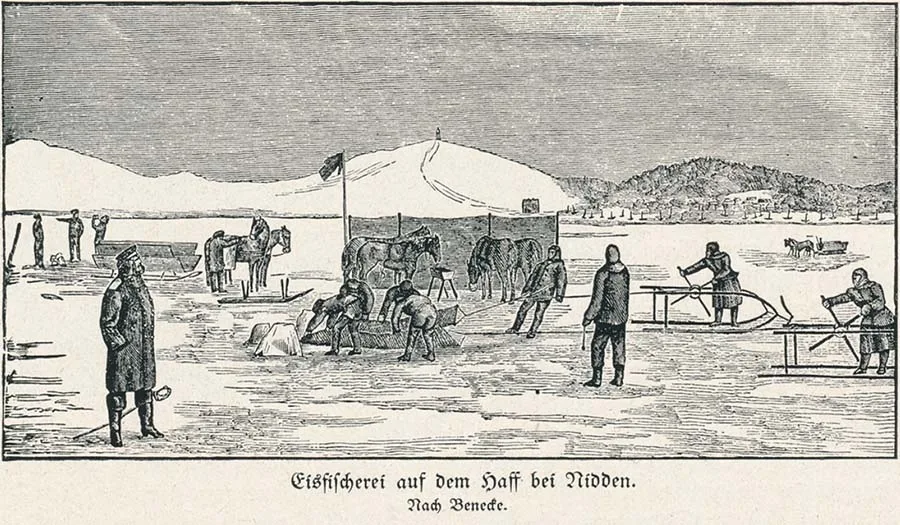 Ice fishing on the lagoon near Nidden (Nida).
Now they stand in a room lit by the faint light of a candle stub and stamp their heels on the threshold in their thigh-high fishing boots, so that their feet in thick stockings settle more comfortably on the straw-lined rubber insoles. From the kitchen comes the appetising smell of fried potatoes with fish, and before the fishermen set off into the icy cold, their stomachs will be filled with hot, warming food.
But while the men are still in the house, the women will on no account tidy up or sweep, since that would ruin the luck of the coming catch. Nor should anything be shouted after the departing fishermen, as that would inevitably bring bad luck to the whole venture. Many superstitions go back to the depths of the centuries and are held sacred, for a fisherman's success and earnings are not so much unpredictable as his hard trade is endlessly dangerous. It is a constant risk to life, especially during winter fishing.
But now the men put on their sou'westers (Südwester), tying the long flaps under their chins, harness the shaggy horses to sledges with long shafts, into which they throw ropes, nets, ice axes and skates, and load a box of provisions (Lölschke).
The sledges set off towards the lagoon, above which a bright glow is already heralding the coming of a new day. At first the way runs along the Fuhsen (Fuhsen), small pine posts placed about 30 metres apart that mark the route from one village on the shore to the next.
Soon the sledges are out on the ice of the lagoon. Clip-clop, clip-clop: in the hard frost the horses' shoes strike the thick ice with a peculiarly muffled sound, and the ice in turn crackles ominously now and then.
One of the fishermen puts on Dutch skates (Holländer Schlittschuhe) with long blades, takes an ice axe and goes on ahead to check the ice for dangerous cracks and pressure ridges.
The ice axe (Eisaxt) is indispensable equipment for a fisherman in winter. It is used to test the strength of the ice: three hard blows guarantee that it will bear the weight of a sledge. On difficult crossings the ice axe is tied under the sledge as an extension of the runners, and finally it serves as a brake on very slippery ice, preventing the sledge from dangerously skidding.
“Well, here we are,” says the scout, stopping at a seemingly unremarkable spot, one that fishermen often pick out in their dreams. Square holes are chopped with the ice axes, then the nets are pushed under the ice with long poles. When all the nets are set, a long narrow board is inserted at a certain angle into a hole set apart from the others, and they begin to strike it with a wooden mallet. This produces a booming echo under the water that carries in all directions. It is this that drives the fish into the nets.
This method of fishing is called the “Rattle” (Klappern). Even lone fishermen practise it, but you won't catch much this way.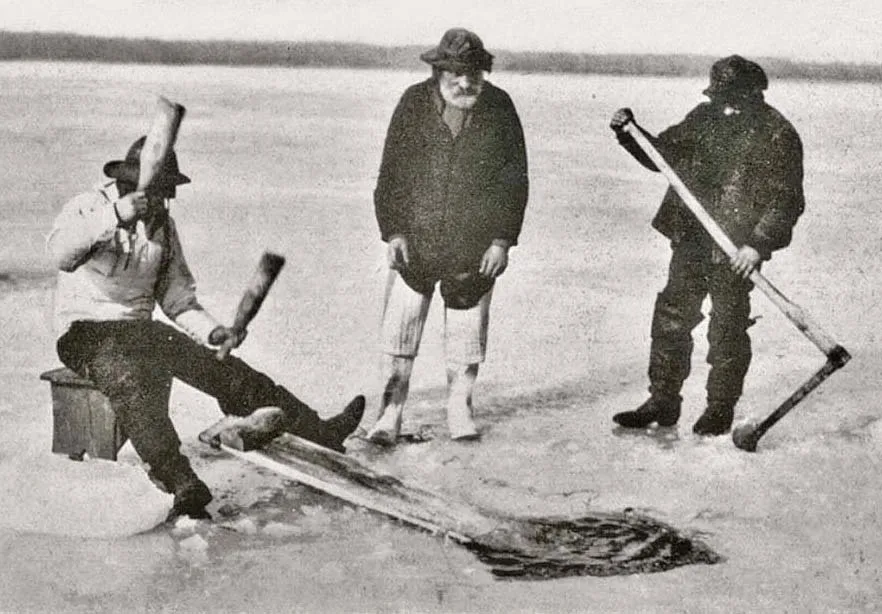 A hole with a “rattle” driving the fish into the net. On the right, a fisherman with an ice axe.
Far more effective is fishing with the “Great Net” (Große Garn). It requires incomparably more time, people and gear and, above all, involves enormous risk.
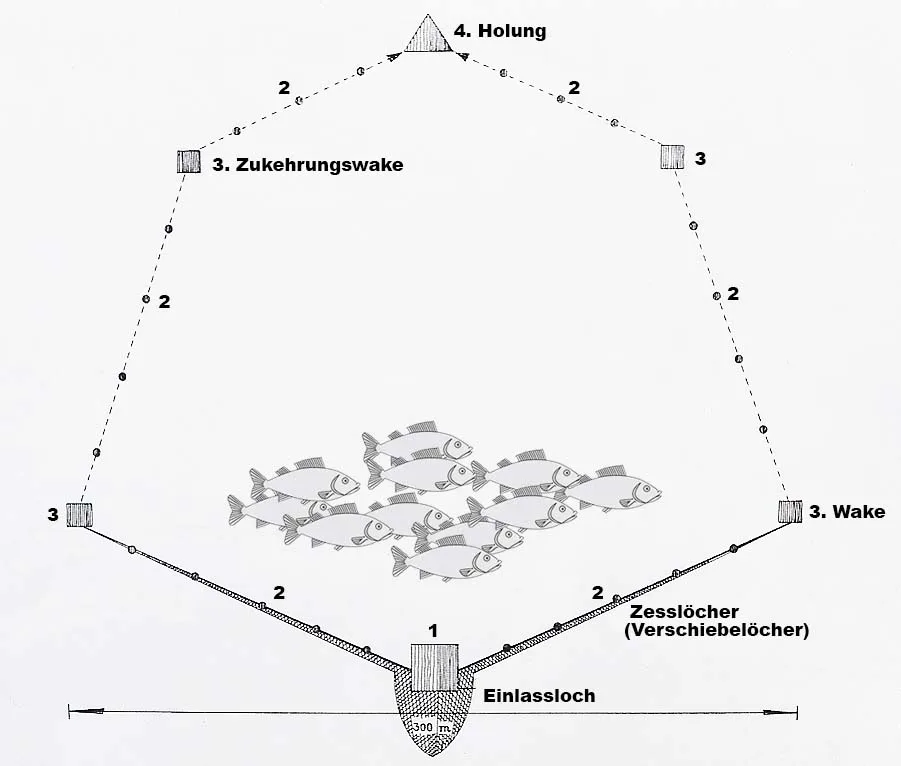 Layout of ice holes for under-ice fishing with the great net. Unlike Samland terminology, Curonian fishermen called all man-made holes “Zesslöcher”. The process of setting the net was called “Zessen”: 1. Einlassloch (the entry hole into which the net is lowered); 2. Zesslöcher / Verschiebelöcher (holes through which the net is pushed further); 3. Zukehrungswake (the turning hole, through which the net's direction of travel is changed); 4. Holung (the hole through which the net with the catch is pulled out).
The horses are unharnessed and covered with blankets, the sledges are drawn up together, and old sails serve as protection against the fierce icy wind.
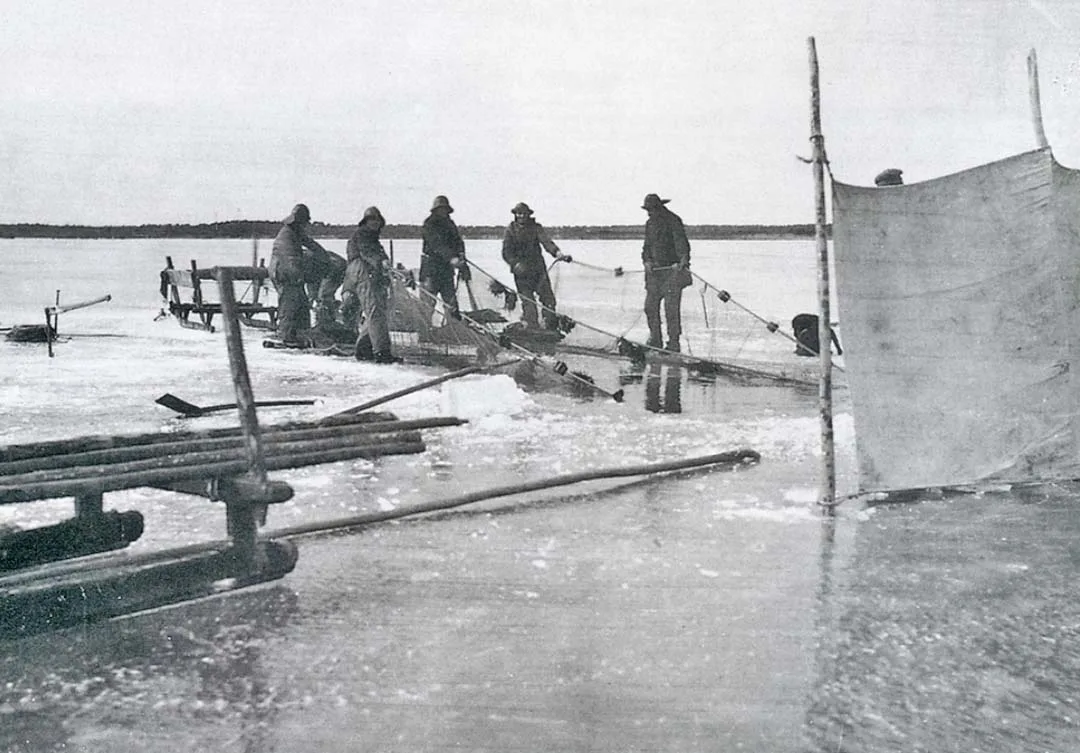
Long, hard work in the cold begins: first a large hole is chopped, then, following a special pattern, smaller holes are cut at some distance from it. Next the great net is pushed into the large hole as far as the long poles can reach, and then further still through the neighbouring holes. A hole made far away from the others is used for the “rattle” (see above), which will drive the fish into the net. There is a fisherman at each hole; the men's beards, jackets and sou'westers are covered with a crust of ice. They work without gloves, because in the biting frost gloves soak up moisture, freeze instantly and only get in the way.
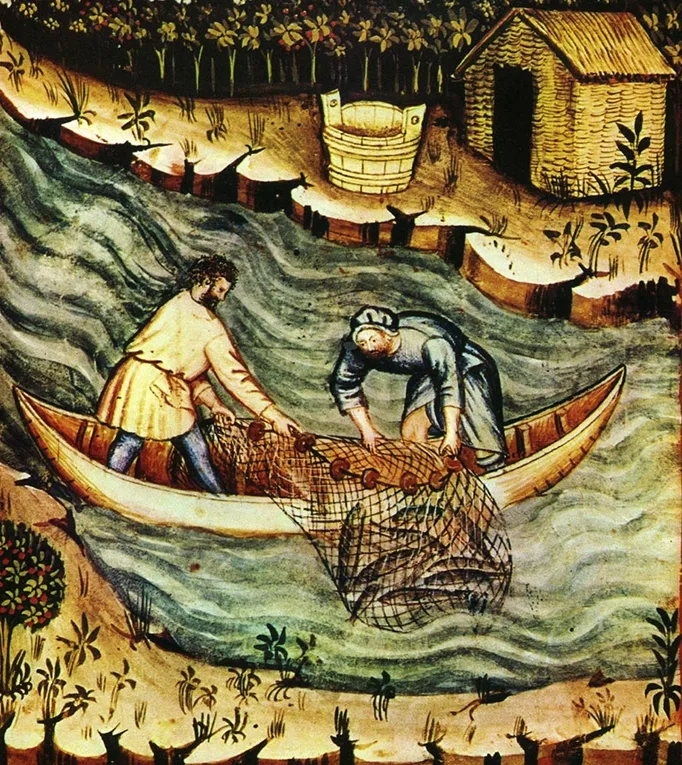
The tension mounts, the climax approaches: everyone has gathered round the main hole and begins, with the help of a wooden winch fixed to a sledge, to haul the net out of the water little by little. Will today be a lucky day, or will the nets turn out empty and all the hard work be in vain? The fishermen spit over their shoulders so as not to jinx it, and now out of the water comes what looks not so much like a net as a large mesh sack, in which zander, pike, bream, burbot, vendace, perch, roach and smelt thrash, wriggle and leap...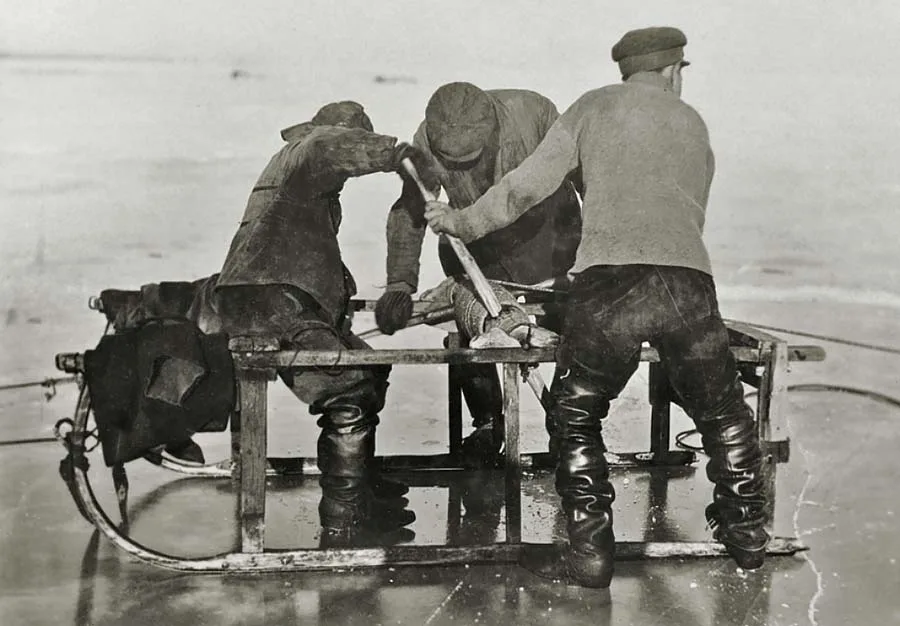 A special sledge with a winch for hauling out the nets.
In the slanting rays of the midday winter sun, fish scales glint silver. A jug of schnapps is pulled out of the straw in the sledge and passed from hand to hand: a rich catch has to be celebrated.
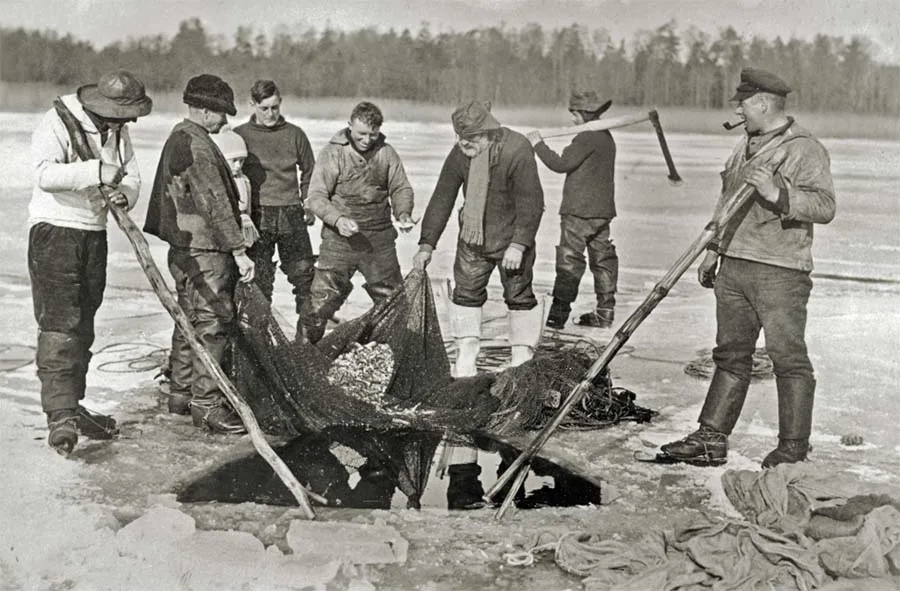 Fishermen rejoicing at a good catch. On the left, on the right and in the background, fishermen on skates.
But such luck was rare, and word of mouth carried the news of it through all the villages of the Curonian Spit like wildfire. For weeks afterwards the rich catch was all anyone talked about, as if someone had won a big lottery prize.
The fishermen drove across the ice of the lagoon for as long as it could bear the sledges, which meant that every winter not only gear, sledges and horses were lost, but human lives too. Again and again the early spring thaws brought with them the heart-rending cry “Lord preserve us!” (De Jes jeihtl!), meaning that not all the fishermen had managed to get off the ice in time and someone had been carried out into the lagoon on a broken ice floe. And then it sometimes happened that fishermen drifted on it for several days until help arrived or a rare stroke of luck helped them get out on their own. But often, very often, on the following Sunday the village church was packed with people, and the pastor in his sermon spoke of the unfortunate victims of the fishing trade and of the suffering of the women and children in black headscarves who waited in vain for their breadwinners to come home.
Source
Ostpreußen-Warte, Folge 01 vom Januar 1952 (p. 5)
Eisfischerei auf dem Kurischen Haff. Von Wanda Wendlandt
https://archiv.preussische-allgemeine.de/ow1952/1952_01_01_01.pdf
Photos
Bildarchiv Ostpreußen bildarchiv-ostpreussen.de.
LEGENDS OF PRUSSIA on the blog of Tatyana Kolivay.
Translated from Russian with the help of AI (Claude, Anthropic), October 2026.