The views expressed are often diametrically opposed, but somehow it is necessary to reach agreement and look for the best ways to solve the problems that have built up. The questions of how trees should be pruned and who should do it can be resolved in the ordinary course of business, given "political will".
Many remember the statement made by Alexander Bashin when he was chief architect of Kaliningrad that "the city is a place for making money, and those who care about trees can move to the forest". If only it were that simple! But even leaving aside the technical difficulties of implementing this proposal, human beings are not such primitive creatures. Besides a place to make money, they need good living conditions and psychological comfort, which is also bound up with aesthetic needs.
Kaliningrad's general plan, in its present form, is not about development, not about ecology, not about aesthetics, not about a comfortable urban environment, not about historical monuments. The general plan is about where and what may be built.
And it does not answer the question: what is our relationship with the urban environment? What do we (the community of citizens) want to get from the city (as the place where we live)? How do we want to see it? What can we give it? Simply to sell off plots of urban (communal) land "efficiently", or somehow to take responsibility for the city's appearance, for its ecology, for its future?
Whether we think about it or not, together with plants, animals and other forms of biological life we make up a single urban ecosystem. The ability of plants to absorb harmful substances from the air helps considerably to reduce the burden and lessen the negative effects of the technogenic factors inherent in a city.
Urban Development and Living Nature in the Urban Environment
Many believe that before the war there were few trees in the city, and as proof they cite photographs of central streets in which no vegetation can be seen. One also hears the opinion that the city developed chaotically. Few people realise that the city always maintained a balance between the natural and the artificial, the biological and the technogenic. There were periods of greater prosperity or relative decline, of systematic planning or spontaneous urbanisation, but the city was always a place shared by living beings: people, plants, birds and various animals, down to insects.
The towns of our region, like those of all Prussia, share one "genetic" feature: settlements received town rights either at the stage of foundation and planning or at an early stage of their development. These rights were granted "to grow into", with an eye to future development. Königsberg (like the region's other towns) was laid out according to a plan and had a clear layout, in line with which plots were allotted for building houses. Each house was meant to have a small patch for a garden. Beyond the town walls stretched common land for vegetable plots and the expanse of the town's meadows and pastures. The castle estate, too, had its own garden with a physic garden. The way of life in the town was not very different from that of the village, organically combining forms and methods of husbandry with a relationship to nature.
The town grew quickly, and urban communities appeared – craft and merchant guilds – and with them forms of social life and new urban spaces: public gardens where members of the corporations held meetings in summer and where festivities took place. There were also private gardens belonging to wealthy townspeople.
The oldest garden laid out according to the rules of the formal park – Duke Albrecht's garden – was located on the site of today's University Square.
Later this was the Königsgarten (King's Garden), handed over by the king to the city and transformed into the Parade Square with a beautiful parterre garden.
The Renaissance and then the Enlightenment were marked by philosophical reflection on the park and garden. The formal park was conceived as a symbol of the victory of reason and order over the forces of nature and chaos. Espaliered trees and parterre beds, in which the art of the gardener-artist found expression in "correct" geometric compositions of flowers and of trees and shrubs shaped by clipping: nothing natural, everything under control, and everything imbued with admiration for Nature, the creation of the Creator.
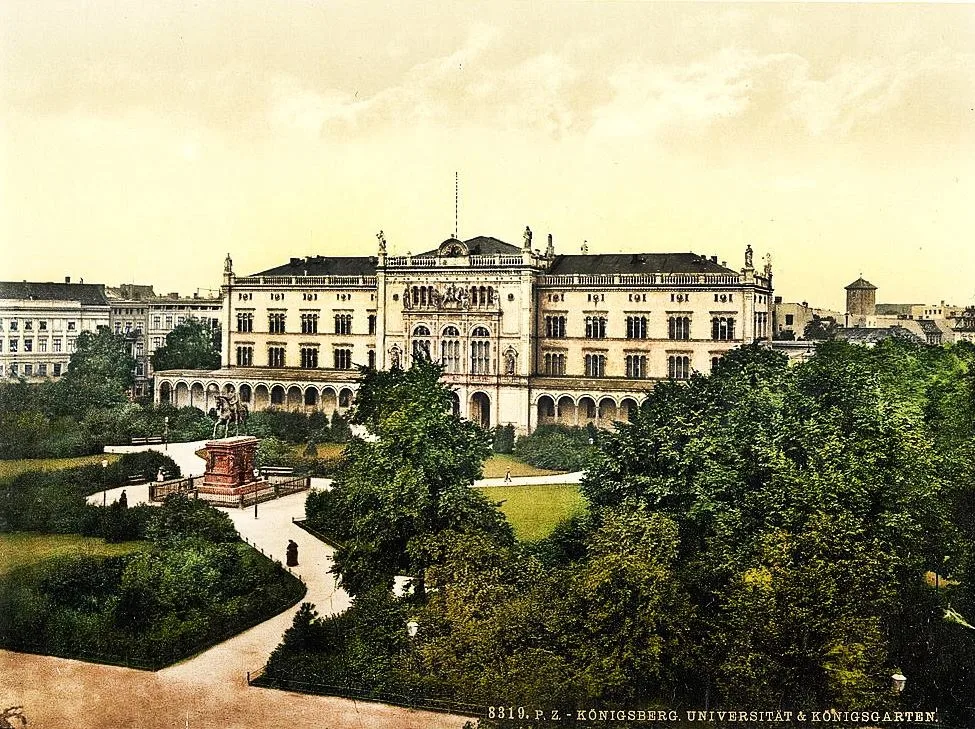 Parade Square – Königsgarten. 1895.
In the Age of Enlightenment the garden-park became a place for festivities and for solitary reflection, a site for scientific experiment and a museum. The best known in Königsberg were the garden of the merchant Saturgus, with its various collections, fountains and fine sculptures, and Luisenwahl, transformed by the philosopher, poet and burgomaster Theodor von Hippel (partly preserved as part of Tsentralny Park). A little later, on the basis of a garden laid out in 1796 by Kant's friend, the writer and statesman Johann George Scheffner (1736–1820), the University Botanical Garden came into being (now the Kaliningrad Regional Children and Youth Centre for Ecology, Local History and Tourism).
At the beginning of the 19th century the understanding of the relationship between "nature and man" changed again. Nature was recognised as valuable in its own right, and the formal French garden-park gave way to the romantic English one, with a subtler organisation imitating "natural" nature, yet calibrated by a skilled master who knew the characteristics of plants and possessed refined artistic taste.
The park remained a private space set apart from the urban environment, a place for walks and recreation. Königsberg was small; nature surrounded it and grew into the fabric of the city.
The industrial revolution changed life in the city radically; within literally a couple of decades the city broke away for good from rural elements of everyday life. Factories and mills, quickly built workers' districts with cheap housing deprived of sun and greenery. Steeped in soot from factory chimneys and dust from the roadways, with bad water and sewerage, industrial cities became breeding grounds of disease, especially tuberculosis. The city was likened to Leviathan. And in reaction to this unhealthy environment, townspeople's longing for nature grew stronger. From the middle of the 19th century, summer-house settlements and seaside resorts became ever more popular. Thanks to the efforts of the government medical councillor Friedrich Christian Kessel (1765–1844), the village of Cranz was turned into a seaside resort. In 1836 Kessel also founded the "Society for the Beautification of the City", which promoted the benefits of plants, created public gardens and parks and placed benches along walking routes.
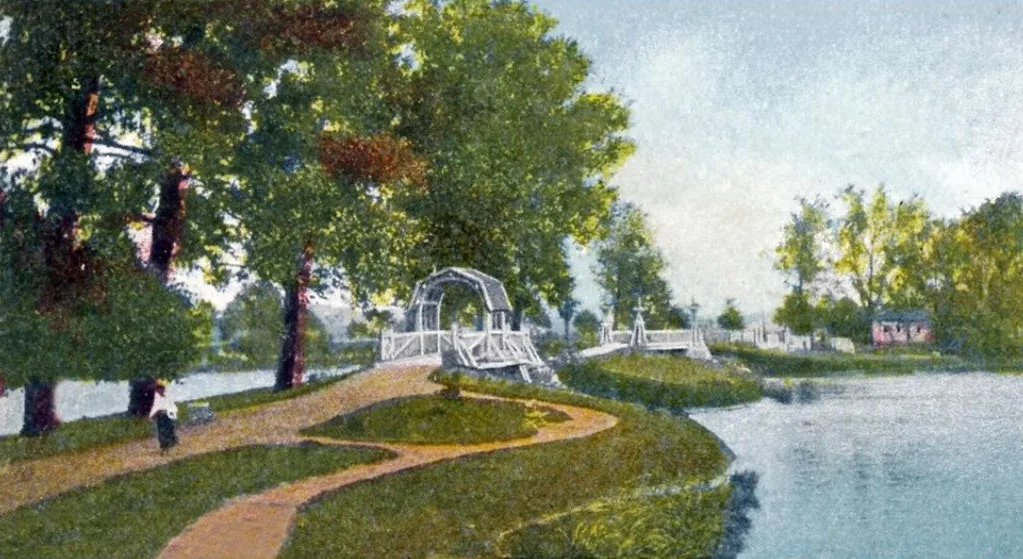
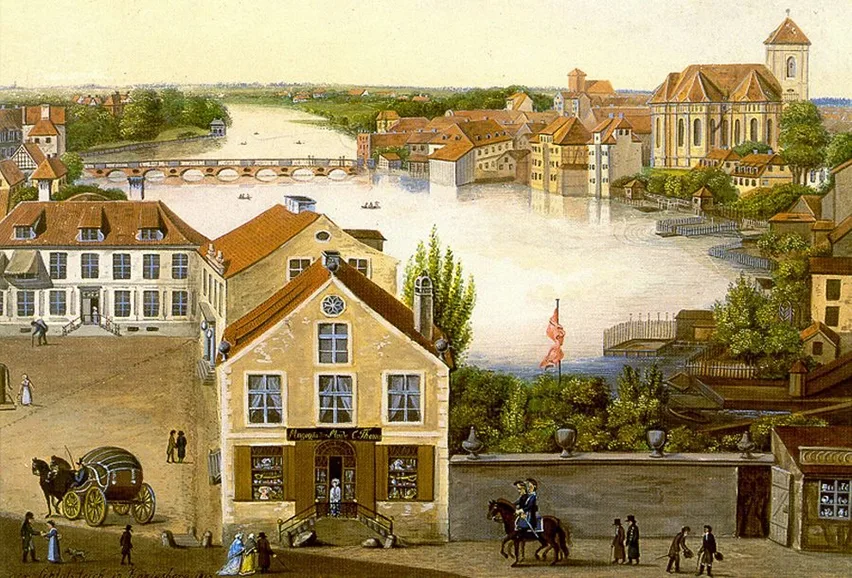 View of the Castle Pond. Circa 1820.
As an antithesis to factory smoke and the inhumanity of the industrial city, the idea of the garden city appeared in Europe. The first to propose combining the best sides of village and city life was the English sociologist Ebenezer Howard (1850–1928). He suggested building small garden cities around large cities so that people could live surrounded by nature without giving up their usual comforts and could get to their workplaces quickly.
At the very beginning of the 20th century this idea was successfully put into practice in Königsberg's new districts: already at the planning stage, not only were public gardens and roadside alley plantings designed and gardens and front gardens provided for apartment buildings and villas, but the species composition of the plants was thought out as well.
In 1901, continuing the work of the "Society for the Beautification of the City", a municipal department of gardens and parks was created (headed by Burgomaster Paul Kunckel, with Professor Paul Kaeber as director).
To meet the needs of greening the city and to provide practical training for students, the Municipal Nursery was founded in 1904 under the direction of Paul Kaeber (1869–1919) (today the IKBFU Botanical Garden).
The Nursery's tasks were to train specialists, to promote the ideas of urban greening and to propagate plants. Within a short time collections were created of rare and ornamental plants, as well as industrial, medicinal, flowering, fruit and vegetable crops.
The "Society for the Beautification of the City" should probably also be credited with the "fashion" for donating parks and land for parks to the city, which was followed by Walter Simon, Max Aschmann, Berthold Kleist, Theodor Krohne…
After these transformations, interrupted by the First World War, a revolutionary breakthrough followed in the tragic years of post-war ruin and inflation. In 1919 the municipality invited the landscape architect Ernst Schneider (1874–1968), who had previously worked in Posen (now Poznań, Poland), to become director of the city's gardens and parks. In Königsberg Schneider succeeded in creating an integrated plan for the city's system of green spaces. He linked the local green spaces of the old city inside the ring of ramparts and the districts built outside the defensive rampart according to the new "green" rules, adding new parks to them.
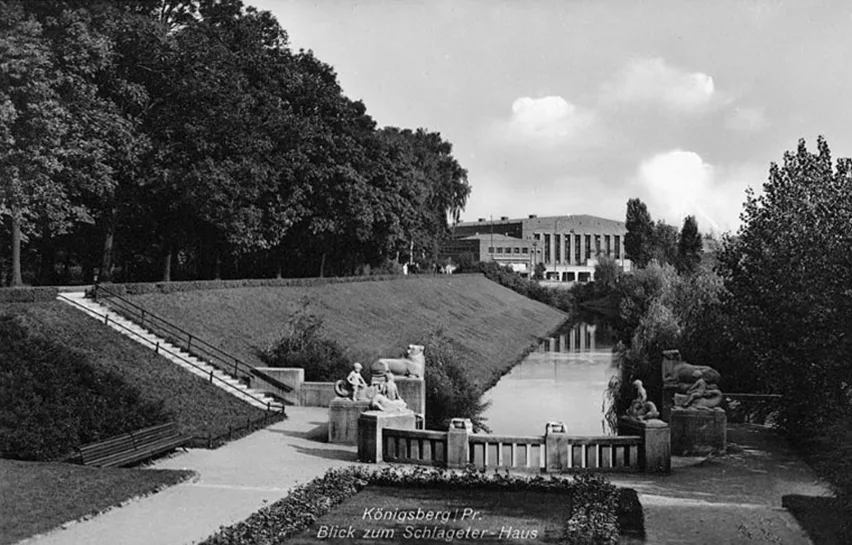 Promenade along a canal.
On the site of the old defensive belt Schneider designed a fifteen-kilometre recreation zone with canals, footpaths, lawns and trees; he laid out a three-kilometre promenade around the Schlossteich (Lower Pond) and created new plantings around the Oberteich (Upper Pond), and the ponds were not only cleaned out but also provided with a system of biological self-purification. In the suburbs he laid out new parks, and in the city he landscaped the stream valleys, creating along them an intricate network of terraces, alleys and paths.
In this period parks acquired a new function, inspired by the pursuit of a healthy lifestyle – sports grounds were set up in them.
The most wonderful thing is that all these stadiums (except the aquatic ones) are still alive! It is worth noting with special pride that the oldest open-air stadium in Russia is our Baltika. It is sad that the green zones around them are rapidly shrinking because of building sites and "absolutely essential" car parks, and the very essence of "open-air" physical exercise is disappearing.
Within just ten years Schneider's transformations had earned Königsberg a reputation as one of the most beautiful, green and healthy cities in Germany!
Rethinking the fortress – the city's rampart fortifications – as a ring of parks was a revolutionary breakthrough. No other city had known such a transformation, which made it possible to preserve the defensive structures as a monument of history and fortification (although that was hardly a concern at the time), to enlarge the city's green "lungs" and to create public spaces. A successful formula was found that made it possible to preserve the historic centre, avoid monotonous development and create new districts with comfortable low- and medium-rise houses, with tall landmarks (churches), visual accents (ornamental plants) and a varied landscape.
Kaliningrad, a Beautiful Garden City
It may seem surprising, but after the Second World War it was precisely this "magic formula" that was understood and developed further.
The post-war city urgently needed its wounds healed, and here plants and "gardeners" came to the residents' aid. The garden city concept took on new forms. On the surviving streets, houses that could not be restored were dismantled and public gardens with flower beds were laid out in their place, and young trees were planted along the streets. Königsberg's municipal nursery went on growing saplings and seedlings for greening the city – in 1948 the Kaliningrad Research Station for Green Construction was set up on its grounds. Then the nursery was turned into a Botanical Garden, which in 1967 was handed over to Kaliningrad University and became one of its research units.
One remembers what the city was like "in the Soviet period" – as we remember it – a garden city immersed in greenery, with beautiful public gardens and parks and a rich variety of trees, flowers and shrubs.
The credit for this belongs not only to our predecessors but also to many contemporaries – workers of the "green economy" in every kind of profession, from labourers to scientists. The image of Kaliningrad as a garden city became fixed in tourist guidebooks, poems and songs, and became a true brand of the city. Its green attire was the pride of the residents and made the city attractive to tourists.
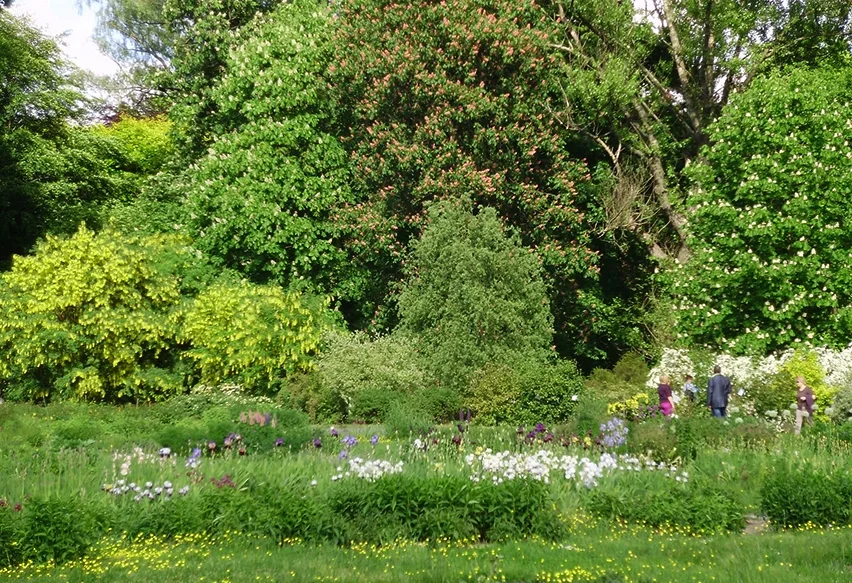 The Botanical Garden of the Immanuel Kant Baltic Federal University.
Before our eyes the economic model of development has broken down, and a new one is taking shape extremely painfully, with great losses for the urban environment. The system of commercial relations has become a harsh test for the city. The burden on the urban ecosystem has grown many times over. We probably need to realise that what is at stake is precisely an ecosystem, whose foundation is the green framework of the city created 100 years ago. And this is a vitally important asset for the city.
Translated from Russian with the help of AI (Claude, Anthropic), October 2026.