I realise that, in time, our urge to explore will pass. In its place, a thought common to many locals will take root: Kaliningrad and its surroundings are right here, so there's no need to hurry – we have a whole lifetime to roam every inch of them. And after that will come something I fear even more: we will stop noticing the city within the city, we will no longer pay attention to what makes Kaliningrad the most special city in Russia.
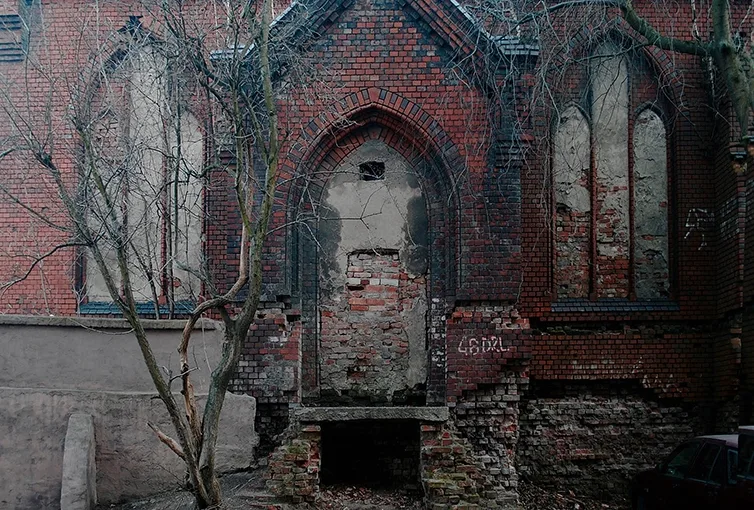
For now, fortunately, Kaliningrad still captivates us. We go out for an hour's walk and often find ourselves, come evening, somewhere in a courtyard, looking at yet another old building. Sometimes there are lights on in its windows, sometimes the panes are smashed... So it was on our last walk: having gone as far as the Sackheim Gate to buy Michael Wieck's book "The Decline of Königsberg", we went down to the river, to Lesopilnaya Street, and in the courtyards opposite the Catholic Parish of the Holy Family we saw this "decline" with our own eyes. Hidden behind a fence on one side (surprisingly, not a blue one, as they are so fond of in Kaliningrad) and, on the other, besieged by the cars of the residents of Lesopilnaya 73–79, a church is dying.
And the saddest thing is not even the fact of its untimely demise as such, but that it is dying like an unknown soldier.
2GIS doesn't know what this building is – it has no address. It is simply a utility building next to the house at 21 Cherepichnaya Street. Neither the ubiquitous Google nor the nosy Yandex with its maps knows what is here. The former chapel (church, kirk, chapel – everyone calls it something different) on the grounds of the former Löbenicht Hospital on Heidemannstraße (now Cherepichnaya Street) is listed on the Kaliningrad city administration's website simply as a chapel built in 1903. Incidentally, it is on the list of cultural heritage sites of regional significance. Like hundreds of other historical and cultural monuments of Kaliningrad and the Kaliningrad Region that are likewise crumbling to dust.
Cultural heritage site of regional significance No. 247, located in the municipality "Urban District 'City of Kaliningrad'"
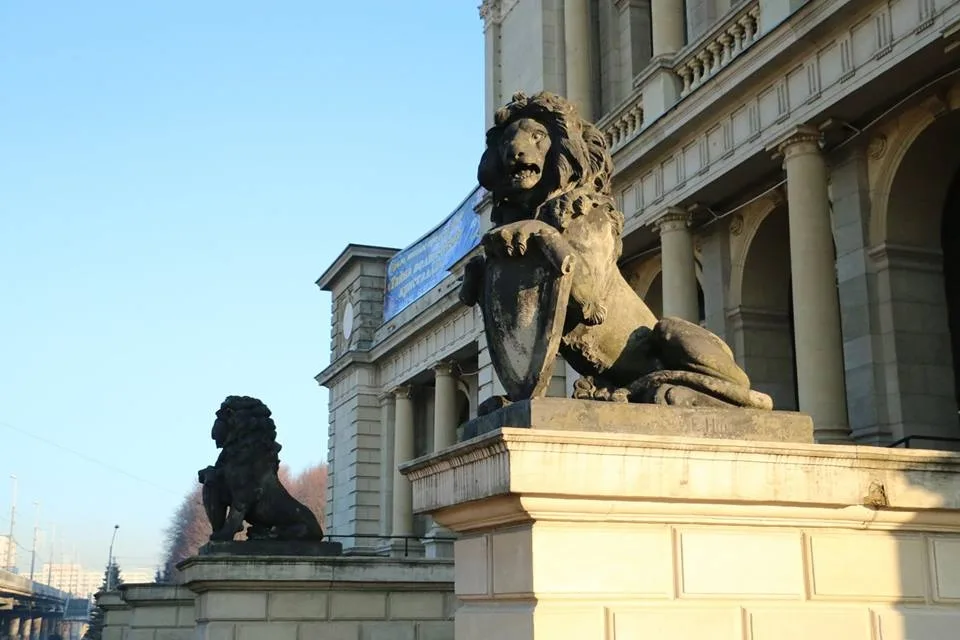
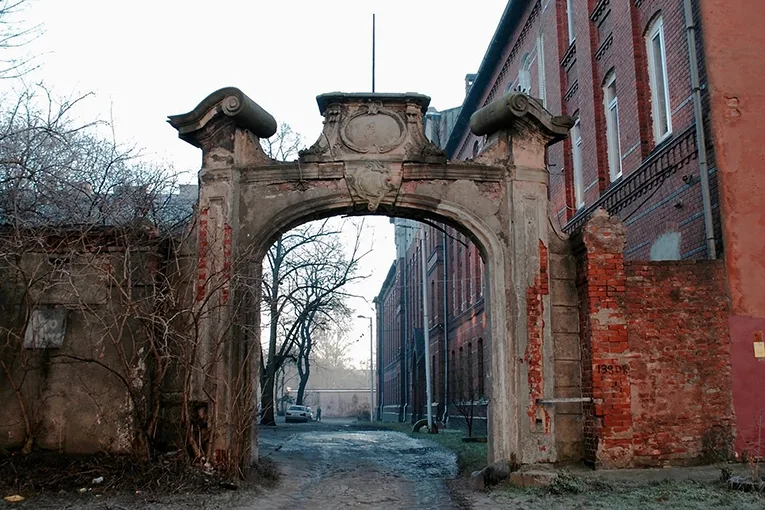
The Löbenicht Chapel (let's call it that, I suppose) is more of an example. I understand that it is clearly not among the priority buildings that need saving right away. A little way off from it stands the portal of the hospital, built in 1771 (in the photo above). Its condition is no better – it is covered in cracks and could fall on someone's head at any moment.
Even now, in its deplorable state and without the Prussian eagle (which has not survived), the arch looks better than any new, most prestigious building with autonomous heating and two-storey apartments. It preserves history.
But, like the Löbenicht Chapel, the gate has practically no chance of survival. It will be remembered in the virtual directory only when there is nothing left to reconstruct.
I wrote above that I am afraid that, after a while, I will stop noticing this church and this gate, will no longer feel shame before those who built it, or the bitterness of regret that, years from now, nothing of old Königsberg will remain. I will resign myself to it. And it's not that I so badly want Kaliningrad to become that German city that no longer exists. I want Kaliningrad to let that city in and become one whole with it. And to do so not in order to become some kind of Europe (let's face it – that's not about us at all), but simply to become a little bit more beautiful. Whatever is being built today, whatever advanced technologies are used, any one of these German houses looks better, in my opinion. Even if it is over a hundred years old and nobody has looked after it.
Each of our walks ultimately leaves us with a mix of two emotions, a kind of cocktail of sadness and joy. And when we return home to Artilleriyskaya Street, still overwhelmed, we always look at the houses that greet us at the corner. Some of them look at us with silent reproach.
Kaliningrad has been handed an amazing chance to make use of what someone built before us. The city is full of ghost buildings.
Each of them is an art space, a house of creativity, a school, or, say, a residential building for the musicians of the symphony orchestra that never came to be. Yes, I understand that some of these buildings do not belong to the state. I am new to this city and don't know many things – I can't know for sure who owns the buildings behind 21 Artilleriyskaya Street, for example. But one thing seems to me, if fantastical, then logical: these buildings should be given to those who need them. There's no need to be Scrooge McDuck, coming to his ruins every evening to bathe in centuries-old dust. Have you seen how enormous the space in the middle there is? Imagine what a wonderful garden square there could be there on Artilleriyskaya, where students of some art college could stroll after classes (why not?). There is so much space that you could lay out a whole sculpture park.
For example, not long ago the city administration was selling (and is still selling) the Kreuz-Apotheke for 12 million roubles with encumbrances: the building's façade, arches, columns, stucco mouldings and bas-reliefs must be preserved. For all its beauty, buying it in this condition is a dubious undertaking. Or perhaps it should simply have been handed over with encumbrances – or, better still, leased out, with the symbolic rent paid in the form of reconstruction? Not to "Horns and Hoofs", of course. Think everything through thoroughly, sign all the necessary documents, set deadlines, determine what this building must under no circumstances become and what it may be turned into. Give these buildings away just like that – don't wait until they are disconnected from life support with no hope of bringing them out of the coma.
Yes, that's not how business is built. It's all wrong, and so on and so forth. You can find a whole heap of "buts". But there are positive examples!
For example, the Sackheim Gate clearly gained a second life when the Vorota art platform settled there; let's hope that the local branch of the Russian Night Wolves biker club will also transform the Pregel Bastion.
It is very hard to value something we did not build. This is how the city came to us. Destroyed, lost in time and space, abandoned and forced to live two lives at once. I so want to believe that we will not leave it to die.
Yes, many of us can do no more than walk past this church and sigh (I, at least, have managed to tell you about it), but surely someone is able to make decisions? Or not? If so, then make the decisions, give it to someone who can breathe life into it and reconstruct it. Let them live there. That is in any case better than watching its slow death. Indifference to the past is the worst thing that can happen to the people of Kaliningrad. You cannot afford it, and now neither can I.
Photos by the author
Translated from Russian with the help of AI (Claude, Anthropic), October 2026.