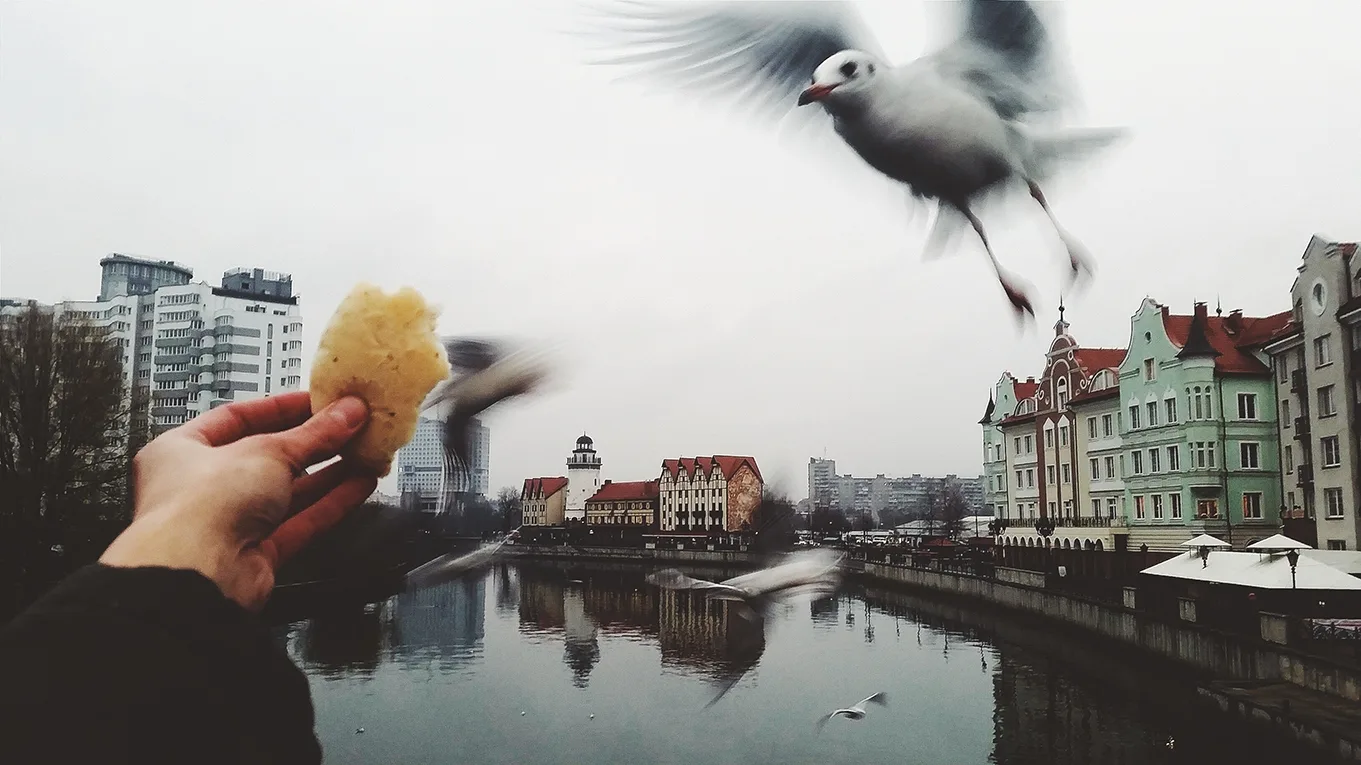
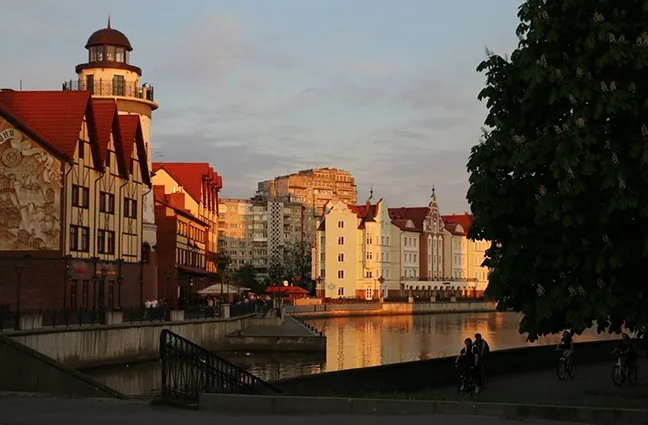
There is a curious rule in our city. If you find yourself in respectable company among people with claims to being cultured intellectuals, and the conversation turns to architecture, you must on no account praise the Fish Village. It is an absolute taboo. Nobody will beat the offender, of course, but he will be labelled as someone who understands nothing about beauty. Speaking favourably of the Fish Village in conversation with a local artist, architect, journalist, cultural scholar and so on is like confessing to a Handel admirer that you actually really like the songs of Arkady Ukupnik and the band Na-Na.
On the other hand, if you casually remark that this kitsch has nothing to do with East Prussian architecture, if you laugh condescendingly at the absurd lighthouse and call the quarter a cheap stage set, you can come across as a clever, sensitive, profound person with extensive knowledge in many fields.
In short, if there were a prize for the least successful architectural project of post-Soviet Kaliningrad, the local beau monde would certainly vote for the Fish Village.
At the same time, it appears to be the only contender for the “audience award”, since its popularity among the broad masses of the population is simply off the charts. Every day thousands of Kaliningraders and visitors come there. They stroll, take photos, buy souvenirs and sit in restaurants. Over the past ten years the Fish Village has become one of the symbols of the city, its calling card. In essence, it is the only post-war building that can rival in popularity the Cathedral, the Dohna Tower, the King’s Gate and other surviving German architectural monuments.
You can show as much contempt for the Fish Village as you like, but how do you get around the fact that its image is just about the most popular on the internet for the subject “Kaliningrad”? People plan trips here specifically to see the Fish Village. And this applies not only to a public far removed from art. Last year, while in Moscow on business, I met one of St Petersburg’s leading journalists, who specialises in writing about culture. On learning that I was from Kaliningrad, she confessed that she had long dreamed of visiting our city to see something of its German architectural heritage. “This, for example,” she said, and showed me a photo of the Fish Village on her smartphone.
Among architects from elsewhere, too, you often come across admirers of this complex.
For example, Maxim Petrov, Vice-President of the Union of Architects of Russia, said after visiting the Fish Village a few years ago that, despite his generally sceptical attitude towards historicist new builds, he liked this one in particular very much.
That is why he would recommend that Kaliningraders build up the city in exactly this vein. However, the Kaliningrad elite (meaning the people who take decisions here) did not heed his advice. The Fish Village will be expanded. But the new buildings are to be built in a completely different style.
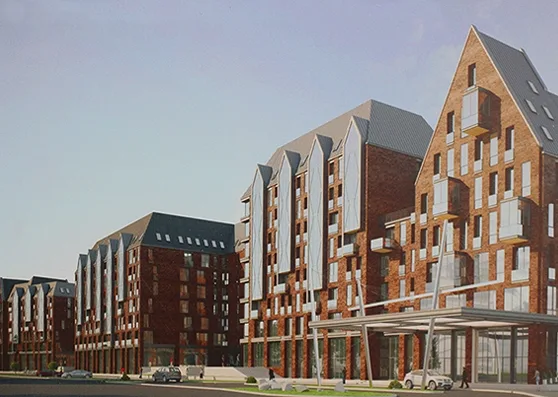
Last summer the results were announced of the competition for Fish Village 2 projects held by the local branch of the Union of Architects. It was won by the Belarusian specialist Sergey Furduy, who proposed a “cut” of warehouses whose shape recalls German harbour warehouse-houses but which have what are essentially modern façades. On the one hand the new Fish Village refers us to Königsberg and the Hanseatic League; on the other, it disowns all of that. “This is the twenty-first century,” Furduy seems to be telling us. “And there is no place in it for old-fashioned curlicues and flourishes.”
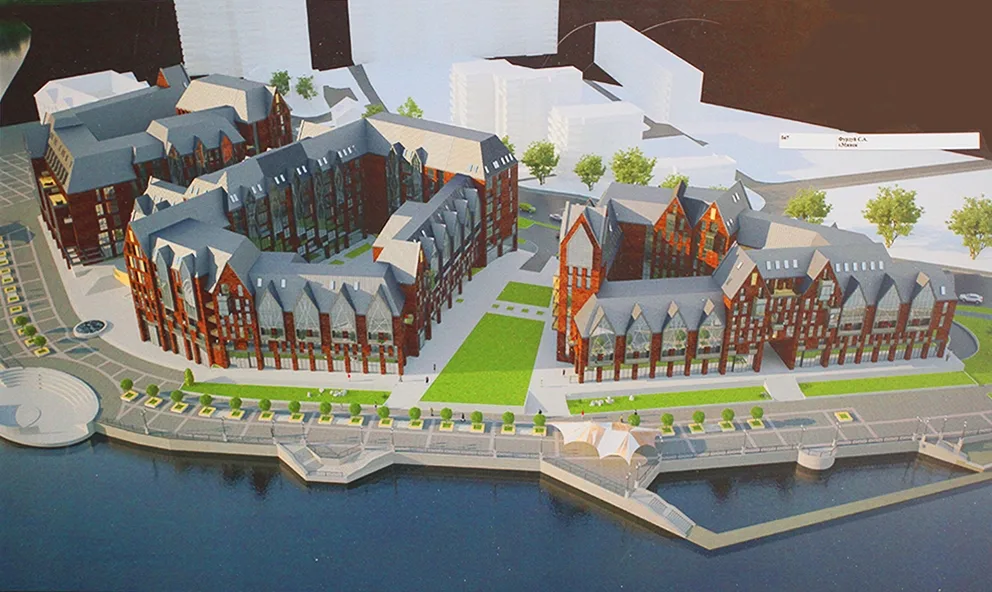 Project by Sergey Furduy. Fish Village 2. View from the Pregolya.
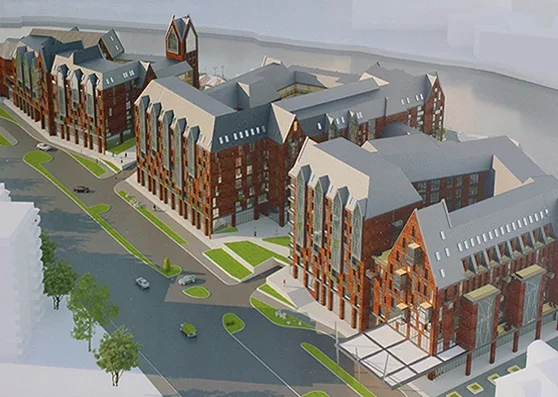
Nor was there any place for them in the project for the “Multifunctional Complex” , now under intensive construction on the bank of the Pregolya next to the Yunost sports complex.
The land for development was allocated to Lastadie LLC several years ago, and the project has changed several times. But now the final version seems to have been worked out. If you look closely, you can see a certain similarity between it and the Fish Village 2 project. According to the architect Vitaly Rusakovich, the design brief was to preserve the historical continuity of development in this area.
That is why the sections of the complex vaguely resemble the warehouses that once stood in this part of Königsberg. At the same time, their façades are modern.
As we have been able to learn, the complex will include a hotel with around 150 rooms, restaurants, shops and even something like a private gallery.
Originally a bridge across the Pregolya was to be built next to the hotel, but as far as is known, this is no longer on the table. On the other hand, a small river terminal is planned. Overall, Rusakovich hopes that the new complex will create a public space similar to the one that now exists in the Fish Village. So it turns out that this new complex aspires to become a kind of Fish Village 3.
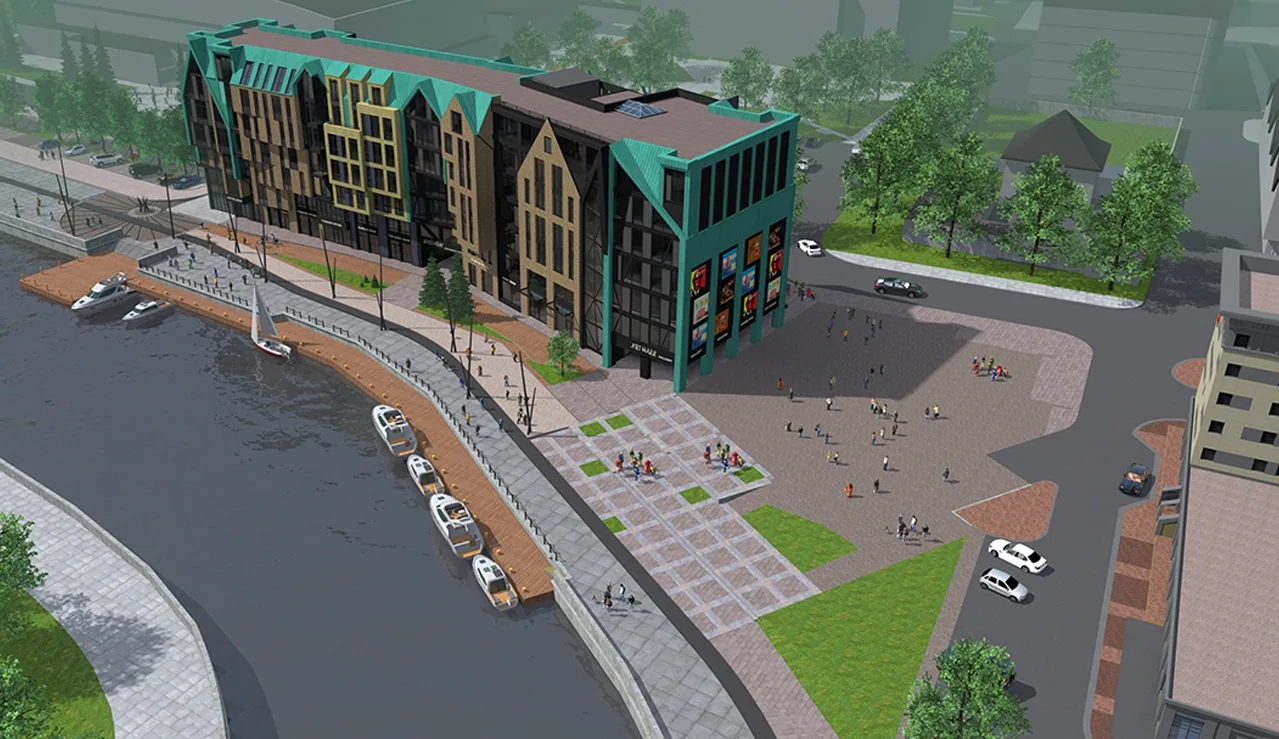 Multifunctional complex on the bank of the Pregolya next to the Yunost sports complex.
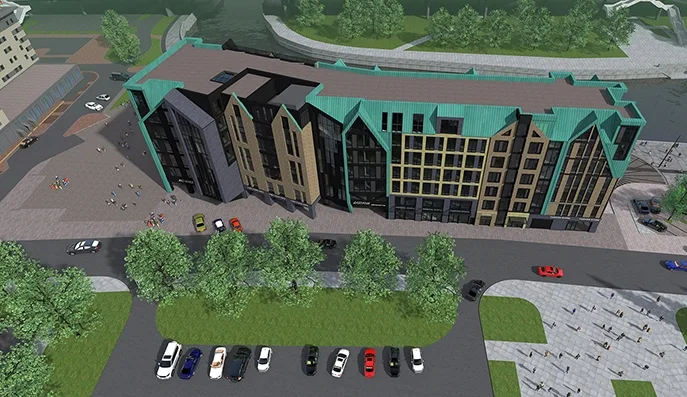
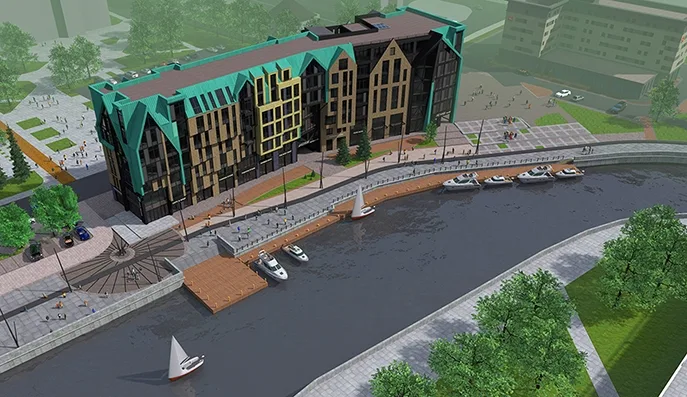
…It must be said that neither the Belarusian architect Furduy nor his Kaliningrad colleague has invented a new style. This technique is often used in Europe, for example in our neighbour Gdańsk.
But there, buildings of this kind often stand next to ones rebuilt exactly as they were, and so they seem to dissolve into the old town. Here, by contrast, the plan is to build free-standing quarters which, I fear, many will perceive simply as complexes of modern buildings, and so I have serious doubts that they will be able to win the kind of popular love that the existing Fish Village has won.
Perhaps they will earn praise from specialists (and most likely deservedly so), but they seem unlikely to become a magnet for tourists.
After all, people do not come to Kaliningrad to look at modern architecture. They come here for Königsberg. And the Fish Village creates the illusion that it is here after all. Yes, I agree, it is an invented, picture-postcard Königsberg. But such a Königsberg is probably better than none at all.
As for Kaliningraders, they too feel a need for pseudo-historical architecture.
Strange as it may seem, many of them have either never been abroad or have been only a few times. For some, such trips are too expensive a pleasure; some never get round to applying for a passport for foreign travel; others are tied down by domestic matters. I think one should not attach much importance to the official statistics on border crossings from the region, where the figures are impressive – they run into the millions. But in reality it is, by and large, the same people who travel. The majority, meanwhile, are glad of the chance to come to the Fish Village at the weekend and for a while find themselves in Europe – Europe as they imagine it.
…One gets the impression that ten years ago Kaliningrad intuitively felt its way to the right architectural path, and that it should have kept to it, correcting the most obvious mistakes along the way – that is, making the replicas of old buildings better in quality and more authentic.
However, at some point we decided to turn onto a different road, subjecting what had been done before to ridicule. And quite harsh, spiteful ridicule at that. And for the most part undeserved. Over the last couple of decades the city and the region have acquired a great many architectural blunders, but not one of them – not the Viktoria by the South Station, nor the Clover Centre, nor the Ibis hotel, nor the Plaza shopping centre – has had as much bile and venom poured on it as the Fish Village.
One could say that the local intelligentsia (mainly the creative intelligentsia) has triumphed over it. If only it does not turn out to be a Pyrrhic victory…
Translated from Russian with the help of AI (Claude, Anthropic), October 2026.