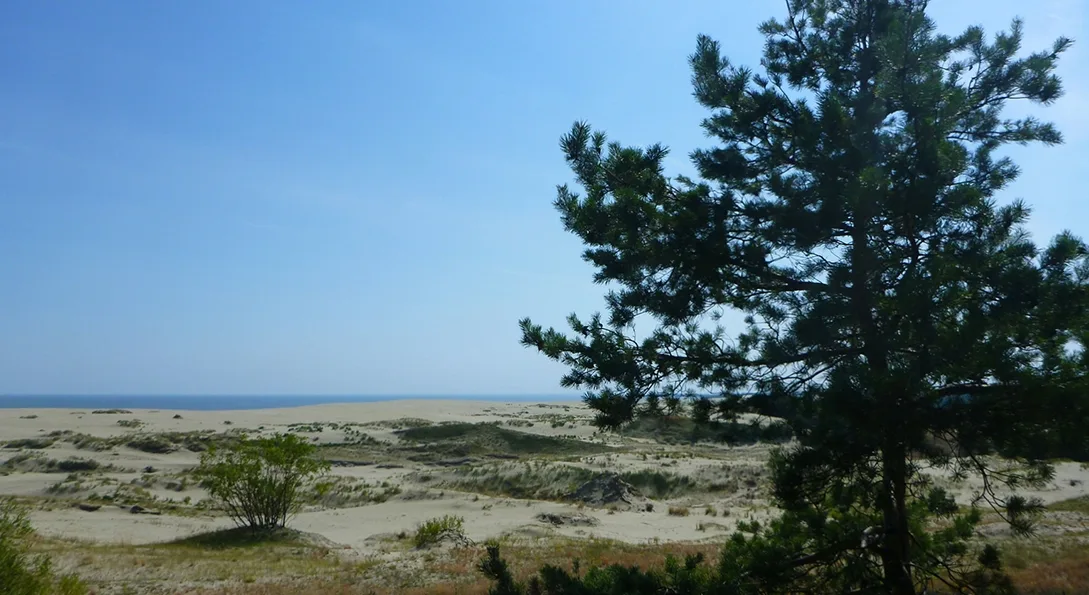
When the dunes formed, nature itself took care of protecting them, gradually settling them first with grasses and herbs, then with shrubs and trees. Of course, in these harsh conditions only the strongest and best adapted survived, but over time 75% of the spit's entire area came to be covered with large tracts of forest, which attracted birds and animals (not to mention the fish, plentiful both in the lagoon and in the sea) – and all this natural wealth brought people here, who decided to take everything nature had to offer.
By the beginning of the 18th century the forests on the Curonian Spit had been almost completely wiped out, and the sand broke loose – fine, prickly, carried uncontrollably in every direction by the wind. Fourteen villages were buried under the sand, and none of the belated tricks the local people tried in order to stop the sands helped – the advance of the sands went on: each year they were recorded as building up by as much as twenty metres. One is reminded of the novel "The Woman in the Dunes" by the great Japanese writer Kobo Abe, whose dominant mood, a sense of hopelessness, reflects this great and in some ways foredoomed struggle. For a time the inhabitants of the spit became nomads; in those hard times even houses were built to be dismantled so that they could more easily be moved to another place. To solve this problem, in 1768 a society of naturalists in the German city of Danzig held a competition for projects. The winner, Professor Titius, decided to draw on the experience of the Danes, who were already successfully tackling problems of this kind on the west coast of Jutland, where the whole range of sandy landforms can be found: sandy seashore, mobile or white sea dunes, grey or fixed dunes, and sandy plain.
At the beginning of the 19th century the Danish scientist Bjørn, together with scholars of the University of Königsberg, developed a technique for stabilising sands. Thus dune forestry was born.
Amid shifting sands, plants must have extraordinary qualities: the ability to survive in full sun on dry, salty soils poor in nutrients. As for trees, pines meet all these criteria. One cannot help recalling Lermontov's famous lines: In the wild north a pine stands alone on a bare summit... And so the work of introduction began (bringing into cultivation species that grow in other regions). The conditions of the Curonian Spit suited natives of North America and Southern Europe: the jack pine and the Murray pine, the black, Virginia, red, pitch, mountain and stone pines. Thus even today one can find black pines on the Curonian Spit that are about 150 years old! Another name for the black pine is Austrian pine, since its homeland is the mountains of Austria (and the Balkan Peninsula). It owes its first name to its black, textured bark, furrowed with deep lengthwise grooves. This majestic tree cannot fail to catch the eye. In its homeland the black pine prefers limestone soils. As it turned out, it also grows well on stony ones. The drought resistance and undemanding nature of this species have allowed it to thrive in the difficult conditions of the Curonian Spit.
Another introduced species is the jack pine, which came to us from the far north of America, where it forms large forests and grows mainly on sandy soils. Its oldest specimens on the spit have reached about 100 years of age. Some trees of this species grow up to 25 metres tall, but more often this plant takes on a bizarre shape, branching right from the base. Its short, light green needles are bent and twisted along their axis. The cones can remain unopened on the branches for many years, so jack pine seeds stay viable for years. In North America this pine is used to form shelterbelts. In Europe, where the jack pine arrived in 1785, it began to be grown for the same purpose. That is why it took root on the Curonian Spit too, for the plants here have to withstand not only the sands but also strong, gusty winds.
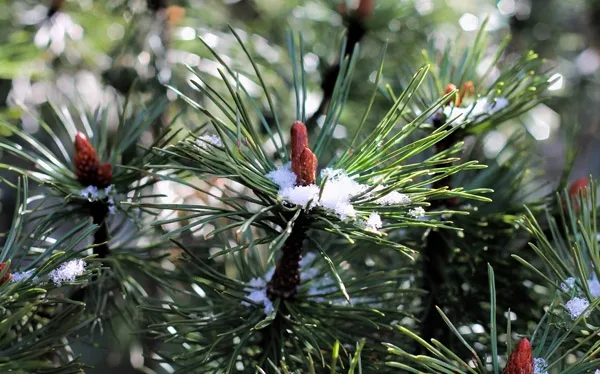
Mountain pine (Pinus mugo).
The mountain pine, which in the wild grows in the mountains of western Europe, is interesting in that it has a low-growing natural form known as krummholz. The roots of this pine, accustomed to life in the mountains, hold on to the soil very firmly, while its broad crown and curved trunk make it even more stable. That is why it is the mountain pine that fits most harmoniously into the mysterious dune landscape of the spit.
Nor should we forget the conifers that are native here. First and foremost these are the Scots pine and the Norway spruce. The Scots pine belongs to the group of two-needled pines (with the needles arranged in pairs in bundles). The age at which its seeds become viable comes fairly early, at 10–15 years, while individual trees of this pine can live to 600 years. The Scots pine is undemanding: it tolerates heat and frost, excess and lack of moisture well, and can grow even on peat soils. And all because of the peculiar structure of its root system: on boggy soils its roots lie on the surface, as if it were afraid of getting them wet. On loose sandy soils, on the contrary, it spreads them both deep and wide, creating a vast web of fine roots to catch moisture. It is precisely this property that allows the Scots pine to anchor itself firmly in the sand and at the same time to anchor the sands themselves.
Of course, introduced species often withstand adverse conditions, pests and diseases more successfully, but we must not forget that it was the native species that held out against the onslaught of sand and wind for many hundreds of years.
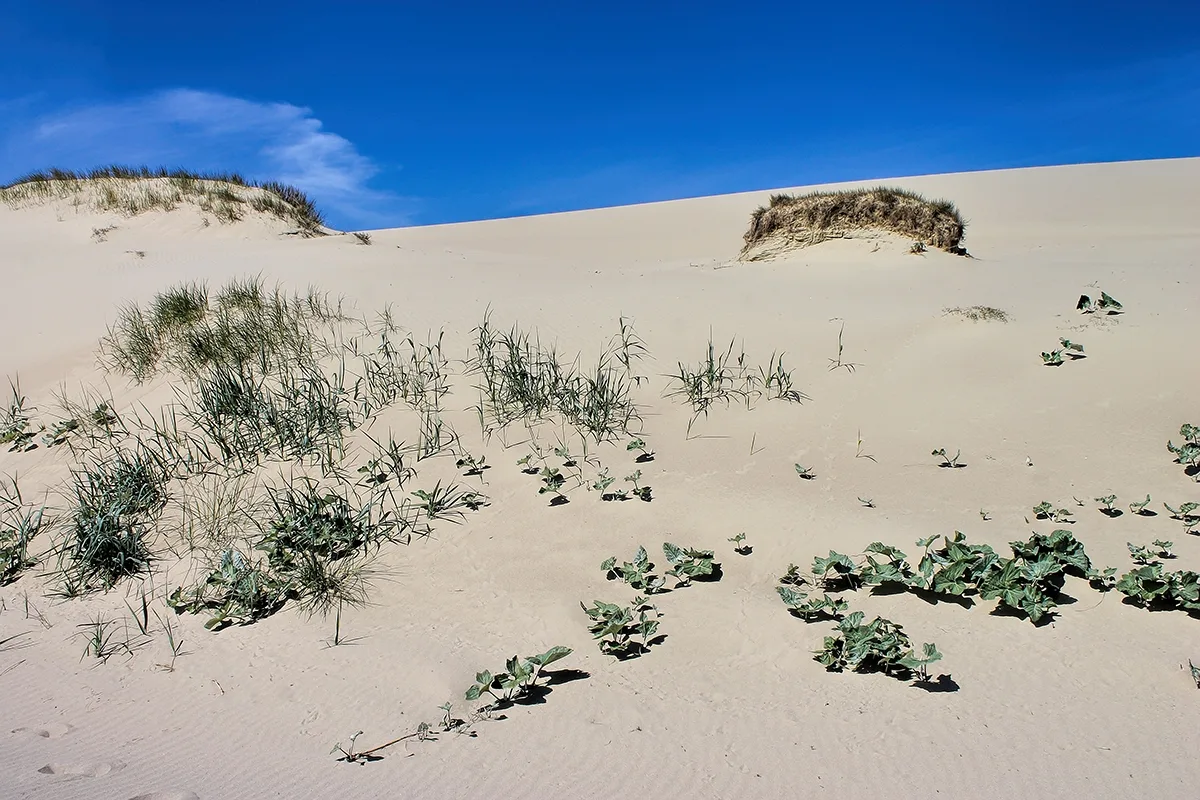
However, as it turns out, you cannot simply take a plant, even the hardiest one, and plant it in bare sand. The process of preliminary preparation is long and complicated, and it was this process that formed the basis for creating the foredune when the first experiments in dune stabilisation were just beginning. On the crest of the foredune two or three parallel fences of stakes and brushwood are set up. Sand thrown up by the sea buries them; new fences are put up in their place, and so on until the foredune reaches the required height. Then this ridge is stabilised with sand-loving grasses, shrubs and trees planted in special cages. The mission of most of the herbaceous plants living on the sands is not so much to survive as to flower as quickly as possible and set seed, which, falling into the soil, allows a new generation to carry on the effective fight against the shifting sands. To survive in such extreme conditions, plants above all try to use moisture sparingly. To reduce the evaporating surface, grey hair-grass, for example, has acquired narrow leaves rolled into tubes, the leaves of hawkweed and milk-vetch are densely hairy, and the stiff, prickly leaves of sea holly are covered with a waxy bloom. And yet the plant best adapted to moving sands turned out to be marram grass, also called sand reed – a plant that grows upwards again and again, even after being completely buried in sand.
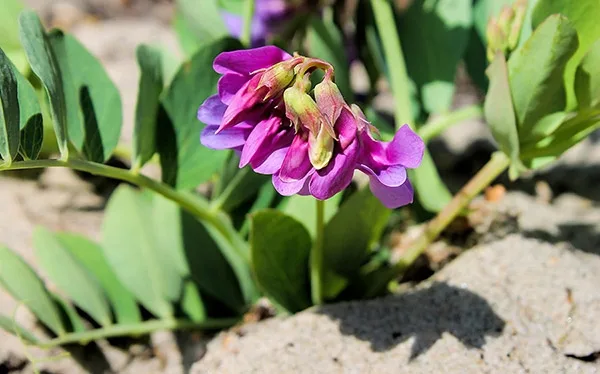
Sea pea (Lathyrus japonicus var. maritimus).
An indispensable plant for stabilising dunes, and a highly ornamental one, is the sea pea, a member of the legume family. This plant seems to creep across the sand: its tough stem and leaves can withstand both sun and wind. From mid-June the sea pea is covered with bright crimson flowers, and just a month after flowering it forms numerous seeds in its narrow pods; the wind carries them away and they give life to new offspring. A very useful property of the sea pea in dune conditions is that, like all legumes, it forms nitrogen-containing nodules on its roots, which naturally fertilise the soil.
The name of another plant used on the spit to hold back the sands speaks for itself: European beachgrass.
It is a perennial grass with a creeping rhizome, 50–100 cm tall, with stiff glaucous leaves, found everywhere on the sandy beaches of the Baltic Sea. Strong winds are especially merciless to it, since marram is a tall plant, but it has flexible stems that merely bend to the ground under the gusts and then straighten again. This plant adorns the desolate landscape of the dunes not only in summer but in winter too.
Another perennial grass of the Curonian Spit, unlike marram, is very small and compact: no more than 35 cm. Yet it fits beautifully into the landscape of the grey dunes, where together with other plants it forms geometrically intricate compositions. This is grey hair-grass, which resembles a hedgehog in shape. Such a small but brave defender of the dunes!
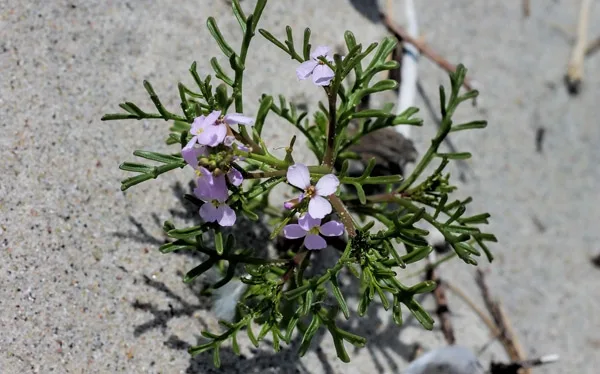
Sea rocket (Cákile).
One plant that seems to need no protection whatsoever is sea holly: sharp spines on its leaves, a stiff glaucous stem, and even its blue flowers, which appear in June, are framed by spiny bracts. Sea holly seeds are protected too: they are fruits with sharp scales. Once ripe, they are carried by the wind far from the parent plant. This plant is listed in the Red Data Book of the Kaliningrad Region and needs additional protection.
Baltic sea rocket is a low plant with glaucous fleshy leaves which in early July bears fragrant lilac or white flowers gathered in dense racemes. Sea rocket can either creep along the sand or grow upright, depending on how sheltered from the wind its growing place is. Its distinctive fruits have the peculiar form of a pod whose upper part is flattened and pointed like a little boat. Each pod holds one seed, and when the seed ripens it can travel together with the boat-shaped upper part over great distances by water to a new shore.
The lower pods travel with the plant when it finishes its growing cycle, scattering over the ground. In this way sea rocket successfully spreads both by water and over land.
One of the first plants to flower on the Curonian Spit is woolly butterbur: its dense greenish-yellow flowering shoots appear in early April, before the plant forms its first leaves, which resemble those of coltsfoot in shape. The plant prefers places close to the water and, developing an extensive root system, helps to hold the sand along the whole shoreline of the lagoon.
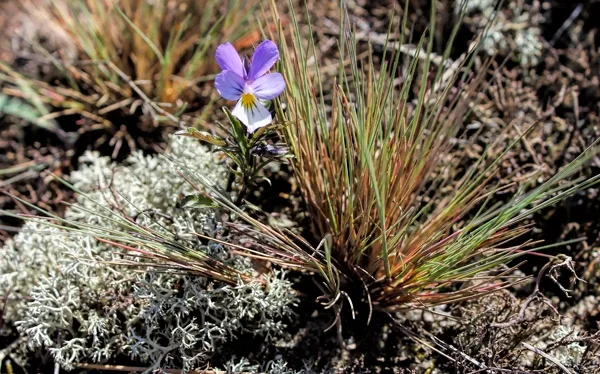
Seaside pansy (Viola maritima).
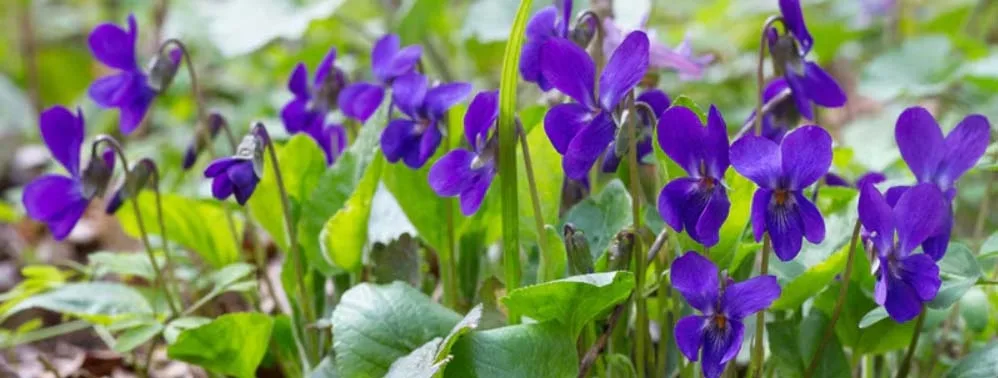
And the last sand-loving plant I would like to tell you about is the seaside pansy. It delights us with its flowers on the Curonian Spit in April and May. Although this species of violet is not included in the Red Data Book of the Kaliningrad Region, it is on the supplementary list of plant species requiring special attention. But it is not a flower that cannot stand up for itself! The coastal pansy is a delicate-looking plant with lilac-and-yellow flowers resembling in shape those of other violet species. Yet its vitality cannot fail to amaze. These tiny plants, in groups or singly, can be found on the shores of the sea and the lagoon, on the white and grey dunes and in the forest glades of the spit.
Besides the herbaceous plants listed above, which prefer to live in the Spartan conditions of sandy soils, one could also name giant lyme grass, sand sedge, sand lyme grass, variable-seeded goatsbeard, Loesel's toadflax, twinflower and common broom. Their role in stabilising the sands is enormous.
And so our green brethren, great and small, defend the Curonian Spit from the sands day after day. Human labour here is especially hard, too, as machinery cannot always be used – the dunes must be protected. The Curonian Spit was created by nature, but it is now the joint offspring of nature and humankind: a rare example in our time of thoughtful human activity in conserving natural riches.
Photo by Natalya Antonova.
Translated from Russian with the help of AI (Claude, Anthropic), October 2026.