Pál Tamás
(born 1948)
Hungarian sociologist, director of the Centre for Social Policy at Corvinus University of Budapest, and since 2014 professor in the Department of Media Theory and Economics at the Faculty of Journalism of Lomonosov Moscow State University. He is one of the leading experts on the social transformations of "post-communist" countries.
– The historical bestseller "The Decline of Königsberg" by Michael Wieck, a German conductor born in Königsberg into a Jewish family who lived through the pre-war Nazi years and the storming of the city here, was recently republished in Kaliningrad. Do you know this book?
– I have the first edition, which came out in our country, I think, in the 1990s. The book is well known in Germany because its foreword was written by the remarkable German writer Siegfried Lenz. So yes, I know this book.
– Well, Michael Wieck implicitly puts forward the idea that Stalin wanted to wipe out the German population through starvation. How justified do you think such a claim is?
– I think Wieck is a good memoirist. He is interesting above all as a witness to the events. But for him to talk about what Stalin did or did not think is simply laughable; he has no idea about that. Many of Wieck's statements should not be taken seriously. He is simply a German memoirist, an honest man, but he is no expert on Soviet history.
– Do you think the Soviet leadership had any concrete plans at all about what to do with the German population once it had been decided that the territory of East Prussia would pass to the Soviet Union?
– I can say with certainty that in 1945 the Soviet leadership had no plans for what to do with the local German population. In general, a very interesting situation arises: by that time the overwhelming majority of the population of East Prussia had already left their native land.
In 1939, before the war, there were two and a half million people in East Prussia. On the territory of today's Kaliningrad Region, that is, the northern part of East Prussia, there lived at that time, by my rough estimate, between 1.5 and 1.7–1.8 million people. Of these, by the summer of 1946, the period we are talking about now, 108,000 remained. The population had vanished. We have to understand that Königsberg was practically empty.
Few remained, and to a large extent they were not Königsbergers of the old stamp. Most of those had left. The people in the city at that moment were mainly peasants who had stayed in the region because they had to look after their farms. They fled to Königsberg in the autumn, winter and spring of 1944–1945, that is, during the East Prussian Operation. They fled their villages and farmsteads because they feared revenge and everything else.
– And when and where did the rest of the population go?
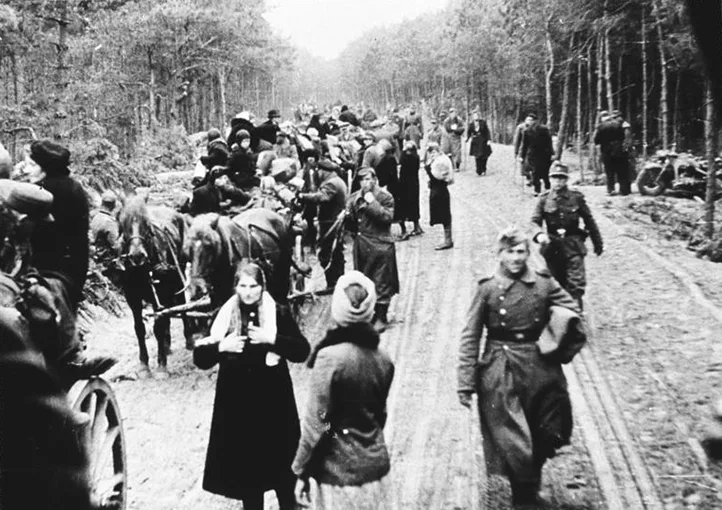
– By that time most of the inhabitants of East Prussia had left the territory. The exodus began in October 1944. It is a very peculiar story, connected with the village of Nemmersdorf [now the settlement of Mayakovskoye in Gusev District, — author's note]. At the end of October 1944 a small part of the border territory of East Prussia came under the control of the Red Army. The Germans very quickly retook the area and discovered that some of the civilian population had been killed. Nazi propaganda used this for its own purposes. All these horrors were shown throughout the region. Goebbels's machine worked flat out: "People of East Prussia, know that what happened in Nemmersdorf will happen to you too. If the Soviet soldiers come, you must fight, resist to the last German." That was the idea they broadcast. But the Germans, the local Prussians, reacted to this campaign, to this propaganda, in a completely different way.
By the end of 1944 about half a million people had left the region. And they were the lucky ones, because by the New Year they had reached the territory of present-day Germany, some going to relatives, some not, it varied. That is, they did not have to endure the very difficult evacuation of the winter of 1945.
The second wave of people, also about half a million, disappeared after January 1945, when the consolidated Soviet attack on Königsberg began. By then fighting was already going on in Pomerania. Reaching "classic" Germany overland was very difficult. And some half a million people had to get there by sea [from the territory of today's Kaliningrad Region, — ed. note] .
In fact, this was one of the largest maritime operations ever undertaken to move a civilian population. We must bear in mind that about 2 million people were evacuated from the pocket that had formed in East Prussia and Pomerania. Every vessel available at the time was used, from ferries to cruisers, from civilian ships to small fishing schooners. The ships sailed to Hamburg and Kiel, that is, to the big German ports.
– Who remained in East Prussia? What was the social profile of this population?
– Firstly, there remained people who were rather "stubborn" and poorly informed. They did not know what awaited them. They did not understand what war is. Secondly, there remained convinced Nazis who defended the territory as civilians rather than soldiers. But there were not many of them. And thirdly, there remained the unfortunate peasants who had lived and worked perfectly well on their farmsteads and did not know that there was any other life beyond the farm. Altogether some 250,000 people remained. A year later the figure was already about 100,000. The rest died as a result of the fighting, hunger and other wartime hardships; some were taken to the Soviet Union for forced labour, and so on. War always means terrible, deeply dramatic pages of history.
– And when did Stalin decide to deport the population remaining in East Prussia?
– That is a very interesting story, because they were forgotten. This is very important! There was no wish to destroy them; they were simply forgotten.
Under the decision of the Potsdam Conference, about 14 million Germans were to be resettled from Eastern Europe and the eastern provinces of Germany to "greater" Germany. And in 1945, but mostly in 1946, the mass expulsion of Germans from Poland and Czechoslovakia began. That was what the Potsdam resolutions laid down. The Germans of East Prussia were not mentioned in these resolutions at all.
– So how was this question resolved in the end?
– It was resolved as follows. It turned out that in Germany, including the lands of the "Soviet occupation zone", there were quite a lot of so-called "Prussians", that is, refugees whose relatives had stayed in East Prussia. And these people were not being sent to Germany at all — what nonsense was this? So these East Prussian refugees began writing to the special office in the "Soviet occupation zone" that dealt with displaced persons, saying: good grief, some of our people are still there! Many or few, they are still there. The German-Soviet authorities then reported the problem to Moscow. And the state apparatus took the decision: the remaining Germans are to be resettled in Germany! The resettlement decree was signed by the Minister of Internal Affairs, Sergey Nikiforovich Kruglov.
The main phase of the resettlement took place in 1947–1948. A total of 42 trains were sent, and they all went to the same station in East Germany, near Magdeburg. We must also bear in mind that all these people ended up on the territory of the future GDR. And until the end of 1989 their fate, their presence and their absorption into German society were not much publicised.
– At the beginning of the interview you said that you rely mainly on German sources. So how do German sources portray the relations between the Soviet settlers who arrived in the Kaliningrad Region in 1946 and the German population, which mostly only began leaving in 1947?
– Let me say straight away that there is a fairly large body of literature, the memoirs of East Prussian refugees, but practically all of them end in 1945. I repeat, most of the "Prussians" fled; only 250,000 remained, of whom only half survived. So it is not at all surprising that the memoirs scarcely reflect the history of relations between the Germans and the Soviet settlers. Most of the Germans had left East Prussia before the Soviet civilian population arrived.
I would also like to share a cultural observation. In the early 2000s a Russian-Polish-German oral history commission was set up in Kaliningrad. This commission searched for surviving Germans, men and women, the so-called "old Königsbergers" who had stayed in the city. They found only seven people, who were, of course, very old. All of them had become Soviet citizens. Three of them gave interviews. The first thing that strikes you in these interviews is that they remember nothing at all except 1945. Their state can be described like this: in 1945 a "train" ran right through them. Secondly, all of them had remained in the Kaliningrad Region because they had registered as Lithuanians.
As for their relations with the Soviet settlers, they recall the following: there were people who helped them, and there were those who did not help but "sat on their necks".
And one more observation, related to the previous one. We must bear in mind that 1945 was a personal drama for German families, when they experienced all the horrors of war first-hand. That period was etched clearly into their memory. The shock of 1945 was very strong. Whereas the years 1946–1947, in cultural terms, mattered far more to the Soviet settlers than to the Germans. The Germans took little interest in the newly arrived population. I think that in 1946–1947 they were still fighting to survive and preparing to leave.
Photo: Bundesarchiv.
Translated from Russian with the help of AI (Claude, Anthropic), October 2026.