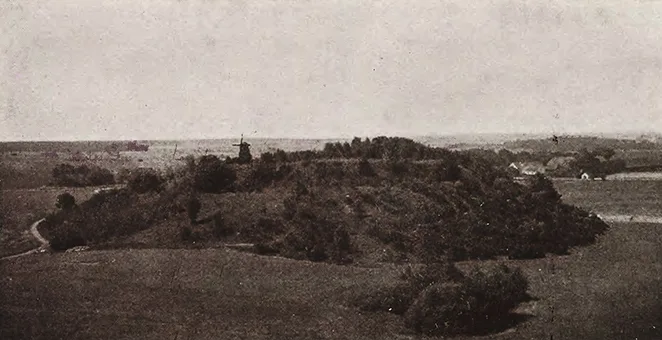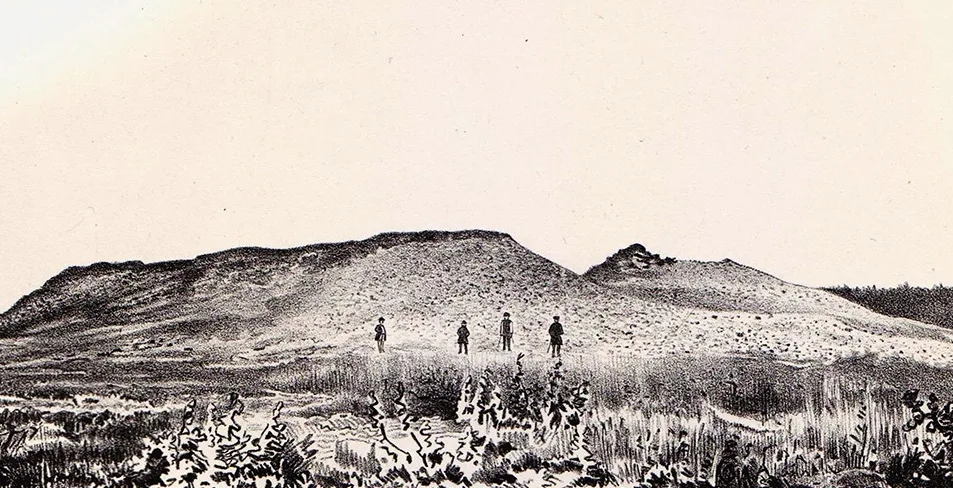
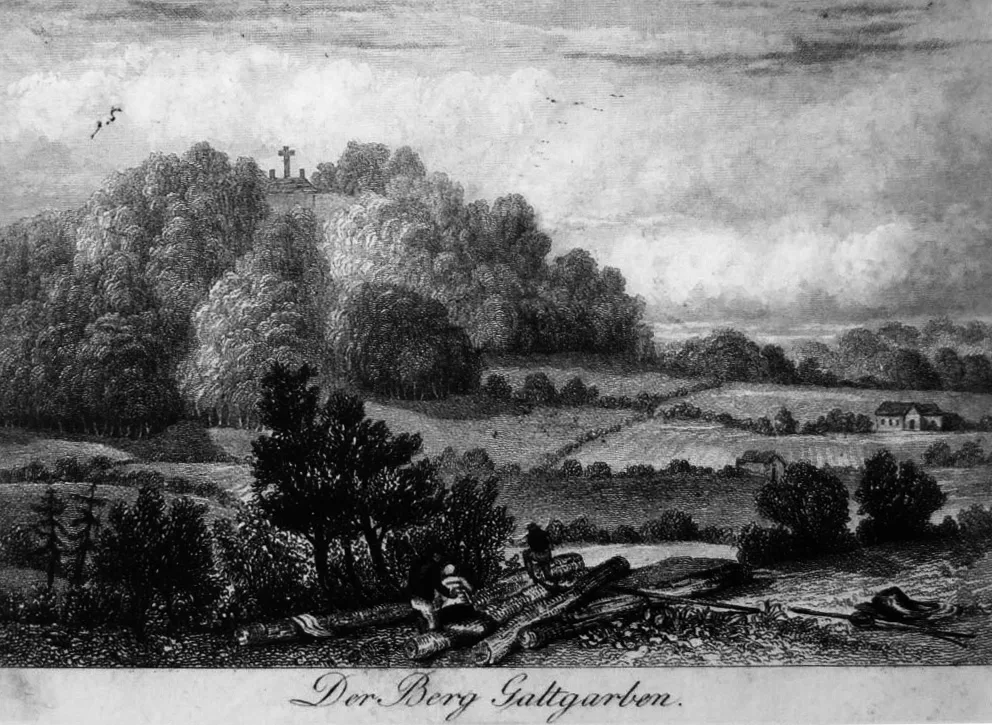
Rising 111 metres above sea level among the Alk hills1, Galtgarben has attracted attention since time immemorial. If you drive from Kaliningrad along the old Svetlogorsk road, the "Magic Mountain" is on your right, about 900 metres before the Svetlogorsk – Pereslavskoye fork. Readers have probably seen this "hill with antennas" while driving past. The Alk "mountains" themselves (Alk-Gebirge) and their surroundings deserve special attention, and I promise to tell you about them a little later.
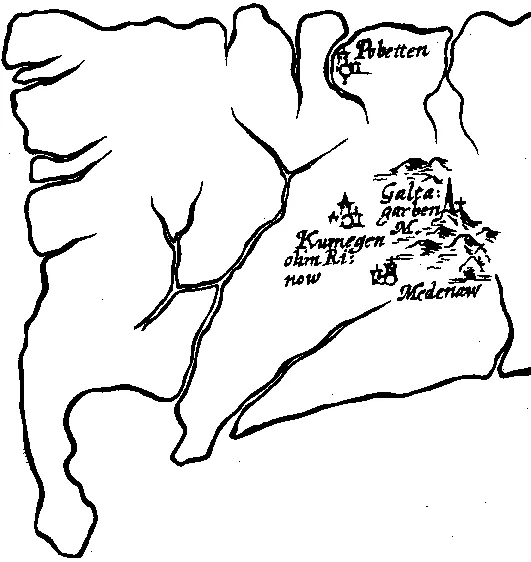
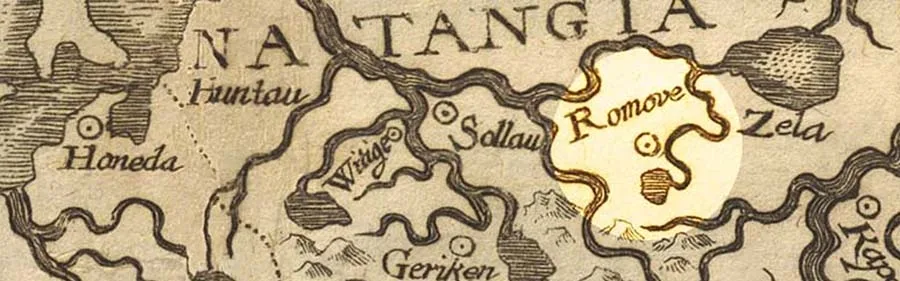
Galtgarben on a map of 1576.
But let us return to Galtgarben2. First of all, Galtgarben is one of the largest Prussian hillforts, with a platform measuring 170x50 m. The ancient fortification is surrounded along its entire perimeter by two or three ramparts 4–6 metres high, overgrown with moss and trees, and by deep ditches. On the west, at the foot of Galtgarben, there was a fortified settlement. In the early 1950s the archaeologist Frida Gurevich discovered a cultural layer up to 1.6 m thick here, containing fragments of 12th–14th-century pottery. Not far from Galtgarben, according to Emil Hollack, lay another Prussian hillfort, Dalwehnen.
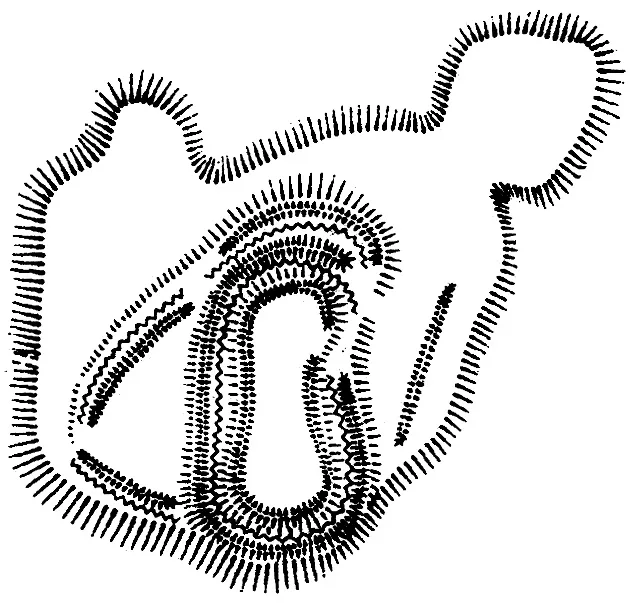
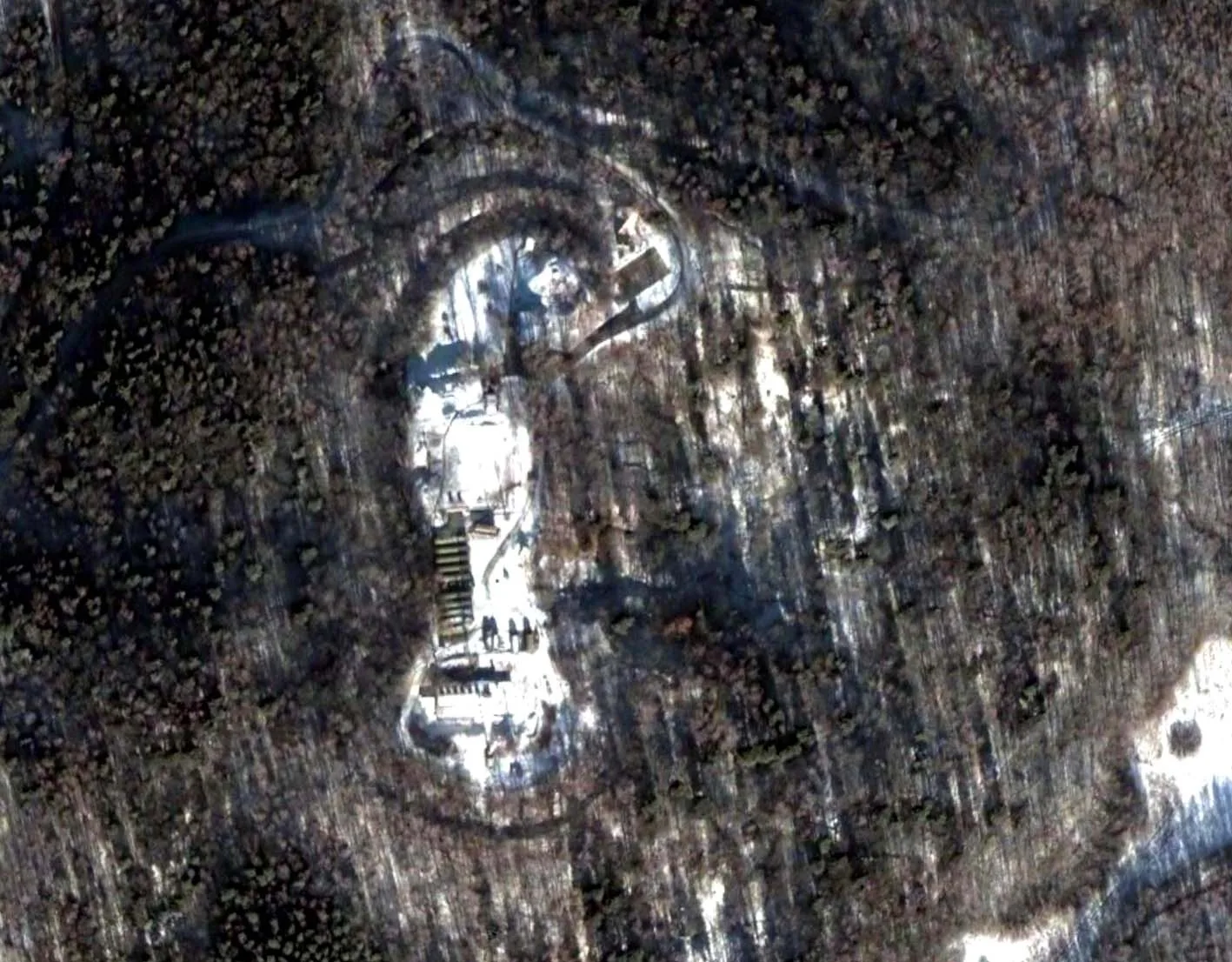
There are several linguistic theories about the origin of the mountain's name. First, in pre-German times the hillfort may have been called Gaīls-gārbs, which in Prussian means "white mountain". And indeed, in winter the snow-covered Galtgarben served as a kind of landmark for travellers, and let us not forget that white was a sacred colour for the Prussians. On the other hand, the name of the mountain may derive from the name of the owners of the castle and land, Galte or Galtis. In that case Galtgarben is "Galte's mountain". There are also other theories linking the mountain with the German "Galgenberge", gallows hills, many of which lie west of the Alk-Gebirge. But all this is prose; now for the magic!
Mystical legends of Galtgarben
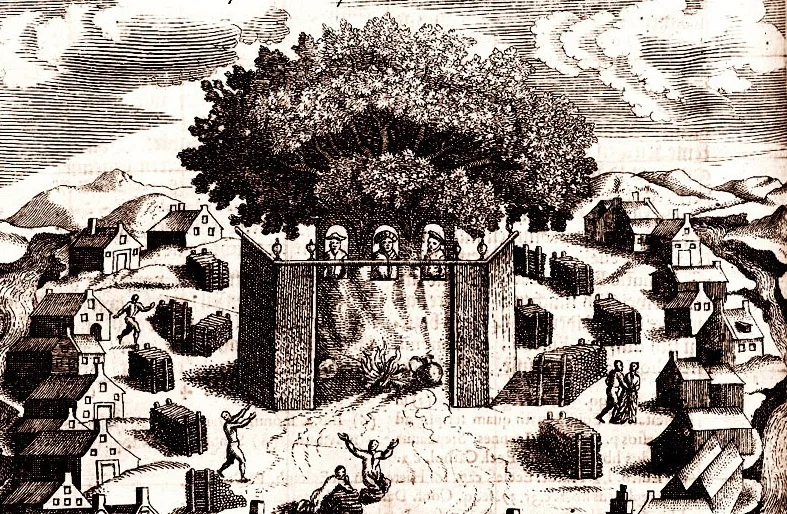
Judging by written sources of the 16th–18th centuries, the wooden Prussian fortress on Galtgarben may also have been one of the main pagan sanctuaries of the Prussians.
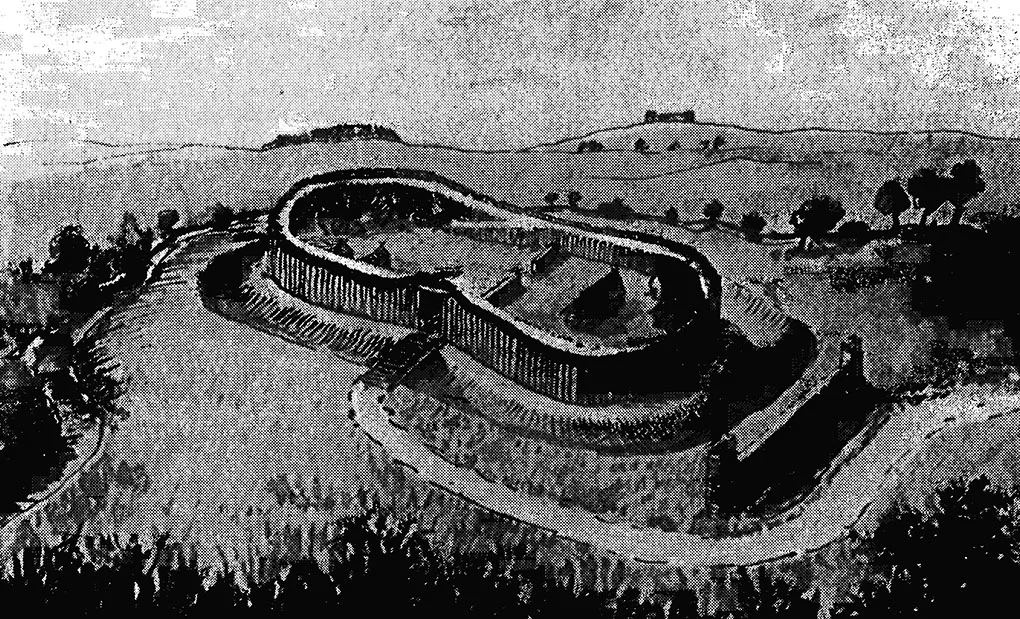 A conjectural reconstruction of the Prussian hillfort of Galtgarben.
Perhaps this was the site of the famous Romowe Rickoyto, the residence of the Prussian priests. It is no accident that in the second half of the 13th century the episcopal castle of Rinau appears on this spot. True, apart from a few mentions and legends, nothing of it has survived to our day. One may also recall the confusion with the castle of Galgarben, built by the Order in the east of Sambia, not far from the Prussian village of Rinawa (Rinau). The legends, too, speak of the special status of Galtgarben. One of them was recorded by the monk Simon Grunau in the 16th century and published in 1865 in the first collection of East Prussian legends, by Tettau and Temme.
The legend says "that once upon a time the descendants of Samo, the lord of all Samland, lived on Mount Rinau. Many mighty oaks grew on the top of the mountain. The mountain was considered sacred. That is why the images of Curcho and Wurschait stood at its very top. And in the depths of the mountain were urns with the ashes of its rulers, surrounded by the finest precious stones, coins and other treasures. The sanctuary was destroyed when the brethren of the Teutonic Order conquered Samland. But the treasures remained lying deep underground, untouched. It happened in 1524, when several monks, expelled from their monastery for their devotion to the Evangelical faith and left without means of subsistence, decided to search for the treasure. And so
fourteen monks set off in search of the treasure to the high mountain near Kumehnen. When they approached the mountain, they saw the ruins of the palace in which the lord of the mountain had lived many years before.
The monks began to dig under a wall. But when the wall collapsed, a poisonous cloud rose from it, from which five monks fell dead, and three more died in agony the next day. Those who remained told how they had seen huge pots, on each of which sat a black dog, and it was from their jaws that these deadly vapours came. A few days later the surviving monks went up the mountain again, carrying holy images, singing prayers and reciting psalms, which protected them from the evil spirits and dispersed the poisoned mist. Coming to the hole in the ground, the monks saw in the pit seven large burial urns and, taking them out, carried them rejoicing to Königsberg. There they opened the urns in the presence of the bishop and the komtur. But since the treasure belonged to the devil, he, to the monks' sorrow, turned it into embers, human bones and ashes."
Here, besides the mention of a sanctuary and a residence of Prussian chieftains, one's attention is also drawn to the urns with the ashes and grave goods of the Prussians, which really might have been buried somewhere in the vicinity or at the foot of the mountain itself. Let us not speculate for now, but turn to another legend about Galtgarben, first published in the same collection:
"Mount Galtgarben, or, as it is otherwise called, Rinau, even if it is not the highest in Prussia, rises so far above its surroundings that from it there is a magnificent view of Königsberg, the lagoon and the sea. On it there is also the famous monument to the heroes of the War of Liberation. In pagan times, on the top of the mountain stood the sanctuary of the god Ligo, the god of spring and joy. An eternal fire burned there, guarded by chaste maidens. One day a young man in love decided to carry off a maiden, the chosen one of the Kriwe himself. He swore to lead her to the altar and into his house as his wife. Three times he rushed at the mountain with his loyal troops, and all three times they were driven back by the guards of the temple. And at last,
when the young man got inside the sacred enclosure and had already seized the maiden by the hand, the earth suddenly shook, lightning struck, and the lovers vanished into the depths of the mountain after the collapsing temple.
The sacred fire went out for ever. Since then the local people often hear at midnight on the top of the mountain a roar resembling the clash of weapons, and from time to time they see flames bursting out from under the ground. And then it all suddenly falls silent, just as it began."
This is probably how the mentions in legends and chronicles of the sacred fire and of a battle between Prussians and knights on Galtgarben were reflected in the popular imagination. The fire on the mountain is also mentioned by Matthäus Praetorius at the beginning of the 18th century, who refers to Galtgarben as a "signal mountain" from which, in case of danger, the Prussians used fires to pass signals deep into the peninsula and to the coast, where there were also similar fortifications.
The third legend about Galtgarben, published by Reusch in 1838, says: "There was once an enchanted castle on Galtgraben, for long, long ago two beautiful women were often seen on the top of the mountain [in another version, 'two beautiful witches' — author's note], who have now vanished from there because of people's ignorance and remain unhappy for ever. A peasant who took a liking to these women once asked them how he could serve them. The women were delighted and said that there was still a way to free them, if someone dared to drive up the mountain with an upturned cart and horses. 'However,' they lamented, 'if the daredevil fails, all is lost for us for ever.' The peasant thought this was child's play.
He went home, took his cart and turned it over, as the women had told him, carefully, every part of it, harnessed the horses back to front and, crab-like, backed up the mountain.
Although Galtgraben was then completely covered with bushes and there was neither road nor path on it, the peasant climbed to the top quite quickly, and at once he heard desperate cries, among which the wailing of the women could clearly be heard: 'Lost for ever! For ever lost!' For a long time he could not understand the cause of the misfortune he himself had brought about, until he went closer to his team and saw that he had forgotten to turn the shaft around. Since then no one has seen those women again."
The motif of rescuing a princess or a witch from an enchanted castle "the other way round" occurs in Baltic folklore. In general, it should be noted that the seemingly superficial and sentimental East Prussian legends recorded in the 19th century often conceal more archaic layers of information that point to the original function or the circumstances in which a particular place came into being.
The 90-metre "Witches' Mountain" (Hegeberg), not far from Galtgarben, is likewise an unmistakable reminder of the "sanctity" of these places. Mystery surrounded the mountain later, too. In Soviet times local drunkards spoke of seeing UFOs over the "Magic Mountain".
From legend to history
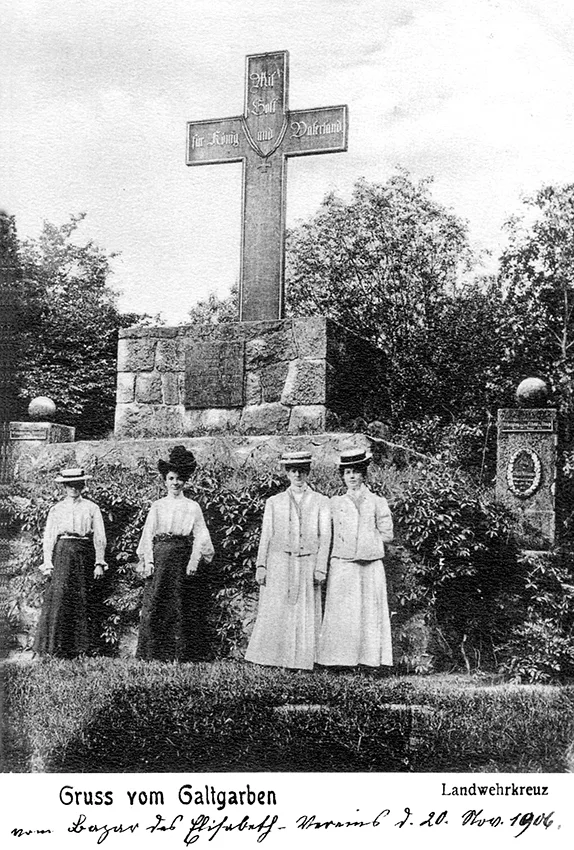
Although we have no factual evidence of the mountain's use in the period of the Order and later, Galtgarben did not lose its significance over time. It was here that in 1818 a memorial cross was erected in memory of the victims of the Napoleonic Wars. The mountain became a popular place of patriotic pilgrimage.
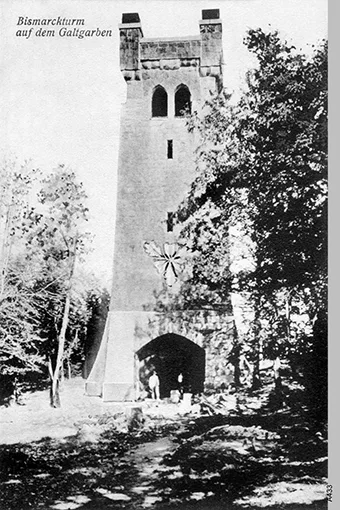
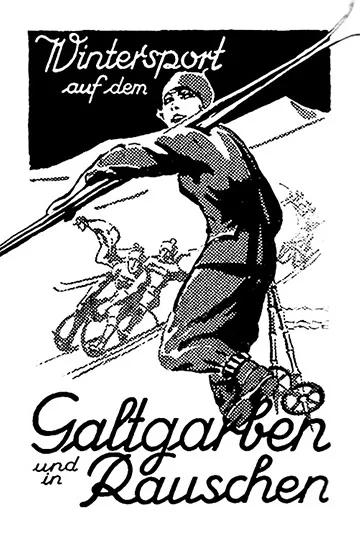
And tourism was quick to follow. In 1906 the Bismarck Tower, an observation tower, appeared on the top of Galtgarben, and a little later guest houses and good roads at its foot.
Thus Galtgarben and its surroundings became extremely attractive to travellers. From the beginning of the 20th century there were ski runs on Galtgarben and other high hills of the Alk, which drew holidaymakers from Königsberg.
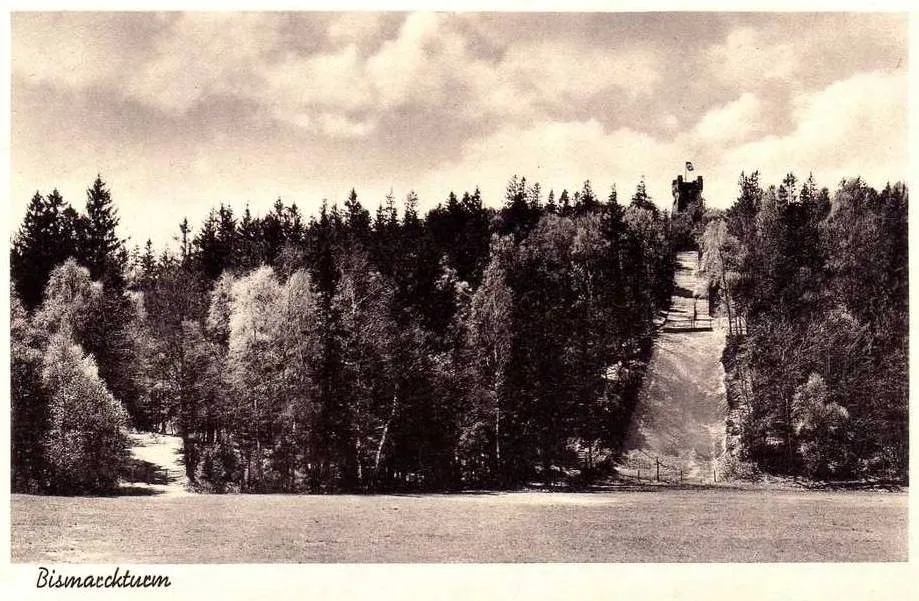 Ski run on Galtgarben, postcard from the first third of the 20th century.
In summer, locals and visitors celebrated the summer solstice on Galtgarben and held folk festivities, which became especially popular after the "occultists" came to power in 1933. The magic mountain was drawing people to it once again.
In the spring of 1945 the Galtgarben area became the scene of fierce fighting between the Wehrmacht and the advancing units of the Soviet Army. It is a pity that after two world wars the magic of this place gradually faded away. Since the 1960s a "secret" military unit has been stationed on the top of the mountain; it is clearly visible from space on Google Maps, but it hides the hillfort platform from visitors. "An ancient hillfort in action," some might joke. Of course, nobody stops you from quietly wandering along the majestic ramparts of Galtgarben and admiring the hill from the side… Besides, during the construction of the "Boosbahn", a sand quarry settled in snugly on the Alk hills a few hundred metres north of Galtgarben.
As the all-knowing Wikipedia says, "In winter Mount Galtgarben is used as a mini ski resort". Today this information is exactly 70 years out of date. That is why I would like our Magic Mountain to become once again a place where it is pleasant to contemplate the surroundings, to ski and simply to reflect.
___________________
1. Alk denotes the holy places of the Prussians.
2. Gārbs means mountain in Prussian.
Translated from Russian with the help of AI (Claude, Anthropic), October 2026.