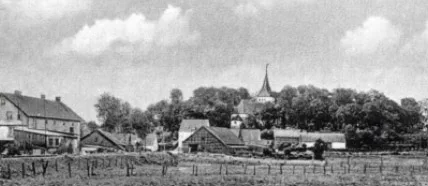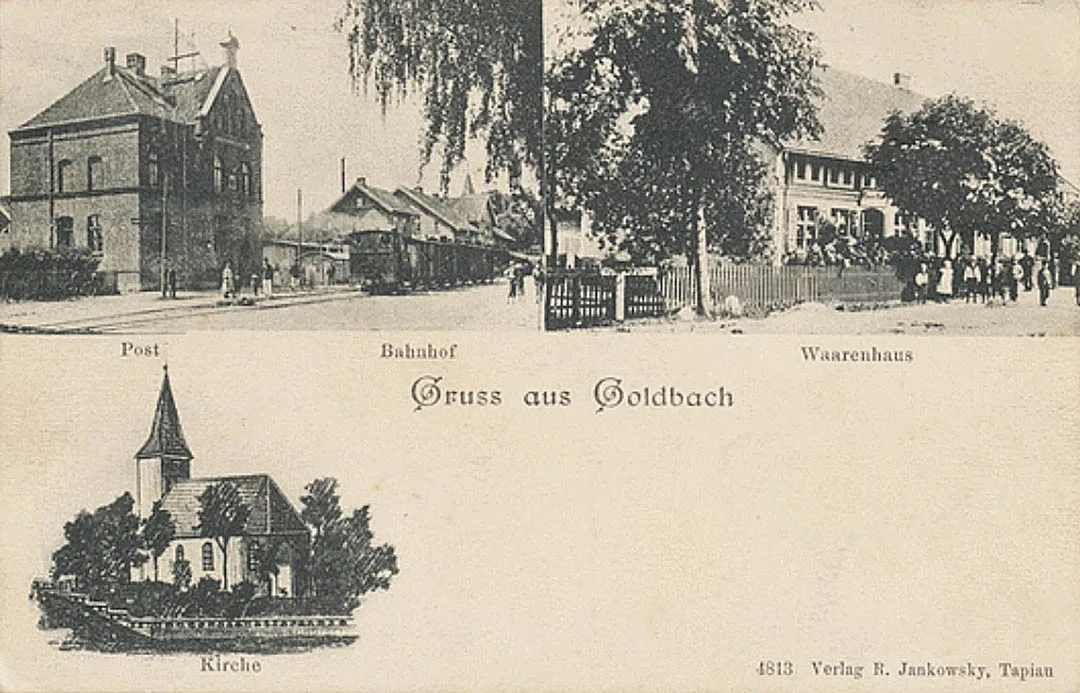
Goldbach was founded in 1300–1302 by Helwig von Goldbach, who came from the Thuringian village of Goldbach near Gotha, was a member of the convent of Christburg and in 1300–1302 was Landmeister of the Order in Prussia. In 1375 Goldbach is mentioned in the charter founding the settlement. In the 14th century a church was built in the village (rebuilt in 1706). In 1636 Elector George Frederick mortgaged Goldbach to Simon Janßen. In 1652 Goldbach became the property of Anschatz von Trenk.
In the 19th century Goldbach, in the Landkreis Wehlau (Znamensk), consisted of two villages: Gross Goldbach (the western part) and Klein Goldbach (the eastern part), separated by the Goldbacher Fließ brook (the Slavinka River) and a ravine. In 1874 Amtsbezirk No. 20 Goldbach was established in the Landkreis Wehlau, comprising four rural communities – Gross Goldbach (Slavinsk), Groß Keylau (Poddubnoye), Klein Goldbach (Slavinsk) and Klein Keylau (54°43'59'' N 21°03'27'' E) – and eight Gutsbezirke: Garbeningken (Belovo, later Yarki), Groß Köwe (Poddubnoye), Groß Kuglack (Yasenskoye), Karpau (Yarki), Klein Kuglack (54°42'43'' N 21°05'26'' E), Perkuiken (Nakhimovo), Perpolken (Belovo) and Wilhelminenhof (Nakhimovo). From 1913 the heads of the Amtsbezirk were residents of Goldbach. On 7 June 1889 the Goldbach Mill was incorporated into the Gross Goldbach community.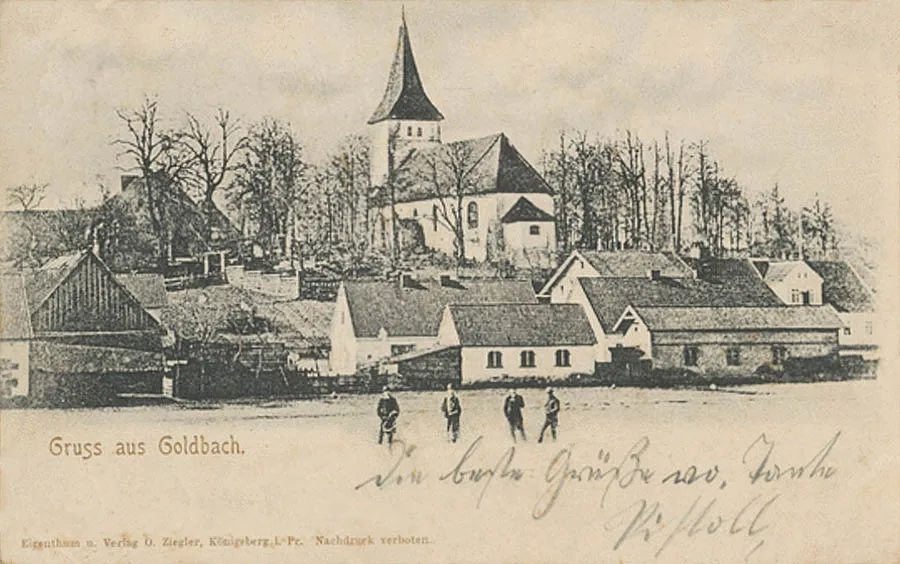
In 1898 a narrow-gauge (750 mm) railway was built from Tapiau (Gvardeysk) to Klein Scharlack (Yermolovo), with a passenger platform in Goldbach. In 1909 the line was extended to Labiau (Polessk).
By 1908 Klein Keylau had become part of the Groß Keylau community (Poddubnoye), and a new Gutsbezirk, Roddau (Belovo), had appeared in the Amtsbezirk Goldbach. The Amtsbezirk Goldbach thus came to consist of three rural communities and nine Gutsbezirke.
On 30 April 1910 the communities of Gross and Klein Goldbach were merged into the new rural community of Goldbach. On 27 September 1923 the Gutsbezirke of Perkuiken (Nakhimovo) and Roddau (Belovo) formed the new rural community of Perkuiken-Roddau. On 30 September 1928 the abolished Gutsbezirke of Garbeningken (Belovo, later Yarki), Groß Köwe (Poddubnoye) and Karpau (Yarki) were incorporated into the Goldbach community. The Gutsbezirke of Gross and Klein Kuglack and the rural community of Lischkau (Yastrebki) from the Amtsbezirk Pomauden (Luzhki) formed the new rural community of Kuglack, which came under the Amtsbezirk Pomauden (Luzhki). The rural community of Roddau-Perkuiken (Belovo-Nakhimovo) was merged with the Gutsbezirke of Perpolken (Belovo) and Wilhelminenhof (Nakhimovo) into the new rural community of Roddau-Perkuiken. On 30 January 1930 the Kuglack community (Yasenskoye) again came under the Amtsbezirk Goldbach, which now consisted of four rural communities: Goldbach (Slavinsk), Groß Keylau (Poddubnoye), Kuglack (Yasenskoye) and Roddau-Perkuiken (Nakhimovo-Belovo). After that the composition of the Amtsbezirk Goldbach did not change. By 1928 the rural community of Goldbach also included the localities of Deimehaus (54°45'12'' N 21°06'56'' E) and the Hirschfeld brickworks (Ziegelei Hirschfeld; 54°45'43'' N 21°05'58'' E)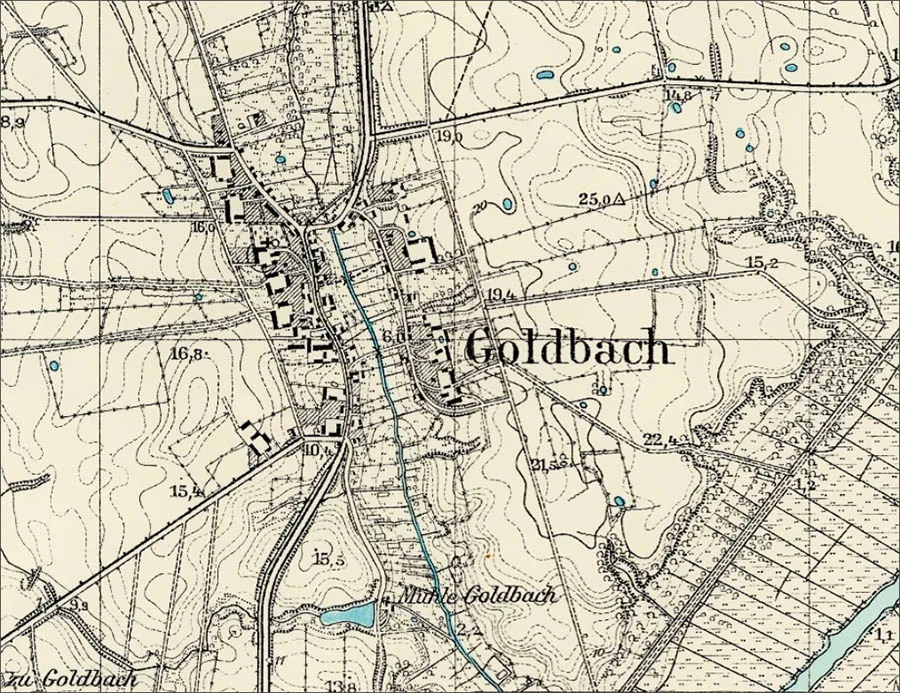
Before the Second World War Goldbach had three butcher's shops, three bakeries, four shoemaker's workshops, two locksmith's workshops, one tailor's and one joiner's workshop, a smithy, a sawmill, a barber's shop, and a windmill and a watermill.
On 23 January 1945 Goldbach was taken by troops of the 5th Guards Rifle Corps under the command of General I.S. Bezugly. A military hospital was set up in Goldbach.
On 17 May 1947 Goldbach was renamed the settlement of Slavinsk. The Slavinsk Village Council was created at the same time. The Goldbach Mill was never officially renamed and became part of the settlement of Slavinsk de facto. Even earlier, by a resolution of the Military Council of the Special Military District No. 2 of 29 January 1946, military state farm No. 16 had been organised on the basis of former auxiliary farms and military units; it was later renamed state farm No. 76, with its centre in the settlement of Slavinsk. On 27 May 1955 state farm No. 76 was renamed the Gvardeysky state farm. At that time Slavinsk had 71 houses, and a poultry farm operated on the site of the Goldbach Mill. In 1973 Slavinsk already had 77 houses, and in 1986, 84 houses. On 29 January 1993 the state farm was reorganised into the agricultural enterprise "Gvardeyskoye UVD of Kaliningrad".
Coordinates of the settlement: 54°45'07'' N 21°05'06'' E (centre), 54°44'38'' N 21°05'13'' E (Goldbach Mill).
Sights: a memorial to fallen Soviet soldiers (869 people buried), the church (1700) and a ruined monument to those who fell in the First World War.
Population change: 1910 – 750, 2002 – 1027 inhabitants.
Population change of the merged Goldbach community: 1933 – 1017, 1939 – 931 inhabitants.
Population of the Goldbach community: 1910 – 750 inhabitants.
Population of the Klein Goldbach community: 1905 – 243 inhabitants.
Population of the Gross Goldbach community: 1905 – 493 inhabitants.
Population of the Goldbach Mill: 1905 – 7 inhabitants.
Population change of the Garbeningken Gutsbezirk: 1905 – 83, 1910 – 94 inhabitants.
Population of the Hirschfeld brickworks: 1905 – 5 inhabitants.
Population of Deimehaus: 1905 – 5 inhabitants.
Population change of the Karpau Gutsbezirk: 1905 – 62, 1910 – 53 inhabitants.
Translated from Russian with the help of AI (Claude, Anthropic), October 2026.