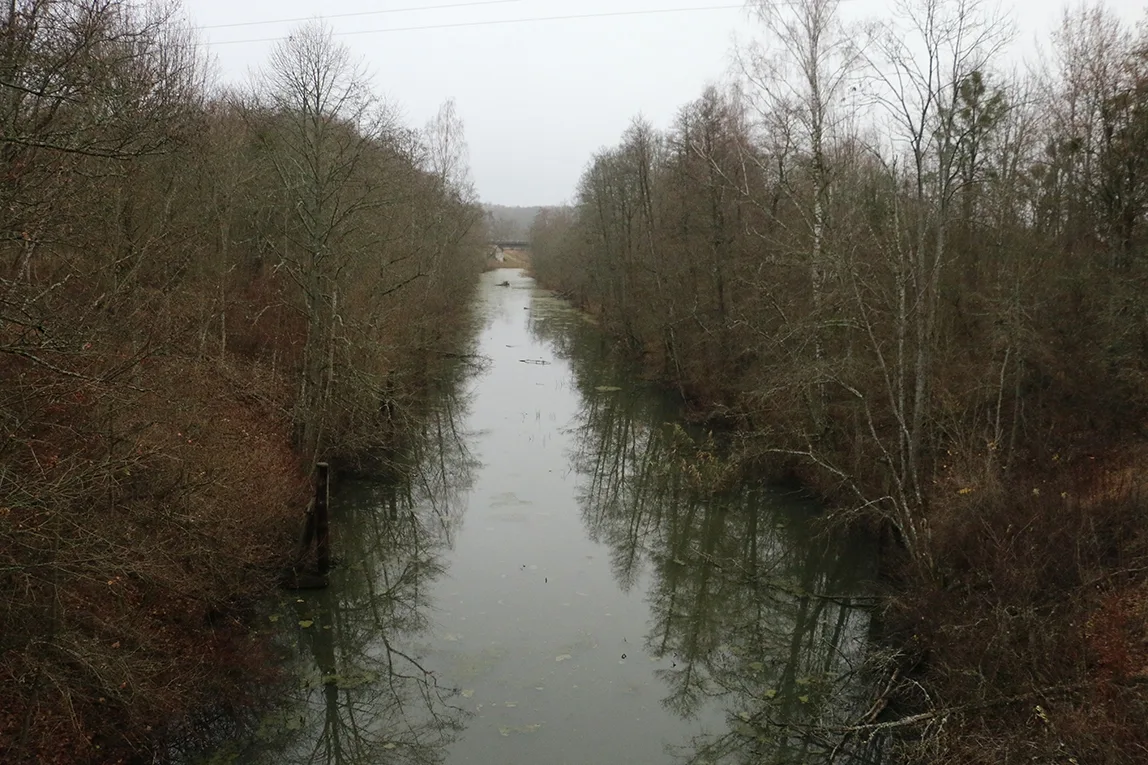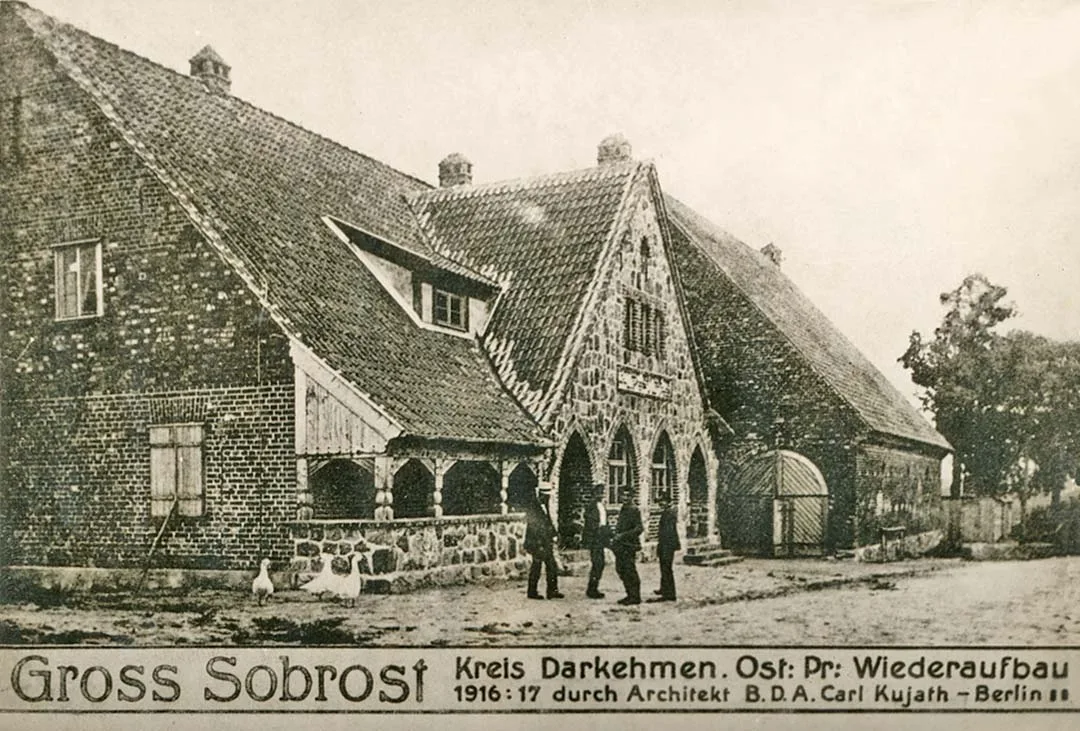
From 1867, the Groß Sobrost estate formed a Gutsbezirk (manorial district) in Kreis Gerdauen (Zheleznodorozhny) and belonged to the parish of Assaunen (Asuny, Poland). Besides the estate itself, the Gutsbezirk included the Vorwerk (outlying farm) of Pröck (54°20'05'' N 21°27'51'' E). In 1871, the Gutsbezirk of Groß Sobrost had seven residential buildings, home to 39 families and one single man. Six of these houses stood on the Groß Sobrost estate and one at the Pröck Vorwerk. On 09.06.1874, the Gutsbezirk of Groß Sobrost was incorporated into the newly established Amtsbezirk of Sobrost. Administrator Anders of Groß Sobrost served as head of the Amtsbezirk in 1892–98. Other residents of Groß Sobrost held the post in 1898–1907 (Administrator Schlieter) and in 1909–30 (estate manager Freytag).
In 1879, the Gutsbezirk of Groß Sobrost owned 580 hectares of land, and its annual property tax revenue amounted to 5,749 marks. By both measures, Groß Sobrost ranked 29th among the 73 Gutsbezirke of Kreis Gerdauen.
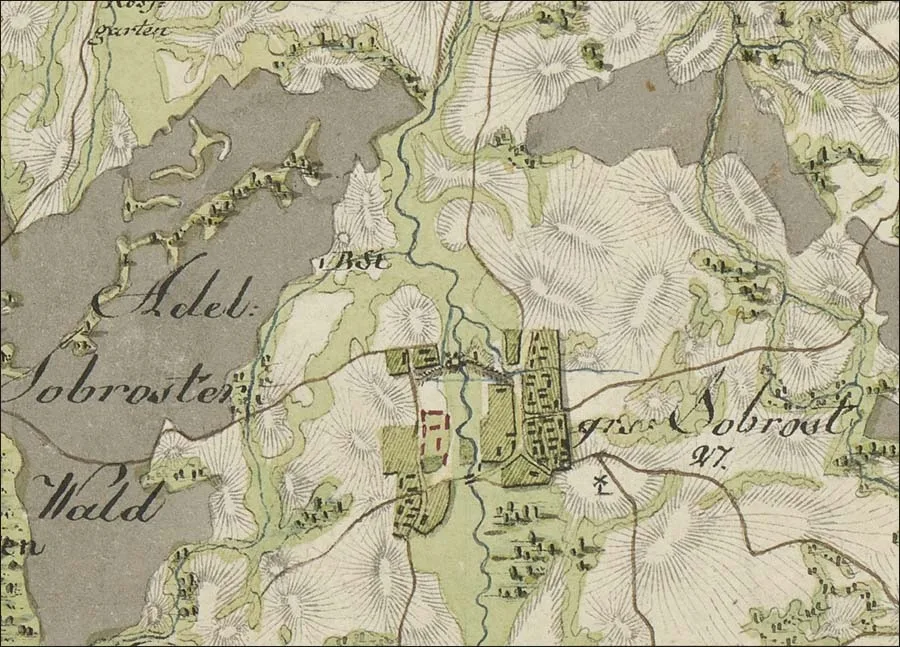 Groß Sobrost on a 1796 map. On the river is a watermill; on the hill to the south-west, a windmill.
On 01.07.1898, traffic opened on the railway line from Königsberg to Nordenburg (Krylovo), along which a station of the same name was built near the Pröck Vorwerk.
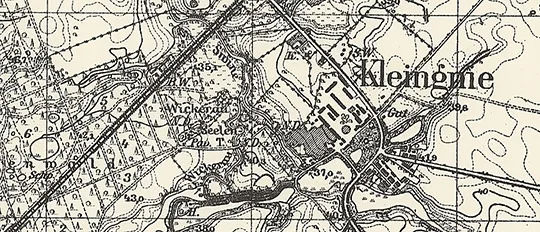
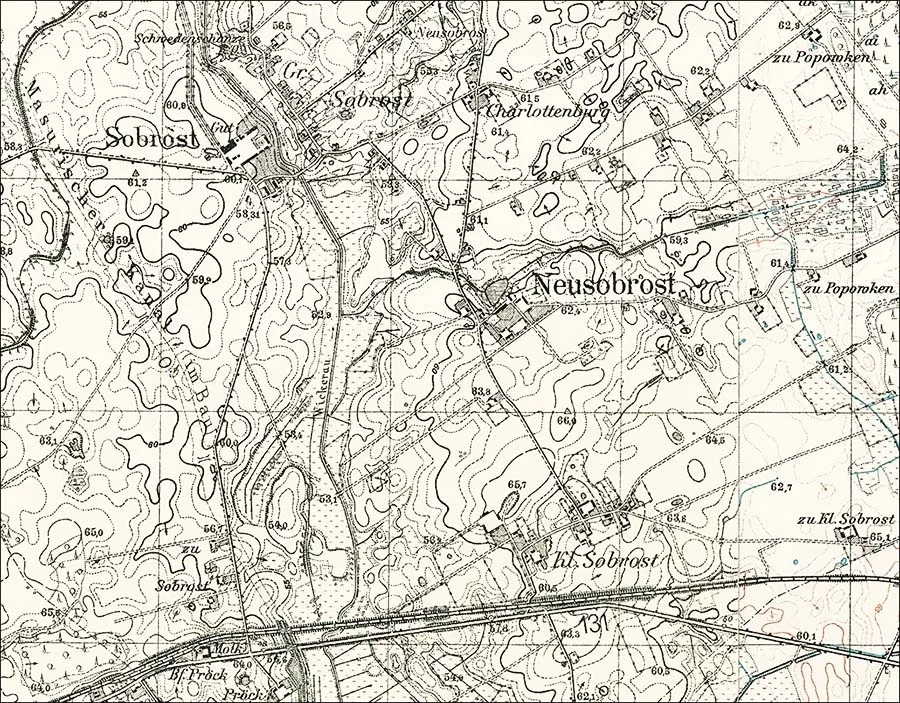 Sobrost and its surroundings as far as the Königsberg – Nordenburg railway line on a 1938 map.
On 04.05.1908, an inn and its adjoining buildings were transferred to the Gutsbezirk of Groß Sobrost from the Gutsbezirk of Popowken (Kochkino). On 30.09.1928, the Gutsbezirk of Groß Sobrost was dissolved and merged with the rural community of Groß Sobrost to form the new rural community of Sobrost. In 1932, the Groß Sabrost estate owned 464 hectares of land, including 340 hectares of arable land, 44 hectares of meadows, 25 hectares of pasture, 45 hectares of forest, 8 hectares of wasteland and two hectares of water. The farm kept 100 horses, 200 head of cattle (including 70 cows) and 200 pigs. The estate was valued at 434,000 marks. Its owner was Richard Freytag. In the years before the war, a dairy operated at the Pröck Vorwerk.
From 1818, the village of Groß Sobrost formed a rural community in Kreis Gerdauen (Zheleznodorozhny). The village belonged to the parish of Assaunen (Asuny, Poland). In 1871, the village of Groß Sobrost had 17 residential buildings, home to 35 families. On 09.04.1874, the rural community of Groß Sobrost was incorporated into the newly established Amtsbezirk of Sobrost. Like the Groß Sobrost estate, the village gained a rail connection in 1898, when the Königsberg – Nordenburg line (Kaliningrad – Krylovo) was opened. On 30.09.1928, the community of Groß Sobrost was merged with the dissolved Gutsbezirk of Groß Sobrost to form the new rural community of Sobrost.
The Amtsbezirk of Sobrost
On 09.04.1874, Amtsbezirk No. 16, Sobrost, was established in Kreis Gerdauen (Zheleznodorozhny). It comprised four rural communities: Agonken (from 1938 Altsiedel; Kochubeyevo), Groß Sobrost (Zarechenskoye), Klein Sobrost (Obilnoye) and Klonofken (from 1938 Dreimühl; Panfilovo), as well as three Gutsbezirke: Damerau (Degtyaryovo), Groß Sobrost (Zarechenskoye) and Popowken (from 1938 Neusobrost; Kochkino).
On 24.05.1911, the Gutsbezirk of Popowken (Kochkino) was converted into a rural community of the same name. On 01.05.1928, the communities of Klein Sobrost (Obilnoye) and Popowken (Kochkino) were merged to form the new rural community of Popowken.
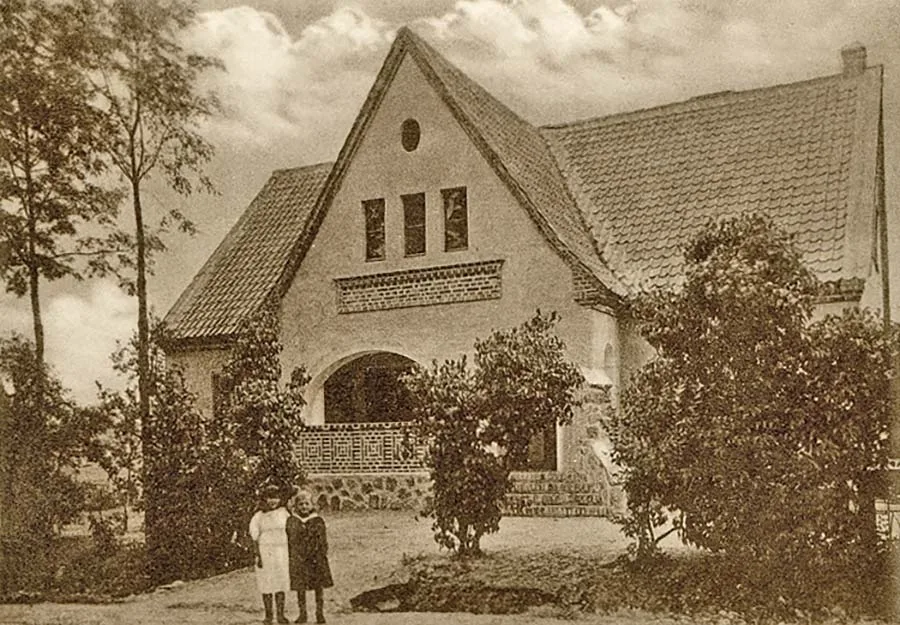
On 30.09.1928, the Gutsbezirk and the community of Groß Sobrost were merged to form the new community of Sobrost. The communities of Agonken (Kochubeyevo) and Klonofken (Panfilovo), together with the dissolved Gutsbezirk of Damerau (Degtyaryovo), were combined into the new rural community of Klonofken.
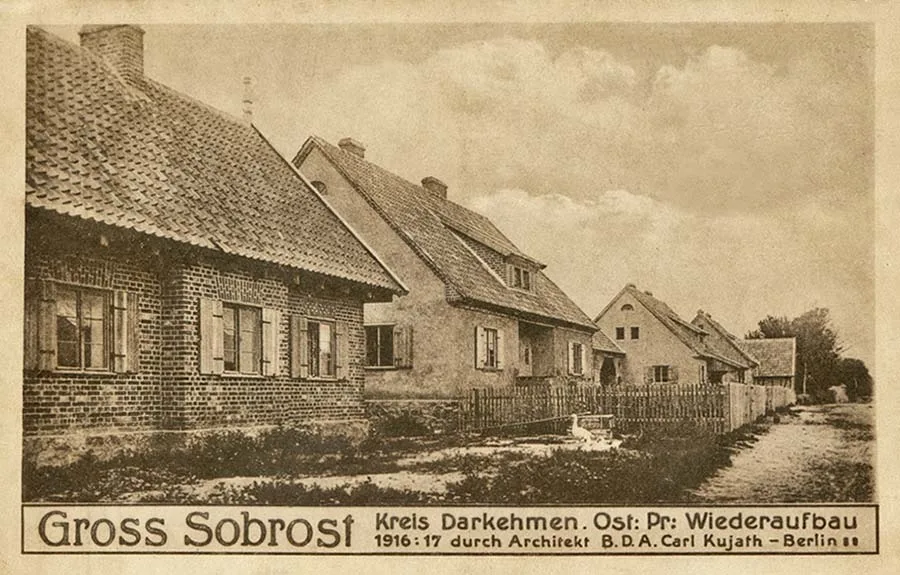
As a result of the dissolution of the Gutsbezirke and the merging of rural communities, by 1928 the Amtsbezirk of Sobrost was left with three rural communities: Sobrost (Zarechenskoye), Klonofken (Panfilovo) and Popowken (Kochkino). Its composition did not change thereafter.
On 17.11.1947, Groß Sobrost was renamed Zarechenskoye. The settlement was initially part of the Podlipovsky village council, and from 1968 of the Krylovsky village council. In 1972, the settlement had 18 houses. The village of Pröck was not included in Zarechenskoye and lay in ruins. As of 2017, the buildings of a dairy farm stand on the site of the estate; their condition is unknown. In 2020, the settlement had 30 residential buildings.
Damerau (Degtyaryovo) is now an abandoned site where nothing remains but thickets of Jerusalem artichoke.
Sights: the “Swedish fortification” — the Groß Sobrost hillfort (54°21'33'' N 21°27'46'' E).
Population trends: 1986 – 80, 2002 – 111, 2010 – 92, 2012 – 98 inhabitants.
Population trends of the village of Groß Sobrost: 1867 – 172, 1871 – 154, 1885 – 126, 1905 – 140, 1910 – 139 inhabitants.
Population trends of the Groß Sobrost estate: 1871 – 173, 1905 – 121 inhabitants.
Population trends of the Gutsbezirk of Groß Sobrost: 1867 – 175, 1871 – 205, 1885 – 152, 1905 – 152, 1910 – 182 inhabitants.
Population trends of the merged community of Sobrost: 1925 – 338, 1933 – 305, 1939 – 226 inhabitants.
Population trends of the village of Pröck: 1871 – 32, 1905 – 19 inhabitants.
Population of the village of Groß Sobrost in 1871: all 154 Evangelical Christians; children under 10 – 30; literate – 108 (96%); blind – 1; insane – 1.
Population of the Gutsbezirk of Groß Sobrost in 1871: all 205 Evangelical Christians; children under 10 – 65; literate – 75 (54%).
Photo: Bildarchiv Ostpreußen
Translated from Russian with the help of AI (Claude, Anthropic), October 2026.