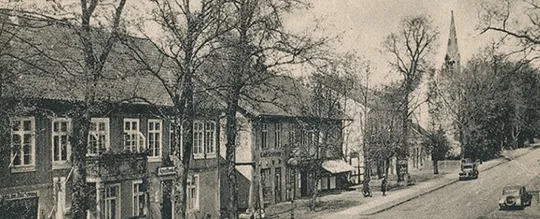
Gross Skaisgirren was founded in 1583. In 1628 (possibly in 1693) a church was built in the settlement. In 1693 a school was opened next to it. In 1820 the school became a two-class school. In 1807 an epidemic of typhus swept through Skaisgirren, and in 1831, 1855, 1857, 1871 and 1873 epidemics of cholera.
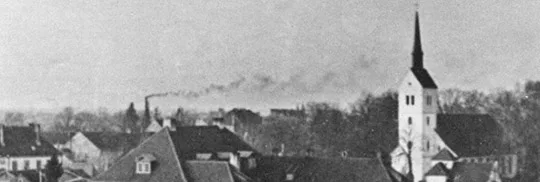
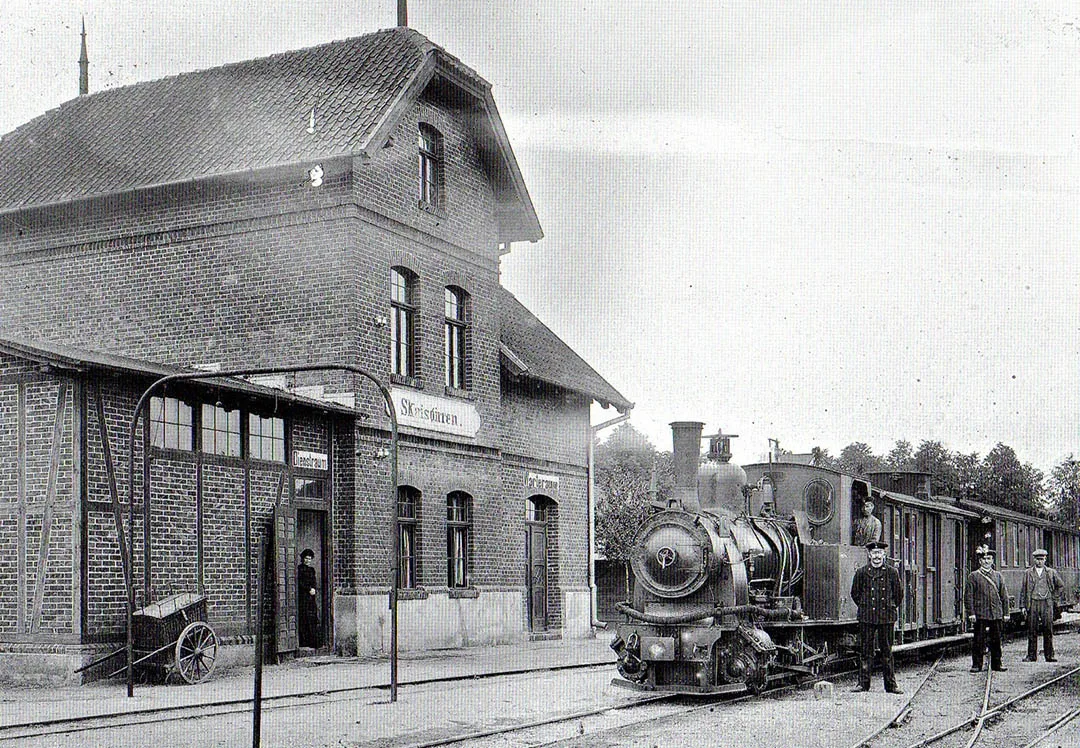
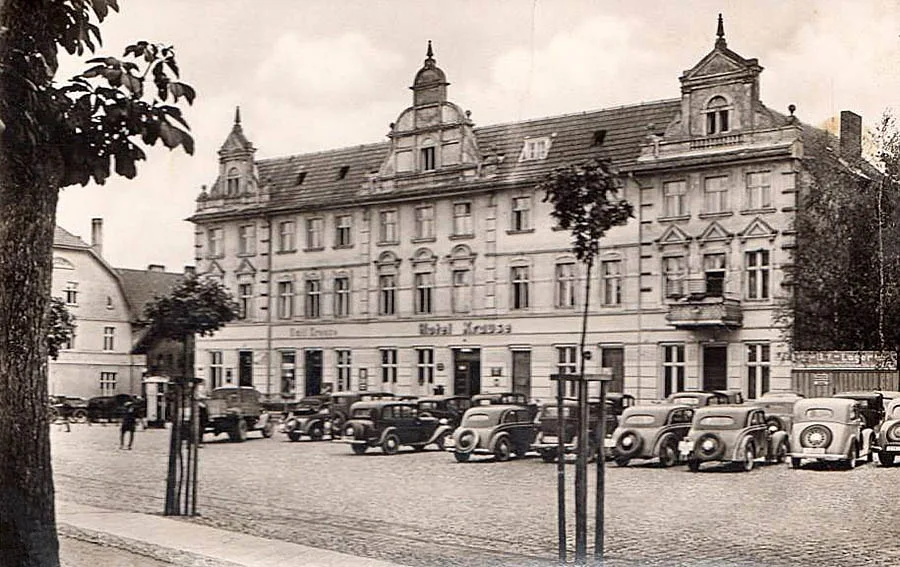
On 1.10.1891 the railway station was opened (in the photo above). In the same year the Königsberg – Tilsit narrow-gauge railway was laid through the settlement (in the photo below). In 1905 Gross Skaisgirren was electrified. From 28 August to 11 September 1914 it was occupied by Russian troops. On 16.06.1925 the foundation stone of a Catholic church was laid. In the 1930s a new school was built.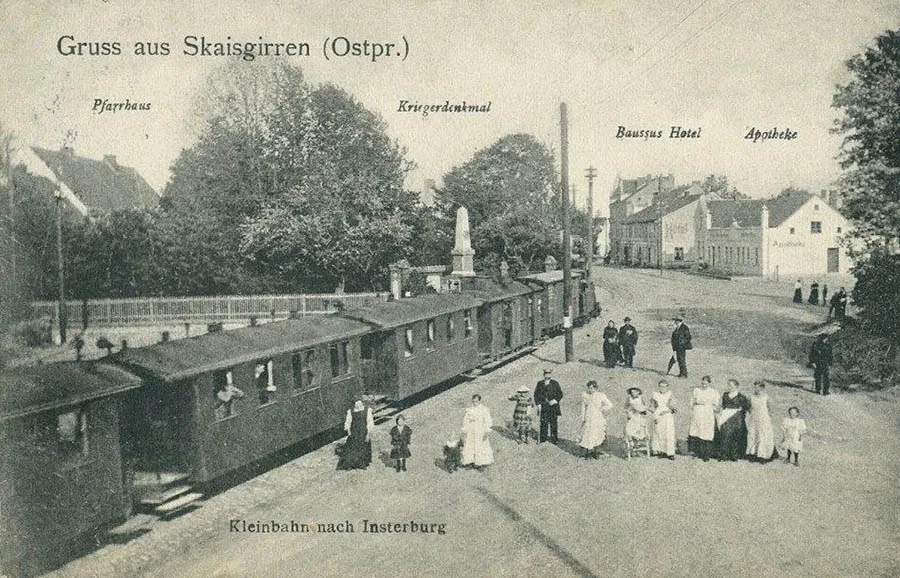
As of 1939 the settlement had a post office, a court, bank branches, two steam mills, a sawmill, two hotels, four coaching inns, two cafés and shops. There were stations on the railway and on the narrow-gauge line. The pig market in Gross Skaisgirren, held on Thursdays, was considered the largest in East Prussia.
As of 01.01.1945 the Amtsbezirk of Kreuzingen comprised five rural communities: Georgenforst (Radishchevo, part), Gronwalde (Krasnoznamenskoye), Georgenheide (Urozhaynoye), Kreuzingen (Bolshakovo) and Wartenhöfen (Bolshakovo), as well as roughly one fifth of the forest Gutsbezirk of Wilhelmsbruch.
Groß Girratischken was a village forming a rural community in the Landkreis of Niederung. Its parish was in Gross Skaisgirren.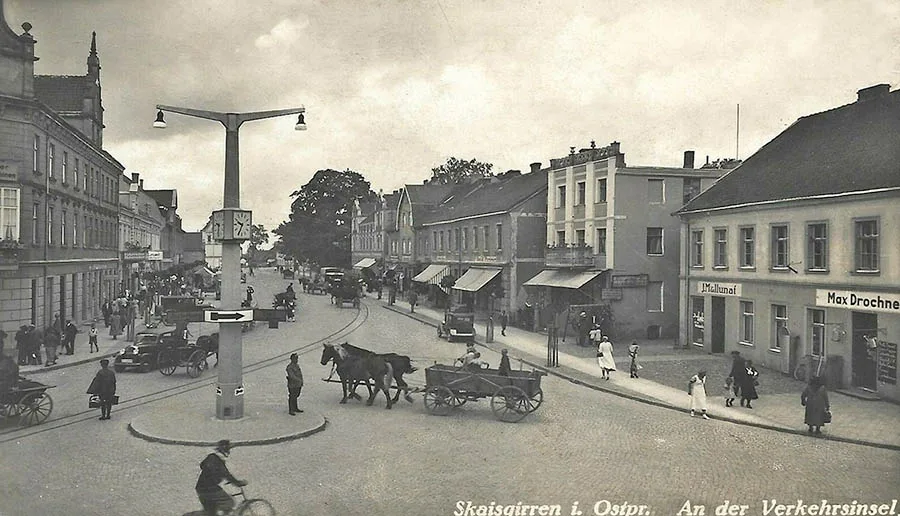
In the spring of 1945 Gross Skaisgirren was taken by troops of the 89th and 117th Tank Brigades and the 44th Motor Rifle Brigade.
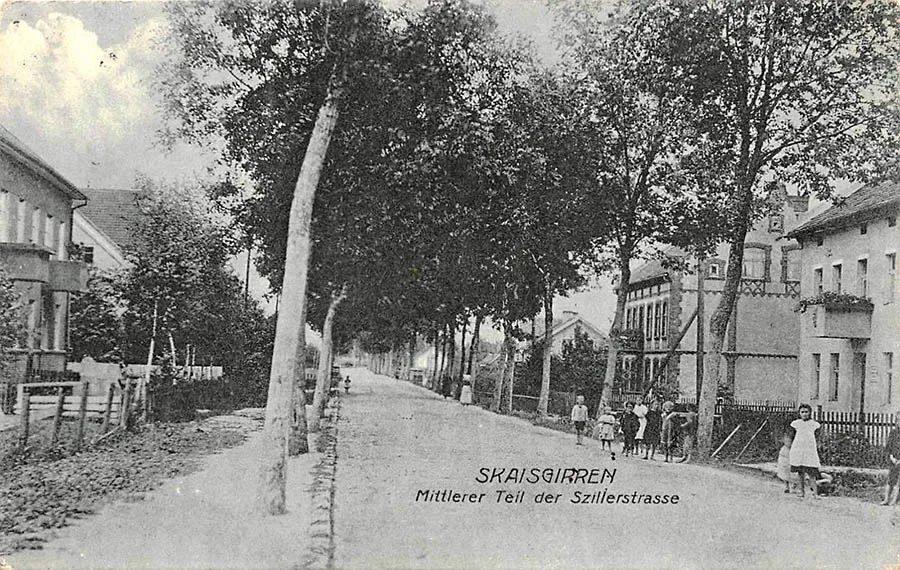
On 28.07.1947 the settlement was renamed Bolshakovo; Groß Girratischken was not officially renamed and became part of Bolshakovo de facto. At the same time Bolshakovo District was formed. On 1.02.1963 Bolshakovo District was abolished. In 1973 the settlement had 173 houses, a school, a hospital and a poultry farm. As of 2020 Bolshakovo has primary and secondary schools, a kindergarten, a hospital, a psychoneurological clinic and a House of Culture.
Coordinates of the settlement: 54°52'34'' N 21°39'13'' E (Gross Skaisgirren, centre), 54°53'21'' N 21°38'55'' E Railway station (Bolshakovo-Novoye).
Sights: the Lutheran church (1698, handed over to the Orthodox Church), the Catholic church (1925), the chapel of the former Lutheran cemetery, a park, a monument to Soviet reconnaissance soldiers, mass grave of Soviet soldiers (140 people, memorial 1958), old cobblestone paving, remains of the old narrow-gauge railway.
Population of Gross Skaisgirren (Bolshakovo): 1885 – 731, 1905 – 1,285, 1910 – 1,466, 1939 – 2,268, 1959 – 2,052, 2002 – 2,059, 2003 – 2,237, 2010 – 2,448, 2012 – 2,442 inhabitants.
Population of Groß Girratischken: 1905 – 593, 1910 – 568, 1939 – 660 inhabitants.
For reference
In 1874 the Amtsbezirk of Groß Skaisgirren was formed, comprising 10 rural communities: Georgenwalde (Urozhaynoye), Gronwalde (Krasnoznamenskoye), Groß Girratischken (Bolshakovo), Groß Skaisgirren (Bolshakovo), Klein Girratischken (Krasnoznamenskoye), Klein Ischdaggen (Radishchevo, part), Klein Wixwen, Leidingsfelde (Krasnoznamenskoye) and Paossen, as well as Warschauningken of the Gutsbezirk of Szanlauken. In 1893 the community of Kletellen (Urozhaynoye), which had absorbed the community of Georgenwalde, joined the Amtsbezirk.
Translated from Russian with the help of AI (Claude, Anthropic), October 2026.