Until 1785 the settlement was called Heyde bei Hafestrom. In 1744 a school appeared in Heyde bei Hafestrom. In 1785 Heidekrug was classified as a royal village (Königlich Dorf) with 26 households. By 1818 the number of households had increased to 27, and the village still had royal status. From 1938 the settlement bore the name Groß Heidekrug.
In the 19th century Gross Heydekrug was a village which from 1818 formed a rural community in the Kreis Fischhausen (Primorsk; from 1939 it became part of the Landkreis Samland). Until 1909 the village belonged to the parish of Medenau (Logvino). However, the distance from the church meant that services began to be held in the village itself as early as 1744, when the first school was built here. In 1862 a new school building was erected in the village. In 1871 Gross Heydekrug had 48 dwelling houses, in which 170 families and eight single people lived. On 13 June 1874 the rural community of Gross Heydekrug was included in the newly established Amtsbezirk Coporn (Spasskoye).
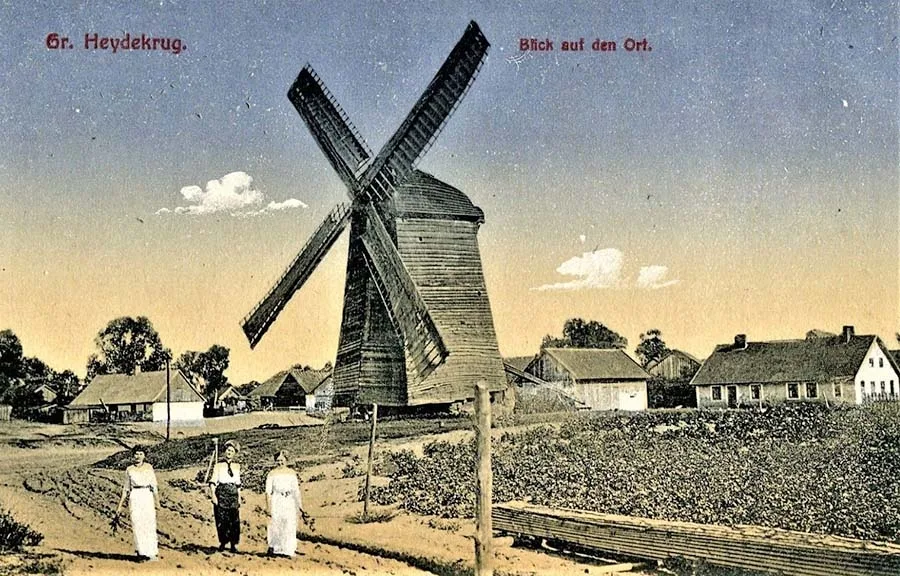 The windmill of the village of Gross Heydekrug.
In the 1890s a windmill operated in the village, and it survived right up to the Second World War. In 1895 the Gross Heydekrug community owned 342.5 ha of land. Besides the village of Gross Heydekrug itself, the community now also included the village of Klein Heydekrug (54°42'33'' N 20°15'10'' E).
The community had 76 dwelling houses, two of which belonged to Klein Heydekrug. Altogether these houses were home to 218 families, three single men and six single women. At the end of the 19th century Gross Heydekrug became a holiday spot for the residents of Königsberg and visitors to the city.
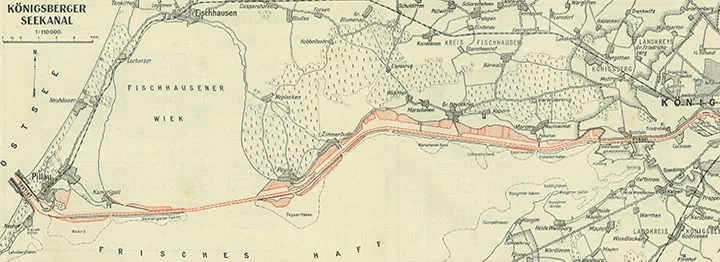
By 1905 the Gross Heydekrug community had also acquired a signalman's house; the signalman's duties included maintaining the navigation lights and marks on the Königsberg Sea Canal. The house had the status of a separate locality. As of 1905 the Gross Heydekrug community had 92 dwelling houses and two non-residential public buildings; two of the dwelling houses belonged to the village of Klein Heydekrug, and one more was the signalman's house. These houses were occupied by 244 families and 16 people living separately from families. Tax revenue from income amounted to 5.59 marks per hectare of land, about half the average for the Kreis Fischhausen.
The growth of the local population and of the number of holidaymakers led to visiting services being held in Gross Heydekrug from 1896; in 1909 a separate pastoral district of the Medenau church was organised, and in 1929 it was reorganised into an independent parish, which nevertheless did not lose its ties with the parish in Medenau (Logvino). In 1925–26 a second building for school lessons was built in the village. In 1927–31 a Lutheran church was built and then consecrated; its bell was a gift from the Medenau parish.
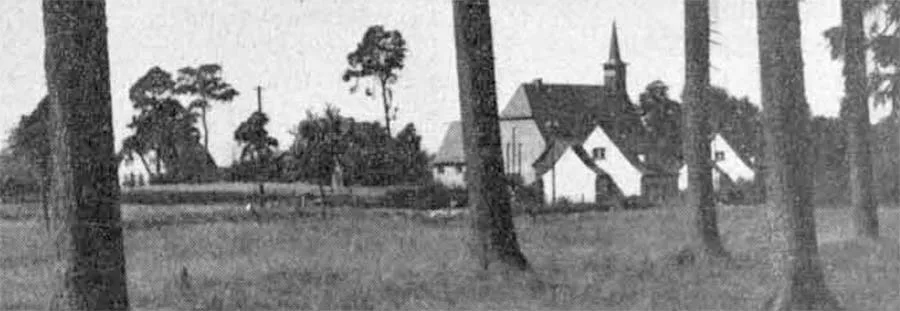
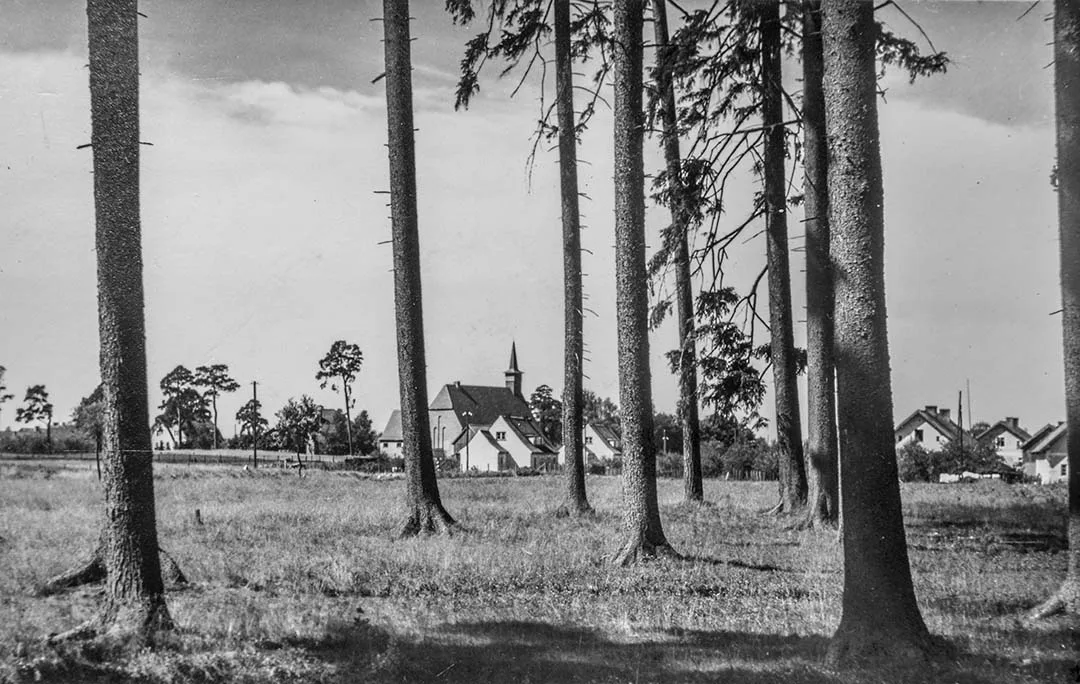
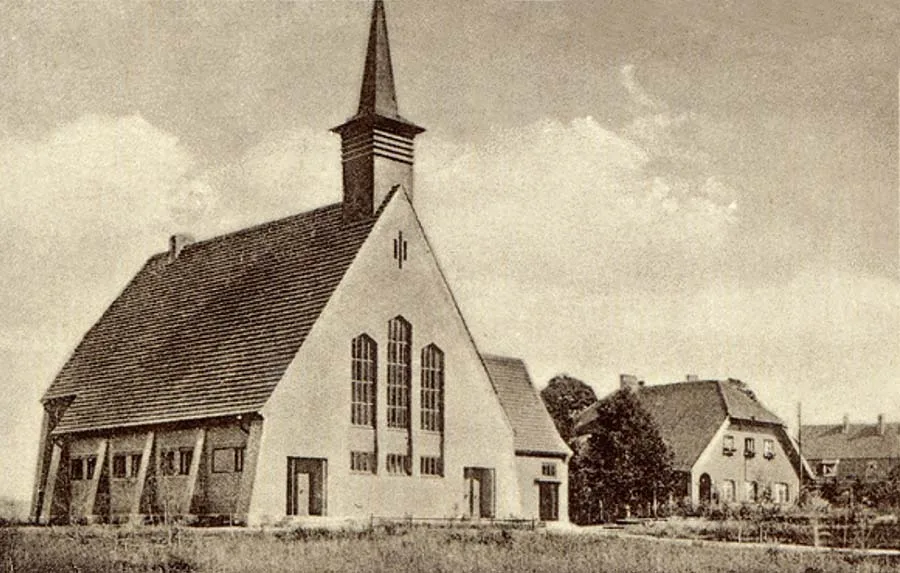 Gross Heydekrug church and the parish house.
In the pre-war period the village had three restaurants with dance floors for holidaymakers, and carousels on the Trommelplatz square.
In addition, before the war the settlement had: a trade school, a post office, coal and hardware shops, a pharmacy, two mills, two locksmith's workshops, a gendarmerie, a police station, a shop selling car, motorcycle and bicycle goods, a savings bank branch, a fire brigade, a kindergarten, a passport office, a registry office and two private bathing establishments.
Amtsbezirk Gross Heydekrug
On 18 May 1930 the Amtsbezirk Coporn (Spasskoye) was renamed the Amtsbezirk Gross Heydekrug. At the time of the renaming the Amtsbezirk comprised two rural communities: Gross Heydekrug (Vzmorye) and Nautzwinkel (Zhukovskoye). Its composition did not change until 1945.
On 30 January 1945 Gross Heydekrug was first taken by soldiers of the 13th Guards Rifle Corps (Maj. Gen. A. I. Lopatin, 1897–1965) and the 1st Tank Corps (Lt. Gen. V. V. Butkov, 1901–81) of the 39th Army. During the counter-operation "Westwind" on 19–22 February 1945 it was reoccupied by German troops. It was taken again on 14 April 1945 by soldiers of the 33rd (Col. N. I. Krasnov, 1909 – not earlier than 1985) and 87th (Maj. Gen. K. Ya. Tymchik, 1903–75) Guards Rifle Divisions of the 13th Guards Rifle Corps of the 43rd Army, with a landing party put ashore from armoured boats on the canal side.
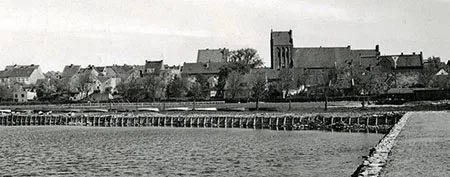
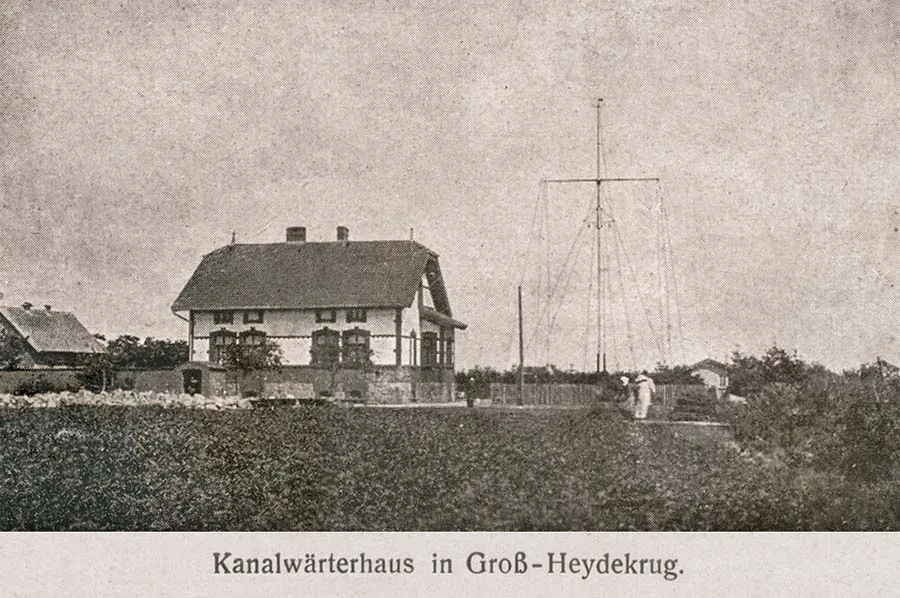 The signalman's house on the shore of the Königsberg Sea Canal.
On 25 July 1947 Gross Heydekrug was renamed the settlement of Vzmorye. The Vzmorye Village Council was created at the same time. Besides the settlement of Vzmorye itself, this Village Council included seven settlements: Veselovka, Volochayevskoye, Zhukovskoye, Izhevskoye, Slavyanskoye and Spasskoye.
In 1948 the ruins of the church in Vzmorye were demolished. In 1954 the Vzmorye Village Council was abolished; the localities that had belonged to it, except Vzmorye and Spasskoye, passed to the Logvino Village Council. Vzmorye and Spasskoye came under the Kaliningrad suburban zone. In 1955 the settlement had 120 houses; by 1966 their number had increased to 140. By 1975 the settlement of Vzmorye had come under the Svetly Town Council. As of 2020 the main enterprise of the settlement is the agricultural production cooperative "Fishing Collective Farm 'Za Rodinu'". The settlement has a school, a hospital, a post office, a bathhouse and a tree nursery.
Coordinates of the settlement: 54°41'42'' N 20°14'47'' E
Sights: remains of the church walls (1927), the former pastor's house, a monument to those who fell in the First World War (1920s), the mass grave of Soviet soldiers (306 people, monument 1950).
Population change: 1811 – 334, 1818 – 265, 1867 – 747, 1871 – 755, 1885 – 920, 1905 – 1115, 1984 – 1100, 2002 – 2205, 2010 – 1883, 2012 – 2008 inhabitants.
Population change of the Gross Heydekrug community: 1811 – 334, 1818 – 265, 1867 – 747, 1871 – 755, 1885 – 920, 1905 – 1129, 1910 – 1107, 1925 – 1780, 1933 – 2064, 1939 – 2411 inhabitants.
Composition of the population of Gross Heydekrug in 1871: all 755 – Evangelical Christians, children under 10 – 209, literate – 417 (77%), blind – 1, deaf-mute – 2, insane – 1.
Population change of Klein Heydekrug: 1895 – 10, 1905 – 9 inhabitants.
Number of residents of the signalman's house: 1905 – 5 inhabitants.
For reference
Composition of the Gross Heydekrug parish: Groß Heydekrug (Vzmorye), Kaporn (Spasskoye), Klein Heydekrug (54°42'33'' N 20°15'10'' E), Margen (Zhukovskoye), Marschehnen (Volochayevskoye), Nautzwinkel (Zhukovskoye), Pokeiten (54°41'15'' N 20°19'16'' E), Vierbrüderkrug (part of the A. Kosmodemyansky settlement), Widitten (Izhevskoye).
Translated from Russian with the help of AI (Claude, Anthropic), October 2026.