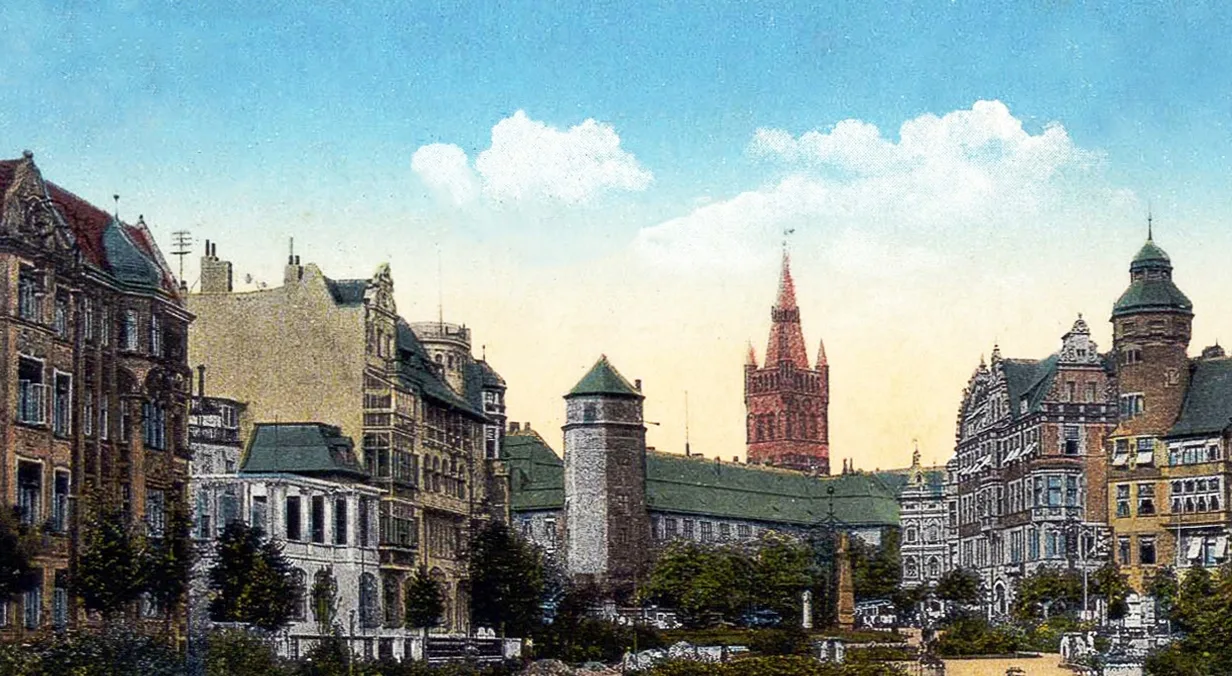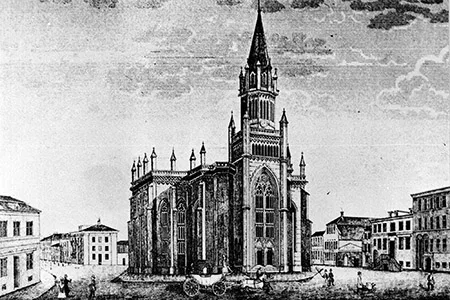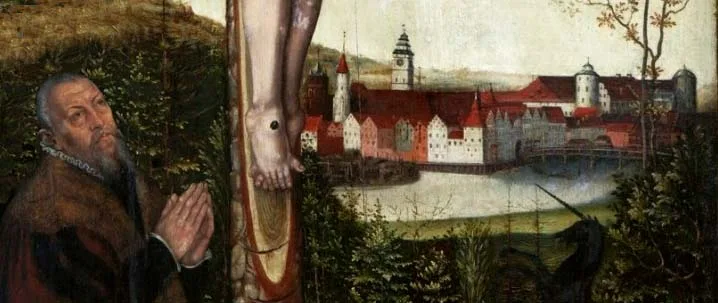
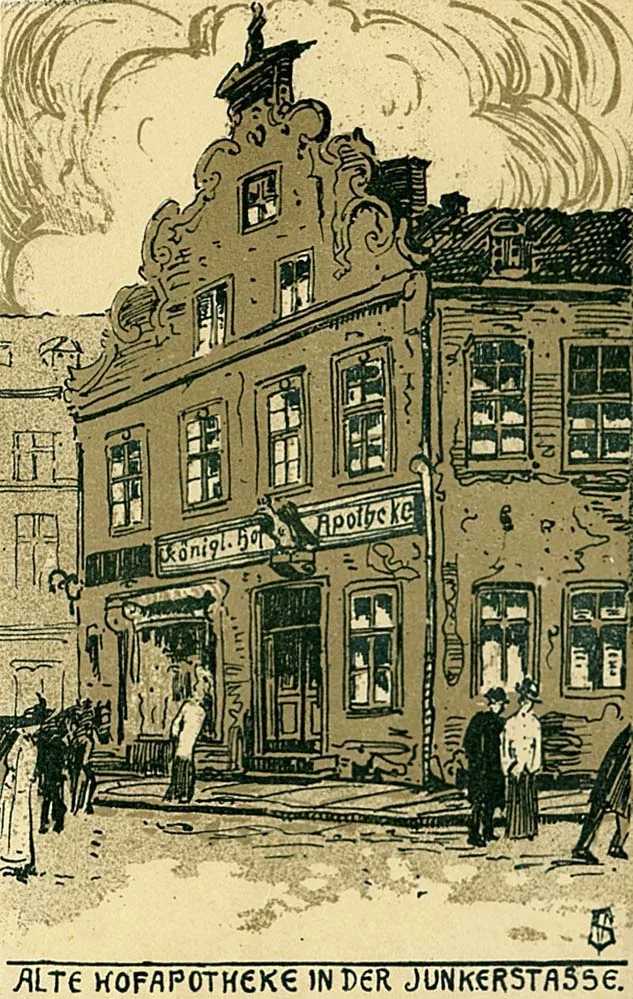
Old Königsbergers remember the Court Pharmacy that stood until 1913 on Junker Street (Junkerstraße).
At the time one of the Königsberg newspapers wrote: "In our day a loss deeply felt by all of us is the impending demolition of Hagen's court pharmacy. The venerable building, with its picturesque gable adorned with volutes and a statue of Hope, with its massive façades on both sides, its atmospheric high roof facing Theatre Street (Theaterstraße), its skylights and its tiers rising one above the other, will soon disappear. Incidentally, the date 1654 on the gable indicates only the year of a reconstruction. For, on the basis of surviving documents, it can be assumed with certainty that the building in the form in which it now stands before us dates from the beginning of the 17th century and is therefore at least 300 years old."
From 1741 this building belonged to my family, until in 1936 the widow of the last court apothecary sold it, as there were no male descendants left.
Construction of the court pharmacy probably began in 1647. It was built on the corner of Kehrwiedergasse (today Theaterstraße) at the Elector's expense.
This apothecary's house, which cost 692 thalers, stood on the same spot where the new court pharmacy building stands today. At the time it was never called anything but the "little house"; it did not even have a proper drying room or a loft for drying herbs.
For this purpose a floor of the neighbouring ballroom house was rented. In 1652 the Elector's apothecary Hans Wilde built an extension onto the façade of this building facing Junker Street (Junkerstraße). The room was intended for storing the pharmacy's jars, so as to free up more space in the pharmacy's laboratory. In the documents the first court pharmacy building is described as a small one-storey house. The pharmacy's laboratory was in the front room of this house. In 1652 the pharmacy became Wilde's property.
However, the rebuilding of this "little house" into the large, old and beautiful building known to everyone, which was demolished in 1913, probably took place only after 1716, after the very wealthy court apothecary Valentin Pitsch had acquired the neighbouring building of the old ballroom house that same year.
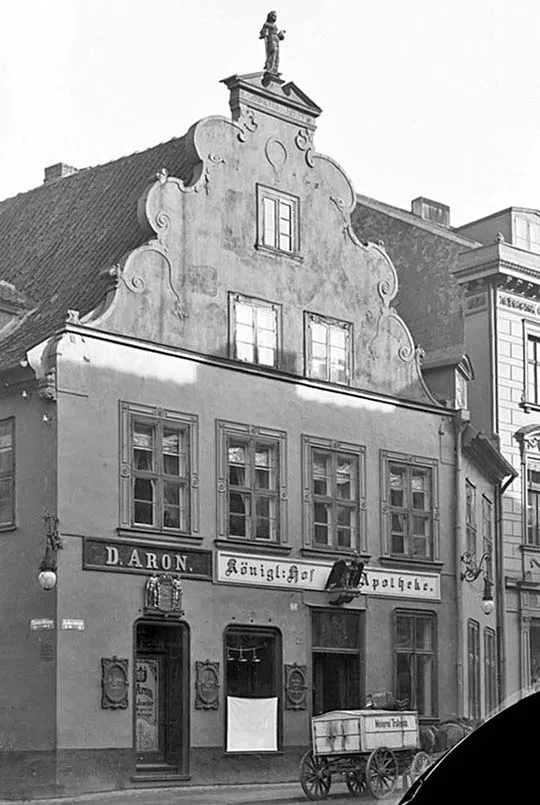
The old Court Pharmacy at Junkerstraße 6.
In 1710–1711 plague raged in the small Prussian town of Schippenbeil (now Sępopol in Poland). For fear of infection, no one entered the houses of the sick. Among the many victims of this terrible disease was a young couple from Hagen.
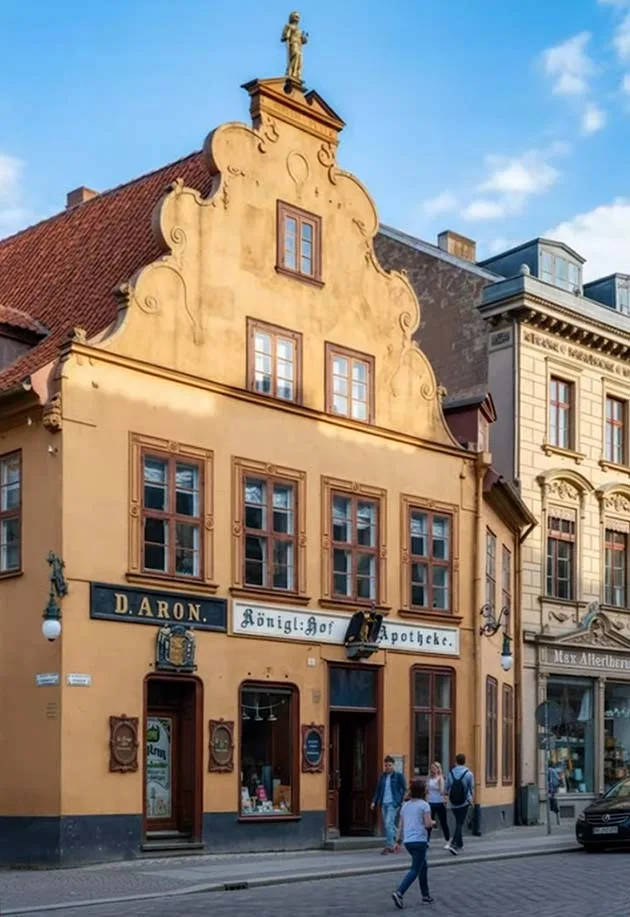
If only the Court Pharmacy had survived to our day.
The woman died on 17 December 1710 with a child in her arms. In the general turmoil the unfortunate child was forgotten and probably taken for dead when the plague house was boarded up on the council's orders. But he was alive, and, moved by his cries, his mother's younger brother entered the infected house and rescued his nephew, who later became the first Hagen to be the pharmacist of the Court Pharmacy in Königsberg.
Heinrich Hagen was born on 4 October 1709. His uncle, himself an apothecary, brought him up and, at the young man's request, paid for his training in practical and scientific pharmacy in Schippenbeil, Königsberg, Thorn and Berlin. The daughter of J. Georgenson, then court apothecary of Königsberg, became his wife. In 1741 Heinrich Hagen bought the Court Pharmacy from his father-in-law. He became the founder of a large family of pharmacists. The best known was his son Karl Gottfried Hagen (1749–1829), medical councillor, professor of chemistry and physics, doctor of medicine, naturalist, physician and pharmacist.
And now let us return to the Court Pharmacy. The pharmacy's sales rooms were housed in a low extension that appeared only around 1800. The main building, however, naturally underwent many changes over time, both outside and inside. Aron's jewellery shop, located on the ground floor long before 1913, originally looked different. For centuries these rooms held the pharmacy owner's apartment, while the ground floor served other purposes: for many decades it housed the classrooms of Karl Gottfried Hagen, who, as was customary at the time, gave lectures in his home. Among his pupils, from February to the autumn of 1808, were the young princes Friedrich Wilhelm and Wilhelm. Yes, the future King Friedrich Wilhelm IV and the Emperor Wilhelm himself took private lessons from the owner of Königsberg's Court Pharmacy.
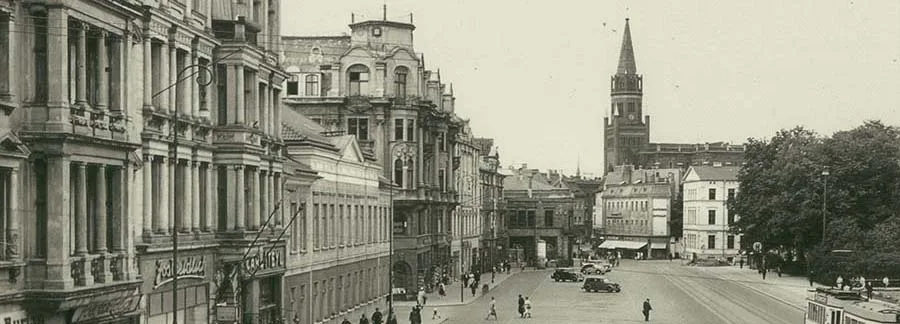
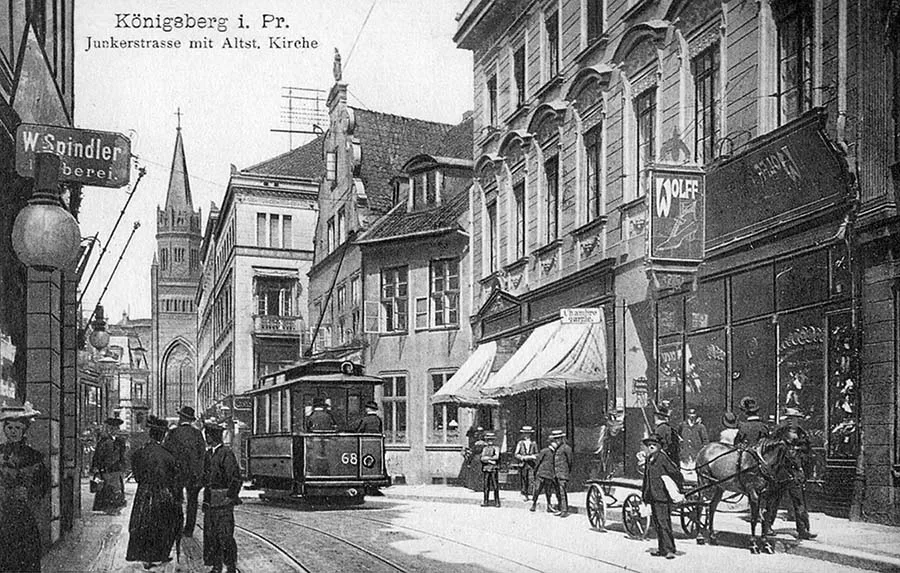 The Court Pharmacy in the middle of Junkerstraße (behind the tram).
Karl Gottfried Hagen knew how to adapt his chemistry and physics lectures to the audience at hand, to make them understandable where necessary, and to sustain interest with small, often amusing experiments, so that his lectures were always popular.
 Enthusiasts keep trying to recreate old Königsberg.
In the "Memorial of 1849" we find: "Many of the things that Hagen showed the princes (1808) delighted them and prompted the subsequent august remark that the princesses, too, would be thrilled to attend these lectures."
Hagen agreed at once, and shortly before the intended visit he received word that the King and Queen, who had already repeatedly expressed their gratitude to their sons' teacher, would accompany the princesses.
The experiments with the electrostatic machine were received with such enthusiasm that the royal couple came a second time, intending to see experiments involving the air pump and the galvanic apparatus, then a novelty.
Hagen wrote in his notes: "Among the most unforgettable days of my life I count 17 and 29 November 1808, when I was able to entertain our King Friedrich Wilhelm III and his unforgettable consort Louise, as well as the princes, the princesses and the court, with experiments that lasted four hours each time."
To demonstrate the effect of the thermolamp to his high-born audience on a large scale, Hagen had mechanics light his entire apartment in the Court Pharmacy with gas. The performance was greeted with stormy applause. When the King was last in Königsberg and the city held a celebration in his honour in the Masonic lodge "Three Crowns", he asked, among other things, about the state of the street lighting and mentioned that he had first learned about gas lighting from Medical Councillor Hagen. In memory of that time the Hagen family kept a gift from the King: a silver sugar bowl and spoons.
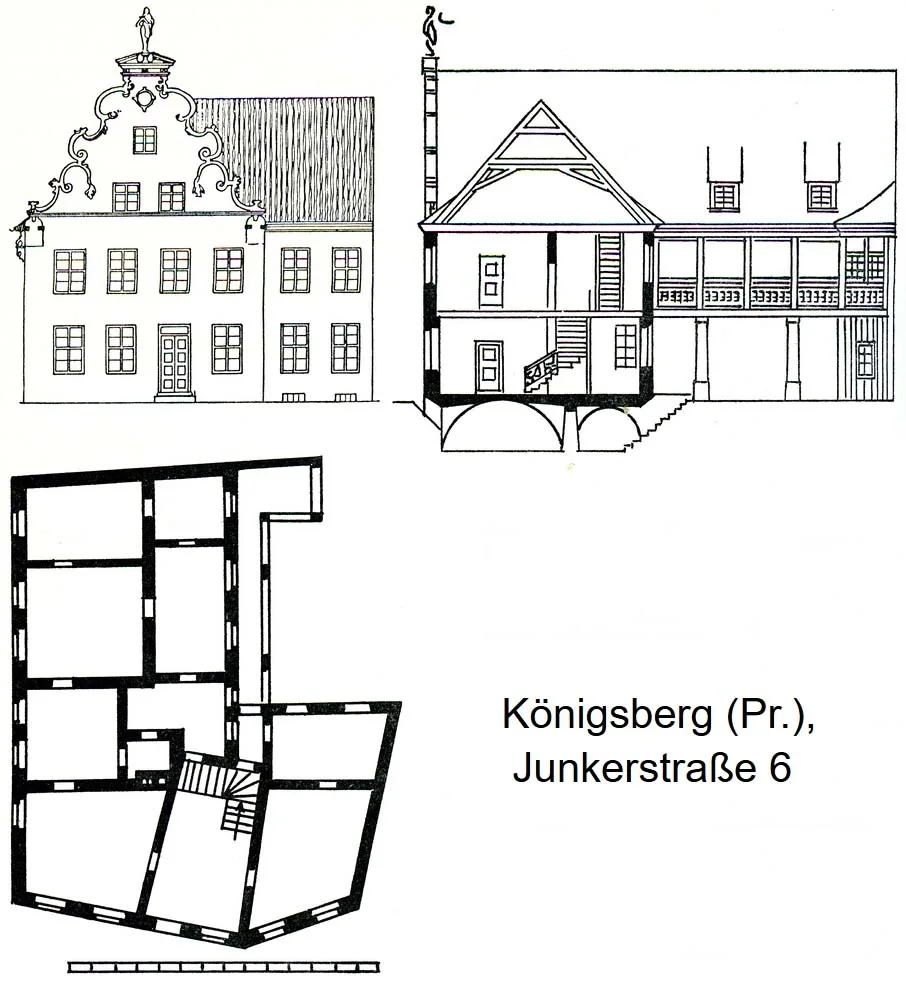
How much there was of interest in this old Königsberg house, with its hidden corners, steep little stairways, wallpapered doors and built-in cupboards!
First of all, mention should be made of the beautiful wooden staircase of 1700 leading to the first floor, the picturesque little courtyard with a gallery supported by wooden columns, and the heavy oak cellar doors richly decorated with wrought-iron fittings. All that remained of the old house was the figure of Hope on the gable, which for many centuries had looked down from there on the old town. It was decided to keep it on the new building into which the Court Pharmacy moved. But this did not happen. The ancient statue had to be moved inside the pharmacy, as it was feared that it would continue to crumble and one day fall on the heads of passers-by as a result of the well-known peculiarities of the local climate: damp, winds and sharp swings in temperature, all of which together are called weathering.
How often I looked at this sculpture when I went into the new building, where it found a place on a high pedestal.
Source
https://archiv.preussische-allgemeine.de/ow1952/1952_06_01_06.pdf (p. 7).
Photos
Bildarchiv Ostpreußen bildarchiv-ostpreussen.de.
● Editor's note: Read on VisitPrussia.com an interview with the translator of German and, in particular, Prussian fairy tales, our regular contributor Tatyana Kolivay, who runs her own blog, where countless other parables, legends and fairy tales in her translations have been published.
Translated from Russian with the help of AI (Claude, Anthropic), October 2026.