LEGENDS OF PRUSSIA in the blog of Tatyana Kolivay.
I.
Life in a village, a small town or a big city each has its own charms and gives the observer rich material for reflection. The countryside will always remind us of the primeval state of mankind, regardless of the modern luxury that has settled here too, on the wealthy estates. The life of provincial towns can give our minds no little food for thought. Finally, a great metropolis often presents us with the whole world in one place, especially if it is a port city.
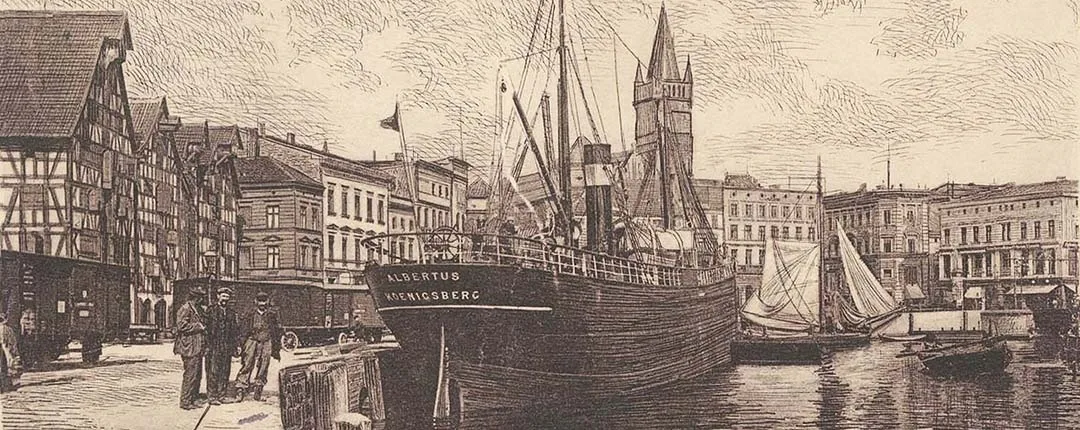
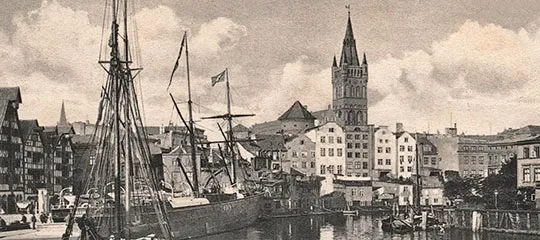
I confess that in a city as beautiful as Königsberg in Prussia, which always awakens new emotions in the traveller, my favourite walk is to the port, to the ships. The impressions I receive here at any time of day carry me far beyond the continent and connect me with distant lands overseas and their inhabitants.
The harbour reaches right into the centre of Königsberg, which is quite rare in port cities. Here you can see Scandinavians, Dutchmen, Englishmen, Americans, Frenchmen — in short, all the nations that populate the globe. See them and learn something about them.
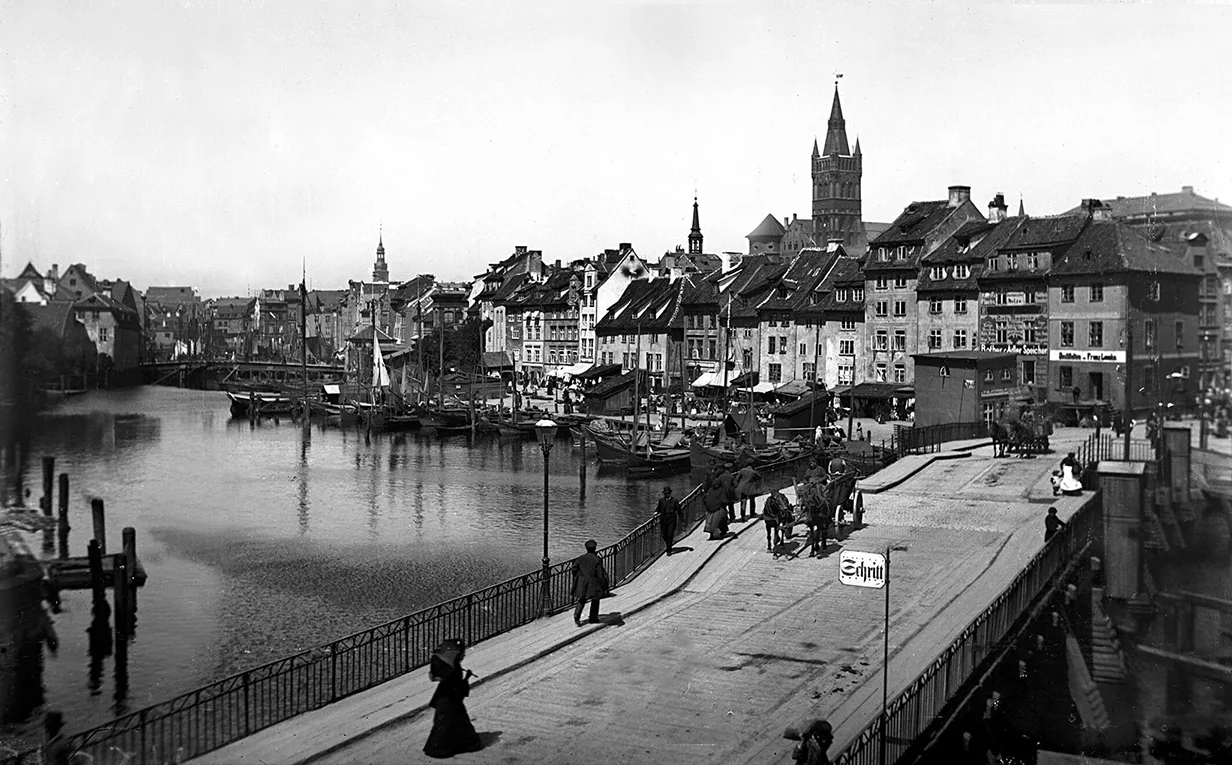
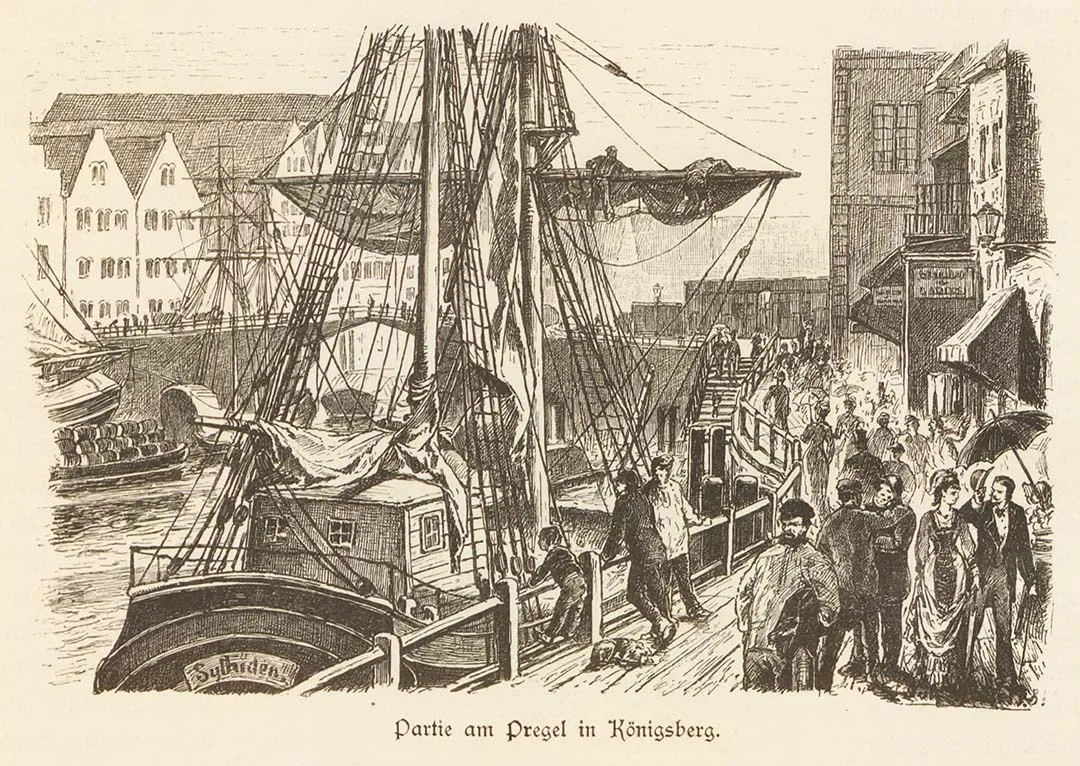
You walk along one of the most beautiful streets of the city, through the so-called Green Gate1, onto the bridge that connects Kneiphof with the Vorstadt (i.e. the "suburb"), and you are at once captivated by an extraordinary spectacle. To the right stretches an unusual city whose houses are ships. It has its own streets, lanes and dead ends, which alternate with open spaces that lead our gaze to the horizon. The port city melts magically into the bluish ink of dusk, and at noon into the gold of the sun. At the end of the bridge we turn the corner to the right and walk along the rampart of the bastion. What an unimaginable mixture of smells, sounds, dialects, clothes, gestures, postures and activities surrounds us! On the flagstaffs of countless ships thousands of flags, standards and pennants of every colour of the rainbow flutter and snap in the wind. Among all these white, red, orange, blue and green flags there is also a special one, with a scattering of stars on a blue field. It is the rare flag of an American ship that had to cross the Atlantic Ocean to get here.
If we now examine our city of ships even more attentively in order to get to know it better, then, besides the Germans (mainly people from Königsberg, Memel, Stettin and Hamburg), our attention will be drawn to Danes, Swedes and Norwegians. As a rule, the different character of the European and non-European peoples is already reflected in the names of their ships.
From their decks the most varied dialects and accents reach us. The Scandinavian languages, for instance, have a very peculiar euphony. In them we immediately recognise the Germanic element, which is, of course, mixed with something hard to define.
The ships of the Scandinavians are very plain and simple. Their bows and sterns are square. Very often they are extremely small. One cannot help marvelling at how the Scandinavian sailors, for all their skill, dare to go out to the open sea in such little vessels, like nutshells.
One recalls the voyages of the ancient Normans, those Arabs of the North, with their passion for adventure and the boldness that allowed them to cover enormous distances.
The Dutch sailors make a completely different impression on us. Stockily built, they are unhurried, almost phlegmatic. And their ships resemble their masters. Solidly put together, massive, rounded at bow and stern, they are built of hard, sturdy timber. They can be compared with the round hard Dutch cheeses that, as a rule, are carried aboard the Dutch vessels.
One must see a Dutch captain among his sailors to picture easily the whole of Holland with its clean, cosy little world and its phlegmatic leisureliness. Such a captain never sails alone with his crew, no — he has his whole family on board, who have brought along everything they need, down to the children's toys. A Dutch ship carries a great number of animals: dogs, cats, ducks, hens — and it must be said that cleanliness and order are nonetheless sacredly observed. If you watch such a family on deck, resting under an elegant awning after the midday meal, you cannot help admitting that the taste and the crude naivety of the paintings of the Netherlandish painters correspond fully to reality.
Husband and wife sit in the family circle together with their children and household and noisily digest the food they have eaten. This, of course, is in complete contradiction with what we understand by decency and good manners. Usually belching of this kind indicates that something is wrong with the stomach. But the Dutchman, man or woman, finds it as natural as, say, breathing in or sighing with relief.
The Dutch ladies are very picturesquely dressed. As a rule, their figures are stout. The women usually wear a black dress with rich draping and a loose-cut jacket without a collar. The Dutchwoman's headdress is especially peculiar. A close-fitting cap trimmed with the finest Brabant lace is fastened on both sides with large gold clasps that glitter from afar like a lowered diadem. And this whole attire, together with gold and diamond rings on their fingers, leaves an impression of solidity and wealth.
Against the background of this black flower bed of ladies, sparkling with golden lights, which the male half, dressed in black tailcoats, modestly joins, the red smocks of the sailors bustling about the ship stand out sharply. But what does their work consist of?
They are busy filling their buckets with water in order to pour it out wherever possible. Their task is to make everything and everyone on the vessel shine and sparkle. Such a mania for cleanliness is unprecedented. The upper and lower decks, the bow and stern of the ship, the cabins of the captain and the sailors, the windows and doors, the floor and the ceiling are cleaned, rinsed, waxed, wiped and scrubbed every day, from morning till night.
The mirror-like gleam and polish of every surface of the ships from the Netherlands can be compared with the parquet floors of the high-society salons of big cities. The light-blue water casks with red rims, standing in neat rows on deck, look as appetising as if a confectioner had just moulded them out of sugar, and the captain's cabin, with its gleaming mirror-like windows crowded with flowerpots and with snow-white curtains at the sides, resembles a bride's chamber.
In sharp contrast to the Dutch ship, as neat as a little Rotterdam brick house, is its neighbour — a three-masted English ship of gigantic size. Its black bowsprit2 juts far out beyond the hull like the menacing sceptre of Neptune. The Englishman is entirely covered in coal dust, as though he had just emerged from the powder smoke of a naval battle, if not from the underworld itself. Even his sails have darkened from this anthracite dust and look at us as forbiddingly as the ship of Theseus returning home, who forgot to hoist a white sail instead of the black one3. At first glance the English ship shows that we are dealing not with just anyone but with Britannia, Mistress of the Seas. From the transom to the keel, from the mainmast with its tops to the smallest neatly plaited rope, the idea of the solid, the practical, the convenient runs through it like a red thread. What reigns here is not petty business but practice that pursues real aims and attains them; an order in which every nail has its allotted place and the lowliest cook's boy in the galley is responsible for every rag.
The whole ship is enormous. And yet, despite the majesty of its individual parts, what strikes the eye at once is the lightness, even the gracefulness of its construction. The ship glides elegantly over the waves with enviable speed. And the British sailors! How many times have artists depicted them on their canvases! They are a breed of men who have no equal. One might think they were born not of a mortal woman but of the sea itself, so much are they at one with the element of the sea.
The sailor from Albion is nimble, agile and cunning as a wave when at work, but when he rests in a harbour tavern he sinks into silent pensiveness — like the sea when a calm sets in. Judging by his unapproachable look, you might think he feasts on beefsteaks and porter, although in reality he makes do with a modest meal of salt meat, ship's biscuit and a ration of spirits.
One must see him in these two states, motion and stillness, to form a true idea of him. It is a joy to watch him up there, even when the ship is sailing over the waves. The rigging of an English sailing ship is a veritable labyrinth of cables, ropes and lines. No tightrope walker would find his way here — least of all if he suddenly found himself on the middle mast, often a hundred feet high, with this net woven of thousands upon thousands of ropes all around him and the dark-blue depths of the sea gaping below.
The English sailor, on the contrary, runs, or rather flies, through all these interlacings with the same ease and assurance as a spider over its web. Having reached the very top, he ties himself on and swings for a while at the very tip of the mast, evidently out of sheer mischief. He hovers in the air as if in a hammock, and then climbs down a rope just as nimbly and cheerfully.
On Sunday complete silence and emptiness reign on an English ship. On that day not only people but even mice — indeed, even the woodworm beetles — do not stir and must not stir. All the cabins are empty. On deck everything is tidied, only the coal dust lies over everything as usual. And somewhere in a corner an old man usually sits reading a prayer book or the Bible. After dinner the sailors sit in groups with their arms folded, or, leaning on the deck, stare motionlessly overboard. Though they hardly see anything there. The English sailor is absorbed in himself, he wanders in his thoughts through Old England. It is a state of comfortable introspection, comparable to the comfort of certain animals when they chew the cud. The English sailor chews tobacco, and his thoughts are far, far away from here.
But this English sailing ship is, of course, inferior in the strength of its construction, its enormous size, its elegance and the splendour of its fittings to the mighty American moored next to it. It too is a sailing ship, and when it sails the ocean under full canvas it seems as if a mighty condor were soaring over the prairie with its wings spread. But now its sails are lowered, and a whole battalion of soldiers could be comfortably housed in this tent of sails.
The sailing ship has come to us from New York and here, in the port of Königsberg, is taking emigrants on board. Crowds of people weary of Europe are striving towards the distant overseas abode of their desires and of promises of a happier future.
Masurians and Lithuanians in national costume have made themselves at home near the wheel and are finishing their meagre dinner. A young journeyman carpenter with a magnificent full beard but in a shabby suit complains up on deck that he wanted to pay for his passage by working on the ship, but the captain flatly refused him. Right there by the mizzenmast stands the captain himself with an imperturbable air. His thickset figure looks as if cast in iron. A broad-brimmed felt hat is pulled low over his ears, his gaze is piercing, he is pondering something. His red, well-fed face is as grave as a beast's, his hands are thrust deep into his side pockets. Sailors with thick side-whiskers, bare chests and shiny flat round hats, from which long ribbons hang fluttering in the wind, are uncoiling the ropes.
Prussian troops march across the bridge to the sounds of a military band. A deafening drumroll rings out, the regimental bugle sounds. Rank after rank passes by, every soldier drawn up straight as a string. The sailors and captains of the ships, even the English ones, climb onto barrels and pumps, clamber up ladders and masts to get a better look at the soldiers and miss nothing of the spectacle unfolding before them. Only the American sailors do not care; they go on working without distraction, and only their captain bores a motionless stare into the Prussians marching past them on the bridge.
The march is over, and the crowd on the bank moves to the other side of the bastion to look at an English screw steamer that arrived some time ago. Goods are now being loaded on board. The whole process looks rather amusing: a lively chain of men and women has formed from one of the warehouses to the ship's holds. They toss grey-green square slabs of agricultural fertiliser to one another. The cargo is stowed in the hold incredibly quickly, and under its weight the ship sinks deeper into the water with every minute. This steamer is a kind of model of shipbuilding. Every detail is beautifully worked and made of good sheet iron, so that the vessel as a whole is extraordinarily strong. No woodworm beetle could pierce this armour. The river waves are magically reflected in the black metal hull, above which a red funnel of unusual thickness towers like a bell tower. The name of the ship is "Countess of Durham"4.
Festively dressed, as if they were going not for a stroll to the port but to church, crowds of people throng the gangways of the vessel on both sides. The helmets of a cuirassier and of a private soldier are side by side with the green veil of a noble lady; next to a local dandy dressed in the very latest fashion one can see a Polish Jew in a long robe.
Everyone is driven by one and the same desire: to get on board and see the screw mechanism of this marvel of the sea. The steamer moves over the waves so fast that the swiftest sailing ship, by comparison, simply crawls like a reptile along the barely damp bed of a dried-up canal.
Sometimes we also notice Frenchmen and Portuguese in our harbour, although they come here more rarely. In small vessels they bring us wines, mainly from Bordeaux. Some time ago a vessel from the Azores was even seen here; on board were not only sailors tanned black by the sun but genuinely black ones.
If we stand on the very edge of the bastion's rampart and look around, we see a beautiful panorama of the city spread out along the majestic river. There, in the distance, to the north-west, on the opposite bank, rises the tower of Bessel's famous observatory. Despite the bright sun, its skylights are open. They look like the eyes of a strange creature from another planet. From these openings, like the tentacles of some unheard-of monster, the most varied astronomical instruments reach towards the sky.
On the other bank of the Pregel is the place where ships dump their ballast. A proverb says: "Stones, mountains and trees of distant lands never meet, but people do." Here, however, we see an exception. It is precisely at this spot that earth from the remotest corners of our planet is mixed together: the sands of the Gironde5 meet the limestone of the cliffs of the English county of Northumberland, the slate of Sweden the mahogany dust of Brazil. And all of them disappear under mountains of local sand.
The shipyard lies further to the right. There, without a break, in every season, something is always burning and smoking: keels are hewn, planks are bent, beams are straightened, ships are caulked, tarred and launched.
The launching of a ship is a truly majestic sight: the ship, decorated with green wreaths, to the joyful roar of the crowd on the upper deck, slides down the soaped slipways and touches the surface of the water for the first time, never to part from it again.
Perhaps it was right here, at this very spot, that the famous Königsberg mystic Johann Schönherr6, before a great gathering of people, launched from the slipways his brainchild — a strange ship which, after many years of reflection and calculation, he had built on the model of Noah's Ark, and in which he wanted to sail out to the open sea, perhaps to rediscover the lost Earthly Paradise. But his grandiose invention, once in the water, alas, showed no ability to move. (And so the visit to the bowers of paradise had to be postponed.)
And over there, in the area of Lizentgraben Street7, where the steamers lie at anchor, there once lived the brilliant Johann Georg Hamann8, who called himself the Magus of the North...
But we turn onto the bank of the Pregel, where there is more to see than just ships. There, on the corner, rises the house of the French consul, with peculiar crenellated decorations on the roof and projecting little balconies. Further on are the warehouses; their colossal storerooms, compared with the old warehouses, bear witness to the progress of building technology. In the vicinity of these gigantic factories huge fires have raged at various times, comparable perhaps only with the fires of Pera9 and old Istanbul. Like rebellious red Janissaries, they burst even into the suburbs. These calamities ended only quite recently — but for how long?
Closer to us opens a space that greatly enlivens the overall landscape of our watery avenue. On a huge site clean white sheets are spread out, on which tall mountains of the blessed fruits of Ceres10 have been heaped: oats, barley, peas, maize. Here they are sifted and cleaned before being loaded onto the ships. Men with shovels toss the maize into the air: a golden rain of maize grains pours down abundantly, while the lighter chaff is carried away by the wind.
II.
Among the varied scenes of life in which a port city abounds there are many situations of both a comic and a tragic nature. Comedy and tragedy are closely linked in life, and all that is needed is a skilful pen to describe what happens.
A summer noon. We are on the bastion, on the left bank of the Pregel. Suddenly a huge crowd of people appears. Representatives of the most varied classes are mixed in it. The crowd has formed a large circle. We push our way inside and see in the centre a man in a state of passion, in turmoil, demanding our sympathy, our pity and our support.
The man paces back and forth, wrings his hands and strikes himself on the forehead so hard that his hat flies off. He is evidently a Dutchman, and a ship's captain at that. Indeed, not far off rises the mast of a ship with the flag of that kingdom fluttering broadly. Our captain stops, shakes his fist at someone in empty space and seems about to turn to the onlookers and burst into an angry tirade, but then his breath fails him, and he can barely bring out:
Myne Heeren, öss dat moenslik?
which in our respectable High German means "Gentlemen, is this thinkable?" Something seems to have happened to the unfortunate man that is not merely strange, no, but so outrageous, surpassing everything thinkable and unthinkable, that the words stick in the poor sailor's throat. He stamps his feet, jumps as if stung by a tarantula, wrings his hands, shaking them, and repeats faster and faster, like a broken mechanism, his:
Myne Heeren, öss dat mönslik?
What monstrous incident crying out for revenge has happened here? We all exchange glances, question one another, want to help, to restore justice. Yet no one knows how to help the unfortunate man, however passionately he appeals to us. The people around whisper, are puzzled, try to intervene, say something, like the chorus in a Greek tragedy, while having not the slightest idea of what has happened. Some are already loudly voicing the guess that this man has gone mad and suggest calling the doctors. But little by little the matter becomes clear.
The day before, the sailors of a Danish vessel had got into a squabble with the crew of a Dutch ship anchored next to them. The squabble grew into a most violent quarrel, and the Danes decided — without their captain's knowledge, of course — to annoy the Dutch as much as they could.
When the next day the Dutch sailors, led by their captain, had gone into town and almost no one was left on board, the Danes, manoeuvring their ship, pressed the Dutch vessel against the quay wall so that the city's sewage outfall ended up directly above the neat, clean little Dutch water casks. An evil fate had decreed that on that day all the water casks were being aired and stood open. We have already mentioned above what order reigns on the ships that come to us from gingerbread-clean Amsterdam. In these casks splashed virgin, perfectly fresh spring water for cooking and drinking, carefully collected and filtered. The Danes had chosen their moment very precisely, since their vessel had not yet taken any cargo on board and was therefore very light and manoeuvrable, with high sides, whereas the Dutch ship, clumsy enough by its construction, was loaded to the brim and barely stayed above water. What had happened was discovered by the Dutch crew only several hours later.
A joker and lover of quotations might quote here, slightly altered, the famous words of our great poet11:
"He to whom an evil lot has fallen —
To become a foe to foe..."
That after such a mean trick the Dutch captain lost the power of speech and could not calm down for a long time is quite understandable. His crew had to pour out the entire contents of the said casks, scour them inside and out, smoke them and seal them again. Who could doubt it?! But by rights these casks should have been smashed to splinters, committed to the flames, wiped off the face of the earth, and the ship itself sold — even at a loss. So demand the national pride of the Dutch and their striving for cleanliness. And to the question the captain kept repeating endlessly — whether what had been done to him was "thinkable" — we should, of course, have had to answer: "It is all human, alas, all too human..."12.
III.
The waters of the port of Königsberg also give us the opportunity to see navigation in its almost primeval state. And the main characters here are a tribe of people who come to us every year from Russian Poland under the name of Dzimkens13.
One can count on the arrival of these water nomads in summer as surely as on the arrival of migratory birds in spring. They come in June and leave at the beginning of September. Most of them come from the Vilna district, from the areas of Kovno, Troki, Medniki, Jurburg, Smorgon, Kiejdany and Kroże14, and they are mostly poor country folk.
Their craft and their mooring places offer peculiar and at the same time fresh images that cannot be denied picturesqueness, especially when compared with the modern ships of the English and Americans. Their vessels are rafts called "wittinas". Wittinas are often 500 to 600 feet long or more. When you see from afar the caravans of Dzimken rafts approaching over the water, you have the impression that a row of hills is floating towards you, a wooded ridge, a whole village with houses, outbuildings and their inhabitants. The floating island moves on and on and seems never to end.
At last it ends, but behind it comes a new island of the same incredible length. It seems as though a great migration of peoples is taking place on the water. Wild, coarse voices are heard. It is quite possible that the Huns once called to each other just as gutturally. The Dzimken rafts sometimes move so slowly that their motion can hardly be noticed, since the current of the Pregel is too weak for these huge structures. The Argonauts of the ancient Greeks, however imperfect their ships may have been, had the advantage that they could carry them over land from time to time, but Heracles himself would not have taken a wittina on his shoulders and dragged it from Kovno. The longest wittinas are not admitted into the harbour of Königsberg, since they take up an enormous space in which 4–5 large seagoing vessels could be accommodated. Some of these medium-sized rafts are right in front of us, and we can examine them closely, together with their inhabitants, in every detail.
These floating "islands" have arbitrary shapes; everything in them is barely knocked together, and yet the wittinas fully serve their purpose, though without any logical proportions, let alone symmetry.
At the base of a wittina there is something resembling a barge or a ferry, and yet on the whole it is very much like a simple raft whose logs are by no means fitted tightly together, so that river water gushes in streams through the gaps.
One careless step — and you easily risk drowning right in the middle of the raft. In the centre of the wittina stands a post. It is the tallest here and in fact bears the whole superstructure. Thus the roof has its highest point in the middle, but then descends on both sides in two slopes, propped up by other posts of various heights.
The roof of this long structure, knocked together from boards and laths, is covered with bast matting and strewn with tree bark. There is no question of windows and doors; instead there are small and large open square holes, from which here and there the heads of Dzimkens stick out — exactly like the heads of chicks peeping out from the feathers of a fluffed-up brooding hen.
The best room on a wittina is the cabin of the captain next to the helm — that is, of a Polish Jew with a long beard, two sidelocks falling to his shoulders, a black coat reaching down to his boots and a long stick in his hand. In building the captain's cabin the carpenter displays all his art. He has arranged something like a room whose walls stick out crookedly in all directions. In the makeshift entrance door there is even a peephole the size of a small shaving mirror.
The floor here, as on the open deck, consists of untreated tree trunks bound together, and water constantly seeps in here too. It has to be pumped out several times by day and by night. The members of the crew, like galley slaves, must keep their raft afloat by constantly bailing out water so as not to sink.
The Dzimkens accept this inconvenience as a matter of course. They are indifferent to death and so carefree in their existence that some of them occasionally drown when, in the dark and befuddled by alcoholic fumes, they step into the gaps between the logs of the raft and helplessly vanish into the depths of the water.
At the other end of the wittina there is a free space where a pump stands; next to it is a long trough from which the Dzimkens, with long wooden spoons or bare hands, before the eyes of the many onlookers crowding the bastion, ladle out their soup of water and bran. It is dressed with a little fat, perhaps with some peas added. They eat it with large chunks of bread baked from flour and the same bran. Nevertheless, it is food whose taste brings an expression of bliss to their contented faces.
It may seem that this amusing little water folk never stray a step from their wittinas. These energetic men and youths living in their huts on the rafts vividly recall the Chinese families on the boats and rafts of the Pekiang near Kan-Beg15, who are born on their vessels, grow up, marry, have children and die, often without ever setting foot on dry land.
The Dzimkens wear jackets of the same colour as the mats they sit on; in just the same way there are insects in nature coloured like the leaves on which they live. Under his jacket a Dzimken wears a shirt of coarse grey linen girded with a belt, and wide trousers of the same cloth. His headgear and footwear give him a light, almost southern look: he wears a straw hat trimmed with a black ribbon and something like sandals on his feet. However, the Dzimken loves extremes and in the fiercest heat may sometimes put on a thick sheepskin coat and replace his light straw hat with a fur cap.
But we soon become convinced that our raftsmen from Kovno are far from being the Chinese boatmen of the Pekiang. They have no families on these wittinas: the Dzimkens never take women with them at all. To satisfy their curiosity they try to get ashore as quickly as possible. To see a city like Königsberg, to walk through it on foot, is an unforgettable event in the life of such a traveller. We see in a Dzimken, even a very old one, the child living side by side with the savage. They love to take part in brisk barter trade, like the trade sailors are used to carrying on with savages, only here the natives represent civilisation and the raftsmen play the part of the savages. Any nonsense, any trinket, even children's toys hold an infinite attraction for a Dzimken. He offers woven mats and intricately carved hazel sticks in exchange and trades them for things he does not even know how to use. Metal buttons, penknives, scissors, children's mirrors and rattles send him into indescribable delight, and he is ready to do anything to get them. These simple-hearted children of nature come ashore in crowds and wander the streets. And then one can observe truly unusual little scenes worthy of our liveliest attention. Here an old Dzimken is returning to his raft from the annual fair in Königsberg. He has bought a toy violin there, or perhaps a horn or a drum, hung it round his neck and is happily beating it with drumsticks. Behind him a crowd of town boys runs with loud laughter and hooting. Our Dzimken, however, is not bothered. He beats his drum for all he is worth, provoking loud joyful laughter from the youngsters accompanying him. The boys block his way, laugh, tug him from behind by the skirt of his jacket and get in his way so that he misses and strikes beside the drum, yet he does not get angry; on the contrary, he smiles joyfully and starts his drum piece over and over again.
Another representative of the same breed of good-natured primitive people, striving in their own way for progress, goes ashore in a coarse brown garment, a straw hat, with bare neck and chest and sandals on his bare feet, and comes back from town completely transformed. Behind him follows the inevitable crowd of street urchins.
Our Dzimken has no idea how ridiculous he looks — he considers himself initiated into civilisation, into the best strata of urban society. He has bought a fluffy cloth cap that is too big for him, and the little rascals, jumping up, pull it even further down over his head. The Dzimken is wearing a necktie, which in his ignorance he has tied in the most bizarre way, but what disfigures him most of all is a frock coat, or more precisely a tailcoat of blue cloth that the man outgrew long ago: the sleeves barely reach his wrists, the waist is somewhere around his chest, and the tails barely cover what they are supposed to cover.
It is said of many well-to-do merchants of Königsberg that they came to our city as the poorest of the poor: just such Polish Dzimkens; they began by trading their simple wares for buttons and children's toys, then gradually rose to wholesale trade and fortunes of millions — and still cannot stop.
On their raft, when they have no particular work, such Dzimkens spend monotonous days which are nevertheless full of impressions of port life and of Königsberg itself. And in the evenings, after a hearty supper of their pea soup, they gather in a crowd on the bastion and dance before the eyes of numerous onlookers.
The Dzimken passionately loves fiddle playing and dancing. But you will almost never hear him sing. He dances with enviable agility, in keeping with the innate gifts of his people, but he also manages to draw such sounds from the three and a half strings of his fiddle that you want to run away from the scratching sharpness of the major key, while the minor fills you with melancholy.
If the Dzimken's dancing master had a talent for teaching, and the tavern in his home village served as his school, the Dzimken performs his mazurka, varsovienne and polka with dexterity and astonishing inventiveness.
His sandals then possess an elasticity and springiness that no elegant footwear can match; his body has such suppleness, sensitivity and rapture in the dance that Terpsichore16 herself would be envious. And in the smallest details he observes the customs of his people and his ancestors, never overstepping the bounds. Although the Polish nation has long since ceased to be united and serves the masters of the whole world, the Dzimken in his dances will never disgrace the honour of a Pole.
But then August comes and fills the heart of the sensitive Königsberger with a kind of melancholy. It reminds him that the end of summer is coming, autumn is approaching, the storks are flying away to distant lands, and the honest Dzimkens will soon begin to take apart their wooden huts on the water. The roof has already been removed, the wooden rafters look at us sadly, one after another the beams are taken down, all the boards, planks and laths are dismantled, the raft itself is rolled apart into logs. The Dzimkens crawl over it until the last piece of wood has been carried ashore. The Jewish captain turns all this wood into money and dismisses his men, and they set off in groups overland for home, to tell their families during the long winter evenings, to the sounds of the fiddle, about the wonderful days they spent in Königsberg.
APPENDIX
CULTURE AND HISTORY OF THE MEMEL LAND:
MEN AT SEASONAL WORK AWAY FROM HOME. THE DZIMKENS
(Kulturgeschichtliches zum Memelland. Losmänner und Dzimken)
The broad Memel, always covered with numerous boats and rafts, supplies Tilsit with the products of neighbouring Russian Lithuania, especially timber, hemp, flax and grain, in which the city carries on a profitable trade with Königsberg. The most varied, sometimes strange-looking vessels sail and drift up and down the river. Whole forests float past: mighty spruces, firs and oaks. In our part of the world such trees grow only in the Russian forests. Unworked or hewn trunks, logs, blocks and boards, firewood and building timber are joined into huge rafts, over which the crew runs back and forth shouting. Using long poles to move their swaying, clumsy craft, they keep it, more or less skilfully, away from the bank and from other ships. On these rafts there is usually a straw hut, which is at once the storeroom and the sleeping quarters of the crew, these hardy and undemanding people who are popularly called Dzimkens, because they are recruited mainly from among the Samogitians, and in their language this is the name of the narrow strip of border land that separates Prussian Lithuania from Russian Lithuania. Sometimes there is even a whole wooden house on these rafts, consisting of several rooms, a kitchen and a living room resembling a veranda. This is the dwelling of the Jewish captain, who is often the owner of the raft and the cargo...
The daily work of a Dzimken is hard and laborious. Since their leaky craft takes in a lot of water, they constantly have to take up buckets and bail it out. Up to four men are needed to work the mighty oars.
The oarsmen have to overcome endless difficulties, since their rafts need at least five feet of water under the keel, and in a dry summer they easily get stuck on the Memel and the Pregel, where there are many shallows.
The work is hard, and the Dzimkens' diet is meagre. Their usual food is potatoes, peas, groats and porridge, which they cook for themselves in huge cauldrons and pots on the bank and scoop out of wooden bowls and troughs with wooden spoons. The Dzimkens eat hardly any meat, but instead of butter they add a little bacon fat to their dishes, which they also eat raw with bread.
Their clothing is simple and primitive. The Dzimkens wear a long caftan of grey felt or of sheepskin turned inside out, a coarse linen shirt open at the chest, trousers of the same material, a fur cap with tassels or a coarse straw hat, and on their feet bast shoes, the so-called parreski. The Dzimken believes that fur protects against both heat and cold, so in summer he turns the coarse sheepskin inside out so that the woolly side is on the outside. Only the older Dzimkens, who have already made several raft journeys and have been to big cities, have a slight touch of urban civilisation. They exchange their bast shoes for boots and their straw hats for caps and go into town in search of "fashionable" clothes. They buy themselves multicoloured waistcoats, a coloured jacket or a scarf in a garish pattern. Such details go badly with the rest of their costume. A constant barter trade goes on with the boys who follow the Dzimkens at their heels. The Dzimkens give them sticks which they decorate with fine carving, and in return receive buttons, especially metal ones, which send them into indescribable delight.
The Dzimkens are slender of build and of medium height, often with an attractive, very pleasant but usually somewhat simple face, with thick dark hair and light, good-natured eyes. Their whole nature is good-natured and peaceable, like a child's. Although in big cities they can often be met in their hundreds, one hears nothing bad about them. They stroll through the streets in comfortable, peaceable idleness. The children's toys in the stalls, a horseman or a band of musicians fascinate them more than the biggest buildings or the most unusual sights, to which they pay no attention. Although the Dzimkens have literally nothing to their name but their own lives, they are always cheerful and quick to laugh.
In the evenings, by the fires lit on the bank, the long-drawn choral songs of the Dzimkens ring out. Soon one of them takes up a fiddle or bagpipes, the others join hands, jump and dance in a circle. The dance may also be a solo, and sometimes two dance facing each other. The dancers make quick movements that are of particular interest.
The dancer's upper body is almost motionless, but his feet are constantly moving, performing small, almost imperceptible turns and jumps. The fiddle plays a poignant melody, the onlookers clap in time with the music and the dancer's movements, sparing no palms, and sometimes someone bursts into loud cries...
For their labour the Dzimkens receive a meagre wage, which until recently, when they were serfs, amounted to no more than one rouble per man for the whole journey; and they usually spend it on buying a hand accordion, a new fiddle or a fine tobacco pipe of birch burl with a nickel-silver mounting. They make the journey home on foot in large groups. The Dzimkens march along the dusty highway in the exhausting August heat, yet they wear their inside-out sheepskins and thick felt caftans. Several of them, armed with newly bought accordions and fiddles, take turns playing them during their journey. They walk in front, the others follow behind, singing, shouting for joy, jumping and dancing. From time to time a bottle of schnapps is passed round. A crowd of Dzimkens returning home resembles a procession of revelling bacchantes of Ancient Greece. Every Dzimken is a born musician, and his greatest pleasure is music and schnapps."
REFERENCES
1. ORIGINAL: "Im königsberger Hafen" von Alex. Jung. 1855. LINK
2. Kulturgeschichtliches zum Memelland. Losmänner und Dzimken. LINK
3. Rosenkranz, Karl: Königsberger Skizzen. Ständisches Leben in Königsberg. LINK
4. DZIMKE m., definition. LINK
LEGENDS OF PRUSSIA in the blog of Tatyana Kolivay.
NOTES
1. Kneiphof is the historical name of one of the three towns of Königsberg. Its modern name is Immanuel Kant Island. Green is the symbolic colour of Kneiphof, which is why the gate leading into this district was called the Green Gate. In addition, the Green Bridge led to Kneiphof, and there were also the Green Crane and the Green Scales.
2. A bowsprit is a horizontal or inclined spar projecting forward from the bow of a sailing ship. The bowsprit serves to move the centre of effort of the sails forward, which improves the vessel's manoeuvrability.
3. The Greek hero Theseus believed in the happy outcome of his expedition to Crete, to the Minotaur in the labyrinth, and on parting promised his father that, if he returned victorious, the helmsman would hoist a white sail on his ship instead of the black one. But on his return home Theseus forgot to change the black sail for a white one. Aegeus, waiting for his son on the Acropolis, saw his ship from afar and, deciding that Theseus was dead, threw himself down and was killed. ("Myths and Legends of Ancient Greece").
4. "Countess of Durham".
5. The Gironde (French: Gironde) is a department in south-western France. Its capital is the city of Bordeaux.
6. Johann Schönherr (German: Schönherr, Johann Heinrich; 1771–1826) was a Königsberg theosophist and mystic.
7. Lizentgraben Street (now Mariupolskaya Street) in the historical district of Lizent. "Graben" is German for "ditch, moat". And "Lizenten" was once the name for trade duties. It is quite possible that it was here that the "Lizenten" were levied on the merchant fleet.
8. Johann Georg Hamann (German: Johann Georg Hamann; 1730–1788) was a German philosopher and an ideologist of the Sturm und Drang literary movement.
9. Pera is the historical (Greek) name of the Beyoğlu district in Istanbul (Constantinople), Turkey.
10. Ceres (Latin: Cerēs) is the ancient Roman goddess of the harvest and fertility.
11. Altered lines from Friedrich Schiller's "Ode to Joy":
He who has been granted the fortune
To become a faithful friend to a friend....
/Wem der große Wurf gelungen,
Eines Freundes Freund zu sein../
12. It is interesting to note that this phrase is now attributed to Friedrich Nietzsche (1844–1900), who was 11 years old at the time of the events described.
13. Dzimken is a word borrowed from Polish ziomek m. 'fellow countryman'; also dschimke, schimke. A term for Polish raftsmen and boatmen in former East and West Prussia.
14. Kowno, Troke, Miedniki, Jurburg, Smorgonie, Kjedany, Kroge.
15. The Pekiang River in China. It is one of the tributaries of the Pearl River.
16. Terpsichore is the muse of dance in Ancient Greece.
Translated from Russian with the help of AI (Claude, Anthropic), October 2026.