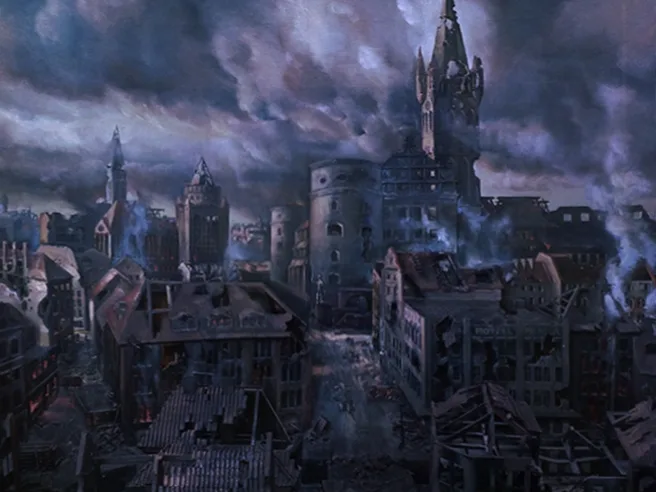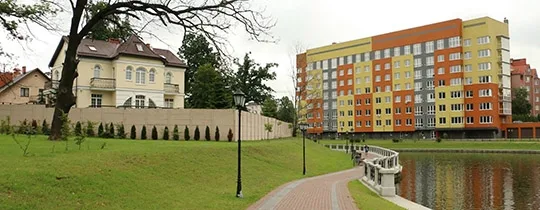
Here is what prompts this interest.
Territories have changed hands in every age, with their inhabitants or without them. In the latter case, a whole world of knowledge built up over centuries disappeared. All local traditions were broken off, the quintessence of experience best suited to local conditions. The experience of dealing not only with the material but also with the spiritual vanished. The traditions of celebrating this land and its people in literature and in the visual arts were broken off.
In this sense the settlers were starting from scratch. The new land was for them a terra incognita in every respect.
But it is impossible to live on a land and know nothing about it. The work of making the new land one's own was not only the mechanical work of restoring material structures, but also a work of discovery. How was knowledge acquired and how was it accumulated? What role did creative people play in this?
What has been said concerns not only Kaliningrad/Königsberg but also other similar places: Vyborg/Viipuri, Yuzhno-Sakhalinsk/Toyohara, Wrocław/Breslau, Lvov/Lwów and so on. I am undertaking a comprehensive study of these processes of settlement within the research topic Culture in an 'Alien' Space.
On settlers as scouts
Soviet people's direct acquaintance with the territory of East Prussia began during the war, with the activities of army reconnaissance groups. True, the information gathered by the scouts was specific and of an "applied" nature.
For the post-war settlers of the Kaliningrad Region this truly was an unexplored land. A person probably felt himself to be a kind of scout. The machinery used by the Germans was unfamiliar. There was no documentation needed to restore the municipal services, the land drainage system and so on. The settlers had no knowledge of the local climate, the fauna and flora, the economic structure of the territory or the peculiarities of the soils. There was no knowledge of local materials and technologies needed to maintain the structures and facilities existing in the territory. There was no knowledge of what mineral resources were present. Everything had to be explored and mastered.
Knowledge was acquired, on the one hand, under state control and, on the other, spontaneously, through the new inhabitants' direct contact with the territory.
These two forms are connected with each other.
Where did the "ordinary person" get knowledge from? I will name only a few sources. A certain amount of knowledge about the region was provided by the local museum of regional history. True, this knowledge was of a specific kind, having passed "state control". Party-authorized lecturers of the regional lecture bureau, who regularly travelled to collective farms and district centres "to propagate political and scientific knowledge", also spread knowledge of local history and nature. Newspapers regularly published popular articles on the nature and history of the region.
The inhabitants of the Kaliningrad Region also came to know the region spontaneously. Hunters, tourists, gatherers of nature's bounty, participants in group and individual hikes were constantly gaining knowledge about this territory.
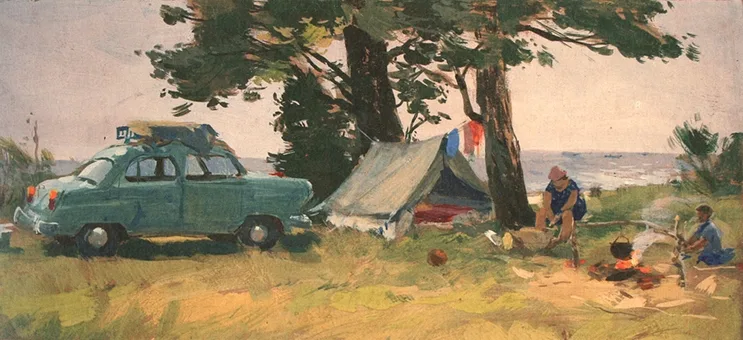 "Motor Tourist". Artist N. P. Karyakin, 1988.
The public education authorities and cultural institutions paid great attention to schoolchildren's leisure and organized their local studies activities. One of the forms of getting to know the region was the excursions, hikes and summer camps organized for schoolchildren, which were sometimes compulsory. For many young Kaliningraders it was precisely through such hikes and summer camps that their acquaintance with what was for them their native land began.
"Micro-Russia"
The Baltic nature of sandy-clay hills and marshy plains was alien to the settlers. They came to know it, in particular, by comparing it with the nature of their native places.
In what was at first alien, something familiar, something of their own, was seen.
This made it possible to turn the Kaliningrad Region, with its motley population, into a "Micro-Russia". The appropriation of nature proceeded creatively, from within. This can be seen, for example, in short poems written by professionals and amateurs alike.
River Pregel
Poltava's cherries, sour and sweet,
And the clouds of Ryazan,
And the starling houses on birches
Are reflected in you, O river.
New, abundant and wondrous
Has the land by your banks become!
You have heard our songs
And have seen the stars of the Kremlin.
Knowing neither sorrow nor grief,
And untouched by black despair,
You flow, discovering a new world,
Heeding the voice of the Volga River.
In your copses have settled
Our Kursk nightingales.
For the collective farm's abundance
Your banks rise up.
(1948)
The author of a geographical description used the same device, taking the trouble, in a lengthy enumeration (given here in abridged form), to compare figuratively the variety of landscapes of the Kaliningrad Region with the variety of Russian landscapes typified in the works of painters.
"The nature of the Kaliningrad Region has much charm of its own, reminiscent of the nature of the ancestral lands of the great Russian people.
A number of places in the region preserve in miniature, as it were, the charm and beauty of the landscapes around Moscow: here one can find typical Levitan landscapes, with birch groves, oak and linden copses, spruce forests, calm little lakes and pools.
In the region, especially on the Samland Peninsula and in the Sovetsk district, there are frequent landscapes of pine forests, as if they had stepped out of the paintings of the great Russian landscape painter Shishkin; there are many places that seem to have been transported from the land between the Oka and the Volga, from the Meshchera region, from the wooded areas around the sources of the Volga and the Dnieper" (1951).
Such comparisons were quite common in the early years: "Further still is the new regional drama theatre. This corner reminds us of our native Moscow. The exterior of the theatre resembles the facade of the Bolshoi Theatre of the USSR" (1949). Topical at the very beginning of Kaliningrad's history, by the 1970s such comparisons had become merely a literary device serving retrospection:
He kneaded a lump of earth in his hands
to learn what salts it held.
He compared with the Volga steppes
the patches of shapeless fields.
He compared the fauna and the flora,
And marvelled at the wonders…
(1974)
On artists' choice of subject matter
An artist's work can be compared with that of a scientist. In art, as in science, a subject that has been worked out yields new knowledge. It was in creative circles that new ideas were first discussed and developed and images typified, which then spread widely.
So what did the first Kaliningrad artists occupy themselves with? The chairman of the board of the Kaliningrad branch of the Union of Soviet Artists, the marine painter Ye. N. Skitaltsev, complained: "Artists … have shut themselves up in insignificant subjects or retreated into the past. Besides, very few have turned to the subjects of our region" (1958). He is echoed by the young artist V. A. Gorbunov: "We have all the conditions for creative work, and we do not use them. … Artists know little of the people of our region. They mostly paint what remains in their memory, those people and those places where they lived and studied before" (1961).
The documents of the branch of the Union of Artists kept in the State Archive of the Kaliningrad Region contain evidence of the subjects Kaliningrad artists worked on. Let us consider only a few of them.
Artists made no small contribution to the Kaliningrad Region becoming famous as a land of fishermen.
Kaliningrad artists often received commissions on this subject. Gathering material, they lived on fishing collective farms, spent days in the fishing port and went out to the Atlantic with the fishermen.
"Yes, you will say, comrade artists, that you live not only by the sea but also by the border; there are border guards, there is the border, but there's no canvas, and one would like this work to be shown more broadly too. … I don't mean to say that I don't like what is exhibited here, but the artists must not look in one direction only: there's the sea, the fish and nothing else. Some 3–4 months ago I was at this studio and met the artist Grigoryev, who was saying that he wanted to show a de-mined city in a painting. However, I again saw the same sea, a ship, and nobody changes the subjects: they paint landscapes, fish and nothing else. It is necessary to reflect not only the labour of fishermen, but also of teachers and construction workers" (1959).
Military subjects were in demand in the region. Firstly, there were many military people here, and they often became clients. Secondly, the Kaliningrad Region is special, "born of victory".
Sculptors carved textbook figures of Russian history: Bagration, Suvorov and others. Commissions were frequent for monuments on the graves of Soviet soldiers, and for busts and sculptures of the heroes of the East Prussian Operation. Let us also turn to some individual examples. A. K. Kruttsov, a candidate member of the Union of Artists, asks for creative assistance "to complete a series of easel drawings on the storming of Königsberg". The museum of regional history commissions a high relief, "Raising the Banner". L. S. Basov, a candidate member of the Union of Artists, is working on a high relief, "The Russian Victory at Gross-Jägersdorf". The artists Pyaskovsky and Karyakin, commissioned by the factory P.O. Box 29, are working on the painting "Peter's Fleet".
Agricultural subjects, compared with the first two, did not become widespread.
"At present we have no agricultural subjects at all. What's the matter? Maybe it is the fault of our party bodies, because we insist that our region is purely a fishing one and we don't know what our region is famous for. Maybe we'll throw ourselves into rural subjects and we'll have nothing but swedes. We must bear in mind that we need both the one and the other that we have achieved, but without letting them slip, improve our successes" (1959).
The first Kaliningrad artists were new people in this land, newcomers, passers-through. What subjects from local history could they work on? The artists turned to the staff of the museum of regional history with the task of briefly describing significant events, both distant and recent.
The museum did provide help. Its director, I. P. Kolganov, prepared a thematic guide, a mosaic of various historical episodes (1963). In all, the guide proposed one hundred and one subjects with commentary. Alongside the canonical ones (the selfless struggle of the Prussians against the Order, the embassy of Peter I, the Seven Years' War, the East Prussian Operation and the storming of Königsberg, the formation of the region and so on), there are some quite unexpected ones. For example, the subject "Against Sectarianism" (there is only the title; the subject was left undeveloped). There is also the stove subject, which has become dear to me.
"Build me a Russian stove, brother.
True, the winter of 1946/47 greeted the settlers harshly. It was harsh in the Russian way. The settlers had much to endure. But they were saved by the Russian stove, which from that time on took a firm, homely place in the new houses."
There is an unexpected passage about idle retired officers, "The Counter Divided Them".
"Some officers discharged into retirement have not found an outlet for their energies in socially useful production. Some of them 'walk little dogs' or 'frequent establishments', others have taken to inflating their private plots, supplying eggs, berries and fruit to the market. Not infrequently they meet their former regimental comrades… at the market. But there are many other kinds of parasites in our region, too."
Or here a ready-made plot is offered, banal, common and "politically correct", it is true:
"Victory Square. /A worker, a former soldier, is nailing up the sign 'Victory Square'; under his foot is the old German one/."
The artists, however, were active themselves, drawing up, for example, "a list of the most important and topical subjects for works devoted to the anniversary of the Kaliningrad Region for the 4th regional anniversary exhibition", or establishing "systematic contact with the Kaliningrad Economic Council and local industrial enterprises, seeking subjects from the life of our region…".
"Apart from all the subjects the artists have worked on, fishermen, amber, there are many more large, significant enterprises where thousands of Soviet working people labour. These are the Railway Car Plant and the Avtozapchast plant, the shipbuilding plant, the Cooperage and Container Works. There are many enterprises where artists could find subjects for depicting our Soviet people" (1959).
The result was that historical and ideological constructs and stereotypes took shape on canvas and cardboard, in concrete and plaster, granite and bronze.
"A Song of the Kaliningrad Region"
I have already pointed out above that in this land there was a break in traditions (Latin traditio, handing over: customs, practices and rules that have taken shape historically and are passed down from generation to generation).
For the artists who had lived here before, this land remained only in memory, while the eyes of the new arrivals saw it, but their hands could not "sing its praises".
The newcomers belonged to other traditions. Like it or not, they celebrated the places they had come from. The very first Kaliningrad artists, who gathered into a small association, did not have an easy time. No one could teach them the local colour; only they themselves could. But gradually the first skills appeared, and the first models of how to depict properly the unfamiliar that was slowly revealing itself. An artist's professionalism showed in the master's ability to capture the local character and convey it in his work.
"These are special people, they reflect natural phenomena philosophically. We are not artists, we don't watch the colour of the sky. But it is exactly this colour of the sky that one can observe in Kaliningrad" (1962).
The oldest Kaliningrad artist, Konstantin Mikhailovich Kishkin (1892, Tiflis – 1970, Kaliningrad), was one of the recognized masters who learned to capture the local character: "Kishkin is an artist with a poetic sense, he understands nature deeply, he has no stereotyped view of the Kaliningrad Region" (1959). It was he who left us an exceptionally interesting and rare testimony. At a discussion of the works of his young colleagues N. P. Karyakin (1921, Sursk – 1990, Kaliningrad) and M. G. Pyaskovsky (1925, Pyatikhatki – 2012, Kaliningrad), he said:
"The subject is interesting; it needs more work, the psychological state must be found. I like the pencil drawing and 'Foul Weather'; there is nothing specific to Kaliningrad nature, none of the silveriness and humidity of the air in which the roofs of the houses would sound differently" (1956).
The author of this article unexpectedly came across the painting referred to in the quoted passage in the storerooms of the Kaliningrad Art Gallery.
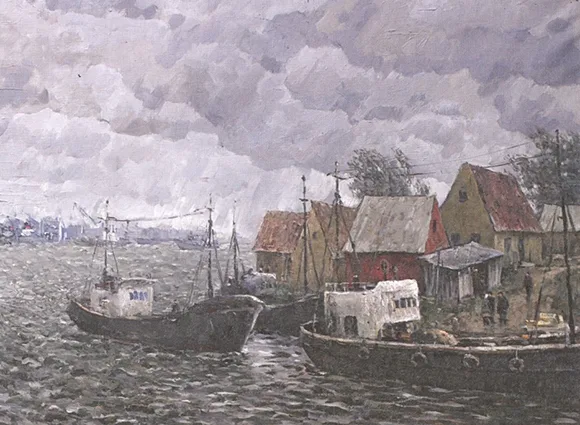 "Foul Weather". Artist N. P. Karyakin, 1985.
The modest master, who by then had been painting local subjects for a decade, thanks to his talent and diligent work became perhaps the first to come close to the damp mystery of the Baltic glacial landscape. He, the first, could already teach others.
As time went on, the artists noticed more and more, learned more and more, achieving greater mastery in rendering the local character. A character whose truthful rendering would be beyond a neophyte.
"A certain time passes before an artist takes a good look around and gets acquainted with life…".
Here, for example, are comments on the works of Pyotr Vladimirovich Simonov (1912 – date of death unknown), one of the first Kaliningrad artists:
"If we take the artist Simonov, he is a real artist, he feels the nature of our Kaliningrad Region superbly. The painting 'The Road to Zelenogradsk' is a song of the Kaliningrad Region, and the manner itself is distinctive" (1959).
"The paintings of the artist Simonov are original and poetic; I am very surprised that they hang in different halls, I mean 'Overcast Day' and 'Spring'. In the painting 'Overcast Day' the water is shown very well. The artist has managed to capture very well those grey tones which are so characteristic of our city" (1962).
A peculiar interplay arose: artists captured certain features of their subject, creating a tradition of reproduction. They shared it with the viewer, creating and consolidating stereotypes of perception. Thereafter the viewer demanded that the masters follow these stereotypes.
Besides the success in capturing the local character, one can also speak of new knowledge in the purely technical sense:
"The sculptor MORGUNOV says that it is time to adorn our region and Kaliningrad with sculptures made of marble and bronze, pointing out that concrete sculptures in our climate quickly lose their original appearance and crumble, so that sculptures that seem cheaper at first glance turn out to be the most expensive" (1957).
This technical aspect, however, is of less interest to us. At least in this article.
On the need for an art museum
The creative discovery of the region was not meant to remain an individual, unrepeatable matter. A mechanism of transmission was needed: a common place where works would be collected, kept, studied and put on display. That is, an art museum was needed.
"In our region the craving for art is very great. … It is a very important question that the paintings of our artists should not be scattered among various offices, where they are seen by a very limited circle of people; of course, in the Fishermen's House of Culture the paintings that get there are seen by a more or less wide circle of viewers, but still a limited circle. Whereas in museums the number of viewers would be far greater. I think it is time to raise the question of creating a museum. If there were one in the city, the researchers would certainly have done some work" (1959).
But there was no museum. The artist Kolesnikov complains that its absence "has a ruinous effect on the development of the artists' creative abilities" (1957). Such statements are not uncommon in the documents of the Kaliningrad branch of the Union of Soviet Artists.
"… the artists suffer a great shortcoming in their work in that there is no art museum of any kind in Kaliningrad. Perhaps I am putting it wrongly, but this question deserves serious attention, and some conclusion must be drawn in this respect. The point is that, preparing for an exhibition, going about their workdays, artists are compelled to turn to finished works that already have high artistic value. Artists of the big cities, Moscow and Leningrad, spend time studying works inherited from artists of the previous generation, from their works, which are made by great masters today" (1959).
The Moscow leadership shared the view that a museum was necessary. Comrade Ruban*, chairman of the committee of the Union of Soviet Artists, instructed the local artists:
"We are writing the chronicle of our time. Our grandchildren will ask us to tell how and in what way the beautiful life in which we are to live was built. … The question of a museum will arise when the first page of this chronicle has been written. I would like to end my speech with the wish that the artists work in such a way that they truly earn the right to receive from the city, as soon as possible, the museum they so ardently desire" (1959).
Some of the functions of an art museum were taken on at the time by the museum of regional history (today the Kaliningrad Regional Museum of History and Art). Its staff drew up a list of subjects according to which paintings were purchased from artists. Today, however, the collection is hard to access and, as a result, little known and little studied.
On "alien motifs"
For various reasons it is hard to establish, and it requires further special research, how the first Kaliningrad artists directly perceived those fragments and remnants of an alien culture that they found here. I do not yet have any materials on this. Perhaps either no documentary traces of it have survived at all, or they are very rare. So for now I will repeat the words of one of the official guests of the sixth regional exhibition of Kaliningrad artists:
"In all three halls I see no traces of the life that was once here; I see here a transformed land" (1959).
P.S.
While collecting material on this subject, the author was unpleasantly surprised by a museum employee's unfounded and categorical refusal to show (simply to show!) the paintings of the first Kaliningrad artists. This despite a written request from the author's university superiors of the time and an equally written authorization from the acting director of the museum. So I had to confine myself to the more modest collection of the Art Gallery. One can only hope that some day attitudes will change, and a double victory will open the now inaccessible collection of the regional museum to researchers and the general public alike!
______________
* "Comrade Ruban" may refer to the polar artist Igor Pavlovich Ruban (1912–1996).
Translated from Russian with the help of AI (Claude, Anthropic), October 2026.