Judging by the choice of books, Comrade Kalinin was a serious reader. A considerable part of the collection consists of works on the history of Russia and Western Europe and writings by the classics of world philosophy. There is even a pre-revolutionary edition of Plato's dialogues — which, on N.K. Krupskaya's orders, were removed from every library in the country or locked away in so-called restricted collections as ideologically harmful. Naturally, there are the works of Marx, Engels and Lenin, and the transcripts of party congresses. Scientific works by such luminaries as the physiologists Mechnikov and Pavlov. And all this even though the owner of the library had almost no education at all. And where would a boy from a poor family have got one? (According to some accounts, his father was a soldier who had returned from extended service and never really got the hang of farming.)
The "outstanding figure of the Communist Party and the Soviet state" (as Soviet encyclopaedias put it) was born on 7 (19) November 1875 in the village of Verkhnyaya Troitsa, not far from Kashin, an old town in Tver Governorate. Mikhail was the first-born child of Ivan Kalinych Kalinin and his wife Maria Vasilyevna, and he had to start helping his parents with all the household chores at an early age. He learned to read and write at home, and at the age of 11 managed to enter a four-year zemstvo primary school. He finished it in two years with a certificate of merit for ability and diligence. Then a chance came along to escape the peasant labour that the boy frankly found burdensome. That chance bore the strange surname Mordukhai-Boltovskoy. It was a noble family that traced its lineage on one side to Tatar commanders of the Golden Horde and on the other to Belarusian szlachta. Not far from Verkhnyaya Troitsa they had an estate, Tetkovo, where the family moved for the summer, as to a dacha. The boy got to know the landowner's children. Then Kalinin's mother came to the masters and tearfully begged them: her husband was a drunkard, they lived in hopeless poverty, please help. And so Misha Kalinin became a footman in the wealthy family of a civilian general, the well-known railway engineer Dmitry Petrovich Mordukhai-Boltovskoy.
Many years later, telling Soviet schoolchildren about his joyless childhood, Kalinin vividly described how the general's wife, his mistress, punished him for breaking a stack of plates and for lesser misdeeds.
But that was for public consumption. In reality, already at the top of the Soviet hierarchy, Kalinin more than once helped the sons of his former master, both with money and with patronage. Why? Because the young servant had been given only the lightest of duties. The general's children happily played with him and treated him with genuine friendliness. And most importantly, no one forbade him to use the family's rich library, which became the main source of knowledge for the village lad who had found himself in the capital. Incidentally, none of the railway general's three sons emigrated after the October Revolution of 1917; they stayed in their homeland. Dmitry Dmitrievich Mordukhai-Boltovskoy, Kalinin's contemporary, became an eminent mathematician and a professor at Rostov University, where before the war the student Alexander Solzhenitsyn studied under him; the future Nobel laureate captured his characteristic traits in one of the characters of the novel "In the First Circle". And at his benefactors' former estate Mikhail Ivanovich ordered a sanatorium to be set up for party officials, and he himself spent his holidays there more than once in the 1920s and 1930s.
At 18, Kalinin started as an apprentice turner at the state-owned Old Arsenal military factory in St Petersburg. He began attending a school for workers. Two years later he moved to the Putilov Works. There he joined an underground socialist circle whose founder, a 26-year-old lawyer of noble birth, had already been arrested. Mikhail met Ulyanov, the future Lenin, in person much later.
His passion for revolutionary activity soon bore "fruit": Kalinin was arrested on suspicion of writing and distributing leaflets of "seditious content". The tsarist secret police, however, failed to find evidence of the young worker's anti-state activities, and after a short spell in prison he was banished from St Petersburg.
But, interestingly, not to the distant North or the even more distant East, but… to Tiflis. Soon, as one of the organisers of a strike, Kalinin was arrested and locked up in the notorious Metekhi Castle. After which he was banished… to Reval (now Tallinn). In these exiles — or were they business trips? — to the future capitals of independent states, Kalinin had no intention of mending his ways: he immediately found like-minded people (in Tiflis it was a young Georgian revolutionary nicknamed Koba, the future Joseph Stalin), conducted propaganda talks among the workers and drafted leaflets. When underground newspapers began to appear, he started publishing his pieces in them. The author of those pieces, however, never actually worked underground. He was arrested 14 times.
All told, Kalinin spent two years and eight months under investigation. Yet not once did a case end in a prison sentence. In Soviet times, historians attributed this oddity to Kalinin's talent for conspiracy.
In post-Soviet times, other versions emerged: that Mikhail Ivanovich simply cooperated with the investigators, wrote a confession and came out unscathed. After so many years, it is hardly possible to establish the truth.
Soviet biographers did not write biographies of the "great revolutionaries" — they wrote lives of saints. That is why much of what was covered in the life stories of writers, actors and artists was hidden from the public, and often even from the biographers of Soviet leaders — their private lives in particular. In the decades before the revolution, young Russian peasants married early, producing the great demographic explosion that, according to modern scholars, fuelled the revolutionary storm no less than political and economic causes. Kalinin, however, stayed a bachelor for a long time. Tver journalists who studied the biography of their fellow countryman repeatedly circulated, in perestroika-era publications, unsubstantiated rumours and "testimonies" that as a young man Kalinin came home to Verkhnyaya Troitsa and proposed to a village girl, but was rejected because of his unprepossessing looks, the spectacles on his nose and his stints in the lock-up. Be that as it may, in the thirtieth year of his life Kalinin at last found family happiness.
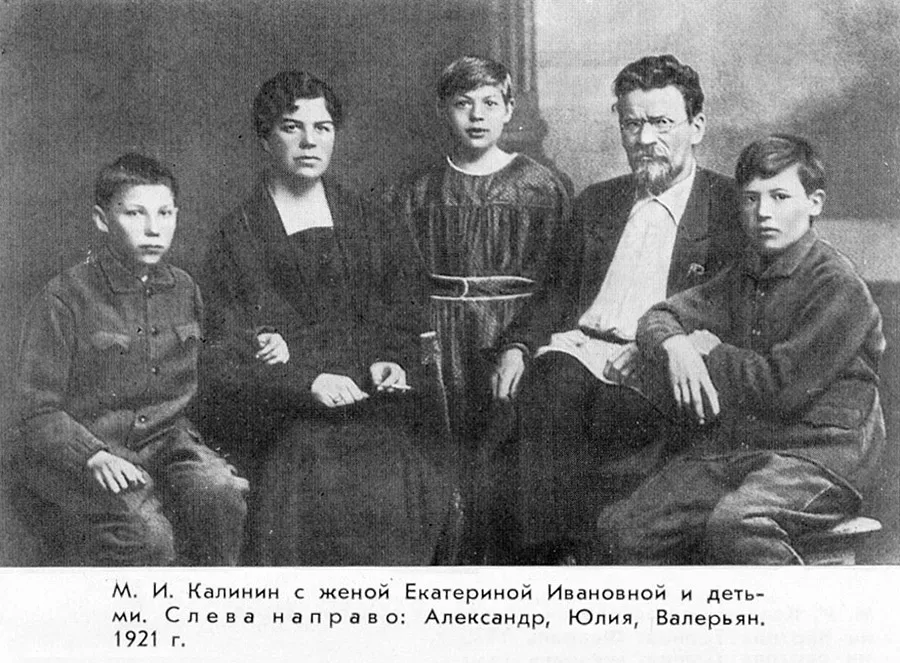
On the eve of the first Russian revolution he was back in St Petersburg. There, in the flat of the Bolshevik Tatyana Slovatinskaya, the future grandmother of the remarkable writer Yury Trifonov, he met a 22-year-old revolutionary, a weaver from Estonia named Ekaterina Lorberg. Ekaterina already had an illegitimate child — a son, Valerian. Born out of wedlock.
Historians have still not found a record of the Kalinins' marriage. The poet and essayist Felix Chuev, V.M. Molotov's biographer, suggested in his book "One Hundred Conversations with Molotov" that the wedding was prevented because the bride was not actually Estonian and professed the Jewish faith.
But this conjecture belongs rather to the realm of fantasy, since there is evidence that Ekaterina's father, a simple peasant day labourer, was Orthodox. Be that as it may, Mikhail Ivanovich proudly brought his young wife to Verkhnyaya Troitsa — to show her off to the local girls who had spurned his advances. Children followed: a daughter, Yulia, a son, Alexander, and a daughter, Lidia.
In the turbulent autumn of 1905 — a time of the all-Russian strike, armed uprisings and terror on both sides (revolutionary and governmental) — Kalinin finally met Lenin and made the very best impression on him. A real worker, straight from the lathe — exactly what the Bolshevik faction of the Russian Social Democrats, who called themselves a "workers' party", sorely lacked. What is more, he could speak in front of an audience, was never at a loss for words, had a decent grasp of the basic tenets of Marxist theory (Marx's works were not banned in tsarist Russia) and had experience of revolutionary work.
During the February Revolution (of 1917), Kalinin led a crowd of demonstrators and directed it to the Kresty prison in Petrograd.
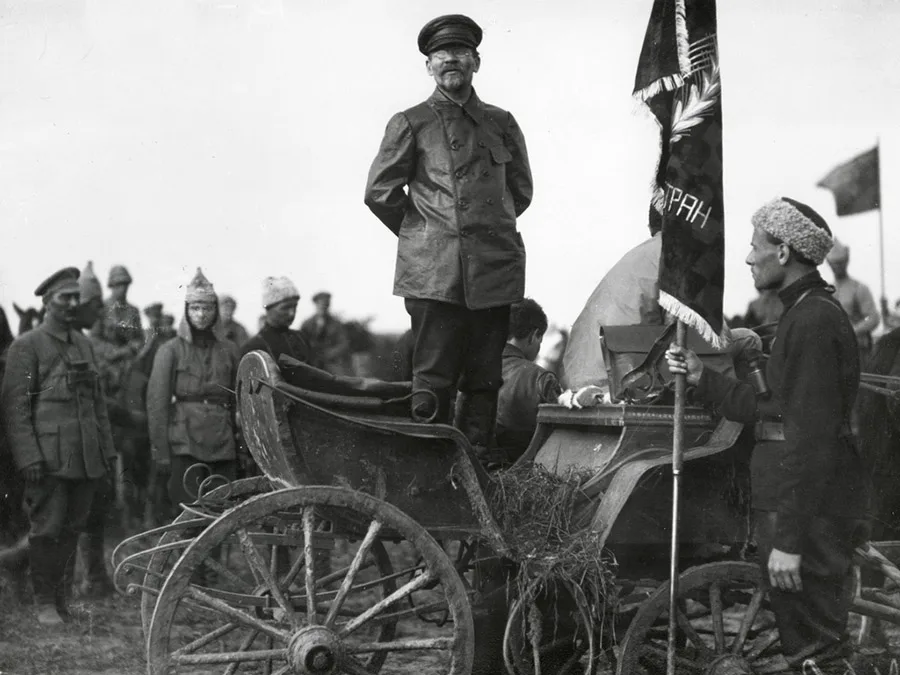 Mikhail Kalinin addresses Red Army soldiers.
As a result of the popular uprising he led, all the prisoners were set free. Among them were dozens of hardened criminals, who seized the prison guards' weapons. For a week Petrograd was plunged into criminal chaos: robberies, violence, thefts and murders occurred daily in huge numbers.
Kalinin became one of the most active functionaries of the Bolshevik faction in the Petrograd Soviet, although he did not immediately accept the course towards seizing power proposed in the "April Theses" of Lenin, who had returned from emigration. In August 1917 he was elected to the Petrograd City Duma on the Bolshevik list. And when the old duma was dissolved after the October coup, he headed the centralised Commissariat for Municipal Economy under the Petrograd Soviet. Soon the Bolshevik government moved to Moscow. Kalinin stayed behind to run things in the former imperial capital. Famine broke out in the city, and many residents left for the countryside, where food could be found. The city's life-support systems were breaking down, and there was a threat of epidemics.
Kalinin and his associates organised the resettlement of workers from the outskirts into requisitioned "bourgeois" apartments, ushering in the era of the famous kommunalkas, the communal flats. At the same time, Kalinin understood perfectly well that a merciless struggle against the bourgeoisie — against what we would now call small and medium-sized business — threatened grave consequences for the economy of the city and the country as a whole. He even published an article calling on the new authorities not to isolate themselves from the petty bourgeoisie, to conclude a pact of cooperation with it as soon as possible and to give entrepreneurs the opportunity to work. But this time he found no understanding from Lenin, who was straining towards communism and world revolution. The party leader's reply was harsh: "I strongly object to Comrade Kalinin, for a bloc with the petty bourgeoisie, with the chauvinists, is unthinkable. The slightest thought of a bloc with the petty bourgeoisie, which is supported by the bourgeoisie, is a betrayal of socialism." This, however, did not stop Kalinin.
Evidently, he utterly failed to grasp what Yevgeny Zamyatin understood in those very months as he began writing his famous novel "We", banned for decades under Soviet rule: the Bolsheviks were building not the Marxist kingdom of "the free development of each as the condition for the free development of all", but what scholars would later call totalitarianism.
In a new polemical article published in early 1919, Kalinin wrote: "We can give the petty bourgeoisie no less than the capitalist system gave it… The government must guarantee the right to small property… The government permits the peasant, the artisan, the cottage craftsman, the small market gardener, the small trader and the milkman to use hired labour under the supervision of the Council of Trade Unions. The petty bourgeois has never had more than this in history, and his claims go no further."
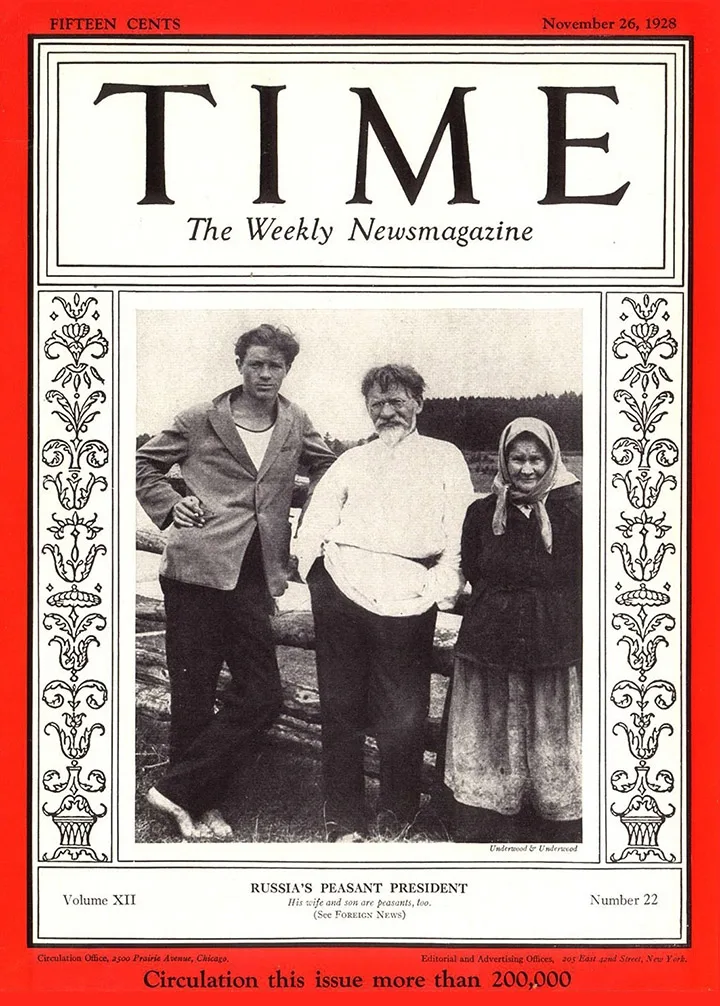
Once again Lenin did not heed the arguments of the "man of the people". It took two more years of insane experiments, which brought the country's economy to near-total collapse, and the menacing uprising of the Kronstadt sailors before Kalinin's arguments were heard and the New Economic Policy — NEP — that Kalinin had called for was proclaimed. But two months after the publication of his "seditious" article, in March 1919, Kalinin was nominated (according to one version by Lenin himself, according to another by Trotsky) for the post of Chairman of the Central Executive Committee, vacated after the sudden death of Ya.M. Sverdlov. Incidentally, in his not entirely reliable memoirs Trotsky claimed authorship of the unofficial title that stuck to Kalinin for the rest of his life: "the All-Russian Elder".
It is quite logical that Kalinin fully supported the New Economic Policy. But the documents and orders he now had to sign increasingly forced him to compromise his former convictions and moral principles. Among them was the notorious decree on the confiscation of church valuables, issued on the pretext of fighting the terrible famine in the Volga region in 1921–1922 but in fact launching a terror against the Russian Orthodox Church that led to mass repressions against the clergy and active parishioners.
And then there were the execution lists of "enemies of the revolution". The agitation train in which Kalinin toured the country in 1919–1920 had a tribunal carriage whose passengers carried out shootings on the spot.
The attitude of Lenin and Trotsky towards Kalinin (both considered themselves outstanding theorists and philosophers) clearly shows the condescension of intellectuals towards a hands-on empiricist. When questions were discussed at Politburo meetings, Lenin invariably turned to Kalinin with: "And what does the head of state have to say about this?" — even though Mikhail Ivanovich's powers could in no way compare with those of the "leader of the revolution". Trotsky, later in exile, wrote even more frankly: "A former Tver peasant and Petersburg worker, he conducted himself in his unexpectedly high post modestly enough and, in any case, cautiously. Only gradually did the Soviet press establish his name and authority in the eyes of the country. True, the ruling stratum did not take Kalinin seriously for a long time…"
With the start of the New Economic Policy, Kalinin's opinions and proposals began to receive closer attention. In these years he published his best theoretical works, which revealed both his natural intelligence and his grasp of the current situation — the result of countless meetings with ordinary people during his many trips around the country, as well as personal audiences for citizens with complaints, announced in advance in the newspapers.
For obvious reasons, the few years of NEP were not followed by further development. The policy of encouraging private business failed to take hold in our country even in moderate forms.
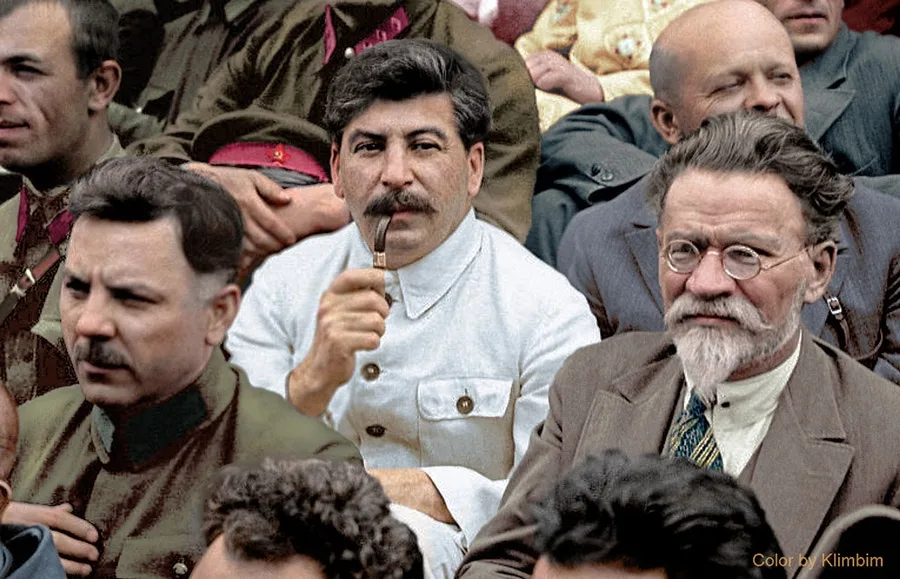 Kalinin in the company of Stalin and Voroshilov.
The logic of the struggle within the party elite, the logic of the struggle for personal power waged by Stalin, and the logic of dogmatically understood Marxism were incompatible with market relations and normal economic development.
In 1928 the party began its struggle against the so-called "Right deviation", and 1930 marked the start of "wholesale collectivisation" and the "liquidation of the kulaks as a class". At the first stage of these events, which were a turning point and a tragedy above all for the Russian peasantry, Kalinin still occasionally dared to speak out timidly against the will of Stalin, who was visibly becoming the Boss. But he soon lost all independence of judgement and capitulated completely.
What caused this capitulation? It must be admitted that Kalinin was never a strong leader. Nor was he a sophisticated schemer. To a large extent, he, a peasant's son, was ruined and corrupted by the privileges of power, including the opportunity to indulge weaknesses that were not always harmless. These weaknesses wrecked the "president's" family life. In the early 1920s a young woman appeared in Kalinin's flat to serve as housekeeper: after all, neither Kalinin nor his wife, who had become a party functionary, had time to run the household and look after the children. This not very edifying story ended with Ekaterina Kalinina asking the Central Committee to send her somewhere far away from her husband, who was showing excessive friskiness in amorous matters, and she left for the Altai for several years.
As the saying goes, the first step is the hardest. In his fifties, Mikhail Ivanovich made up for what he had been denied in his bachelor years. Once a satirical piece even appeared in the press about the "All-Union Elder's" courtship of an operetta actress. Later, publications of this kind about prominent figures were banned once and for all.
But Kalinin's adventures on the amorous front did not end there. Surprisingly, given his education and tastes, he became a devotee of ballet. And not so much of ballet as an art as of young ballerinas...
Yet what broke him as a person were not these "escapades" but far grimmer events. In 1931–1932, the man who a decade earlier had defended small business fully supported all the measures taken by the Stalinist leadership against the peasantry and the urban petty bourgeoisie. Kalinin's archive holds literally hundreds of thousands of letters from peasants describing the horrors of collectivisation. But only in a few cases did Kalinin help individual middle peasants who were being deported to the North and the East as "kulaks". His signature is on the resolution of the USSR Central Executive Committee "On the Protection of the Property of State Enterprises, Collective Farms and Cooperatives…". This law of 7 August 1932 led to the arrest and long imprisonment of a great many poor and middle peasants — "for ears of grain", as the people put it. Hungry peasants were arrested for "stealing" even a handful of grain from the collective farm, although it was they who had grown it. Kalinin's signature seals the resolution on the passport system, which turned rural inhabitants into virtually new serfs by depriving them of freedom of movement. The same signature is on the monstrous resolution of 1 December 1934 "On the Procedure for Conducting Cases of the Preparation or Commission of Terrorist Acts". This resolution remained the main legal norm for the pseudo-judicial procedures of the 1930s and 1940s. Kalinin also signed the act extending all forms of criminal law to children from the age of 12. Imprisonment in a camp for being late for work, for absenteeism, for leaving a job without permission, for petty theft — all these draconian measures were sealed with his signature in 1940 by the "All-Union Elder", who looked like a kindly grandfather with a neat grey beard.
As a reward for his obedience and lack of will — or rather, for his complicity in the state "legitimisation" of Stalin's terror — the "father of nations" not only turned a blind eye to his associate's erotic adventures but also rewarded him in his own way. In the first days of November 1931, workers at enterprises in the old city of Tver suddenly began sending in collective letters with a request: to name their city after their fellow countryman, the "All-Union Elder".
Never mind that Tver was not Kalinin's home town and that until then he had passed through it only two or three times. For his 56th birthday, Mikhail Ivanovich received as a gift a city named after himself.
And yet only five years earlier he had sensibly and judiciously objected to a proposal to give his name to the district centre of Kimry, which lies much closer to his native Verkhnyaya Troitsa…
But besides such "carrots", Stalin also used the stick in dealing with his associates. Mikhail Ivanovich was no exception. In 1938 Ekaterina Ivanovna was arrested. She may in fact have been living apart from her husband, but formally she was still his wife. The elderly woman, who was working at the time in the apparatus of the Supreme Court, was blamed for an old and tragic story. Back in 1924 she had gone to the Cheka and confessed that before the revolution her elder brother Vladimir had collaborated with the tsarist secret police. Her brother was shot at the time. And now, fourteen years later, she was tormented with questions: why had she not given her brother up earlier? The sentence was typical of the Yezhovshchina: 15 years in the camps. Did Kalinin try to appeal to Stalin and defend his wife? Such a request is known to have been made at the beginning of the war. Stalin rudely refused: "Let me deal with your case once we've finished the war," he said. During the "purge" of the Red Army command on the eve of the war, Kalinin's son-in-law — his daughter's husband, a military officer — was also arrested. But he was released: Beria, who had replaced Yezhov, engineered the release of some of those arrested on utterly absurd charges in order to earn a reputation as a "fighter against excesses".
The repressions also struck members of the USSR Central Executive Committee that Kalinin headed. Kalinin did not even try to save people with whom he had worked side by side for years, whom he knew well as people devoted to the party and the state.
Pavel Aksyonov, a member of the USSR Central Executive Committee and Kalinin's direct subordinate, former chairman of the Kazan City Soviet and father of a well-known writer, who managed to survive 18 years in the camps, recalled that he was arrested right at a session of the Central Executive Committee. He was asked to step into Mikhail Ivanovich's office, where three NKVD officers were already waiting. In Kalinin's presence they showed Aksyonov the arrest warrant. Mikhail Ivanovich, with tears in his eyes, embraced Aksyonov and mumbled something like a plea for forgiveness. And then he stepped back and let the officers of the "organs" do their work.
During the years of the Great Terror, a stream of letters from relatives of the unlawfully repressed poured into Kalinin's reception office. Even children wrote, pleading for their arrested fathers and mothers. These letters bear no resolutions or notes of any kind in Kalinin's hand. He was simply too afraid by then to intercede for anyone... And, it is said, to those who managed to get a personal audience he would reply: "My own wife has been arrested, and I can do nothing to help her. And I can do nothing to help you."
A transcript has survived from the same period of a meeting between the "All-Union Elder" and the residents of Khibinogorsk in the Murmansk Region (now Kirovsk).
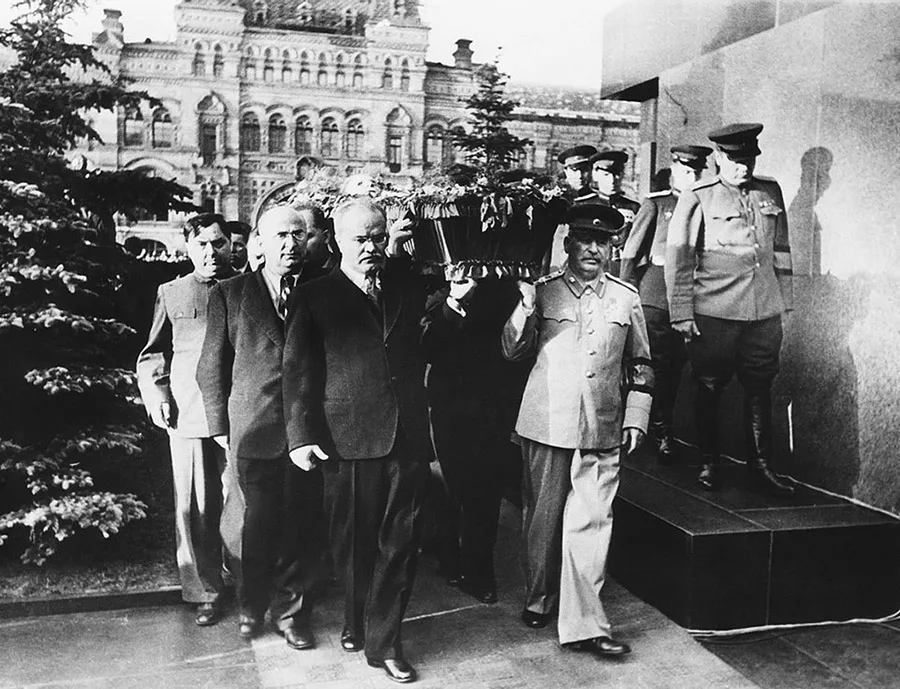 On his final journey Kalinin was accompanied by Malenkov, Beria, Molotov and Stalin (left to right).
The stenographer recorded for history the following words of the "president": "Don't ask me for anything, I am a man without power. Go to Molotov."
During the Great Patriotic War, Kalinin performed mostly formal functions as "head of state". Moreover, he began to fall ill. Immediately after the Victory, doctors diagnosed cancer. An operation did not help. Before it, Kalinin pleaded with Stalin one last time to release his wife. By then Ekaterina Ivanovna had spent more than seven years in the camps — half of the penal term imposed by the "court". She was pardoned by supreme will, and for several months she nursed her fading husband. After his death on 3 June 1946, she walked beside Stalin behind the coffin bearing her husband's remains…
A year after Mikhail Ivanovich's death, another terrible blow awaited Ekaterina Ivanovna. Her first-born, Valerian Kalinin, by then a brilliant diplomat who had worked for several years in the United States, took his own life in circumstances that have never been clarified…
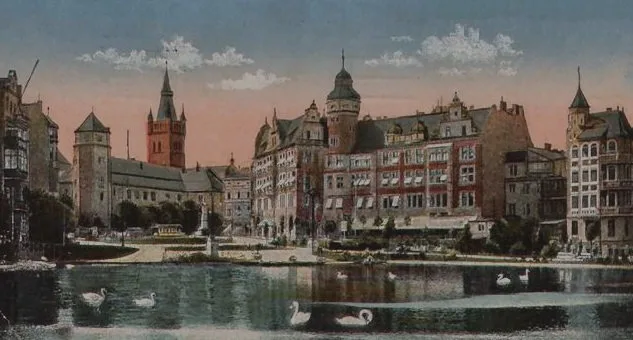
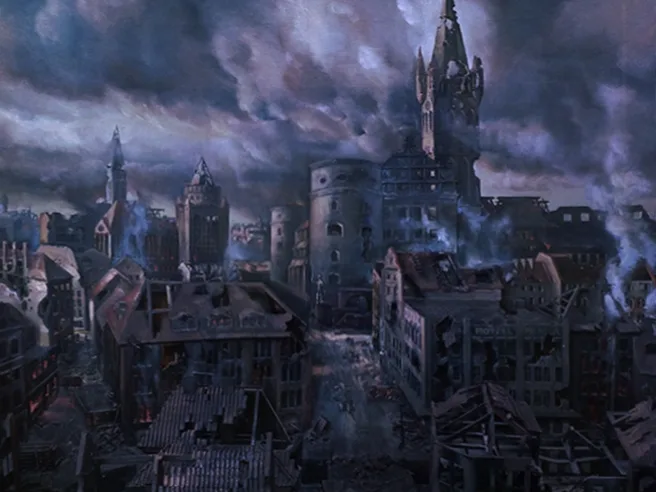
The idea of giving Kalinin's name to the former capital of East Prussia (even though the map of the USSR was already dotted with this simple Russian surname — Kalinin, Kaliningorsk, Kalininabad, Kalininakan) arose immediately after the death of the "All-Union Elder". By then, a decision had already been taken to rename Königsberg Baltiysk and to call the new region the Baltic Region. But… a rule had already taken shape of naming some settlement after a deceased statesman. And by virtue of this absurd tradition, it was Pillau that was named Baltiysk, while Königsberg suddenly received the name of a man who had made his mark on the country's history on the front stage, true, but far from in a leading role.
Translated from Russian with the help of AI (Claude, Anthropic), October 2026.