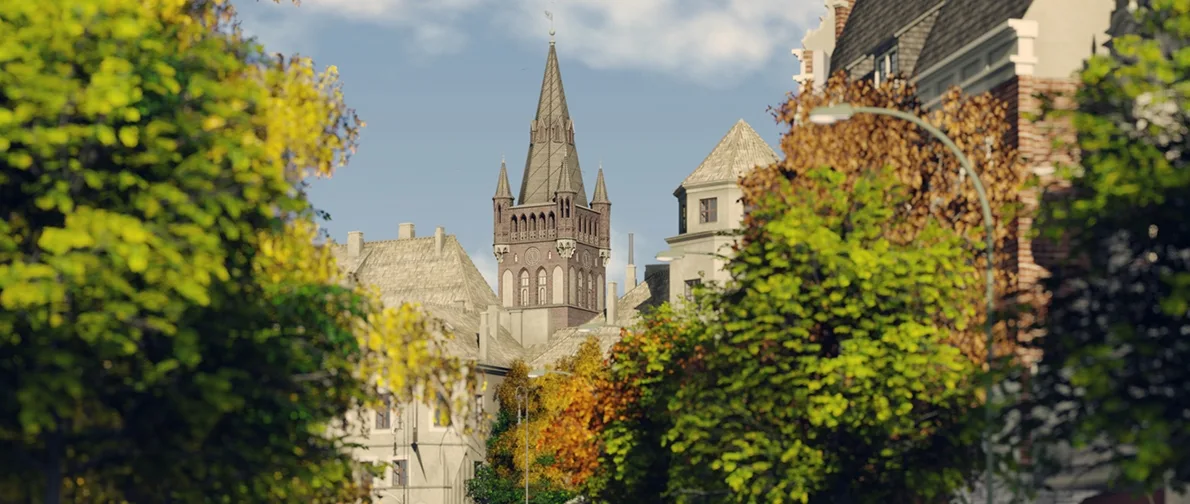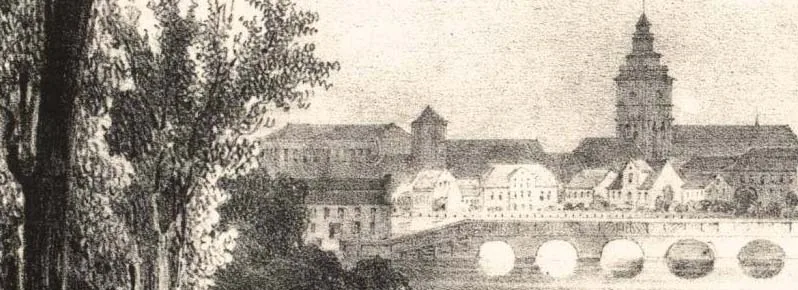
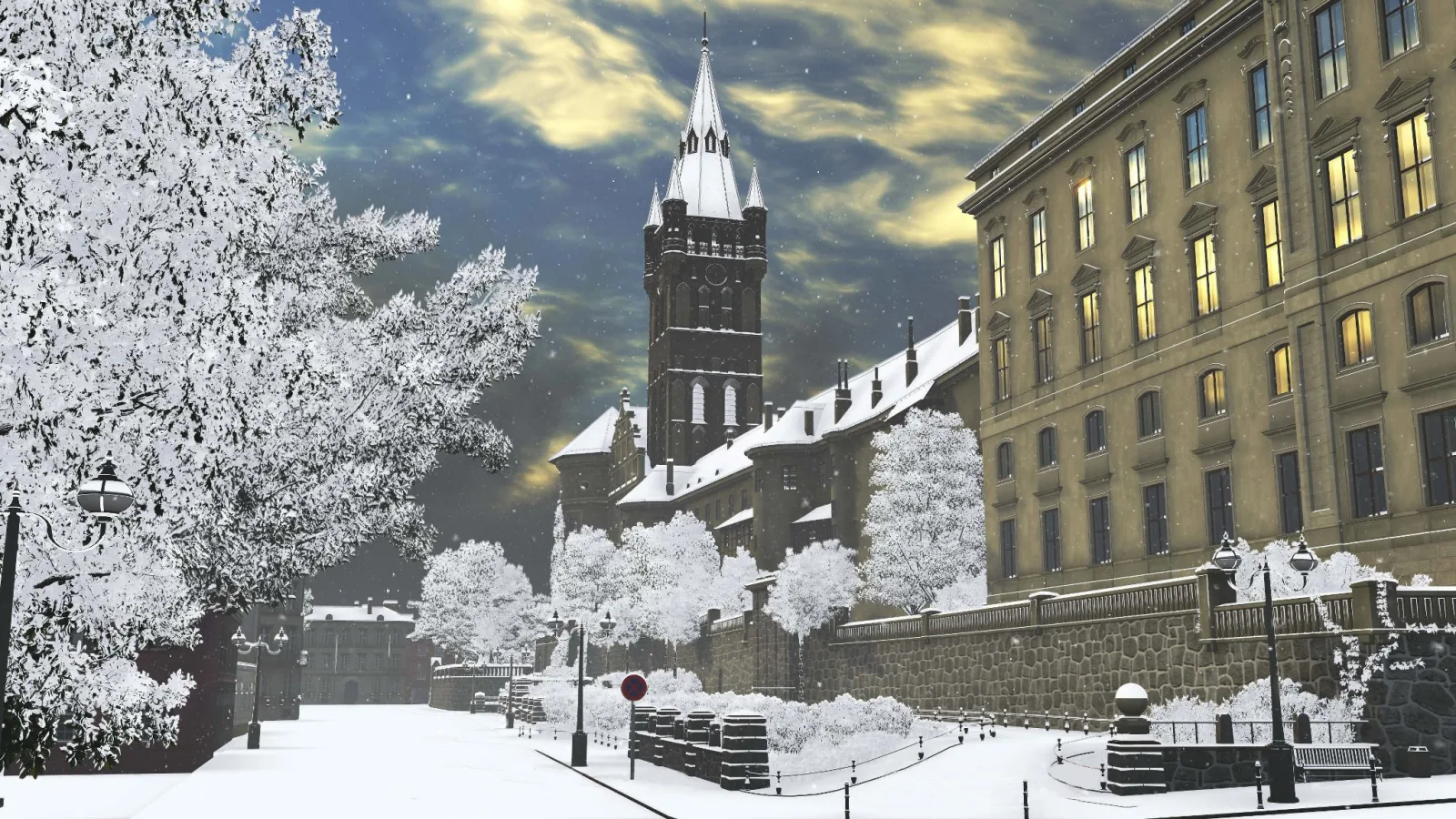
And it seems that we like that almost vanished city better than the one that grew up after the war. After all, when friends visit us from “mainland Russia” or from abroad, we don’t take them to admire the Yunost sports complex, the regional prosecutor’s office or the Oktyabr cinema (now the House of Arts). We show our guests the Cathedral, the Amber Museum, the Puppet Theatre. And the Zoo, of course.
Still, in Kaliningrad it is hard, almost impossible, to avoid encountering what is perhaps the best-known architectural landmark of the Soviet era: the House of Soviets, which stands on Royal Hill, quite literally hovering over the city.
“Good Lord, what is that?!” is the usual reaction of people seeing the huge, lifeless building for the first time. And of course you explain, not forgetting to mention that this was once the site of the ruins of Königsberg Castle, which were blown up in the late 1960s for ideological reasons.
Attached to a “monster”
I am sure that many of us, when offering explanations of this kind, feel embarrassed for our city. The House of Soviets looks just too absurd, and it compares just too obviously unfavourably with the Royal Castle, whose images hang everywhere in Kaliningrad, from public transport stops to the offices of local officials.
Most visitors are baffled as to why the people of Kaliningrad have put up with a dead monster in the middle of their city for so many years (soon it will be half a century!).
And among the baffled are some very well-known architects. A couple of years ago, for instance, the Dane Jan Gehl (the very man who turned Copenhagen into a city of cyclists), while visiting Kaliningrad, called the House of Soviets a wretched, elephant-like structure and proposed demolishing it immediately.
Doing so, however, has proved far from simple. And the problem is not at all a lack of money, nor the legal complications that come with transferring property rights — the House of Soviets does, after all, have owners. Given the will, I think, all these problems could be solved.
It is simply that many of us (especially the older generation) have found it very hard to acknowledge the plain fact that a mistake was made at some point.
That is why many people, when talking about the House of Soviets, come up with a million reasons why it absolutely must be kept. It is, they say, an original design that reinterpreted the ideas of the Brazilian Oscar Niemeyer, a striking example of constructivism, a vivid illustration of the use of technologies that were cutting-edge for their time, and so on and so forth…
I remember how once a well-known Kaliningrad architect, having used all of the above arguments in a conversation with me and realising that he still had not convinced me, said: “Look, you can’t just go and demolish the House of Soviets. Because if we do, it will mean that a whole generation lived and worked in vain. The Khrushchev-era and Brezhnev-era blocks and other Soviet buildings will fall apart in 30–40 years. But the House of Soviets will stand for a very long time yet, a reminder of a bygone era.”
And that, really, is what is frightening. One very much hopes it will not stand for long.
After all, if it is clear that this was a mistake (and the architect I was talking to eventually had to admit that the House of Soviets, for all its undeniable merits, would look far more at home somewhere around Internatsionalnaya Street or Lyubov Shevtsova Street), then it needs to be corrected. That would show more respect for those who made it than preserving the results of their mistake. Wouldn’t it?
Our history
Demolishing the House of Soviets, however, is only half the job. Having said “A”, you have to say “B” — that is, rebuild the Royal Castle. Yet not all Kaliningraders are by any means ready to accept such changes. They have plenty of arguments. But all of them, by and large, are contrived as well.
For instance, you very often hear that Königsberg Castle is now supposedly someone else’s history. And if so, there is no need to rebuild it. Nonsense! Listen, if this is not our history, then why does every souvenir shop have heaps of fridge magnets with pictures of the castle? Why do local artists never tire of painting it and making mosaics of it out of amber? Nobody makes the House of Soviets out of amber (at least I have never come across anything of the kind). Nor the Wedding Palace, nor the House of Trade Unions. But the Royal Castle of Königsberg — all the time.
And all because the claim that the Royal Castle is “not ours” is false from the outset. Everything that was here, everything that is and everything that will be is ours. Including the history of this land.
In a certain sense it is our trophy. And a precious one at that. We could, of course, squander it, cross it out and forget it, but it would be far wiser to carefully weave it into our own.
We have inherited a great city, a great history, a great culture. And it seems to me that we must take good care of all this and, as far as possible, restore what has been lost. Such a course is by no means a sign of weakness. On the contrary, it is a sign of wisdom and strength.
An ideology of peace
The next most popular argument of those opposed to the idea of rebuilding Königsberg Castle in Kaliningrad is an architectural and aesthetic one.
“A modern replica won’t interest anyone,” they predict.
“If it is a long-term project, if we faithfully recreate the castle as it was, then believe me, it will be an event,” counters the architect Arthur Sarnitz, the most ardent and consistent advocate of recreating the city’s former dominant landmark. “It seems to me that what matters in rebuilding the castle is not only the result as such (although this astonishingly beautiful building will simply transform the city), but also the process, which will involve a great many people from different countries. Through their work they will become imbued with an ideology of peace and creation. You could say that the Royal Castle in Kaliningrad will become a symbol of the end of the war.”
As for replicas, after the Second World War many European cities were in effect rebuilt from scratch. In Berlin, in Warsaw, in neighbouring Gdańsk there are replicas at every turn. And nobody is bothered by it.
…Opponents of rebuilding the Royal Castle are also fond of setting it against the rest of East Prussia’s architectural heritage. Instead of putting up a mock-up, they say (they are very fond of the word “mock-up”, which they consider disparaging), it would be better to restore the castles and churches scattered across the region. This way of framing the question seems rather odd. It is like reproaching someone for treating their aching head instead of their aching leg. If both your leg and your head hurt, you have to treat both. And if an investor appears who is willing to put money into rebuilding the Royal Castle, there is little point in reproaching him for not investing in the reconstruction of some half-ruined church out in the region.
Vox populi*
It was expected that the recent “Post-Castle” architectural competition for the development of Royal Hill (organised by the Heart of the City urban planning bureau) would put an end to disputes of this kind. Its results, however, only intensified them.
The winner was a project by Anton Sagal, a student at the Politecnico di Milano, who proposed both preserving the House of Soviets and restoring-cum-building the Königsberg-Kaliningrad castle. Not in full, though, but in part. Moreover, in his concept the fragments of the castle were to be linked by elements of contemporary architecture. In short, everyone should seemingly have been happy — the supporters of the castle, those fond of the House of Soviets, and those looking to the future.
Yet, as often happens in such cases, very few turned out to be satisfied.
The “patriotically” minded public was outraged by the castle in Kaliningrad even in such a truncated form, while those who consider the House of Soviets a monster could not understand why it should be preserved. Above all, it became clear to many that Kaliningrad, like that old Bolivar, cannot carry double. The city (or rather its residents) will have to choose: either the castle or the House of Soviets. And it seems they have made their choice in favour of the development scenario that envisages bringing the Royal Castle back to Kaliningrad. After the competition jury (half of which consisted of local officials) announced the winner, an online vote was held, which ended on 6 November.
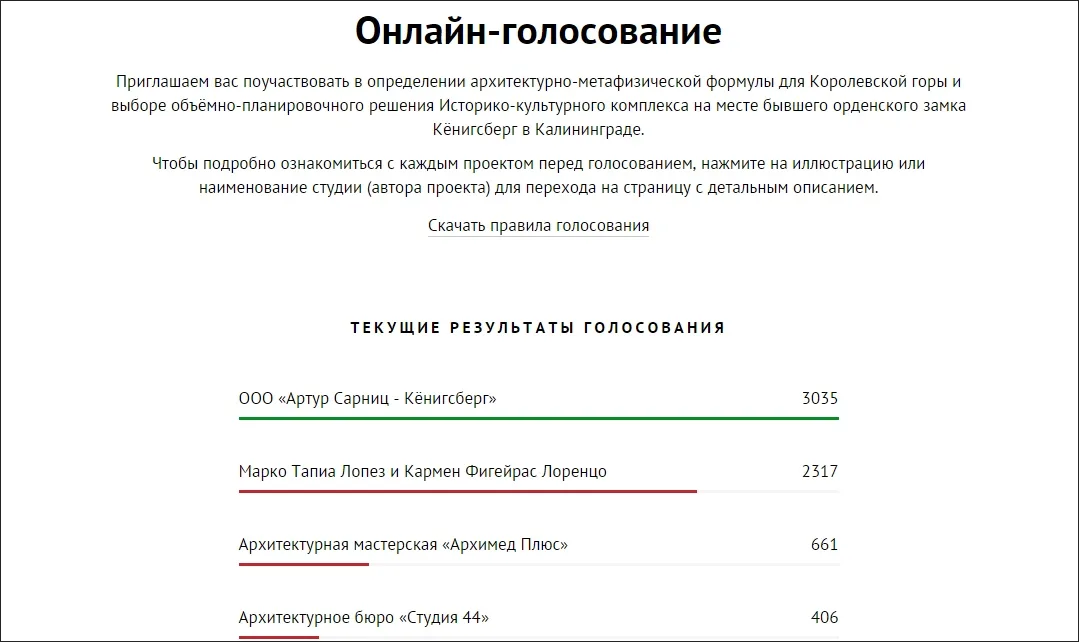
6 November 2015, 7 p.m. (five hours before the end of the online vote on tuwangste.ru): Arthur Sarnitz’s project, which envisages rebuilding the castle, was more than 700 votes ahead of its closest rivals. By 10.30 p.m. the gap between the contestants had even widened slightly.
First place, by a very comfortable margin over the runners-up, went to Arthur Sarnitz, whose project envisages the complete restoration of Königsberg Castle together with the surrounding quarters. There was no room for the House of Soviets in his design.
…If Sarnitz's project is ever realized (and one very much wants to believe it will be), Kaliningrad will simply return to the mainstream of the European architectural tradition. After all, almost all the cities around it are laid out in much the same way. Each has a historic centre that was destroyed during the war and then carefully restored. Why should we look for some special path of our own? Why should we reinvent the wheel yet again? Yes, we are a little late, by some seventy years, and we have taken a historical detour, but it seems we are finally returning to where we started.
* The voice of the people ( Lat.)
Translated from Russian with the help of AI (Claude, Anthropic), October 2026.