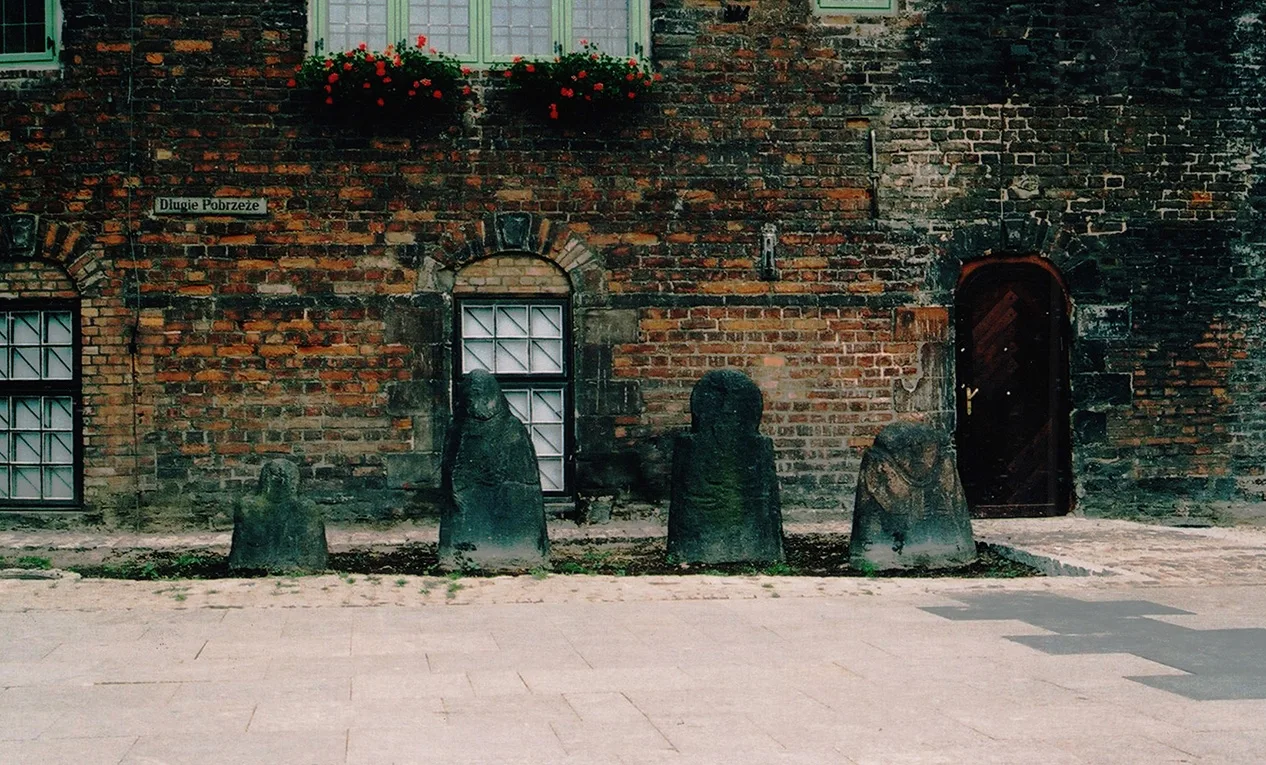
Before the arrival of the crusaders in Prussia in 1233, there were two striking periods when the local population erected massive stone structures. In the Bronze Age these were barrow chambers made of massive stone slabs and boulders, which later degenerated into the stone settings of Prussian burials. And later still, in the Early Middle Ages, the Prussians — alone among all the Balts — began to erect anthropomorphic stone sculptures on the southern borders of their lands, often called "babas"1. It is these that we shall discuss here.
News from Germany
In the holdings of the Museum of Prehistory and Early History in Berlin (MVF)2, a pre-war plaster cast was discovered of a Prussian stone "baba" — a cult statue that until 1891 stood in a field on the boundary of the villages of Husehnen-Rossiten-Wackern (roughly the area between the villages of Pogranichnoye and Dolgorukovo). In that year Professor Adalbert Bezzenberger (then director of the Prussia Museum) took the anthropomorphic sculpture, presumably dating from the 11th–13th centuries, to the museum, where it was set up together with other ancient stone monuments, and later it vanished without a trace.
The original was most likely destroyed in the crucible of the Königsberg Castle quarry that went on for many years. Although this is only an assumption. But the copy has been found, and now it is clearly better than the original, which no longer exists. At night the "Petrified Man" from Husehnen, or, as the sculpture was also called, the "Nasty Girl from Skirwitten", studies the rescued exhibits of the Prussia-Sammlung. Most likely the copy of this sculpture was taken to Berlin together with the so-called "study" part of the collection in 1944 and was kept in one of the crates in the storerooms of the Museum of Prehistory and Early History until German researchers of the Prussia collection noticed it.
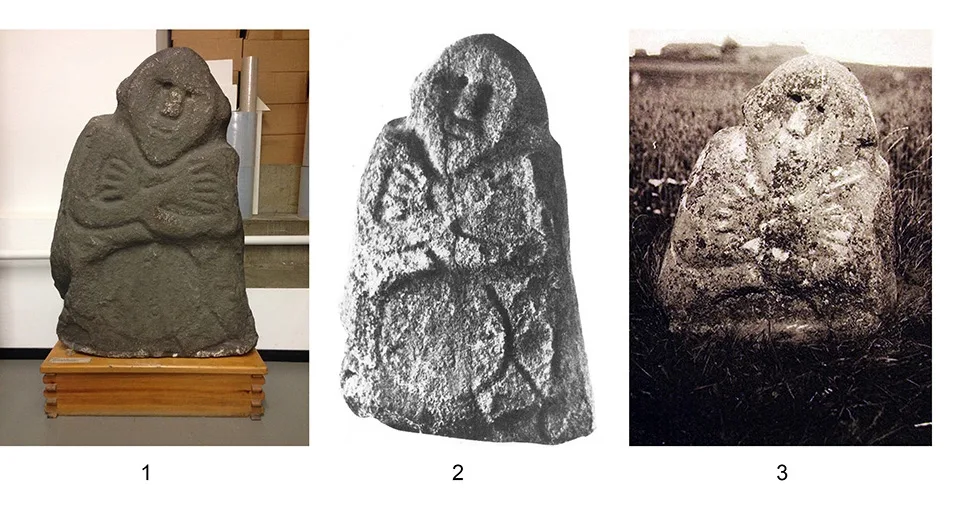 The stone baba from Husehnen-Rossiten (Bagrationovsk District).
1. Plaster cast of the sculpture discovered in the holdings of the Berlin Museum of Prehistory and Early History. Photo by Christoph Jahn, 2015.
2. The sculpture in the courtyard of the Prussia Museum in Königsberg Castle. Photo from an article by Wolfgang La Baume, 1927.
3. The "Nasty Girl from Skirwitten" in situ in the field between the three villages, before it was taken to the Prussia Museum.
Photo from an article by Adalbert Bezzenberger, 1891.
In all there are more than 20 Prussian stone statues with a "human face", including those lost as early as the 18th–19th centuries, of which only oral mentions remain. At least 14–15 are recognised as genuine; the rest are considered modern or recent imitations. All of them are concentrated in the southern part of the Prussian lands: the south of Natangia and Barta (the "baba" mentioned above, plus 2 from Bartoszyce and the most famous one from Barciany, discussed below), Galindia (one of the sculptures has survived in the Kaliningrad Museum of History and Art), Pomesania and Sasna (south of Elbląg, at the junction with the Slavs; most of them are here). I will not list all the sculptures by name and location — there are enough Polish publications on that. For example, the excellent collection of articles "Prussian Stone Babas", published by our neighbours following a scholarly conference in 2007, with articles by the archaeologists and historians Mirosław Hoffmann, Seweryn Szczepański and Jerzy Łapo, some of which can be found on the Internet.
On the origin of the stone "babas"
At the first cursory glance at the stone statues found in the Prussian lands, images flash through one's mind of the Turkic, Scythian and Polovtsian medieval "babas" from the foothills of the Altai or the Ukrainian steppes.
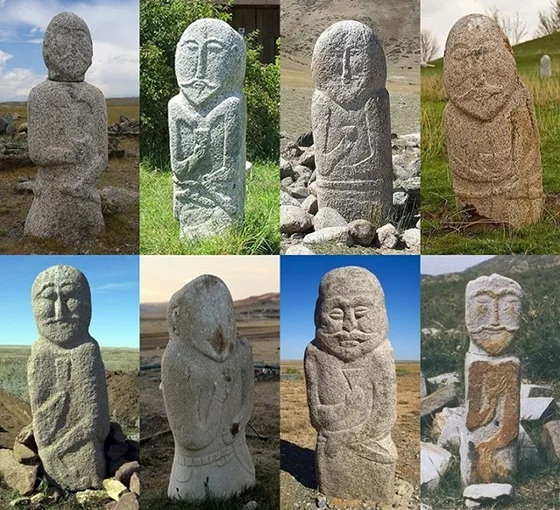
Early medieval stone babas of the steppe peoples.
Photo from the author's collection.
You will agree, that is a long way from the Prussians. Although it is known that time is no distance for any thoughts and images, even the boldest and seemingly most radical ones. It may be noted that all these examples may have common origins lying in the realm of Stone Age art. Since our territory was covered by the glacier for a long time, it is unlikely that the stone statues of either the Prussians or the nomads have a direct connection with the Palaeolithic Venuses (recall the so-called "Venus of Laussel" with her "horn of plenty").
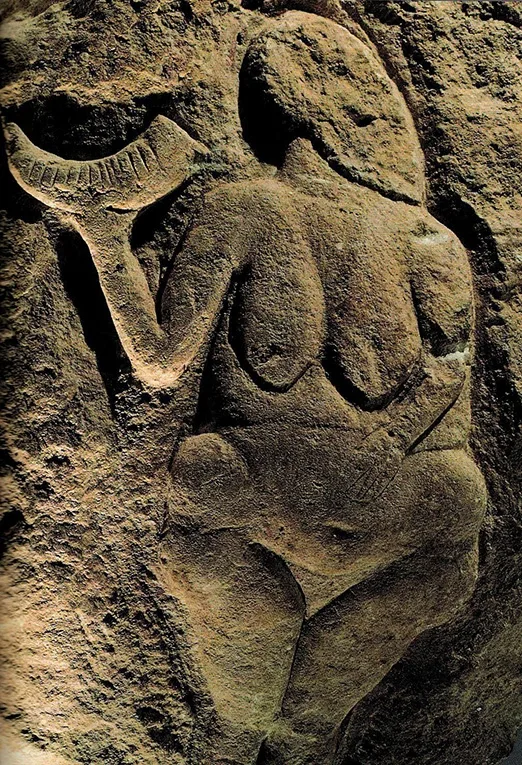
The Venus of Laussel, Upper Palaeolithic.
Photo from the author's collection.
At the same time, the ideas, myths and mysteries of the Mesolithic travelled in time and space, and about 10,000–12,000 years ago, together with reindeer hunters, they may well have reached the shores of the newly formed Baltic. Much later, in the Neolithic, around 5000 BC, examples of local ritual "art" appear in the south-eastern Baltic which distantly resemble the monumental depictions of ancestors, spirits, gods or heroes on the Prussian medieval sculptures. First and foremost, these are the amber figurines of the hoard from Schwarzort-Juodkrantė, once part of the famous Prussia collection kept in Königsberg until 1944.
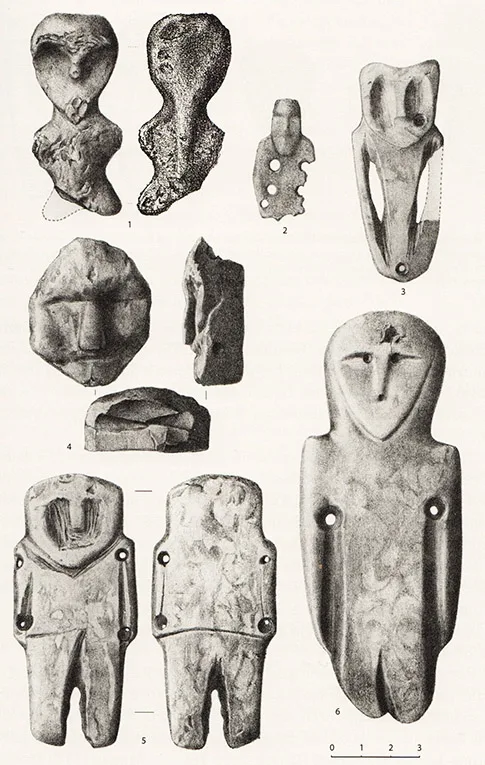
Neolithic amber figurines from the hoard found in a quarry near Schwarzort-Juodkrantė.
Drawing from the second half of the 19th century, from Audronė Bliujienė's book of 2007.
The monumentality and minimalism of expressive forms determined the development of the art of the Baltic region for many millennia. What we see today on the stern faces of the Prussian statues may have arisen long before the appearance of the Prussians themselves — or, more precisely, before their formation and their awareness of themselves as such.
What do the statues from different regions of historical Prussia have in common?
First of all, similar size and shape, and their material — granitoid stones. Many of the sculptures clearly depict male warriors, chieftains or chieftain-priests (the baba from Mozgowo-Łasieczno) and are furnished with rhytons — horns for libations — and in some cases with swords, helmets and even shields. Sometimes the sculptures' arms are crossed on the chest, recalling the pose of an "orant". What stands out is the common plasticity, the expressiveness and clarity of form achieved by ascetic means. It is mainly carving on the front of the stone, where lines of varying depth achieve maximum expressiveness through the play of light and shadow. Usually the head and the arms folded on the chest or at the waist are well worked, sometimes also details of clothing and adornment. The back of the sculpture is usually worked minimally, simply smoothed.
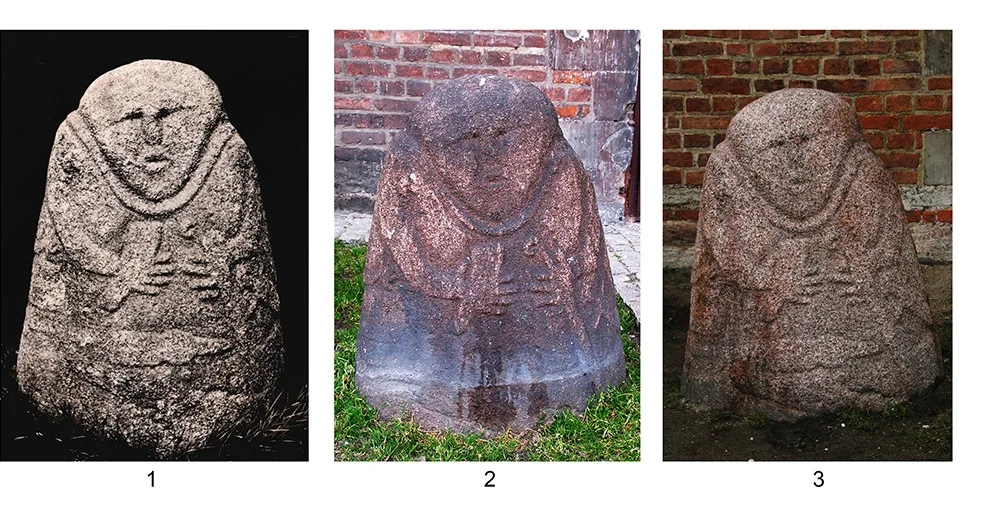 The stone baba from Mozgowo-Łasieczno. 1. Photo by W. La Baume from the Herbert Jankuhn archive, Schleswig.
2. Before restoration, 2006. Photo by the author. 3. After restoration/cleaning, 2009. Photo by the author.
When did stone "babas" appear in the territory of the Prussians?
What could have led to the appearance among the Prussians of a phenomenon so uncharacteristic of the other Balts? Some authors believed that the erection of monumental stone statues by the Prussians is as much a reminiscence of steppe or nomadic culture as burial with horses, drinking kumis, the use of stirrups, etc. — in particular of the traditions of the Avars. The latter appeared on the borders of Europe in the 6th century and in the 8th–9th centuries dissolved into the empire of Charlemagne and among the Magyars. The snag is that horse burials-sacrifices appear among the Aestii — the ancestors of the Prussians — as early as the turn of the 1st and 2nd centuries. And drinking mare's milk is characteristic of all peoples among whom the horse plays a special role in everyday life and ritual. In that case the stone "babas" should have appeared among the Prussians at the end of the Migration Period. But this happens several centuries later.
How do we know when the Prussian stone "babas" were made? First of all, from the relative dating of certain types of archaeological artefacts depicted by the stonemasons. For example, the sword at the side of the "baba" from Mozgowo, the appearance of which is dated to the end of the 12th — first half of the 13th century (see the previous figure). The pointed and oval helmets of the sculptures from Bartoszyce and Bronowo may belong to a broader period — the 11th to early 13th centuries.
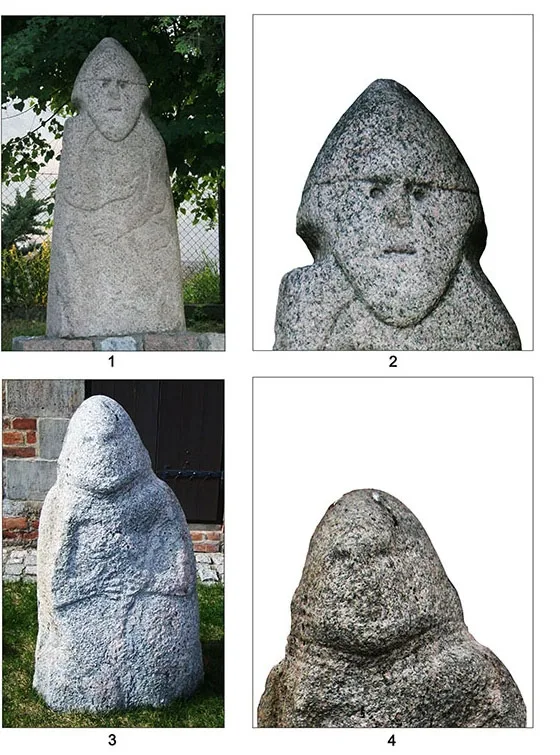
Sculptures from Bartoszyce ("Bartel") (1, 2) and Bronowo (3, 4),
crowned with presumed helmets. Photo by the author.
And the multi-coiled neck rings, probably depicted on the above-mentioned "babas" from Bronowo and Mozgowo, spread among the Prussians in the 13th century and later. The stone "baba" from Barciany is possibly holding at the bottom a so-called pavise, also known as the "Prussian shield", which appeared at the turn of the 12th and 13th centuries.
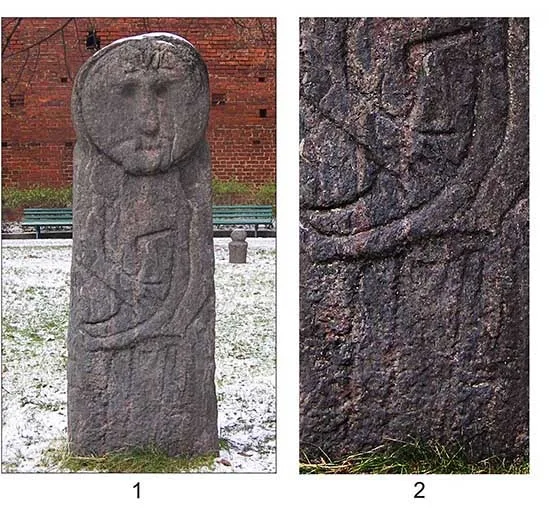
The stone baba from Barciany in the courtyard of Olsztyn Castle, and its details:
a rhyton and a presumed pavise shield. Photo by the author.
True, the latter may have been carved later — at the turn of the 13th and 14th centuries. Thus the general tentative dating of the 11th–13th centuries can be narrowed to the period from the second half of the 12th to the first half of the 13th century — a time of intense clashes of the Prussians with Polish and Danish feudal lords and, from the 1230s, with the knights of the Teutonic Order.
Other images similar to the "babas"
So, the stern images of ancestors and gods have existed for millennia in the archetypes of the subconscious. Perhaps the source of figurative inspiration for the Prussian stone carvers was somewhere nearby. Closer than we think. We know that the Prussians travelled a great deal: Novgorod and Gdańsk, Gotland and Jutland, and many other towns and villages of Northern Europe, early Poland and Rus. The examples of monumental art closest to the Prussian statues and contemporary with them are the bas-reliefs depicting priests and gods of the Western Slavs on the island of Rügen and in Pomerania. First and foremost, this is the so-called "Svantevit/Svetovit Stone" in the church of the town of Altenkirchen near the famous Arkona on the island of Rügen, built into the wall of the 12th–13th-century church and depicting a god or priest (?) with a rhyton or horn of plenty. Similar to it is a stone built into the town wall of Bergen on Rügen, which is usually associated either with Svetovit or with the Rügen prince Jaromar.
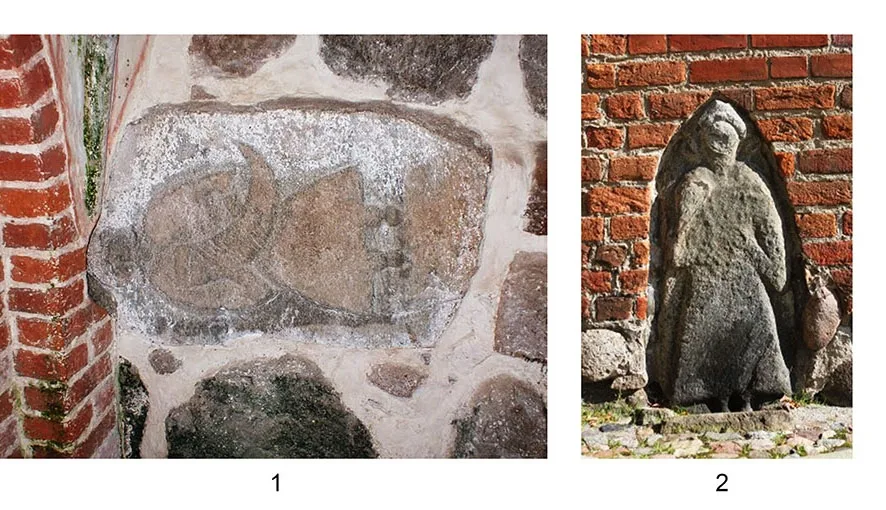 Stone statues of West Slavic gods or priests, 11th–12th centuries.
1. The stone built into the wall of the church in Altenkirchen. 2. The stone in the town wall of Bergen.
Photo by Denis Davydov.
And also some other stones interpreted as pagan, discovered in the Lusatian lands (part of present-day Saxony and Brandenburg) in Northern Germany. Close to the Prussian "babas" are also the wooden "idols" of the first millennium AD discovered in Pomerania and Schleswig-Holstein. Interestingly, at least one of the Prussian statues was also built into the wall of a 14th-century Order church in Prątnica.
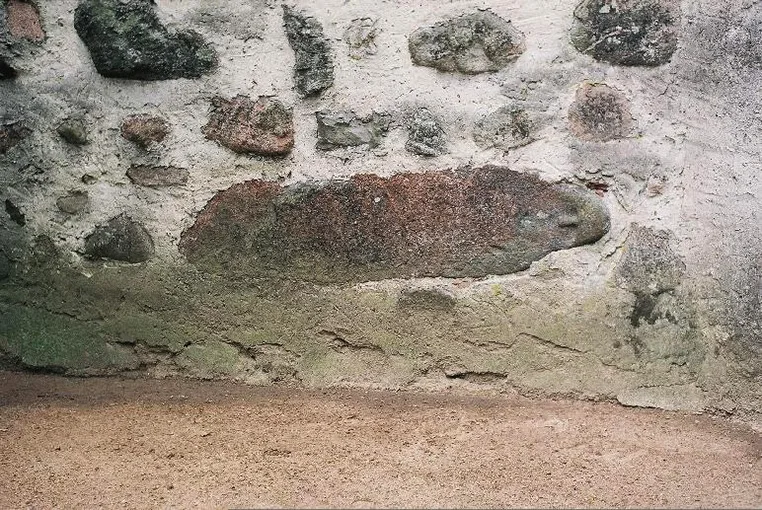
A Prussian idol (?) built into the wall of the 14th-century church in Prątnica, Poland.
Photo by Seweryn Szczepański.
In this way the ministers of the new cult emphasised the subordinate position of the old religion, building churches on the sites of old sanctuaries and partly using pagan attributes and festivals to attract neophytes. But that is not the point here. The craftsmanship of the West Slavic stone carvers of the 11th–12th centuries was considerably influenced by the monumental Romanesque style, whose influence was especially felt in the religious architecture and sculpture of Europe in this period.
The Prussians themselves, well-known travellers, may also have been greatly impressed by the decoration of the early stone cathedrals of Gniezno, Gdańsk, Denmark, Gotland and Northern Germany, and partly adopted the stern expressiveness of the Romanesque image. And of course, earlier Scandinavian rune stones may have served as a source of inspiration. In particular, the Gotland picture stones of the 5th–12th centuries could not fail to catch the attention of Prussian traders.
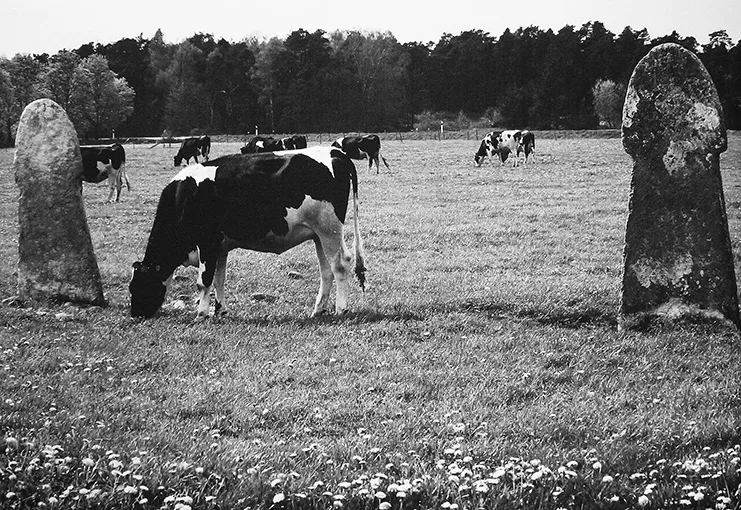
Gotland picture stones of the 9th–11th centuries in the landscape.
Photo: Gotland Museum, Visby.
Thus ancient archetypes, the geometric character of the Prussian style and external influences were embodied in primitive but expressive sculptures of ancestors, chieftains, gods or heroes that stood on the southern borders of the Baltic linguistic area.
The functional significance of the stone "babas"
One of the problems in interpreting the Prussian stone sculptures is that by the 18th–19th centuries none of them was any longer in its original place. And one can only guess at the original position and significance of the "babas". Judging by the period of their creation and their visual range, they must have had a cult significance. But what kind? A likely clue may be the find of a stone resembling an anthropomorphic statue, together with contextual pottery of the 11th–12th/13th centuries, during Mariusz Wyczółkowski's excavations at the foot of the hillfort-sanctuary of the Bartian Prussians at Poganowo (near the town of Kętrzyn).
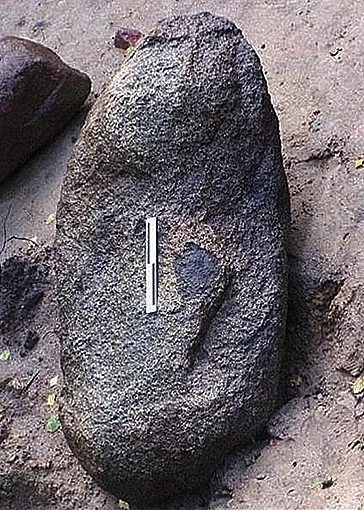
A presumed stone statue found
at the foot of the Prussian hillfort of Poganowo, near the town of Kętrzyn.
Photo by Mariusz Wyczółkowski.
The stone itself, admittedly, barely resembles the well-worked images of the Prussian sculptures; it looks more like the Bronze Age "stelae" from the Black Sea region and Crimea. We are probably dealing with a natural stone that has certain "human" features and was therefore placed by the Prussians within the sacrificial site. Perhaps some of the Prussian stone "babas" really may have stood within known cult centres, since a similar sculpture in the southern part of Prussia is mentioned in one of the Order's documents as a sacred object.
There is also a hypothesis by the Olsztyn researcher of Prussian antiquities Robert Klimek that the Prussian stone "babas" may have stood at the crossroads of the most important roads, trade routes and other lines of communication, including those connected with pilgrimages to holy places before the arrival of the crusaders. It is also interesting that the greatest concentration of Prussian stone "babas" is in the region of Pomesania-Sasna, close to the Balto-Slavic borderland. Perhaps these monumental sculptures were a kind of marker of the border of the Prussian lands as the Prussians advanced southwards.
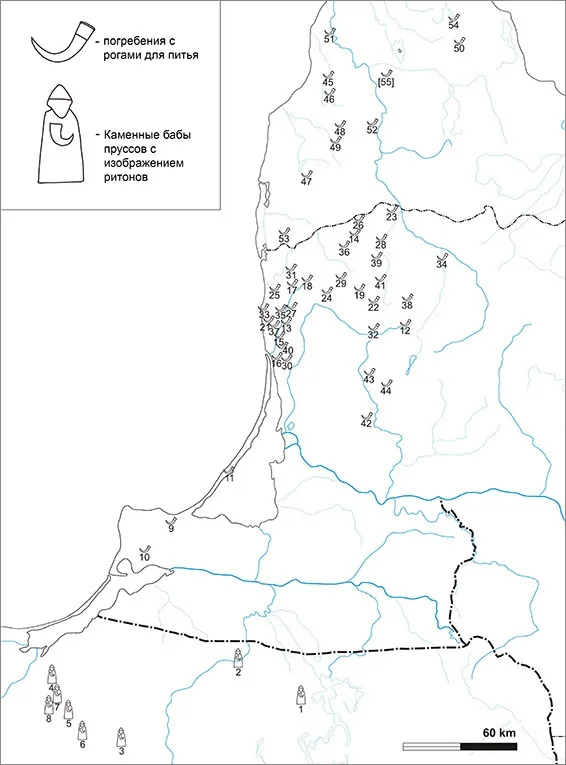
Distribution map of burials with drinking horns —
rhytons — among the Curonians and Prussians in the 10th–13th centuries. In the lower left corner is the zone
of the main concentration of the most expressive Prussian sculptures.
Figure from the author's dissertation, 2012.
It is known that the relations of the Prussians with the Polish feudal lords in the 11th–13th centuries were far from peaceful, although they did not rule out the participation of Prussian retinues in the fratricidal internecine wars of the Poles.
In the Middle Ages and the modern era new interpretations of the images of the Prussian sculptures appear, and their original meaning becomes less and less understood as time passes. Hence the shallow, yet not devoid of charm and partly of historical context, legends of "Bartel and Gustabalde" (the "babas" from Bartoszyce), the "Nasty Girl from Skirwitten" and other people turned to stone for their misdeeds and sins. Thanks to his conical helmet, Bartel even managed to play the role of a sculpture of a bishop, being adorned with a real golden tiara in the 18th–19th centuries (which is why holes for fastening it appeared on the side of the sculpture's head). By the end of the 19th century many of the sculptures had been taken from their then locations and placed in the open-air displays of the museums of Danzig and Königsberg. A small anthropomorphic stone from Jelitken/Jelitki, depicting a bearded man in a cap (?), from the old collection of the Prussia Museum, was found in the ruins of Königsberg Castle and is now kept in the Kaliningrad Museum of History and Art.
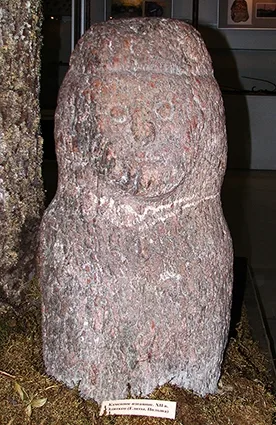
Anthropomorphic statue from Jelitken (Jelitki)
in the old archaeological display
of the Kaliningrad Regional Museum of History and Art.
Photo by the author, 2008.
Stone "babas" in the Kaliningrad Region
Judging by historical sources and archaeological data, no stone "babas" are known in the Kaliningrad Region today, apart from the stone from Husehnen discussed above. There is, it is true, a mention of a "cult stone" near the village of Pribrezhnoye in the Zelenogradsk District, said to bear the image of a human face. The stone was found during archaeological surveys carried out by Vladimir Kulakov in 1977. Since the stone itself, according to later mentions by this author, has not survived, it is difficult to judge its authenticity from the drawings and photograph provided3.
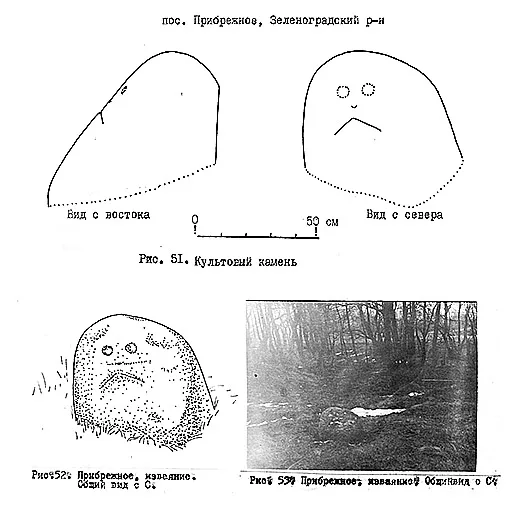
The stone from the village of Pribrezhnoye in the Zelenogradsk District.
Drawings and photo from V. Kulakov's report, 1977.
On the other hand, in one of his historical guidebooks to the Kaliningrad Region Vladimir Kulakov mentions another curious stone, which today stands not far from the town of Svetlogorsk in the village of Salskoye/St. Lorenz, by the ruins of a church destroyed in the post-war years. It is an elongated "stele", flattened at the sides, which from a distance resembles the Prussian stone "babas" in shape. However, the stone is smaller and has no obvious anthropomorphic features or other details characteristic of those sculptures. On the belly and back of the stone, crosses in a shield are carved, as well as the Latin letters A.H., which may indicate that the stone was used as a boundary stone placed on the borders of Order and church lands or of old allotments — though this remains open to question. It is not known, however, by whom and when these symbols were carved on the stone, or when it came to be by the church. Vladimir Kulakov interprets the stone as an unfinished Prussian stone "baba", which may be indicated by the rudimentary "arms" on the sides of the "statue", and by the "knocked-off" and smoothed front, "adorned" with an Order (?) cross in a shield, with a rounded protrusion at the top. All in all, like the Prussian stone "babas" themselves, the stone from Sankt Lorenz leaves more riddles than real facts.
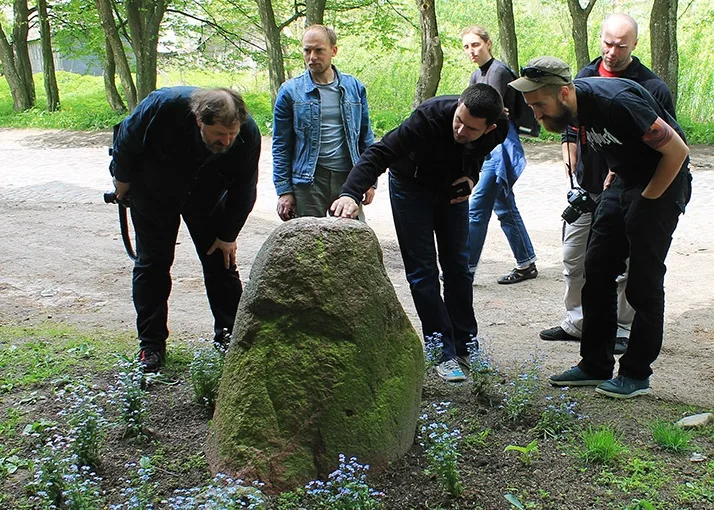
Participants of the international scholarly conference Natural Holy Places,
held at the Kaliningrad Regional Museum of History and Art,
examine the stone from Sankt Lorenz. Photo by the author, 2012.
In recent decades our Polish neighbours have taken up the active popularisation of the East Prussian historical heritage. They have not passed by such a visually striking phenomenon as the Prussian stone "babas" either. The most popular has become the round-faced sculpture from Barciany, now in the courtyard of Olsztyn Castle. Plaster replicas of this sculpture, sometimes in quite unexpected colours and unusual interpretations, regularly turn up in the public spaces of Olsztyn, and also in small-scale form as key rings and other knick-knacks.
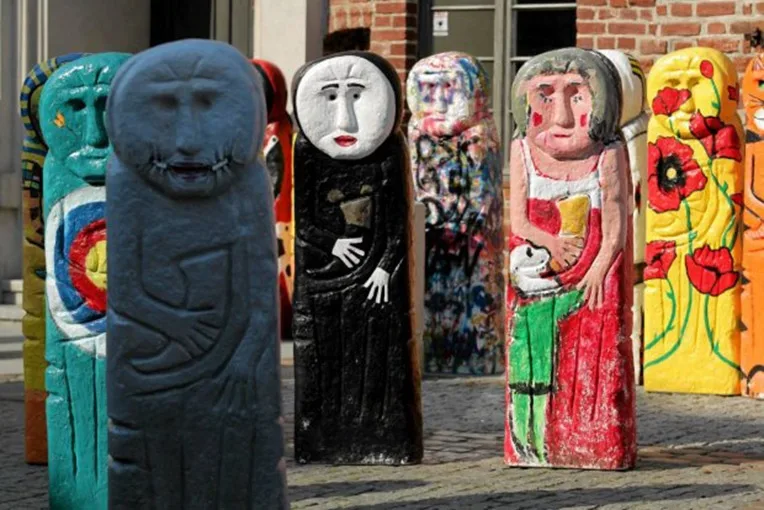
"Parade of Prussian Babas". Replicas of the statue from Barciany on a street in Olsztyn.
Photo by Tomasz Waszczuk, Gazeta Wyborcza, 2012.
And the "Prussian Babas" jewellery collection by Anna Szewczuk-Ciesielska (Studio TT, Elbląg), which uses the images of the sculptures from Barciany and Mozgowo, won a prize a few years ago as the best "Souvenir of Warmia-Masuria" and has become a calling card of the Warmian-Masurian Voivodeship.
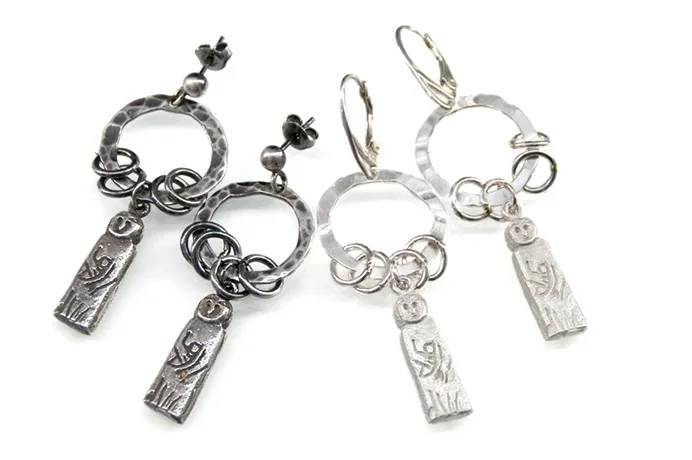
The stone baba from Barciany in Anna Szewczuk-Ciesielska's jewellery collection.
Photo: Studio TT.
Some like it, some do not, but the main thing is that the heritage of the Prussians, taking on new and sometimes quite unexpected forms, lives on and continues to attract the attention of lovers of ancient history and art.
I will tell you about the legends, myths and folk tales about the Prussian stone "babas" in my next article.
______________
1. Some translate the Turkic "babá" as "father, dad" or "ancestor". The Polish baby kamienne is close to their German name Steinbaben, hence the Russian "kamennye baby" ("stone babas").
2. The Museum of Prehistory and Early History is in many respects the heir of the Königsberg Prussia Museum, since it holds a significant part of the latter's "study" collection, taken away at the end of 1944.
3. One can only add that in the summer of 2005 staff of the Sambian Archaeological Expedition of the Russian Academy of Sciences, without much difficulty, made a copy of this remarkable pseudo-Prussian statue from the drawing in V. Kulakov's 2003 book; it was nicknamed "Pikachu" and became an indispensable festive attribute during the excavations of the 2005–06 season. The further fate of the statue, like that of its prototype, is unknown.
Translated from Russian with the help of AI (Claude, Anthropic), October 2026.