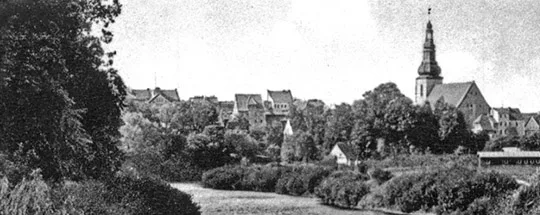
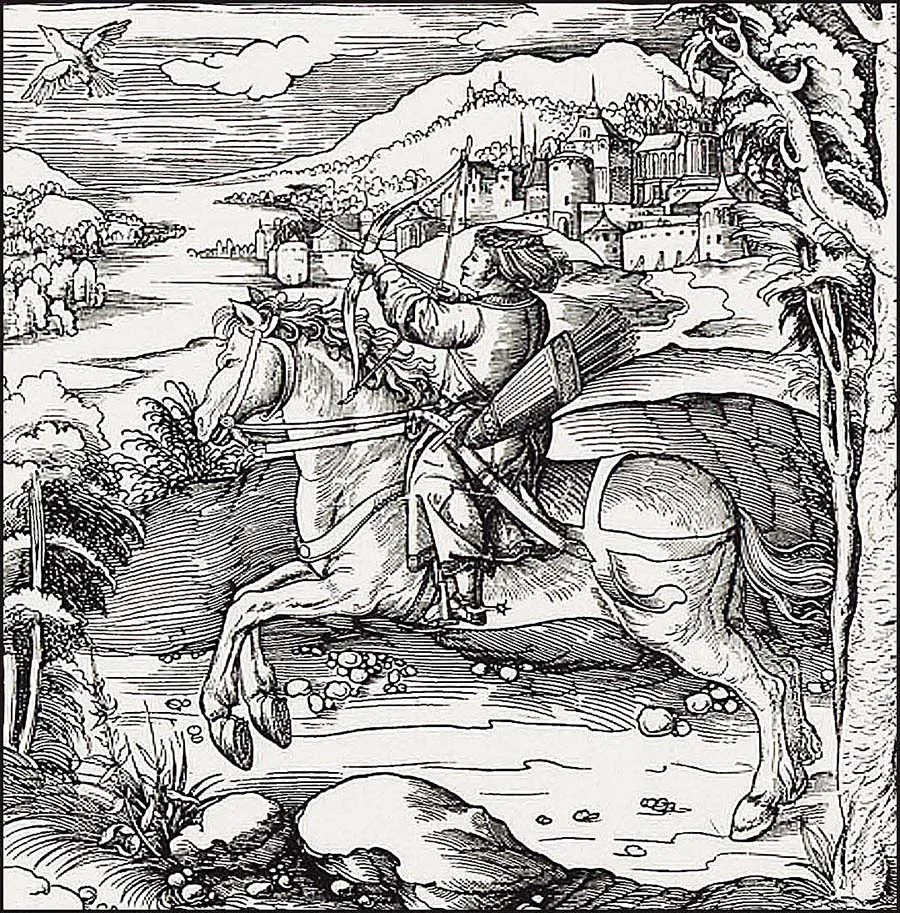
The local peasants try not to go near the hill in the evening and at night, keeping well away from it. They claim that something strange happens there at those hours. A black cow with fiery horns runs headlong, and close on her heels races a wild black cat, ceaselessly driving her on before it. Others claim that the cow is pursued by a black knight on horseback who keeps lashing her with a whip. People often see the two of them at midnight wandering through the thickets on the hill near the summit, and anyone who stood in the way of these phantoms lost his life. This has happened more than once to those who searched at night for the gold buried on Kamswikus.
Both the wild cat and the fiery cow were once people — the pagan prince Kamswikus and his wife. People say that this prince had a cruel and unbridled temper. From his raids on Christian lands he brought back much booty, gold and jewels, as well as captives, young men and maidens, whom he sacrificed to the gods. His wife at first sight seemed merciful and kind; she cared for the poor and the sick and brought food and medicine to their huts, but all this was pretence and deceit, and the woman was a villain worthy of her husband.
God alone knows how it came about that this wicked couple had a son blessed with the grace of kindness, mercy and meekness, and his name was Medus.
In those days the Christian faith began to spread across the land of the Prussians; here and there monasteries began to spring up, and the hermitages of monks began to appear in the forests.
Once, while hunting in his father's domains, Medus met one of these monks and made friends with him. But he told his parents nothing about it, for fear that they would order the monk to be killed. Yet the change in her son's character did not escape his mother's eyes, and she never stopped trying to find out why his eyes now shone so brightly and where the gentleness in his manner had come from. And in the end Medus did tell her about his new friend, making her promise to keep the secret. His mother assured her son that she would tell no one, and that she herself would do all she could so that his father would never again be cruel to people.
Medus was happy to hear her assurances. He could not even imagine how she intended to keep her promise, for his mother seemed to him the complete opposite of his father.
The lady of the castle very soon had the chance to keep the promise she had given her son, when Kamswikus collapsed senseless with drink at a feast.
The mother ordered the servants to seize him and wall him up alive in the castle dungeon. For several days the desperate cries of the condemned man were heard in the castle, but soon they fell silent.
But this was not what Medus had asked for, and he had not wanted his father to die at all! Yet his pleas to his mother to let his father see the light of day again were in vain. His mother answered hypocritically that her husband could not be changed and that he had deserved such a death.
The son tried to understand how he was to go on living, for he still could not believe that his mother was capable of such a crime. He persuaded himself that she must have embraced the new faith too zealously and was therefore determined to punish with death anyone who remained loyal to the ancient gods. In the end Medus decided that he could find answers to all his questions only at the old monk's forest hermitage, and he asked his mother's permission to go there. The princess did not try to dissuade him. But when Medus came to the hermit three days later, he saw that the hermitage had been destroyed and the monk lay dead among its ruins. The murderers sent by his mother had been quicker and nimbler!
In a single hour Medus had lost everything: his father, his mother and his friend, and, to atone for the terrible crimes of his parents, from that hour on he took no food, renouncing life.
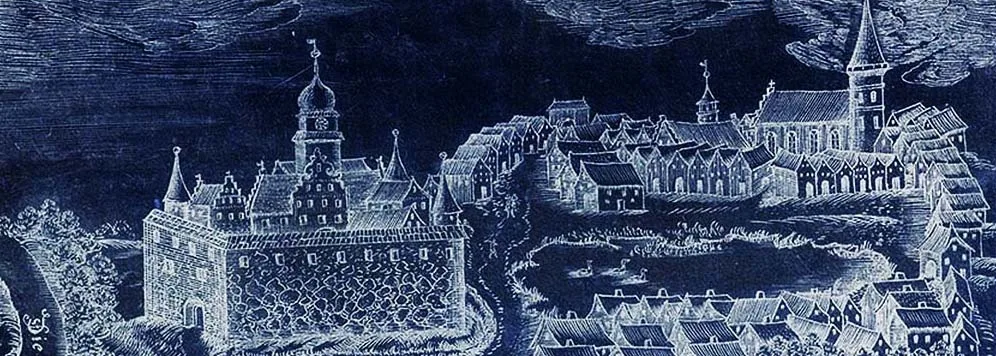
At the moment he gave up the ghost, a bolt of lightning destroyed the pagan castle, and a curse brought Kamswikus back to life in the skin of a wild forest cat, while it condemned his wife to take the form of a cow with fiery horns, which this black cat now pursues for all eternity.
The curse, people say, was sent down on the wicked pair by the ancient pagan gods as punishment for their crimes. But wise men who believe neither in ghosts nor in phantoms nor in any other supernatural phenomena claim that what glows on the hill at night is not the fiery horns of a black cow but St Elmo's fire — electrical discharges in the stormy air that appear around pointed objects. But, we would say, if they are seen on the masts of ships and on church spires, why should these lights not flare up on cows' horns on the hill of Kamswikus too?
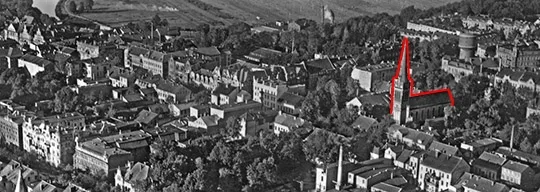
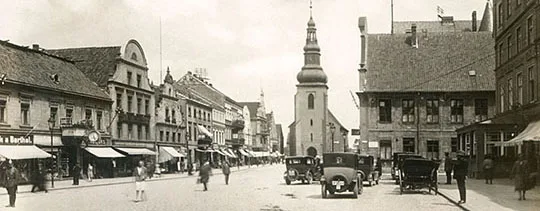
And people raised a monument to the son of the cruel lord of the hill. It is believed to be the very iron cross that was found later and is now kept in one of the churches of Insterburg. Medus was buried at the foot of Kamswikus, where his family's ancestral castle once stood. On the grave lies a huge boulder twenty-five feet long and twenty-five feet wide. And to this day Lithuanian and German songs praising the young man's nobility and death have not been forgotten in Insterburg.
SOURCES
1. Tettau/Temme collection. 1837. Folk Legends of East Prussia, Lithuania and West Prussia. (W.J.A. v. Tettau und J.D.H.Temme. Berlin. 1837. Die Volkssagen Ostpreußens, Litthauens und Westpreußens.)
2. Christian Krollmann. The Book of Legends of East Prussia. 1915. (C. Krollmann. 1915
Ostpreußisches Sagenbuch. )
3. Legends of Mecklenburg-Western Pomerania. (Sagen aus Mecklenburg-Vorpommern.)
● Editor's note: Read on VisitPrussia.com an interview with the translator of German and, in particular, Prussian fairy tales, our regular contributor Tatyana Kolivay, who runs her own blog, where countless other parables, legends and fairy tales in her translations have been published.
Translated from Russian with the help of AI (Claude, Anthropic), October 2026.