Gratitude can take various forms, the least burdensome – and therefore, alas, the most common – being the recitation, on assorted solemn occasions, of stock phrases seasoned with two or three well-known quotations from the philosopher.
Both phrases and quotations wear thin with frequent use and lose their content; behind their monotonous heap the image of the real man is lost. The city's most famous resident turns out to be unknown.
Listening to yet more solemn words about Kant's greatness and his importance for the modern city, looking at yet more costly schemes to perpetuate his name, one can't help wondering: wouldn't Kant himself have preferred the fate of his friend and philosophical opponent Johann Georg Hamann, another great Königsberg philosopher, whose memory in Kaliningrad is hidden from the idle public? From what we know of Kant, it is clear that modesty was a constant feature of his personality, and respecting it is the first duty of gratitude.
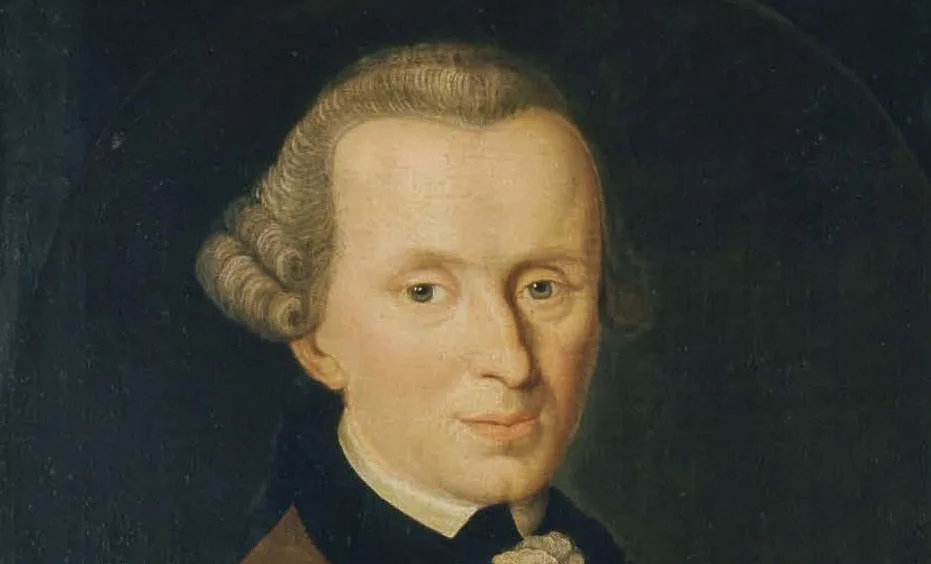
Emanuel Kant was born, of course, in 1724 in Königsberg – but from here on we will try to skip the well-known facts in favour of little-known ones. It is not widely known, for instance, that for the first twenty-odd years of his life Kant bore the name Emanuel, changing it of his own accord only around 1746. The young Kant, who by then had studied the ancient languages well, believed that "Immanuel" rendered more accurately the sound of the Hebrew expression "God with us" from which his name derived. He had received it, without any flights of fancy, according to the church calendar, from his parents, the hereditary harness-maker Johann Georg Kant and Anna Regina, née Reuter. His parents' origins and occupation meant that he himself could expect to become a harness-maker, a clergyman or, at best, a Prussian official. As in today's Kaliningrad, in the Königsberg of that time an official's career was often seen as – given a certain dexterity – a comparatively undemanding way of gaining prosperity and position.
Dexterity of that sort was out of the question in the Kant family: his mother's piety, a strict upbringing and the family's active immersion in the life of the local Pietist community steered Kant from early childhood towards the path of a clergyman.
Living in the craftsmen's suburb near today's crossroads of Leninsky Prospekt and Polotskaya Street, Kant began, at the age of eight, to attend a small school attached to the hospital, where the only teacher was the local pastor. The beginning promised little, but Kant's abilities were noticed by one of the leaders of the local Pietists and the family's patron, Franz Schultz, who helped him get into the prestigious Collegium Fridericianum, a gymnasium that prepared pupils for university and a subsequent career in the church or the civil service. Kant recalled his years at the gymnasium with unvarying disgust. The religious atmosphere was to blame: Pietism calls for a deep and emotional attitude to faith, and the teachers made zealous efforts to "awaken" it in their pupils. After such an upbringing, Kant for the rest of his life appeared in church only when circumstances left no way out. Yet despite the psychological pressure, Kant was an impeccable student. His achievements in Latin were particularly convincing, and the Roman classics remained his favourite reading all his life.
It is not known what subject Kant enrolled in at university in 1740 – the faculty was never entered next to his surname (and even the surname was misspelt as "Kandt").
But that hardly matters, because in those days everyone's education began the same way, with philosophy. By the end of his first year, Kant was firmly resolved never to part with it.
He carried out that resolution to the full.
Entering university meant a change of status for Kant: he moved from the ranks of craftsmen into the circle of men of learning, and his life was now regulated not by the guild community but by the university. From then on he was surrounded by eminent professors, energetic lecturers and merry students. Kant gladly joined their company, though, according to the recollections of his friends of the time, he was not particularly keen on drinking bouts, fencing and other student pursuits. By his senior years he had earned authority among the younger students, whom he helped with difficult subjects. For Kant this was also a way of earning money, which he badly needed in those years: his father was ill, and he could count only on his own efforts and on help from the brother of his mother, who had long since died. His friends recalled Kant's straitened circumstances and how calmly he bore them.
Things became really difficult for Kant in 1748, when his father died and he had to take on the care of his younger sisters and brother. Kant had barely finished university and, before he had even defended his dissertation, was forced to become a private tutor. He was first hired by Pastor Andersch, a father of five sons, who lived in the village of Judtschen, today's Veselovka, 120 kilometres from Königsberg. Kant spent about three years in Judtschen, after which he moved to Gross Arnsdorf, today's Jarnołtowo in Poland, to tutor in the family of Friedrich von Hülsen.
He returned to Königsberg only in August 1754, having spent about six years away from it, so we will have to say goodbye to the myth of Kant the stay-at-home.
These six years were filled with scholarly work: Kant was writing his first works, evidently intending to find a post at the university. His very first work was published in 1749 and contained profound metaphysical reasoning. But Kant then turned to the natural sciences. Several of his works from the mid-1750s were devoted to cosmology, and one of them, Universal Natural History and Theory of the Heavens, contained a hypothesis on the origin of the celestial bodies that later became known as the "Kant–Laplace hypothesis". We may say that the young Kant was clearly more interested in the starry heavens than in the moral law.
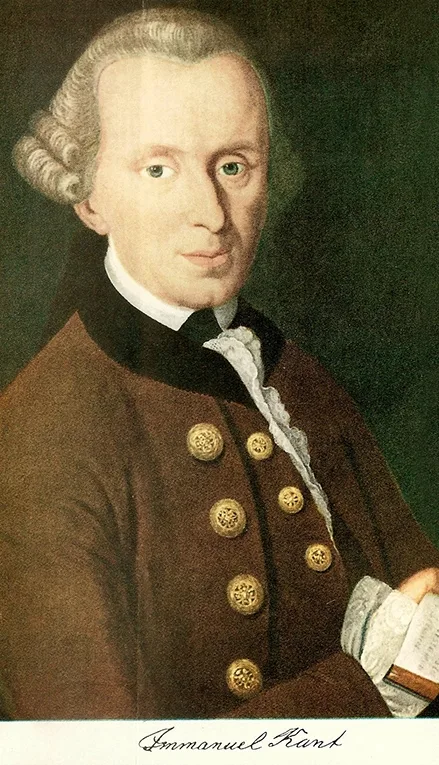
Reflections on celestial bodies did not prevent Kant from immersing himself in the city's social life. Soon after arriving in Königsberg he joined the regular circle of the family of Count Heinrich von Keyserlingk, one of Königsberg's great aristocrats, who had close ties with Russia – first as a private tutor, and then as a friend and conversation partner. The count's wife Caroline painted the first surviving portrait of Kant in 1754, and all his life he called her his ideal of a woman. From this time Kant began to acquire a reputation as the "elegant magister" – a worldly scholar, a salon intellectual able to lend depth to casual conversations on the topics that occupied Königsberg society.
The notion of "elegance" in a man of that era implied, among other things, gallantry towards the ladies. Kant showed such gallantry not only to Caroline von Keyserlingk. One Charlotte von Klingspor, for example, writing as late as the seventies, thanked Kant in a letter for a poem by Christoph Wieland he had once given her, whose content was not merely philosophical.
At least two occasions are known when Kant seriously contemplated marriage, each time, however, deciding against this burdensome step.
No doubt Kant's fate was also shaped by the fact that his humble birth made it impossible for him to marry a woman from the circles in which he moved. Only with time did Kant turn into the old bachelor we know, dropping unkind platitudes about the opposite sex into his texts.
In 1755 Kant defended two dissertations in a row, which gave him the right to teach, and he set about it with great enthusiasm. Interestingly, alongside Logic and Metaphysics, the most sought-after of Kant's courses turned out to be the popular-science Physical Geography, which he gave forty-nine times over his career. Though not, as we know, a stay-at-home, Kant was certainly no keen traveller either, but wide reading, memory and imagination enabled him to offer his audience vivid lectures about distant lands and their customs.
Another popular project of Kant's – alas, one that never came off and is therefore virtually unknown – was a physics textbook for children. The idea came to him in the late 1750s; he discussed it with Hamann and invited him to be co-author. It would have been Königsberg's "dream team", but Kant and Hamann held views that were too different: Kant intended to follow Newton and set out the foundations of mechanism for children, while Hamann was a creationist and warned Kant against "corrupting minds".
Both Kant and Hamann belonged to a community of local men of letters that also included Johann Gotthelf Lindner, professor of poetry; Theodor Gottlieb von Hippel, a lawyer and later mayor of Königsberg; and Johann George Scheffner, an official. This community extended beyond Königsberg, with ties to Riga, Berlin and St Petersburg. Kant also spent a great deal of time in the company of officers – Russian ones during the four-odd years when Königsberg belonged to the Russian Crown, and Prussian ones afterwards. Through giving private lessons, Kant gradually made friends with Generals Meyer and Lossow, and even stayed for several months on the latter's estate. Kant had friends among his colleagues, too – Professor Kypke, for example, who in time grew so sick of teaching that he took up growing onions and carrots for sale instead, or Professor Funk, whose untimely death in 1764 shook Kant badly.
The "elegant" stage of Kant's life lasted until the mid-1760s, that is, until he was about forty. In this period we find no trace in his life of his future famous orderliness:
yes, he spent a lot of time at his desk and gave lectures, but from lunchtime on his attention was devoted to friends, his evenings to cards and billiards, and more than once Magister Kant had trouble finding his way home.
All this began to change in the mid-1760s, when Kant got to know the British merchants living in Königsberg. One of them, Joseph Green, became his best friend. The story goes that their friendship began rather dramatically: as strangers, they were drawn into a political argument about the right of the North American colonies to self-determination; Kant took the side of the future United States, Green challenged him to a duel in response, but Kant argued his position so well that the two disputants made peace and became friends. Green's life was governed by a carefully thought-out system of rules, or "maxims", so friendship with him called for great punctuality. There is a well-known anecdote about how Kant, having arranged a carriage ride with Green, was a few minutes late and, hurrying to his friend's house, saw him drive past without so much as turning his head towards the shouting, arm-waving Kant.
Green, drawing on the theories of British and French philosophers he knew well, believed that a person can be free and possess true dignity only insofar as he does not drift with the current of events but follows rules he has set for himself. This conviction passed to Kant as well. Gradually he too subjected his life to a strict routine, whose first victims were cards and late-night carousing, and among the last, visits to the theatre. Only now did Kant's image take on the features usually attributed to him, and from about 1770 the philosopher set about writing his celebrated "critical" works. But that story is well enough known.
It is time to ask: what does it matter to us ordinary Kaliningraders that Immanuel Kant once lived in this city?
Should we all read the Critique of Pure Reason at once, or start with the Prolegomena to Any Future Metaphysics? What from Kant's life and teaching can be of use to us? We hear the voices of sceptics who for some reason extend their mockery of official "Kant worship" to the figure of the philosopher himself, and the voices of self-styled "patriots" troubled by what they consider the most important fact – that Kant was a German. Both only multiply needless fuss. First of all, our city has been extremely lucky. It is famous not for the name of some notorious tyrant or general, nor at all for the name of the figure in whose dubious honour it is now named. Its chief resident is not a darling of fortune raised to fame by chance, but a self-made man who, through painstaking work of thought and a consistent effort of will, rose to the heights of the spirit from a starting position that promised little. Kant was not bothered by the city's provincialism: he, a harness-maker's son, simply went and put it on the map of world culture. If one tries to name the central idea of his philosophy, it will be not the "thing in itself" or the "categorical imperative", but the idea, understandable to anyone, of human dignity, realised in the free and conscious choice to treat oneself and others with respect. One cannot but admit that this idea is worthy of reverence at all times. And we could honour Kant's memory by, for example, proclaiming that his city is a place where every person is treated as an end and not merely as a means. And by trying to make sure that this is true as often as possible.
Translated from Russian with the help of AI (Claude, Anthropic), October 2026.