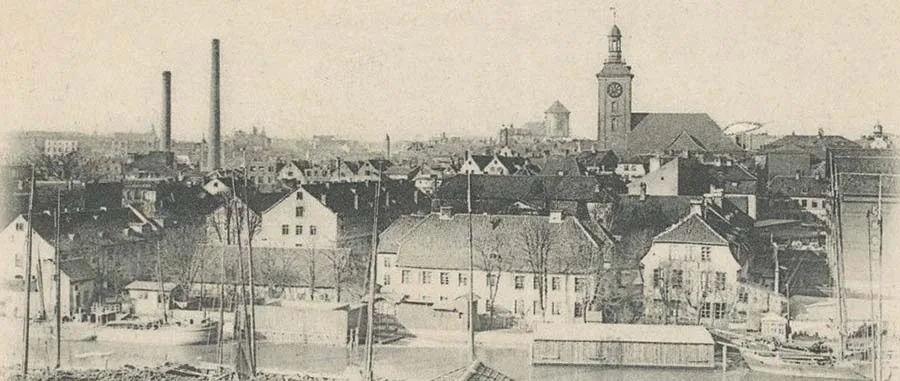
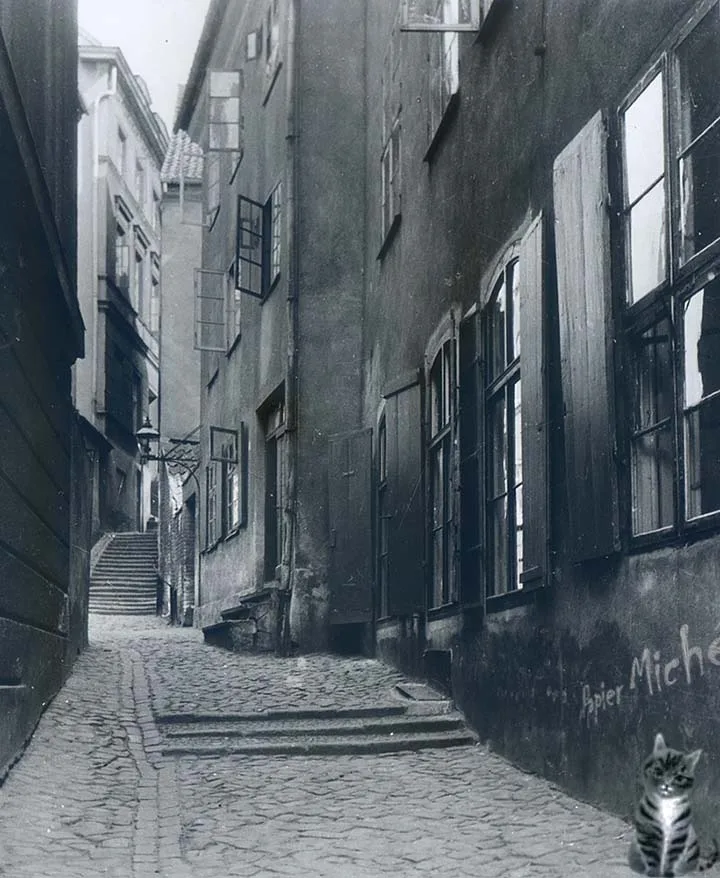
The Löbenicht lane known as Cat's Descent (Katzensteig) could, if one wished, also be called a "corner", for Königsberg had no other alleys quite so narrow and sinister. However, the name hardly derives from its being so narrow that only a cat could pass through it — after all, to our ancestors, who were used to narrow streets, it did not seem all that narrow. Rather, its name indicates that it led to the Cat Brook, which babbled merrily down from the Mill Hill (Mühlenberg).
From the Rossgarten Market (Roßgärter Markt), the top of Cat's Descent could be reached via College Lane (Kollegiengasse) or via Mittelanger.
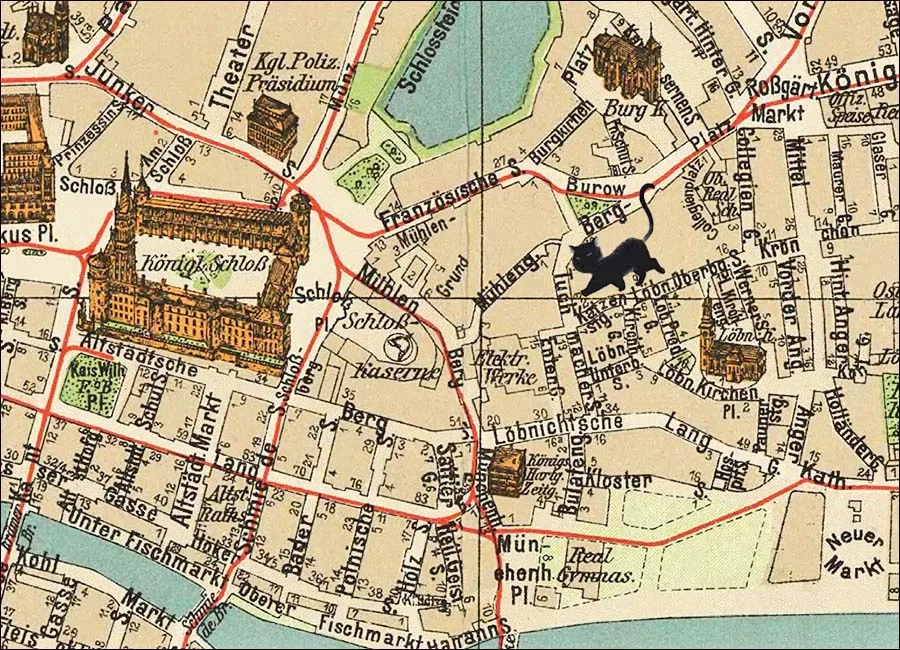 Cat's Descent on a map of 1901. The Rossgarten Market is at top right.
Turning from either of them into Krönchenstraße and then continuing along Upper Hill Street (Oberbergstraße), you would come to the spot where the Crown Gate (Krönchentor) once stood — a low building with a gable roof and a small pediment, which was demolished only in 1814.
The house beyond the gate, on the corner of College Lane and Upper Hill Street, had in its day been the Community Garden of Löbenicht (Löbenichtscher Gemeingarten) or, in modern terms, a guild club. On the inside of the door hung the following inscription:
"Here in the people's garden, so they tell,
the dark beer is a treasure — mark it well!
Who doubts my word, let him come by as well
and drink his fill of black beer for a spell!"
«In diesem Garten ingemein, Sagt man,
soll das best' Schwartzbier seyn;
Wer's nicht will glauben, wag' daran Ein'
Zech' und sey nur friedesam».
Until almost 1900, the old hall of the Community Garden was used for dancing and fencing lessons. On 7 December 1840, Hermann Goetz (Hermann Gustav Goetz, 1840–1876), composer of the opera The Taming of the Shrew, was born in this house. A memorial plaque dedicated to him hangs on the modern building standing on the same site.

Beyond the gate the street narrowed, stone steps led downwards, a gas lamp glimmered dimly on the wall, and you could purr a little if you felt like it — this was it: Cat's Descent.
Emerging from the gloom onto Clothmakers' Street (Tuchmacherstraße) and crossing it, you came to the crooked Duck Lane (Entengasse), which led to Löbenicht Long Street (Löbenichtsche Langgasse). Leaving the poet's house1 behind, you went on into Bullaten Lane (Bullatengasse), leading to the Monastery Yard square (Münchenhof), where, leaving the old ways behind, you found yourself amid the bustling whirl of the present day.
Although Cat's Descent lacked the poetry of similar alleys in Passau or Danzig, it nevertheless became the setting of an old legend that undoubtedly goes back to the time of the dukes, or perhaps even to the last days of the Teutonic Order:
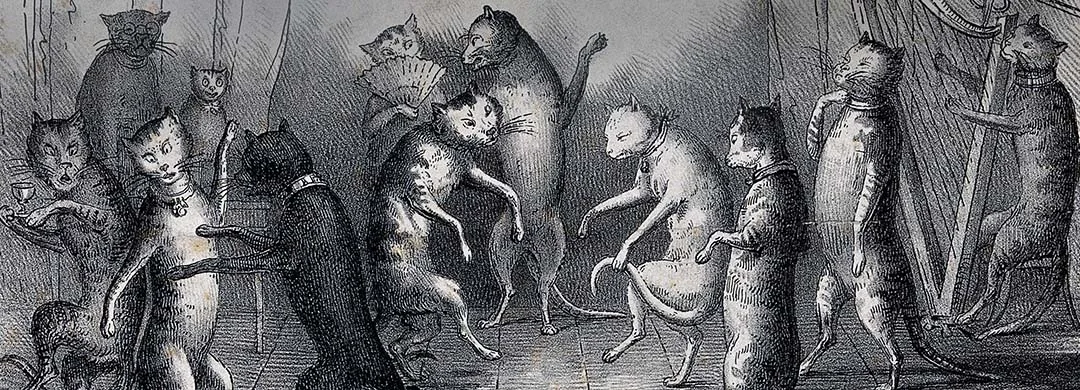
Night after night, two cats rolled down the narrowest lane in Königsberg to the Pregel in a brewing kettle, and then floated away in it somewhere downstream. The watchman on the old Wood Bridge often witnessed this spectacle, and rumours spread. A young brewer's helper from the street On the Hill followed them and told what he had seen to everyone he knew, including his mistress, who happened to be the wife of the brewer whose brewery stood on that very hill. Soon afterwards, as the helper stood by the brewing kettle, a big cat came up to him and, purring, began to rub against his legs, and then suddenly tried to push the lad into the kettle. The terrified brewer's helper crossed himself and, summoning his last strength, hurled it into the boiling beer. The next day the brewer's wife was found dead in the kettle, boiled. She was one of the witches who turned into cats and played their devilish tricks on the Pregel.
TRANSLATOR'S NOTE
1. Presumably the author means the house marked with a memorial plaque at Löbenichtsche Langgasse 12, where Heinrich von Kleist (Bernd Heinrich Wilhelm von Kleist, 1777–1811), a writer, poet and playwright popular in his day, lived in 1804–1806.
Translated from Russian with the help of AI (Claude, Anthropic), October 2026.