If you stop and think about it, Kaliningrad is an entirely accidental city. Its history could have turned out differently, it could have had a different name, and it could have looked quite unlike it does now.
It simply so happened that, at the end of the Second World War, East Prussia and its capital were annexed to the USSR; Stalin simply decided to “award” ancient Königsberg the name of a hapless old man who played the jester at Kremlin drinking bouts, and did so; and the new inhabitants of this land simply tore down some of what their predecessors had built and left the rest standing. What guided them? Ideological considerations? Partly, yes. But in most cases the fate of any given building was decided by blind chance.
On the whole, as we can see, fate treated Königsberg very harshly. The city has virtually disappeared. By and large, all we can show visitors are a handful of architectural monuments that have survived from before the war. And a significant share of them are the work of the German architect Heitmann. How did that come about? Also, in essence, by chance…
Defiantly sharp, conspicuously not ours
Friedrich Heitmann (born on 27 October 1853 in the Westphalian town of Ahlen) built a great deal in Königsberg, and did so with relish. About two thirds of the villas of Amalienau were built to his designs. But Heitmann’s chief pride (and, for that matter, ours) is of course his churches. Three have survived to this day: the Königin-Luise-Gedächtniskirche, the Queen Louise Memorial Church (today the Puppet Theatre); the Adalbertkapelle, the Chapel of St Adalbert (a laboratory of IZMIRAN); and the Kirche zur Heiligen Familie, the Church of the Holy Family (the concert hall of the Kaliningrad Philharmonic).
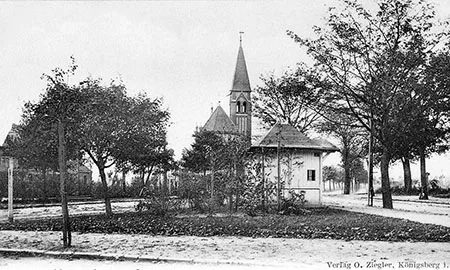
The Queen Louise Memorial Church appeared in Königsberg at the turn of the 19th and 20th centuries, in 1901. The style in which it was built is described as Neo-Romanesque.
That said, some specialists detect elements of Neo-Renaissance and Art Nouveau in it. Be that as it may, the townspeople quickly grew fond of it, and once construction was complete Heitmann’s reputation as a great master was firmly established.
During the Second World War the building, like the whole city, took a heavy battering, but it held out. The local Party leadership, however, does not seem to have been especially pleased by this. The church’s spire — defiantly sharp, conspicuously not ours, not Soviet — was a thorn in their side, which in the end led to an order to solve the problem with dynamite.
A sapper’s heroic deed
Everything pointed to this work of Heitmann’s being blown sky-high, just as many other architectural masterpieces of Königsberg had been before it. The church was lucky, however, in that the job of demolishing it was given to a young army sapper, Grigory Zatserkovny.
And the point is not that he was a poor demolition man. On the contrary, he was a very good one. It was simply that Zatserkovny cared what he was blowing up. And that set him apart from most of his colleagues. Many, many years later Grigory Moiseyevich recounted that he could not bring himself to destroy such a beautiful building, so he reported to his superiors that the church could not be demolished because neighbouring houses might be damaged in the process.
This, of course, was untrue. Zatserkovny’s experience and skill would have allowed him to “drop” the church gently without harming anyone. But he decided to use a ruse. Who knows how it all might have ended for him? Quite possibly, had the deception come to light, the sapper would have lost not only his rank but his freedom as well. Those were by no means gentle times.
Against the current
For a long time the Luisenkirche stood half-ruined and abandoned. In the late sixties the city and regional authorities grew tired of this and decided to set up a puppet theatre there. The design was entrusted to the architect Yuri Vaganov. The work progressed with difficulty, because the local Party bosses kept interfering in the process, demanding that the theatre be made to look as little like a German church as possible. No spires, no Neo-Romanesque style, no hints of this land’s pre-war past.
Vaganov, however, had his own view on the matter, and despite serious pressure from all manner of officials he managed to defend it. And things could have turned out quite differently had the project been handled not by Vaganov but by someone else — more pliable and inclined to compromise. Guided by simple worldly wisdom, such a person would not have argued with the Party functionaries but would have done as they said. He would have removed what had to go and added what had to be added.
And what would be standing in Central Park today would not be Heitmann’s church but some faceless box.
Nobody would have died of it, of course. The sky would not have fallen, and the Pregolya would not have flowed backwards. On the contrary, many people would probably have found the new building perfectly tolerable. And the architect, giving interviews today, would probably be saying that preserving the church in its original form had been technically impossible, and that in any case a sharp spire simply did not go with the idea of a puppet theatre, so it had to be removed. You do understand, don’t you? And we, of course, would have understood, accepted and forgiven.
Fortunately, though, there was no need for that, because Zatserkovny, Vaganov and a great many people who helped them managed to preserve this city landmark almost exactly as Heitmann built it.
An observatory, prosthetic limbs and an organ
Heitmann’s two other places of worship — the Chapel of St Adalbert and the Church of the Holy Family — have had somewhat similar (though certainly less dramatic) fates.
The first was founded in 1902 and ceremonially opened in 1904. Twenty-eight years later an extension was “attached” to it that turned out to be almost twice the size of the chapel itself. The whole ensemble was named the Adalbertkirche, the Church of St Adalbert. During the Second World War the extension was almost completely destroyed, and the chapel lost its spire. Perhaps it was this that allowed it to survive: after all, without a spire a church does not look all that ideologically harmful. For a time the chapel housed an organisation that made prosthetic limbs for the disabled, and later a laboratory of IZMIRAN’s magnetic and ionospheric observatory moved in.
Then again, the high spire of what is probably Heitmann’s best-known church — the Church of the Holy Family (completed in 1907) — survived the fierce fighting and did it no harm even in Soviet times. Perhaps a role was played here by the fact that the church stands away from the city centre and, being somewhat hidden behind the surrounding houses, does not catch the eye very much.
Whereas the Queen Louise Church can be seen from afar, the splendour of the Church of the Holy Family can only be appreciated by walking right up to it.
The building is designed in the Neo-Gothic style (before setting to work on the design, Heitmann spent a long time studying churches built in the days of the Teutonic Order) and is perfectly symmetrical, which is not entirely typical of the architect’s work. Heitmann intended the church to be warm, homely and bright, and above all to convey the atmosphere of Christ’s earthly family. And he seems to have succeeded. The church turned out remarkably joyful. It is said that no funeral services were ever held there. Only baptisms and weddings.
Immediately after the war the Church of the Holy Family was used as a warehouse. A few decades later, however, the architectural monument found a more worthy use. In the late seventies a large-scale reconstruction began (led by the architect Pavel Gorbach); it was completed in 1980, after which the Philharmonic moved into the former church. Two years later an organ by the Czech firm Rieger-Kloss was installed there, whose pipes, thanks to the hall’s superb acoustics (undoubtedly Heitmann’s achievement), are capable of producing a truly fantastic sound.
No church, no problem
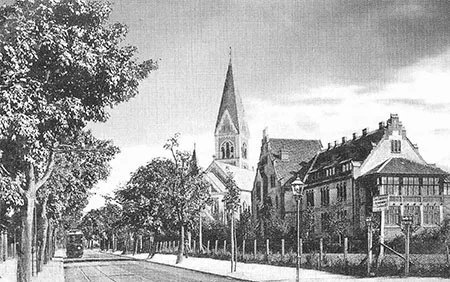
Fortune, however, did not smile on all of Heitmann’s churches. Sadly, his last work — the Lutherkirche (Luther Church), built in 1910 — can only be seen in photographs. Today there is nothing on the spot where it stood (roughly opposite the Moskovsky District administration building). Just an empty lot.
The bitter irony is that this church had a far better chance of a long life than its sisters, since it was practically undamaged during the war. Yet in 1976 the slender, beautiful and still very sound building was blown up without any explanation.
There were reasons, though, or so they say. According to one version, the church was destroyed because the local Orthodox believers had laid claim to it. Supposedly they wrote a letter “to the top” asking for the church to be handed over to them, since it stood empty anyway and the faithful had nowhere to pray.
It should be noted that in Soviet times the Kaliningrad Region, which did not have a single functioning church (the first one opened here only in 1985), was considered the most atheist region in the country.
The regional Party leadership was very proud of this “achievement” and was determined not to cede first place to anyone on such an important matter. And so, apparently, it decided to get rid of the church. Because if there is no building, then there is, so to speak, nothing to hand over to the believers.
All in all, one may suppose that had the Orthodox asked not for the Lutherkirche but, say, for the Church of the Holy Family, there would now be a vacant lot in its place too. Or perhaps some shopping centre.
Forgotten in his own lifetime
Few people today remember the Lutherkirche. Its architect’s name, too, is known to only a few. To be fair, though, it should be noted that Heitmann was forgotten not in Soviet times at all.
The architect’s star began to wane after the First World War, from which he returned a gravely ill old man. He was constantly unwell and therefore unable to work. Very soon his savings ran out and poverty set in. Heitmann had to sell his villa in Amalienau and move into a small parsonage he had once built next to the Chapel of St Adalbert. It was there, in fact, that he died in 1921. The famous architect was buried quietly, without honours, in a cemetery (near present-day Lesoparkovaya Street) of which not a trace remains today.
So there is nowhere to lay flowers on Heitmann’s birthday, 27 October — although I think there would be no shortage of people wishing to do so…
Translated from Russian with the help of AI (Claude, Anthropic), October 2026.