The “Salt” Monopolist
The history of the Beynuhnen estate is still full of blank spots and mysteries. Ever since the Middle Ages this land was highly prized. It belonged in turn to the Schlieben family, then to the Lehndorffs and the Dönhoffs, and finally to the Farenheids, the wealthiest merchant family in all of East Prussia.
One of the family's ancestors moved to Königsberg from Rostock, presumably around 1500, and settled firmly in the Kneiphof. Sadly, neither his name nor the dates of his birth and death have survived. The first to be mentioned in the chronicles is the “salt” monopolist and commercial councillor Friedrich Reinhold Farenheid. The salt trade brought in a great deal of money, and by supplying salt to the front during the Seven Years' War the merchant grew his fortune. He spent it mostly on buying land and property in the south-east of the province.
In 1760 Farenheid was elected to the board of the city council, and three years later King Frederick II appointed him Prussian Commercial Councillor, with a seat and a vote in the Kommerzkollegium, in recognition of his remarkable character, erudition, foresight and business acumen, as well as his honesty and integrity. Reinhold was indeed an exceptional man: kind towards others but extremely demanding of himself.
A dedicated philanthropist, he founded a poorhouse in Königsberg, bearing the entire cost of its construction himself, and donated 50,000 guilders to support the needy, a considerable sum in those days.
The Move to Beynuhnen
His only son and heir, Friedrich Wilhelm Johann, was destined for a career in the civil service. Defying his father's wishes, however, he secretly enlisted in the “Black Hussars”. As punishment for his disobedience, Reinhold threatened to disinherit the young man and leave his entire fortune to charity and the needs of the city. Only after earnest pleading by relatives not to punish his son so harshly did the father relent.
Thanks to the efforts of a family friend, General von Lossow, Friedrich was released from further military service and given the post of war councillor, and soon afterwards joined the board for land administration under the Gumbinnen government. Before long he was raised to the nobility.
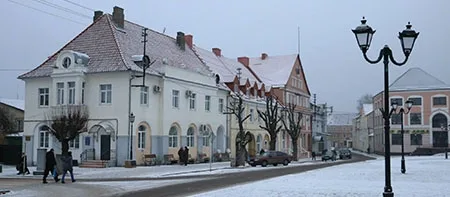
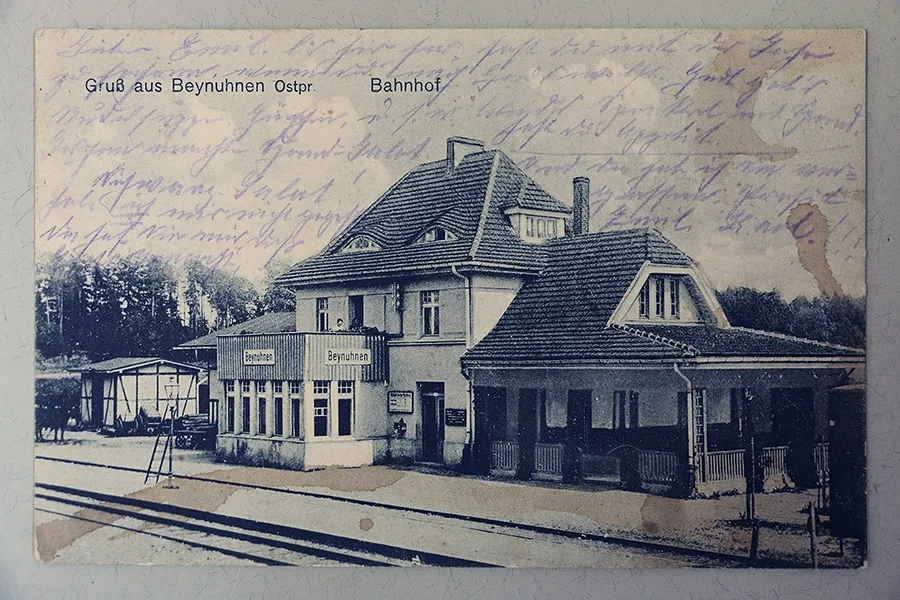 Beynuhnen railway station.
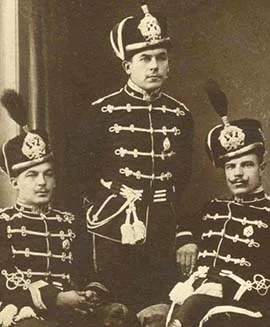
The “Black Hussars”
The “Black Hussars” (or “Death Hussars”) are first mentioned in 1741, during the reign of the Prussian king Frederick the Great. The Fifth Hussar Regiment, made up of these “Black Hussars”, wore a predominantly black uniform, and its emblem was the death's head (Totenkopf — German).
The Russian Empire also had its “black hussars”: the 5th Alexandria Hussar Regiment (pictured). They called themselves not the “Black” but the “Immortal” Hussars. According to legend, the regiment earned this semi-official name after the battle at Kaubach on 14 August 1813, where it formed a single brigade with its allies, the German “Black Hussars”.
The early Christian symbol of “Adam's head” (or the “death's head”) was interpreted in the tradition of the Russian army as a sign of readiness to die for Faith, Tsar and Fatherland, thereby attaining immortality.
Meanwhile, the Farenheids' farmlands kept expanding, and managing them took up so much time that Johann was forced to give up his government post. The family was fabulously rich as it was. Their holdings stretched from the south of the Darkehmen district to the centre of the Wehlau district. In West Prussia they also owned the Flatow estate, as well as land in Poland. And in 1793 Friedrich Wilhelm Johann bought Klein Beynuhnen (German Klein, “Little”) from the Dönhoffs for 75,000 thalers and settled there — for good, as it turned out.
It was said of the Farenheids that they could ride all the way to Königsberg without ever leaving their own land. In the Darkehmen district, besides Beynuhnen, he owned the estates of Medunischken, Mikalbude, Auerfluss, Dombrowken and others, inherited from his father.
The heir ran his farms wisely, using the most up-to-date machinery of the time to cultivate grain and fodder crops. He excelled in animal husbandry and became famous for breeding pedigree cattle and thoroughbred horses.
In his personal life Friedrich Johann was less fortunate. Three of his four children died. The loss of his beloved wife broke his health completely. On top of that came the Napoleonic Wars with their terrible consequences, which severely damaged his finances. He had to give up some of his lands in the Gerdauen and Wehlau districts, and in 1820 Farenheid sold the Flatow estate to the Prussian king Frederick William III.
“The Sage of Angerapp”
Friedrich Wilhelm Johann von Farenheid died on 7 September 1834 at the age of 88. The estate passed to his 54-year-old son, Friedrich Heinrich Johann.
In 1799 the son had enrolled at the University of Königsberg but did not complete his studies there. All that is known is that, armed with a letter of recommendation from Kant, the student moved to Göttingen. He travelled widely, studying agriculture in North America, France, Switzerland, Italy and England, and also learning about horse breeding and the art of riding.
The love of horses he inherited from his father became the passion of Farenheid's whole life. On returning home he devoted himself to breeding thoroughbreds and came to own the second-largest stud farm on the Continent (after that of the Duke of Holstein-Augustenburg). He was also a co-founder of the racecourses in Königsberg and Danzig.
During the war years Friedrich Heinrich Johann was known for his selfless readiness to help struggling peasants; he raised village schooling to a proper standard and made farming profitable. He was a true patriot of his country.
By 1822 he was already a notable, a distinguished figure belonging to the highest circles of society. For his services he was given the title “The Sage of Angerapp”. The King of Prussia called on Farenheid to help review new laws concerning the province.
Friedrich Heinrich was married to Wilhelmine Lehmann, the sister of a university friend from Göttingen. The couple had four children, a son and three daughters. The eldest, Ninette, died in early childhood and was buried in the family crypt at Angerapp. In 1847 Friedrich Heinrich's wife was laid to rest beside her. Two years later, while visiting the Lehndorffs at their Steinort estate, the head of the family himself died suddenly.
After his death the estates were divided among his three children. His son Fritz von Farenheid inherited Klein Beynuhnen and Angerapp. Friederike Charlotte and her husband Sigmund von Bujack received Gross Medunischken and Oschnagorren. Emilie Henriette von Farenheid, who was married to the pastor Voigt, was given the estates of Dombrowken and Auerfluss.
The Last of the Farenheids
Fritz von Farenheid, the only and last male heir and representative of the illustrious family, was born in Darkehmen on 31 October 1815. He attended the royal Collegium Fridericianum in Königsberg, where he studied Greek literature and the history of religion. Besides material wealth, he inherited from his forebears a keen intellect and a capacity for genuine humanity. His upbringing was strongly influenced by Karl Lehrs, a teacher at the Collegium and an expert on antiquity, as well as by the writings of the German art historian Winckelmann. From then on the ancient world became Fritz's ideal, and the service of art his life's purpose.
Frequent and lengthy journeys to Greece and Italy only strengthened his resolve to devote his life to classical art. But that was not enough. Fritz decided to recreate the world of antiquity at home, on his Beynuhnen estate.
His best friend, Major Ulrich von Salpius, supported him in every way. His father, on the other hand, regarded his son's dreams as frivolous. Nevertheless, after Fritz finished at the Collegium, he sent him to Greece, hoping that a long and exhausting journey would cool his passion for antiquity. Far from it. This was only the beginning. Another trip to Greece followed, then Constantinople, Asia Minor, Jerusalem… In 1851, after his father's death, Fritz visited Rome for the first time, and it was then that he began building his collection. He brought back plaster casts of outstanding works of ancient sculpture from Italy, Paris and London. In those days such casts were not yet mass-produced items to be seen in every museum. Good old copies were highly prized and the pride of any owner.
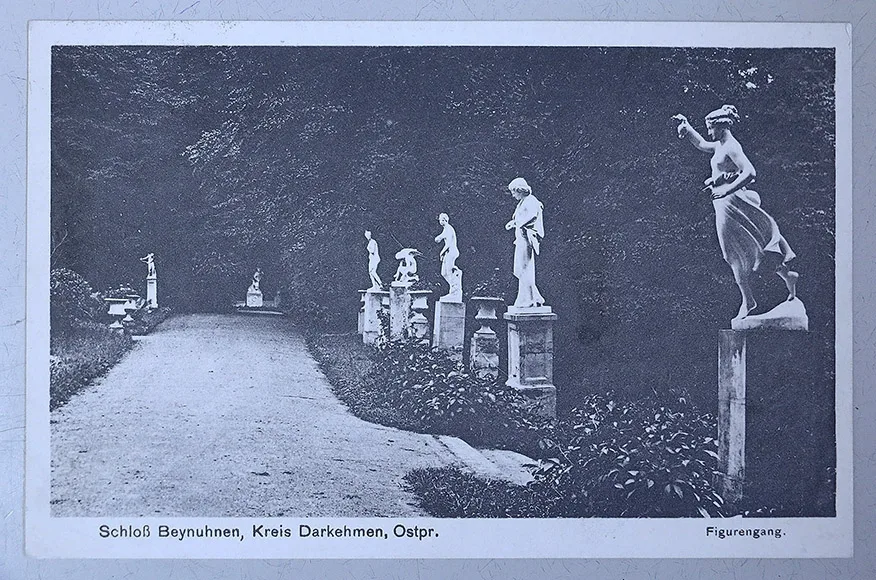 Sculptures in the estate park.
Since there was no railway (the Eastern Railway, the Ostbahn, only arrived in 1856), the plaster figures had to be shipped by sea and then carried to the estate by cart. This required not only great effort but also vast sums of money.
Major Rebuilding at Little Beynuhnen
Over time, Fritz Farenheid's manor became too cramped for its masterpieces, and in 1854 he added a Baroque-style wing to the house. This was the Antique Hall, which marked the beginning of a major transformation of the estate. That same year Klein Beynuhnen was visited by King Frederick William IV of Prussia, who was delighted both with the hall itself and with Farenheid's collection of ancient art.
Before long Fritz was seized by a new passion: Italian Renaissance painting. He bought copies and originals by famous masters. The collection kept growing and needed more and more space.
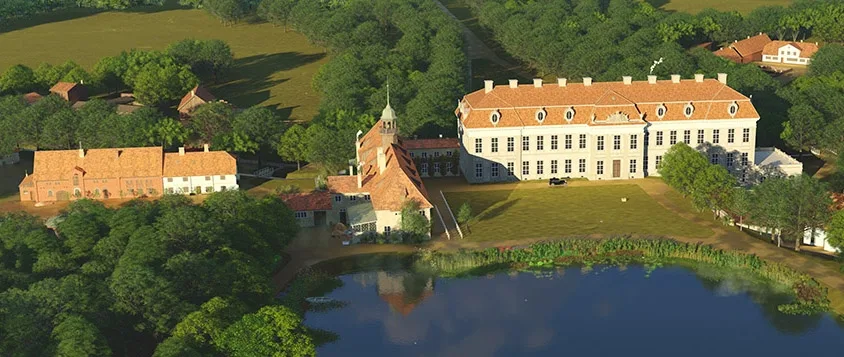
Construction of the palace began in 1862 on a royal scale, with the finest craftsmen invited to work on it. According to some sources, its architect was the Berliner Christian August Hanemann. It was he who named his creation the Villa Farenheid.
There is also a version that the palace was designed by Fritz's friend, the German sculptor Carl Conrad Albert Wolff, a pupil of Christian Daniel Rauch and later a professor at the Berlin Academy of Arts, creator of the equestrian statue of King Frederick William III of Prussia in the Lustgarten, the monument to Immanuel Kant in Königsberg and the fighting lions in front of the Neues Museum in Berlin. It would, however, be more logical to assume that he served as an assistant and adviser in furnishing the palace halls and laying out the park.
In 1866 (or, according to other sources, in 1864) construction was completed. The building consisted of three parts: a central block with lower side wings, and two transverse wings. Executed in the late Neoclassical style, it was distinguished by its ceremonial splendour and the clarity and refinement of its geometric forms.
The lateral transverse wing harmoniously completed the architectural composition and lent it plasticity. Snow-white statues, copies of ancient sculptures, bowls and acroteria adorned the pediment and cornice and seemed to float above the simple outlines of the building. Its exterior was in perfect harmony with its contents. The masterpieces were distributed among the halls, each of which had its own name: the Column Hall, the Antique Hall, the Europa Hall, the Grey Hall, the Red Hall, the Engravings Hall, the Kore Hall, which housed ancient Greek statues, and the Coffee Room. The walls of the latter were kept in smoky brown tones. The furniture was brown. The sofa and armchairs were upholstered in patterned red velvet. In front of the table stood two handsome late-Baroque chairs. On the walls hung 19 works, some of them originals by Federico Barocci, Agnolo Bronzino, Guido Reni, Francesco Trevisani… The rooms of the west wing included a hall of caryatids displaying copies of the famous figures of the Erechtheion on the Athenian Acropolis.
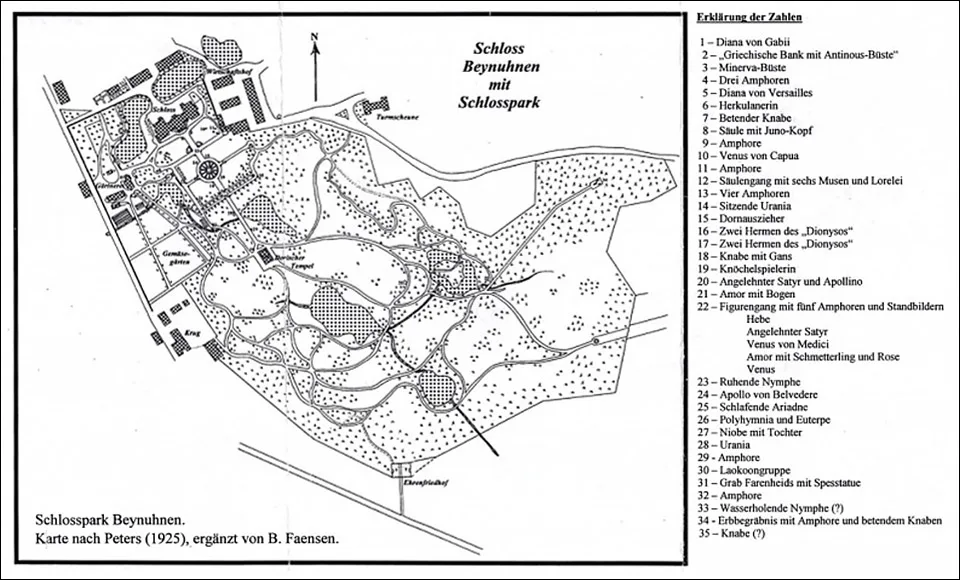 Beynuhnen. Plan of the palace park (1925).
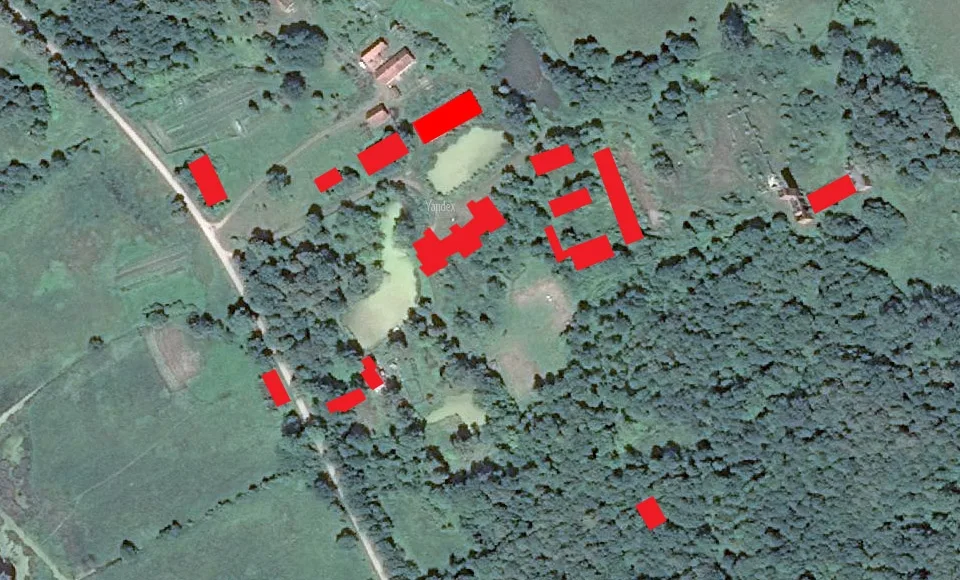 Layout of the estate's structures on a current map (Yandex).
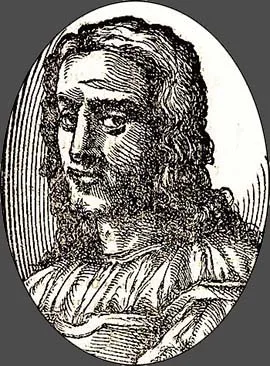
Marcantonio Raimondi
The engraver Marcantonio Raimondi published the first print run of erotic engravings in history, including some after works by Raphael; he was imprisoned for distributing pornography and survived a lawsuit for forging Dürer.
On the first floor was the Green Hall, or Hall of Heroes, which brought together portraits of outstanding figures of European history, politics, science and art of the time.
The catalogue of the collection ran to more than 400 pages. It listed, for example, 10 engravings after Correggio, 7 after Guido Reni, 4 after Titian, and 33 engravings after works by Raphael, most likely made by Marcantonio Raimondi.
In addition, 67 original canvases adorned the walls of the palace: Guido Reni's "The Crucifixion of St. Peter" and "Madonna", Luca Giordano's "The Rape of Europa", Jusepe de Ribera's "The Dying Sebastian", Carlo Maratta's "Rest on the Flight into Egypt", Domenichino's "Joseph with the Christ Child", and Raphael Santi's "Saint Cecilia" (this painting had belonged to Pope Clement XIII). The "Mona Lisa" by the great Leonardo (the finest copy) hung in von Farenheid's study, which was opened to visitors only at the beginning of the 20th century. There were many works of art here too. A carpet from ancient Greek Smyrna lay on the marble floor, and a bust of Athena stood on the white stone fireplace. The study held 35 paintings, among them originals by Annibale Carracci, Giorgione and Francesco Solimena.
Farenheid bought not only works of ancient art and paintings by Renaissance and Baroque masters, but also pictures by artists fashionable at the time, his own contemporaries: Anselm Feuerbach (rendered in Russian as Feyerbakh) and Arnold Böcklin. He also acquired several fine canvases by the last German Romantics, Carl Blechen and Johann Schirmer.
The English Park
The spirit of the ornate early Baroque already reigned everywhere, yet Fritz Farenheid never ceased to admire the pure forms of classical art. By now he was no longer satisfied with the old French-style park with its regular beech-lined paths and flower beds. On the south side of the palace, over an area of 150 hectares, he laid out a new, much larger park in the English style. Even earlier, before building the antique hall, he had erected a Doric temple right at the centre of the park's composition and installed in it a copy of the sculptural group "Laocoön and His Sons".
As is well known, the original sculpture, executed in bronze in Pergamon in 200 BC, has not survived. The "Laocoön" in the Vatican's Pius-Clementine Museum, by the Greek sculptors Agesander of Rhodes and his sons Polydorus and Athenodoros, is likewise a marble copy, but one made from an original by the ancient Greek sculptor Phidias (c. 490 BC – c. 430 BC), and it dates from the second half of the 1st century BC.
Several copies of the "Laocoön" exist in the world, but only two are of the greatest value: those in the Vatican and in Beynuhnen. The latter, unfortunately, has been irretrievably lost.
A multitude of plaster sculptures found a cosy home in the new park with its ponds, lakes, streams, a bypass canal and even irrigation channels. The adjustable, self-cleaning water system was looped into the local drainage network and fed from an artesian spring.
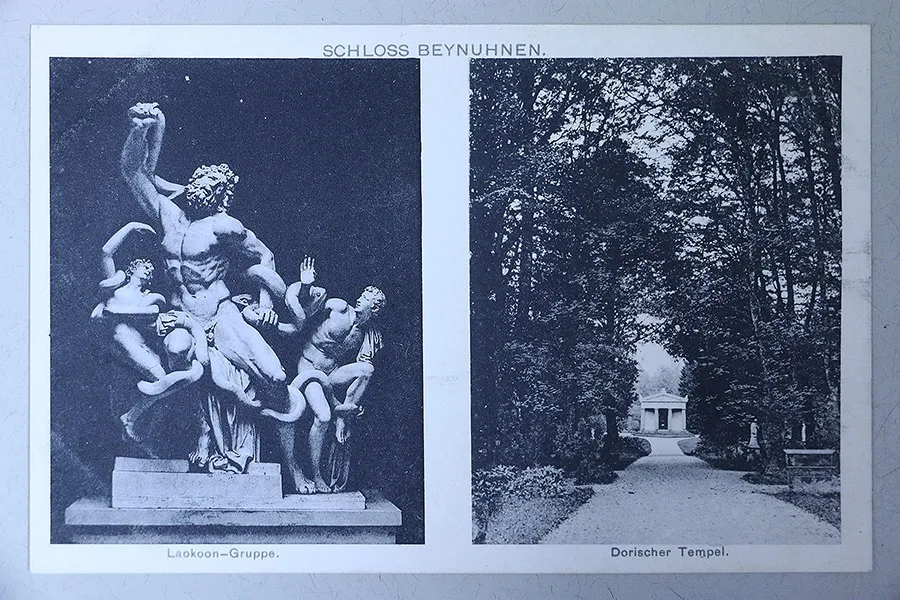 The Laocoön sculptural group.
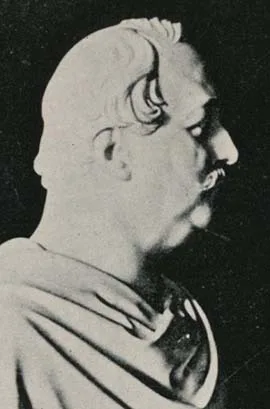
Fritz von Farenheid
A career was never Fritz von Farenheid's goal. The wealthy heir generously spent his entire fortune on acquiring works of art, a cause which, he believed, would serve the people of East Prussia for a long time to come. That is why he stipulated in his will that after his death admission to the museum should be free for everyone without exception.
The landscape design of the park was shaped with the help of the finest European garden specialists. The result was a unified architectural ensemble laid out as a sequence of vistas. Ancient trees blended beautifully with ornamentally clipped shrubs, or bosquets, and with exotic trees brought from all corners of the world. Avenir Petrovich Ovsyanov, a Kaliningrad local historian, wrote: “Here were structures dedicated to nymphs, architecturally finished grottoes, rock gardens, arbours of living trees, viewing platforms, little fountains and pergolas – open galleries covered with light canopies of climbing greenery. And the whole park was ‘brought to life’ by more than two hundred ancient sculptures set on pedestals of varying heights along the lake shores, the park paths and in the forest clearings.”
The End of Beynuhnen
In summer, Fritz Farenheid opened the doors of his estate to anyone who wished to discover the world of art. He was a superb guide and teacher. He spent his winters in Italy and returned home inspired by the beautiful southern scenery and the healthful air, bringing with him works of art he had bought or been given.
In the last years of his life Farenheid was often ill, suffering from poor circulation, asthma and arthritis of the knees. On 8 June 1888 the Beynuhnen estate was orphaned. The last male representative of the family had died; four of its last generations had written their names into the history of East Prussia.
Fritz von Farenheid was a member of the Prussian House of Lords in Berlin, an honorary member of the Royal Academy of Arts and an honorary Doctor of Philosophy of the Albertina University in Königsberg. A year before his death he received a high distinction from the hands of the Prussian king: the Star of the Order of the Crown.
During his lifetime Fritz von Farenheid left instructions that he was not to be buried beneath the gloomy vaults of the family crypt on the noble estate of Angerapp. He chose the spot himself: in the centre of the park, east of the Doric temple, beside his great friend Major von Salpius, beneath a slender column bearing the statue of Hope.
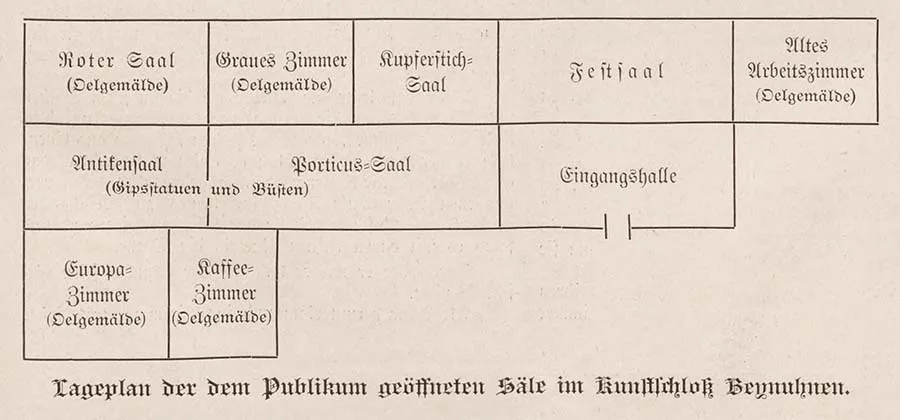 Plan of the halls open to the public in the palace of the Beynuhnen estate.
The gravestone bears words that Farenheid chose for himself: "Leaving this world, full of unfulfilled passions, I humbly await the great revelation before the Lord."
The entailed estate passed to Friedrich von Bujak, the son of his sister Friederike, who took the Farenheid name. The next owner was Wolfgang von Altenstadt, a grandson of Farenheid's sister, who also adopted his surname.
The Fate of the Collection
In 1888 the collection was included in the list of the province's places of interest, and a little later in that of all Prussia. Today the East Prussian architectural, landscape, dendrological and park-and-art reserve of Beynuhnen — the "Sanssouci of the East", as it was sometimes called — no longer exists.
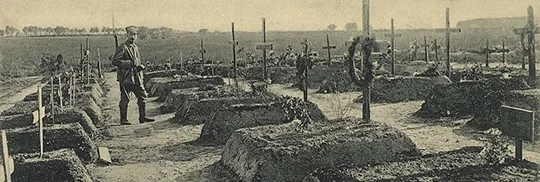
During the First World War fallen soldiers were buried here. On 11 September 1929 a memorial was unveiled at the military cemetery in the palace park of Beynuhnen. It was built of dressed stones in the form of a pyramid, crowned with a sphere bearing an Iron Cross. The memorial has not survived.
In 1945 part of the palace was blown up, and the surviving works of art, as the local press reported, were requisitioned by the Soviet trophy commission. It was also stated that in 1944 part of the collection had nevertheless been taken away by Farenheid's relatives, and part had been buried in the park.
The "Deutsches Adelsblatt" ("German Nobility Gazette") of 15 June 1973 wrote that before the first Russian offensive the transportable works of art, at the wish of the owner, Frau Gertrud von Farenheid, were sent in railway carriages to the Flatow estate. The valuable original paintings were taken out of their frames and transported to Zoppot, where they were sold to a trusted person.
Settlers' Memories
Tatyana Nikonorovna Nadezhdina came to Beynuhnen with her family from the Bryansk region in 1946 under the resettlement recruitment scheme: "Many years have passed, but I still remember what we saw here. What struck us first of all was the abundance of flowers. They were tended by a few nuns who lived in a small church in the park. The park seemed inhabited to us, as if there were people in it, because white statues stood everywhere. The cemetery also looked like a park: well-kept trees, arbours, clipped ornamental shrubs, monuments with chains and all sorts of gravestones made of coloured stone. All of it was enclosed by beautiful railings.
When we arrived, the palace was still standing intact; only in its middle section was there some minor damage and traces of fire. Every room in the palace had its own colour. Statuettes, vases, bowls, jugs and sculpted portraits still stood on the shelves. And how much of all that lay on the shelves broken, shot up and crushed, mixed with rubbish!
In the palace basements and cellars there was stewed meat in tubs, cabbage in big vats, rotten potatoes and various juices in large bottles. Only the cabbage turned out to be edible. I remember there was a big German apiary there at the time, with hundreds of hives. Not knowing how to handle them, we simply took the honey, of which there were large stocks. A lot of crockery, whole and broken, remained in various cupboards, chests, boxes and on shelves.
Sadly, we could not preserve any of it. None of it was ours, nothing was dear to us, nothing had been earned by us — and above all, it belonged to no one. Gradually people began dismantling the palace, because we believed that Göring himself had lived here. That name was surrounded by hatred and contempt, and so nothing was spared. Everything was smashed and taken apart.
The plaster statuettes and the moulded wall decorations of the palace were pounded in mortars, mixed with water and used to whitewash flats. Then various brigades and teams with orders from the military started coming to us regularly. They loaded onto lorries and carts everything that could be carried off: farm equipment, building structures, decorative railings and posts, park fittings, fireplaces and plumbing fixtures, monuments, sculptures, water and fuel tanks, furniture and palace furnishings."
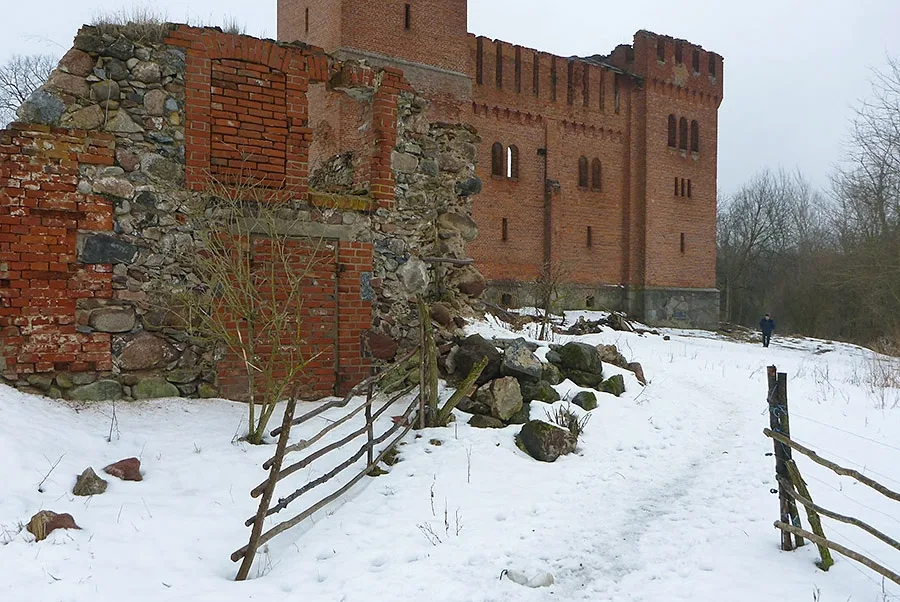 A sheep pen. February 2017.
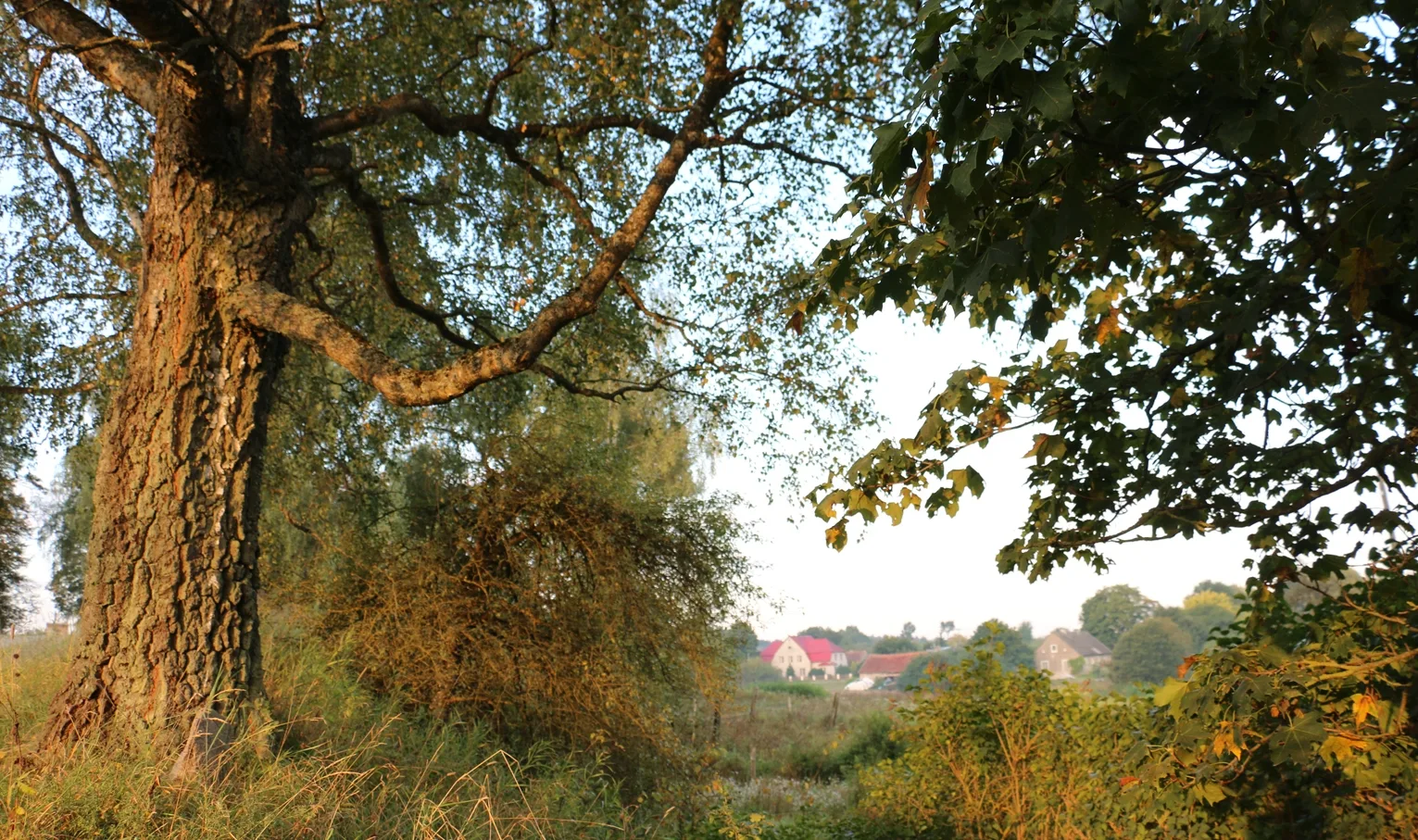
Avenir Ovsyanov, formerly chief expert of the State Cultural Institution "Scientific and Production Centre for the Protection of Monuments", said that there had been a plan for a Beynuhnen museum complex. The site where the huge late-classical palace once stood has been identified. Nothing of it remains today. The whole area has been dug up by illegal treasure hunters. In the undergrowth one can still find remnants of columns, fragments of cornices, flights of stairs and balustrades. Of the once luxurious park, only paths overgrown with shrubs and waterlogged ponds survive. The drainage system has been damaged, causing the groundwater level to rise. There is no trace of the Doric temple. The "Laocoön" has vanished without a trace.
"The villagers did not carry off the exhibits from the castle, but they did smash the sculptures in the park," one Kaliningrad resident recalled. Her husband, the chairman of the collective farm, smashed the statue of Apollo while drunk, out of jealousy, because his wife often admired the naked figure of the youth. And their grandson shot up the statue of Flora with a pistol.
Several attempts were made to blow up the palace. One night the building housing the library caught fire...
A. Smirnova, a resident of Kaliningrad, recalled that in the early 1950s her father took her and her sister to Beynuhnen. Some sculptures were still there, and in the surviving rooms she remembered large seashells that they held to their ears. She liked them very much, but when they left they took nothing; everything stayed where it was. By around 1955 only the walls of the palace remained.
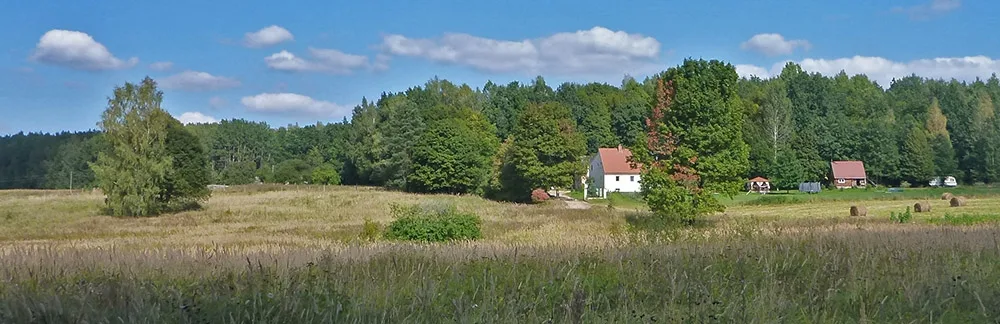
In February 2017 livestock were being kept on the grounds of the former estate.
Sources:
А.П. Овсянов. «В руинах старого замка», «Сан-Суси на Востоке».
«Angerapper Heimatbrief», 1977
Ph. Fr. von Bujak-Ramburg. «Fritz von Farenheid-Beynuhnen»
Prof. Dr. K. H. Olasen. «Schloß Beynuhnen und seine KunstsammIungen».
K. H. Czerlinski. «Fritz von Farenheid, Beynuhnen».
«Deutsches Adelsblatt», 15.6.1973 №.6. «Beynuhnen, Kreis Angerapp».
Prof. Dr. Fritz Gause. «Die Geschichte der Stadt Königsberg».
Prof. Dr. M. Hecht. «Führer durch Beynuhnen, die Kunstschöpfung Fritz von Farenheids».
Katalog des Farenheidschen Schlosses Beynuhnen in Ostpreußen.
Beiträge zur Geschichte des Ostpreußischen Grundbesitzes.
G. Krüger. «Beiträge zur Geschichte der Familie Farenheid».

In Memoriam
The author and the editors express their deep gratitude to Avgust Vasilyevich Solovyov (1937–2017), director of the Ozyorsk Museum of History and Local Lore, for his invaluable help in preparing this article and for the information and illustrations he provided (postcards from his personal collection). Sadly, he will no longer hear our words. Only recently our land lost one of the keepers of its history, a wise and remarkable man. He was 80.
Avgust Vasilyevich was an Honorary Citizen of the Ozyorsk District. For the last 13 years he kept the museum going almost single-handedly, on sheer enthusiasm. He studied the region's post-war history, pieced together the history of the Prussian land bit by bit, worked with primary sources and translated them into Russian, and organised exhibitions. He was a wonderful storyteller and a sensitive, conscientious person.
Avgust Vasilyevich came to the Kaliningrad Region among the very first settlers. He graduated from the Kaliningrad Agricultural Technical College in Gusev, then from the engineering faculty of the Leningrad Institute of Agricultural Mechanisation and the teaching faculty of the V. P. Goryachkin Moscow Institute of Agricultural Production Engineers. Three times he went to develop the Virgin Lands on a Komsomol assignment (once he even had an incident there with Leonid Ilyich himself!). For 44 years he taught at the Ozyorsk Technical College of Agricultural Mechanisation. From 2004 until the last day of his life, Avgust Vasilyevich was director of the Ozyorsk Museum of History and Local Lore, which there had long been plans to close. Now hardly anyone will stand in the way of that decision…
Rest in peace, Avgust Vasilyevich.
Translated from Russian with the help of AI (Claude, Anthropic), October 2026.