LEGENDS OF PRUSSIA in the blog of Tatyana Kolivay.
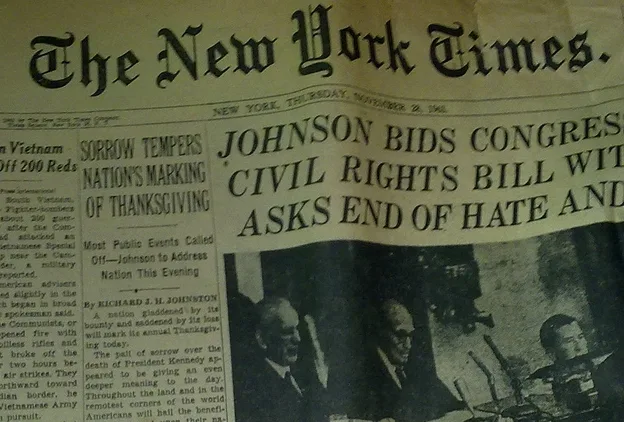
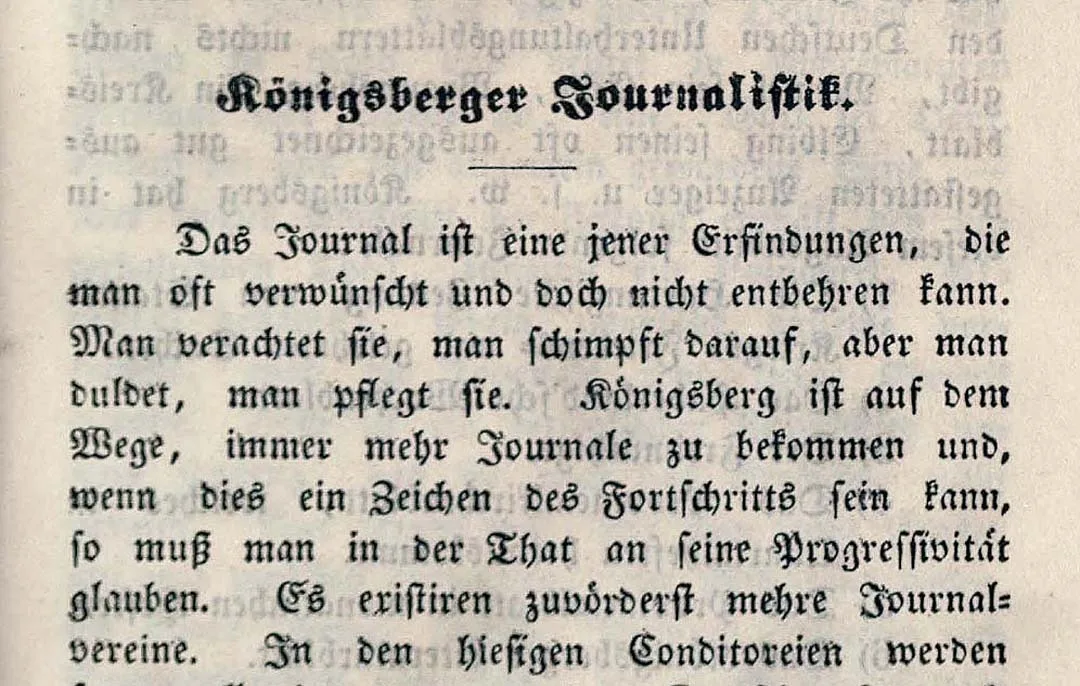
Journals are one of those inventions of mankind that are often abused but cannot be done without. People try to ignore them; some despise them, some put up with them, and some publish and read them.
Every year Königsberg acquires more and more newspapers and journals, and if this is a sign of progress, then Königsberg is undoubtedly a progressive city. There are several journal reading societies here.
The local confectioners' shops keep all the leading German journals, including those that appear once a quarter, such as the Cotta'sche Vierteljahrsschrift1, and even the theological essays and critical writings of F. Umbreit2 and K. Ullmann3, printed as separate pamphlets. When the townsman goes to a confectioner's today, he wants not so much to feast on cakes, chocolate, ice cream and meringues – no, God forbid! – as to read the journals, perhaps the theatre reviews, and even poems of his own composition that he has written for some weekly.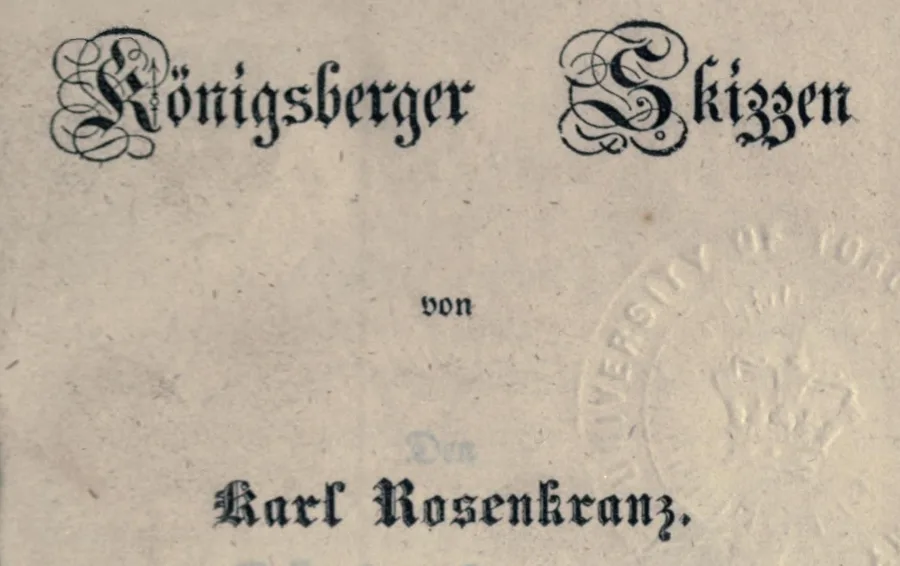
The fact is that Königsberg has local journals too. To satisfy curiosity and the desire for news, one newspaper is no longer enough. Every town of any size in Prussia has its own journal.
In Danzig (Gdańsk, Poland) it is the Danziger Dampfboot4, which is in no way inferior to most of the popular all-German entertainment publications. Memel has its own Das Echo /"The Echo"/5, Braunsberg (Braniewo, Poland) has Das Braunsberger Kreisblatt, Elbing (Elbląg, Poland) has the local Anzeiger6, which is little inferior to its many namesakes, and so on.
The following publications currently appear in Königsberg:
1) Die Königsberger Hartung'sche Zeitung7 – on affairs of state and learning, war and peace /"The Königsberg Hartung Newspaper"/.
2) Das Haberland'sche Wochenblatt8 /"The Haberland Weekly"/.
3) The journal Der Königsberger Freimütige9 /"The Königsberg Plain-Speaker"/.
4) Das Provinzialkirchenblatt /"The Provincial Church Journal"/, a quarterly.
5) Das Provinzialblatt /"The Provincial Journal"/, a monthly.
6) Das Königsberger Literaturblatt /"The Königsberg Literary Journal"/.
I do not know whether Die Annalen des landwirthschaftlichen Vereins von Kreyßig10 /"Annals of the Agricultural Society of W. A. Kreyssig"/ ought to be included here. I shall simply mention them.
The newspaper Die Königsberger Hartung'sche Zeitung has four sections.
– The first section of the newspaper contains a brief survey of the most important events at home and abroad. This survey usually takes up half the issue. The newspaper is printed six times a week. Sometimes, as need arises, a supplement appears.
The political department of the DHZ is distinguished by a careful choice of contributors and an independent editorial policy. The newspaper does not confine itself to publishing abridged reprints from the leading Berlin press, but regularly offers material from other German periodicals, each time citing its source – a laudable custom that has, at last, become almost universal among us.
– The second section of the newspaper is the entertainment section, which contains something that journals call a "little chronicle". But the essential distinction of our newspaper is that it does not forget the practical.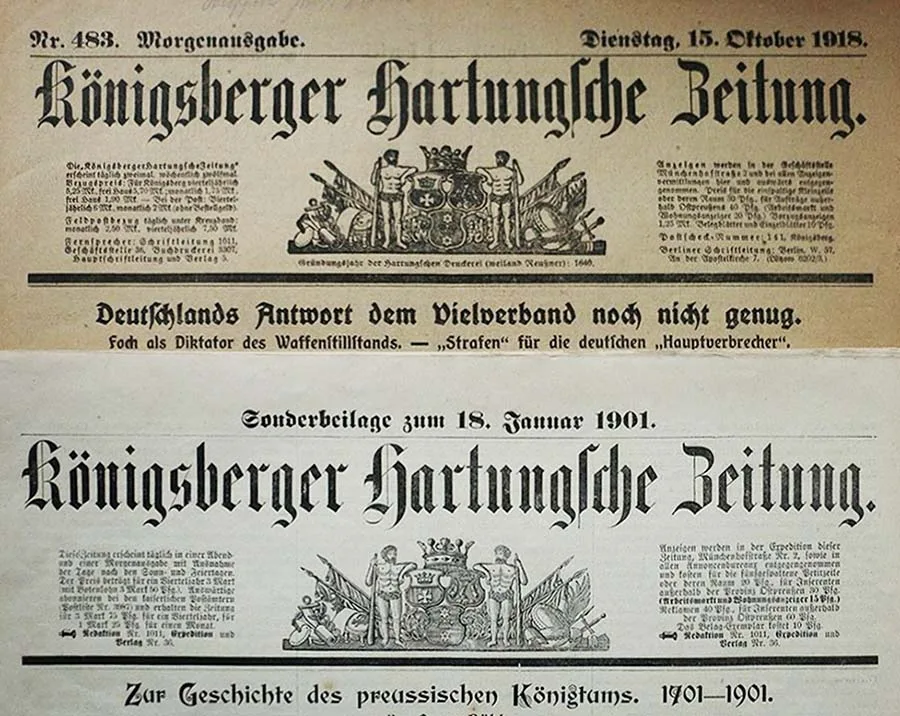
If you wish to learn how to pickle cucumbers well and cheaply, cure anthrax, dye your hair black, get rid of bedbugs, rats and freckles, brew a good potato beer yourself, keep apples from rotting over the winter, and so on, read this section of the newspaper carefully.
The obliging compiler of these interesting notes also does not forget to tell us from time to time what the fashion is in Paris, and to relate the lives of foreign actors and actresses. Then follow reviews of concerts, theatres and sights, and sometimes announcements of new books, mostly from their publishers.
– The third section of the newspaper contains announcements of engagements, marriages, births and deaths.
– The fourth contains advertisements from various firms and private individuals.
In the niche of light reading on the local market, the local journals Das Haberland'sche Wochenblatt and Der Königsberger Freimütige compete with the all-German grandees.
The former has existed for a long time and in its contents (novellas, poems, critical articles on theatres and art exhibitions, riddles, charades, anagrams and so on) is in no way inferior to its many illustrious competitors, which merely have a more elegant appearance.
The less content most of these boulevard sheets have, the more they vie with one another in the luxury of their get-up – just as pocket-sized books long strove to win readers with copper and steel engravings, gilt edges and delicate flowered bindings, until they suddenly took on a completely artless, simple form and made novellas their sole content. For novellas are enormously popular now.
The journal Der Königsberger Freimütige /"The Königsberg Plain-Speaker"/ is a young publication that has forged ahead thanks to its peculiarly caustic style and the boldness with which it lays bare the heart of the matter. The journal has also begun to print caricatures in its pages from time to time.
Das Provinzialkirchenblatt /"The Provincial Church Journal"/ is published by the Consistorial Councillor and Court Preacher of Austria, together with Professor and Superintendent Lehnerdt. It contains works on the history of the provincial church, dogmatic and exegetical studies and literary criticism, but above all essays on practical matters of pastoral care, dealing with the sick, relations with the clergy, confirmation teaching and so on.
Das Provinzialblatt /"The Provincial Journal"/, edited by Criminal Police Councillor Mr Richter, pleases not only with the quality of its form (its printing) but also with its topical content, which enlightens the province on the most varied matters. Biographical sketches, articles on natural science, travels, debates on present-day prejudices, educational discussions, questions of industry and agriculture and critical writings of all kinds – these are the main subjects of this publication.
Very valuable are this journal's reports on the public lectures given here on special occasions, and especially on the lectures delivered at the meetings of the Physical-Economic Society11 by Professors Meyer, Dulk, Moser, Kruse, Sachs, Jacobi, Rathke and Burdach. The one thing sorely missing is the lectures of Friedrich Bessel12 on the most important questions of physical geography and astronomy, which he gives from time to time, striving to make the material as accessible to his listeners as possible.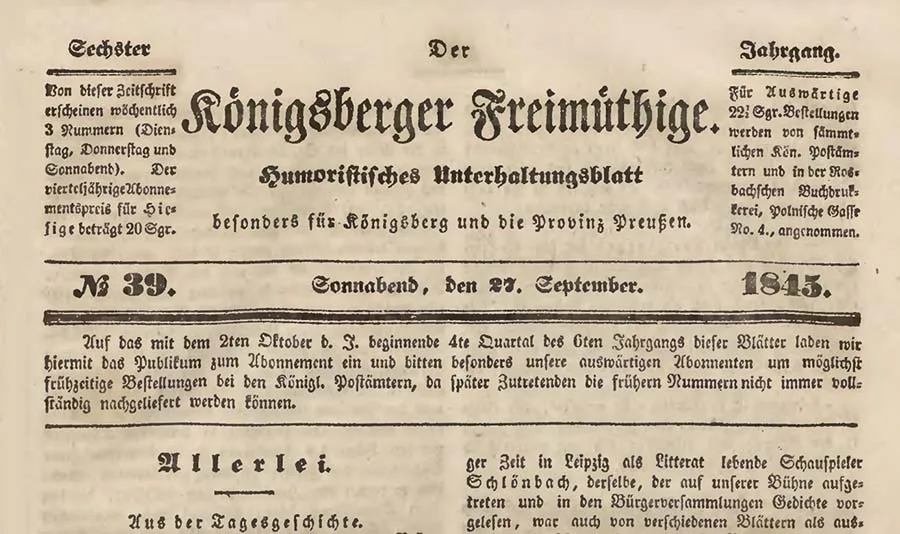
From what has been said above it is clear that our journalism amply represents politics, news, entertainment and doctrinaire instruction, and that only literary criticism occupies a chance, subordinate place in the journals mentioned.
There is therefore a need to create a special organ for it. In a city with so many university-educated civil servants, with three gymnasia and a university, a journal of this kind is urgently needed. Königsberg professors have repeatedly attempted to found such publications.
Hüllmann, Vater, Herbart and others recently published an archive. The younger professors, Lengerke, Simson. Siefert, Nicolovius (who is now in Bonn), made an attempt to bring out the journal Ostseeblätter /"Baltic Pages"/, which at first was published quite briskly. But soon the devil took it – and in the literal sense of the word. Disputes arose in the editorial office about the nature and possible existence of His Infernal Majesty, which led to an appalling monotony, so disliked by readers, to bitter quarrels among the contributors and, in consequence, to the ruin of the publishers.
In 1834 City Councillor Hartung entered into negotiations with me about appointing me editor of a publication devoted to literary criticism.
Reflecting on this proposal, I thought about the difficulties such a project might encounter. I drew up an outline in which I defined the aim of the journal precisely. And I added my considerations, in which I tried to show that the undertaking was impracticable.
My arguments, as far as I remember, were as follows:
1) all the German journals are in circulation here;
2) the critical articles in the newspapers and town weeklies of Danzig, Elbing and so on are quite sufficient to satisfy the literary needs of the province;
3) all the local creative forces already contribute to the central German journals; in particular, the professors are correspondents of the all-German literary newspapers of Halle, of Brockhaus and of Berlin, as well as of specialist journals, and it would therefore be impossible to pay them an equally high fee here on the spot.
Such were my considerations.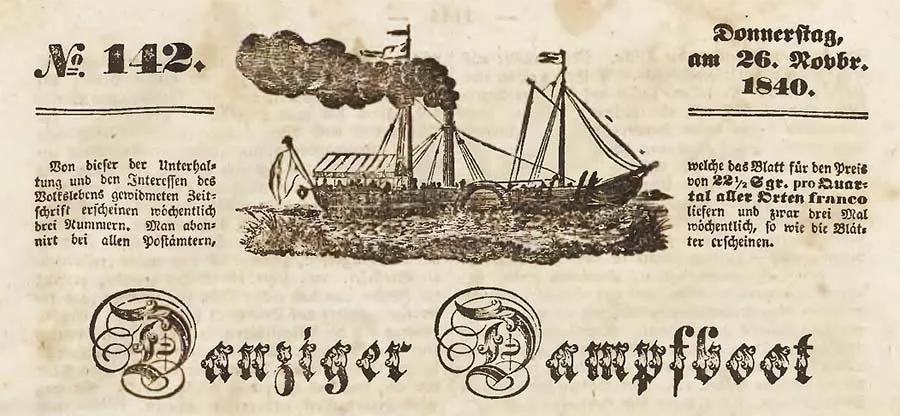
I have since revised them, and I now consider it absolutely necessary for Königsberg to have its own critical publication and thereby be in more active interaction with the rest of Germany.
The man who will devote himself with the purest enthusiasm to editing the "Königsberg Literary Journal" is Dr Alexander Jung13. He opened the journal with an introductory article discussing the state of German journalism and the relation of Königsberg to Prussia, of Prussia to Germany, of Germany to the pressing problems of our time, and, finally, how far the content and form of a modern literary journal correspond to these problems.
In this way he fully explains why such a journal must exist, and the future, I hope, will justify the expectations placed on it not only here but beyond Königsberg as well.
It goes without saying that the editor's intention to take a position above party views has been censured in every possible way. It was claimed that this was impossible. In saying so, however, people probably failed to take into account that the matter concerns scholarly criticism, not the momentary effect that the organ of some party wishes to produce on its readers.
If a journal wishes from the outset to propagate ultramontanism14, Lutheranism, Herbartianism15, republicanism16, absolutism, traditionalism17 and so on, then it must of course express itself with one-sided sharpness. The clearer, the better.
It must not shy away from extreme expressions, for it is opposed by other extremes. It may from time to time assure its readers that it judges impartially, but that is not so.
The better the editors of the journal know this, the easier it will be for them in their polemics to soften the attacks directed against them and to sustain their adherents' belief that this organ is necessary.
Thus, in practice, the existence of a party is necessary to achieve certain aims. But in theory, in scholarship? Even if scholarship, unconsciously and in fact, is not free of partiality and a certain narrowness, it must nonetheless strive to stay aloof from all party interests.
Our "Königsberg Literary Journal" is starting small, because it does not wish to reflect the frivolity of the times and does not wish to be a mere means of making money. Indeed, some journals seem to hold on to their public only so that their editor may have something to live on. Such publications are alms that you pay, receiving a receipt in the form of newsprint. You will find nothing new in them.
Some journals have evidently set themselves the goal of making the fragmentation of the public mind still more apparent. As soon as you take such a sheet with its chaotic contents in your hands, the whole text falls apart into separate letters, which now join together, now fly apart and negate one another.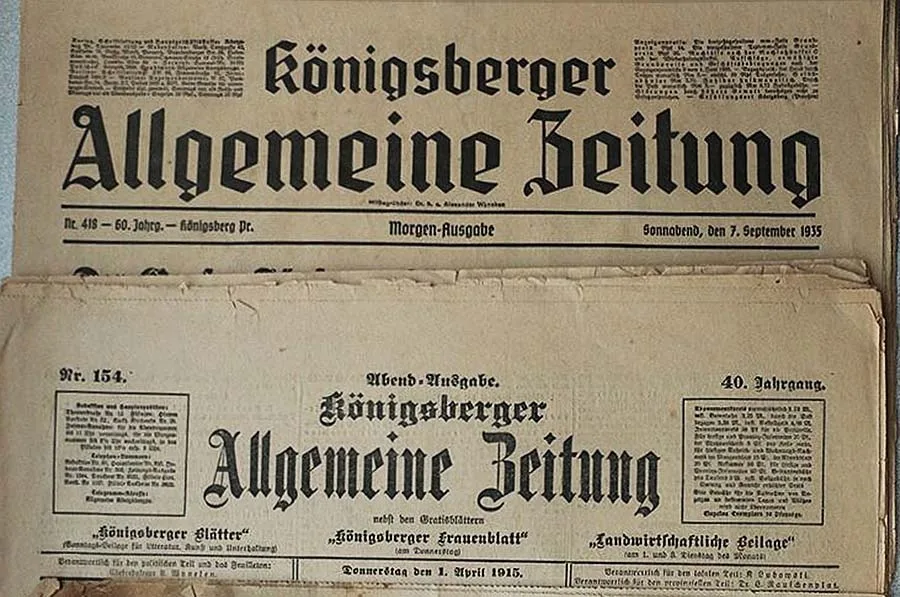
The eye tries to rest on something, now here, now there, while the brain vibrates uselessly in the chaos. If anything can testify to the soundness of an individual's mind, it is his ability to preserve himself in this disorderly diffusion.
Das Königsberger Literaturblatt /"The Königsberg Literary Journal"/ will strive for unity and cohesion against material of this kind. The time has come for the so-called "pure reader" (in J. Fichte's18 phrase), who reads only for the sake of reading and not in order to understand anything, to disappear from our lives.
TRANSLATOR'S NOTES
1. Cotta'sche Vierteljahrsschrift. A German quarterly journal published by Georg von Cotta. LINK
2. Friedrich Wilhelm Carl Umbreit /Ullmann, Carl: Friedrich Wilhelm Carl Umbreit/ (11 April 1795, Sonneborn – 26 April 1860, Heidelberg), German Protestant theologian and scholar of the Hebrew Bible. LINK
3. Karl Christian Ullmann /Carl Christian Ullmann/ (15 March 1796, Epfenbach – 12 January 1865, Karlsruhe), German theologian and historian. LINK
4. The newspaper Danziger Dampfboot /"The Danzig Steamboat"/.LINK
5. It seems that what is meant here is Tilsit, with its journal Echo an der Memel.
6. Only an issue for 1898 could be found: Elbinger Wohnungs-Anzeiger 1898. LINK
7. The newspaper Die Königsberger Hartungsche Zeitung. It is mentioned by Thomas Mann in his novel "Buddenbrooks" as the "Hartung newspaper". One of the novel's characters, the young commoner Morten Schwarzkopf, conducting an imaginary argument with the King of Prussia, says: "They don't write respectfully enough, you see, about the government, the nobility, the clergy and the Junkers... and on top of that they know how to lead the censors by the nose." LINK
8. Das Haberland'sche Wochenblatt. A Königsberg weekly. Printed at Haberland's press. Appears twice a week, on Wednesdays and Saturdays.LINK
9. The journal Der Königsberger Freimütige /"The Königsberg Plain-Speaker"/. LINK
10. W. A. Kreyssig /Kreyßig W. A./ (1780–1854), East Prussian farmer and agricultural writer. He lived at Karlsruhe auf den Husen near Königsberg (East Prussia). Honorary member of various domestic and foreign economic and agricultural societies. LINK
11. The Physical-Economic Society /Physikalisch-Ökonomische Gesellschaft/, a landmark organisation originally founded in Mohrungen, then in East Prussia (Morąg, Poland), to introduce innovations into the province's agriculture, which after its move to Königsberg in 1798 changed the focus of its activity to archaeology and ethnography. The society later gave rise to the famous local archaeological museum "Prussia". LINK
12. This refers to Friedrich Wilhelm Bessel /Friedrich Wilhelm Bessel/ (22 July 1784, Minden – 17 March 1846, Königsberg), German mathematician and astronomer, a pupil of Carl Friedrich Gauss. LINK
13. Alexander Jung /Dr. Alexander Jung/. LINK
14. Ultramontanism. LINK
15. Herbartianism. LINK
16. Republicanism. LINK
17. Traditionalism. LINK
18. Johann Gottlieb Fichte /Johann Gottlieb Fichte/ (19 May 1762, Bischofswerda, Upper Lusatia – 27 January 1814, Berlin), German philosopher.
In 1791 Fichte came to Königsberg; here he made the acquaintance of Kant, to whom he sent the manuscript of his "Attempt at a Critique of All Revelation". Kant approved of the work and found a publisher for it. The work appeared anonymously and was received by the public with the greatest sympathy: it was taken for Kant's own eagerly awaited work on the philosophy of religion. When the misunderstanding was cleared up, Fichte became famous at once. In 1805 the French advance forced him to move to Königsberg, where he lectured at the University of Königsberg. LINK
LEGENDS OF PRUSSIA in the blog of Tatyana Kolivay.
Translated from Russian with the help of AI (Claude, Anthropic), October 2026.