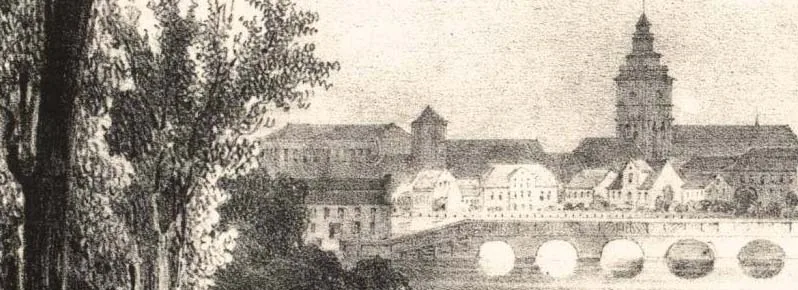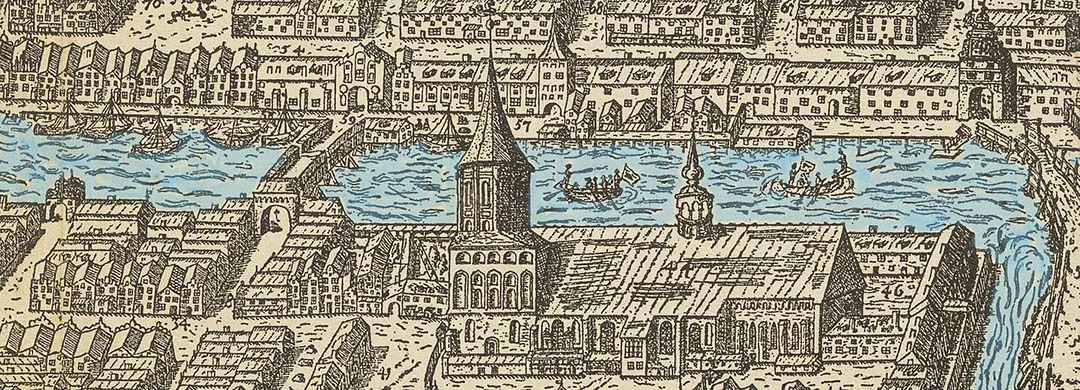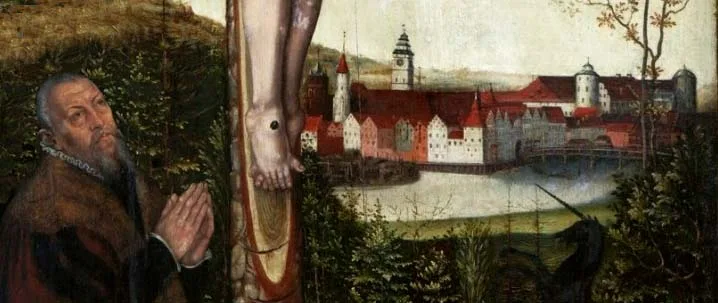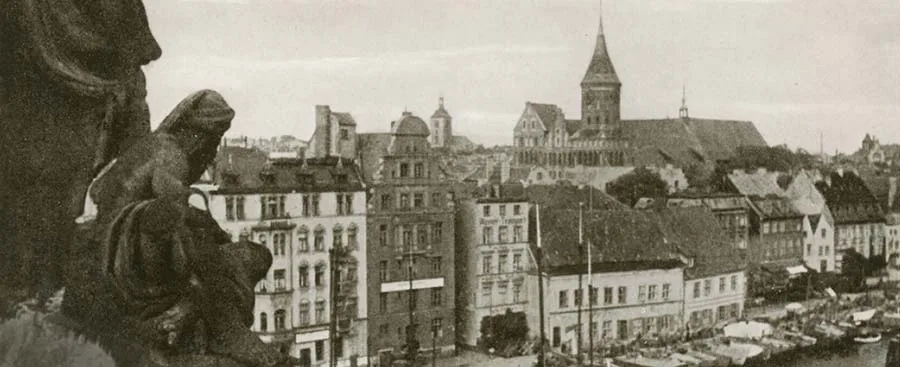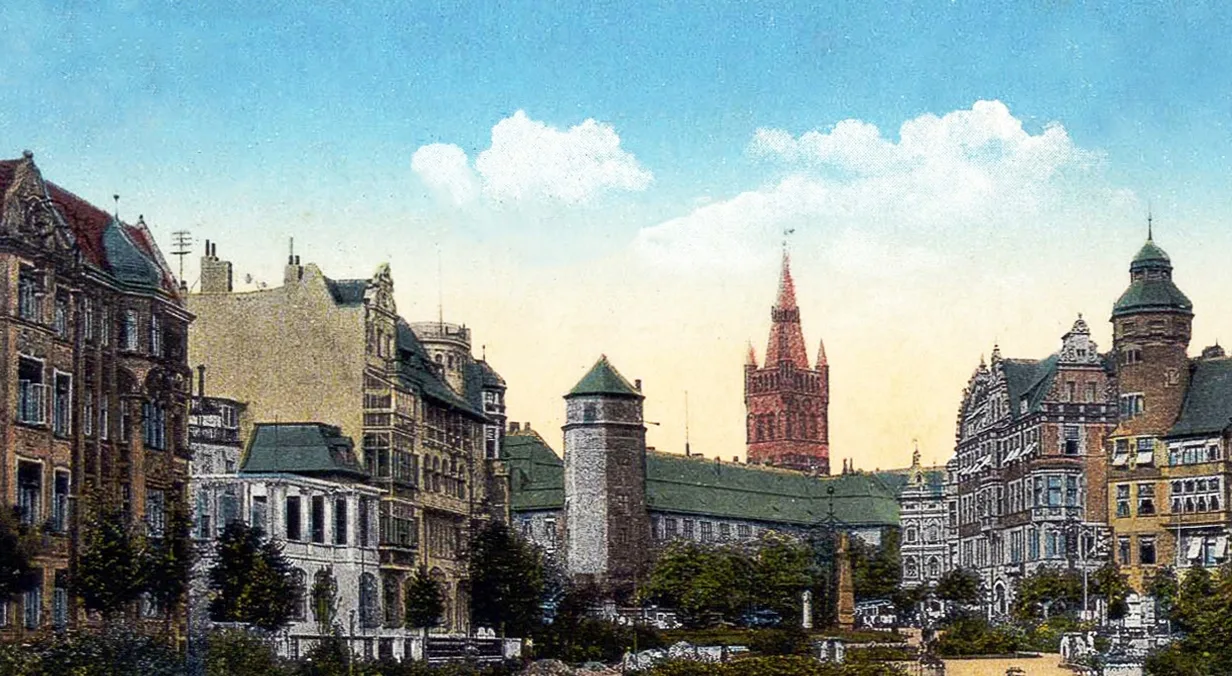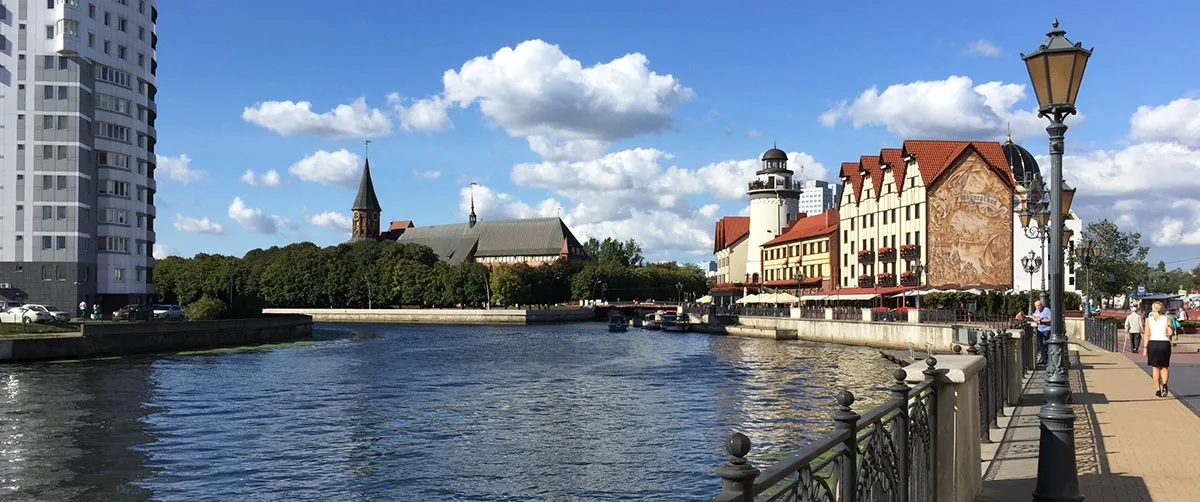
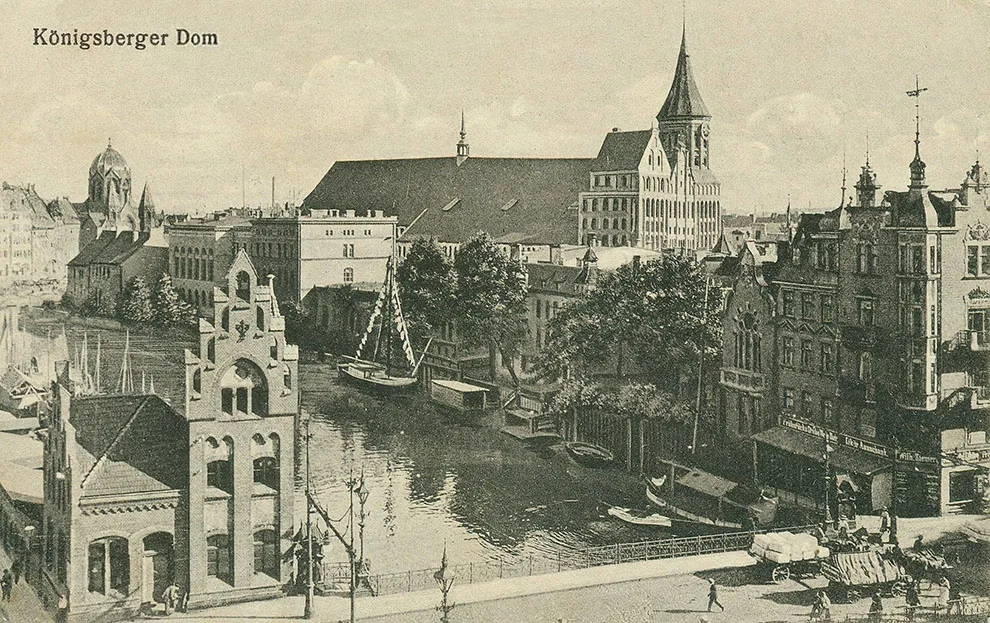
Soon work began on rebuilding it. But even this did not meet the needs of the townspeople, so in 1330 the cathedral was demolished. The site for a new one, intended as the residence of the head of the cathedral and the members of his chapter, was chosen by Bishop Johann of Samland. It lay in the north-eastern part of the island of Vogtswerder (later Kneiphof, today Kant Island), which had been added to the bishop's possessions in 1322. Work began with the construction of the cathedral choir in 1325.
The walls of the choir were unusually thick and sturdy for a religious building. And when the construction of the choir was completed with a defensive gallery, the head of the Order forbade the bishop to continue the work, lest he build a fortress instead of a cathedral.
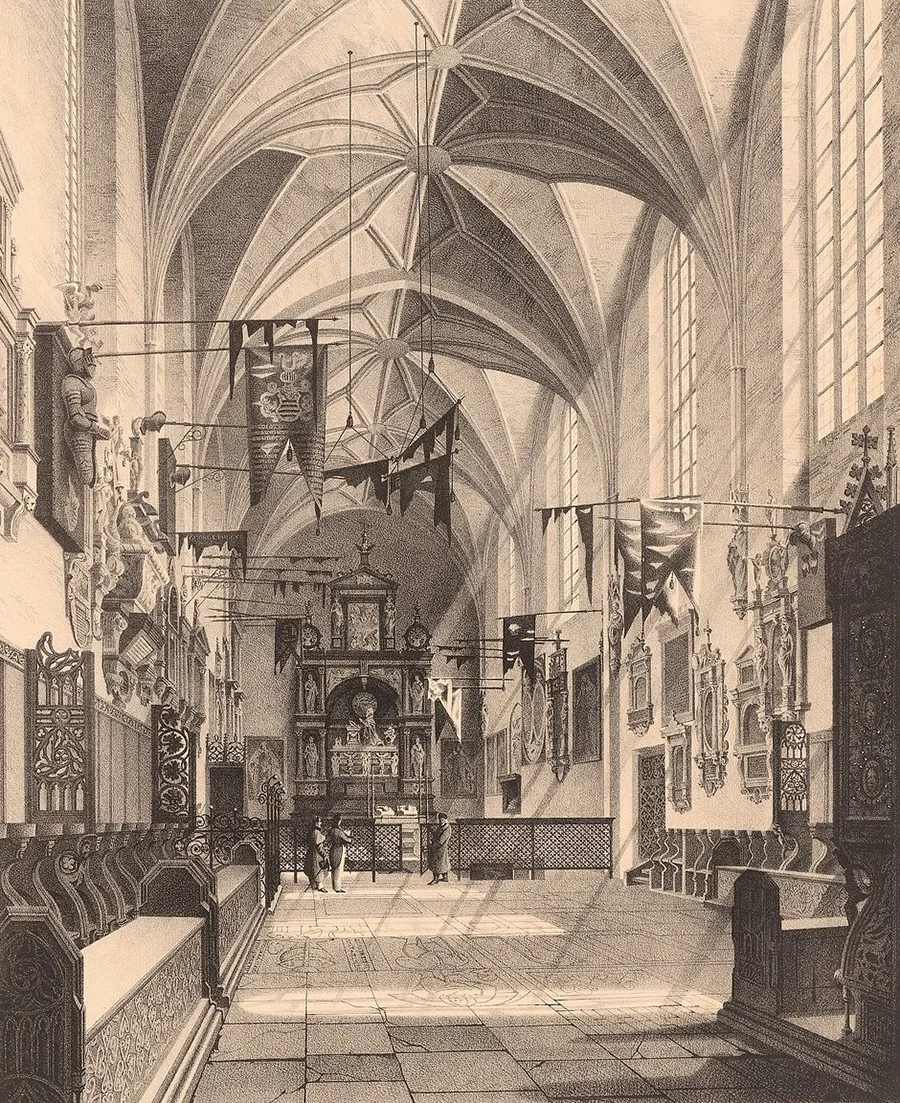
Some time later an agreement was concluded between the Grand Master and the Order on the one hand and the bishop and the chapter on the other, under which the clergy undertook to build the cathedral without fortifications. The long sides of the choir were accordingly given walls and buttresses of a lighter design. Nevertheless, the south wall was built up to a height of 2.75 m in particularly massive brickwork on a fieldstone foundation, with a defensive gallery and loopholes right under the roof.
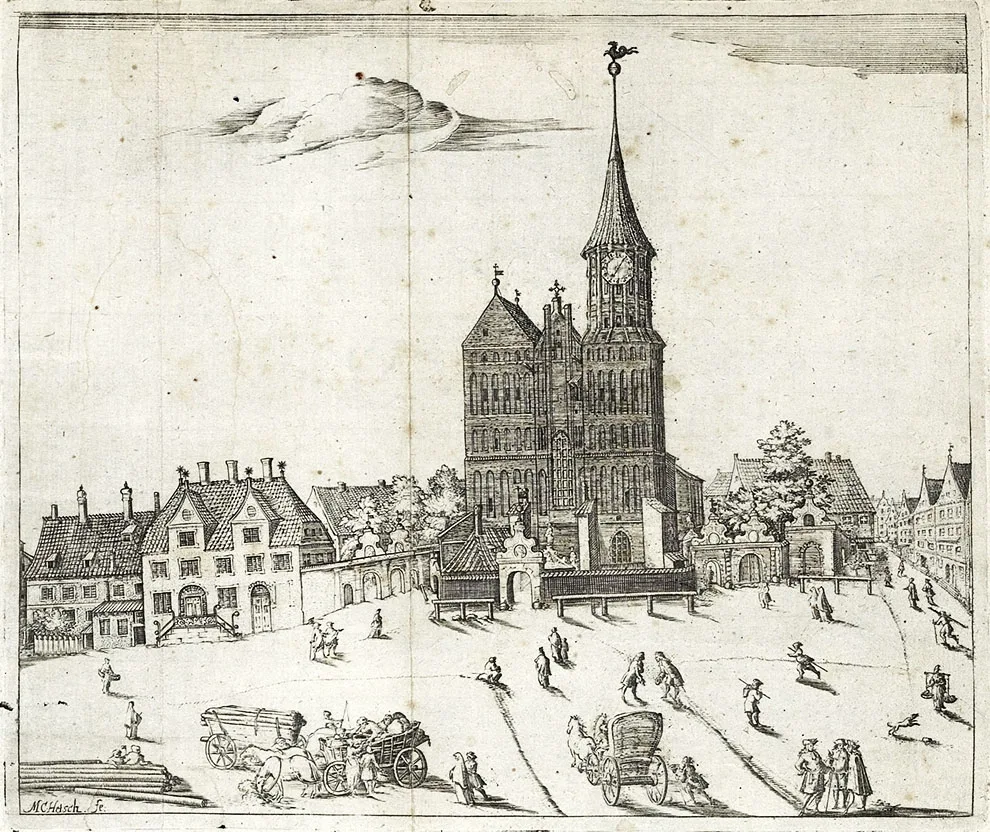
The defensive gallery was reached through the altar by a staircase in the north-eastern corner (behind the grave of Immanuel Kant). Towers were planned at the corners of the cathedral; of these, only the south-eastern one remains.
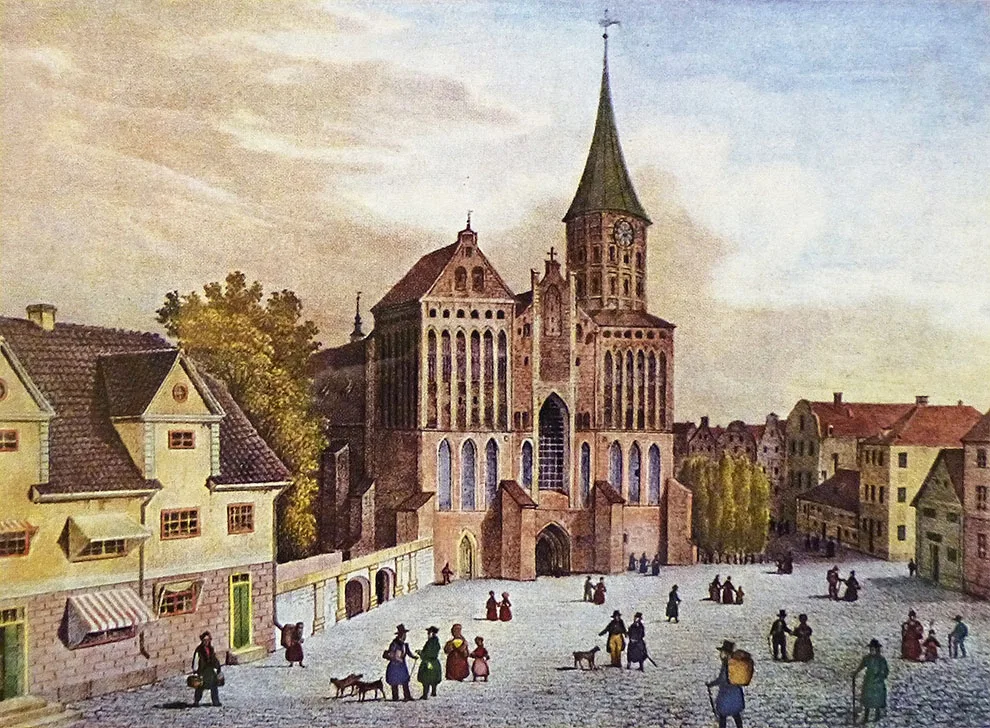
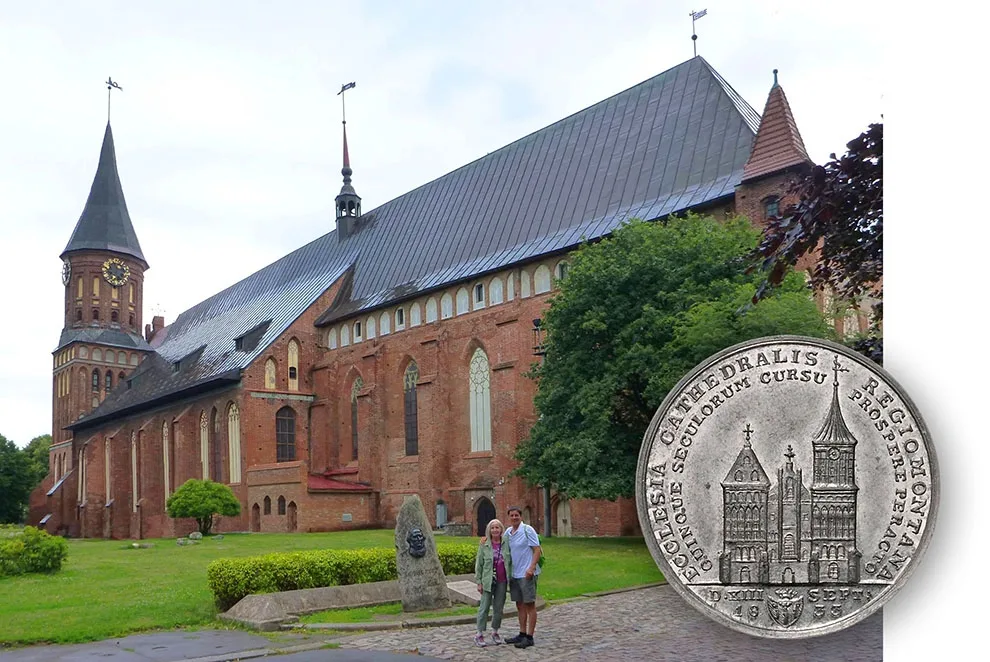
In 1333 towers rose on the west side of the cathedral (above the plastered band): the southern one with a twelve-sided top, and a simple gable on the northern side. The massive western façade is divided by numerous blind windows that diminish in height towards the top. In the narrow central gable, two long pilaster strips reaching all the way to the top create an impression of lightness. Blind windows flank the main west portal on both sides.
The nave was built almost at the same time as the towers. It was roofed in 1344 but not fully completed until 1351.
Originally the nave had a flat ceiling, which looked far more modest than the vaulted ceiling of the choir. Under Grand Master Winrich von Kniprode an internal reconstruction of the cathedral was begun (1351–1358), turning it into a three-aisled space with a higher central nave.
The reconstruction was completed no later than 1382. The walls of the side aisles were raised, the windows lengthened, and above the row of blind windows on the north side a second row appeared. The blind windows on the south side were lengthened. Between 1370 and 1400 the nave of the cathedral was decorated with paintings. 1380 is regarded as the year in which the construction of the cathedral was officially completed. St Mary and St Adalbert became the patron saints of the cathedral.
In 1440 the wooden ceilings were replaced with stone vaults. The vaults of the central nave were modelled on those of the choir, while those in the side aisles were made of triangular sections. The eastern windows of the side aisles were cut through in the 16th century.
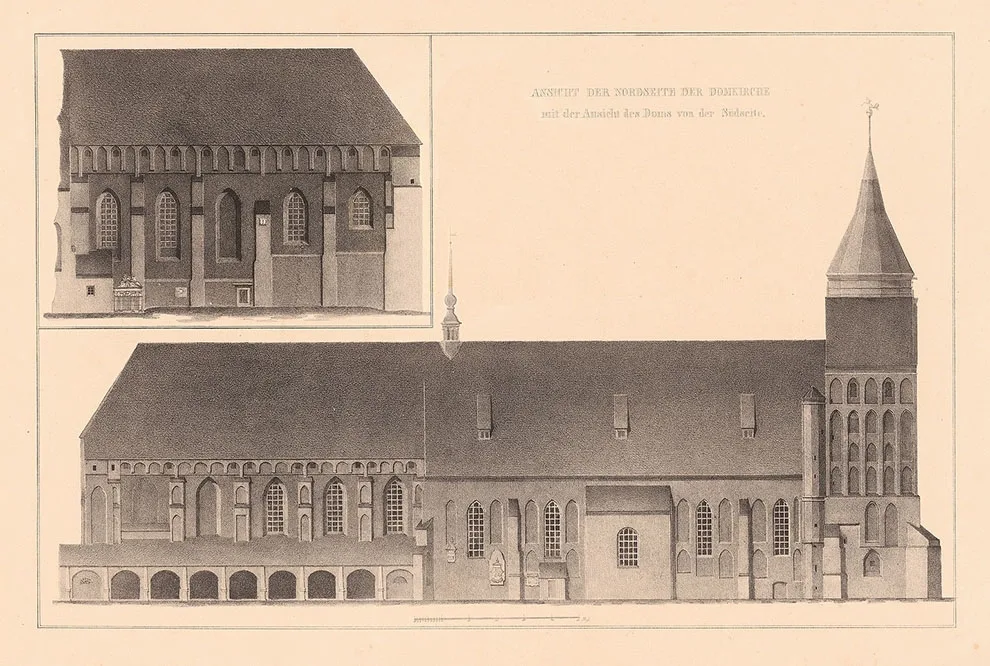
The ridge turret on the cathedral roof was installed in 1568.
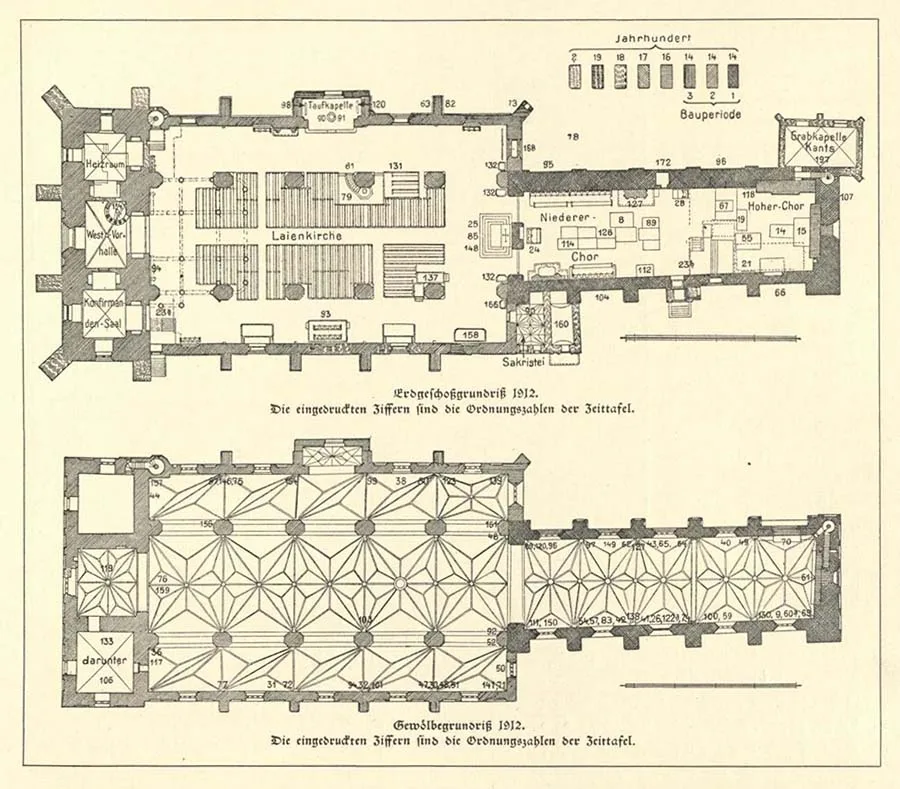
At first the cathedral was separated from the town of Kneiphof by a wall. The bishop's court was built next to the cathedral, and a school and a hospital on its north side.
On the eve of the Reformation, on 27 September 1523, Johann Briesmann delivered the first Protestant sermon in the cathedral. On 25 December 1523 a sermon in German was preached by Georg von Polentz, the first Catholic bishop to embrace Protestantism. In 1528 the cathedral became the parish church for the inhabitants of Kneiphof. In 1544 a fire broke out in the cathedral tower. From 1560 the cathedral also served as the university church.
A tower clock was installed in 1640, and in 1695 an organ with sixty stops, which greatly enhanced the cathedral. In 1718–1721 a second organ with fifty-six stops was installed, the work of the master builder Johann Josua Mosengel. In 1809 the cathedral was restored.
In 1832, for the cathedral's 500th anniversary, 14th-century wall frescoes (previously painted over) were uncovered. The best preserved of them, on the south wall of the south-eastern side aisle, showed three knights in full armour with closed visors.
In 1844 Otto Nicolai conducted an orchestra in the cathedral in a performance of the festive overture “A Mighty Fortress”.
Another restoration was carried out in 1901–1907. The walls of the cathedral were stripped of plaster and returned to their original appearance. By that time the ancient floor of the tower lay 1.67 m below the 20th-century floor.
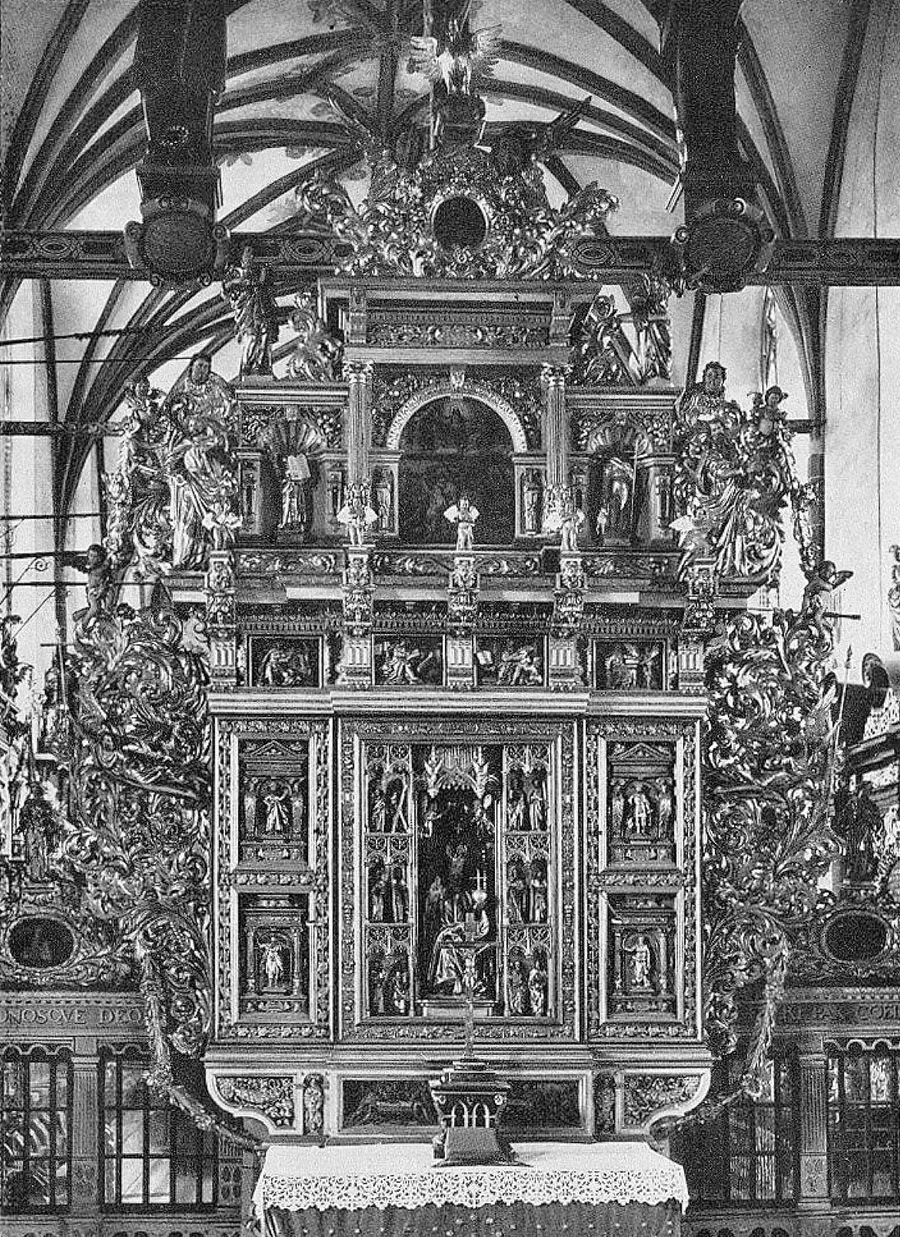
The altar in the cathedral dated from the early 16th century. In 1591 the Königsberg painter Anton Möller painted its side wings and upper section. The altar screen was also made in 1591.
The pulpit, made of limestone, was installed in 1589 on the third pillar from the altar (the one separating the north aisle from the central nave). The entrance to the pulpit was closed by a beautiful wrought-iron door made in 1590.
The organ was magnificently decorated and spanned the entire width of the central nave.
The Wallenrodt Library was housed in the western part of the cathedral on the upper floors, in two rooms: one in the central part of the building and one in the south tower.
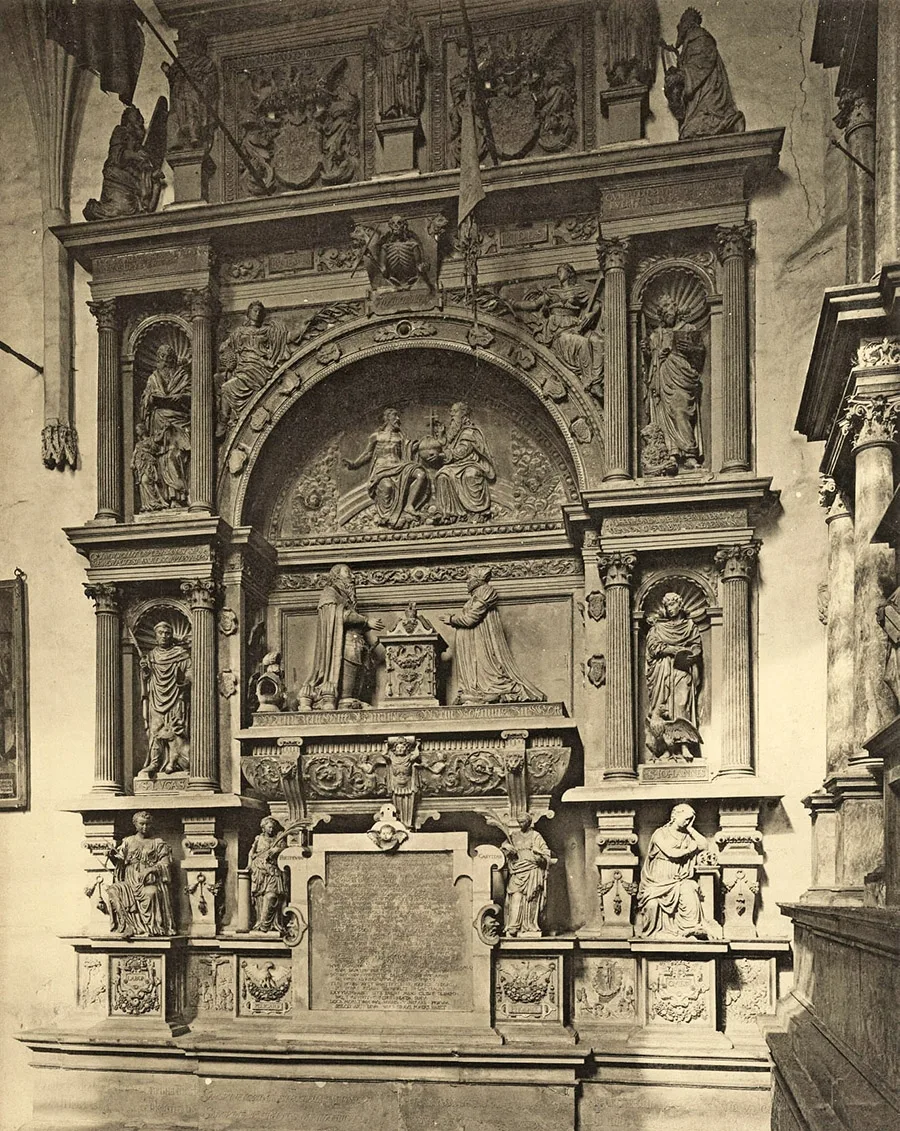 Epitaph of Elisabeth of Brandenburg-Küstrin behind the altar.
It was opened to visitors in 1673. From 1721 it was the property of the Wallenrodt family under state protection, and in 1909 it was incorporated into the State and University Library. The famous library was reached by a special spiral staircase built in the 16th century in the north-eastern corner of the central porch, with elegant columns and arches at its base.
At first the library occupied only the room above the main entrance to the cathedral, with its 14th-century vaults. In 1688–1689 the adjoining, slightly higher room in the south tower, with a cross vault, was added. The library held valuable books, particularly on theology, as well as manuscripts and genealogical material.
On the night of 27 to 28 August 1944, during a British air raid, the cathedral was badly damaged and its interior completely burnt out. The vaults partly collapsed. Numerous epitaphs and the stone pulpit were burnt or smashed. The magnificent high altar and the baptismal chapel were destroyed.
Banners, portraits of the Grand Masters and wooden effigies of Grand Master Luther von Braunschweig perished in the flames. By some miracle, the tomb of Duke Albrecht by Cornelis Floris at the east altar survived. The beautiful bust of Duchess Dorothea and the wall tomb of Chancellor Johann von Kospoth also remained intact. The Wallenrodt Library room survived with all its folios, its globe, the chancellor's travel notes and its carved wooden shelves. Then, in April 1945, during the storming of Königsberg by Soviet troops, the long-suffering cathedral sustained further damage, yet even so it was not completely destroyed. The grave of Immanuel Kant survived in fairly good condition.
After the war the cathedral continued to deteriorate, and by 1964 its structural condition was extremely poor, in places on the verge of collapse. In 1970 the official authorities opened the cathedral's crypts in the area of the choir.
In the vaults, the tombs were broken open and the remains of those buried there were partly thrown outside. How these “searches” ended and what was found there has never been made public to this day.
And finally, in 1982, yet another “air raid” was carried out on the cathedral: the so-called “conservation”. The main blow fell on the chancel, where the remains of Albrecht’s tomb and of the surviving epitaphs were almost completely destroyed.
Then, after 1985, a new chapter began in the cathedral’s history, marked by a sudden universal affection for it on the part of both the authorities and the public. The “Cathedral” society was founded, followed by other similar associations. Their members decided to clean out the inside of the cathedral. This saga went on for more than a week, and as a result the remnants of some very important architectural details were carted away along with the rubbish. All that was left of the cathedral was a mutilated, “conserved” shell of a building.
The next stage began after the founding of the so-called “state” company “Cathedral”, which set to work on the building without any coherent concept, without a design and with a complete absence of specialists.
The quality of the work was what one might expect... Colossal sums of money were spent! Every attempt to find out from specialists what kind of work (conservation, repair or restoration) was actually being carried out on the cathedral left them at a loss.
Much water has flowed under the bridge since then. Perhaps the cathedral ought to have been restored differently... But what’s done is done. Most local residents and tourists, gazing at the ancient church on Kant Island (as the Kneiphof is now called), do not stop to think about the finer points of restoration science, and happily visit the museum, the Orthodox and Catholic chapels and the concert hall housed within it.
Translated from Russian with the help of AI (Claude, Anthropic), October 2026.